

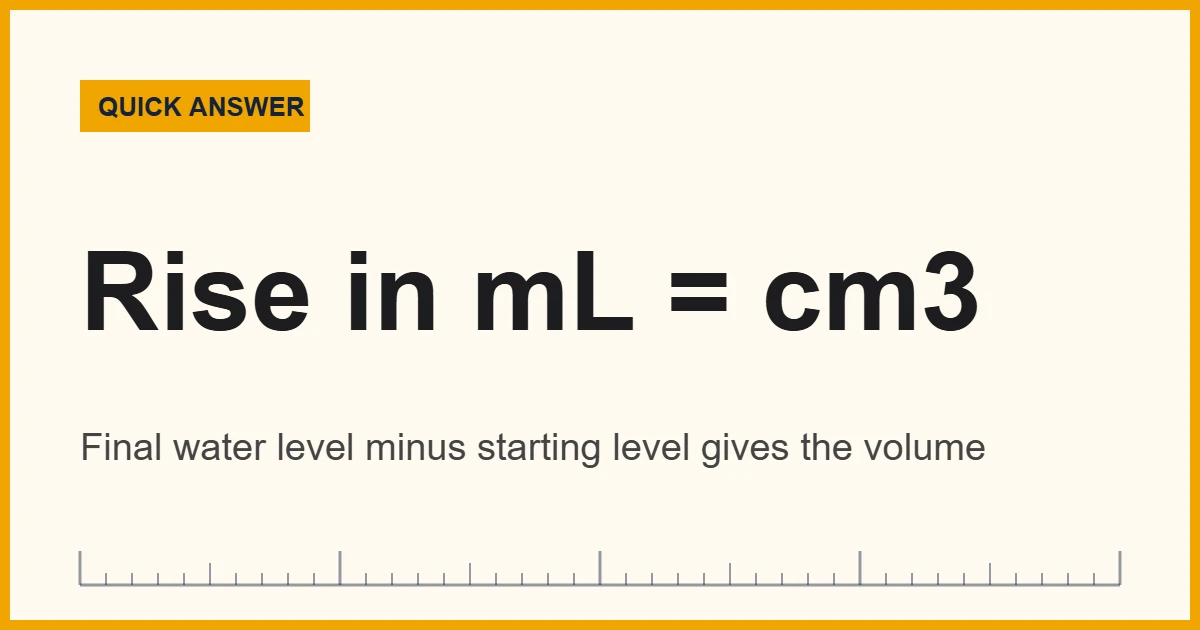
To find the volume of irregular object shapes, use water displacement. Pour water into a graduated cylinder, read the level, sink the object completely, and read the level again. The rise in milliliters equals the object’s volume in cubic centimeters, because 1 mL is exactly 1 cubic centimeter. Divide by 16.387 for cubic inches.
A box or a ball is easy, because you can measure its sides or diameter and use a formula. However, a rock, a key, a seashell or a lump of clay has no formula. Instead, you let water do the measuring. When a solid sinks, it pushes aside exactly its own volume of water, so the water level rises by that amount. In fact, Archimedes used the same idea more than 2,000 years ago, and school labs still teach it today.
In short: water displacement works for any solid that sinks, does not dissolve and does not soak up water. For small objects, use a graduated cylinder. For bigger ones, on the other hand, use an overflow can or a bucket inside a tray. If you own a kitchen scale, you can even weigh the displaced water instead of reading a scale on glass, and that is often the most precise home method.
The rule behind every method is simple. For example, the general chemistry lab manual on LibreTexts finds the volume of metal pellets by subtracting the starting water level from the final level, and it reads every level at the bottom of the curved surface (the meniscus). Below, you will find four methods, worked examples with real numbers, and a converter for your own readings.
Convert the Volume of Irregular Object Readings to Other Units
Enter the rise in water level in milliliters. The converter then shows the same volume in cubic centimeters, fluid ounces, tablespoons, cups and liters. It does not list cubic inches, so divide the mL value by 16.387064 for that (the table below shows common values).
| Displaced water | Volume (metric) | Volume (US) |
|---|---|---|
| 1 mL | 1 cubic centimeter | 0.061 cubic inch |
| 10 mL | 10 cubic centimeters | 0.610 cubic inch |
| 16.39 mL | 16.39 cubic centimeters | 1 cubic inch |
| 100 mL | 100 cubic centimeters | 6.102 cubic inches |
| 1 L | 1,000 cubic centimeters | 61.02 cubic inches |
| 3.785 L | 3,785 cubic centimeters | 231 cubic inches (1 US gallon) |
| 28.32 L | 28,317 cubic centimeters | 1,728 cubic inches (1 cubic foot) |
Recommended Tools for Measuring Volume of Irregular Object Samples
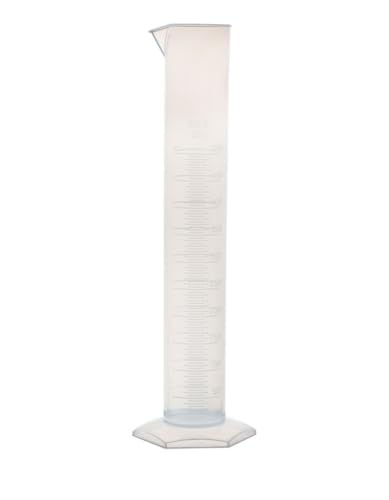
You need very little gear. First, a graduated cylinder gives far better readings than a kitchen jug, because its narrow tube spreads each milliliter over a taller column. Next, pick a size that fits your object with room to spare. A 100 mL cylinder suits pebbles and keys, while a 500 mL or 1,000 mL plastic cylinder handles larger stones. Also, a digital scale that reads to 0.01 g lets you use the weighing method described below.



As an Amazon Associate, Measuring Expert earns from qualifying purchases.
- A sunken solid pushes aside its own volume of water, so the rise in level equals its volume.
- 1 mL equals exactly 1 cubic centimeter, and 1 cubic inch equals exactly 16.387064 mL.
- Read every level at the bottom of the meniscus, with your eye level with the water.
- Pick the narrowest container the object fits in, because a bigger rise means a smaller relative error.
- On a scale, each gram of displaced water is about 1 mL (0.9982 g/mL at room temperature).
- For a known pure material, volume = mass / density with no water at all.
- Floating, porous or soluble objects need a sinker, a coating or a different liquid.
Method 1: Water Displacement in a Graduated Cylinder
This is the classic classroom method. In other words, you read the water level twice and subtract. Because the cylinder is narrow, even a small pebble raises the level enough to read. However, the object must fit through the mouth and sit fully below the surface.
One common mistake in older guides is to say you should “measure the water that overflows” from a graduated cylinder. In fact, a cylinder should never overflow; you simply read the new level. Overflow belongs to a different tool, the overflow can, covered in method 2.
How to Measure the Volume of Irregular Object Shapes Step by Step
Specifically, these steps use a graduated cylinder. They also work with a measuring jug, although with less precision.
- Choose the container. Pick the narrowest graduated cylinder the object fits into with water above it.
- Add enough water. Pour in water so the object will be fully covered, and leave room for the level to rise.
- Read the starting level. Set the cylinder on a flat surface, bring your eye level with the water, and read the bottom of the meniscus.
- Lower the object in gently. Tilt the cylinder and let the object slide to the bottom without splashing.
- Remove air bubbles. Tap the side or nudge the object with a thin wire so no bubbles cling to it.
- Read the final level. Again, keep your eye level with the meniscus and record the value.
- Subtract the two readings. Final level minus starting level gives the volume in mL, which equals cubic centimeters. Enter it in the converter above for other units.
Method 2: The Overflow Can (Eureka Can)
An overflow can is a container with a spout near the top. First, fill it until water runs out of the spout, and wait for the dripping to stop. Then place a dry graduated cylinder or measuring cup under the spout. Finally, lower the object in. The water that runs out is the displaced volume, so you read it directly.
This method suits objects too wide for a cylinder, such as a large stone or a toy figure. Similarly, you can improvise one: stand a bucket filled to the brim inside a clean tray, sink the object, then pour the spilled water from the tray into a measuring jug. For example, if 1.35 L collects in the tray, the object’s volume is 1,350 cubic centimeters, or about 82.4 cubic inches.
Method 3: Weigh the Displaced Water on a Kitchen Scale
This trick gives excellent home results, and it needs no glassware at all. Put a container of water on a digital scale and press tare. Next, hang the object from a thin thread and lower it until it is fully under water. Also, make sure it does not touch the sides or the bottom. As a result, the scale now shows how much the water pushes up on the object, and that equals the mass of the displaced water.
Because water at room temperature has a density of about 0.9982 g/mL, each gram on the display is almost exactly 1 mL. For instance, if the scale reads 80.0 g, the object’s volume is 80.0 / 0.9982 = 80.1 cubic centimeters, or about 4.89 cubic inches. The USGS water density page lists how this value changes with temperature, from 1.000 g/cm3 near 39 degrees F (4 degrees C) down to about 0.96 g/cm3 near boiling.
A scale that reads to 0.01 g turns this into a very precise test, because a 0.01 g change equals only 0.01 mL. By comparison, a typical 100 mL cylinder has 1 mL marks.
Method 4: Volume of Irregular Object From Mass and Density
Sometimes you cannot put the object in water at all, or you already know what it is made of. In that case, weigh it and divide by the density of the material: volume = mass / density. Note that this uses mass in grams, not weight in pounds of force, and density in grams per cubic centimeter.
However, this method only works for a single, solid material with no hidden holes. A cast part with air pockets, a rock with mixed minerals, or a hollow toy will give a wrong answer. Our guide on how dense oil is shows how density changes from one substance to the next, which is why the material must be known.
Objects That Float, Soak Up Water or Dissolve
Of course, displacement assumes the object sinks and stays the same. Many everyday items break that rule, so here are the usual fixes.
- Floating objects (cork, wood, plastic). Tie on a heavy sinker. First measure the sinker alone, then the sinker plus the object, and subtract. For example, if the sinker displaces 12.0 mL and both together displace 31.0 mL, the cork is 19.0 cubic centimeters.
- Porous objects (sponge, brick, sandstone). Seal them in a thin plastic bag with the air pressed out, or coat them with a thin layer of wax. Otherwise, water fills the pores and the reading comes out too small.
- Soluble objects (sugar cubes, salt crystals). Use a liquid they do not dissolve in, such as vegetable oil for sugar, or fine dry sand in a graduated container.
- Objects that must stay dry. Wrap them tightly in cling film, or use the mass and density method if the material is known.
Comparing the Methods
In general, each method fits a different object size and accuracy need. The table below sums them up.
| Method | Best for | Typical resolution | Main error source |
|---|---|---|---|
| Graduated cylinder | Small solids that sink | About half the smallest mark | Reading the meniscus, bubbles |
| Overflow can | Objects too wide for a cylinder | Depends on the collecting cylinder | Water left on the spout |
| Scale (weighed water) | Any size that fits the container | Equal to the scale’s resolution in mL | Thread touching, object touching sides |
| Mass and density | Known pure materials that must stay dry | Depends on the density value | Hidden air pockets, wrong density |
People also mix up volume and capacity. The table below separates them.
| Term | Meaning | Example |
|---|---|---|
| Volume | Space the solid itself takes up | A rock occupies 18.5 cubic centimeters |
| Capacity | How much a hollow container can hold | A mug holds 350 mL of coffee |
| Displaced volume | Water pushed aside by the submerged part | Equals volume only if the object is fully under water |
For a full list of volume instruments, see what tools measure volume. If you need to measure liquids rather than solids, our guide on measuring the volume of a liquid covers jugs, pipettes and burettes.
Do and Don’t
Do
- Read the meniscus at eye level.
- Remove air bubbles before the final reading.
- Pick the narrowest container that fits.
- Repeat the test three times and average the results.
- Dry the object between repeat runs.
Don’t
- Let water splash out when the object goes in.
- Hold the object with your fingers under water.
- Measure porous items without sealing them.
- Guess the density of a mixed or unknown material.
- Count a floating object’s volume without a sinker.
Honest Limits of Volume of Irregular Object Measurements
Every method here gives a good estimate, not a perfect number. For one thing, a cylinder with 1 mL marks lets you estimate to about half a mark, so a reading of 18.5 mL could really be 18 to 19 mL. As a result, a small pebble in a large cylinder can carry an error of 5 percent or more. In addition, tiny bubbles, water trapped in cracks and drops left on the overflow spout all shift the result.
By contrast, temperature matters only a little. Water expands slightly as it warms, so the weighing method changes by about 0.2 percent between cold tap water and warm water. Therefore, for school and home projects, treat 1 g of water as 1 mL. For lab work, however, look up the water density at the measured temperature.
When to Call a Professional
Generally, home methods are fine for science fair projects, aquarium decor, casting and crafts. Still, some jobs need certified equipment. For example, valuable gems and precious metals need a jeweler or assay lab, because a small volume error changes the calculated purity. Likewise, engineering parts with tight tolerances go to a metrology lab that uses calibrated gas pycnometers or 3D scanners. Medical and body-volume measurements belong with a clinician.
For more on the classroom displacement method and its history, read our guide to measuring volume with the displacement method.
Volume of Irregular Object FAQs
What is the easiest way to find the volume of irregular object shapes?
Use water displacement. Read the water level in a graduated cylinder, sink the object, and read again. The difference in mL equals the volume in cubic centimeters.
What tool measures the volume of an irregular solid?
A graduated cylinder works for small objects. For larger ones, use an overflow can or a bucket in a tray. A digital scale also works if you weigh the displaced water.
Why does displacement give the volume of irregular object samples?
Two things cannot fill the same space. So when a solid sinks, it pushes aside exactly as much water as its own volume, and the level rises by that amount.
Is 1 mL the same as 1 cubic centimeter?
Yes. A milliliter is defined as exactly 1 cubic centimeter, so a rise of 25 mL means the object has a volume of 25 cubic centimeters.
How do I convert the result to cubic inches?
Divide the mL value by 16.387064. For example, 50 mL equals about 3.05 cubic inches.
Can I measure the volume of irregular object items that float?
Yes. Attach a sinker, measure the sinker alone, then measure both together. Subtract the first reading from the second to get the floating object’s volume.
How do I find volume using mass and density?
Divide the mass by the density. For instance, 135 g of aluminum at 2.70 g/cm3 has a volume of 50 cubic centimeters.
Why is my displacement reading too low?
Water probably splashed out, or the object was not fully under water. Porous materials also absorb water, which lowers the reading.
How accurate is a kitchen measuring jug?
Not very accurate for small objects, because its marks are far apart. Instead, use a narrow graduated cylinder or weigh the displaced water on a scale.
Does water temperature affect the result?
Only slightly. Room-temperature water has a density of about 0.9982 g/mL, so treating 1 g as 1 mL causes an error of about 0.2 percent.
The Bottom Line
To sum up, an irregular shape has no formula, so you measure the space it takes up. Sink it in water, measure the rise or the overflow, and remember that 1 mL is 1 cubic centimeter. For small objects, use a narrow graduated cylinder. Then, for big ones, use an overflow can, and for the best precision, weigh the displaced water.
Finally, if the object floats, absorbs water or must stay dry, use a sinker, a seal, or the mass and density method. Plug your reading into the converter at the top of the page to see it in fluid ounces, cups or liters.
1 thought on “How to Measure the Volume of an Irregular Object (4 Easy Methods)”