
The most common tools to measure length are rulers, tape measures and yardsticks for everyday jobs, calipers and micrometers for small parts, and laser measures or measuring wheels for rooms and long distances. Each one trades range for resolution: a micrometer reads to 0.001 in (0.025 mm), while a tape covers 25 ft (7.62 m) or more.
Length is the measurement people take most often, so it is easy to forget how many different instruments do the job. For example, a carpenter checks a board with a tape, a machinist checks a shaft with a micrometer, and a surveyor checks a property line with a laser or GPS receiver. Still, all three are measuring length. However, each one needs a different level of detail.
So which tool should you pick? Start with two questions: how long is the thing, and how close does the answer need to be? For instance, a bookshelf only needs the nearest 1/16 inch. A bearing seat, by contrast, may need the nearest ten-thousandth of an inch. As a result, choosing the right tool is mostly about matching range and resolution to the job, not about buying the most expensive gadget.
In short: use a ruler or tape for anything you can reach, a caliper or micrometer for anything small and precise, and a laser measure or wheel for anything long. Then the rest of this guide explains why, with real numbers.
Why All Tools to Measure Length Agree
All of these tools trace back to one definition. The US National Institute of Standards and Technology (NIST) explains that the meter is now defined through the fixed speed of light, and that the inch has been exactly 25.4 mm since 1959. Because of that, a good tape in Ohio and a good ruler in Germany agree with each other.
Next, you will find a converter, a comparison of the main tools, a step-by-step method for choosing one, and the limits that matter in practice.
Convert Inches, Feet and Metric Lengths
First, read a length off any tool, type it below and pick the unit. The converter then shows the same length in millimeters, centimeters, meters, feet, yards and mils (thousandths of an inch), using the exact 25.4 mm inch.
Recommended Tools to Measure Length
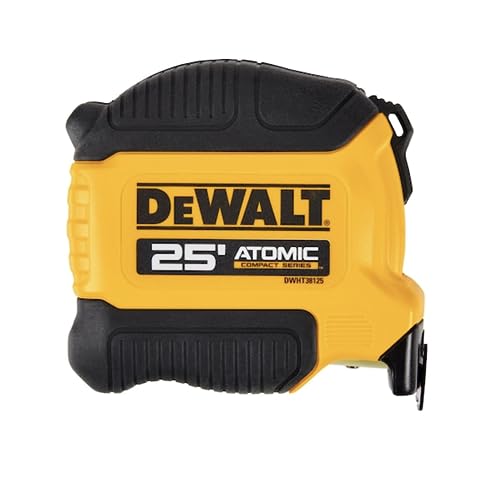
A small kit covers almost every home and shop job. First, a 25 ft tape handles rooms and lumber. Next, a steel rule and a digital caliper handle small parts. Finally, a laser measure or wheel covers long runs. The picks below come from established brands and are chosen based on manufacturer specs and buyer reports.



As an Amazon Associate, Measuring Expert earns from qualifying purchases.
Key Takeaways
- Rulers, tapes and yardsticks are the everyday choice and read to about 1/16 in or 1 mm.
- Digital calipers typically resolve 0.01 mm (0.0005 in in inch mode) over a 6 in (150 mm) range.
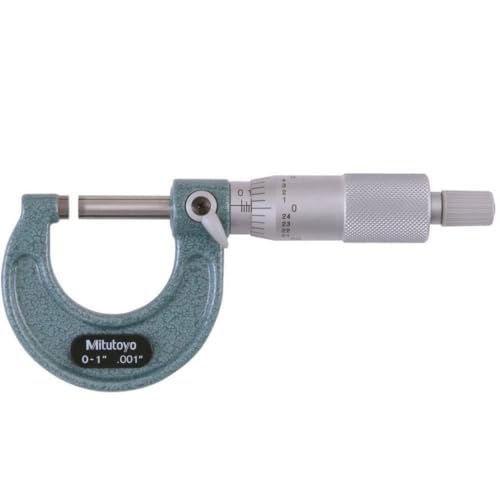
- Outside micrometers read to 0.001 in, or 0.0001 in with a vernier scale, over a 1 in span.
- Laser measures and measuring wheels take over for rooms, yards and roads.
- GPS suits distances of hundreds of feet or miles, not furniture.
- Resolution is not accuracy: a display can show more digits than the tool can deliver.
- Every inch is exactly 25.4 mm, so metric and US tools always convert cleanly.
Tools to Measure Length at a Glance
This table compares typical ranges and readings. Of course, exact figures vary by model, so check the spec sheet of the tool you own.
| Tool | Typical range | Typical smallest reading | Best for |
|---|---|---|---|
| Ruler or steel rule | 6 to 24 in (15 to 60 cm) | 1/16 to 1/64 in, or 0.5 to 1 mm | Paper, crafts, layout lines |
| Tape measure | 16 to 35 ft (about 5 to 10 m); long tapes 100 ft (30.48 m)+ | 1/16 in or 1 mm | Rooms, lumber, fabric, the body |
| Yardstick or meter stick | 36 in (91.44 cm) or 100 cm (39.37 in) | 1/8 to 1/16 in, or 1 mm | Straight runs, classrooms, fabric |
| Caliper (vernier, dial, digital) | 0 to 6 in (150 mm); longer models exist | 0.001 in or 0.01 to 0.02 mm | Outside, inside and depth sizes |
| Micrometer | 1 in (25 mm) spans: 0-1 in, 1-2 in, and so on | 0.001 in, or 0.0001 in with a vernier | Shafts, sheet, wire, machined parts |
| Laser distance measurer | About 100 to 400 ft (30 to 120 m) | 1/16 in or 1 mm display | Rooms, ceilings, estimates |
| Measuring wheel | Practically unlimited | Usually 0.1 ft or 1 in | Fences, driveways, roads, sports fields |
| GPS receiver | Miles or kilometers | A few feet under open sky | Trails, land, long routes |
| Laser interferometer | Lab benches up to tens of meters | Fractions of a micrometer | Calibration labs, machine tools |
Everyday Tools to Measure Length: Rulers, Tapes and Sticks
In fact, most measuring at home happens with these three. Also, they are cheap, need no batteries, and are accurate enough for building, sewing and school work.
Rulers and Steel Rules
A standard ruler is 12 in (30.48 cm) long, while a metric school ruler is usually 30 cm (about 11.81 in). Of course, plastic and wooden rulers are fine for paper. A stainless steel rule, however, is the better choice in a workshop, because its etched lines are finer and it does not warp. In addition, many machinist rules are marked down to 1/64 in or 0.5 mm.
Tape Measures
The retractable tape is the workhorse of construction. Common sizes are 16, 25 and 30 ft, and the blade usually shows inches with 1/16 in marks on one edge and often centimeters on the other. Also, the hook at the end slides on purpose. It moves by its own thickness, so the reading is right for both inside and outside measurements. For commercial use, NIST notes that a 6 ft tape should be within 1/32 in (0.79 mm) under Handbook 44 rules.
Yardsticks and Meter Sticks
A yardstick is 36 in, or exactly 91.44 cm, and a meter stick is 100 cm, or about 39.37 in. Because they are rigid, they are handy for drawing straight lines and measuring flat runs such as fabric on a table. On the other hand, they cannot follow curves. For more on how the two systems relate, see our guide to metric vs imperial units.
Precision Tools to Measure Length in the Shop
When a part must fit another part, a tape is no longer enough. Instead, machinists and engineers reach for calipers and micrometers.
Calipers
A caliper has two jaws that close on the part. In addition, most models have smaller jaws for inside diameters and a rod for depth. Vernier calipers are read from two scales, dial calipers from a needle, and digital calipers from a screen. A typical 6 in (150 mm) digital caliper resolves 0.01 mm, or 0.0005 in when switched to inch mode. Mitutoyo, for example, lists one 150 mm model at 0.01 mm resolution and plus or minus 0.02 mm accuracy. Calipers also come in 8 in, 12 in and longer sizes, so the old idea that they stop at 6 in is wrong. If you are shopping, our roundup of the best digital calipers compares the main models.
Micrometers
A micrometer closes a precise screw (the spindle) against a fixed anvil. Each frame covers a 1 in or 25 mm span, so you buy 0-1 in, 1-2 in and larger frames as needed. For instance, a standard inch micrometer reads to 0.001 in (0.0254 mm), and one with a vernier scale reads to 0.0001 in (0.00254 mm). Similarly, metric versions read to 0.01 mm, or 0.001 mm on many digital models. Therefore, a micrometer is roughly ten times finer than a caliper, but over a much shorter range.
Tools to Measure Length Over Long Distances
Past about 30 ft, a tape gets awkward and usually needs a second person. Fortunately, three tools make long distances a one-person job.
Laser Distance Measurers
A laser measure times a beam of light that bounces off a wall and back. In general, consumer models reach 100 to 165 ft (30.48 to 50.29 m), and outdoor models go farther. Moreover, many listings quote accuracy of about 1/16 in (1.59 mm). Even so, results drop on shiny, dark or angled surfaces, so aim at a flat, light target.
Measuring Wheels
A measuring wheel counts turns as you walk. One full turn equals the wheel’s circumference, which is pi times its diameter. For example, a wheel with a 1 m circumference is about 318 mm (12.53 in) across. Because of this, wheels are popular for fences, driveways and road work. Still, bumps, grass and skidding add small errors.
GPS Receivers
A GPS receiver works out your position from satellite signals and then calculates the distance between points. According to the US government’s GPS accuracy page, real-world results depend on receiver quality, sky blockage and the atmosphere. In practice, GPS is great for trails and land plots, but not for a door frame.
How Labs Measure Length: Interferometry
At the top of the accuracy ladder sits the laser interferometer. It splits a laser beam in two, sends one half to a moving mirror, and counts the light and dark fringes as the halves recombine. Each fringe matches a known fraction of the laser’s wavelength. As a result, NIST can calibrate tapes in a tunnel over 60 m (about 197 ft) long to about 0.1 mm (about 0.004 in).
Of course, you will not need one at home. However, it is the reason your tape reads true: calibration labs check master gauges with interferometers, and makers check their tools against those gauges. The old claim that spectroscopy measures the length of objects is also a mix-up. In fact, spectroscopy measures the wavelength of light to identify substances, not the size of a part.
Accuracy vs Resolution vs Precision
These three words get mixed up in product listings, so it helps to separate them before you choose.
| Term | What it means | Example |
|---|---|---|
| Resolution | The smallest step the tool can show | A caliper screen that shows 0.01 mm |
| Accuracy | How close the reading is to the true length | Plus or minus 0.02 mm across the range |
| Precision (repeatability) | How closely repeat readings agree | Five readings of a pin all within 0.01 mm |
A tool can therefore show more digits than it can deliver. For example, a cheap caliper may display 0.01 mm and still be off by 0.05 mm. Similarly, a laser that shows 1/16 in may only be that good on an ideal target.
How to Choose and Use Tools to Measure Length
- Estimate the size first. Under 6 in points to a caliper or micrometer, a few feet to a rule or tape, and anything past 30 ft to a laser or wheel.
- Decide the tolerance you need. Framing needs about 1/16 in, woodworking joints 1/32 in, and machined fits 0.001 in or finer.
- Pick a tool about ten times finer than that tolerance. For a 0.01 in fit, a caliper reading 0.001 in is a sensible match.
- Zero or check it. Close a caliper and press zero, check a micrometer on its standard, and look for a bent tape hook.
- Measure square to the part. Keep the tape straight, the caliper jaws flat, and your eye directly over the mark.
- Repeat the reading. Take two or three readings and use the average if they differ.
- Write it down with units. Note “in” or “mm” every time, then use the converter above if a plan uses the other system.
Not sure whether you are measuring length or width? Our explainer on the difference between width and length sorts out which side is which.
Do and Don’t When Measuring Length
Do
- Match the tool’s range and resolution to the job.
- Check zero before each session.
- Keep tapes level and pulled snug, not stretched.
- Store calipers and micrometers clean and dry.
- Record units with every number.
Don’t
- Trust extra digits on a cheap display.
- Read a scale from an angle (parallax error).
- Force a micrometer past its ratchet.
- Bend the hook of a tape to “fix” it.
- Use GPS for anything shorter than a few yards.
Honest Limits
No tool reads the true length perfectly. For one thing, temperature changes length: steel grows by roughly 0.0000065 in per inch for each degree Fahrenheit, which matters in machining but not in carpentry. Moreover, your technique often adds more error than the tool. For example, a sagging tape, a tilted caliper or a parallax glance can each cost more than the tool’s rated accuracy. Finally, the ranges and figures on this page are typical values from standards and spec sheets, not tests of every model. So check the spec sheet for the exact tool you buy.
When to Call a Professional
Some length measurements carry legal or safety weight. For example, property lines need a licensed land surveyor, not a phone app or a measuring wheel. Similarly, parts for aircraft, medical devices or pressure equipment need gauges checked by an accredited calibration lab. For body measurements tied to health, such as a child’s growth, a doctor’s measurements are the ones that count.
Frequently Asked Questions
What are the main tools to measure length?
The main tools to measure length are rulers, tape measures, yardsticks and meter sticks, calipers, micrometers, laser distance measurers, measuring wheels and GPS receivers. Labs also use laser interferometers.
Which tool measures length most accurately?
A laser interferometer is the most accurate and is used in calibration labs. Among shop tools, a micrometer is the most accurate, reading to 0.001 in or 0.0001 in with a vernier scale.
What is the best tool to measure the length of a room?
A laser distance measurer is fastest for one person. A 25 ft tape works well too, and it is the better choice for short, exact cuts.
What tools to measure length do students use in school?
Students mostly use a 12 in or 30 cm ruler and a meter stick. Later, science classes may also add vernier calipers for small objects.
Is a caliper or a micrometer better?
A caliper is more versatile because it measures outside, inside and depth sizes over about 6 in. A micrometer, however, is about ten times finer, but each frame covers only 1 in or 25 mm.
How long is a standard ruler?
A standard US ruler is 12 in, which is exactly 30.48 cm. A common metric ruler is 30 cm, or about 11.81 in.
How accurate is a tape measure?
For commercial use, NIST Handbook 44 allows about 1/32 in (0.79 mm) over a 6 ft tape. Also, most tapes are marked to 1/16 in, and technique usually matters more than the blade.
Which tools to measure length work for long distances?
Laser distance measurers, measuring wheels and GPS receivers suit long distances. Lasers cover about 100 to 400 ft, wheels have no practical limit, and GPS covers miles.
How is the meter defined today?
The meter is defined by the speed of light in a vacuum, 299,792,458 meters per second. In other words, one meter is the distance light travels in 1/299,792,458 of a second.
Which tools to measure length should a home DIYer own?
A 25 ft tape measure, a 12 in steel rule and a digital caliper cover most home projects. Add a laser measure if you often measure whole rooms.
Tools to Measure Length: The Bottom Line
To sum up, the right tool depends on size and tolerance. First, rulers, tapes and yardsticks cover everyday jobs to about 1/16 in. Next, calipers and micrometers cover small parts to 0.001 in or better. Meanwhile, lasers, wheels and GPS cover long distances.
So start with a good 25 ft tape and a steel rule, then add a digital caliper if you work on small parts. Whatever you use, check zero, read square to the scale, and write down the units. For quick inch and centimeter checks, our page on how long 6 inches is shows real-world comparisons.
2 thoughts on “What Tools Are Used to Measure Length? 9 Tools, From Rulers to Lasers”