

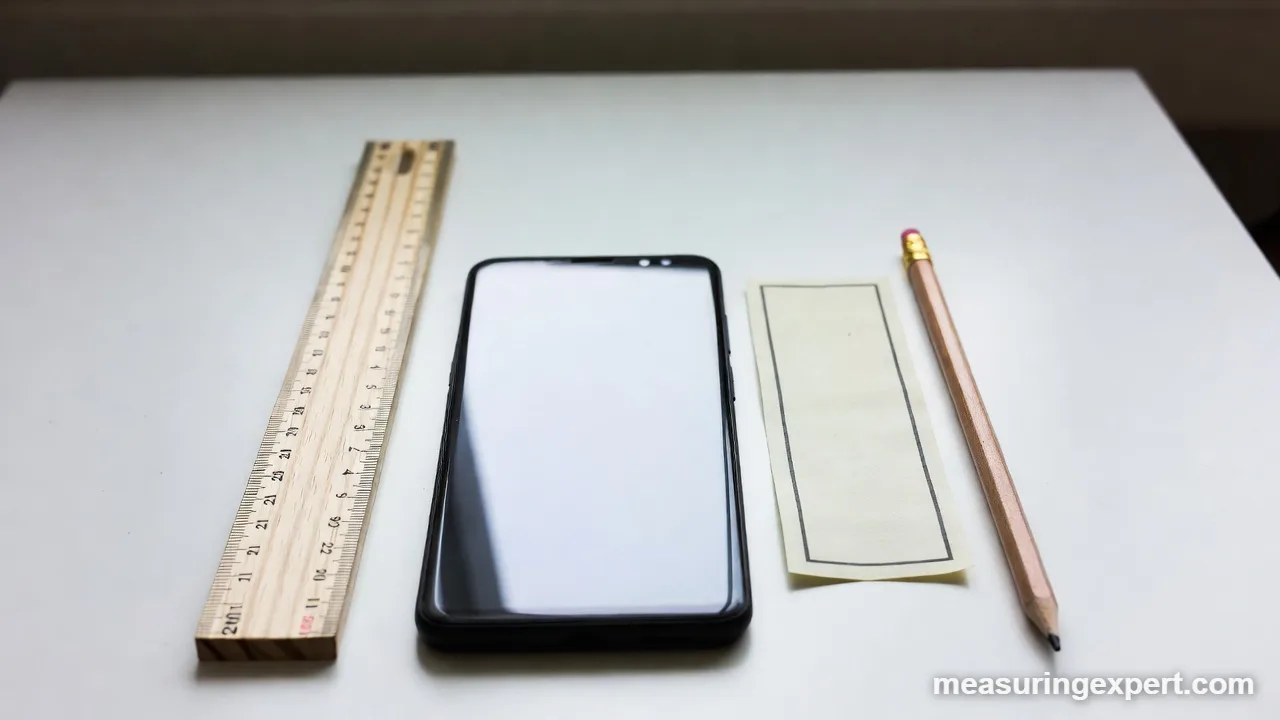
6 inches is exactly 15.24 centimeters, or 152.4 millimeters, which is half a foot (0.5 ft). That follows from the international definition of the inch as exactly 25.4 mm, used by NIST since 1959. For a quick picture, 6 inches is half of a standard 12-inch ruler.
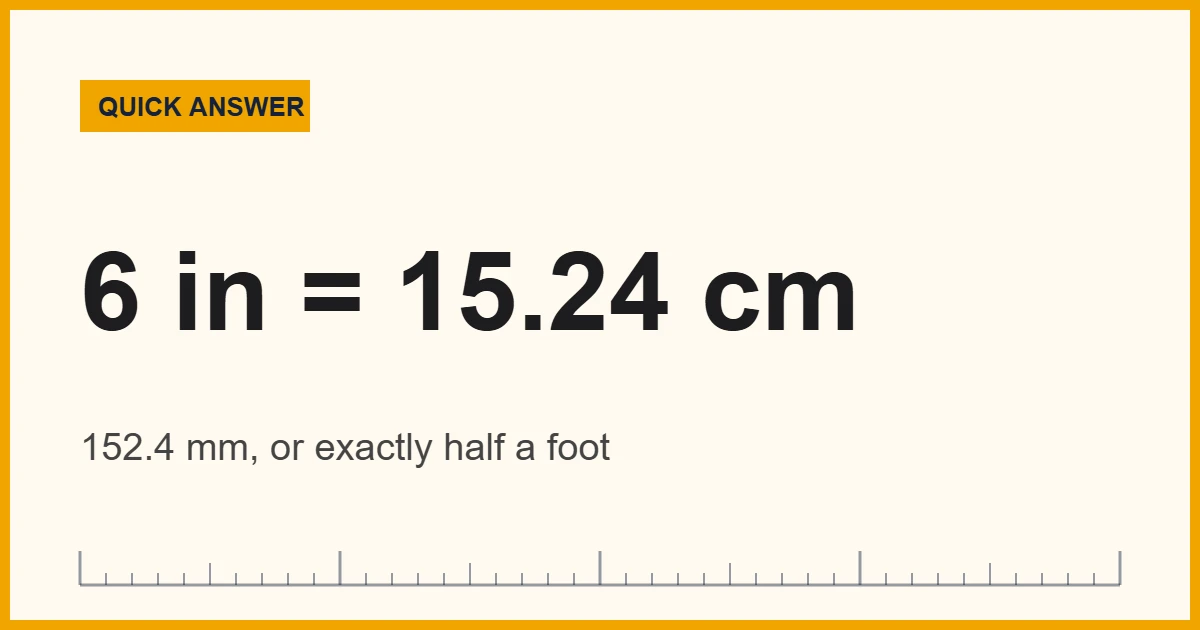
Convert 6 Inches to Centimeters, Millimeters and Feet
The converter opens with a value of 6 in. Next, change the number or the unit, and it updates the centimeter, millimeter, foot and meter values right away. It also shows the formula it used, so you can check the math yourself.
In fact, six inches is one of those lengths that shows up everywhere once you start looking. For example, it is the length of a short school ruler, the long side of a standard 4 x 6 photo print, and a common size for pocket steel rules. Even so, it is easy to misjudge by eye, because most people picture lengths much less precisely than they think.
Above all, the numbers never change. An inch is defined as exactly 25.4 millimeters, so 6 inches is always exactly 152.4 mm. According to the US National Institute of Standards and Technology (NIST), this value comes from the international yard and pound agreement of 1959, when English-speaking countries agreed to define the yard, and therefore the inch, in metric terms. In other words, 15.24 cm is not a rounded figure. Instead, it is the exact answer.
Below, you will first find a chart of nearby values, objects you can use to picture the length, and a short method for measuring it accurately.
Inches to Centimeters Chart for Half a Foot
This chart covers the lengths people usually compare with half a foot. All values are exact or rounded to two decimals, so you can also print it and keep it near your workbench.
| Inches | Centimeters | Millimeters | Feet |
|---|---|---|---|
| 1 in | 2.54 cm | 25.4 mm | 0.08 ft |
| 2 in | 5.08 cm | 50.8 mm | 0.17 ft |
| 3 in | 7.62 cm | 76.2 mm | 0.25 ft |
| 4 in | 10.16 cm | 101.6 mm | 0.33 ft |
| 5 in | 12.7 cm | 127 mm | 0.42 ft |
| 6 in | 15.24 cm | 152.4 mm | 0.5 ft |
| 6 1/2 in | 16.51 cm | 165.1 mm | 0.54 ft |
| 7 in | 17.78 cm | 177.8 mm | 0.58 ft |
| 8 in | 20.32 cm | 203.2 mm | 0.67 ft |
| 9 in | 22.86 cm | 228.6 mm | 0.75 ft |
| 10 in | 25.4 cm | 254 mm | 0.83 ft |
| 12 in | 30.48 cm | 304.8 mm | 1 ft |
| 18 in | 45.72 cm | 457.2 mm | 1.5 ft |
| 24 in | 60.96 cm | 609.6 mm | 2 ft |
To convert any value yourself, multiply inches by 2.54 to get centimeters, or divide inches by 12 to get feet. For bigger numbers, see our worked example on how many feet are in 60 inches.
How Long Is 6 Inches? Everyday Objects to Compare
A reference object helps when no ruler is around. However, only some common comparisons hold up, so the list below sticks to items with published or standard sizes.
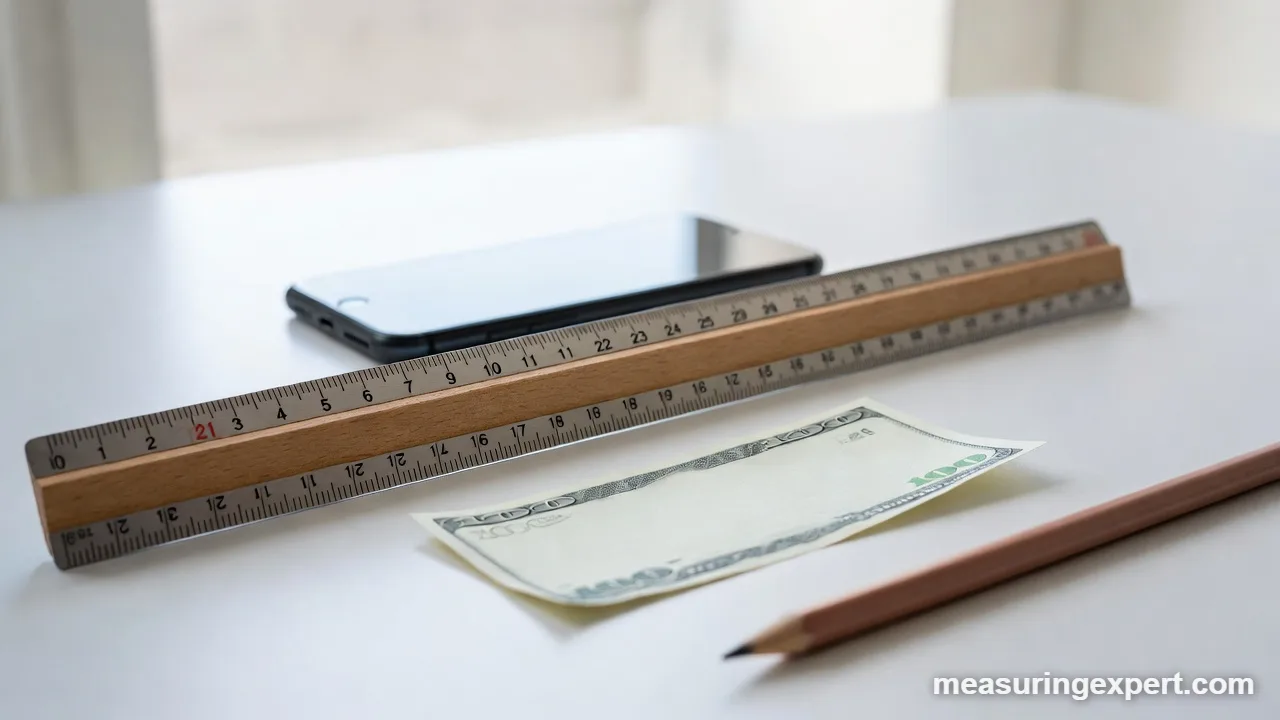
- Half a standard ruler. A common school ruler is 12 inches long, so its middle mark sits at exactly 6 inches.
- A US dollar bill, almost. The Bureau of Engraving and Printing lists current notes at 6.14 x 2.61 inches. As a result, a bill is about 0.14 inch (3.6 mm) longer than 6 inches.
- The long side of a 4 x 6 photo. Similarly, standard 4 x 6 prints and 4 x 6 index cards are 6 inches on the long edge.
- Almost two credit cards end to end. A payment card is about 3.37 inches long, so two of them make roughly 6.74 inches, a bit more than half a foot.
- A bit more than half of letter paper’s long side. For comparison, US letter paper is 8.5 x 11 inches, and half of 11 inches is 5.5 inches.
6 Inches vs Similar Measurements People Confuse
Most errors with half-foot lengths come from mixing up the unit, not from the arithmetic. For that reason, this table separates the lengths and areas that often get swapped.
| People often confuse | What it really equals |
|---|---|
| 6 in vs 6 cm | 6 in = 15.24 cm; 6 cm = about 2.36 in |
| 6 in vs 15 cm | 15 cm is about 5.91 in, so it is 2.4 mm short of 6 in |
| 6 in vs 6 ft | 6 ft = 72 in = 182.88 cm, twelve times longer |
| 6 in vs 6 sq in | 6 sq in is an area (about 38.71 sq cm), not a length |
| 6-inch ruler vs 150 mm ruler | Many pocket rules are marked “6 in / 150 mm” but the metric scale stops 2.4 mm before the 6-inch mark |
The 15 cm vs 6 inch gap is small, but it adds up. For example, four lengths cut at 15 cm come out almost 1 cm shorter in total than four cut at 6 inches. Also, if you want a refresher on which dimension is which, our guide to the difference between width and length explains the naming.
Recommended Tools for Measuring 6 Inches
For a length this short, a 6-inch steel pocket rule is the most practical tool. First, look for engraved or etched graduations that will not rub off. Next, check that it shows fine marks such as 1/32 or 1/64 inch alongside millimeters. In addition, a digital caliper is worth having if you measure small parts, because it reads to a few hundredths of a millimeter. Finally, the picks below come from established brands and are described from manufacturer listings.


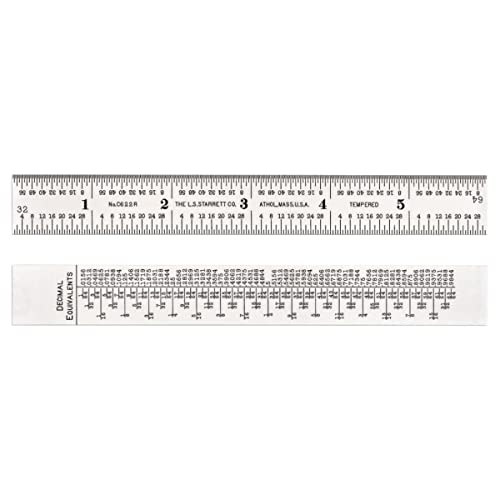
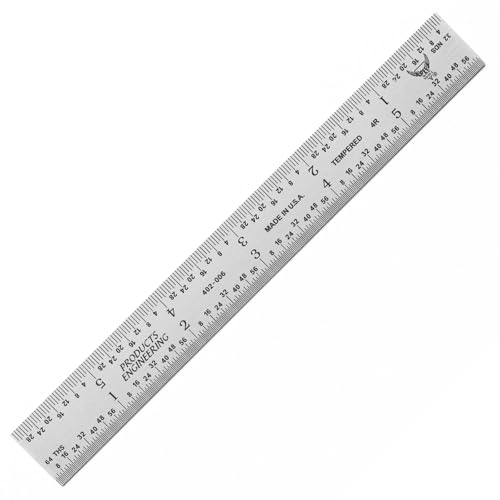


As an Amazon Associate, Measuring Expert earns from qualifying purchases.
How to Measure 6 Inches Accurately
Measuring a short length well is mostly about where you start and how you read the mark. So follow these steps whether you use a ruler, a tape or a pocket rule.
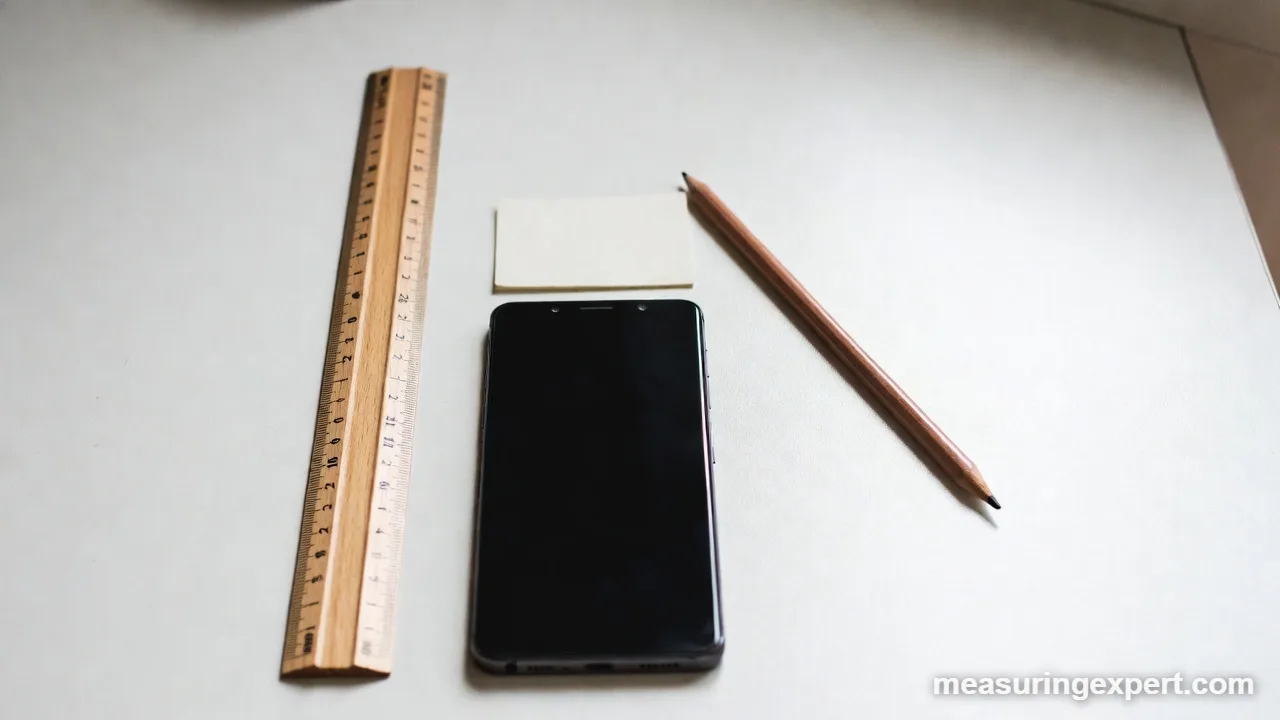
- Choose a rigid rule. A flat steel or wooden rule stays straight, while a soft tape can sag or stretch.
- Find the true zero. Some rulers have a blank margin before the 0 line, so start from the line itself, not the wooden end.
- Line up the edge. Then set the start of the object exactly on the zero line and hold the rule flat against it.
- Look straight down. Read the end mark with your eye directly above it to avoid parallax, which makes marks seem shifted.
- Read the 6 mark. The long line labeled 6 on the inch side is your target; on the metric side, that point falls at 15.24 cm.
- Mark and double-check. Make a thin pencil tick, then measure again from the other direction before you cut.
Do and Don’t When Measuring Short Lengths
Do
- Check which scale (inch or metric) you are reading.
- Start from the zero line, not the ruler’s end.
- Keep your eye directly above the mark.
- Mark with a sharp pencil or a knife line.
- Measure twice before cutting.
Don’t
- Treat 15 cm as the same as 6 inches for precise work.
- Rely on phones or pencils as length references.
- Read a flexible tape while it curves.
- Use a worn ruler with faded marks.
- Round 15.24 cm to 15 cm in a cut list.
Where You Will Meet Half a Foot
In general, half a foot is a handy unit in many hobbies and trades. In sewing and quilting, for instance, 6-inch squares and 6-inch rotary-cutting rulers are common. Similarly, gardeners often see planting depths and spacings of a few inches on seed packets, and 6 inches is a typical value for spacing smaller plants.
In construction, the size appears in nominal lumber names and in measured gaps. Note, though, that a “2 x 6” board is a nominal size; the actual dressed width is smaller than 6 inches. Meanwhile, in printing and photography, the 4 x 6 inch print remains a standard format. Because of all this, knowing that 6 inches equals 15.24 cm helps whenever an instruction mixes US and metric units.
Honest Limits of Short Measurements
Of course, the conversion is exact, but real measurements are not. For one thing, everyday rulers are only as good as their printing, and inexpensive plastic rulers can be slightly off over their length. Also, the thickness of your pencil line can be a millimeter or so wide, which is already a large share of a short length. Finally, wood and paper move with humidity, so a 6-inch piece cut today may differ slightly next month. In short, 152.4 mm is the definition; your result depends on the tool, the mark and the material.
When Precision Really Matters
For crafts and household jobs, being within about 1/16 inch (1.6 mm) is usually fine. However, some jobs need more care:
- Machining and 3D printing. In this case, a digital caliper or a steel rule with 1/64-inch or 0.5 mm marks is the better tool.
- Fitting parts between countries. A part listed as 150 mm is not a 6-inch part, so check which unit the drawing uses.
- Body or health measurements. Above all, follow the method your doctor, nurse or the instructions give, since technique changes the result.
For a wider look at instruments, see our overview of tools used to measure length.
6 Inches: Frequently Asked Questions
How many centimeters is 6 inches?
Six inches is exactly 15.24 centimeters, because you multiply 6 by 2.54, the exact number of centimeters in an inch.
How many millimeters are in 6 inches?
There are exactly 152.4 millimeters in 6 inches, because one inch is defined as 25.4 mm.
Is 6 inches half a foot?
Yes. A foot has 12 inches, so 6 inches is exactly 0.5 feet, or half a foot.
How many meters is 15.24 cm?
It equals 0.1524 meters, because you divide 15.24 cm by 100 to get meters.
Is a dollar bill 6 inches long?
Almost. Current US notes measure 6.14 by 2.61 inches, according to the Bureau of Engraving and Printing, so a bill is about 0.14 inch longer.
Is 15 cm the same as 6 inches?
No. 15 cm is about 5.91 inches, which makes it 2.4 mm shorter. Even so, the difference matters for precise work.
How can I find 6 inches without a ruler?
Use the long side of a 4 x 6 index card or photo print, or a US dollar bill, which is only about 0.14 inch longer. Both are rough methods, so measure properly when it counts.
What fraction of a yard is half a foot?
A yard has 36 inches, so half a foot is one sixth of a yard, about 0.167 yd.
Where is the halfway mark on a 12-inch ruler?
On a 12-inch ruler, it is the long line labeled 6 in the middle. Meanwhile, on the metric edge, the same point falls just past 15 cm, at 15.24 cm.
Which tool measures short lengths most accurately?
A 6-inch digital caliper reads to about 0.01 mm. For most marking jobs, however, a good steel pocket rule is accurate enough and faster to use.
The Bottom Line on 6 Inches
Six inches equals exactly 15.24 cm, 152.4 mm or half a foot. That never changes, because the inch is fixed at 25.4 mm by definition. So when you need to picture it, think of the midpoint of a 12-inch ruler or a dollar bill minus a sliver.
Finally, for any other length, the converter at the top of this page does the math for you, and a steel pocket rule turns the number into an accurate mark.
1 thought on “How Long Is 6 Inches? 15.24 cm, Half a Foot and Easy Comparisons”