

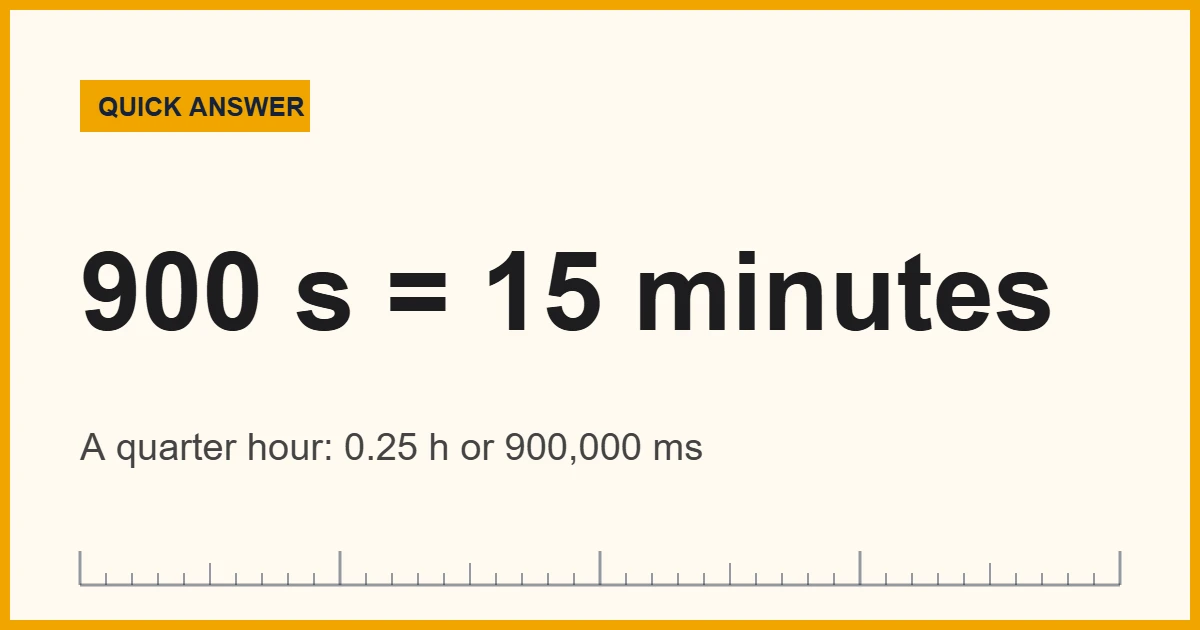
900 seconds is exactly 15 minutes, which is one quarter of an hour (0.25 h). Because one minute has 60 seconds, 900 / 60 = 15. In addition, it equals 900,000 milliseconds and 1/96 of a day. So a 900-second timer started at 2:00 pm rings at 2:15 pm.
Convert 900 Seconds to Minutes and Hours
Type any number of seconds below. Then the converter shows the same span in minutes, hours and milliseconds, so you can check 900, 1,200 or 5,400 seconds in one place.
Durations in seconds often turn up in odd places, so the question is common. For example, a microwave keypad, a workout app, a server timeout setting or a lab protocol may all ask for seconds instead of minutes. As a result, a figure like 900 looks bigger than it really is. In everyday terms, however, it is a quarter of an hour: about the length of a coffee break.
Importantly, the conversion rests on a fixed definition, not an estimate. The US National Institute of Standards and Technology (NIST) explains that the SI second is the time it takes for 9,192,631,770 oscillations of the cesium atom’s microwave signal. Because a minute is defined as 60 seconds and an hour as 60 minutes, every figure on this page follows from simple division.
900 Seconds and Nearby Values: Conversion Chart
First, this chart lists the second counts people convert most often. Next, each row divides by 60 for minutes and by 3,600 for hours; hours are rounded to four decimals.
| Seconds | Minutes | Hours | Everyday name |
|---|---|---|---|
| 60 | 1 | 0.0167 | one minute |
| 300 | 5 | 0.0833 | five minutes |
| 600 | 10 | 0.1667 | ten minutes |
| 900 | 15 | 0.25 | a quarter hour |
| 1,200 | 20 | 0.3333 | a third of an hour |
| 1,500 | 25 | 0.4167 | one classic Pomodoro |
| 1,800 | 30 | 0.5 | half an hour |
| 2,700 | 45 | 0.75 | three quarters of an hour |
| 3,600 | 60 | 1 | one hour |
| 5,400 | 90 | 1.5 | an hour and a half |
Also, this table prints cleanly from your browser, so you can tape it near a microwave or gym timer. For the longer end of the scale, see how long 90 minutes is.
How to Convert 900 Seconds to Minutes
In fact, there are two quick routes, and both give the same answer.
Route 1: divide by 60. Since one minute holds 60 seconds, 900 / 60 = 15 minutes. Likewise, 600 / 60 = 10 and 1,200 / 60 = 20.
Route 2: divide by 3,600 for hours. After all, one hour holds 60 x 60 = 3,600 seconds. Therefore 900 / 3,600 = 0.25 hour, which is the same as a quarter hour.
Conversely, to go the other way, multiply. For instance, 15 minutes x 60 = 900 seconds, and 0.25 hour x 3,600 = 900 seconds. However, if a number does not divide evenly, split it into whole minutes plus leftover seconds. For example, 950 seconds is 15 minutes (900 seconds) plus 50 seconds, so you would write it as 15:50.
900 Seconds in Other Units
Minutes are the usual answer. Still, some tasks need a different unit. In software, for example, timeouts are often set in milliseconds, while schedules may count fractions of a day.
| Unit | Value of 900 s | How it is worked out |
|---|---|---|
| Milliseconds | 900,000 ms | 900 x 1,000 |
| Minutes | 15 min | 900 / 60 |
| Hours | 0.25 h | 900 / 3,600 |
| Days | about 0.0104 day (1/96) | 900 / 86,400 |
| Weeks | about 0.0015 week (1/672) | 900 / 604,800 |
In other words, a single day contains 96 quarter hours, and a week contains 672 of them. If you want the full-day figure, our guide to how many seconds are in a day walks through the 86,400 total.
Similarly, distance helps make the span concrete. At a steady 60 mph, a car covers 15 miles (about 24.1 km) in that time. Meanwhile, a walker at 3 mph covers about 0.75 mile (about 1.2 km). Finally, light, which travels exactly 299,792,458 meters per second by definition, covers roughly 270 million km in the same quarter hour.
Recommended Timers and Stopwatches for Timing 900 Seconds
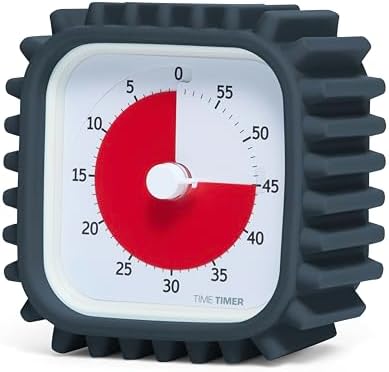
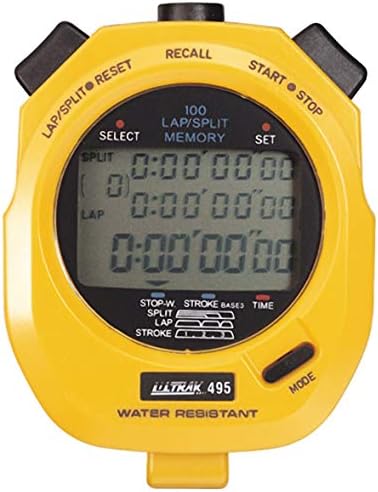
Of course, a phone works, but a dedicated timer is easier to start with wet or floury hands, and it does not get buried under notifications. First, look for a loud alarm and large digits. Next, check that the timer counts down from at least 99 minutes so a quarter hour sits well within range. Finally, a stopwatch with lap or split memory helps if you time intervals rather than count down.


As an Amazon Associate, Measuring Expert earns from qualifying purchases.
Where 900 Seconds Shows Up in Everyday Life
Fifteen minutes is a common building block for schedules, because four of them fill an hour neatly. As a result, here are a few places you are likely to meet it:
- Calendar slots. Many calendar apps let you book meetings in 15-minute steps, so a short check-in often lasts exactly a quarter hour.
- Focus timers. The Pomodoro Technique, created by Francesco Cirillo, uses 25-minute work blocks with short breaks and then a longer 15 to 30 minute break after four rounds. Some people also run shorter 15-minute work blocks as a variant.
- Parking meters. Coin and app-based meters often sell time in small blocks; check the posted rate, since the minutes per coin differ from city to city.
- Kitchen timers. Plenty of recipes give a 15-minute bake, simmer or rest time, which is a 900-second countdown on a seconds-based timer.
- Workouts. Short interval or circuit sessions are frequently built around a 15-minute block.
How to Time 900 Seconds Accurately
- Pick one timing device. Use a kitchen timer, stopwatch or phone, but avoid switching between devices partway through.
- Enter the time in the unit it accepts. Set 15:00 on a minutes-and-seconds timer, or 900 on a seconds-only keypad.
- Check the display before you start. Make sure it reads 15:00 and not 1:50 or 9:00, which are easy keypad slips.
- Start the timer at the exact moment the task begins. For cooking, that is when food goes in, not when the oven turns on.
- Confirm the alarm volume. Otherwise, a quiet beep in another room defeats the purpose.
- Write down the end time as a backup. If the timer fails, add 15 minutes to the start time on any clock.
900 Seconds on a Clock vs Elapsed Time
People sometimes mix up a duration with a time of day. Therefore, the table below separates the formats that cause most errors.
| You see | What it means | Is it 900 seconds? |
|---|---|---|
| 15:00 on a timer | 15 minutes, 0 seconds of duration | Yes |
| 15:00 on a 24-hour clock | 3:00 pm, a time of day | No |
| 0:15:00 (h:mm:ss) | 15 minutes of duration | Yes |
| 9:00 on a timer | 9 minutes, or 540 seconds | No |
| 0.25 h | a quarter hour | Yes |
| 0.15 h | 9 minutes (0.15 x 60) | No |
Do and Don’t When Timing a Quarter Hour
Do
- Divide seconds by 60 for minutes.
- Log a quarter hour as 0.25 in decimal timesheets.
- Start timing when the task truly begins.
- Keep one timer per task in a busy kitchen.
Don’t
- Confuse 15:00 on a timer with 3 pm.
- Write 0.15 h when you mean 15 minutes.
- Rely on a silent phone alarm.
- Assume every recipe time is exact.
Honest Limits of a 900-Second Count
The conversion itself is exact: 900 seconds is 15 minutes with no rounding at all. However, the real-world timing around it is not. For example, a kitchen timer may drift by a second or two, and a person pressing start and stop adds reaction time. Also, older mechanical wind-up timers are often marked only in whole minutes, so they cannot show the last few seconds clearly. In short, the number is precise, but your measurement of it is only as good as the device and the hand using it.
In addition, leap seconds are another edge case. They are occasionally added to official clock time (UTC), yet they never change the length of a single second. Thus a 900-second timer always runs for 900 SI seconds.
When Accuracy Really Matters
For most errands, of course, being a few seconds off is harmless. Still, a few situations call for care:
- Lab and science work. Incubation or reaction times should follow the protocol, measured with a calibrated timer.
- Food safety. Rest and hold times matter; also check internal temperature with a thermometer rather than relying only on time.
- Medicine and care routines. If a label or clinician gives timing instructions, follow those exactly.
Planning something longer? If so, our explainer on how long 72 hours is covers multi-day windows and deadlines.
Frequently Asked Questions
How many minutes is 900 seconds?
900 seconds is exactly 15 minutes, because 900 divided by 60 equals 15.
How many hours is 900 seconds?
It is 0.25 hour, or a quarter of an hour, because 900 divided by 3,600 equals 0.25.
Is 900 seconds a quarter of an hour?
Yes. Because an hour has 3,600 seconds, one quarter of 3,600 is 900.
How many milliseconds are in 900 seconds?
There are 900,000 milliseconds in that span, since each second holds 1,000 milliseconds.
How do you convert seconds to minutes?
Divide the number of seconds by 60. For leftovers, the remainder is the extra seconds; for example, 950 seconds is 15 minutes and 50 seconds.
What fraction of a day is 900 seconds?
It is 1/96 of a day, or about 1.04 percent, because a day has 86,400 seconds.
How do I set 900 seconds on a timer?
Enter 15:00 on a minutes-and-seconds timer, or type 900 on a timer that accepts seconds only. Then check the display before you press start.
Is a quarter hour the same as 0.15 hours?
No. In fact, 0.15 hour is only 9 minutes. Instead, a quarter hour in decimal form is 0.25.
How far can you drive in 15 minutes?
At a steady 60 mph you cover 15 miles, or about 24.1 km. Similarly, at 30 mph you cover 7.5 miles, or about 12.1 km.
How many 900-second blocks are in a day?
There are 96 blocks of 900 seconds in a day, and therefore 672 in a week.
The Bottom Line on 900 Seconds
To sum up, 900 seconds is exactly 15 minutes, or 0.25 hour, and it fits 96 times into a day. In short, the math is simple division by 60, and it rests on the SI second that NIST maintains.
Finally, if you need a different number, the converter at the top of this page turns any count of seconds into minutes, hours and milliseconds in one step.
1 thought on “How Long Is 900 Seconds? Exactly 15 Minutes (a Quarter Hour)”