

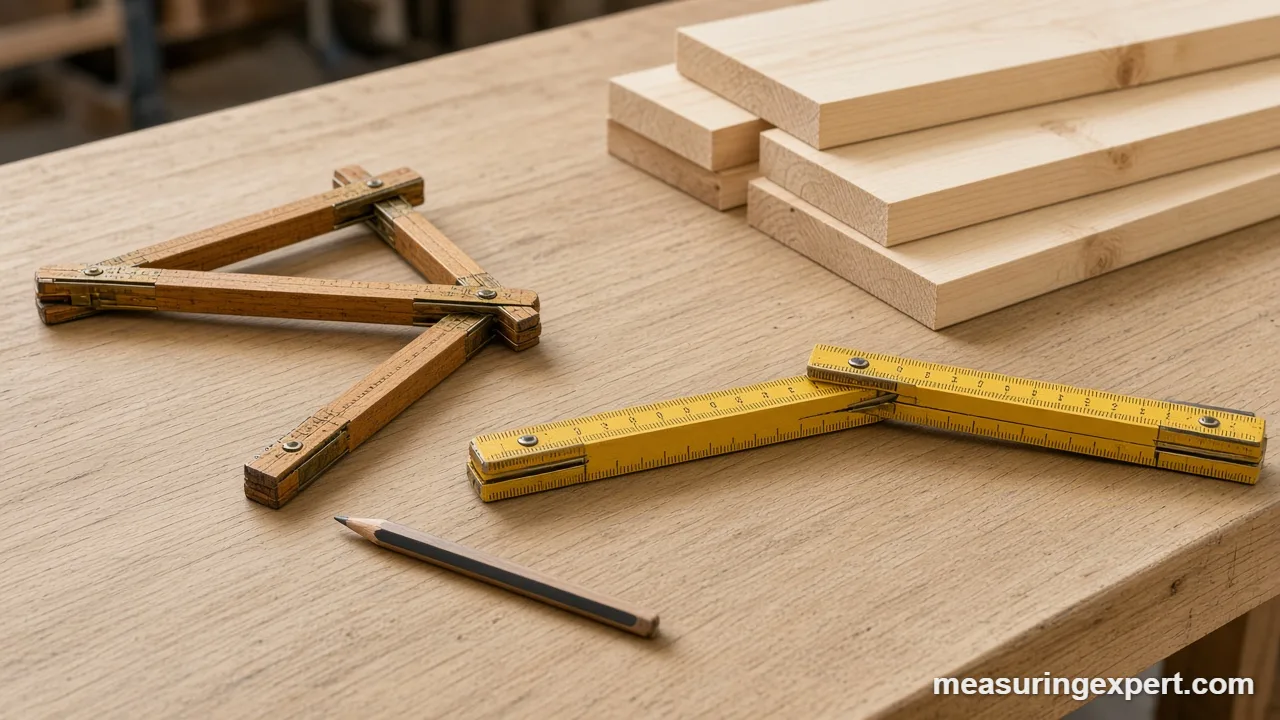
The best folding measuring stick for most carpenters is the Lufkin X46, a 6 ft wood rule with a brass slide extension for quick inside measurements. Your choice comes down to wood or fiberglass, inside or outside reading, and whether you need inches, metric or both on the same rule.
In short: get the Lufkin X46 for trim and openings, the Klein 910-6 for wet job sites, and the Perfect Measuring Tape FR-72 if you want inch and metric on a budget.
As an Amazon Associate, Measuring Expert earns from qualifying purchases. Our picks are based on research, specifications and owner feedback, not paid placement.
Best Overall
Best Budget
Quick Answer: Folding Rule Picks by Job
- Best overall: Lufkin X46, a 6 ft wood rule with a 6 in brass slide.
- Wet or dirty sites: Klein 910-6, glass-filled nylon with locking joints.
- Depth checks: Wiha 61620 MaxiFlex, with a built-in 6 in depth extension.
- Inch plus metric: Hultafors 61-2-10, a 2 m birch rule with both scales.
- Metric only: Stabila Type 617, certified to accuracy class III.
- Budget pick: Perfect Measuring Tape FR-72, with 1/32 in marks for the first 6 in.
- Masonry: Lufkin 636, with a brick spacing scale on the inside.
On This Page
- Comparison Table
- The 8 Picks, Reviewed
- How We Chose
- Wood vs Fiberglass vs Composite
- Inside vs Outside Reading
- Accuracy Classes Explained
- Length Converter
- How to Take an Inside Measurement
- Care and Joint Maintenance
- Do and Don’t
- Honest Limits
- FAQ
- Bottom Line
Best Folding Measuring Stick Comparison Table
| # | Image | Product | Best For | Standout Feature | Link |
|---|---|---|---|---|---|
| 1 |  | Lufkin X46 Wood Rule | Carpenters and trim work | 6 in brass slide for inside reads | View |
| 2 |  | Klein Tools 910-6 | Electricians and wet job sites | Glass-filled nylon, stainless springs | View |
| 3 | 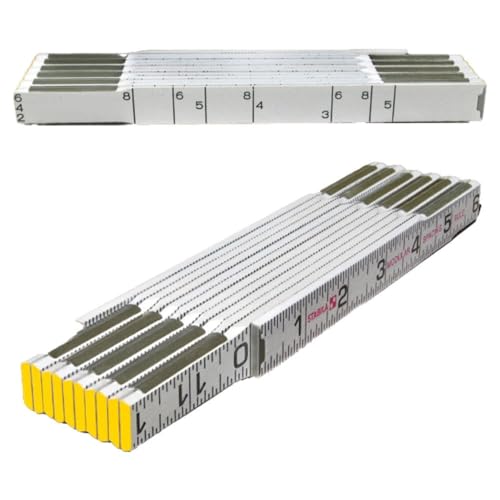 | Stabila Type 600 Oversize | Daily carpentry and general layout | Sealed rivets, hardened steel springs | View |
| 4 |  | Wiha 61620 MaxiFlex | Depth checks and wet work | 6 in depth extension, 30% fiberglass | View |
| 5 |  | Hultafors 61-2-10 | Mixed inch and metric projects | 2 m birch rule, Swedish steel joints | View |
| 6 | 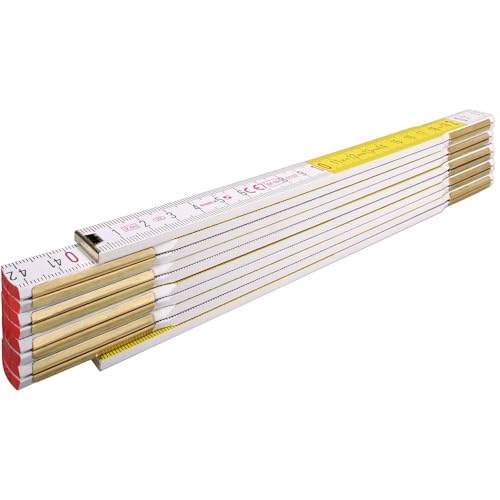 | Stabila Type 617 (2 m) | Metric-only work and accuracy class III | EC accuracy class III certified | View |
| 7 | 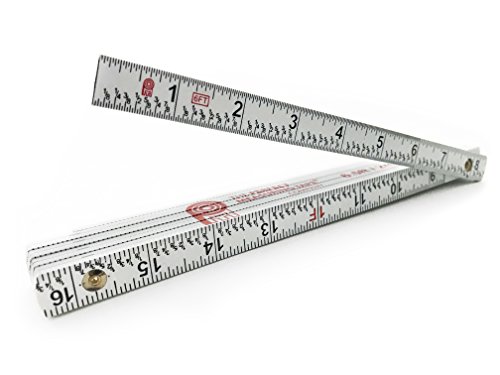 | Perfect Measuring Tape FR-72 | Budget kits and shop use | 1/32 in for the first 6 in | View |
| 8 |  | Lufkin 636 Brick Mason | Bricklayers and block work | Brick spacing scale on the inside | View |
The 8 Best Folding Measuring Stick Picks, Reviewed
Folding rules go by many names: zig-zag rule, carpenter’s rule, folding yardstick or folding meter stick. However, they all do one job. In other words, each one gives you a rigid scale that folds to pocket size. So the best folding measuring stick for you depends on where you work and what you measure most.
Best Overall
1. Lufkin X46 Red End Wood Rule with Brass Slide Extension
Best for: Finish carpenters, cabinet installers and anyone who measures inside door jambs, window openings and cabinet boxes.
Above all, the Lufkin X46 is the classic zig-zag rule that many carpenters picture first. First, it opens to 6 ft (72 in, or 182.9 cm) and carries a brass slide extension in a T-slot on the first section. Also, the slide runs under friction and has stops at each end, so it does not fall out. As a result, it is the best folding measuring stick here for inside measurements.
On the measurement side, the X46 is graduated to 1/16 in (about 1.6 mm) on both sides and both edges. In addition, it marks 16 in stud centers in red, which speeds up framing layout. Lufkin starts the numbering on the inside of the rule, so the scale reads correctly when you hold the rule against an opening. However, it is an inch-only rule, so metric users should look further down the list.
- Length: 6 ft (72 in / 182.9 cm), wood
- Graduations: 1/16 in on both sides and both edges
- 16 in stud centers marked in red
- Graduated brass slide extension, up to 6 in, with end stops
- Inside-start numbering for reading against openings
Pros
- Slide extension makes inside measurements quick
- Red stud marks help framing layout
- Classic wood feel with a stiff, straight span
Cons
- Inch scale only, so no metric
- Wood can swell or chip if left wet
Skip it if: you work outdoors in rain and mud most of the time, or you need a metric scale.
Best Pro Fiberglass
2. Klein Tools 910-6 Fiberglass Folding Rule, Inside Reading
Best for: Electricians, plumbers and remodelers who want a rule that shrugs off water, grime and most chemicals.
The Klein 910-6 swaps wood for nylon reinforced with glass fibers. In fact, Klein says this build resists weather, abrasion and most chemicals. So it suits basements, crawl spaces and outdoor work where a wood rule would swell. In addition, it weighs 5.3 oz (150 g) and is 0.75 in (1.9 cm) wide.
Like the X46, it is also an inside-reading rule, graduated to 1/16 in on both sides and both edges. Moreover, the markings are black on yellow, which stays readable in poor light. Also, red marks every 16 in help you find stud centers. Finally, the joints use stainless steel spring hinges that lock positively, so the sections hold straight while you read.
- Length: 6 ft (1.8 m)
- Material: nylon reinforced with glass fibers
- Graduations: 1/16 in, engraved, both sides and both edges
- Inside reading, black on yellow, red 16 in stud marks
- Positive-locking joints with stainless steel spring hinges
Pros
- Handles water, dirt and most chemicals
- High-contrast yellow scale
- Locking joints hold the rule straight
Cons
- No slide extension, so inside reads take longer
- Inch scale only, so no metric
Skip it if: you mostly measure inside openings, where a slide extension saves time.
Best Wood Build
3. Stabila Type 600 Oversize Folding Rule (Cat. No. 80005)
Best for: Builders who want a German-made wood rule with a tough painted finish and joints that lock firmly.
Stabila has built folding rules for more than a century, and the Type 600 is its core wood line. In particular, this oversize 6 ft version uses beech sections with a hard-wearing, weather-resistant paint. Moreover, distributors describe the wood as fiberglass reinforced. Therefore, it resists the warping that cheap pine rules show after a few seasons.
Unlike the Klein, the Type 600 reads on the outside along both edges, in 1/16 in steps. Likewise, its high-strength hinges and hardened steel springs give a positive lock at each joint. In addition, the rivets are fully sealed, so water and grit have a harder time getting into the pivots. Finally, Stabila includes a certificate of accuracy, which is a nice touch at this level.
- Length: 6 ft, beech wood sections
- Graduations: 1/16 in, outside reading on both edges
- High-strength hinges and hardened steel springs
- Fully sealed rivets for weather resistance
- Ships with a certificate of accuracy (per distributors)
Pros
- Sturdy beech build with weather-resistant paint
- Firm, positive joint lock
- Accuracy certificate included
Cons
- No slide extension, so inside reads take longer
- Outside reading only, so openings are slower to read
Skip it if: you need to read inside openings directly from the scale.
Best Depth Extension
4. Wiha 61620 MaxiFlex Folding Ruler with 6 in Depth Extension
Best for: Remodelers and installers who check depths, such as recesses, pockets and holes, as often as they measure lengths.
The Wiha MaxiFlex is molded with 30% fiberglass, and Wiha calls it waterproof and chemical resistant. Also, it folds in 12 sections to a 6 ft outside-reading rule. Furthermore, its play-free joints lock at 0, 90 and 180 degrees, with stainless steel springs at the 90 and 180 degree stops. So you can use a section as a quick right angle.
Still, the 6 in depth extension is the standout feature. For example, slide it out to read the depth of a hole or recess without a separate gauge. Meanwhile, the scale is deep embossed, black on yellow, and graduated to 1/16 in on both sides and both edges. In addition, black diamond marks show truss spacing, which helps when you locate drill points.
- Length: 6 ft, 12 sections, outside reading
- Material: molded with 30% fiberglass; waterproof
- Graduations: 1/16 in, deep embossed, both sides and edges
- 6 in depth extension
- Joints lock at 0, 90 and 180 degrees
Pros
- Depth extension doubles as a depth gauge
- Joint stops form a quick 90 degree check
- Shrugs off water and chemicals
Cons
- Outside reading only, so openings are slower to read
- Plastic feel will not suit wood-rule fans
Skip it if: you want an inside-reading scale for door and window openings.
Best Inch and Metric
5. Hultafors 61-2-10 Birch Folding Rule, 2 m (100504U)
Best for: Woodworkers and DIYers who switch between inch plans and metric hardware or European cabinet systems.
Hultafors is a Swedish rule maker, and its 61-2-10 is a thin, flexible birch rule. In fact, the model code tells you the basics: 2 m long with 10 sections. Also, it carries millimeters along the bottom edge and inches along the top edge, with black figures on both sides. As a result, you can read either system without flipping units in your head.
The joints are also heat-treated Swedish steel, epoxy coated and oiled at three points. Moreover, Hultafors says it checks each section twice during production with high-speed cameras. The sections are 17 mm (about 0.67 in) wide and finished in a water-based lacquer that resists dirt and moisture. However, birch is still wood, so keep it dry.
- Length: 2 m (78.7 in), 10 sections
- Material: downy birch, water-based lacquer
- Scales: millimeters on the bottom edge, inches on the top edge
- Heat-treated, epoxy-coated Swedish steel joints
- Section width: 17 mm (0.67 in)
Pros
- Inch and metric on one rule
- Thin, light sections that still feel solid
- Camera-checked sections during production
Cons
- No slide extension, so inside reads take longer
- Thin birch can snap if forced sideways
Skip it if: you only work in inches and want the stiffest possible span.
Best Metric
6. Stabila Type 617 Wood Folding Rule, 2 m Metric (01128)
Best for: Users who work in centimeters and millimeters and want a rule with a stated legal accuracy class.
The Type 617 is the metric member of Stabila’s Series 600. First, it is 2 m long, made of PEFC-certified beech, and 1.7 cm wide. The two-sided cm/mm scale runs on both edges, with large digits and red tens for quick orientation. So reading 1,250 mm at a glance is easy.
Still, what sets it apart is the paperwork. In particular, Stabila lists accuracy class III with an EC type examination certificate. Under the EU Measuring Instruments Directive, a class III 2 m rule may deviate by no more than plus or minus 1.4 mm. In addition, Stabila uses clasping joint plates, a concealed rivet and galvanized hardened steel springs.
- Length: 2 m (78.7 in), cm/mm scale only
- Material: PEFC-certified beech, 1.7 cm wide
- Accuracy class III with EC type examination certificate
- Large digits with red tens
- Hardened, galvanized steel springs and concealed rivets
Pros
- Stated legal accuracy class
- Very clear metric scale
- Weather-resistant painted finish
Cons
- No inch scale, so US plans need converting
- Can be hard to find in US stores
Skip it if: you work from inch plans, since it has no inch scale.
Best Budget
7. Perfect Measuring Tape Co. FR-72 Composite Folding Rule
Best for: Hobbyists, students and anyone who wants a light, waterproof rule with a fine scale at the start.
The FR-72 is a composite rule made from fiberglass-reinforced ABS plastic, with reinforced rivets and stainless steel springs. In addition, it measures 78 in (6.5 ft, or about 2 m), and it folds to about 9 in by 1.5 in. Also, the maker says it bends without breaking and wipes clean.
For measuring, the top side reads in 1/32 in for the first 6 in, then in 1/16 in after that. As a result, that fine start helps with small parts and trim reveals. Meanwhile, the bottom side carries metric along with inches. Also, the internal hinges lock at every 90 degrees and have no protruding edges, so the rule does not snag.
- Length: 78 in (6.5 ft / about 2 m)
- Material: fiberglass-reinforced ABS composite
- 1/32 in graduations for the first 6 in, then 1/16 in
- Metric scale on the bottom side
- Weight: 8 oz; blade width 9/16 in
Pros
- Fine 1/32 in start, especially useful for small parts
- Inch and metric on one rule
- Waterproof and wipeable
Cons
- Composite feels less rigid than beech
- No slide or depth extension
Skip it if: you need a stiff span for long, unsupported reads.
Best for Masonry
8. Lufkin 636 Red End Brick Mason Wood Rule
Best for: Bricklayers and masons who space courses and need a standard inch scale on the same tool.
Similarly, the Lufkin 636 is a 6 ft Red End wood rule, but it is built for masons. In particular, its inside surface carries a brick spacing rule, which helps you lay out even course heights. Meanwhile, the outside shows feet and inches graduated to 1/16 in on both edges, so it still works as a general rule.
Lufkin also uses brass-plated joints and brass end caps that keep the ends from splintering. In addition, the rule weighs about 0.30 lb and carries a full lifetime warranty.
- Length: 6 ft (72 in), wood
- Inside: brick spacing scale
- Outside: feet and inches to 1/16 in, both edges
- Brass-plated joints and brass end caps
- Full lifetime warranty (Lufkin)
Pros
- Masonry scale and inch scale on one tool
- Brass end caps protect the tips
- Also backed by a lifetime warranty
Cons
- Spacing scale is useless outside masonry
- Wood still needs to stay dry
Skip it if: you never lay brick or block; the X46 is the better general rule.
How We Chose the Best Folding Measuring Stick Picks
We did not run hands-on tests. Instead, these picks are research-based. First, we read the maker’s product pages and distributor spec sheets for length, graduations, reading side, joints and materials. Next, we looked at owner feedback for common failures, such as loose joints, faded numbers and snapped sections. Finally, we removed near-duplicates and unbranded listings so that each pick covers a distinct job.
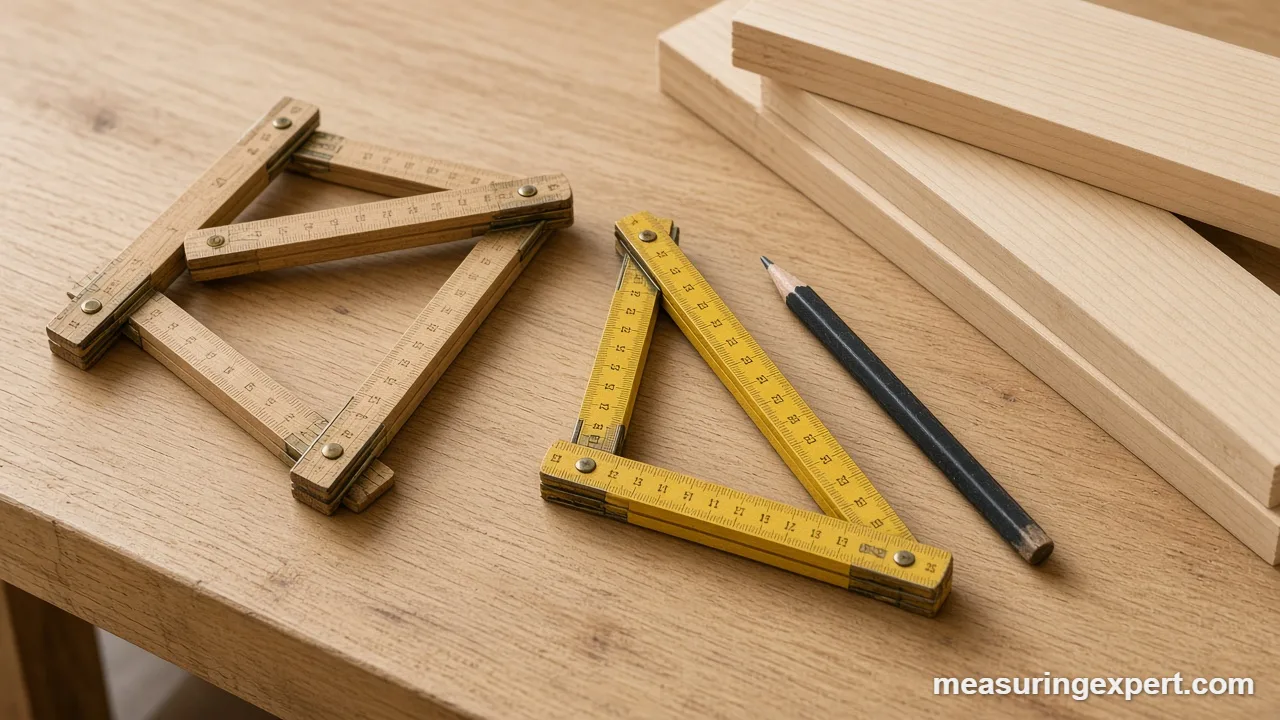
- Scale quality: clear 1/16 in or mm graduations, ideally on both sides and both edges.
- Joints: locking springs and sealed or protected rivets that keep sections in line.
- Material: a fair mix of wood, fiberglass and composite rules for dry and wet work.
- Extras that measure: slide extensions, depth extensions and masonry scales.
- Documented accuracy: a stated accuracy class or certificate earned extra credit.
For the accuracy side, we used the length tolerances in Annex X of the EU Measuring Instruments Directive (2014/32/EU). For unit definitions, we used the NIST note on the international foot of exactly 0.3048 m.
Wood vs Fiberglass: Choosing the Best Folding Measuring Stick Material
The material decides how a rule handles weather, drops and years of folding. However, accuracy depends more on the joints than on the material.
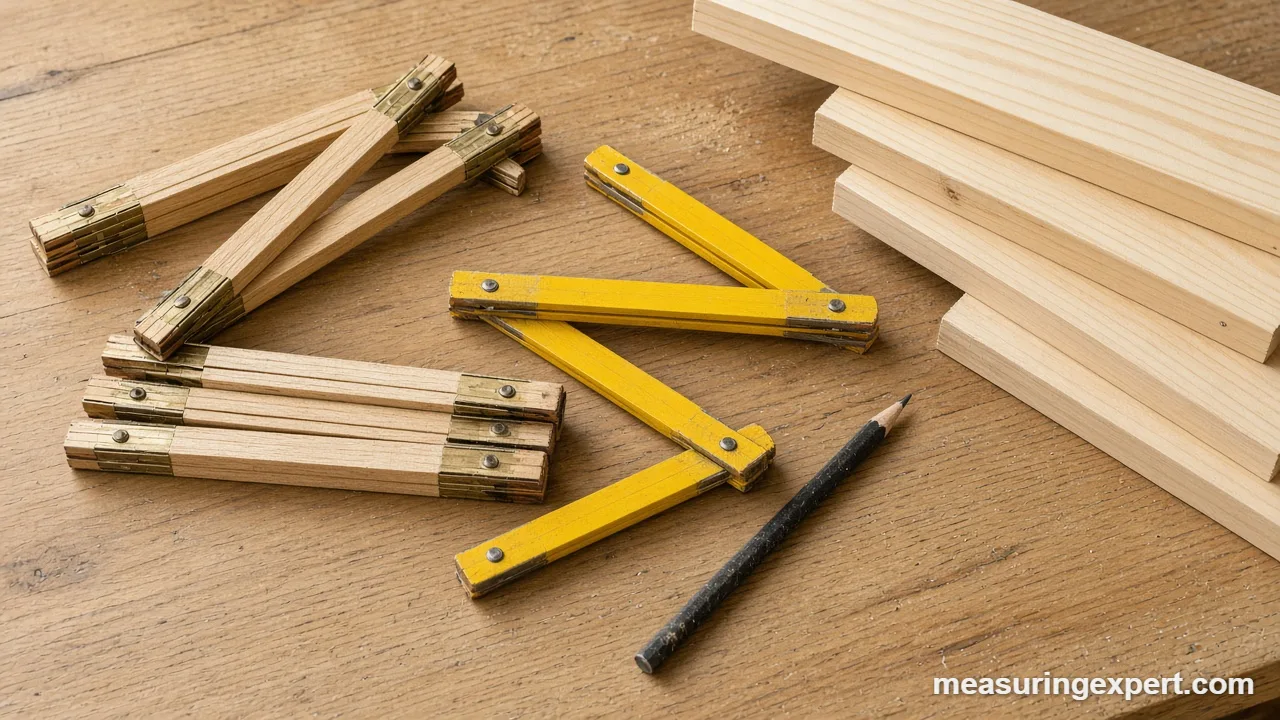
| Material | Examples here | Strength | Weakness |
|---|---|---|---|
| Beech or birch wood | Lufkin X46, Stabila Type 600, Hultafors 61-2-10 | Stiff span, classic feel, easy to read | Swells or splits if left wet |
| Glass-filled nylon (fiberglass) | Klein 910-6, Wiha MaxiFlex | Waterproof, resists most chemicals | Slightly more flex over long spans |
| ABS composite | Perfect Measuring Tape FR-72 | Light, low cost, wipes clean | Less rigid than beech |
| Vintage boxwood with brass | Old Rabone and Stanley rules | Beautiful, often finely divided | Shrinkage and worn joints over time |
For longer runs than 6 ft or 2 m, switch to a tape; our guide to the best tape measure covers 16 ft to 35 ft models. For bench work under 1 ft, a steel rule is more exact; see the best precision ruler picks. If you want a rigid stick that does not fold, the best meter ruler list has one-piece options.
Inside vs Outside Reading Folding Rules
To begin with, reading direction is the spec that confuses most buyers. On an inside-reading rule, the numbers start on the inside face of the first section. So when you open the rule against an opening, the scale faces you and reads the right way. The Lufkin X46 and Klein 910-6 work this way.
An outside-reading rule numbers the outer face instead. As a result, that layout suits laying the rule flat on a board to mark a cut. The Stabila Type 600, Wiha MaxiFlex and the outside of the Lufkin 636 read this way. In practice, neither is more accurate; pick the one that matches your habit.
Best Folding Measuring Stick Accuracy: Classes and Joints
In Europe, folding rules can carry a legal accuracy class under the Measuring Instruments Directive. The maximum permissible error is plus or minus (a + bL) mm, where L is the length rounded up to the next whole meter. For class II, a is 0.3 mm and b is 0.2. For class III, a is 0.6 mm and b is 0.4.
| Class | Formula | 2 m rule (L = 2) | 6 ft rule (1.83 m, L = 2) | Extra joint limit |
|---|---|---|---|---|
| Class I | 0.1 + 0.1L mm | 0.3 mm (0.012 in) | 0.3 mm (0.012 in) | Not specified |
| Class II | 0.3 + 0.2L mm | 0.7 mm (0.028 in) | 0.7 mm (0.028 in) | 0.3 mm |
| Class III | 0.6 + 0.4L mm | 1.4 mm (0.055 in) | 1.4 mm (0.055 in) | 0.5 mm |
To put 1.4 mm in context, 1/16 in is about 1.6 mm. So a class III rule stays within roughly one graduation over its full length. In addition, the directive says joints must not add more than 0.3 mm (class II) or 0.5 mm (class III). Consequently, worn, wobbly joints matter more than the material. However, US rules rarely list a class, so the Stabila Type 617 is the only pick here with one stated.
Folding Rule Length Converter
Folding rules come in 6 ft and 2 m sizes, so you will often need to convert. The inch is exactly 25.4 mm, and the foot is exactly 0.3048 m. Enter a length in feet below to see inches, centimeters, meters and millimeters.
How to Take an Inside Measurement With a Folding Rule
The slide extension is the reason many pros still carry a folding rule. For instance, a tape measure has to bend into a corner, and then you add the case length. A folding rule with a slide, by contrast, reads the opening directly. Follow these steps.
- Pick the right rule. Use a rule with a slide extension, such as the Lufkin X46. Check that the slide moves smoothly and that the zero end is not chipped.
- Unfold to the last full section. Open the rule one joint at a time until the next section would no longer fit inside the opening. Keep the slide end facing the far side.
- Seat the zero end. Press the zero end of the rule firmly against one side of the opening. Hold the rule level and straight, not at an angle.
- Push out the slide. Slide the brass extension out until it just touches the opposite side. Do not force it, because pressure can bow the rule.
- Read both scales. Note the length of the open rule at the base of the slide, then read the slide scale. For example, 48 in on the rule plus 3 5/16 in on the slide gives 51 5/16 in.
- Check and record. Take the reading twice, once at the top and once at the bottom of the opening. Then record the smaller value for a fitted part.
Care and Joint Maintenance
A folding rule lives or dies by its joints. After all, each joint is a small pivot, and every pivot adds a little play as it wears. For that reason, gentle handling keeps a rule accurate for years.
- Oil the joints: a drop of light machine oil keeps springs smooth and slows wear.
- Keep wood dry: wipe off water and let a wet rule dry closed, away from heat.
- Protect the ends: a chipped zero end shortens every reading you take.
- Check it yearly: compare the rule against a good steel tape at 1 m or 3 ft.
Folding Rule Do and Don’t
Honest Limits of the Best Folding Measuring Stick
Even the best folding measuring stick has limits. First, it stops at 6 ft or 2 m, so longer runs need a tape or a laser. Second, each joint adds a tiny error, and those errors stack as a rule wears. Third, a rule sags a little when you hold it out flat, so support long spans. Finally, reading parallax matters: look straight down at the mark, because an angled view can shift a reading by a fraction of a graduation. For a broader look at length tools, see our overview of tools to measure length.
Best Folding Measuring Stick FAQ
What is the best folding measuring stick for most people?
For most carpenters and DIYers, the Lufkin X46 is the best folding measuring stick, because its 6 in brass slide makes inside measurements fast and its 1/16 in scale covers general work. For wet sites, choose the Klein 910-6 fiberglass rule instead.
What is the difference between a folding rule and a tape measure?
A folding rule is rigid, so it can span a gap, reach up a wall or take inside readings with a slide. A tape measure is longer and hooks onto an edge, but it sags over open spans. Therefore, many tradespeople carry both.
What does inside reading mean on a folding rule?
On an inside-reading rule, the numbers start on the inside face, so the scale reads correctly when the rule is open against an opening. On an outside-reading rule, the numbers read along the outer face, which suits laying the rule flat on stock.
How do you use the slide extension on a folding rule?
Open the rule to the last full section that fits inside the opening. Then slide the brass extension out until it touches the far side, and add the slide reading to the reading at the end of the rule. The total is the inside dimension.
Is a wood or fiberglass folding rule better?
Wood, usually beech or birch, is stiff and traditional but can swell when wet. Fiberglass-reinforced nylon resists water and chemicals and holds up in damp sites. Therefore, choose by your work environment rather than by accuracy.
How accurate is a folding measuring stick?
A quality rule is accurate enough for carpentry. Under the EU Measuring Instruments Directive, a class III 2 m rule may be off by up to 1.4 mm, and a class II rule by up to 0.7 mm. Worn joints add more error, so keep them clean.
Why is a folding rule 6 ft or 2 m long?
Six feet and two meters are long enough for door heights, cabinet runs and stud layouts, yet short enough to fold into a pocket. A 6 ft rule is 182.88 cm, while a 2 m rule is about 78.74 in, or 6 ft 6.7 in.
Are old Rabone or boxwood folding rules still accurate?
Vintage boxwood rules from makers such as Rabone can still read well, but wood shrinks and brass joints wear over decades. Check one against a steel rule before you trust it for fitted work.
Which best folding measuring stick has inch and metric scales?
The Hultafors 61-2-10 and the Perfect Measuring Tape FR-72 both carry inches and metric. Hultafors puts millimeters on the bottom edge and inches on the top, while the FR-72 places metric on its bottom side.
How do I keep a folding rule from breaking?
Open and close it one joint at a time, never by flicking it straight. Also, keep sections in line and do not bend them sideways. Finally, put a drop of light oil on the joints now and then and store the rule dry.
Bottom Line: The Best Folding Measuring Stick to Buy
The Lufkin X46 is the best folding measuring stick for most buyers, because its brass slide, inside-start numbering and red stud marks make everyday carpentry faster. If your work is wet or dirty, the Klein 910-6 is the tougher choice. And if you need metric, the Hultafors 61-2-10 or Stabila Type 617 will serve you well.
Black Friday is coming: shop the deals with Prime