

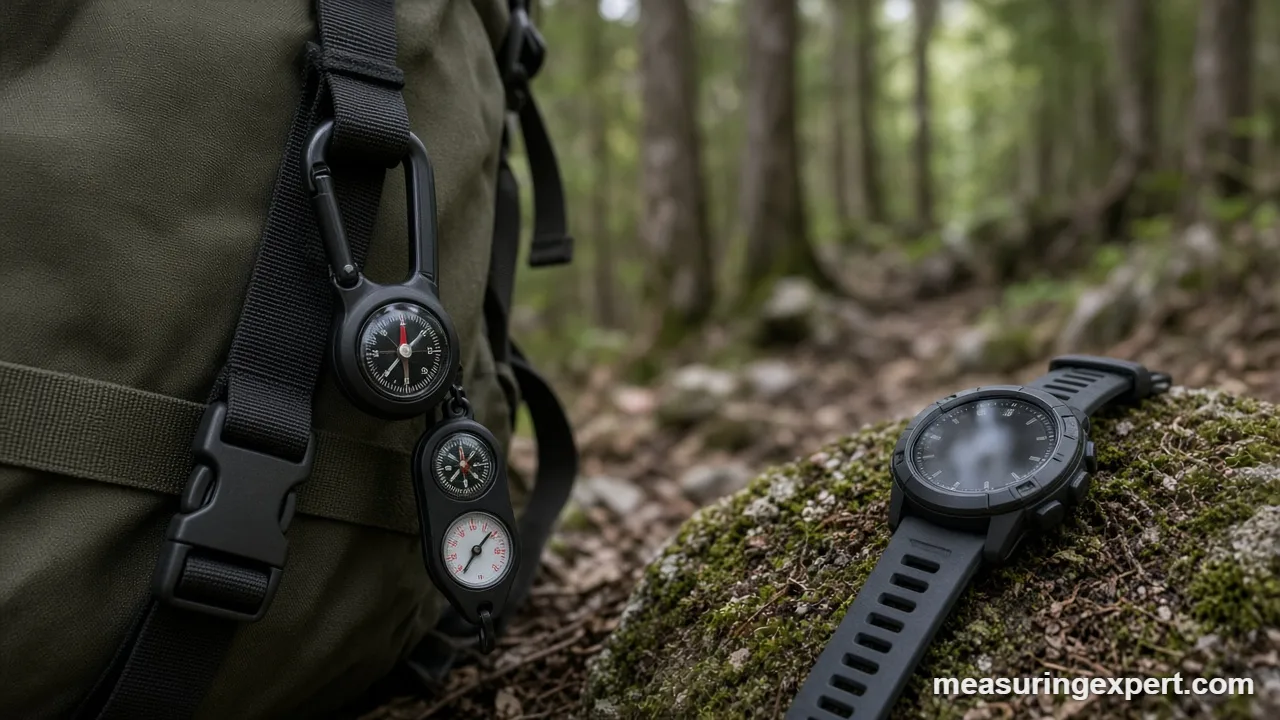
The best compass thermometer combo for most hikers is the Sun Company TempaComp, a ball compass and dial thermometer on a carabiner. However, the right pick depends on how you carry it, whether you want survival tools, and whether a solar ABC watch with an altimeter and barometer suits you better.
In short: clip on the Sun TempaComp, zip on the cheap Coghlan’s pull, or wear the Casio PRW-3500 for a full ABC watch.
As an Amazon Associate, Measuring Expert earns from qualifying purchases. Our picks are based on research, specifications and owner feedback, not paid placement.
Best Overall
Best ABC Watch
Quick Answer: Best Compass Thermometer Combo Picks
- Overall: Sun Company TempaComp, a ball compass and F/C thermometer on a carabiner.
- Budget: Coghlan’s Zipper Pull, with a wind chill chart on the back.
- Survival kit: Sun Company Outsider adds a whistle and a fire starter.
- Whistle combo: Coghlan’s Four Function Whistle for kids and paddlers.
- Smart GPS: Garmin Instinct 2 with compass, barometric altimeter and thermometer.
- ABC watches: Casio PRW-3500, or the lower-cost Casio PRG-270.
On This Page
- Comparison table
- The 7 picks, reviewed
- How we chose
- Zipper pulls vs survival gauges vs ABC watches
- How the thermometer really works
- Temperature converter
- Using the wind chill chart
- How to take a true reading
- Compass accuracy tips
- Do and do not
- Honest limits
- FAQ
- Bottom line
Best Compass Thermometer Combo Comparison
| # | Image | Product | Best For | Standout Feature | Amazon |
|---|---|---|---|---|---|
| 1 |  | Sun TempaComp | Hikers who want both gauges on a pack strap | Ball compass readable at any angle | View |
| 2 |  | Coghlan’s Zipper Pull | Kids, scouts and a spare on every jacket | Wind chill chart on the back | View |
| 3 |  | Sun Outsider | Emergency kits and bug-out bags | Compass, thermometer, whistle and fire starter | View |
| 4 |  | Coghlan’s 4-Function | Kids, paddlers and a lanyard backup | Pealess whistle plus compass, thermometer, magnifier | View |
| 5 |  | Garmin Instinct 2 | Hikers who want GPS, compass and thermometer on the wrist | GPS with compass, barometric altimeter and thermometer | View |
| 6 |  | Casio PRW-3500 | Climbers who want altimeter, barometer and compass without charging | Solar power, 0.1 C thermometer resolution | View |
| 7 |  | Casio PRG-270 | A lower-cost entry into ABC watches | Triple Sensor V3 with solar power | View |
The 7 Best Compass Thermometer Combo Options, Reviewed
We start with clip-on and zipper gauges, then move to survival tools and finally to wrist devices. Note that we found only seven combos from established brands that we could recommend, so this list is shorter than the old top 10.
Best Overall
1. Sun Company TempaComp Carabiner
Best for: Day hikers, backpackers and campers who want a compass and a thermometer clipped where they can see them.
The TempaComp is our pick as the best compass thermometer combo for most people. It pairs a liquid-filled, luminous ball compass with a cushion-mounted dial thermometer on an aluminum carabiner. Because the compass is a ball, it reads at any tilt, so you do not have to hold it level like a flat needle.
Sun Company says the thermometer reads down to -20 F (-30 C) and shows both F and C. However, note one quirk. Specifically, the ball has a top card for cardinal points and a side card for direction of travel. Sun warns that the side card reads 180 degrees off if you use it for general orientation, so read the top card when you check north.
- Compass: liquid-filled, luminous ball with top and side cards
- Thermometer: F and C scales, reads down to -20 F (-30 C)
- Size: 1.5 x 1.5 x 2.9 in (about 38 x 38 x 74 mm)
- Weight: 1.12 oz (about 32 g)
- Clip: aluminum carabiner plus brass split ring (not load bearing)
Pros
- Ball compass reads at any angle
- Dual F and C scales
- Also clips to a strap, zipper or belt loop
Cons
- Side card can confuse first-time users
- Thermometer reads body heat if clipped to a jacket
- Also, the carabiner is not for climbing loads
Skip it if: You need to take bearings off a map, because a ball compass has no baseplate or sighting line.
Best Budget
2. Coghlan’s Zipper Pull Thermometer/Compass
Best for: Scouts, kids and anyone who wants a cheap backup gauge on a jacket zipper.
Coghlan’s makes a small zipper pull that combines a general-purpose compass with a thermometer printed in both F and C. Also, a wind chill chart is printed on the back, so you can estimate how cold the wind makes it feel without an app.
Because it is so light, it is easy to leave on a winter coat or a day pack all season. Still, treat it as a sanity check rather than a navigation tool. A tiny needle like this will point north well enough to orient a trail map, but it cannot hold a precise bearing.
- Compass: general-purpose dial
- Thermometer: F and C scales
- Extra: wind chill chart on the back
- Mount: zipper pull ring
Pros
- Very low cost
- Wind chill chart is handy in winter
- Also light enough to forget it is there
Cons
- Coghlan’s does not publish a temperature range
- Small dial is hard to read with gloves
- Also, the listing shows several Coghlan’s compass styles, so pick the thermometer version
Skip it if: You want to follow a bearing across open ground, because a real baseplate compass does that far better.
Best Survival Multi-Tool
3. Sun Company Outsider 4-in-1 Survival Tool
Best for: Preppers, hunters and campers who want a compact survival gauge with fire and signal tools.
The Outsider is a survival gauge rather than just a pull. It packs a luminous, liquid-filled compass and a cushion-mounted thermometer with a flint rod, a striker and a survival whistle. As a result, one small item covers direction, temperature, fire and signaling.
Sun Company says the thermometer reads down to -20 F. In addition, the metal parts detach from the compass for more precise readings. That detail matters, because steel and ferro rods near a needle can pull it off north.
- Compass: luminous, liquid-filled
- Thermometer: cushion-mounted, reads down to -20 F (-30 C)
- Extras: flint rod, striker, survival whistle, key ring
- Size: 1.4 x 2.2 x 0.5 in; weight 1.3 oz (about 37 g)
Pros
- Four survival tools in one small body
- Metal parts detach to protect compass accuracy
- Also a whistle for signaling
Cons
- Fire rod is small for frequent use
- However, keep the rod away from the needle when reading
- Also, there is no wind chill chart
Skip it if: You only need a zipper gauge for day hikes, because the TempaComp or Coghlan’s pull is simpler.
Best Whistle Combo
4. Coghlan’s Four Function Whistle
Best for: Families, paddlers and scouts who want a loud whistle with a basic compass and thermometer attached.
Coghlan’s Four Function Whistle puts a pealess whistle, a thermometer, a magnifying lens and a glow-in-the-dark compass on one plastic body. Moreover, a spring-loaded metal clip holds it on a belt or lanyard.
Here the whistle is the main tool and the gauges are bonuses. For example, one owner noted the thermometer reads in 5 F or 2 C steps, so expect a rough reading. Even so, a pealess whistle keeps working when wet, which makes this a smart item for every child on a hike.
- Functions: whistle, thermometer, magnifier, compass
- Whistle: pealess design
- Thermometer: F and C scales
- Compass: glow-in-the-dark dial
- Body: plastic with spring-loaded metal clip
Pros
- Loud pealess whistle for signaling
- Magnifier helps read maps
- Also light, cheap and colorful
Cons
- Coarse thermometer scale
- Plastic body is less tough than metal
- Also, Coghlan’s lists no temperature range
Skip it if: You want an accurate air temperature, because the coarse scale is only a rough guide.
Best Smart
5. Garmin Instinct 2 GPS Watch
Best for: Hikers and hunters who want GPS tracking plus a compass, altimeter and thermometer on one device.
For a smart upgrade, the Instinct 2 is a rugged GPS watch. Garmin lists a compass, a barometric altimeter and a thermometer among its sensors. So it can log a track, show your heading and plot pressure trends that hint at incoming weather.
Garmin rates it to 10 ATM and lists up to 28 days of battery life in smartwatch mode. However, like every watch, its thermometer sits against your skin. For a true air reading, take it off and let it sit in the shade first.
- Sensors: GPS, compass, barometric altimeter, thermometer
- Water rating: 10 ATM
- Battery: up to 28 days in smartwatch mode
- Weight: 52 g (45 mm case)
- Display: 0.9 x 0.9 in (23 x 23 mm), two-window
Pros
- GPS tracking plus TracBack routing
- Long battery life for a GPS watch
- Also syncs data to a phone app
Cons
- Thermometer reads wrist heat while worn
- Costs far more than a zipper gauge
- Also needs charging, unlike a dial
Skip it if: You only want a quick temperature check, because a cheap carabiner gauge does that without charging.
Best ABC Watch
6. Casio Pro Trek PRW-3500 ABC Watch
Best for: Climbers, hunters and backpackers who want a full altimeter, barometer and compass (ABC) watch that never needs a charger.
The PRW-3500 is a classic ABC watch from Casio’s Pro Trek line. Inside, it uses Casio’s Triple Sensor Version 3. The compass reads 0 to 359 degrees in 1 degree steps, and the altimeter covers -700 to 10,000 m (-2,300 to 32,800 ft) in 1 m (5 ft) steps.
In addition, the thermometer reads -10 to 60 C (14 to 140 F) with 0.1 C (0.2 F) resolution. Then Tough Solar keeps the cell charged, and Multi-Band 6 radio sync sets the time automatically in covered regions. Keep in mind that fine resolution is not the same as accuracy, especially on your wrist.
- Compass: 0 to 359 deg, 1 deg resolution, 16 points, declination correction
- Altimeter: -700 to 10,000 m (-2,300 to 32,800 ft), 1 m resolution
- Barometer: 260 to 1,100 hPa (7.65 to 32.45 inHg)
- Thermometer: -10 to 60 C (14 to 140 F), 0.1 C resolution
- Water: 200 m; Tough Solar; weight 89 g
Pros
- Solar power, so no charging
- Full ABC sensor set with declination correction
- Also 200 m water resistance
Cons
- Thermometer bottoms out at 14 F (-10 C)
- Larger and heavier than the PRG-270
- Also no GPS track
Skip it if: You camp in deep cold, because the thermometer stops reading below 14 F (-10 C).
Best Budget ABC
7. Casio Pro Trek PRG-270 Triple Sensor
Best for: Hikers who want an altimeter, barometer, compass and thermometer watch at a lower price.
The PRG-270 is the simpler, lower-cost Pro Trek. It still uses Triple Sensor Version 3 with temperature sensing, plus Tough Solar power. Also, its compass reads 0 to 359 degrees in 1 degree steps.
Next, the altimeter spans -700 to 10,000 m (-2,300 to 32,800 ft), and the barometer reads 260 to 1,100 hPa. So it handles the same core jobs as the PRW-3500, but without radio time sync. Casio does not list the thermometer range for this model online, so check the manual if that number matters to you.
- Compass: 0 to 359 deg, 1 deg resolution, 16 points
- Altimeter: -700 to 10,000 m (-2,300 to 32,800 ft), 1 m resolution
- Barometer: 260 to 1,100 hPa (7.65 to 32.45 inHg), 1 hPa resolution
- Water: 100 m (10 ATM); Tough Solar
Pros
- Lower cost than most ABC watches
- Solar power
- Also a compact digital case
Cons
- No radio time sync
- Thermometer range not published online
- Also reads wrist heat while worn
Skip it if: You want automatic time sync, because the PRW-3500 adds Multi-Band 6.
How We Chose the Best Compass Thermometer Combo Picks
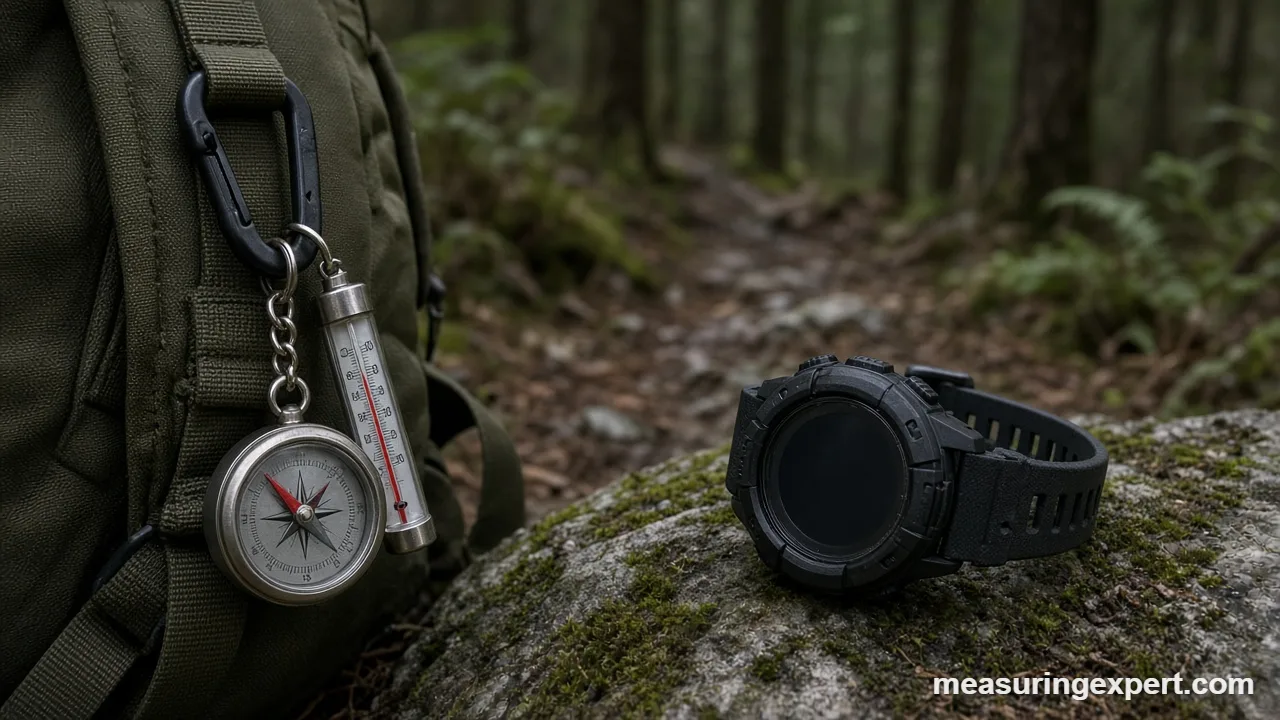
To be clear, we did not field test these gauges. Instead, our picks are research based. First, we read maker spec pages and manuals. Next, we compared compass type, thermometer range and scale, and how each one mounts. Then we weighed owner feedback on readability, durability and how fast the needle settles.
- Real brands: we skipped unbranded keychains that list no specs and no maker support.
- Readable scales: dual F and C scales, or a stated range, beat a bare dial.
- Distinct jobs: each pick covers a different use, from a zipper pull to an ABC watch.
- No overlap: we left out the stand-alone compasses from our best compass roundup.
Sources included the Sun Company TempaComp page, Casio and Garmin spec sheets, the National Weather Service wind chill chart and the NOAA magnetic field calculator for declination.
Best Compass Thermometer Combo Types: Pulls, Survival Gauges and Watches
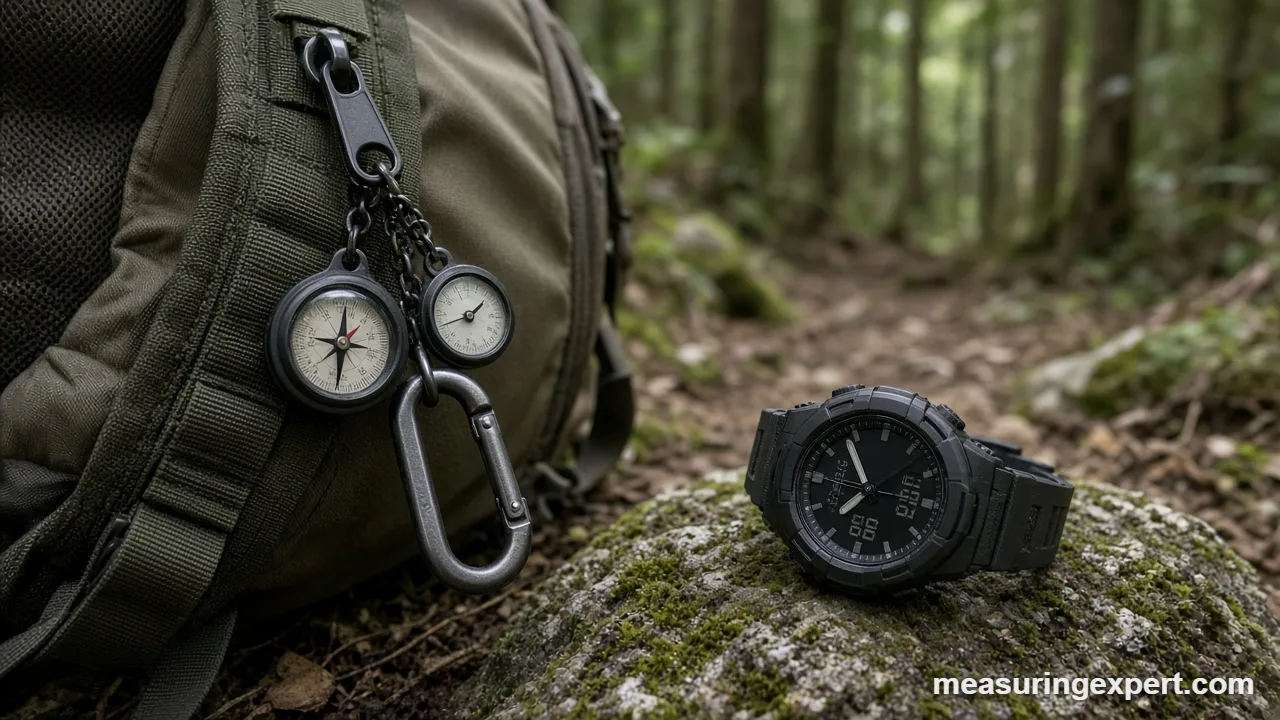
A compass thermometer combo comes in three main forms. Also, each one trades size and cost against features, so start with how you plan to carry it.
| Type | Compass | Thermometer | Good for | Weak spots |
|---|---|---|---|---|
| Zipper pull or carabiner | Small liquid-filled needle or ball | Tiny bimetal dial, F and C | Day hikes, kids, a coat backup | Coarse scale; reads body heat |
| Survival multi-tool gauge | Small luminous needle | Tiny dial | Emergency kits, hunting packs | Steel parts can deflect the needle |
| ABC or GPS watch | Digital magnetic sensor, 1 deg steps | Electronic sensor, 0.1 to 1 deg steps | Climbing, long trips, weather trends | Wrist heat; cost; needs light or charging |
In short, a pull or carabiner is enough for orientation and a rough temperature. On the other hand, an ABC watch adds an altimeter and a barometer, which help you track elevation and spot falling pressure before a storm. For background, see how air pressure shapes the weather.
How the Thermometer in a Compass Thermometer Combo Works
Most zipper and carabiner gauges use a bimetal dial. Inside, for example, a coil of two bonded metals expands at different rates, so the coil winds or unwinds as the temperature changes. As a result, that motion turns the pointer. It is the same idea as a larger analog thermometer, only far smaller.
Because the coil is tiny, the dial has only room for coarse marks. For example, a scale that spans -20 to 120 F on a dial about 1 in (25 mm) wide leaves little space per degree. As a result, you can usually read it to the nearest 2 to 5 F, not to 1 F. In contrast, watch sensors are electronic. For example, the Casio PRW-3500 shows 0.1 C steps.
However, resolution is not accuracy. A watch that shows 0.1 C can still be 5 or 10 degrees off if it sits on a warm wrist. Similarly, a bimetal dial in the sun can read far above the true air temperature.
Temperature Converter for Your Compass Thermometer Combo
Often, many small dials print F large and C small, or the reverse. So this converter helps you check the tiny second scale. Then type a reading, and it shows the other units.
The math is simple: C = (F – 32) x 5/9, and K = C + 273.15. For example, 20 F works out to -6.7 C, or 266.48 K.
Using the Wind Chill Chart on a Compass Thermometer Combo
Some pulls, such as the Coghlan’s model, print a wind chill chart on the back. In simple terms, wind chill estimates how cold exposed skin feels when wind strips heat away. It does not change the air temperature, and it does not make a water bottle colder than the air.
The National Weather Service uses this formula, with T in F and V in mph: Wind chill = 35.74 + 0.6215T – 35.75(V^0.16) + 0.4275T(V^0.16). However, it applies only at 50 F (10 C) or below and with winds above 3 mph.
| Air temp | Wind | Wind chill |
|---|---|---|
| 30 F (-1.1 C) | 10 mph (16 km/h) | 21 F (-6.0 C) |
| 20 F (-6.7 C) | 15 mph (24 km/h) | 6 F (-14.3 C) |
| 10 F (-12.2 C) | 20 mph (32 km/h) | -9 F (-22.7 C) |
| 0 F (-17.8 C) | 15 mph (24 km/h) | -19 F (-28.6 C) |
The NWS notes that exposed skin can freeze in about 30 minutes at that last value. So if your pull reads near 0 F and the wind picks up, cover your face and hands.
How to Take a True Reading With a Compass Thermometer Combo
After all, a tiny thermometer reads whatever it touches, so the method matters more than the device. Follow these steps for a fair air reading.
- Unclip the gauge from your jacket, pack strap or wrist.
- Hang it from a branch or pole in full shade, at least 3 ft (1 m) above the ground.
- Keep it away from rock, snow glare and your body.
- Wait 10 to 15 minutes so the coil or sensor settles.
- Read the dial straight on, with your eye level with the pointer.
- Note the reading in F and C, plus the wind, for a wind chill estimate.
For a watch, remove it and set it in the shade for 15 to 30 minutes. In contrast, a reading taken on your wrist mostly shows your skin temperature.
Compass Tips for the Best Compass Thermometer Combo
A small compass can still be useful, but it is easy to throw off. First, steel and magnets bend the field near the needle. For example, keys, a phone, a knife or a ferro rod can shift the reading by many degrees. So hold the gauge away from them, or detach metal parts as Sun Company suggests on the Outsider.
Second, remember declination. That is, a needle points to magnetic north, not true north, and the gap varies by place. You can look up your local value with the NOAA magnetic field calculator. Third, a flat needle must be held level, while a ball compass reads at any tilt. Finally, for map work and bearings, a baseplate compass is the right tool. Our guide to measuring angles with a compass explains the basics.
Do and Do Not With a Compass Thermometer Combo
Honest Limits of Even the Best Compass Thermometer Combo
A tiny bimetal thermometer has real limits. First, body heat skews it. On a jacket zipper, it can read several degrees above the air on a cold day, because it sits in the warm layer near your chest. Second, sun heats the case. Similarly, a dark gauge in direct sun can read far above the shade temperature. Third, the scale is coarse, so treat it as a guide to the nearest few degrees.
Likewise, a small compass is a backup, not a primary tool. Still, it can orient a map or confirm a trail direction. However, it cannot sight a bearing to a distant peak. Meanwhile, watches fix some of this with digital sensors, yet they still read wrist heat while worn. In short, these combos are convenient and cheap insurance, as long as you read them the right way.
Compass Thermometer Combo FAQ
What is the best compass thermometer combo for hiking?
For most hikers, the Sun Company TempaComp is the best compass thermometer combo. It pairs a luminous ball compass with an F and C thermometer that reads down to -20 F (-30 C), and it clips to a pack strap.
How accurate is the best compass thermometer combo?
A small bimetal dial is usually readable to the nearest 2 to 5 F, and only in shade after it settles. In addition, the compass is fine for orienting a map, but it cannot hold a precise bearing like a baseplate compass.
Why does my zipper thermometer read too warm?
It is reading your body heat or the sun. So unclip it, hang it in shade away from your body, and wait 10 to 15 minutes before you read it.
Can a watch replace a compass thermometer combo?
Yes, an ABC watch such as the Casio PRW-3500 adds an altimeter and barometer. However, it reads wrist heat while worn, so take it off for 15 to 30 minutes before you trust the temperature.
What does ABC mean on an outdoor watch?
ABC stands for altimeter, barometer and compass. Many ABC watches, including the Casio Pro Trek models here, also include a thermometer.
Is a ball compass better than a flat needle?
A ball compass reads at any tilt, so it is quick to check while walking. On the other hand, a flat needle on a baseplate is better for taking and following bearings from a map.
What is the best compass thermometer combo for a survival kit?
For a survival kit, the Sun Company Outsider is a strong choice. Besides the compass and thermometer, it adds a whistle, a flint rod and a striker in a 1.3 oz body.
How do I check if my compass thermometer combo is accurate?
First, place the thermometer in a glass of ice water for a few minutes, and it should read 32 F (0 C). Then compare the compass with a known north line, such as a map or a trusted compass, away from metal.
What is wind chill on the back of my thermometer?
Wind chill is how cold exposed skin feels when wind adds to the cold. For example, the National Weather Service formula gives a wind chill of about 6 F for 20 F air in a 15 mph wind.
Do I still need a real compass if I have a combo?
For anything beyond a marked trail, yes. A small combo is a backup, while a baseplate or sighting compass lets you take and follow accurate bearings.
Bottom Line on the Best Compass Thermometer Combo
For most hikers, the Sun Company TempaComp Ball Compass and Thermometer Carabiner is the best compass thermometer combo. After all, it reads north at any tilt, shows F and C, and clips where you can see it. However, choose the Coghlan’s pull to save money, the Sun Outsider for a survival kit, or the Casio PRW-3500 if you also want an altimeter and barometer.
Black Friday is coming: shop the deals with Prime