
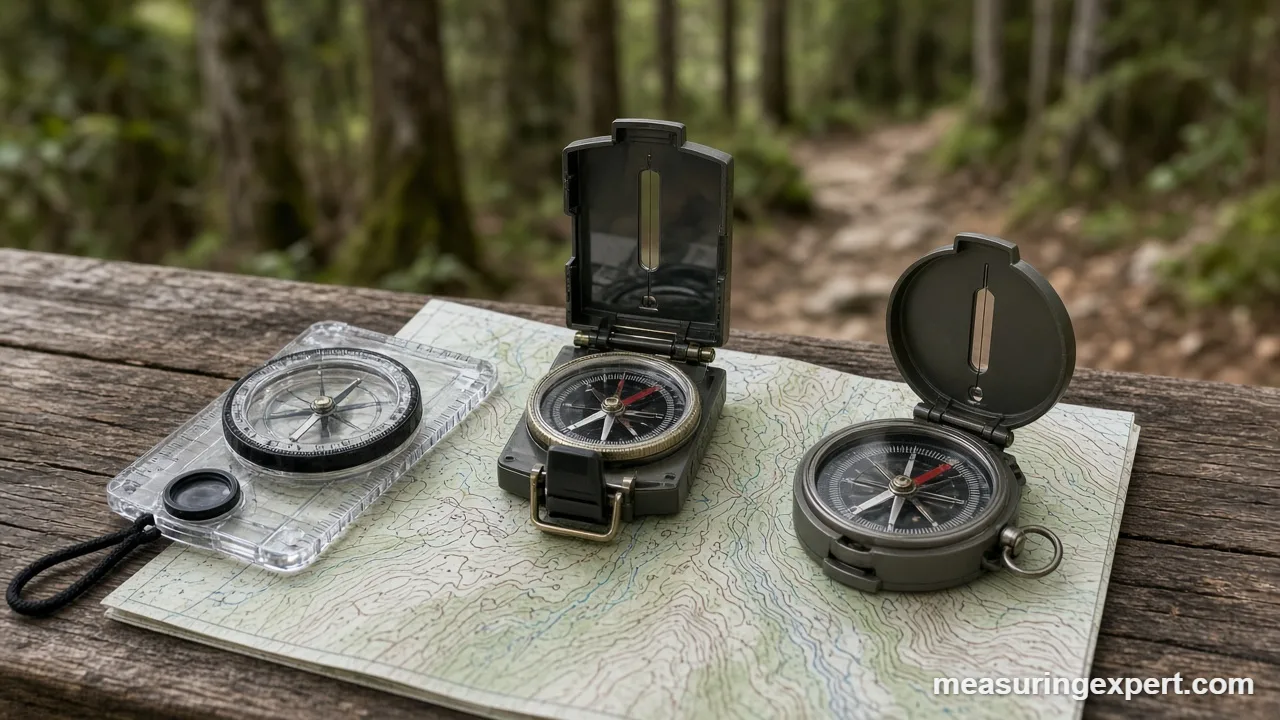
The best compass for most hikers is the Suunto MC-2 G, a mirror compass with a global needle, adjustable declination and a built-in clinometer. Your choice comes down to compass type (baseplate, lensatic or mirror), whether declination is adjustable, where in the world you hike and how much map work you do.
In short: pick the Suunto MC-2 G for all-round navigation, the Sun Company ProMap on a budget and the Cammenga 3H if you want a rugged lensatic.
As an Amazon Associate, Measuring Expert earns from qualifying purchases. Our picks are based on research, specifications and owner feedback, not paid placement.
Best Overall

Best Budget

Best Lensatic

Quick Answer: Which Compass Should You Buy?
- Best overall: Suunto MC-2 G, with a mirror, clinometer and global needle.
- Mirror for less: Silva Ranger 2.0, which adds a declination adjuster and clinometer.
- Toughest: Cammenga 3H, a metal lensatic compass with tritium lights.
- Map planning: Silva Explorer Pro and its long list of map scales.
- Lightest backup: Suunto A-10 at just 30 g (1.06 oz).
- Pro accuracy: Brunton Standard Transit, rated to 0.5 degrees.
- Key rule: set your declination first, or every bearing will be off.
On This Page
- Best Compass Comparison Table
- The 7 Best Compass Picks, Reviewed
- How We Chose
- Baseplate vs Lensatic vs Mirror Compass
- Declination, Explained
- Specs That Separate the Best Compass
- Slope Angle Converter
- How to Take a Bearing
- Care, Storage and Checks
- Honest Limits
- FAQ
- Bottom Line
Best Compass Comparison Table
| # | Product | Best For | Standout Feature | Link |
|---|---|---|---|---|
| 1 | Suunto MC-2 G | Serious hikers | Global needle, mirror, clinometer | View |
| 2 | Silva Ranger 2.0 | Mirror sighting on a budget | Mirror, clinometer, declination scale | View |
| 3 | Cammenga 3H | Rugged and night use | Tritium lights, induction damping | View |
| 4 | Silva Explorer Pro | Map and route planning | Many map scales, declination adjuster | View |
| 5 | Suunto A-10 | Trail backup | 30 g, jewel-bearing needle | View |
| 6 | Sun Company ProMap | Beginners and scouts | Six map scales, 36 g | View |
| 7 | Brunton Standard Transit | Geology and survey | 0.5 degree accuracy | View |
The 7 Best Compass Picks, Reviewed
Every best compass pick below is a navigation compass for the field, not a drawing compass for geometry. Also, we kept to established brands with published specs, and we mixed baseplate, mirror and lensatic designs so you can match the tool to the job.
Best Overall
1. Suunto MC-2 G Mirror Compass
Best for: Hikers and backpackers who want one mirror compass that works anywhere on Earth and handles real map work.
The MC-2 G is the best compass for most people who navigate off trail, because it combines every core feature in one tool. First, its sighting mirror lets you take a bearing at eye level while you watch the needle. Second, the declination correction is adjustable, so once you set your local value, every reading is already a true bearing. In addition, the integrated clinometer reads slope angles from 0 to 90 degrees.
In addition, the G in the name matters. Suunto’s global needle is balanced for use worldwide and still swings freely with 20 degrees of tilt. As a result, the same compass works in Colorado, Patagonia or New Zealand. Moreover, Suunto rates both compass accuracy and resolution at 2 degrees, which is right for hand-held field work.
- Compass accuracy and resolution: 2 degrees
- Global needle with jewel bearing, 20 degree tilt margin
- Adjustable declination with included adjustment tool
- Clinometer: 0 to 90 degrees, 2 degree accuracy
- Weight: 75 g (2.65 oz); 65 x 101 x 18 mm (2.56 x 3.98 x 0.71 in)
Pros
- Mirror sighting improves bearing accuracy
- Works in both hemispheres
- Scales in cm, inch and 1:25k/1:50k UTM
Cons
- Pricier than basic baseplate models
- More features than a casual trail walker needs
Skip it if: you only walk marked trails and want the lightest possible backup.
Best Value Mirror Compass
2. Silva Ranger 2.0

Best for: Hikers who want mirror sighting, a clinometer and a declination adjuster for less than a premium compass.
Silva has made compasses since the 1930s, and the Ranger 2.0 is its classic folding mirror design. Similarly, it lets you sight a distant landmark in the mirror while you line up the needle. Also, it adds a declination scale with adjustment, a clinometer for slope readings and a magnifier for small map symbols.
Retail listings put it at about 0.28 lb (127 g) and 2.4 x 4.3 x 0.8 in (6.1 x 10.9 x 2 cm). Meanwhile, luminous markings help at dusk. However, Silva sells several Ranger versions, so check the listing for the needle balance and the map scales before you buy, especially if you travel south of the equator.
- Folding sighting mirror
- Adjustable declination with scale
- Built-in clinometer
- Magnifier and luminous markings
- About 0.28 lb (127 g)
Pros
- Mirror and clinometer at a mid-range price
- Trusted orienteering brand
- Waterproof capsule
Cons
- Needle balance varies by version
- Fewer published accuracy specs than Suunto
Skip it if: you need a published accuracy rating for professional work.
Best Lensatic
3. Cammenga 3H Tritium Lensatic Compass
Best for: Hunters, preppers and military-style navigators who want a tough metal lensatic compass that glows all night.
Cammenga builds the official US military lensatic compass, and the 3H is its tritium model. Instead of a liquid capsule, it uses copper induction damping to slow the magnet. So there is no bubble to form and no fluid to leak. In addition, its dial reads in both degrees and mils, and it is built to the MIL-PRF-10436N specification.
Meanwhile, seven tritium micro lights glow without any charging, which makes night navigation simple. On the other hand, a lensatic compass has no clear baseplate, so map work is slower than with an orienteering compass. Many users therefore pair it with a protractor or a separate map tool.
- Induction damping, no liquid capsule
- Seven tritium micro lights for night reading
- Dial graduated in degrees and mils
- Cast aluminum frame; waterproof housing
- Rated -50 to 150 F (-45 to 65 C); about 155 g
Pros
- Extremely durable metal body
- Glows all night without charging
- Proven military design
Cons
- Heavy compared with a baseplate compass
- No declination adjustment; you correct bearings by hand
- Awkward for plotting on a map
Skip it if: you mainly plot routes on topo maps.
Best for Map Work
4. Silva Explorer Pro

Best for: Navigators who spend most of their time on a map, measuring distances and plotting bearings.
The Explorer Pro is a baseplate compass built around map work. For example, its edges carry 1:25k, 1:40k, 1:50k and 1:24k USGS scales plus millimeters and inches. In addition, a distance lanyard adds more map scales, so you can measure a winding route.
It also has a built-in declination adjuster, a clinometer with a slope card and luminous markings that glow for up to 4 hours after charging. Moreover, the DryFlex rubber grip and friction feet keep it from sliding on a map. Because it has no mirror, though, field bearings are a little less precise than with a sighting compass.
- Map scales: 1:25k, 1:40k, 1:50k, 1:24k USGS, mm and inch
- Built-in declination adjuster
- Clinometer and slope card
- Luminous markings glow up to 4 hours
- Magnifier and DryFlex grip
Pros
- Excellent range of map scales
- Declination adjuster on a baseplate model
- Grippy, non-slip base
Cons
- No sighting mirror
- Busy scale layout can confuse beginners
Skip it if: you want mirror sighting for long-distance bearings.
Best Lightweight
5. Suunto A-10

Best for: Day hikers and trail runners who want a light, reliable backup compass from a major brand.
The A-10 is the simplest compass in this list, and that is the point. For instance, it weighs 30 g (1.06 oz), so it disappears in a hip-belt pocket. Even so, it uses a liquid-filled capsule and a steel needle on a jewel bearing, just like Suunto’s pricier models.
Note one limit, however. Its declination correction is a fixed scale, not an adjustable setting. Therefore, you add or subtract declination in your head each time. Also, Suunto lists 2.5 degree accuracy and 2 degree resolution, and the northern hemisphere balance suits North America and Europe.
- Accuracy 2.5 degrees; resolution 2 degrees
- Liquid-filled capsule, jewel-bearing needle
- Fixed declination correction scale
- cm and inch scales
- Weight: 30 g (1.06 oz); 56 x 104 x 10 mm
Pros
- Very light and compact
- Quality needle and capsule
- Simple for beginners
Cons
- No adjustable declination
- Northern hemisphere balance only
- No mirror or clinometer
Skip it if: you travel in the southern hemisphere or want declination set once and forgotten.
Best Budget
6. Sun Company ProMap
Best for: Beginners, scouts and families who want a clear baseplate compass for learning map and compass skills.
The ProMap is Sun Company’s basic baseplate compass. For example, it weighs 1.3 oz (36 g) and is just over 4 in (10.9 cm) long. Also, the transparent baseplate carries six map scales, a 3X magnifier and a break-away safety lanyard.
Like the Suunto A-10, it has a fixed declination scale rather than an adjustable one. As a result, you correct each bearing by hand. For learning, however, that is useful, because it forces you to understand what declination actually does.
- Weight: 1.3 oz (36 g); length 4.25 in (10.9 cm)
- Six map measuring scales
- Fixed declination scale
- 360 degree rotating bezel
- 3X magnifier, break-away lanyard
Pros
- Low cost for a branded compass
- Clear baseplate for teaching
- Light enough for kids
Cons
- No adjustable declination
- No mirror or luminous markings listed
Skip it if: you navigate at night or in rough terrain often.
Best Pro
7. Brunton Standard Transit (Azimuth)

Best for: Geologists, foresters and surveyors who need strike, dip and bearing readings to half a degree.
The Brunton pocket transit is a professional instrument, not a hiking compass. Brunton rates both its azimuth and its internal clinometer at plus or minus 0.5 degrees, with 1 degree graduations. In addition, it uses induction damping, a sapphire jewel bearing and a declination adjustment of plus or minus 180 degrees.
Above all, its machined aluminum body, mirror and long sight help with precise vertical and horizontal angles. Brunton also balances the needle for different magnetic zones. However, it weighs 6.9 oz (195 g) and costs far more than a hiking compass. So buy it only if your work depends on that extra precision.
- Azimuth and clinometer accuracy: +/- 0.5 degrees
- 1 degree graduations; percent grade in 5% steps
- Induction damping, sapphire jewel bearing
- Declination adjustment: +/- 180 degrees
- 6.9 oz (195 g); made in Wyoming, USA
Pros
- Highest accuracy in this list
- Measures strike, dip and slope
- Built to last a career
Cons
- Very expensive for recreation
- Heavy and slower to use on the move
Skip it if: you just need to follow a bearing on a hike.
How We Chose the Best Compass Picks
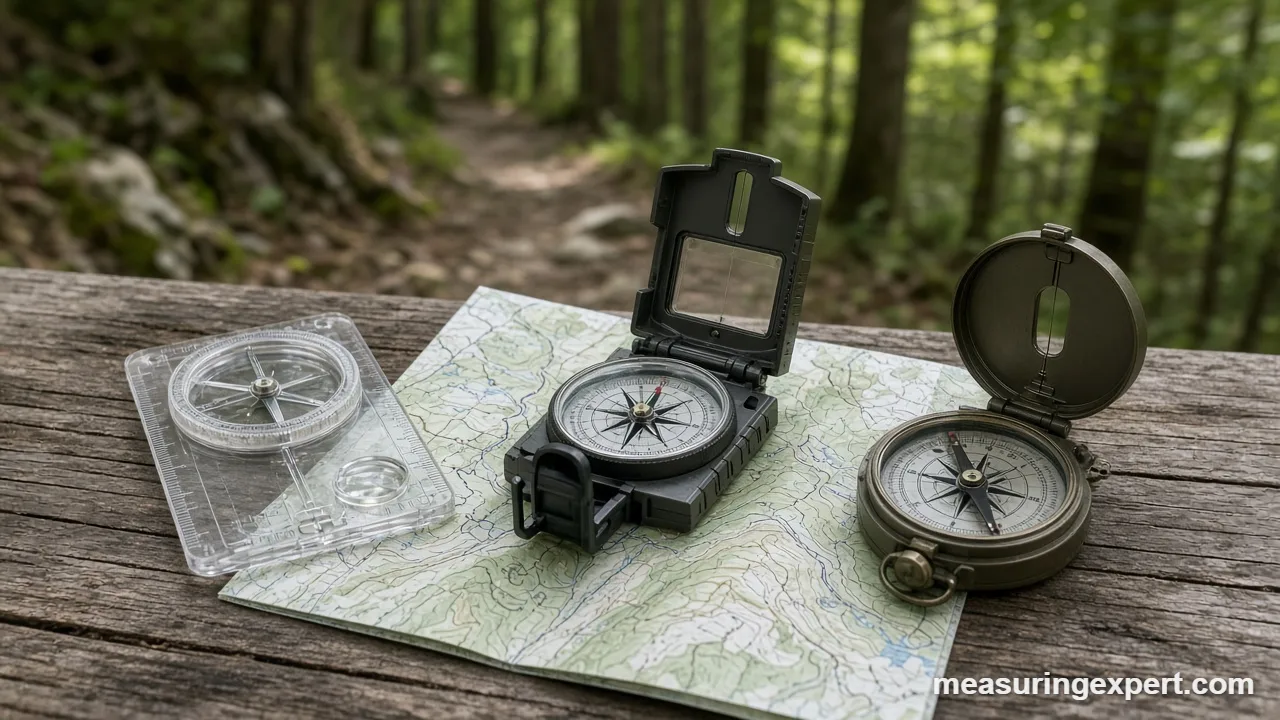
We did not run hands-on field tests. Instead, our picks are research-based. First, we read manufacturer spec pages for accuracy, resolution, needle balance and declination features. Next, we checked owner feedback for common failures such as bubbles, slow needles and cracked mirrors. Finally, we confirmed that each compass is a current, complete product.
- Measurement quality: stated accuracy and resolution, jewel bearings and damping.
- Declination handling: adjustable settings scored higher than fixed scales.
- Needle balance: global needles earned extra credit for travelers.
- Map tools: clear baseplates, map scales and magnifiers.
- Build: sealed capsules, durable housings and luminous markings.
- Range of use cases: one pick each for budget, map work, rugged use and pro survey.
For declination facts, we relied on the NOAA NCEI magnetic declination guide. For needle and accuracy details, we used maker pages such as the Suunto MC-2 G spec sheet.
Baseplate vs Lensatic vs Mirror Compass
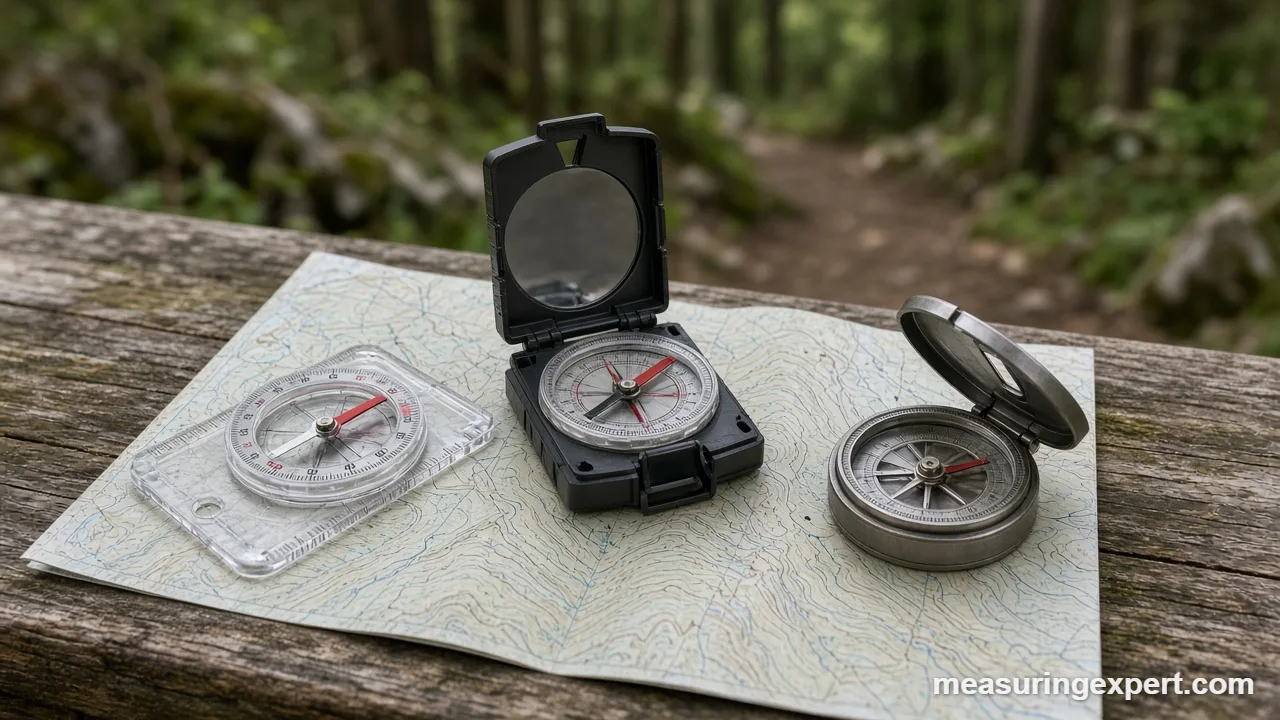
The three main navigation compass types read the same magnetic field. However, they differ in how you sight a target and how easily you work with a map. So, choose the type first, then the model.
| Type | How you sight | Map work | Typical accuracy | Best for |
|---|---|---|---|---|
| Baseplate (orienteering) | Hold at waist, box the needle | Excellent; clear base and scales | About 2 to 2.5 degrees | Trail hiking, learning, orienteering |
| Mirror (sighting) | Eye level via mirror and sight notch | Excellent; same baseplate | About 2 degrees, better in practice | Off-trail travel, mountains |
| Lensatic | Eye level through lens and sight wire | Slow; needs a protractor | Degrees and mils | Rugged use, military-style navigation |
| Pocket transit | Mirror and long sight, often on a staff | Limited | About 0.5 degrees | Geology, forestry, survey |
In fact, a mirror compass is really a baseplate compass with a hinged lid. Because you see the needle and the target at the same time, you avoid the small errors that come from glancing up and down. Meanwhile, a lensatic compass uses a floating dial and a magnifying lens. Its dial often reads in mils as well as degrees; the US military circle has 6,400 mils, so 1 degree is about 17.8 mils. If you want to brush up on the angle side, see our guide on what an angle is and how it is measured.
Declination, Explained (and Why the Best Compass Lets You Set It)
First, your needle points to magnetic north, not true north. NOAA defines the gap between the two as magnetic declination, also called variation. East declination is positive and west is negative. Also, declination changes with place and slowly over time, so an old map can be several degrees off.
To convert a magnetic bearing to a true bearing, add the declination. For example, with 10 degrees east declination, a magnetic bearing of 50 degrees is a true bearing of 60 degrees. With 10 degrees west, the same reading becomes 40 degrees. An adjustable compass does this math for you. As a result, the best compass for beginners is often one with a declination screw or tool-free setting.
To begin, get your current value from the NOAA calculator, which uses the World Magnetic Model and the IGRF. Then set it on the compass before every trip to a new area.
Global needle vs hemisphere-balanced needle
Earth’s field also dips downward at an angle that changes with latitude. Therefore, makers balance needles for zones. A northern-hemisphere needle may tilt and scrape in Australia or South America. A global needle, by contrast, is built to stay level everywhere. Suunto, for instance, says its global needle tolerates 20 degrees of tilt.
Specs That Separate the Best Compass
- Accuracy and resolution: resolution is the spacing of the bezel marks; accuracy is how close the reading is to the real bearing. Most hiking compasses are 2 degrees on both.
- Damping: liquid-filled capsules or induction damping stop the needle from swinging, so it settles in a second or two.
- Declination: adjustable is easier than a fixed scale.
- Needle balance: NH, SH, zone-balanced or global.
- Map scales: match your maps, such as 1:24,000 for USGS quads or 1:25,000 and 1:50,000 for many other countries.
- Clinometer: reads slope angle, useful for avalanche terrain and contour checks.
- Luminous markings: phosphorescent paint needs charging; tritium glows all night.
- Weight: 30 g for a light baseplate up to about 195 g for a metal transit.
Above all, small errors add up fast. A 1 degree error puts you about 92 ft off after 1 mile, or 17.5 m off after 1 km. At 2 degrees, that grows to about 184 ft per mile, or 35 m per km. So, a steady, well-damped needle matters more than extra features. Contour reading helps too; see our guide to measuring and mapping contour lines.
Slope Angle Converter for Clinometer Readings
Many of these compasses include a clinometer, which reads slope in degrees. However, trail signs and road plans often use percent grade. Enter a slope in degrees below, and the converter shows percent grade and pitch.
How to Take a Bearing With Your Compass
These steps work with any baseplate or mirror compass. With a lensatic model, you follow the same idea, but you sight through the lens instead of boxing the needle at your waist.
- Set your declination. Look up the local value from NOAA or your map, then set it on the compass. If your compass has a fixed scale, note the value instead.
- Place the compass on the map. Lay one long edge of the baseplate along a line from where you are to where you want to go. Also, make sure the direction-of-travel arrow points toward the goal.
- Turn the bezel to grid north. Rotate the bezel until its orienting lines run parallel to the map’s north-south lines, with the N toward map north.
- Read the bearing. Read the number at the index line. Next, if you have no declination adjustment, subtract east declination or add west declination to turn the map (true) bearing into a magnetic one.
- Box the needle. Hold the compass level at your waist, then turn your whole body until the red needle sits inside the orienting arrow.
- Walk to landmarks on the bearing. Pick a tree or rock in line with the travel arrow, walk to it, then repeat. Finally, check your position on the map at each major feature.
Care, Storage and Accuracy Checks
A compass has no calibration screw for the needle. Instead, you check it. First, compare it with a second compass or a known bearing, such as a straight street on a map. If both agree within a couple of degrees, you are fine.
- Store it away from magnets, speakers, phones and steel tools, because strong fields can weaken or reverse a needle.
- Keep it out of hot cars, since heat can create bubbles in a liquid capsule.
- Rinse off salt and grit with fresh water, then dry it.
- Recharge luminous paint with a flashlight before a night hike.
Do and Don’t
Do: hold the compass level, check declination before each trip and practice in a park first.
Don’t: take bearings next to a car, a phone or a wire fence, and never trust a compass with a large bubble.
Honest Limits of Even the Best Compass
A compass tells you direction, not position. Therefore, you still need a map and some skill to know where you are. In addition, iron-rich rock, power lines and steel structures can shift the needle without warning. Near the magnetic poles, NOAA notes that declination values become unreliable. Finally, cheap unbranded compasses often have sticky needles, so the best compass for you is one from a maker that publishes its specs.
Best Compass FAQ
What is the best compass for hiking?
For most hikers, the best compass is a baseplate or mirror compass with adjustable declination and a global needle. Our top pick is the Suunto MC-2 G because it adds a sighting mirror and a clinometer.
Is a lensatic or baseplate design the best compass type?
For map work, a baseplate compass wins, because its clear base lines up directly with the map. By contrast, a lensatic compass is tougher and sights well, but it is slower for plotting routes.
Do I need a compass with declination adjustment?
It helps a lot. With adjustable declination, you set the local value once and read true bearings directly. Otherwise, you must add or subtract declination by hand on every bearing.
Where do I find my magnetic declination?
Use the NOAA magnetic field calculator, which is based on the World Magnetic Model. Also, check the date on your topo map, because declination changes every year.
Does the best compass need a global needle?
Only if you travel widely. A global needle is balanced to work in both the northern and southern hemispheres. In contrast, a northern-hemisphere needle may tilt and drag in the south because the magnetic field dips at a different angle.
How accurate is a hand compass?
Good hiking compasses read to about 2 degrees. For example, a 2 degree error puts you about 184 ft off after 1 mile, or about 35 m off after 1 km.
Is the best compass better than a phone app?
Yes, for backup navigation. Even the best compass needs no battery or signal. However, a phone GPS is great for checking your position, so carry both.
Why is my compass bubble a problem?
A small bubble usually comes from cold or altitude and often disappears in warmth. A large bubble, however, can drag the needle, so replace the compass if it does not shrink.
Can a compass be wrong near metal?
Yes. Steel, magnets, phones and car bodies all pull the needle. So step a few yards away from vehicles, fences and electronics before you take a bearing.
Is a compass thermometer combo worth it?
A combo is fine as a zipper-pull backup. Still, for real navigation, the best compass is a dedicated baseplate or mirror model with a rotating bezel and map scales.
Bottom Line: The Best Compass for Most People
The Suunto MC-2 G is the best compass for most hikers, because it pairs a mirror, a clinometer and adjustable declination with a needle that works worldwide. On a tight budget, the Sun Company ProMap teaches the basics well. And if you want a compass that shrugs off abuse, choose the Cammenga 3H.