

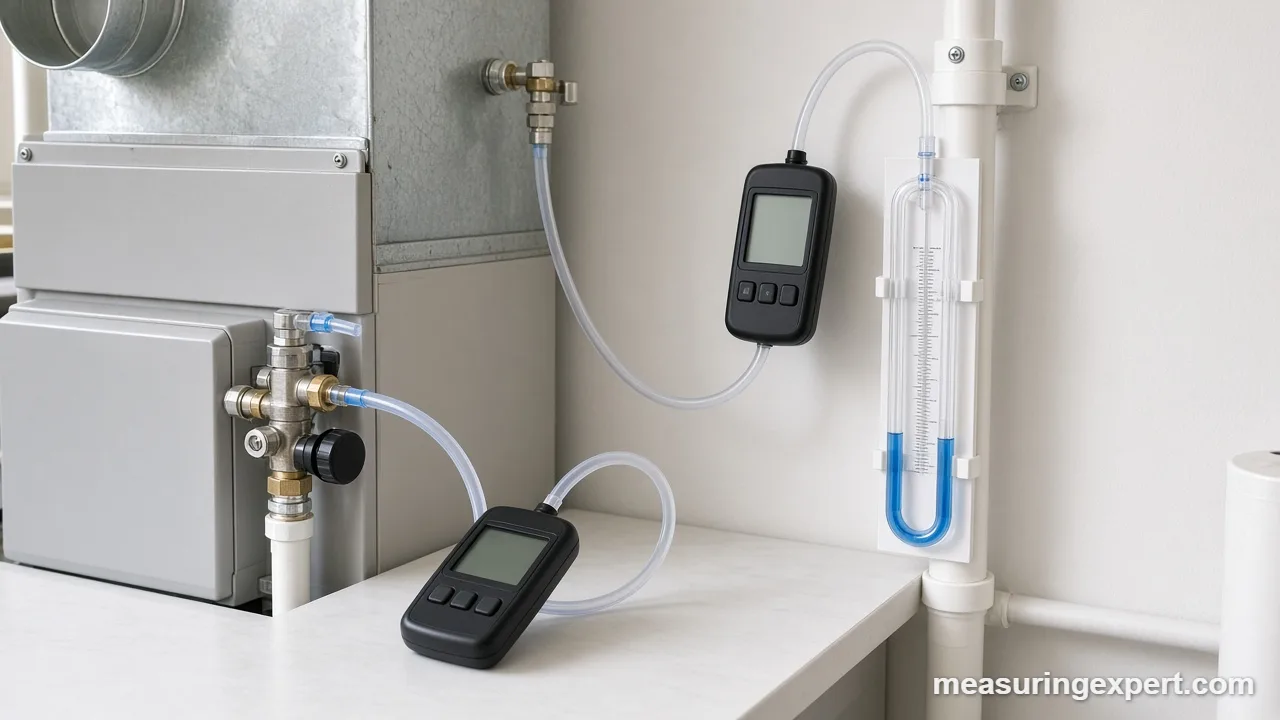
The best manometer for most gas and HVAC techs is the Fieldpiece SDMN5, a dual-port digital model that reads -60 to +60 inWC in 0.01 inWC steps. What decides your pick is the job: gas valve setup, duct static pressure, wireless logging, or a simple U-tube for a radon fan.
In short: Fieldpiece SDMN5 overall, Klein ET180 for value, Testo 510i for phone-based work and the Aprilaire ARN05M for radon systems.
As an Amazon Associate, Measuring Expert earns from qualifying purchases. Our picks are based on research, specifications and owner feedback, not paid placement.
Best Overall
Best Value

Best Smart

Quick Answer: Which Pick Fits Your Work?
- Gas valves and duct static on one tool: Fieldpiece SDMN5, dual port, 0.01 inWC steps.
- Lowest cost dual-port digital: Klein ET180 with 11 pressure units.
- Phone app and reports: Testo 510i Bluetooth probe.
- Wireless readings across a house: Fieldpiece JL3KM2 Job Link kit.
- Higher pressures up to 5 psi: Extech HD750 with USB output.
- No batteries for gas checks: Meanlin Measure 0-35 inWC dial kit.
- Radon fan monitoring: Aprilaire ARN05M U-tube.
On This Page
- Side-by-side table
- Reviews of each pick
- How we chose
- Manometer types
- Pressure units explained
- Pressure converter
- How to test gas pressure
- Accuracy and calibration
- Honest limits
- FAQ
- Bottom line
Best Manometer Comparison at a Glance
First, find your job in the Best For column. Next, jump to the review for verified specs, pros and cons.
| # | Product | Best For | Standout Feature | Amazon |
|---|---|---|---|---|
| 1 | Fieldpiece SDMN5 | Gas and HVAC service | +/-0.02 inWC accuracy below 2 inWC | View |
| 2 | Klein Tools ET180 | Value and homeowners | 11 units, backlit screen, min/max/avg | View |
| 3 | Testo 510i | App-based reports | Bluetooth range up to 350 ft | View |
| 4 | Fieldpiece JL3KM2 | Wireless static pressure | About 1,000 ft line-of-sight radio | View |
| 5 | Extech HD750 | Higher range and logging | 5 psi sensor, +/-0.3% FS, USB | View |
| 6 | Meanlin Measure 0-35 inWC Kit | Battery-free gas checks | Dial gauge on a 40 in hose | View |
| 7 | Aprilaire ARN05M | Radon mitigation | 0-5 inWC U-tube for vent pipe | View |
The 7 Best Manometer Picks, Reviewed
Most of these tools measure small pressures in inches of water column (inWC), because gas and air systems run at low pressure. For context, a typical natural gas supply sits near 7 inWC, which is only about 0.25 psi. That is why a tire gauge or a refrigerant manifold cannot do this job, for example. For refrigerant work, see our refrigerant gauge set picks instead.
Best Overall
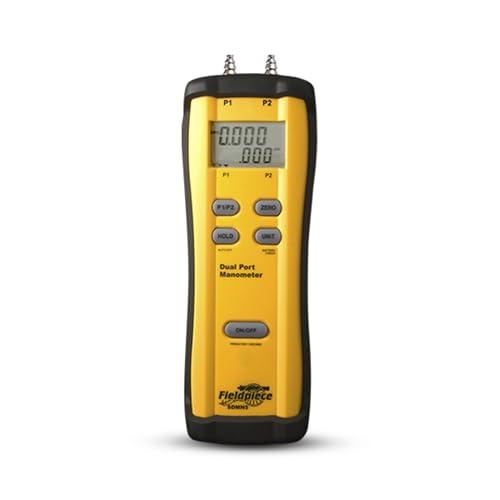
1. Fieldpiece SDMN5 Dual-Port Manometer
Best for: Gas and HVAC techs who set gas valves and check duct static pressure every day.
The SDMN5 is a plain, rugged dual-port meter, and that is exactly why it tops this list. In fact, it reads -60 to +60 inWC (-150 to +150 mbar) with 0.01 inWC resolution. Better still, Fieldpiece lists accuracy of +/-0.02 inWC from 0 to 2 inWC. So it holds up on low duct readings, where many meters get vague.
Above 2 inWC, however, accuracy is +/-1.5% of full scale. In practice, that still covers gas manifold and supply checks without fuss. Also, the meter shows P1, P2 or the difference between them, and a magnet on the back frees your hands. Finally, one 9V battery lasts about 200 hours.
- Range: -60 to +60 inWC; -150 to +150 mbar
- Resolution: 0.01 inWC or 0.01 mbar
- Units: inWC, mmWC, mbar, psi
- Accuracy: +/-0.02 inWC to 2 inWC, then +/-1.5% FS
- Power: one 9V, about 200 h, 15 min auto-off
Pros
- Tight accuracy, especially at low static pressures
- Simple buttons, quick zero
- Rubber boot and magnet for field work
Cons
- No Pa unit on the display
- No app or data logging
- 9V battery is bulkier to stock
Skip it if: you need written reports or readings in pascals, because a smart probe fits better.
Best Value
2. Klein Tools ET180 Digital Manometer
Best for: Homeowners, plumbers and new techs who want a dual-port digital manometer at a lower cost.
Similarly, the Klein ET180 covers the same -60 to +60 inWC span as the Fieldpiece. However, Klein lists a flat +/-1.5% of full scale, which works out to about +/-0.9 inWC across the range. As a result, it is fine for gas supply and manifold checks, yet less precise for fine duct readings.
Instead, where the ET180 shines is flexibility. For example, it switches among 11 units, including inWC, mbar, kPa, psi and mmHg. In addition, a backlit LCD helps in dark crawl spaces, and min, max and average modes catch pressure swings while a burner fires. Besides, three AAA cells power it, and 2 m of silicone tubing comes in the pouch.
- Range: -60 to +60 inWC (2.16 psi max)
- Listed accuracy: +/-1.5% of full scale
- Units: 11, including inWC, mbar, kPa, psi, mmHg
- Features: backlight, hold, min/max/average, magnet
- Power: 3 x AAA with low-battery icon
Pros
- Many units, so no math between specs
- Backlit screen
- Common AAA batteries
Cons
- Coarser accuracy at low pressures
- Klein does not list resolution
Skip it if: you diagnose airflow by tenths of an inch of static pressure.
Best Smart
3. Testo 510i Bluetooth Differential Pressure Probe
Best for: Techs who document jobs on a phone and then send reports to customers.
Unlike the others, the Testo 510i has no screen of its own. Instead, it sends readings to the testo Smart Probes app, which can show up to six probes at once and export PDF or Excel reports. In addition, its range is -60 to +60 inWC (-150 to +150 hPa), and resolution is 0.01 inWC.
First, accuracy is +/-0.02 inWC from 0 to 0.4 inWC. Above that, it is +/-(0.1 inWC + 1.5% of reading). Also, the app adds pressure-drop alarms, and with a pitot tube it can estimate air velocity and volume flow. Meanwhile, the probe weighs just 92 g (3.2 oz) and runs about 150 hours on three AAA cells.
- Range: -60 to +60 inWC; -150 to +150 hPa
- Resolution: 0.01 inWC or 0.01 hPa
- Wireless: Bluetooth, range up to 350 ft
- App: Smart Probes, plus measureQuick support
- Battery: 3 x AAA, about 150 h
Pros
- Reports straight from the job site
- Very light and pocketable
- Pitot tube support for airflow
Cons
- Useless unless your phone is charged
- Only inWC and hPa units
Skip it if: you want a stand-alone display instead of an app.
Best Wireless Kit
4. Fieldpiece JL3KM2 Job Link Dual-Port Manometer Kit

Best for: HVAC pros who test static pressure as well as gas pressure at the furnace.
Next, the JL3KM2 is a complete kit built around Fieldpiece Job Link manometer probes. Since the radio reaches about 1,000 ft (305 m) in line of sight, you can watch readings on the Job Link app from the attic or the outdoor unit. Also, accuracy matches the SDMN5: +/-0.02 inWC up to 2 inWC, then +/-1.5% of full scale.
In addition, the kit includes two ASP2 static pressure probes with hose, brass screw fittings and slide gas adapters. So you can test supply and return plenums in one setup. Moreover, the probes read inWC, mmWC, mbar, psi and Pa, and an overload limit of 321 inWC (11.6 psi) protects the sensor from accidental spikes.
- Range: +/-60 inWC; +/-14,930 Pa
- Units: inWC, mmWC, mbar, psi, Pa
- Wireless: 2.4 GHz, about 1,000 ft line of sight
- Kit: static pressure probes, gas adapters, padded case
- Battery: 2 x AAA, about 150 h
Pros
- Long wireless range
- Static probes and gas adapters included
- Pascal readout for metric specs
Cons
- Needs the app because it has no screen
- Costs more than a basic meter
- More parts to keep track of
Skip it if: you only check gas pressure now and then, since the SDMN5 is simpler.
Best for Higher Ranges
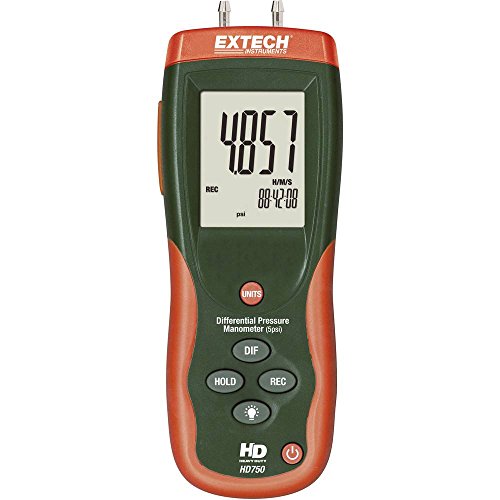
5. Extech HD750 Differential Pressure Manometer
Best for: Lab, maintenance and commercial work above 60 inWC, especially where a PC record matters.
The Extech HD750 uses a 5 psi sensor, so it reads up to about 138 inWC. As a result, that headroom suits commercial gas trains, compressed air checks and filter banks. Besides, Extech lists a basic accuracy of +/-0.3% of full scale, which is tighter in relative terms than most HVAC meters.
However, resolution is 0.1 inWC, so it is not the tool for tiny duct readings. On the plus side, it also offers 11 units, a USB interface with software, and max/min recording. Also, a 9V battery or the included AC adapter powers it, and a hard case and 3-year warranty come with it.
- Range: 0 to 5 psi (about 138 inWC)
- Accuracy: +/-0.3% FS basic
- Resolution: 0.1 inWC; 0.001 psi
- Output: USB with PC software
- Power: 9V battery or AC adapter
Pros
- Wide range for commercial jobs
- Good full-scale accuracy
- USB data to a computer
Cons
- Coarse 0.1 inWC steps, so weak on duct work
- Larger and heavier at 280 g
Skip it if: your work is mostly residential duct static pressure, because its steps are coarse.
Best Analog Gas Kit
6. Meanlin Measure 0-35 inWC Gas Pressure Test Kit

Best for: Plumbers and gas fitters who want a battery-free backup for natural gas and propane checks.
Meanwhile, this kit pairs a 0 to 35 inWC dial gauge with a 40 in hose and a 1/8 in NPT fitting. Moreover, that fitting threads into the test port on most gas valves. Because 35 inWC equals about 1.26 psi, the dial comfortably covers natural gas near 7 inWC and propane near 11 inWC.
Of course, a dial reads by eye, so expect less precision than a digital meter. Still, it has no battery to die in a cold basement, and it is easy to leave on a port while you adjust a regulator. For this reason, many techs carry one as a sanity check for the digital tool.
- Range: 0 to 35 inWC (about 87 mbar)
- Hose: 40 in
- Fitting: 1/8 in NPT with barbed connection and hex bushing
- Power: none needed
Pros
- No batteries
- Threads straight into valve test ports
- Good backup, as well as a cross-check for a digital meter
Cons
- Single port, no differential mode
- Read by eye, coarse at low pressure
- Lesser-known brand
Skip it if: you also need static pressure or differential readings.
Best U-Tube
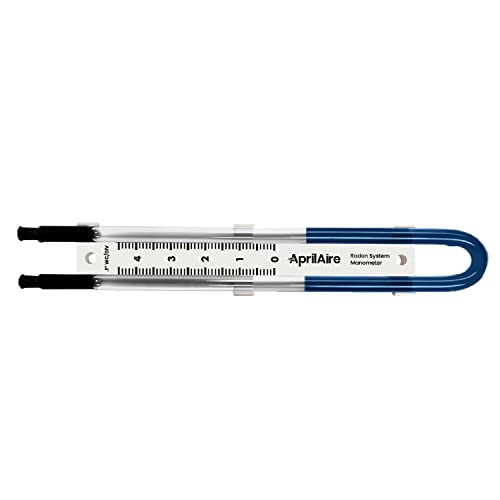
7. Aprilaire ARN05M Radon U-Tube Manometer
Best for: Homeowners and radon installers who need a permanent suction indicator, for instance on a vent pipe.
Finally, a radon system pulls soil gas through a PVC pipe, and the ARN05M shows that the fan still pulls. Specifically, it mounts on the outside of the pipe and reads 0 to 5 inWC on a colored liquid scale. So if the two liquid columns go level, the fan has likely stopped.
In other words, this is a monitor, not a service tool. Also, it has no electronics, weighs about 0.1 lb, and Aprilaire describes it as a secondary indicator next to an alarm. After installation, mark the starting level with tape. Afterward, a quick glance tells you if suction has changed.
- Range: 0 to 5 inWC
- Mounting: outside of PVC radon vent pipe
- Type: liquid U-tube, no power
- Weight: about 0.1 lb
Pros
- Works with no power at all
- Easy for homeowners to read
- Very low cost
Cons
- Fixed install, so not portable
- Only 5 inWC of range
Skip it if: you need a portable tool for gas or duct work as well.
How We Chose the Best Manometer
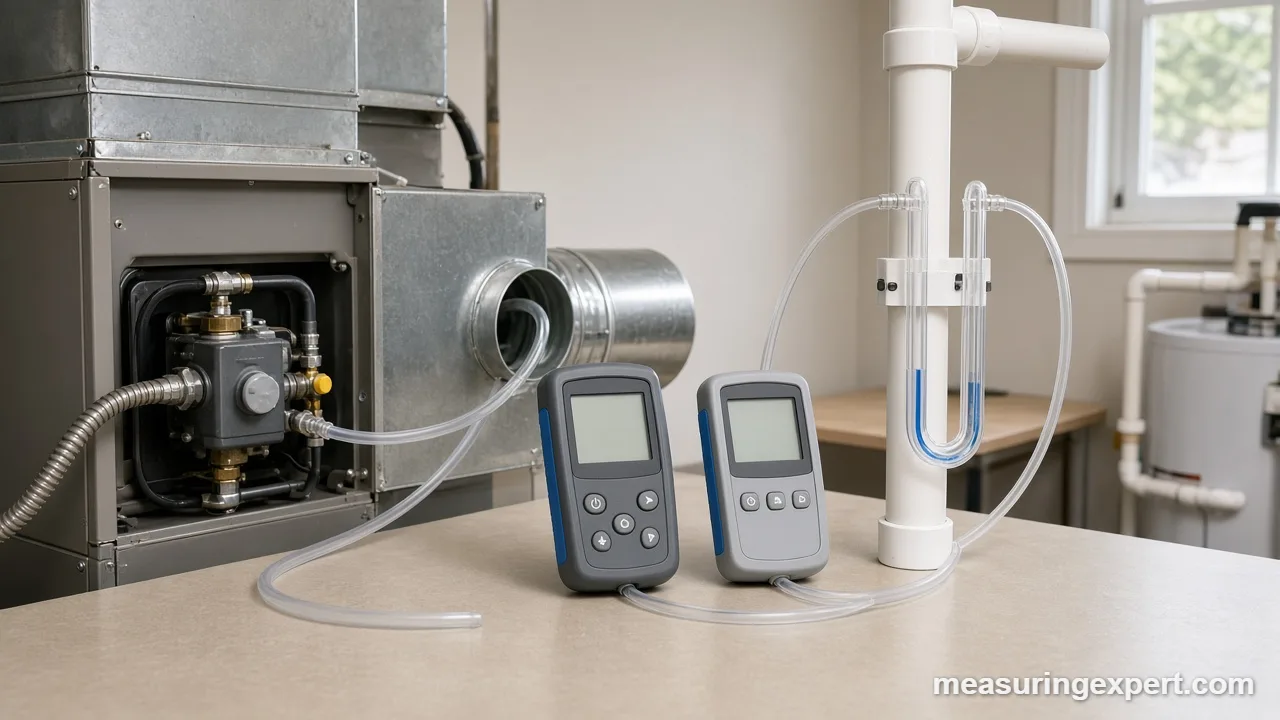
To be clear, we did not run hands-on lab tests. Instead, these picks come from research: manufacturer spec pages, distributor data sheets and patterns in owner feedback. In addition, we confirmed that each listing still renders and that each tool is a complete unit, not a spare probe or tube.
- Published accuracy: we favored makers that state accuracy by range, not a vague promise.
- Range and resolution: enough span for gas checks, with fine steps for static pressure.
- Units: inWC for US specs, plus Pa, mbar or kPa for metric appliances.
- Job fit: gas service, HVAC airflow, commercial work, or else radon monitoring.
- Brand support: makers that also sell probes, adapters and service.
- Variety: no more than two picks per brand, and no near-duplicates.
We also left out refrigerant and deep-vacuum gauges on purpose. After all, they work at far higher pressures or in microns, so see our vacuum pressure tester guide for those.
Digital, U-Tube or Dial: Manometer Types Compared
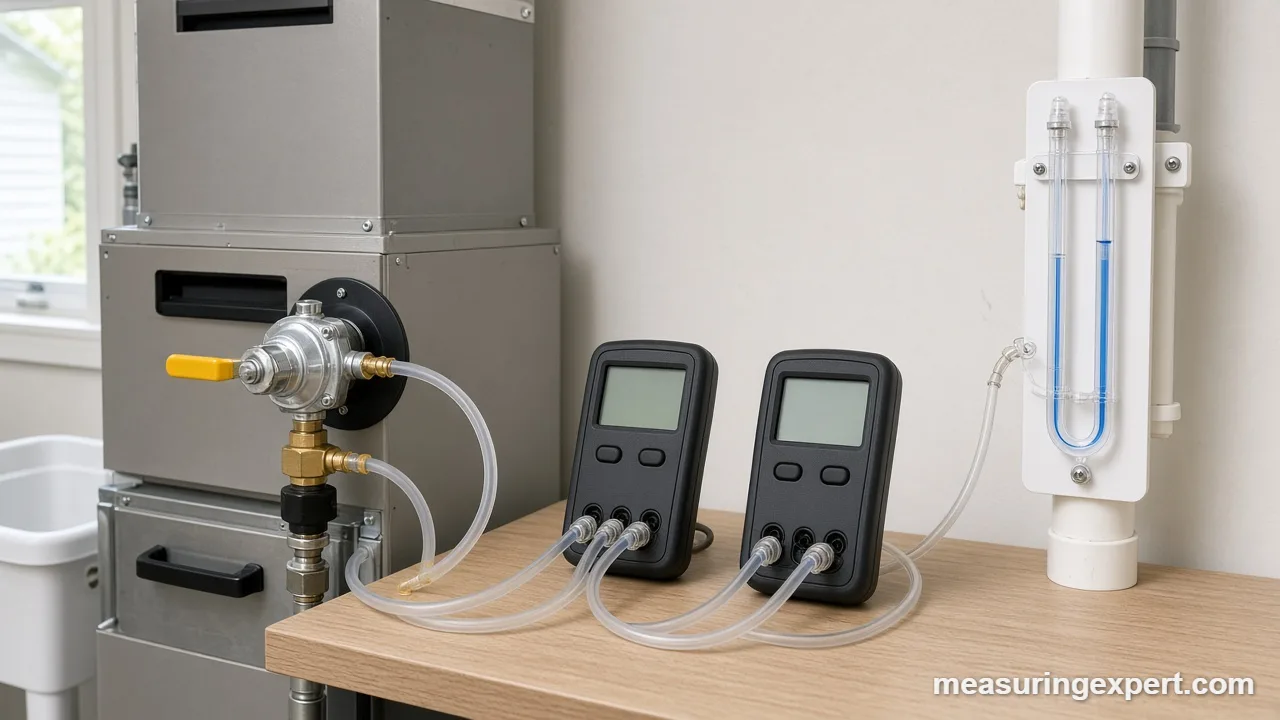
Basically, every manometer compares two pressures. Often, one side is open to room air, so the tool shows gauge pressure. However, with both ports connected, it shows the difference between two points, such as across a furnace filter.
| Type | How it reads | Best use | Watch out for |
|---|---|---|---|
| Digital dual-port | Sensor, 0.01 inWC steps | Gas valves, duct static | Battery, zero drift |
| Smart probe | Sensor plus phone app | Reports, multiple points | Phone and pairing |
| U-tube (liquid) | Height difference of liquid | Radon, teaching, reference | Must stay level |
| Dial gauge kit | Needle on a dial | Quick gas checks | Coarse at low pressure |
| Panel differential gauge | Needle, fixed mount | Filters, clean rooms | Not portable |
Historically, the U-tube came first, and it still teaches the physics well. In other words, the pressure difference equals liquid density x gravity x height difference. For example, with water, a 1 in difference between the two columns equals 1 inWC, or about 249 Pa. Thus, if one leg drops 3.5 in and the other rises 3.5 in, the reading is 7 inWC, not 3.5.
Pressure Units on the Best Manometer, Explained
To begin with, gas appliances in the US list pressures in inches of water column. By contrast, European boilers often use mbar, and building specs may use pascals. Our explainer on how gas pressure is measured covers gauge versus absolute pressure in depth.
According to NIST Special Publication 811, one conventional inch of water equals 249.0889 Pa, and one psi equals 6,894.757 Pa. Therefore, 1 psi is about 27.7 inWC. Here are common reference points:
| Typical reading | inWC | Pa | mbar | psi |
|---|---|---|---|---|
| Residential duct static (common design) | 0.5 | 124.5 | 1.25 | 0.018 |
| Natural gas manifold (typical) | 3.5 | 871.8 | 8.72 | 0.126 |
| Natural gas supply (typical) | 7 | 1,743.6 | 17.44 | 0.253 |
| Propane supply (typical) | 11 | 2,740.0 | 27.40 | 0.397 |
| Half a psi | 13.84 | 3,447.4 | 34.47 | 0.5 |
| Full scale of most HVAC meters | 60 | 14,945.3 | 149.45 | 2.168 |
Even so, always use the pressures on the appliance rating plate and the installation manual. After all, the table only shows typical values.
Pressure Converter for inWC, Pa and psi
Use this converter whenever a spec and your meter disagree on units. For example, enter 7 inWC to see it in pascals, kPa, bar and psi.
In short, multiply inWC by 249.09 to get pascals, or divide by 27.68 to get psi.
How to Test Gas Pressure With the Best Manometer
Gas work carries real risk, so follow the appliance manual and local code. Above all, if you are not trained, call a licensed pro. With that said, these are the general steps a tech follows on a furnace or water heater:
- Turn the appliance off and close the manual gas valve before you open a test port.
- Zero the manometer with both ports open to room air.
- Remove the inlet or outlet test port screw on the gas valve with the right driver.
- Connect the tubing or a 1/8 in NPT adapter to the port, and attach the other end to P1.
- Open the gas valve, fire the appliance, and let the reading settle for a minute.
- Compare the reading with the rating plate, and adjust the regulator only if the manual allows it.
- Shut off gas, remove the tubing, refit the port screw, and leak-check it with soap solution.
For duct static pressure, the idea is similar. First, drill small test holes in the supply and return plenums. Then connect P1 to the supply and P2 to the return, and read the total. Next, compare it with the blower table in the furnace manual.
Accuracy, Zeroing and Calibration
First, resolution is the smallest step on the screen. Accuracy, on the other hand, is how close that number is to the true pressure. For example, a meter rated +/-1.5% of a 60 inWC full scale may be off by 0.9 inWC at any reading. Therefore, that error is small on a 7 inWC gas supply. However, it is huge on a 0.5 inWC duct reading.
So for airflow work, pick a meter that lists a tight low-range spec, like the +/-0.02 inWC on the Fieldpiece models. Also, zero the meter before every test, because sensors drift with temperature. In addition, most makers suggest a yearly calibration check, especially if your readings go on reports.
For higher pressures, see our roundup of pressure tools for engineering, which covers transducers and gauges.
Honest Limits of the Best Manometer
Keep in mind that a manometer only reads pressure at the point you connect it. Therefore, a good gas reading at the valve does not prove the whole pipe system is sized right. Similarly, a static pressure reading hints at airflow problems, but it does not measure CFM directly. Also, digital meters assume dry, clean gas; water or oil in the tubing ruins accuracy. Finally, no handheld meter replaces a combustion analyzer when you need to check CO or burner efficiency.
Best Manometer FAQ
What is the best manometer for HVAC static pressure?
Overall, the Fieldpiece SDMN5 is a strong choice because it reads in 0.01 inWC steps with +/-0.02 inWC accuracy below 2 inWC. If you want wireless readings, the Fieldpiece JL3KM2 kit offers the same accuracy with an app.
What is the best manometer for gas pressure testing?
In general, any dual-port digital meter with a 60 inWC range handles natural gas and propane. The Klein ET180 is a good value, while a dial kit like the Meanlin Measure 0-35 inWC makes a battery-free backup.
What does inWC mean?
It means inches of water column. In other words, one inWC is the pressure that holds up a 1 in column of water, which equals about 249 Pa or 0.036 psi.
Is a digital or U-tube manometer more accurate?
In theory, a clean, level U-tube can be very accurate, since it relies on simple physics. However, a digital meter is easier to read and handles field work better. For most techs, digital wins on speed.
What gas pressure should a natural gas furnace have?
Typically, supply pressure is around 7 inWC and manifold pressure around 3.5 inWC. Still, always use the values on the furnace rating plate and in the installation manual.
Can the best manometer measure propane pressure?
Yes. For example, propane supply is often around 11 inWC, which sits well within the 60 inWC range of most digital models and the 35 inWC range of common dial kits.
How do I zero a digital pressure meter?
First, disconnect both hoses or leave both ports open to the same room air. Then press the zero button, and wait until the display reads 0.00 before you connect to the system.
What is a differential manometer used for?
In short, it compares two pressures. For example, techs use it to measure the drop across a furnace filter or coil, or the total external static pressure between supply and return ducts.
How do I convert inWC to psi?
To convert, divide inWC by 27.68. For instance, 7 inWC divided by 27.68 is about 0.25 psi. To get pascals, multiply inWC by 249.09 instead.
How often should I calibrate a manometer?
Generally, most makers suggest a yearly check. In addition, zero the meter before each job and compare it with a second gauge if readings look odd.
Bottom Line on the Best Manometer
For most gas and HVAC work, the Fieldpiece SDMN5 Dual-Port Manometer is the best manometer to buy. After all, it reads gas pressure and duct static pressure on one simple tool, and it stays accurate at the low end where airflow problems hide. Meanwhile, pick the Klein ET180 to save money, the Testo 510i for app reports, or the Aprilaire ARN05M to monitor a radon fan.