

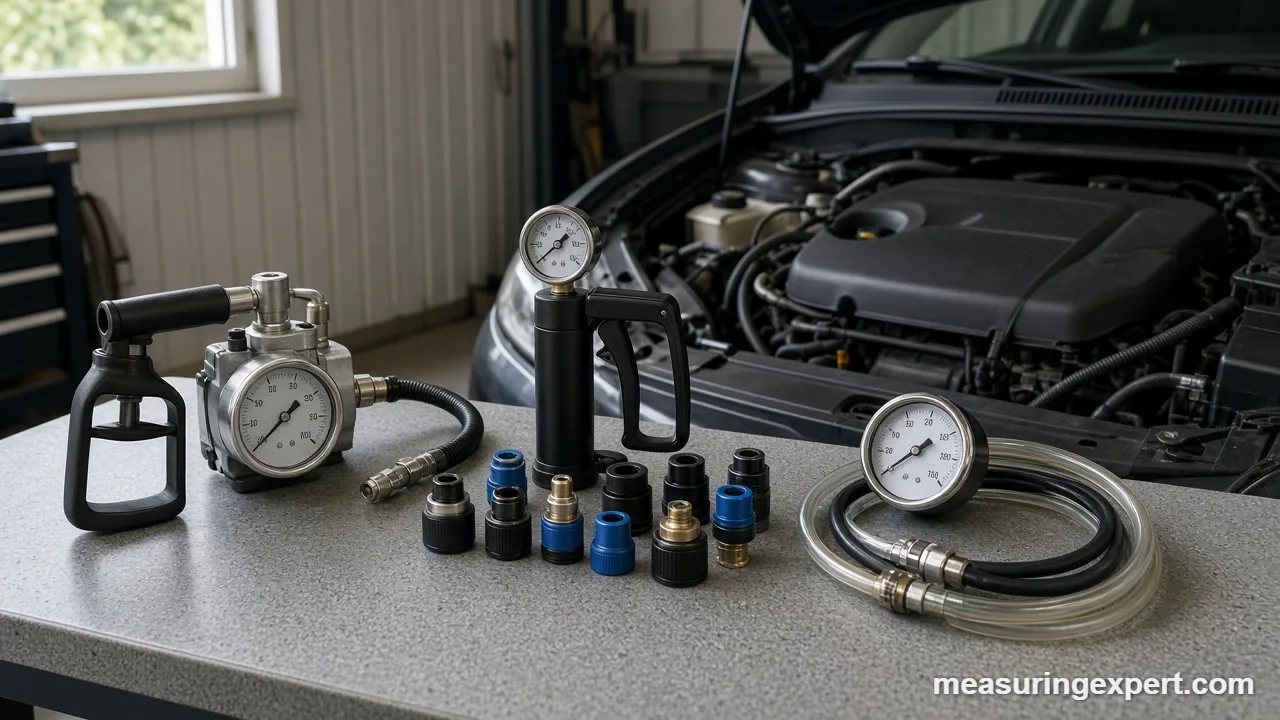
The best vacuum pressure tester for most garages is the Mityvac MV8500 Silverline Elite, because one hand pump tests vacuum parts, bleeds brakes and pressure-checks small circuits. Still, the right kit depends on the system you test: engine vacuum, fuel pressure or the cooling system, and on the inHg or psi range you need.
In short: get the Mityvac MV8500 for vacuum and brakes, the Lisle 20300 on a budget, the Mityvac MV4530 for coolant leaks, and the Lang TU-469 for fuel injection pressure.
As an Amazon Associate, Measuring Expert earns from qualifying purchases. Our picks are based on research, specifications and owner feedback, not paid placement.
Best Overall

Best Budget
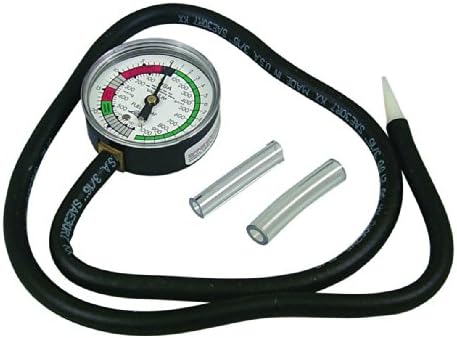
Best Cooling System

Best Vacuum Pressure Tester Picks in 30 Seconds
- One tool for vacuum and brakes: Mityvac MV8500, up to about 28 inHg and over 60 psi.
- Clear engine vacuum readings: OTC 5613 with a 3-1/2 in, 0 to 30 inHg dial.
- Lowest cost gauge: Lisle 20300 for vacuum and mechanical fuel pumps.
- Coolant leaks: Mityvac MV4530 (0 to 30 psi), or the OMT kit if you also want vacuum refill.
- Air-free coolant refills: UView Airlift II, if you own a compressor.
- Fuel injection pressure: Lang TU-469 for Schrader ports, Lisle 55700 for everything else.
On This Page
- Comparison table
- The 8 picks, reviewed
- How we chose
- Reading inHg, psi and kPa
- Which tester fits which job
- Pressure unit converter
- How to run an engine vacuum test
- What the needle tells you
- Safety, care and gauge checks
- Honest limits
- FAQ
- Bottom line
Best Vacuum Pressure Tester Comparison Table
First, find the system you need to test in the “Best For” column. Then, jump to the full review for ranges and caveats.
| # | Product | Best For | Standout Feature | Amazon |
|---|---|---|---|---|
| 1 | Mityvac MV8500 Silverline Elite | Vacuum tests, brake bleeding and fluid work | One metal hand pump for vacuum and pressure | View |
| 2 | OTC 5613 Vacuum/Pressure Gauge Kit | Engine vacuum and low-pressure fuel checks | Large 3-1/2 in dual-scale gauge | View |
| 3 | Lisle 20300 Vacuum Gauge and Fuel Pump Tester | Budget engine vacuum and fuel pump tests | Simple gauge with a 24 in hose | View |
| 4 | Mityvac MV4530 Cooling System Pressure Test Kit | Coolant leaks and head gasket checks | 0 to 30 psi gauge with push-button release | View |
| 5 | OMT 33-Piece Coolant Pressure Tester and Vacuum Refill Kit | Home garages that test and refill coolant | 23 adapters plus a vacuum refill tool | View |
| 6 | UView 550500 Airlift II Cooling System Refiller | Fast, air-free coolant refills | Vacuum leak check before refill | View |
| 7 | Lang Tools TU-469 Fuel Injection Pressure Tester | Fuel-injected engines with a Schrader port | 3-1/2 in dual psi and bar scale | View |
| 8 | Lisle 55700 Master Fuel Injection Kit | Shops that test many fuel systems | Adapters for PFI, TBI and Bosch CIS | View |
The 8 Best Vacuum Pressure Tester Kits, Reviewed
We sorted the list by system. Specifically, picks 1 to 3 read vacuum, picks 4 to 6 test or refill the cooling system, and picks 7 and 8 measure fuel injection pressure.
Best Overall
1. Mityvac MV8500 Silverline Elite
Best for: DIY mechanics and techs who want one hand pump that tests vacuum parts, bleeds brakes and pressure-checks small circuits.
Overall, the Mityvac MV8500 is the best vacuum pressure tester for most garages because one pump covers several jobs. First, it pulls vacuum to test actuators, check valves, vacuum lines and sensors. In addition, it pushes light pressure and bleeds brakes and clutches with the included reservoir.
For measuring, the 2 in compound gauge reads vacuum in inHg and pressure in psi on one dial. According to a trade review, the pump reaches about 28 inHg of vacuum (about 95 kPa below atmosphere) and more than 60 psi (about 414 kPa). However, a small dial cannot resolve fine steps, so treat readings as a go or no-go check.
- Vacuum up to about 28 inHg; pressure above 60 psi
- 2 in diaphragm-style compound gauge with a rubber boot
- Die-cast metal pump body that works one-handed
- 4.5 oz (133 mL) fluid reservoir plus a master cylinder refill kit
- Bleed screw adapters, vacuum caps, a tee and connection tubes
Pros
- Handles vacuum, pressure and bleeding in one tool
- Metal body survives shop use
- Lots of adapters and caps in the case
Cons
- Small gauge limits resolution
- Not a fuel-rail or cooling-system tester
- Hand pumping a large brake system takes time
Skip it if: you only need to read engine manifold vacuum, because a larger dedicated gauge such as the OTC 5613 reads it more clearly.
Best Engine Vacuum Gauge
2. OTC 5613 Vacuum/Pressure Gauge Kit

Best for: Engine tuners and diagnosticians who read manifold vacuum often and want a dial that is easy to see from the fender.
Next, the OTC 5613 is a classic engine vacuum gauge from a major tool maker. Its 3-1/2 in face is much larger than a hand-pump gauge, so small needle swings are easy to spot. That matters, because needle behavior tells a story.
On the vacuum side, the dial reads 0 to 30 inHg. Meanwhile, the pressure side reads 0 to 15 psi (0 to 100 kPa), which suits mechanical fuel pumps on carbureted engines. OTC lists uses such as vacuum lines, low-pressure fuel systems and internal problems like worn rings, valves and leaking head gaskets.
- Vacuum 0 to 30 inHg; pressure 0 to 15 psi (0 to 100 kPa)
- 3-1/2 in gauge with chrome bezel and protective boot
- Adapters for most applications
- Storage case included
Pros
- Big, readable dial for needle behavior
- Covers vacuum and low fuel pressure
- Long-running OTC design
Cons
- Cannot read fuel injection pressure
- No pump, so it only reads, it cannot pull vacuum
- Adapter list is not itemized
Skip it if: you work mainly on fuel-injected engines, because 15 psi is far below most injection pressures.
Best Budget
3. Lisle 20300 Vacuum Gauge and Fuel Pump Tester
Best for: Home mechanics who want an affordable gauge for occasional vacuum and mechanical fuel pump checks.
Similarly, the Lisle 20300 reads both vacuum and low pressure, but it costs less and weighs very little. So, it is an easy first gauge for an older car or a small engine.
A distributor listing for SKU 20300 gives 0 to 30 inHg (0 to 750 mmHg) of vacuum and 0 to 15 psi of pressure. In addition, it ships with a 24 in (61 cm) hose, adapters and a step-by-step instruction sheet.
- Vacuum 0 to 30 inHg (0 to 750 mmHg)
- Pressure 0 to 15 psi
- 24 in hose with adapters
- Instruction sheet with test procedures
Pros
- Low cost for a branded gauge
- Light and easy to store
- Covers the most common engine checks
Cons
- Smaller, plainer dial than the OTC
- Lisle does not publish the gauge size
- Low-pressure fuel only
Skip it if: you want a protective boot and a larger face for daily shop use.
Best Cooling System Tester
4. Mityvac MV4530 Cooling System Pressure Test Kit
Best for: Techs and serious DIYers who chase coolant loss, overheating or a suspected head gasket leak.
In contrast to the vacuum gauges above, this kit pressurizes the cooling system. You pump it to the cap rating, then watch the gauge. If the needle falls, coolant is leaving through a hose, the radiator, the water pump or an internal path.
The gauge reads 0 to 30 psi (0 to 207 kPa), which covers typical caps. Also, the four neck adapters fit most domestic and Asian cars and light trucks. Then, a push-button valve bleeds off pressure safely before you remove the adapter.
- Gauge range 0 to 30 psi
- Four radiator and coolant bottle neck adapters
- Push-button pressure release valve
- 2 ft hose with self-locking quick-disconnects
- Custom molded storage case
Pros
- Finds external and internal leaks
- Pressure release adds safety
- Shop-grade build
Cons
- Many European cars need extra adapters
- No vacuum refill function
- Costs more than generic kits
Skip it if: you also want a vacuum refill tool in the same case, since the OMT kit bundles one.
Best Budget Cooling Kit
5. OMT 33-Piece Coolant Pressure Tester and Vacuum Refill Kit

Best for: DIY owners who want leak testing and air-free coolant refills without buying two separate tools.
For a home garage, the OMT (Orion Motor Tech) kit bundles two jobs. First, its hand pump and gauge pressure-test the cooling system like the Mityvac. Second, a venturi refill tool pulls a vacuum on the system and then draws fresh coolant in, so fewer air pockets remain.
According to the listing, the case holds 33 pieces, including 23 radiator adapters. However, OMT does not publish gauge accuracy, so compare suspicious readings against a known-good gauge before you condemn a head gasket.
- 33-piece kit with 23 radiator adapters
- Hand pump and gauge for pressure testing
- Venturi vacuum refill tool (needs shop air)
Pros
- Two tools in one case
- Broad adapter coverage
- Good value for occasional use
Cons
- Gauge accuracy is not published
- Vacuum refill needs a compressor
- Generic adapters may fit less snugly than OE-style ones
Skip it if: you test cooling systems every day, because the Mityvac MV4530 is built for that pace.
Best Vacuum Coolant Refill
6. UView 550500 Airlift II Cooling System Refiller

Best for: Shops and DIYers with a compressor who refill cooling systems after hose, pump or radiator work.
Strictly speaking, the Airlift II is a vacuum tester and refiller rather than a pressure tester. It uses shop air through a venturi to pull the cooling system into vacuum. Then, it holds that vacuum as a quick leak check before it draws coolant in, including into the heater core.
The UView manual calls for at least 90 psi (6 bar) of dry shop air. Next, you build vacuum until the gauge reads 24 to 26 and hold it for 20 seconds. If the needle drops, the system leaks. Otherwise, you open the refill valve, and the gauge returns to zero as the system fills.
- Venturi vacuum from shop air (90 psi minimum per manual)
- Built-in gauge for a 20-second vacuum hold test
- Universal cone adapter for the radiator neck or reservoir
- Push-button venturi valve
Pros
- Removes most airlocks in one pass
- Leak check comes free with every refill
- Simple push-button operation
Cons
- Needs a compressor with a dryer
- Does not pressure-test above atmosphere
- Cone adapter may not seal on every neck
Skip it if: you do not own a compressor, because the venturi cannot work without shop air.
Best Fuel Pressure Gauge
7. Lang Tools TU-469 Fuel Injection Pressure Tester
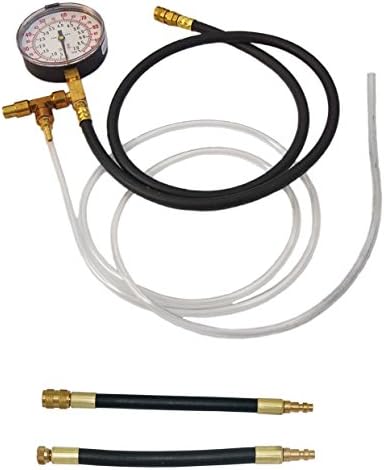
Best for: Owners of port fuel-injected cars and trucks whose fuel rail has a Schrader test valve.
Fuel injection runs at far higher pressure than a carburetor. Therefore, you need a gauge built for it. The Lang TU-469 uses a 3-1/2 in dual-scale dial that reads up to 100 psi and 7 bar (about 690 kPa), which covers typical port injection specs.
Also, it includes both the standard and the small Schrader adapters, so it fits most rails with a test port. Then, compare key-on, idle and hold readings with the manual.
- Gauge reads up to 100 psi and 7 bar
- 3-1/2 in dual-scale dial
- Standard and small Schrader adapters
- Fuel injection manual and storage case
Pros
- Large dual-unit dial
- Covers most Schrader-port rails
- Compact kit
Cons
- No adapters for rails without a test port
- Not for diesel or direct injection high-pressure sides
- Hose length is not published
Skip it if: your vehicle lacks a Schrader port, because you would need the adapter set in a master kit.
Best Pro Fuel Kit
8. Lisle 55700 Master Fuel Injection Kit

Best for: Professional shops and restorers who meet many fuel system designs, including older Bosch CIS and throttle body systems.
Finally, the Lisle 55700 is the master kit for fuel pressure. Lisle says the set tests GM, Ford, Chrysler, Honda/Acura, Toyota, Bosch CIS and L-Jetronic systems. In addition, it covers most port fuel injection (PFI) and throttle body injection (TBI) systems.
Because the case holds many hoses, fittings and gauges, it adapts to lines without a Schrader valve. However, it is heavy at 10.4 lb (4.7 kg) and costs far more than a single gauge.
- Tests PFI and TBI systems, plus Bosch CIS and L-Jetronic
- Variety of gauges, hoses and adapters with a component list
- Ford spring lock and hairpin hose options
- Replacement parts sold individually, including a 3-1/2 in gauge
Pros
- Widest vehicle coverage here
- Handles older CIS systems
- Parts can be replaced one by one
Cons
- Expensive for a home garage
- Heavy case at 10.4 lb
- Kit gauge range is not published on the product page
Skip it if: you own one or two modern cars, since the Lang TU-469 covers Schrader-port rails for much less.
How We Chose the Best Vacuum Pressure Tester Kits
We did not bench-test these tools. Instead, our picks are research-based. First, we listed the jobs a home or shop mechanic actually measures: engine manifold vacuum, vacuum parts, brake bleeding, cooling system pressure, coolant refill and fuel pressure. Then, we looked for at least one established brand for each job.
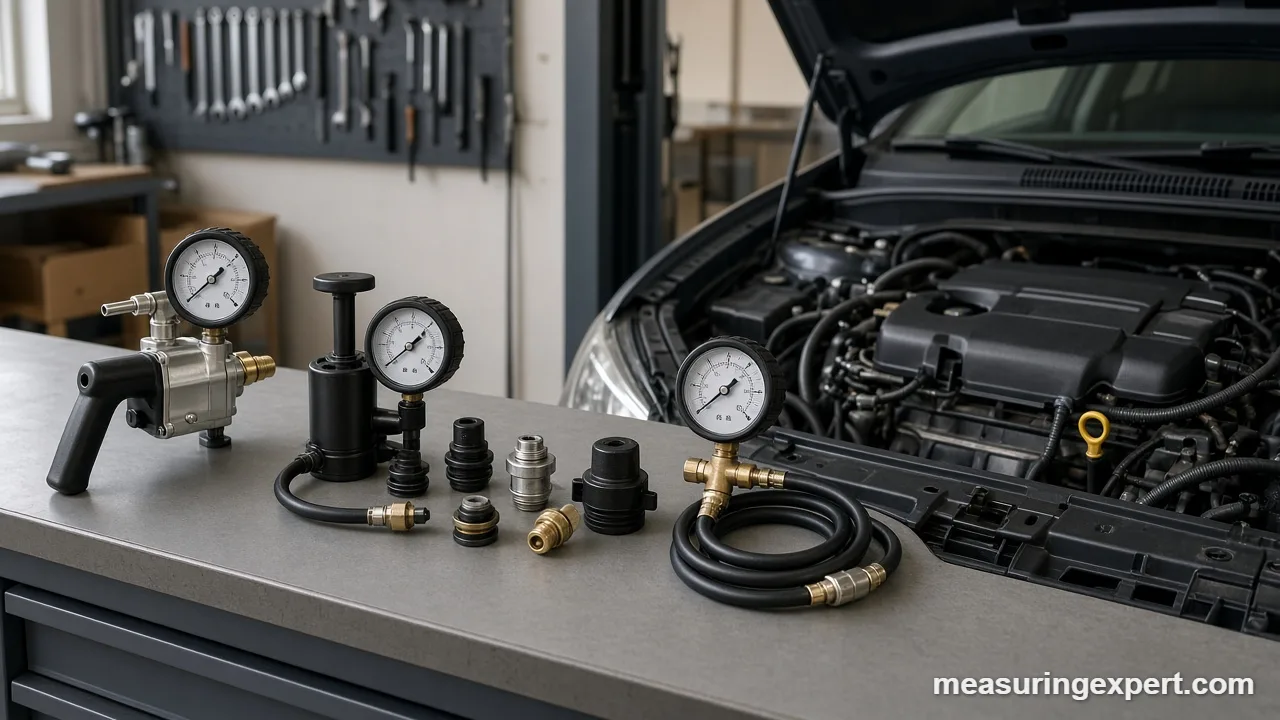
Next, we checked every range, gauge size and adapter claim on the maker’s page, a manual or a reliable distributor listing. If we could not confirm a spec, we left it out. We also read owner feedback for common failures, such as leaking adapters. Finally, we dropped unbranded kits with no published specs, and we kept no more than two tools per brand.
- Range fit: the gauge must cover the job, for example 0 to 30 inHg for vacuum or 0 to 100 psi for port fuel injection.
- Readability: larger dials and dual units (psi and kPa or bar) scored higher.
- Coverage: adapters for common radiator necks, Schrader ports or vacuum hose sizes.
- Safety features: pressure release valves, protective boots and clear instructions.
For unit conversions, we used the exact factors in the NIST Guide to the SI, Appendix B.9. For vacuum diagnosis, we leaned on MOTOR magazine’s guide to reading a vacuum gauge.
Reading inHg, psi and kPa on a Vacuum Pressure Tester
Inches of mercury (inHg) is the usual vacuum unit in the US. It describes how far below the outside air pressure the reading sits. For example, 20 inHg of vacuum equals about 67.7 kPa below atmosphere. At sea level, the outside air is about 29.92 inHg (101.325 kPa), so a gauge cannot read much past 30 inHg of vacuum. In other words, 30 inHg is close to a perfect vacuum.
Pounds per square inch (psi) is the usual pressure unit for fuel and coolant. Gauges like these read gauge pressure (psig). That means zero is the outside air, not a true vacuum. For instance, a cooling system held at 15 psi sits 15 psi above the air around it, or about 103 kPa.
Kilopascals (kPa) and bar are the metric units. One psi is 6.894757 kPa, and one bar is exactly 100 kPa, so 1 bar is about 14.5 psi. Meanwhile, one inHg is 3.386389 kPa, and one inHg also equals exactly 25.4 mmHg. If you want the physics behind these units, our guide to the pressure of a gas explains absolute and gauge pressure in more depth.
Also, remember that altitude changes engine vacuum. Because the air is thinner up high, idle vacuum drops by roughly 1 inHg for every 1,000 ft (305 m) above sea level. The same thin-air effect drives the barometer readings in our article on air pressure and weather.
Which Best Vacuum Pressure Tester Fits Your Job?
No single gauge covers every system on a car. Instead, each job sits in its own pressure band. So, use this table to match the tool to the task.
| Job | Tool type | Typical range on the tool | Our pick |
|---|---|---|---|
| Engine manifold vacuum | Vacuum/pressure gauge | 0 to 30 inHg | OTC 5613, Lisle 20300 |
| Vacuum parts and brake bleeding | Hand vacuum pump | About 0 to 28 inHg | Mityvac MV8500 |
| Mechanical fuel pump (carbureted) | Low-pressure gauge | 0 to 15 psi | OTC 5613, Lisle 20300 |
| Port or throttle body injection | Fuel injection gauge | 0 to 100 psi | Lang TU-469, Lisle 55700 |
| Cooling system leaks | Hand pressure pump | 0 to 30 psi | Mityvac MV4530, OMT kit |
| Coolant refill | Venturi vacuum tool | Gauge to about 25 inHg | UView Airlift II |
In practice, many owners start with a hand vacuum pump and add other gauges later. A related tool, a tire pressure monitoring system, reads psi too, but it only watches tires.
Pressure Unit Converter for inHg, psi and kPa
Use this converter when a service manual lists a spec in one unit and your gauge reads another. For example, enter a vacuum reading in inHg to see it in kPa, psi or mmHg.
How to Run an Engine Vacuum Test
A vacuum test is the easiest way to learn what a gauge can tell you. It takes about ten minutes on most gasoline engines. Always follow the service manual for your engine, and keep hands and hoses clear of the fan and belts.
- Warm the engine to normal operating temperature, then shut it off.
- Find a manifold vacuum port below the throttle plate, such as the brake booster or PCV line.
- Connect the gauge with the shortest hose and the tightest adapter that fits.
- Start the engine and let it idle in park or neutral with the parking brake set.
- Read the needle and note both the number and how steady it is.
- Hold about 2,500 rpm for 15 seconds, then snap the throttle closed and watch the needle.
- Shut off the engine, remove the gauge and reconnect the original hose.
Afterward, correct your reading for altitude, and compare it with the ranges below.
What the Needle on Your Gauge Tells You
According to MOTOR, a healthy engine at sea level usually idles at about 18 to 22 inHg (61 to 75 kPa below atmosphere). However, some engines run 15 to 17 inHg and are still normal. So, the pattern often matters more than the exact number.
- Steady but low: late ignition or valve timing, low compression or an intake leak.
- Regular flutter: uneven compression in one or two cylinders, such as a leaking valve or head gasket.
- Occasional dips: a valve that sticks open now and then.
- Steady but high: often over-advanced timing.
- Falls at 2,500 rpm and stays low: a likely exhaust restriction, such as a clogged catalytic converter.
Likewise, the snap test should show the needle jump above the idle reading as the throttle closes. If it rises less than a couple of inches, suspect worn rings or valves. Next, confirm the finding with a compression or leak-down test before you buy parts.
For cooling systems, the logic is simpler. Pump the tester to the rating stamped on the radiator cap, often in the 13 to 18 psi range on modern cars. Then, watch the gauge for several minutes. A steady needle means the system holds; a falling needle with no outside drip points to an internal leak. Similarly, a fuel gauge should match the manual spec and hold pressure after shutdown.
Safety, Care and Gauge Checks
Pressure tools are simple, but they work around hot coolant and gasoline. Therefore, a few habits protect both you and the gauge.
Also, compare two gauges on a tee now and then. In addition, replace cracked hoses and worn O-rings, because a tiny leak at the adapter looks exactly like a leak in the car.
Honest Limits of Analog Pressure Gauges
Most kits here use analog dials. As a result, resolution depends on dial size and markings. A 2 in hand-pump gauge is fine for “holds or leaks,” but it cannot split 18 and 19 inHg with confidence.
Moreover, a few makers do not publish an accuracy class at all. So, treat each reading as one clue, and confirm it with another test before you replace an expensive part.
Best Vacuum Pressure Tester FAQ
What is the best vacuum pressure tester for home mechanics?
For most home garages, the Mityvac MV8500 is the best pick. It pulls vacuum to test parts, pushes light pressure, and bleeds brakes with one hand pump. However, add a cooling system or fuel injection gauge if you need those systems.
What is a normal engine vacuum reading?
At sea level, a healthy gasoline engine usually idles at about 18 to 22 inHg, or about 61 to 75 kPa below atmosphere. Some engines run 15 to 17 inHg and are still fine. Also, subtract about 1 inHg for every 1,000 ft of altitude.
How do I convert inHg to psi or kPa?
Multiply inHg by 3.386389 to get kPa, or by 0.4912 to get psi. For example, 20 inHg equals about 67.7 kPa or 9.82 psi. Similarly, one psi equals 6.894757 kPa.
Can the best vacuum pressure tester also bleed brakes?
Yes, if it is a hand vacuum pump with a fluid reservoir, such as the Mityvac MV8500. It pulls fluid out through the bleeder screw. However, some ABS units need a scan tool procedure, so check the service manual first.
What psi should I use to test a cooling system?
Use the pressure rating on your radiator or reservoir cap, which is often in the 13 to 18 psi range. Never go above it. Then, watch the gauge for several minutes; a falling needle means a leak.
Can I test fuel injection pressure with a vacuum gauge?
No. A combined vacuum and fuel pump gauge usually tops out at 15 psi, while port fuel injection often runs much higher. Instead, use a fuel injection gauge that reads to about 100 psi, such as the Lang TU-469.
Why does my vacuum gauge needle flutter?
A regular flutter usually points to uneven compression in one or two cylinders. For example, a leaking valve or head gasket can cause it. Therefore, follow up with a compression or leak-down test to confirm.
Is the best vacuum pressure tester the same as a compression tester?
No. A vacuum tester reads pressure below atmosphere in the intake, while a compression tester reads cylinder pressure, often well over 100 psi. Both help with engine diagnosis, but they use different gauges and adapters.
Do I need a compressor for a vacuum coolant refill tool?
Yes, venturi tools like the UView Airlift II run on shop air. UView lists a minimum of 90 psi (6 bar), and it recommends dry air. Without a compressor, use a hand pressure tester and a spill-free funnel instead.
How accurate are analog vacuum and pressure gauges?
Accuracy varies, and some makers do not publish it. So, treat readings as trends and patterns rather than exact values. Also, compare two gauges on a tee now and then, and replace leaking hoses or adapters.
Bottom Line on the Best Vacuum Pressure Tester
Overall, the Mityvac MV8500 Silverline Elite is the best vacuum pressure tester for most people, because it tests vacuum parts, bleeds brakes and pressure-checks small circuits with one pump. Still, match the tool to the system. Pick the OTC 5613 or Lisle 20300 for engine vacuum, the Mityvac MV4530 or OMT kit for coolant leaks, and the Lang TU-469 for fuel rails. Finally, always compare your readings with the service manual spec.
2 thoughts on “8 Best Vacuum Pressure Tester Kits for Engine, Fuel and Cooling Systems (2026)”