

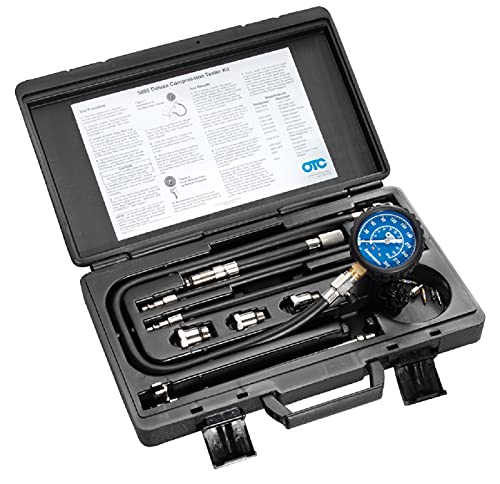
The best compression tester for most garages is the OTC 5605 Deluxe kit, because it pairs a 0 to 300 psi dual-scale gauge with a 26 in. hose and the widest adapter set here. What decides the choice is your spark plug thread, whether you want a digital readout, and whether you also test small engines.
In short: choose the OTC 5605 for range, the Performance Tool for a digital readout, the Mityvac for small engines, and the Innova for a basic kit.
As an Amazon Associate, Measuring Expert earns from qualifying purchases. Our picks are based on research, specifications and owner feedback, not paid placement.
Best Overall
Best Digital
Best for Small Engines

Quick Answer: The Best Compression Tester for Each Engine
- Best overall: OTC 5605 Deluxe, with a 26 in. hose and many adapters.
- Best digital: Performance Tool W89747, which holds the reading for 90 seconds.
- Best for small engines: Mityvac MV5530, with 10 mm and 12 mm adapters.
- Best budget kit: Innova 3612, with 12 mm and 14 mm adapters.
- Best shop-style kit: ATD 5639, with a 24 in. hose and spare parts.
On This Page
- Comparison Table
- The 5 Best Compression Testers, Reviewed
- How We Chose
- Analog or Digital
- Reading the Numbers
- Cars, Outboards, Small Engines and Bikes
- Pressure Converter
- How to Use a Compression Tester
- Care and Safety
- Honest Limits
- FAQ
- Bottom Line
Best Compression Tester Comparison Table
| # | Product | Best For | Standout Feature | Link |
|---|---|---|---|---|
| 1 | OTC 5605 Deluxe | Cars and trucks with crowded engine bays | 26 in. hose and a wide adapter set | View |
| 2 | Performance Tool W89747 | A digital readout with a held reading | Digital gauge that holds a reading for 90 seconds | View |
| 3 | Mityvac MV5530 | Cars, mowers, saws and bikes in one case | 10 mm and 12 mm small engine adapters | View |
| 4 | Innova 3612 | A simple kit for occasional checks | Color-coded 2.5 in. dial and 15 in. hose | View |
| 5 | ATD 5639 Super | Replaceable parts and a 24 in. hose | Rubber boot, push-button deflator, spare gauges | View |
The 5 Best Compression Testers, Reviewed
Each pick below lists only specs that a maker or retailer spec sheet confirms. Prices change often, so check the current price on Amazon.
Best Overall
1. OTC 5605 Deluxe Compression Tester Kit for Gasoline Engines
Best for: home mechanics and shops that test many different gasoline engines and want one complete case.
The OTC 5605 is our best compression tester pick for most garages, because the kit covers more plug types than any other pick here. First, OTC lists a dual-scale gauge that reads 0 to 300 psi and 0 to 2100 kPa. Second, the gauge sits on a 26 in. flex hose, so you can read it outside a crowded engine bay.
In addition, the adapters include a 12 in. flex 14 mm standard reach, a 12 in. flex 14 mm long reach, an 8 in. deep well 14 mm connector, a 16 mm flex adapter and loose 10 mm, 12 mm and 18 mm adapters. Also, OTC says they work on flat and tapered seat plugs. However, this is a gasoline-only kit, so it does not suit diesel engines.
- Gauge: dual scale, 0 to 300 psi and 0 to 2100 kPa
- Hose: 26 in. flex hose with a quick coupler
- Adapters: 14 mm standard, long reach and deep well; 16 mm; 10 mm, 12 mm and 18 mm
- Fits flat and tapered seat spark plugs
- Nickel-plated finish; blow-molded hard case
- For gasoline (petrol) engines only
Pros
- Broadest adapter set in this guide
- Long hose keeps the gauge easy to read
- Hard case keeps parts together
Cons
- Gasoline engines only
- Analog gauge, so you read the needle by eye
- Larger and heavier than a basic kit
Skip it if: you only need to test one lawn mower, since a small-engine kit costs less and packs smaller.
Best Digital
2. Performance Tool W89747 Digital Compression Tester
Best for: anyone who wants a digital number instead of a needle, without paying for a full deluxe kit.
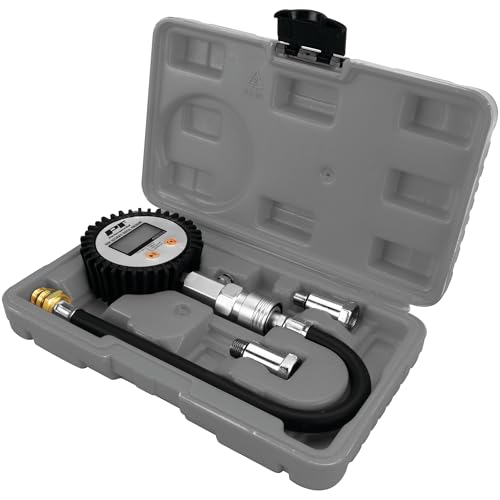
First, the Performance Tool W89747 replaces the needle with a digital gauge. The retailer listing gives a 300 psi range, a rubber boot and a quick disconnect fitting. In addition, the gauge holds a reading for 90 seconds or until you press reset, so you can step back and read it. As a result, it suits a job done alone.
Next, the adapters are a stepped adapter for 14 mm and 18 mm plugs, plus 10 mm and 12 mm adapters. The listing shows a 12 in. hose, which is short next to the OTC hose. However, it reads in psi only, and the listing does not say whether it is for gasoline engines only, so treat it as a petrol tester unless the maker says otherwise.
- Gauge: digital, 300 psi range; psi only
- Holds the reading for 90 seconds or until reset; automatic shut-off after 3 minutes
- Hose: 12 in., with a quick disconnect fitting
- Adapters: stepped 14 mm and 18 mm, plus 10 mm and 12 mm
- One 9-volt battery, included per the listing; rubber boot
Pros
- Digital readout that holds the reading
- Battery is included
- Covers 10, 12, 14 and 18 mm plugs
Cons
- Short 12 in. hose
- Psi only, with no kPa or bar
- Fuel type is not stated on the listing
Skip it if: you want kPa or bar readings, or a long hose to read the gauge from outside the bay.
Best for Small Engines
3. Mityvac MV5530 Professional Engine Compression Test Kit
Best for: owners of a mixed fleet, such as a car, a lawn mower, a chain saw and a trimmer.
First, Mityvac builds this kit for gasoline engines of many sizes. The retailer listing gives a 0 to 300 psi analog gauge with psi, kg/cm2, bar and kPa scales, a 2-3/4 in. gauge face and a rubber boot. A manual release valve lets you hold a peak reading while you look at it.
In fact, the adapters are what set it apart. The list includes 14 mm short and long thread, 18 mm short thread, a 14 mm by 18 mm combination, and 10 mm and 12 mm small engine adapters. For example, the listing names lawn mowers, chain saws and trimmers. In addition, a quick-release air hold adapter helps with valve seal repairs without pulling the head. However, the listing says it is not for diesel engines.
- Gauge: analog, 0 to 300 psi; psi, kg/cm2, bar and kPa scales
- 2-3/4 in. (70 mm) gauge with rubber boot
- Hoses: 10 in. gauge hose plus 6.5 in. and 12 in. adapter hoses
- Adapters: 14 mm short and long, 18 mm, 10 mm and 12 mm, and a quick-release air hold adapter
- Blow-molded case and a field service kit
- Gasoline engines only
Pros
- Small engine adapters in the box
- Four pressure scales
- Manual release holds the peak reading
Cons
- Shorter gauge hose than the OTC
- Not for diesel engines
- The Mityvac page lists fewer details than OTC
Skip it if: you test only cars with deep plug wells, since the OTC deep well connector is a better fit.
Best Budget Kit
4. Innova 3612 Compression Tester, 4-Piece Kit

Best for: home mechanics who check compression a few times a year and want a no-frills kit.
In short, the Innova 3612 is the simplest kit here. Innova lists a 0 to 300 psi gauge with a roughly 2.5 in. dial, dual-calibrated and color-coded scales, and a 15 in. high-pressure rubber hose. Also, the side release valve lets you retest without disconnecting the hose, and a quick-disconnect fitting speeds up changes.
Next, the maker page names 12 mm and 14 mm adapters, and says the hose end has built-in 14 mm and 18 mm fittings. As a result, it covers many common plug threads. However, the page does not list a 10 mm adapter, so check your engine first. Also, Innova showed this kit as sold out when we looked, so confirm stock.
- Gauge: 0 to 300 psi, about 2.5 in. dial with color-coded scales
- Hose: 15 in. high-pressure rubber
- Adapters: 12 mm and 14 mm, plus built-in 14 mm and 18 mm hose-end fittings
- Side release valve and a quick-disconnect fitting
- 1-year warranty, per Innova
Pros
- Simple and compact
- Release valve speeds repeat tests
- Color-coded dial is easy to read
Cons
- No 10 mm adapter listed
- Shorter hose than the OTC
- Maker listed it as sold out
Skip it if: you need small engine adapters or a hard case.
Best Shop-Style Kit
5. ATD Tools 5639 Super Compression Tester Kit

Best for: DIY mechanics who want a gauge with a long hose and replacement parts available.
In short, the ATD 5639 is a shop-style kit. ATD describes a dual-scale dial in psi and bar, a quick coupler and a push-button deflator that releases the pressure between cylinders. In addition, a rubber boot protects the gauge. The manual lists a 24 in. hose assembly, 14 mm short and long hoses, a 12 mm and 16 mm hose assembly and a 10 mm adapter.
In fact, spare parts are a strength. ATD sells 300 psi and 200 psi replacement gauges, and a repair kit with O-rings and valve cores. However, the manual does not give a complete kit list or the numeric scale limits, so confirm the contents on the listing. The manual also warns not to exceed the gauge rating and not to use the gauge with a cracked lens.
- Gauge: dual-scale dial in psi and bar; replacement gauges listed at 300 psi and 200 psi
- Hose assembly: 24 in. with a quick coupler
- Hoses for 14 mm short and long, 12 mm and 16 mm; 10 mm adapter
- Push-button deflator and rubber boot
- Procedure in the manual: crank 6 times or to peak, for no more than 15 seconds
Pros
- Long hose and a deflator
- Spare gauges and a repair kit are sold
- Manual includes a clear procedure
Cons
- Full kit list is not published in the manual
- Scale limits are not stated in the manual
- Dial only; no digital memory
Skip it if: you need a verified list of every adapter in the box before you buy.
How We Chose the Best Compression Tester
In short, we did not test these kits on an engine. Instead, we compared maker pages, instruction manuals and retail listings. Therefore our picks are research-based, and we state only specs that a maker or retailer spec sheet confirms. Where a figure was missing, we say so.
These criteria decided the ranking:
- Gauge range: 0 to 300 psi (about 2,070 kPa) covers petrol engines.
- Adapters: the kit must fit your spark plug thread, whether 10, 12, 14, 16 or 18 mm.
- Hose length: a longer hose lets you read the gauge outside the engine bay.
- Release valve: a side valve makes repeat tests quick.
- Parts support: replacement gauges, O-rings and valve cores extend the life of a kit.
We also read the Actron CP7827 instruction sheet and the ATD 5639 manual for test procedures, and a Yamaha motorcycle service manual for a bike procedure. We found no Amazon match for a Lisle, Actron or Motion Pro kit in our check, and the OTC 5605-DG digital kit did not render in our affiliate check, so none of those are in the list.
Analog or Digital: Which Gauge Style Fits?
First, most kits use a mechanical dial. A needle shows the highest pressure and holds it until you press the release valve. Next, digital gauges show a number and can hold a reading. For example, the Performance Tool W89747 holds its reading for 90 seconds, so you can step back and read it.
| Style | Strength | Trade-off |
|---|---|---|
| Analog dial | No battery; simple and rugged | You read and write down each number |
| Digital | Holds the reading; easy to read | Needs a battery |
In practice, an analog kit is enough for most garages. However, a digital kit helps when you check many cylinders or compare engines often. Also, check the plug thread and reach before you buy, because a long-reach adapter in a short-reach hole can hit the piston, as the Actron instructions warn.
Reading the Best Compression Tester Numbers
First, a compression test gives one pressure per cylinder. Therefore, the key question is whether the cylinders agree. The Actron instructions say a healthy engine shows readings within the maker specification and within 10 percent of each other. For example, readings of 150, 148, 146 and 144 psi differ by 4 percent, which is fine. On the other hand, readings of 150, 148, 120 and 146 psi differ by 20 percent, so one cylinder needs attention.
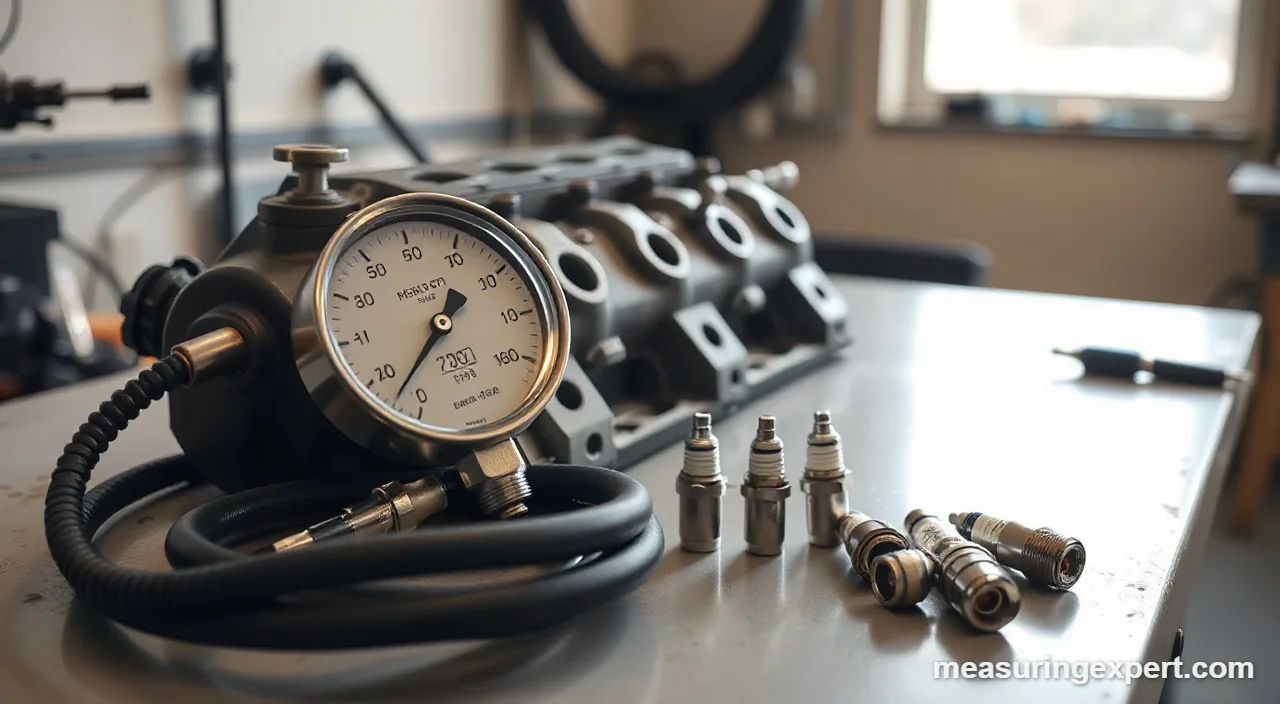
The same instructions suggest what the pattern may mean:
- Needle rises slowly or stalls: a sticking valve is likely.
- One reading well above spec: carbon buildup is possible.
- Two neighboring cylinders low by 20 psi or more: a head gasket problem is possible.
- Low reading that rises after a teaspoon of oil: worn or poorly seated rings are likely; a reading that stays low points to the valves.
Also, always compare against the specification for your engine. The ATD manual says to consult the maker service manual, because a tester only reports pressure and does not know your engine target.
Cars, Outboards, Small Engines and Bikes
The same tool works on many engines, but the details change. First, your spark plug thread decides the adapter. The kits above list 10, 12, 14, 16 and 18 mm adapters, so match the size before you buy. Next, remember that every kit here is for gasoline engines, and the OTC and Mityvac listings say so.
- Outboards: follow the outboard maker procedure and specification. Use a tester with the right plug adapter, and note that the engine is cranked by the starter, so keep clear of the propeller and disable the ignition as the manual directs.
- Small engines: a lawn mower, chain saw or trimmer often needs a 10 or 12 mm adapter. The Mityvac kit lists those adapters.
- Motorcycles: a Yamaha manual says to warm the engine, ground the spark plug cable, fully open the throttle and crank on a fully charged battery until the reading stabilizes.
For deeper diagnosis, pair the test with a vacuum check. Our guide to the best vacuum pressure tester explains how vacuum readings point to leaks that compression alone can miss.
Pressure Converter: psi, kPa and bar
Next, use this converter to move between psi and the kPa or bar scales on your gauge. It starts at 150 psi.
Also, one psi is 6.8948 kPa. The OTC gauges stop at 2100 kPa, which is about 305 psi. For more on pressure units, see our guide to measuring tools.
How to Use the Best Compression Tester
The steps below follow the Actron and ATD instructions. In addition, always check the service manual for your engine first.
- Warm the engine. First, run the engine to normal temperature, then stop it. A warm engine gives more consistent readings.
- Remove the plugs. Next, disconnect the plug wires or coils, label them, and remove all spark plugs. Clean around each plug first so dirt cannot fall into the cylinder.
- Open the throttle and disable ignition. Then hold the throttle wide open and disable the ignition and fuel as the manual directs. On a motorcycle, ground the plug cable.
- Fit the adapter by hand. After that, thread the adapter into the first plug hole by hand. Do not use a wrench, and do not use a long-reach adapter in a short-reach hole.
- Crank the engine. Crank for about six compression strokes, or until the needle stops rising. ATD limits cranking to 15 seconds.
- Record and release. Write down the peak pressure, press the release valve and repeat on every cylinder. Finally, compare the numbers using the 10 percent rule.
Finally, return the throttle to closed and reconnect the ignition and fuel before you start the engine. The Actron instructions warn that leaving the throttle plates open can damage the engine. For the torque to refit the plugs, use a proper wrench from our best torque wrench guide.
Care and Safety for Your Compression Tester
First, release the pressure before you disconnect the hose. Next, keep the gauge in its case, because the dial and the O-rings are the weak points. Also, replace worn O-rings and valve cores, as the ATD repair kit includes them. In addition, wear safety goggles, keep clear of moving parts, and do not touch hot engine parts, as the ATD manual advises. Finally, do not exceed the gauge pressure rating or use a gauge with a cracked lens.
Honest Limits of Any Compression Tester
A compression test shows how well each cylinder holds pressure, but it does not say why. For example, low readings can come from rings, valves or a gasket. Moreover, cranking speed matters, because a weak battery lowers every reading. Therefore, keep the battery charged, as the ATD manual advises. In addition, the numbers depend on altitude, temperature and the gauge itself, and we found no accuracy figure for any kit in this guide. Therefore, treat a reading as a comparison between cylinders, and confirm a diagnosis with a leak-down test or a shop inspection.
Best Compression Tester FAQ
What is the best compression tester for home use?
For most garages, the OTC 5605 Deluxe is the best compression tester, because it has a 26 in. hose and adapters for 10, 12, 14, 16 and 18 mm plugs. However, the Innova 3612 is a simpler choice if you test only occasionally.
What is the best compression tester for outboard motors?
No kit here is made only for outboards, so match the adapter to your spark plug thread and follow the outboard maker procedure. The OTC 5605 and Mityvac MV5530 cover the widest range of adapter sizes.
What is the best compression tester for small engines?
The Mityvac MV5530 lists 10 mm and 12 mm small engine adapters and names lawn mowers, chain saws and trimmers. Therefore it is our pick for small engines.
Can I use a compression tester on a motorcycle?
Yes, if the adapter fits the spark plug thread. A Yamaha service manual says to warm the engine, fully open the throttle, use a fully charged battery and crank until the reading stabilizes.
What psi should a good engine show?
It depends on the engine, so use the maker specification. As a rule, the Actron instructions say the cylinders should be within 10 percent of each other.
How do I do a wet compression test?
After a dry test, add about a teaspoon of clean SAE 30 oil to a low cylinder and test again. A large rise suggests worn rings, while a similar reading points to the valves, per the Actron instructions.
Do I need to remove all the spark plugs?
Yes. In fact, ATD and Actron both say to remove all spark plugs, so the engine cranks freely, and to hold the throttle wide open.
How many times should I crank the engine?
In short, the ATD manual says to crank six times or until the maximum pressure is reached. It also limits cranking to 15 seconds.
Can a compression tester work on a diesel engine?
Not the kits in this guide. The OTC and Mityvac listings say they are for gasoline engines only, and diesel engines need a tester built for them.
Is a digital compression tester more accurate?
Not necessarily. A digital gauge is easier to read and can hold a reading, but we found no accuracy figures for these kits. Use the same tester on every cylinder, so any error is the same.
Bottom Line: The Best Compression Tester to Buy
If you want one kit for most gasoline engines, the OTC 5605 Deluxe is the best compression tester for most people because of its long hose and wide adapter set. Pick the Performance Tool for a digital readout and the Mityvac for small engines. For related tests, see our best vacuum pressure tester and best battery load tester guides.