

The best measuring wheel for most yards and job sites is the REED R8000, a 12.5 in. digital wheel with a stated +/-0.5% accuracy and 0.1 ft resolution. Therefore, what decides the choice is wheel size, whether you need a battery-free counter, and whether your plans use feet, decimal feet or meters.
In short: choose the REED R8000 for accuracy, the Milwaukee for one-hand use, the DigiRoller for area math, and the Zozen for a no-battery budget wheel.
As an Amazon Associate, Measuring Expert earns from qualifying purchases. Our picks are based on research, specifications and owner feedback, not paid placement.
Best Overall
Best for Area Math

Best Budget Mechanical

Quick Answer: Top Picks for Each Job
- Best overall: REED R8000, with +/-0.5% accuracy and 0.1 resolution.
- Best one-handed: Milwaukee 48-22-5112, with grip-mounted buttons.
- Best for area and volume: DigiRoller Plus III, which converts a length into quantities.
- Best budget mechanical: Zozen double collapsible, with no batteries.
- Best for decimal feet: DuraWheel DW-PRO, reading feet and tenths.
- Best compact metric: Lufkin CMW4M, a 10 cm wheel.
- Best for curves: Keson RoadRunner, a 4 in. wheel with 1 ft circumference.
On This Page
- Comparison Table
- The 7 Best Measuring Wheels, Reviewed
- How We Chose
- Digital, Mechanical or Compact
- Accuracy Over Rough Ground
- Distance Converter
- How to Measure a Fence Line
- Care and Checks
- Honest Limits
- FAQ
- Bottom Line
Best Measuring Wheel Comparison: Seven Wheels Side by Side
| # | Product | Best For | Standout Feature | Link |
|---|---|---|---|---|
| 1 | REED R8000 | Digital reading with a stated accuracy | 12.5 in. wheel, 0.1 resolution, +/-0.5% accuracy | View |
| 2 | Milwaukee 48-22-5112 | Handle buttons and an IP54 display | Three unit modes and 4-reading memory | View |
| 3 | Calculated Industries DigiRoller Plus III | Turns distance into area and volume | Area, volume and circle calculations | View |
| 4 | Zozen Double Collapsible | No batteries and a folding frame | Double collapsible frame with a kickstand | View |
| 5 | DuraWheel DW-PRO 68901 | Feet and tenths for layout drawings | Trigger brake and folding kickstand | View |
| 6 | Lufkin CMW4M Metric Centerline | Small metric wheel for short runs | 10 cm wheel and 46 in. telescopic handle | View |
| 7 | Keson RoadRunner 1 ft | 1 ft circumference and a magnified counter | 4 in. wheel, 9,999 ft 11 in. counter | View |
The 7 Best Measuring Wheels, Reviewed
As a result, each pick below lists only specs that a maker or retailer spec sheet confirms. Prices change often, so check the current price on Amazon.
Best Overall
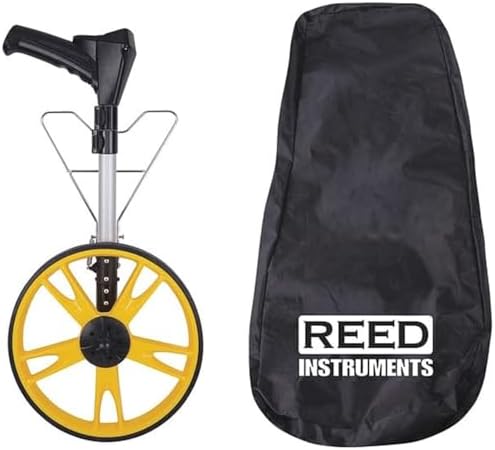
1. REED Instruments R8000 Measuring Distance Wheel
Best for: landscapers, fence installers and estimators who want a digital readout with published accuracy figures.
The REED R8000 is our best measuring wheel pick for most yard and job-site work, because it is one of the few wheels whose maker publishes both a resolution and an accuracy figure. First, the 12.5 in. (318 mm) wheel rolls over small ruts and clumps more smoothly than a small wheel. Second, the backlit display counts in feet or meters in 0.1 steps.
In addition, the counter adds distance as you walk forward and subtracts it when you roll backward. As a result, a mistake or a short backup does not ruin a long run. REED also lists memory for five measurements, a spring-loaded kickstand and a soft carrying case. However, the wheel needs batteries, so keep spares in the truck. Therefore, it suits long fence lines and large lawns.
- Wheel diameter: 12.5 in. (318 mm)
- Range: up to 99,999.9 ft or m, with 0.1 resolution
- Accuracy: +/-0.5%, per the REED datasheet
- Units: feet and meters; backlit LCD with a low-battery indicator
- Weight: 2.6 lb (about 1.2 kg); 3 AAA batteries included
- Telescopic handle, memory for 5 readings, kickstand
Pros
- Published resolution and accuracy
- Counts backward as well as forward
- Memory and a carrying case are included
Cons
- Needs three AAA batteries
- Feet and meters only, with no feet-and-inches mode
- Plastic body is less rugged than a steel frame
Skip it if: you want inches and area modes, since the DigiRoller below adds both.
Best for One-Handed Use
2. Milwaukee 48-22-5112 12 in. Digital Measuring Wheel

Best for: tradespeople who carry the wheel in one hand and want to read and reset without bending down.
First, Milwaukee builds its digital wheel around the handle. The buttons sit on the grip, so you can start, hold and switch units with the same hand that steers the wheel.
Next, the maker lists three unit modes, which are imperial, metric and an engineer scale. It also lists a hold button that works as a brake, a telescoping frame and memory for four readings. However, the product page does not publish an accuracy figure or a counter range, so we cannot compare it with the REED on those points.
- Wheel diameter: 12 in.
- Units: imperial, metric and engineer scale
- IP54-rated backlit LCD
- Memory for up to 4 measurements
- Hold button doubles as a brake; telescoping frame
- 2 AAA batteries included; limited lifetime warranty
Pros
- One-handed controls on the grip
- Backlit display with a dust and splash rating
- Limited lifetime warranty
Cons
- No accuracy figure on the maker page
- Counter range is not published
- Needs batteries
Skip it if: you need a documented accuracy number for a bid or a permit sketch, because the maker page gives none.
Best for Area and Volume
3. Calculated Industries DigiRoller Plus III Electronic Distance Measuring Wheel
Best for: estimators who turn a rolled length straight into square feet, acres or cubic yards.
The DigiRoller Plus III is a measuring wheel with a small calculator built in. For example, Calculated Industries lists linear units in feet-inch, inches, decimal feet, yards and meters. It also lists area units such as square feet, acres and hectares, plus volume units such as cubic yards.
That matters for mulch, gravel and concrete, because you can roll a length, enter a width, and read the quantity. In addition, the maker states 99.5% wheel accuracy, a 12.5 in. wheel with a 1 m circumference, and a handle that folds from 40.5 in. to 21.5 in. However, the Amazon listing we found is a bundle that also includes a Komelon tape, so check what is in the box. As a result, it suits estimators more than casual users.
- Wheel diameter: 12.5 in. (32 cm), 39.3 in. (1 m) circumference
- Accuracy: 99.5% wheel accuracy, per the maker
- Range: 0 to 9,999,999 yards or meters; maximum speed 12 mph (19 km/h)
- Units: linear, area and volume in US or metric
- Weight: 4.1 lb (1.9 kg); one 9-volt battery included
- Glove-friendly buttons; backlit display; 2-year warranty
Pros
- Area and volume modes cut out hand math
- Handle folds for the truck
- Buttons work with gloves
Cons
- Heaviest wheel in this guide
- The listing is a bundle with a tape
- Uses a 9-volt battery
Skip it if: you only need a plain distance reading, because simpler wheels cost less and weigh less.
Best Budget Mechanical
4. Zozen Measuring Wheel in Feet and Inches, Double Collapsible, Mechanical
Best for: homeowners and occasional users who want a battery-free wheel that fits in a trunk.
The Zozen wheel is a mechanical counter, so it has no screen and nothing to charge. In addition, the listing describes a double collapsible frame, durable TPR tires, a one-key reset and a kickstand. As a result, it is an easy wheel to keep in a garage and pull out for a weekend fence or garden project.
Next, the listing gives a 12 in. wheel, a 0 to 9,999 ft range and +/-0.5% accuracy. However, the reading is in feet and inches only, and a mechanical counter has no memory or backward subtraction mode, so write each leg down before you reset. Therefore, it is a sensible first wheel.
- Wheel diameter: 12 in., per the listing
- Range: 0 to 9,999 ft; reads feet and inches
- Accuracy: +/-0.5%, per the listing
- Weight: 3.83 lb
- Double collapsible frame, TPR tires, one-key reset and kickstand
- No batteries required
Pros
- No batteries to replace
- Folds small for storage
- Straightforward one-key reset
Cons
- No memory or backward subtraction
- Feet and inches only
- Specs come from the retail listing
Skip it if: you want a backlit display or metric readings, because this model offers neither.
Best for Decimal Feet
5. US Tape 68901 DuraWheel Measuring Wheel DW-PRO, 12.5 in., Feet and Tenths

Best for: site crews who work from civil or landscape plans drawn in feet and tenths.
First, site plans in the United States are usually drawn in decimal feet, not feet and inches. The DuraWheel DW-PRO 68901 reads in feet and tenths, so you can compare a rolled distance with the drawing without converting inches.
The maker also lists a pistol grip with a counter-clear control, a trigger-operated brake and a belt-driven counter. In addition, the wheel has a hi-traction tire, a debris scraper and a folding frame. However, the maker page gives no accuracy figure, so treat it as a rugged field tool rather than a documented instrument. In short, it is a layout tool first.
- Wheel diameter: 12.5 in.
- Counter range: up to 9,999 ft, in feet and tenths
- Trigger-operated brake and counter-clear control on the grip
- Wide-stance folding kickstand and in-line roller bearings
- Debris scraper and a heavy-duty chassis; folds for carrying
Pros
- Feet and tenths match site plans
- Trigger brake holds the count
- Folding frame and kickstand
Cons
- No accuracy figure published
- Mechanical counter has no memory
- Metric needs a separate model
Skip it if: your plans use feet and inches or meters, because other models match those better.
Best Compact Metric
6. Lufkin 10 cm Metric Centerline Measuring Wheel CMW4M

Best for: metric users measuring short runs indoors, on paving or around garden beds.
First, the Lufkin CMW4M is a small wheel with a 10 cm diameter and a telescopic handle. In addition, Crescent lists it with a gear drive, a glare-resistant counter and a quick-reset function.
First, the Crescent page gives a range of up to 999.9 m before the counter resets. However, the same page contradicts itself on units, since one section says meters and another says feet and inches. Therefore, confirm the markings on the listing you buy. The page also gives no numeric accuracy figure and says the wheel has no brake.
- Wheel diameter: 10 cm
- Range: up to 999.9 m before resetting, per Crescent
- Telescopic handle: 46.25 in. extended, 23.375 in. contracted
- Gear drive with a centerline design and quick reset
- No brake; full lifetime warranty
Pros
- Small and light for short runs
- Compact when the handle is contracted
- Lifetime warranty
Cons
- Units are described inconsistently by the maker
- No brake
- Small wheel struggles on rough ground
Skip it if: you will roll over long grass, gravel or ruts, since a 12 in. wheel handles those better.
Best for Curves and Short Runs
7. Keson 1′ RoadRunner Measuring Wheel (Inches)
Best for: people measuring curved edges, flower beds and tight indoor spaces.
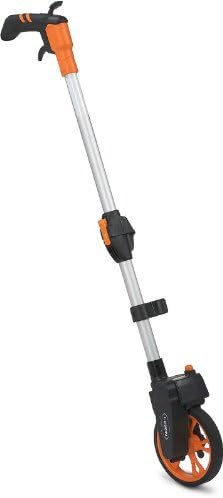
The Keson RoadRunner is a small 4 in. wheel with a circumference of 1 ft, so one turn equals one foot. Therefore the arithmetic is easy, and it follows curved edges well. In addition, Keson lists a five-digit magnified counter, a light body and a limited lifetime warranty.
Next, Keson says the counter reaches 9,999 ft 11 in. before it resets, and it reads in feet and inches. However, the model number is not stated in the Amazon title, so match it against the RR112 listing before you buy. Also, expect a wheel for beds, not for long runs.
- Wheel diameter: 4 in.; circumference 1 ft
- Counter range: 9,999 ft 11 in., in feet and inches
- Five-digit magnified counter
- Lightweight design; limited lifetime warranty
- Accuracy is not published
Pros
- Follows curves and bed edges
- One turn equals exactly one foot
- Light and simple
Cons
- Not suited to rough ground
- No published accuracy
- No brake or kickstand described
Skip it if: you will measure long straight runs over grass, because a 12 in. wheel is steadier.
How We Chose the Best Measuring Wheel
In short, we did not roll these wheels across a field. Instead, we compared maker pages, datasheets and listings. Therefore our picks are research-based, and we state only specs that a maker or retailer spec sheet confirms. Also, where a figure was missing, we say so rather than guess.
Overall, these criteria decided the ranking:
- Wheel size: a larger wheel rolls over bumps with less skipping and less error.
- Published accuracy: a maker that states a percentage gives you something to check.
Digital, Mechanical or Compact: Choosing the Best Measuring Wheel Type
First, a measuring wheel is a wheel of known circumference attached to a counter. Each turn adds a fixed length, so the reading is the number of turns times the circumference.
First, for most yards, the best measuring wheel is a 12 in. model, because it rolls over turf and gravel without catching. However, a compact wheel is the better choice for beds, paths and room layouts. Also, a digital wheel stores readings, while a mechanical wheel suits occasional jobs.
Best Measuring Wheel Accuracy Over Rough Ground
In fact, a measuring wheel is only as accurate as the ground it rolls on. Therefore, three effects matter most: wheel size, slope and slip. In short, each one makes the reading differ from the true horizontal distance.
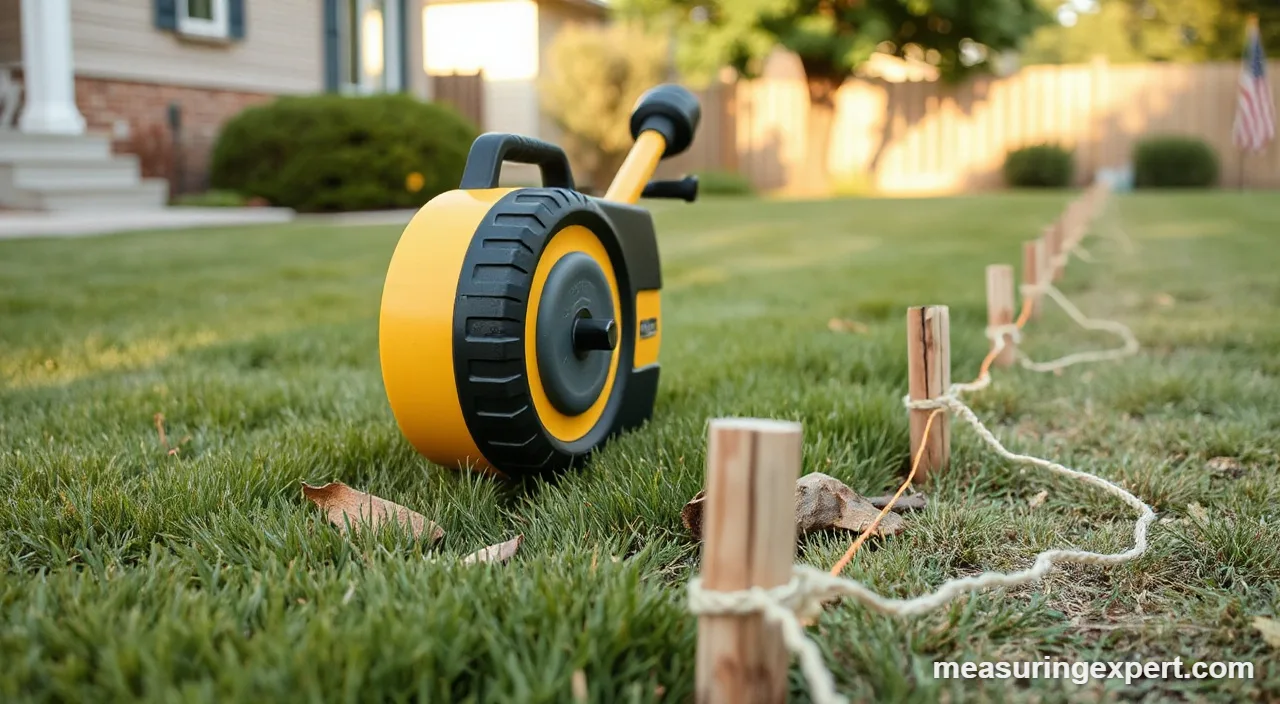
Wheel circumference. For example, a 12.5 in. wheel travels 39.27 in. (3.27 ft) per turn, and a 12 in. wheel travels 37.70 in. (3.14 ft).
Stated accuracy. For example, the REED R8000 lists +/-0.5%. In practice, on a 100 ft run, that is up to 0.5 ft (6 in.), and on a 300 ft run, it is up to 1.5 ft. Therefore, a fence line planned with a wheel needs a small allowance for post spacing.
How Slope Changes the Reading
Also, a wheel measures the distance along the ground. A plan, however, uses the horizontal distance. The conversion is horizontal distance = ground distance x cos(angle), as a university surveying lecture explains in its notes on reducing slope distance to horizontal. Next, the table shows how much a slope shortens the true distance.
| Grade | Angle | Wheel reading is too long by | 200 ft on the ground equals |
|---|---|---|---|
| 5% | 2.86 deg | 0.12% | 199.8 ft |
| 10% | 5.71 deg | 0.50% | 199.0 ft |
| 15% | 8.53 deg | 1.11% | 197.8 ft |
| 20% | 11.31 deg | 1.94% | 196.1 ft |
| 30% | 16.70 deg | 4.22% | 191.6 ft |
As a result, a gentle slope up to 10% adds about the same error as the wheel itself. However, a steep bank does not. For example, a 20% grade turns 200 ft on the ground into 196.1 ft of horizontal distance. Therefore, if you need a true horizontal figure on a hillside, measure the slope angle and apply the cosine, or use one of the laser tools in our best laser distance measurer guide.
Distance Converter for Feet, Yards and Meters
Next, use this converter to move between the units your wheel reads and the units your plans use.
Also, one foot is exactly 0.3048 m. If your plans mix units, see our guide to imperial to metric construction conversions.
How to Measure a Fence Line With the Best Measuring Wheel
First, a fence run is the classic job for a wheel. For example, the line is 240 ft long, and the posts are set 8 ft on center. The steps below also work for a garden border or a driveway.
- Stake the corners. First, mark the start and end points with stakes or paint, and clear any tall grass from the line.
- Zero the wheel. Next, set the counter to zero and place the wheel against the first stake with its start mark at the ground.
- Roll at a steady pace. Then walk the line at an even speed with the handle upright, and avoid pushing the wheel sideways.
- Read and record. At the end stake, stop the wheel, read the count and write it down. For example, a reading of 240 ft means the run is 240 ft along the ground.
- Check the slope. After that, estimate the grade. If the line climbs more than about 10%, apply the cosine from the table above.
- Plan the posts. Finally, divide the length by the spacing. A 240 ft run with posts every 8 ft has 30 sections, so it needs 31 posts for an open line, before you subtract gate openings.
Also, roll the line twice and average the two readings to catch slips. The same method gives quantities. For example, a 12 ft by 20 ft slab at 4 in. thick needs 80 cu ft, or about 2.96 cu yd of concrete. In addition, our guide on finding the area of a shape covers the formulas for irregular beds.
Best Measuring Wheel Care and Checks Before Each Job
First, check the wheel against a known length before each job. For example, lay out a 100 ft steel tape on flat pavement, roll the wheel along it and compare the readings. Next, if the wheel reads short or long by more than its stated accuracy, look for a worn tire or a loose axle. Also, for help choosing the tape for this check, read our best tape measure guide.
Honest Limits of Any Wheel
First, a wheel gives a distance along the path you rolled, not a legal boundary. For a property line, a licensed surveyor and the recorded plat are the authority, as we explain in our guide to measuring property boundaries. In addition, most makers publish an accuracy figure for the counter, not for your ground, so tall grass, mud and slopes add error that the datasheet does not cover. Finally, treat your reading as a good planning number and confirm critical dimensions with a tape or laser before you cut or pour. Therefore, add a margin when you order materials.
Best Measuring Wheel FAQ
What is the best measuring wheel for landscaping?
For most yards, the best measuring wheel is a 12 in. model such as the REED R8000, because the larger wheel rolls over turf and small ruts. If you also need area or volume, the DigiRoller Plus III adds those modes.
What is the best measuring wheel for fencing?
Look for a 12 in. wheel with a brake or hold button, since you will stop often at posts and corners. For example, the Milwaukee 48-22-5112 and the DuraWheel DW-PRO both list a brake, and the REED subtracts when you roll backward.
How accurate is a measuring wheel?
In fact, some makers state about +/-0.5%, which is up to 6 in. over 100 ft. However, rough ground, slopes and slip add error that the datasheet does not include, so confirm key dimensions with a tape.
Is a digital or mechanical wheel better?
First, a digital wheel offers a backlit display, unit switching and memory. Meanwhile, a mechanical wheel needs no batteries and is simple to reset. In short, digital suits frequent users, and mechanical suits occasional jobs.
What size is best for rough ground?
In practice, a 12 to 12.5 in. wheel is the usual choice. Small wheels, such as the 4 in. Keson or the 10 cm Lufkin, skip on rough turf, so keep them for beds, paths and rooms.
Does it measure horizontal distance?
No, it measures the distance along the ground. Therefore, on a slope, the horizontal distance equals the wheel reading times the cosine of the slope angle. For example, a 20% grade makes a 200 ft reading about 196.1 ft horizontal.
How do I calibrate the best measuring wheel?
First, roll it along a known length of 100 ft on flat pavement and compare the reading. Next, if it is off by more than the stated accuracy, check the tire and the axle. Also, most wheels have no user calibration setting.
How many fence posts do I need for a 240 ft run?
For example, with posts 8 ft on center, a 240 ft open run has 30 sections and needs 31 posts. However, a closed loop of the same length needs 30. Subtract the width of any gate openings first.
Can a wheel measure area?
A wheel measures length, so you multiply two lengths for area. However, the DigiRoller Plus III does this on the device, and lists area units such as square feet and acres. For a patio of 12 ft by 20 ft, the area is 240 sq ft.
Is it accurate enough for a property line?
No. Instead, a licensed surveyor and the recorded plat define a legal boundary, although a wheel is fine for planning. Also, see our guide to measuring property boundaries for the limits.
Bottom Line: The Best Measuring Wheel to Buy
If you want one wheel for fencing, landscaping and layout, the REED Instruments R8000 is the best measuring wheel for most people because it publishes both its resolution and its accuracy. Otherwise, pick the Milwaukee for one-handed use, the DigiRoller for area math, and the Zozen if you want no batteries. Also, for short laser checks, see our best laser distance measurer guide.