

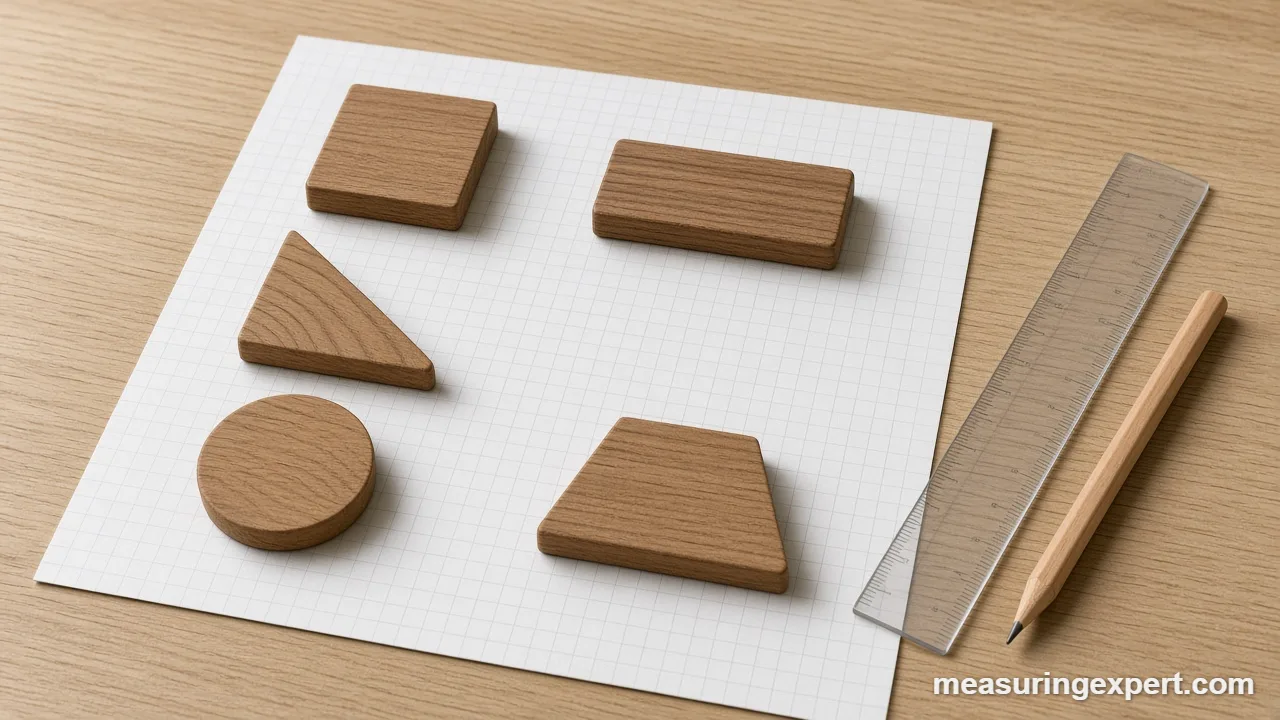
To find the area of a shape, measure its key lengths and plug them into that shape’s formula: side x side for a square, length x width for a rectangle, 1/2 x base x height for a triangle, and pi x radius squared for a circle. Always give the answer in square units, such as square feet or square meters.
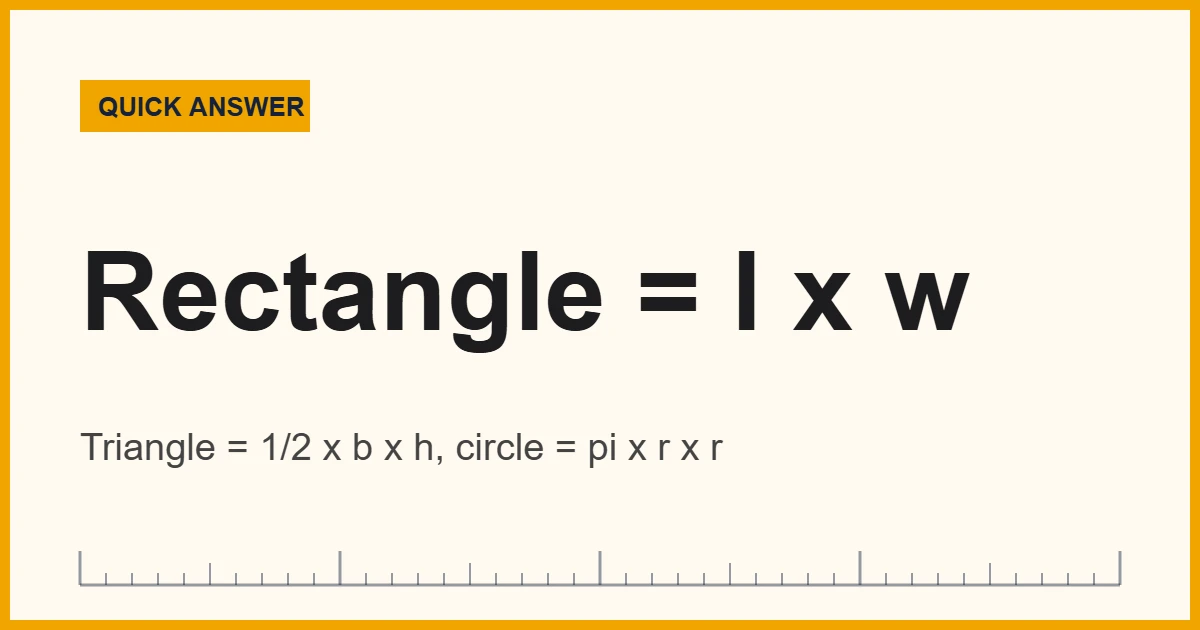
Area of a Shape in Plain Terms
Area tells you how much flat surface a shape covers. Also, it is the number you need when you buy flooring, seed a lawn, paint a wall, or check a homework answer. However, the method changes with the shape, and that is where most mistakes happen.
Here is the short version. First, identify the shape, or split a complicated outline into simple pieces. Next, measure the lengths the formula needs: sides for squares and rectangles, base and perpendicular height for triangles and parallelograms, the two parallel sides plus height for trapezoids, and the radius for circles. Then multiply as the formula says. For a composite shape, find the area of each piece and add them, or subtract any cutouts. For an irregular outline, trace it on grid paper and count squares. Finally, report the result in square units, because area is length times length, never plain feet or meters.
In short: a correct formula plus careful measurements gives you the area of a shape every time. Most errors, however, come from using a slanted side instead of the true height, mixing inches with feet, or forgetting to square the unit.
The international standard for units, the BIPM SI Brochure, defines the square meter as the SI unit of area. In the United States, NIST publishes the official conversion factors for land area, including an acre of about 4,046.86 square meters.
Below, you will find a unit converter, a formula table, worked examples for every common shape, and two reliable ways to handle odd outlines.
Convert Your Area of a Shape Into Other Units
Once you have a result, type it into the converter below and pick its unit. It then shows the same area in square feet, square meters, square inches, square yards, square centimeters and acres, so you can match whatever unit a store or teacher uses.
Recommended Tools for Measuring the Area of a Shape
You only need a few tools to measure real spaces. For rooms and yards, a laser distance measurer is fast, and many models also calculate area for you. A steel tape measure, on the other hand, handles short runs and curved edges. In addition, quad-ruled graph paper is ideal for the grid method, while a scientific or construction calculator keeps pi and feet-inch fractions accurate.


As an Amazon Associate, Measuring Expert earns from qualifying purchases.
Key Takeaways
- Area measures flat surface and is always written in square units.
- Rectangle: length x width. Square: side x side.
- Triangle: 1/2 x base x height, where height is perpendicular to the base.
- Circle: pi x r x r. Halve the diameter before you square it.
- Trapezoid: 1/2 x (top + bottom) x height. Parallelogram: base x height.
- Composite shapes: split, solve each part, then add or subtract.
- Irregular shapes: count full grid squares plus half the partial ones.
Area of a Shape: Formula Cheat Sheet
Every formula below uses lengths in the same unit. So if one side is in inches and another in feet, convert first. In addition, the example column uses simple numbers you can check by hand.
| Shape | Formula | What to measure | Example |
|---|---|---|---|
| Square | A = s x s | One side | s = 4 ft gives 16 sq ft |
| Rectangle | A = l x w | Length and width | 12 ft x 10 ft = 120 sq ft |
| Triangle | A = 1/2 x b x h | Base and perpendicular height | b = 8 in, h = 5 in gives 20 sq in |
| Circle | A = pi x r x r | Radius (half the diameter) | r = 3 m gives 28.27 m2 |
| Trapezoid | A = 1/2 x (a + b) x h | Both parallel sides and height | a = 6, b = 10, h = 4 gives 32 |
| Parallelogram | A = b x h | Base and perpendicular height | b = 9 cm, h = 5 cm gives 45 cm2 |
| Rhombus or kite | A = 1/2 x d1 x d2 | Both diagonals | d1 = 6, d2 = 8 gives 24 |
| Semicircle | A = 1/2 x pi x r x r | Radius | r = 4 gives 25.13 |
| Ellipse | A = pi x a x b | Both semi-axes | a = 5, b = 3 gives 47.12 |
Worked Examples for Each Common Shape
To begin, seeing the numbers move through each formula makes the pattern clear. In every case, you multiply two lengths, so the answer ends up in square units.
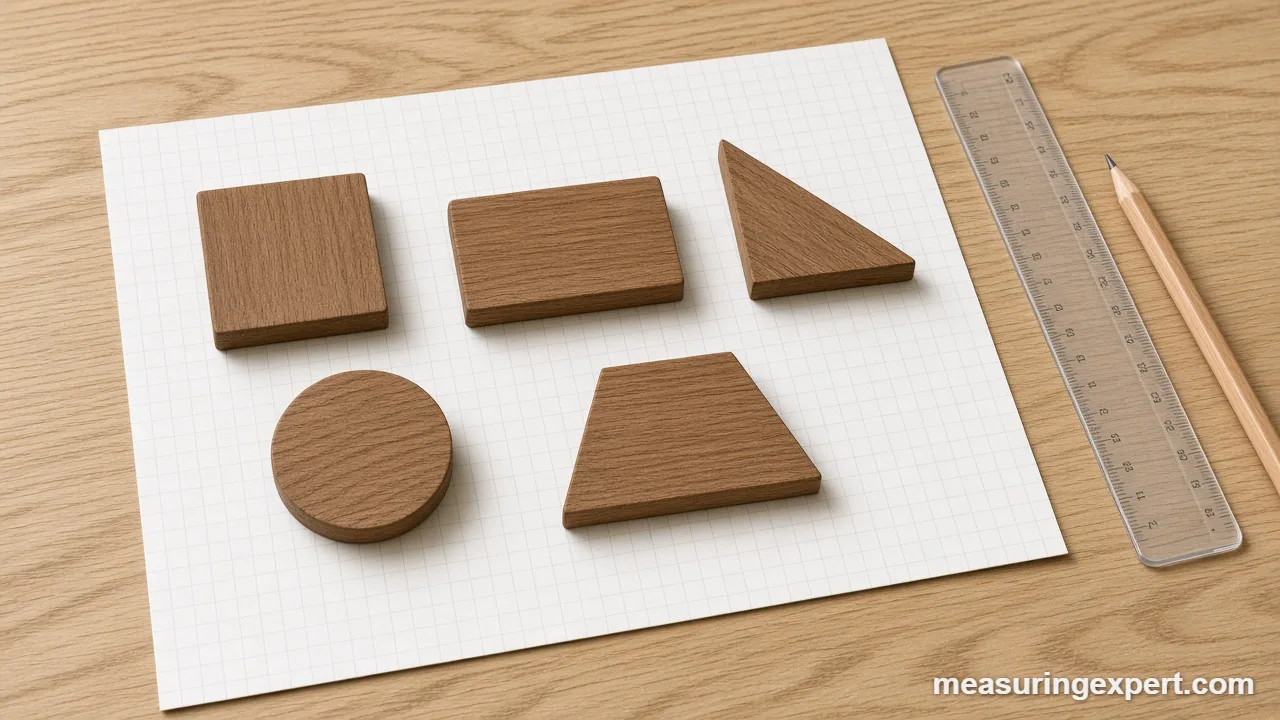
Square: The Simplest Area of a Shape
All four sides of a square match, so one measurement is enough. For example, a square patio tile with 4-foot sides covers 4 x 4 = 16 square feet. Because the side is multiplied by itself, this is also called “side squared.”
Rectangle
Measure the length and the width, then multiply. A bedroom that is 12 feet by 10 feet therefore has 120 square feet of floor, which is about 11.15 square meters. This is the formula you will use most at home, since most rooms, walls and garden beds are rectangles.
Triangle
First, pick any side as the base. Next, measure the height straight up from that base to the opposite corner, at a right angle. A triangle with an 8-inch base and a 5-inch height covers 1/2 x 8 x 5 = 20 square inches, or about 129.03 square centimeters. If you only know all three sides, use Heron’s formula instead; for sides of 13, 14 and 15, it gives exactly 84. When you know two sides and the angle between them, our guide to the area of a triangle using angles walks through the sine method.
Circle
Measure across the circle through its center to get the diameter, then halve it to get the radius. For instance, a round table 10 inches in diameter has a radius of 5 inches, so its area is pi x 5 x 5 = 78.54 square inches. Use at least 3.1416 for pi, or the pi key on a calculator; 3.14 is fine for rough estimates.
Trapezoid
A trapezoid has one pair of parallel sides. First, add those two sides, multiply by the height between them, and then halve the result. With parallel sides of 6 and 10 feet and a height of 4 feet, the area is 1/2 x 16 x 4 = 32 square feet. In effect, you are averaging the two parallel sides and treating the shape like a rectangle.
Parallelogram
Picture cutting a triangle off one end of a parallelogram and sliding it to the other end. The result is a rectangle, which is why the formula is simply base x height. A parallelogram with a 9 cm base and a 5 cm height thus covers 45 square centimeters. Just remember that the slanted side is not the height.
Rhombus and Kite
A rhombus has four equal sides, while a kite has two pairs of equal adjacent sides. In both shapes the diagonals cross at right angles, so the area is half the product of the diagonals. Diagonals of 6 and 8 inches, for example, give 1/2 x 6 x 8 = 24 square inches. A rhombus is also a parallelogram, so base x height works for it too.
How to Find the Area of a Shape Step by Step
This method works for homework diagrams and for real rooms alike. Also, you can use the converter above at the end to switch units.
- Identify the shape. Name it, or sketch the outline and mark where it splits into rectangles, triangles and circles.
- Choose one unit. Decide on inches, feet, centimeters or meters before you measure anything.
- Measure the right lengths. Take the sides, diagonals, radius or perpendicular height that the formula asks for.
- Apply the formula. Multiply carefully and keep pi to at least four decimal places.
- Combine the parts. Add the areas of separate pieces and subtract any holes or cutouts.
- Label the answer. Write the result in square units, then convert if a store or teacher wants a different unit.
Area of a Shape Made of Several Parts
Of course, real floors and garden beds are rarely one neat rectangle. Instead, you split a composite shape into simple pieces, find each area, and combine them. There are two ways to do it, and both give the same answer.
Similarly, a gable wall is a rectangle with a triangle on top, and a running track is a rectangle with a semicircle on each end. Whichever split you choose, make sure the pieces do not overlap and do not leave gaps.
Estimating the Area of a Shape With a Grid
Some outlines, such as a pond, a leaf or a curved flower bed, have no formula at all. In that case, the grid method gives a good estimate. First, trace the outline onto graph paper, or draw it to scale. Next, count every square that is fully inside the line. Then count the squares the line cuts through and take half of that number, since partial squares average about half full.
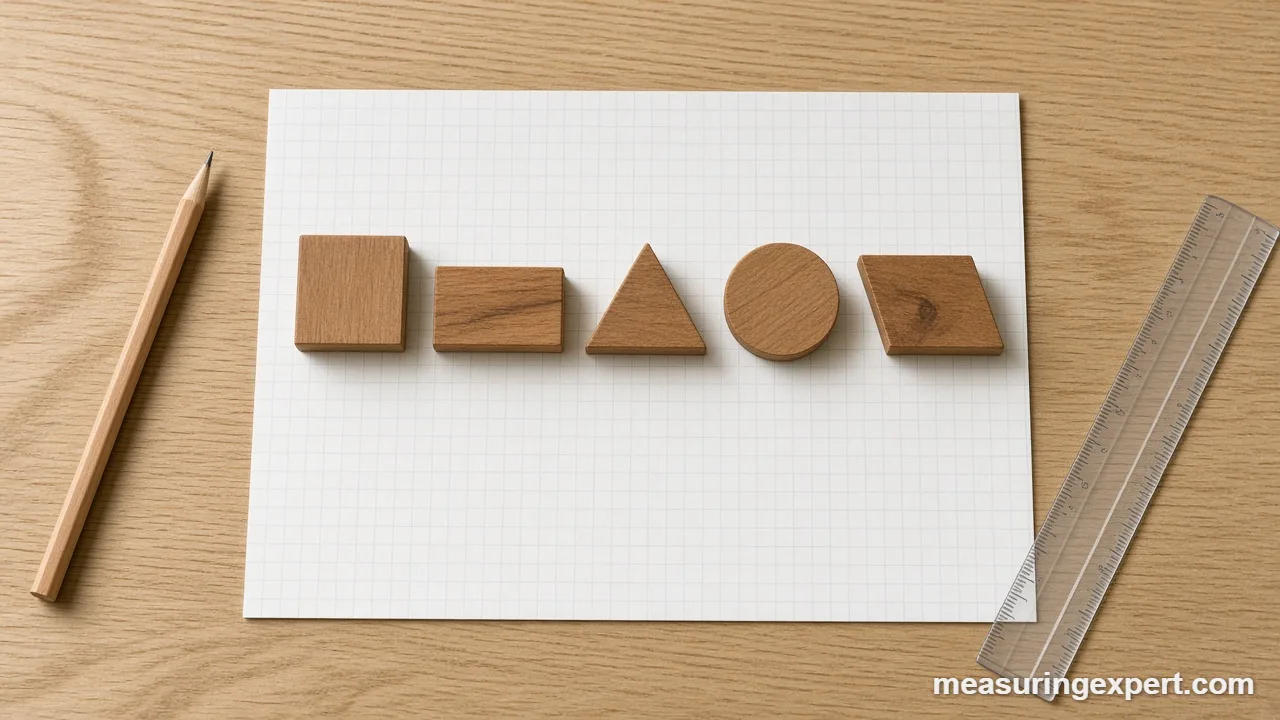
Smaller squares give a better estimate, because less of the area sits in partial squares. For a yard or a field, the same idea works with a scale drawing: if each square equals 1 square yard, you count squares and read the result directly. Alternatively, split the outline into many thin triangles or trapezoids and add them up, which is what surveying software does with coordinates.
Square Units and Conversions
Area is length multiplied by length, so the units are squared too. That is why 1 square foot equals 12 x 12 = 144 square inches, not 12. Likewise, 1 square yard is 3 x 3 = 9 square feet. Because 1 inch is exactly 2.54 cm, 1 square inch is exactly 6.4516 square centimeters.
| Unit | Equals | Metric equivalent |
|---|---|---|
| 1 square inch | 1/144 sq ft | 6.4516 cm2 (exact) |
| 1 square foot | 144 sq in | 0.09290304 m2 (exact) |
| 1 square yard | 9 sq ft | 0.83612736 m2 (exact) |
| 1 square meter | 10,000 cm2 | about 10.764 sq ft |
| 1 acre | 43,560 sq ft | about 4,046.86 m2 |
| 1 hectare | 10,000 m2 | about 2.471 acres |
For a deeper look at square feet, acres and hectares, see our guide to area units and how they compare.
Area vs Perimeter vs Surface Area
These three ideas get mixed up all the time, especially when people shop for trim, paint or flooring. The table below therefore separates them.
| Measure | What it means | Units | Use it for |
|---|---|---|---|
| Perimeter | Distance around the outside edge | ft, m (length) | Baseboards, fencing, edging |
| Area | Flat surface inside the outline | sq ft, m2 | Flooring, sod, a single wall |
| Surface area | Total area of every face of a 3D object | sq ft, m2 | Painting a box, wrapping a gift |
| Volume | Space inside a 3D object | cu ft, m3, gallons | Concrete, mulch, tank capacity |
In fact, two shapes can share a perimeter and still have very different areas. A 1 x 9 ft rectangle and a 5 x 5 ft square both have a 20-foot perimeter, yet one covers 9 square feet and the other 25. For straight-line measuring basics, see what linear measurement means.
Do and Don’t When Measuring Area
Do
- Use the perpendicular height for triangles and parallelograms.
- Convert every length to one unit first.
- Sketch and label the shape before you calculate.
- Measure each wall twice and use the average.
- Write the answer in square units.
Don’t
- Use the slanted side as the height.
- Plug the diameter in where the radius belongs.
- Count overlapping pieces of a composite shape twice.
- Convert area with a length conversion factor.
- Forget to subtract cutouts such as islands or pools.
Honest Limits
A formula is exact, but your measurements are not. For example, a 1/4-inch error on each side of a 12 x 10 ft room changes the area by less than half a square foot. Real rooms, however, are often slightly out of square, so the two diagonals may differ by an inch or more. In that case, split the floor into two triangles, or measure each wall and average opposite sides.
Similarly, the grid method is an estimate, and its accuracy depends on square size and on how carefully you trace. Rounding pi to 3.14 also shaves about 0.05 percent off a circle’s area, which matters only in precise work. Finally, a floor plan’s listed square footage may follow its own measuring rules, so it can differ from your own measurement.
When to Call a Professional
Overall, home projects usually need nothing more than a tape and the formulas above. Still, some situations call for an expert. For example, a licensed land surveyor should measure property lines and lot area for sales, permits or boundary disputes. An appraiser or real estate professional follows specific standards for a home’s official square footage. Likewise, a flooring or roofing contractor can measure complex roofs, stairs and patterns, where waste is hard to estimate.
Area of a Shape FAQs
What is the area of a shape?
Area is the amount of flat surface inside a closed outline. It is measured in square units, such as square inches, square feet or square meters.
How do you find the area of a shape with no formula?
Split it into rectangles, triangles and circles and add their areas. If the outline is curved and irregular, trace it on grid paper, count full squares, and add half the partial squares.
Why is area measured in square units?
Because area multiplies one length by another. Feet times feet gives square feet, and meters times meters gives square meters.
Is the area of a shape the same as its perimeter?
No. Perimeter is the distance around the edge, in plain length units. Area is the surface inside, in square units. A 5 x 5 ft square has a 20 ft perimeter but a 25 sq ft area.
How do I find the area of a circle from its diameter?
Halve the diameter to get the radius, square it, and multiply by pi. A 10-inch circle has a 5-inch radius, so its area is about 78.54 square inches.
What height do I use for a triangle?
Use the perpendicular height, measured at a right angle from the base to the opposite corner. A slanted side only works as the height in a right triangle, where it meets the base at 90 degrees.
How many square inches are in a square foot?
There are 144 square inches in a square foot, because 12 inches x 12 inches = 144.
How do I convert the area of a shape from square feet to square meters?
Multiply square feet by 0.09290304. For example, 120 square feet is about 11.15 square meters.
How do you find the area of an L-shaped room?
Split it into two rectangles, find each area, and add them. A 12 x 10 ft section plus a 6 x 4 ft section gives 144 square feet.
Can I estimate the area of a shape from a photo or map?
Yes, if the image has a known scale. Measure lengths on the image, convert them with the scale, and then apply the formula or the grid method.
The Bottom Line on the Area of a Shape
Finding the area of a shape comes down to three habits: use the right formula, measure the lengths it needs in one unit, and write the answer in square units. Squares, rectangles, triangles, circles, trapezoids and parallelograms each have a short formula, so the math itself is quick.
For anything messier, split the outline into simple pieces or count squares on a grid. Then use the converter at the top of this page to switch between square feet, square meters and acres before you buy materials.