
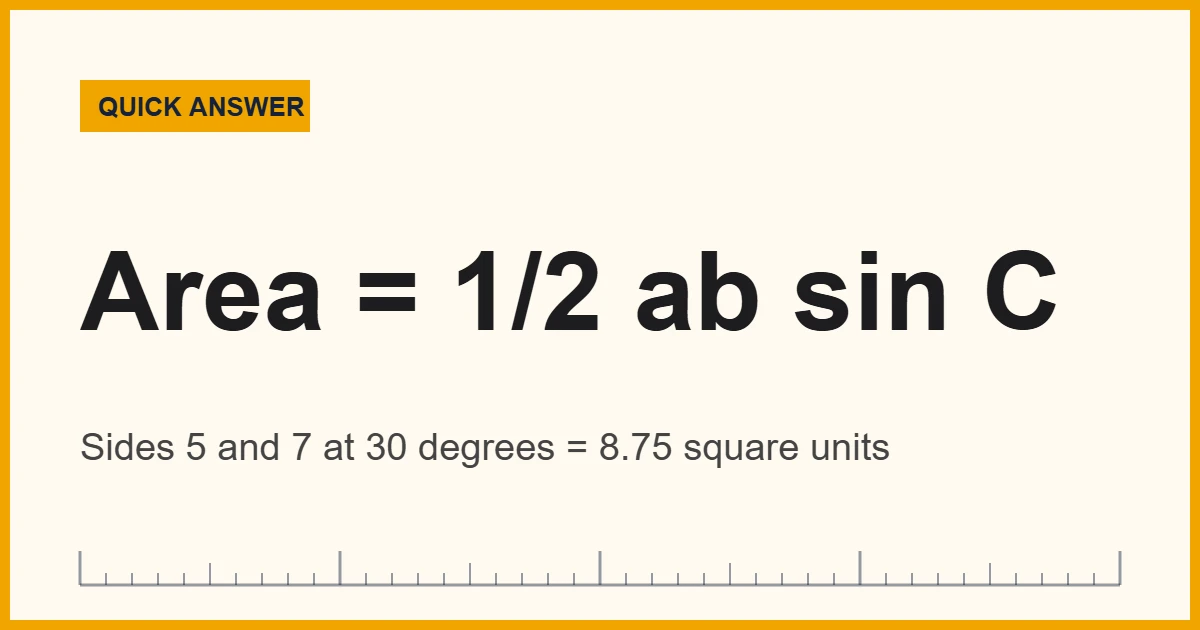
To find the area of a triangle using angles, multiply two sides by the sine of the angle between them and halve the result: Area = 1/2 ab sin C. For example, sides of 5 and 7 with a 30-degree included angle give 8.75 square units. If you know two angles and one side instead, use the law of sines first.
Most of us learned the area of a triangle as “half the base times the height.” That rule works well on paper, but in a yard, on a roof or in a survey sketch, you rarely know the height. Instead, you usually have a couple of tape measurements and an angle from a protractor, a digital angle finder or a plan.
Why Angles Reveal the Missing Height
Fortunately, the sine formula fills that gap. In fact, the sine of the included angle simply gives you the missing height without measuring it. So, if side b leans away from side a at angle C, the height above side a is b sin C. Plug that into “half base times height” and you get 1/2 ab sin C. As a result, any triangle with two known sides and the angle between them has a quick, exact area.
In short: two sides plus the angle between them (SAS) is the direct case. Two angles plus any side (ASA or AAS) needs one extra step, and three sides (SSS) needs the law of cosines or Heron’s formula.
Also, these are standard results, not shortcuts. For example, Wolfram MathWorld lists all three SAS versions of the triangle area formula next to Heron’s formula, and Math is Fun walks through the same 1/2 ab sin C method with worked examples.
Below, you will find the formulas side by side, a step-by-step method, five worked examples, and the mistakes that cause most wrong answers. Every example on this page was recalculated, and the results are rounded to two or three decimals.
Convert Your Triangle’s Area to Other Units
Once you have the area of a triangle in one unit, type it below and pick that unit. The converter then shows square meters, square inches, square yards and more, using exact definitions (1 inch = 2.54 cm). It does not do the trigonometry itself, so work out the area first with the steps further down.
Recommended Tools for Triangle Area Calculations
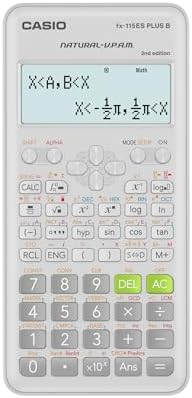
You only need two things: a calculator with a sine key and a reliable way to measure angles. First, a scientific calculator with a degree/radian indicator on the screen helps you avoid the most common error. Next, a protractor set covers paper work, while a digital angle finder is easier on real objects such as roof rafters, boards and garden edges.




As an Amazon Associate, Measuring Expert earns from qualifying purchases.
Key Takeaways
- Two sides and the included angle: Area = 1/2 ab sin C.
- The angle must sit between the two sides you multiply.
- With two angles and one side, find a second side with the law of sines, then use the sine formula.
- Three angles alone cannot fix the size, so they cannot give an area.
- Your calculator must be in degree mode when your angle is in degrees.
- Angles of C and 180 – C give the same area, because their sines are equal.
- The answer is in square units of whatever length unit you used.
Area of a Triangle Formulas by What You Know
First, pick the row that matches your measurements. Here, the usual labels apply: sides a, b and c sit opposite angles A, B and C. Also, remember that the three angles always add up to 180 degrees.
| You know | Name | Area formula |
|---|---|---|
| Base and height | Basic | 1/2 x base x height |
| Two sides and the angle between them | SAS | 1/2 ab sin C (or 1/2 bc sin A, or 1/2 ca sin B) |
| Two angles and the side between them | ASA | c^2 sin A sin B / (2 sin C) |
| Two angles and a side not between them | AAS | a^2 sin B sin C / (2 sin A) |
| All three sides | SSS | Heron: square root of s(s – a)(s – b)(s – c), where s = (a + b + c) / 2 |
| Three angles only | AAA | No area: the size is unknown |
The ASA and AAS formulas look different, but they come from the same idea. The law of sines (a / sin A = b / sin B = c / sin C) turns your one known side into a second side, and then the SAS formula does the rest.
Why does it work? To see this, drop a height from the top corner onto side a. That height equals b sin C, because sine is the ratio of the opposite side to the hypotenuse in the small right triangle you just made. So half the base times the height becomes 1/2 x a x b sin C.
How to Calculate the Area of a Triangle Using Angles
Follow these steps for any SAS triangle. For ASA or AAS, however, do the extra law-of-sines step in the next section first.
- Measure two sides. Use the same unit for both, such as feet or centimeters.
- Find the angle between those sides. It must be the corner where the two measured sides meet.
- Set the calculator to degrees. Look for DEG on the screen; RAD will give a wrong answer.
- Take the sine of the angle. For instance, sin 30 = 0.5 and sin 90 = 1.
- Multiply the two sides by that sine. Then halve the product.
- Label the result in square units. Feet give square feet; centimeters give square centimeters.
Worked Examples: Area of a Triangle With Angles
Example 1: Sides 5 and 7, angle 30 degrees
First, sin 30 = 0.5. Next, 5 x 7 = 35, and 35 x 0.5 = 17.5. Finally, half of 17.5 gives an area of 8.75 square units.
Example 2: The same sides at 45, 60 and 90 degrees
Next, keep a = 5 and b = 7, and the area grows as the angle opens. At 45 degrees it is about 12.37 square units; at 60 degrees, about 15.16; and at 90 degrees, exactly 17.5. Beyond 90 degrees, however, the area shrinks again. For example, a 120-degree angle gives about 15.16 again, and 150 degrees gives 8.75, the same as 30 degrees.
Example 3: Area of a triangle in a garden bed
Say two edges of a corner bed measure 12 ft and 15 ft, and they meet at 70 degrees. Because sin 70 is about 0.9397, the area is 1/2 x 12 x 15 x 0.9397, or about 84.57 square feet. In metric, that is about 7.86 square meters, which is the default value in the converter above.
Example 4: Area of a triangle for a large plot
Similarly, Math is Fun uses a field with sides of 150 m and 231 m at 123 degrees. We get 1/2 x 150 x 231 x sin 123, or about 14,530 square meters. In other words, that is roughly 3.59 acres, or about 156,400 square feet. For the unit side of this, see our guide to area measurement units.
ASA and AAS: Area of a Triangle From Two Angles
Sometimes you know two angles and only one side, for example from a survey sketch. In that case, first find the third angle: C = 180 – A – B. Then use the law of sines to get a second side. After that, the SAS formula applies.
ASA example: side c = 10 between angles A = 50 and B = 60
The third angle is C = 180 – 50 – 60 = 70 degrees. Next, the shortcut formula gives c^2 sin A sin B / (2 sin C) = 100 x 0.7660 x 0.8660 / (2 x 0.9397), or about 35.30 square units. As a check, the law of sines gives side a = 10 sin 50 / sin 70, about 8.15. Then 1/2 x 8.15 x 10 x sin 60 also gives about 35.30.
AAS example: side a = 8, angle A = 40, angle B = 65
Here, by contrast, the known side sits opposite angle A, not between the two angles. Again, the third angle comes first: C = 75 degrees. Side b = 8 sin 65 / sin 40, about 11.28. Therefore the area is 1/2 x 8 x 11.28 x sin 75, or about 43.58 square units.
For help reading those angles off a real object or drawing, see how to measure angles in a triangle.
No Angle Given? Use Three Sides
If you measured all three sides but no angle, you have two routes. Both give the same answer, so pick whichever feels easier.
The first route is Heron’s formula. Take a 7-8-9 triangle: s = (7 + 8 + 9) / 2 = 12, so the area is the square root of 12 x 5 x 4 x 3, which is the square root of 720, about 26.83 square units.
Route two uses angles. The law of cosines gives cos C = (a^2 + b^2 – c^2) / (2ab) = (49 + 64 – 81) / 112, so C is about 73.40 degrees. Then 1/2 x 7 x 8 x sin 73.40 also gives about 26.83. Similarly, a 6-8-10 triangle gives cos C = 0, so C = 90 degrees and the area is 24 square units.
| Method | Inputs | Best for | Watch out for |
|---|---|---|---|
| Sine formula (SAS) | 2 sides + included angle | Corners you can measure with an angle finder | Using an angle that is not between the sides |
| Law of sines + SAS (ASA, AAS) | 2 angles + 1 side | Survey sketches, plans | Forgetting to find the third angle |
| Heron’s formula (SSS) | 3 sides | Tape-only measurements | Rounding s too early on long, thin triangles |
| Base x height / 2 | Base + perpendicular height | Right triangles, drawings | Measuring a slanted side instead of the height |
Sine Values to Check Your Area of a Triangle
In addition, keep these values in mind as a quick check on your calculator. If your sine of 30 does not read 0.5, your calculator is not in degree mode.
| Angle (degrees) | Sine | Area with sides 5 and 7 |
|---|---|---|
| 30 | 0.5 | 8.75 |
| 45 | 0.7071 | 12.37 |
| 60 | 0.8660 | 15.16 |
| 70 | 0.9397 | 16.44 |
| 90 | 1 | 17.50 |
| 120 | 0.8660 | 15.16 |
| 150 | 0.5 | 8.75 |
The table also shows a handy fact: for two fixed sides, a right angle gives the largest possible area. Likewise, an equilateral triangle is another special case. With every angle at 60 degrees and side s, the area is about 0.433 x s^2, so a side of 6 gives about 15.59 square units.
Common Mistakes With the Area of a Triangle
- Radian mode. In radian mode, sin 30 reads about -0.988 instead of 0.5. With sides 5 and 7, that turns 8.75 into a negative “area” of about -17.29.
- The wrong angle. The sine formula only works with the angle between the two sides. If your angle sits elsewhere, find the missing pieces with the law of sines first.
- Mixed units. One side in feet and one in inches gives nonsense. Convert first, then multiply.
- Calling it the cosine formula. Area always uses sine. Cosine only helps you find an angle when you know three sides.
- Rounding too early. Keep at least four decimals for the sine, and round only the final answer.
Do and Don’t
Do
- Check DEG mode before you start.
- Sketch the triangle and label a, b, c and A, B, C.
- Confirm that the three angles add up to 180 degrees.
- Keep the same length unit for every side.
- Cross-check with Heron’s formula when you can.
Don’t
- Use an angle that is not between the two sides.
- Expect an area from three angles alone.
- Round sines to one decimal place.
- Forget to square the units in your answer.
- Trust a result bigger than 1/2 x a x b.
Honest Limits
The formulas on this page are exact, but your inputs are not. A tape measure is good to about 1/16 inch over short spans, and a typical digital angle finder reads to about 0.1 degree. As a result, the area of a triangle you calculate is only as reliable as your worst measurement. Long, thin triangles with a very small angle are the most sensitive, so measure those twice. Real plots, rooms and roofs are also rarely perfect triangles. For example, edges bow, corners round off, and ground slopes. For a rough estimate that is fine. However, for anything you pay for by the square foot, add a margin or split the shape into smaller triangles.
When to Call a Professional
Use these methods freely for homework, craft projects, garden beds, paint or flooring estimates. Even so, some jobs need a licensed expert. For instance, property lines, land sales and boundary disputes need a licensed surveyor, because legal area depends on recorded boundaries, not your tape. Similarly, roof framing and structural loads belong to a contractor or engineer. Finally, if a classroom grade depends on it, check which formula your teacher expects you to show.
Frequently Asked Questions
What is the formula for the area of a triangle using angles?
Use Area = 1/2 ab sin C, where a and b are two sides and C is the angle between them. With two angles and one side, use the law of sines first.
Can you find the area of a triangle with only angles?
No. Three angles fix the shape but not the size, so a tiny and a huge triangle can share the same angles. You need at least one side length.
How do you find the area of a triangle with side-angle-side?
Multiply the two sides, multiply by the sine of the included angle, and halve the result. For example, sides 5 and 7 at 30 degrees give 8.75 square units.
How do you find the area of a triangle with angle-side-angle?
Find the third angle (180 minus the other two), then use Area = c^2 sin A sin B / (2 sin C), where c is the side between angles A and B.
Why is my answer negative or way off?
Your calculator is probably in radian mode. Switch it to degrees, check that sin 30 reads 0.5, and try again.
Does the angle have to be between the two sides?
Yes. The 1/2 ab sin C formula only works with the included angle. Otherwise, solve for the missing side or angle first.
Is there a cosine formula for triangle area?
Not directly. Instead, the law of cosines finds an angle from three sides, and then the sine formula gives the area.
Which angle gives the largest area for two fixed sides?
A 90-degree angle, because sin 90 = 1. At that point, the area equals half the product of the two sides.
What units is the area of a triangle in?
The area of a triangle comes out in square units of your side lengths. Feet give square feet, and meters give square meters. Use the converter on this page to switch units.
Do I need radians for the sine formula?
No. Degrees work fine as long as your calculator is set to degrees. Radians only matter if your angle is already given in radians.
The Bottom Line
To get the area of a triangle using angles, you need two sides and the angle between them: halve the product of the sides and multiply by the sine of that angle. When you have two angles and one side instead, the law of sines supplies the missing side in one extra step.
So keep your calculator in degree mode, measure carefully, and sanity-check that your answer is no bigger than half the product of the sides. Then, if you need the result in another unit, the converter near the top of this page handles square feet, square meters and acres.