

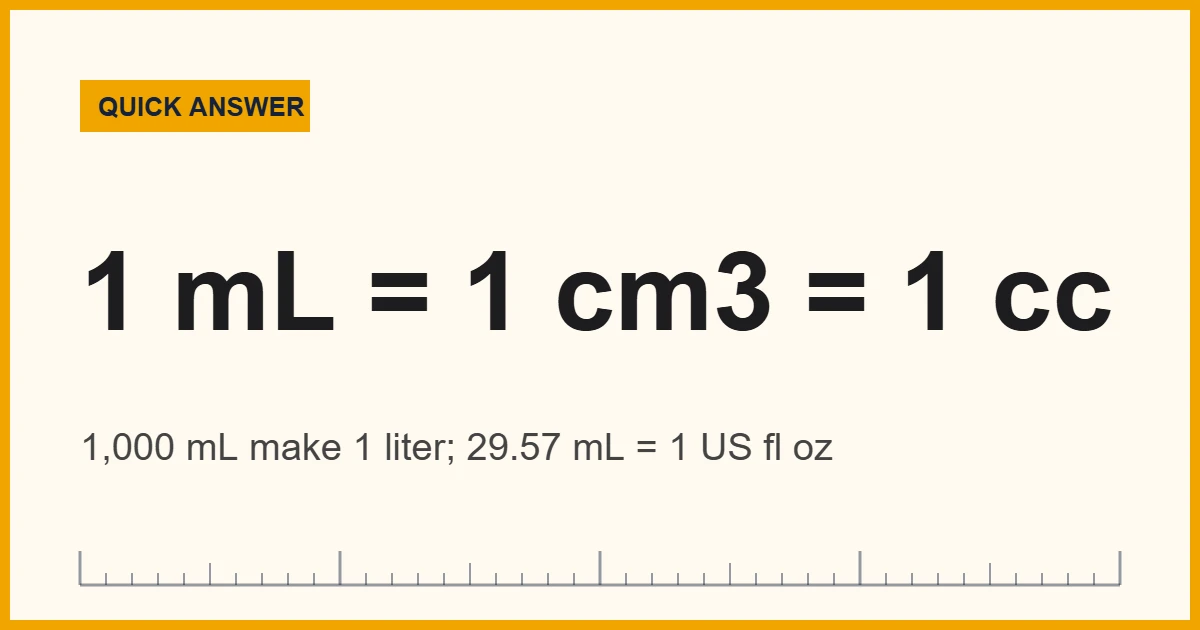
Yes. You can measure volume in mL for any liquid, powder or solid object. One milliliter is exactly one cubic centimeter (1 cm3, also written 1 cc), and 1,000 mL make 1 liter. In US kitchen terms, 1 mL is about 0.2 teaspoon, and 29.57 mL equal 1 US fluid ounce.
Convert Volume in mL to Spoons, Cups and Ounces
First, enter an amount and pick the unit you have. The converter then uses the exact US definitions, so mL, cc, teaspoons, fluid ounces and cups all line up.
First of all, volume is simply the amount of space something takes up. So any substance that fills space can have its volume expressed in milliliters, whether it is water in a glass, rice in a jar or a stone dropped into a cylinder. In addition, the milliliter is small enough for a dose of syrup and still practical for a bottle of soda, which is why labels, recipes and labs use it so often.
Most importantly, a milliliter is not a separate kind of unit. The US National Institute of Standards and Technology (NIST) states on its SI volume page that the milliliter is a special name for the cubic centimeter. Similarly, the liter is a special name for the cubic decimeter. In short, mL and cm3 are two labels for one identical amount of space.
Next, below you will find a quick chart, a plain comparison of mL, cm3 and cc, and the steps for measuring volume in mL for liquids, solids and odd shapes.
Common Volume in mL Chart
All of these values use the exact US definitions (1 US fl oz = 29.5735295625 mL). As a result, they are rounded only at the last step.
| Milliliters (mL) | Cubic cm (cm3 / cc) | US teaspoons | US fluid ounces | Everyday example |
|---|---|---|---|---|
| 1 mL | 1 cm3 | 0.20 tsp | 0.034 fl oz | About 20 drops of water |
| 5 mL | 5 cm3 | 1.01 tsp | 0.17 fl oz | One metric teaspoon |
| 15 mL | 15 cm3 | 3.04 tsp | 0.51 fl oz | One metric tablespoon |
| 30 mL | 30 cm3 | 6.09 tsp | 1.01 fl oz | A small medicine cup |
| 50 mL | 50 cm3 | 10.14 tsp | 1.69 fl oz | A miniature bottle |
| 100 mL | 100 cm3 | 20.29 tsp | 3.38 fl oz | Airline carry-on liquid limit |
| 250 mL | 250 cm3 | 50.72 tsp | 8.45 fl oz | One metric cup |
| 355 mL | 355 cm3 | 72.02 tsp | 12.00 fl oz | A standard US soda can |
| 500 mL | 500 cm3 | 101.4 tsp | 16.91 fl oz | A small water bottle |
| 1,000 mL | 1,000 cm3 | 202.9 tsp | 33.81 fl oz | One liter |
Printable tip: save this page as a PDF and keep the chart by your kitchen or lab bench. Also, the drop count above is a rough guide, because drop size depends on the dropper.
Recommended Tools for Measuring Volume in mL
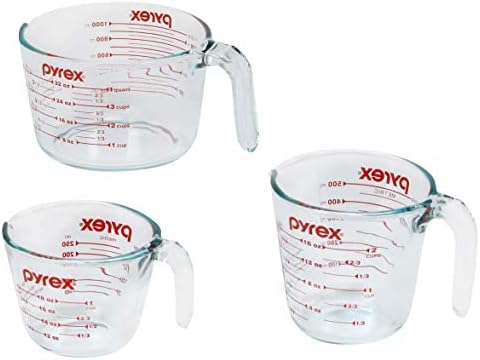
For kitchen work, for example, a clear measuring cup with mL markings covers most jobs. For smaller or more precise amounts, however, a graduated cylinder reads far more finely. Either way, look for printed or molded scales in mL, a spout that pours cleanly, and glass or sturdy plastic that will not warp.




As an Amazon Associate, Measuring Expert earns from qualifying purchases.
mL vs cm3 vs cc: Same Amount, Different Labels
People often ask whether volume should go in mL or cm3. In fact, both are correct, because the two units are identical. So the difference is mostly about habit and context.
| Label | What it means | Where you usually see it |
|---|---|---|
| mL (milliliter) | One thousandth of a liter | Food and drink labels, recipes, medicine, lab glassware |
| cm3 (cubic centimeter) | A cube 1 cm on each side | Math and physics problems, solid objects, density in g/cm3 |
| cc (cubic centimeter) | Older shorthand for cm3 | Engine sizes (a 250 cc motorcycle), older medical charts, syringes |
| L (liter) | 1,000 mL, or 1 cubic decimeter | Bottles, fuel, engine sizes (a 2.0 L engine) |
| m3 (cubic meter) | 1,000 liters, or 1,000,000 mL | Concrete, water utility bills, room volume |
The SI rules, published by the International Bureau of Weights and Measures in the SI Brochure, accept the liter for use with SI units. Also, since 1964, 1 liter has been defined as exactly 1 cubic decimeter. Before then, however, the liter was based on the volume of 1 kilogram of water, which made it about 28 parts per million larger. As a result, 1 mL now equals 1 cm3 with no rounding at all.
When Volume in mL Is the Usual Choice
Although mL and cm3 are equal, each field tends to prefer one. For instance, here is how the choice usually breaks down:
- Liquids you pour. For example, drinks, cooking oil, shampoo and fuel additives almost always list mL or L, because people measure them in containers.
- Medicine. Likewise, pharmacists dose liquid medicine in mL, and oral syringes carry mL scales.
- Laboratory glassware. Similarly, beakers, cylinders, pipettes and burettes carry mL graduations.
- Solid shapes. Geometry, by contrast, gives cm3 directly, since you multiply lengths in cm. You can then also call the result mL if you prefer.
- Engines. Displacement uses cc or liters by tradition, so a 1,600 cc engine is a 1.6 L engine.
For example, a box measuring 10 cm by 5 cm by 4 cm has a volume of 200 cm3. Therefore, filled with water, it would hold 200 mL, which is about 6.76 US fluid ounces.
How to Measure Volume in mL Step by Step
Of course, the method depends on what you are measuring. For a liquid, follow these steps; you can also check your result in the converter above.
- Choose a container with mL marks. First, pick one whose capacity is close to your amount, so the scale divisions are fine enough to read.
- Set it on a flat, level surface. Otherwise, a tilted cylinder or cup gives a false reading.
- Pour slowly near the target mark. Next, slow down for the last few mL, or finish with a dropper.
- Read at eye level. In other words, bend down until your eye is level with the liquid surface rather than looking from above.
- Read the bottom of the meniscus. Because water curves up at the walls, take the reading at the lowest point of the curve.
- Write the result with its unit. Finally, note it in mL (or cm3) so nobody mistakes it for ounces.
Measuring Solids and Irregular Objects
Solids have volume too, so mL works for them as well. First, for a regular shape, measure the sides in centimeters and use the formula. For example, a cube 2 cm on each side holds 2 x 2 x 2 = 8 cm3, which is 8 mL. Similarly, a cylinder with a 3 cm radius and 10 cm height holds about 282.7 cm3, or 282.7 mL.
For an irregular object such as a key or a rock, use water displacement instead:
- Start with a known level. To begin, fill a graduated cylinder partway and record the reading, say 50 mL.
- Lower the object in gently. Then tilt the cylinder slightly so the object slides down without splashing.
- Read the new level. If the water rises to 63 mL, the object takes up 13 mL, or 13 cm3.
Powders and grains such as rice or flour, on the other hand, are a special case. A cup of flour does have a volume in mL, but that volume includes the air between particles. As a result, the number changes with how tightly you pack it, which is why bakers prefer weighing.
Do and Don’t for mL Measurements
Do
- Use the smallest container that fits the amount.
- Read liquids at eye level, at the meniscus bottom.
- Treat cc, cm3 and mL as the same amount.
- Write “mL” next to every number.
- Use the dosing syringe that comes with medicine.
Don’t
- Confuse mL (volume) with mg (mass).
- Read a measuring cup from above.
- Assume 1 mL of oil or honey weighs 1 gram.
- Pack powders when a recipe gives mL.
- Use kitchen cutlery as a medicine spoon.
Honest Limits of Measuring Volume in mL
The definition of a milliliter is exact, yet real measurements are not. For example, kitchen measuring cups often mark only every 25 or 50 mL, so readings between the lines are estimates. Meanwhile, lab glassware has a stated tolerance, and a 100 mL cylinder is less precise than a 10 mL one. In addition, temperature matters, because liquids expand slightly when warm.
Mass is another trap, too. In fact, only water comes out close to 1 gram per mL. For instance, cooking oil is lighter, while honey is much heavier. So if you need grams, multiply the mL value by the density of that specific substance. For a related example in spoons and ounces, see how much 30 mL is.
When Accuracy Really Matters
For soups and sauces, a few mL either way changes nothing. In contrast, three situations call for real care:
- Liquid medicine. Dose with the oral syringe or cup supplied with the product, which is marked in mL.
- Baking and brewing. Small errors in leaveners, yeast or acids add up, so weigh where you can.
- Lab and chemistry work. Instead, use volumetric glassware of the right class, and record the temperature.
Volume in mL: Frequently Asked Questions
Can you measure volume in mL for solids?
Yes, since any object that takes up space has a volume. You can find it with a formula in cm3 or with water displacement, and 1 cm3 equals 1 mL.
Is volume in mL or cm3?
Both are correct, because one milliliter is exactly one cubic centimeter, so the choice depends on habit: mL for liquids, cm3 for solid shapes and math problems.
Is 1 cc the same as 1 mL?
Yes, because a cc is a cubic centimeter, and a cubic centimeter equals one milliliter exactly.
How many mL are in a liter?
There are 1,000 mL in 1 liter. Therefore, to convert liters to mL, multiply by 1,000.
How do you convert cubic inches to volume in mL?
First, multiply cubic inches by 16.387064. For example, 10 cubic inches equal about 163.9 mL.
Is mL always a unit of volume?
Yes, a milliliter always measures volume. However, it never measures weight, although 1 mL of water happens to weigh about 1 gram.
How many mL are in a US fluid ounce?
One US fluid ounce is exactly 29.5735295625 mL, usually rounded to 29.57 mL or simply 30 mL on labels.
What is the best tool to measure volume in mL?
For cooking, use a clear measuring cup with mL marks. Meanwhile, for small or precise amounts, a graduated cylinder or an oral syringe reads much more finely.
Why do engines use cc instead of mL?
It is mostly tradition, since historically engine displacement grew up with the cubic centimeter, so a 125 cc scooter has 125 mL of swept cylinder volume.
How many mL is a teaspoon?
In short, a US teaspoon is about 4.93 mL. However, metric recipes and nutrition labels round it to 5 mL.
The Bottom Line
To sum up, you can measure volume in mL for nearly anything, from a drop of medicine to a stone in a cylinder. After all, a milliliter is exactly a cubic centimeter, so mL, cm3 and cc all describe the same amount of space.
In practice, then, choose mL for liquids, cm3 for solid shapes, and the right container for the job. Then, finally, read carefully at eye level, and use the converter above whenever you need spoons, cups or ounces instead.