

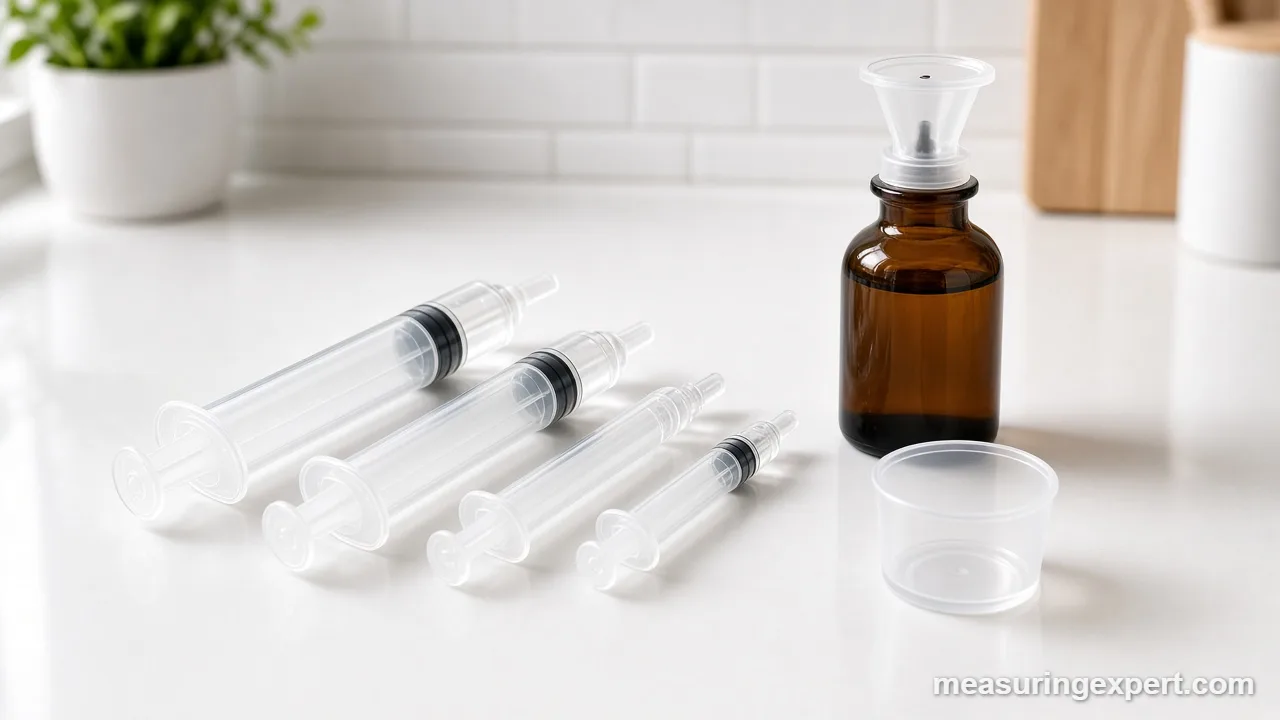
The best dosage syringe for most families is the Ezy Dose Kids True Easy 10 mL oral syringe, thanks to its color-coded dial and built-in stops. Still, the right pick depends on the amount you measure, the tip type (oral or ENFit) and whether you dose a baby, a toddler or a pet.
In short: choose the Ezy Dose True Easy for kids, a 1 mL UltiCare oral tip syringe for tiny amounts, Vesco ENFit syringes for feeding tubes, and a BD amber oral syringe for clinics and rescues.
As an Amazon Associate, Measuring Expert earns from qualifying purchases. Our picks are based on research, specifications and owner feedback, not paid placement.
Best Overall

Best Budget
Best Pro
Best Dosage Syringe Picks at a Glance
- Kids at home: Ezy Dose Kids True Easy, 10 mL, with a color-coded dial and safety stops.
- Drawing straight from the bottle: Ezy Dose Oral Syringe with Dosage Korc bottle adapter.
- Very small amounts: UltiCare 1 mL oral tip syringe, sterile and wrapped one by one.
- Pets and everyday refills: UltiCare 5 mL oral tip syringe in a 60-count box.
- Feeding tubes with ENFit ports: Vesco ENFit Low Dose Tip 3 mL and Vesco ENFit 10 mL.
- Babies who spit medicine out: MediFrida Accu-Dose Pacifier with syringe.
- Clinics, shelters and rescues: BD amber 5 mL oral syringe with tip caps.
On This Page
- Comparison table
- The 8 picks, reviewed
- How we chose
- Why mL beats a kitchen spoon
- Oral, ENFit and Luer tips
- Picking a size
- How to measure with a syringe
- mL to teaspoon converter
- Cleaning and care
- Do and don’t
- Honest limits
- FAQ
- Bottom line
Best Dosage Syringe Comparison Table
First, decide who gets the medicine and how much liquid you usually measure. Then use the table to jump to the matching review.
| # | Product | Best For | Standout Feature | Amazon |
|---|---|---|---|---|
| 1 | Ezy Dose Kids True Easy 10 mL | Kids at home | Color-coded dial with safety stops | View |
| 2 | Ezy Dose Oral Syringe with Dosage Korc | Drawing from the bottle | Press-in bottle adapter | View |
| 3 | UltiCare Oral Tip 1 mL | Very small amounts | Sterile, wrapped one by one | View |
| 4 | UltiCare Oral Tip 5 mL | Pets and repeat use | Oral tip with cap, 60 count | View |
| 5 | Vesco ENFit Low Dose Tip 3 mL | Small amounts via ENFit tube | Low dose tip, ISO 80369-3 | View |
| 6 | Vesco ENFit 10 mL | Larger amounts via ENFit tube | Free of BPA, DEHP and latex | View |
| 7 | MediFrida Accu-Dose Pacifier | Babies who spit out medicine | Side channel aims at the cheek | View |
| 8 | BD Oral Syringe 5 mL, Amber | Clinics and rescues | Non-luer tip, amber barrel | View |
The 8 Best Dosage Syringe Picks, Reviewed
First, every product below is an oral or enteral syringe without a needle. In other words, none of them is meant for injections. If you need a syringe for glue, ink, lab work or feeding animals by the cup, see our separate best syringe guide instead.
Best Overall
1. Ezy Dose Kids True Easy Oral Syringe, 10 mL
Best for: Parents who want help stopping at the same line every time, especially at night or with a squirming child.
The Ezy Dose Kids True Easy is our pick as the best dosage syringe for most homes. Also, it holds 10 mL, which is 2 US teaspoons, so it covers most liquid children’s medicine in a single fill. However, the real reason it stands out is the dial. Apothecary Products, the maker, describes a color-coded dosage dial and built-in safety stops, so the plunger is easier to stop at the mark your pharmacist showed you.
In addition, the oversized grip helps tired hands. Moreover, the brand lists easy-to-read calibrations, and the product carries a Parent Tested, Parent Approved award. As a result, it suits caregivers who share medicine duty and want a repeatable routine.
- Capacity: 10 mL (2 tsp)
- Color-coded dial with built-in safety stops
- Oversized grip; BPA free per the listing
- Reusable; wash between uses
Pros
- Dial makes repeat measuring easier
- One fill covers most kids’ liquids
- Comfortable large grip
Cons
- 10 mL barrel is coarse for tiny amounts
- More parts to clean than a plain syringe
- No ENFit option
Skip it if: You measure under 1 mL at a time, because a 1 mL syringe such as the UltiCare below reads small steps far more clearly.
Best With Bottle Adapter
2. Ezy Dose Oral Syringe with Dosage Korc, 10 mL
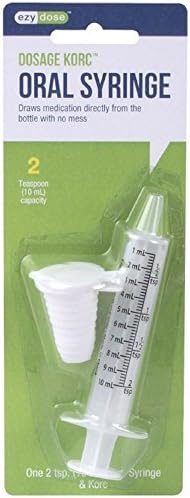
Best for: Caregivers who want to draw medicine straight from the bottle without pouring it into a cup first.
This plain Ezy Dose oral syringe comes with a Dosage Korc, a press-in adapter that sits in the bottle neck. So you can turn the bottle upside down and pull the plunger, which means less mess and fewer spills. In addition, according to the maker, the syringe is calibrated in milliliters and is latex free.
Also, Apothecary Products says its gasket material keeps the plunger from sticking after repeated use. That matters because a sticky plunger tends to jump past the line. Finally, the simple shape is designed to prevent over-insertion into the mouth.
- Capacity: 10 mL; a 5 mL version is also made
- Calibrated in mL
- Includes a press-in bottle adapter (Dosage Korc)
- Latex free; gasket resists sticking
Pros
- Bottle adapter cuts spills
- Smooth plunger over many uses
- Simple design is easy to clean
Cons
- Adapter may not fit every bottle neck
- No dial or stops
- Coarse for very small amounts
Skip it if: Your pharmacy already pressed an adapter into the bottle, since you then only need a syringe that fits it.
Best Budget
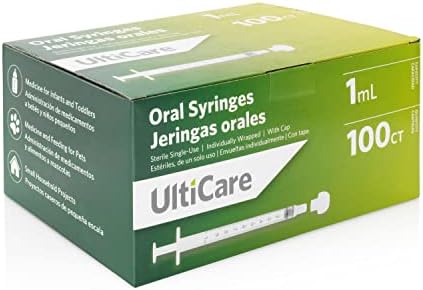
3. UltiCare Oral Tip Syringe with Cap, 1 mL
Best for: Infants, small pets and any prescription measured in fractions of a milliliter.
When the amount is small, a small barrel is the most accurate choice. That is because the same 1 mm of plunger travel moves far less liquid in a 1 mL barrel than in a 10 mL one. So the UltiCare 1 mL oral tip syringe is our budget pick and the best dosage syringe for tiny volumes.
Furthermore, each syringe is sterile and individually wrapped, and each has a cap and an oral tip. Therefore, you can keep a clean one in a diaper bag or pet travel kit. Because the box holds 100, you can also replace a syringe as soon as its markings fade.
- Capacity: 1 mL
- Oral tip with cap
- Sterile, individually wrapped
- 100 per box
Pros
- Fine steps for small amounts
- Large box at a low cost per piece
- Clean, sealed packaging
Cons
- Too small for 5 mL or 10 mL amounts
- Caps are a choking risk for kids
- Thin print can be hard to read
Skip it if: You usually measure 5 mL or more, because refilling a 1 mL syringe several times adds error.
Best for Pets
4. UltiCare Oral Tip Syringe with Cap, 5 mL

Best for: Dog and cat owners, and families who give the same liquid every day and want spares.
Similarly, the 5 mL UltiCare has the same oral tip and cap design as the 1 mL model, but it holds five times more. For example, it handles a typical pet liquid or a child’s antibiotic in one fill. In addition, the 60-count box means you can keep one syringe per medicine, so two liquids never share a barrel.
When dosing pets, first aim the tip into the cheek pouch behind the canine tooth, then push slowly. However, always ask your veterinarian how much to give, since pet amounts depend on weight and the drug.
- Capacity: 5 mL (1 metric tsp)
- Oral tip with cap
- 60 per box
Pros
- Good middle size for daily use
- Enough spares for one per medicine
- Oral tip, so no needle fit
Cons
- Not ideal under 1 mL
- Disposable build wears with washing
Skip it if: Your pet takes less than 1 mL, because the 1 mL size gives a clearer reading.
Best ENFit Low Dose
5. Vesco Medical ENFit Low Dose Tip Syringe, 3 mL
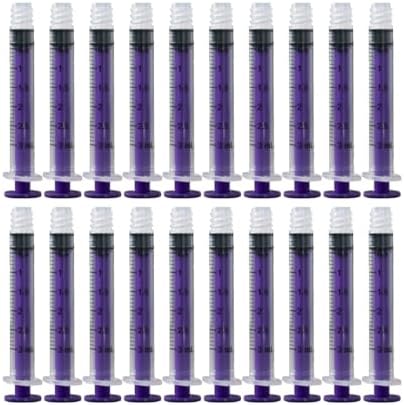
Best for: Children and adults with a feeding tube that has an ENFit port, when the amount is small.
To begin with, ENFit is the enteral connector defined in ISO 80369-3. It is shaped so it cannot connect to IV lines, which helps prevent a deadly wrong-route mistake. However, a standard ENFit tip can hold a little liquid around its tip, and that error matters more at small volumes. So Vesco offers a Low Dose Tip version in 0.5, 1 and 3 mL.
Furthermore, Vesco prints the mL graduations following ISMP guidance. Also, the company says these syringes are not made with natural rubber latex, BPA, DEHP or other phthalates. Even so, the sterile versions are single-patient use, so ask your care team how often to replace them.
- Capacity: 3 mL, low dose tip
- ISO 80369-3 ENFit connector
- mL graduations per ISMP guidance
- Not made with latex, BPA or DEHP
- Pack of 20
Pros
- Low dose tip suits small volumes
- Fits ENFit tube ports
- Clear safety-focused materials list
Cons
- Needs an ENFit bottle adapter to fill
- Single-patient use, not lifetime use
- Overkill if there is no feeding tube
Skip it if: Nobody in your home uses a feeding tube; a plain oral syringe is simpler for mouth dosing.
Best ENFit Standard
6. Vesco Medical ENFit Syringe, 10 mL

Best for: Families flushing a tube or giving larger liquid amounts through an ENFit port.
In contrast, this is the standard-tip partner to the Low Dose Tip model. Vesco makes the standard version in 5, 10, 20, 35 and 60 mL, and the 10 mL size is a handy middle ground. As a result, many home-tube families keep both: a small low dose syringe for medicine and a 10 mL syringe for larger volumes.
Likewise, the same material claims apply: no latex, BPA, DEHP or other phthalates. In addition, every Vesco product is ISO 80369-3 compliant, according to the company.
- Capacity: 10 mL, standard ENFit tip
- ISO 80369-3 compliant
- Not made with latex, BPA or DEHP
- Pack of 25
Pros
- Locks onto ENFit ports
- Good size for larger volumes
- Same maker as the low dose pick
Cons
- Standard tip is less precise at small volumes
- Does not fit oral-tip bottle adapters
Skip it if: You only give medicine by mouth, since an oral tip syringe is lighter and easier to handle.
Best for Babies
7. MediFrida Accu-Dose Pacifier

Best for: Babies who already use a pacifier and tend to spit medicine back out.
The MediFrida pairs an oral syringe with a pacifier that has a side channel. First, you fill the syringe and twist it into the channel. Next, you place the pacifier with the channel toward the cheek. Then, once the baby starts to suck, you push the plunger. Frida says this sends medicine toward the cheek instead of onto the tongue, which can mean fewer spit-ups.
Additionally, both parts are BPA free and dishwasher safe, according to Frida. Also, the pacifier works with standard oral syringes, so you can still use the syringe that came with the medicine.
- Pacifier with side syringe channel
- Works with standard oral syringes
- BPA free; dishwasher safe
- Pacifier tab closes for normal use
Pros
- Delivers toward the cheek
- Calms babies who like a pacifier
- Accepts other oral syringes
Cons
- No help if baby refuses pacifiers
- Extra parts to wash
- Thick liquids flow slowly
Skip it if: Your child is past the pacifier stage; a plain oral syringe works better for toddlers.
Best Pro
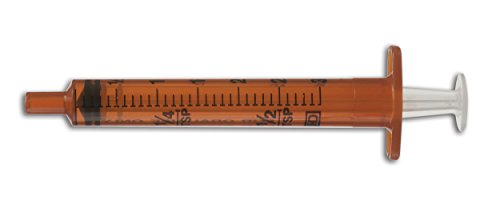
8. BD Oral Syringe with Tip Cap, 5 mL, Amber
Best for: Vet clinics, animal rescues, foster homes and pharmacies that prepare many doses ahead.
First of all, BD oral syringes use a larger non-luer tip. BD says this tip does not misconnect with luer devices, so the syringe cannot accept a standard needle or IV connector. Moreover, the amber barrel helps shield light-sensitive liquids, and the tip caps let staff fill syringes in advance.
In addition, BD lists metric markings for accuracy. However, these syringes are non-sterile, and the tip caps come loose in a bag. Because the box holds 500, this is a pro pick rather than a home one.
- Capacity: 5 mL, amber barrel
- Non-luer oral tip
- Metric markings; tip caps included
- Non-sterile; 500 per box
Pros
- Cannot take a needle
- Amber helps protect light-sensitive liquids
- Caps allow pre-filling
Cons
- 500-count box is far too many for one home
- Non-sterile
- Amber tint makes the liquid line harder to see
Skip it if: You treat one child or one pet; a 60 or 100 count box of clear syringes is plenty.
How We Chose the Best Dosage Syringe Picks
To be clear, we did not run hands-on tests. Instead, our picks are research-based. First, we listed oral and ENFit syringes from established medical and baby brands. Next, we checked each maker’s specifications, such as capacity, tip type, markings and materials. Then we read owner feedback for common complaints, for example sticky plungers or fading print.
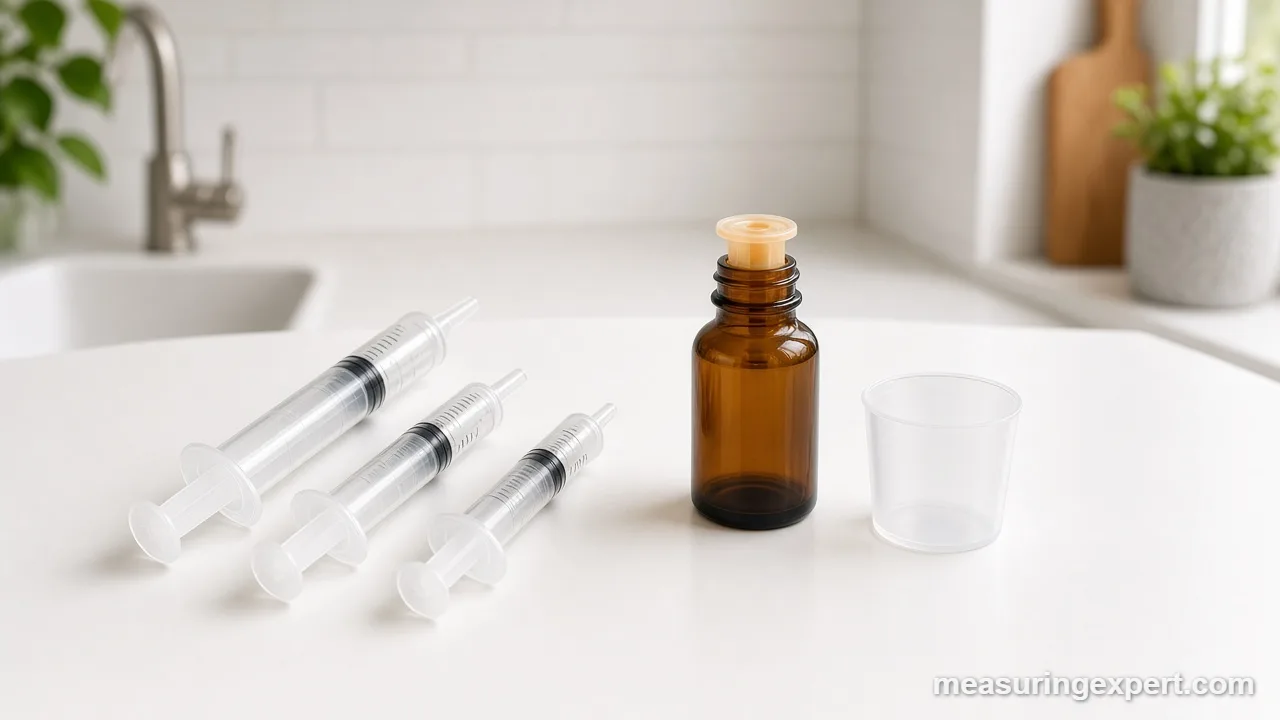
In addition, we leaned on public guidance. The American Academy of Pediatrics, through its HealthyChildren.org advice on liquid medicines, calls an oral syringe usually the most accurate dosing tool. We also read the FDA guidance on dosage delivery devices for over-the-counter liquid drugs. Finally, we removed anything with a luer tip that could take a needle, because this guide covers oral use only.
- Clear mL markings that are easy to read.
- Oral or ENFit tip, never a needle fitting.
- Size range from 1 to 10 mL.
- Brand track record in pharmacy, hospital or baby care.
Why an mL Syringe Beats a Kitchen Spoon
In fact, kitchen spoons are made for soup, not medicine. Also, their size varies a lot from one set to the next, so the same “teaspoon” can hold very different amounts. That is why the AAP advises never to use household spoons for medicine. Similarly, in a 2015 policy statement, the AAP recommended that liquid medicine be dosed in milliliters only.
Likewise, the FDA guidance points the same way. It covers the cups, droppers, syringes and spoons that come packed with over-the-counter liquids, and it pushes makers to match the device markings to the label. As a result, the safest habit is simple: use the device that came with the medicine. If none came with it, ask your pharmacist for an oral syringe marked in mL.
Oral, ENFit or Luer: Which Best Dosage Syringe Tip Fits?
Above all, the tip decides what the syringe can connect to. So it matters as much as the markings. To clarify, here is how the three common types compare.
| Tip type | What it fits | Use it for | Takes a needle? |
|---|---|---|---|
| Oral tip | Oral bottle adapters | Medicine by mouth | No |
| ENFit (ISO 80369-3) | ENFit tube ports and adapters | Feeding tubes; some hospitals also use it by mouth | No |
| ENFit Low Dose Tip | Same as ENFit | Small volumes through a tube | No |
| Luer slip or lock | Needles and IV parts | Lab, craft and injection use | Yes |
In short, a luer syringe is the wrong tool for medicine by mouth. Instead, choose an oral tip for mouth dosing and ENFit for a feeding tube. That way, the best dosage syringe you pick can never be connected to the wrong line.
Sizing the Best Dosage Syringe: 1, 3, 5 or 10 mL
A simple rule from pharmacy practice: pick the smallest syringe that holds the whole amount in one fill. That is because a small barrel spreads each milliliter over a longer stretch of plunger, so each line is easier to hit. On the other hand, refilling a tiny syringe several times adds error with every fill.
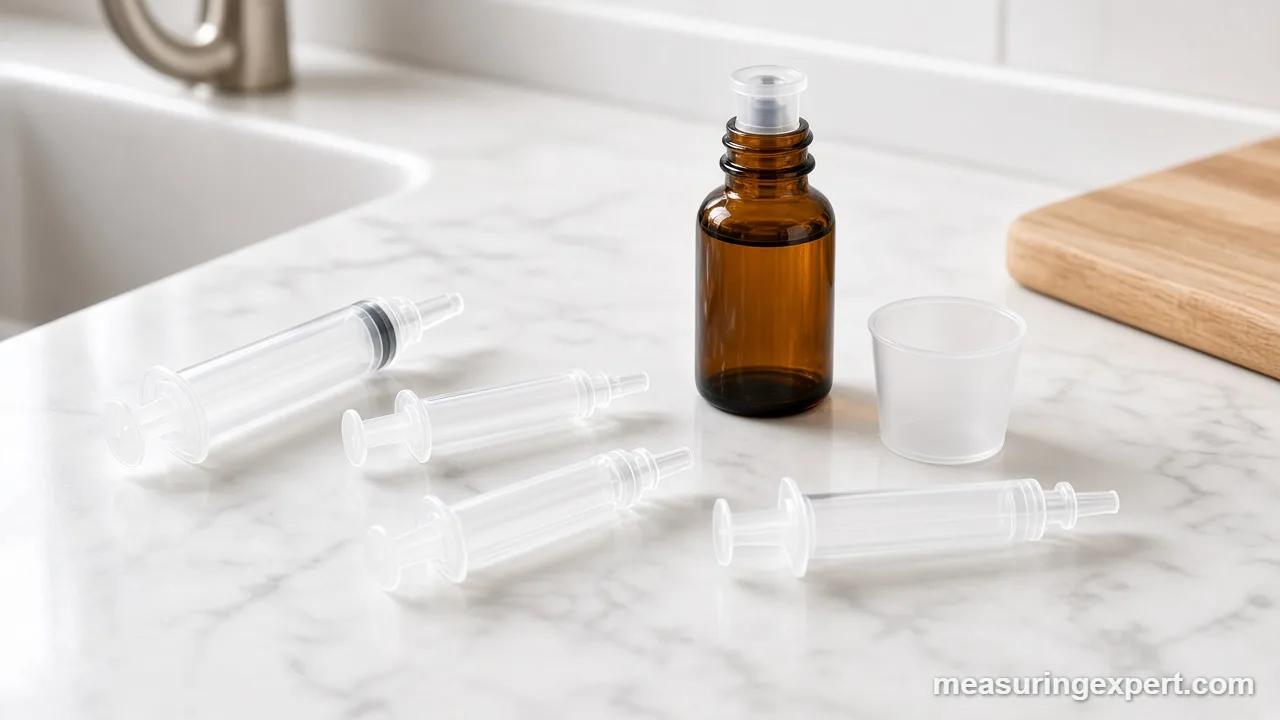
| Syringe size | Good for | Watch out for |
|---|---|---|
| 1 mL | Fractions of a mL; infants and small pets | Tiny print; easy to lose |
| 3 mL | Small amounts that are more than 1 mL | Fewer home brands |
| 5 mL | Everyday kids’ and pet liquids | Coarser than 1 mL for small amounts |
| 10 mL | Larger amounts in one fill | Least precise for small amounts |
For more on reading volume, see our guide on how to measure volume in mL.
How to Measure Liquid Medicine with an Oral Syringe
Note that these steps cover the measuring side only. Instead, your doctor, pharmacist or vet decides the amount.
- Read the label and confirm the amount in mL with your pharmacist if anything is unclear.
- Choose the device that came with the medicine, or else the smallest oral syringe that holds the amount.
- Shake the bottle if the label says so, then fit the bottle adapter or pour a little into a clean cup.
- Pull the plunger slightly past the line, turn the tip up, tap out air bubbles and push back to the line.
- Hold the syringe at eye level and line up the front edge of the plunger seal with the mark.
- Remove the cap, then give the liquid slowly toward the inside of the cheek, not the back of the throat.
- Wash the syringe, let it dry and store it with that medicine only.
Also, write the time on a chart after each dose, so two caregivers do not repeat it.
mL to Teaspoon Converter
Of course, older labels and recipes sometimes say “tsp.” However, medicine should be measured in mL with the device that came with it. Use this converter only to understand an old label, then confirm with your pharmacist. Note that a metric (medical) teaspoon is exactly 5 mL, while a US teaspoon is about 4.93 mL. For background, our page on what tsp means explains the difference.
Cleaning and Care for Your Best Dosage Syringe
First, take the syringe apart right after use. Rinse the barrel and plunger in warm water, then wash with mild soap. Next, rinse again and let both parts air-dry before you put them back together. For general tips on reading small kitchen measures, our guide to using measuring spoons also helps.
After that, replace the syringe when the print fades, the plunger sticks or the barrel cracks. In addition, follow the maker’s rule on reuse. For example, Vesco labels its sterile ENFit syringes for single-patient use, and BD oral syringes are non-sterile from the box. Finally, keep caps away from small children, since a loose cap is a choking hazard.
Do and Don’t at Medicine Time
Honest Limits
Of course, even the best dosage syringe cannot fix a wrong amount on the label or a misread decimal. Also, markings can rub off with heavy washing. In the same way, thick liquids can trap air bubbles, so a reading may look right while the barrel holds less. Moreover, a child who spits out part of a dose changes what was actually taken; in that case, call your doctor or pharmacist before giving more.
Best Dosage Syringe FAQ
What is the best dosage syringe for kids?
For most kids, the best dosage syringe is a 10 mL oral syringe with clear mL marks, such as the Ezy Dose Kids True Easy. However, if the medicine came with its own syringe, use that one first.
Why should I use an oral syringe instead of a spoon?
Kitchen spoons vary in size. As a result, they can give too much or too little. In contrast, an oral syringe marked in mL is usually the most accurate tool, according to the AAP.
What is an ENFit syringe?
An ENFit syringe has the enteral connector from ISO 80369-3. It fits ENFit feeding tube ports and cannot connect to IV lines, which helps prevent wrong-route errors.
Is 5 mL the same as 1 teaspoon?
In short, a metric or medical teaspoon is exactly 5 mL. A US teaspoon is about 4.93 mL. Still, always dose in mL with the device that came with the medicine.
What size best dosage syringe should I buy?
First, pick the smallest size that holds the whole amount in one fill. For example, use a 1 mL syringe for fractions of a mL and a 5 or 10 mL syringe for larger amounts.
Can I use an oral syringe for my dog or cat?
Yes. In fact, many vets send liquids home with an oral syringe. Aim into the cheek pouch and push slowly, and ask your vet how much to give.
Can I reuse an oral syringe?
Generally, many home oral syringes can be washed and reused until the print fades or the plunger sticks. However, follow the maker’s label, since some are marked single use or single-patient use.
Why does an oral syringe have a different tip from a regular syringe?
Oral and ENFit tips do not fit needles or IV parts. Therefore, they reduce the risk of giving an oral liquid by the wrong route.
How do I read the line on a syringe?
Hold the syringe at eye level and line up the front edge of the plunger seal with the mark. Also, tap out air bubbles first, since they take up space.
Is the best dosage syringe the one that comes with the medicine?
Usually, yes. That device is matched to the label directions, so it is the best dosage syringe for that medicine. If it is lost, ask your pharmacist for a replacement marked in mL.
Bottom Line: Which Best Dosage Syringe to Buy
For most families, the Ezy Dose Kids True Easy 10 mL is the best dosage syringe, because its dial and stops make repeat measuring easier. Meanwhile, add a 1 mL UltiCare for tiny amounts, choose Vesco ENFit syringes for a feeding tube, and pick BD amber syringes for a clinic. Above all, use the device that came with the medicine when there is one.
1 thought on “Best Dosage Syringe for Kids and Pets: 8 Oral Syringes Compared”