

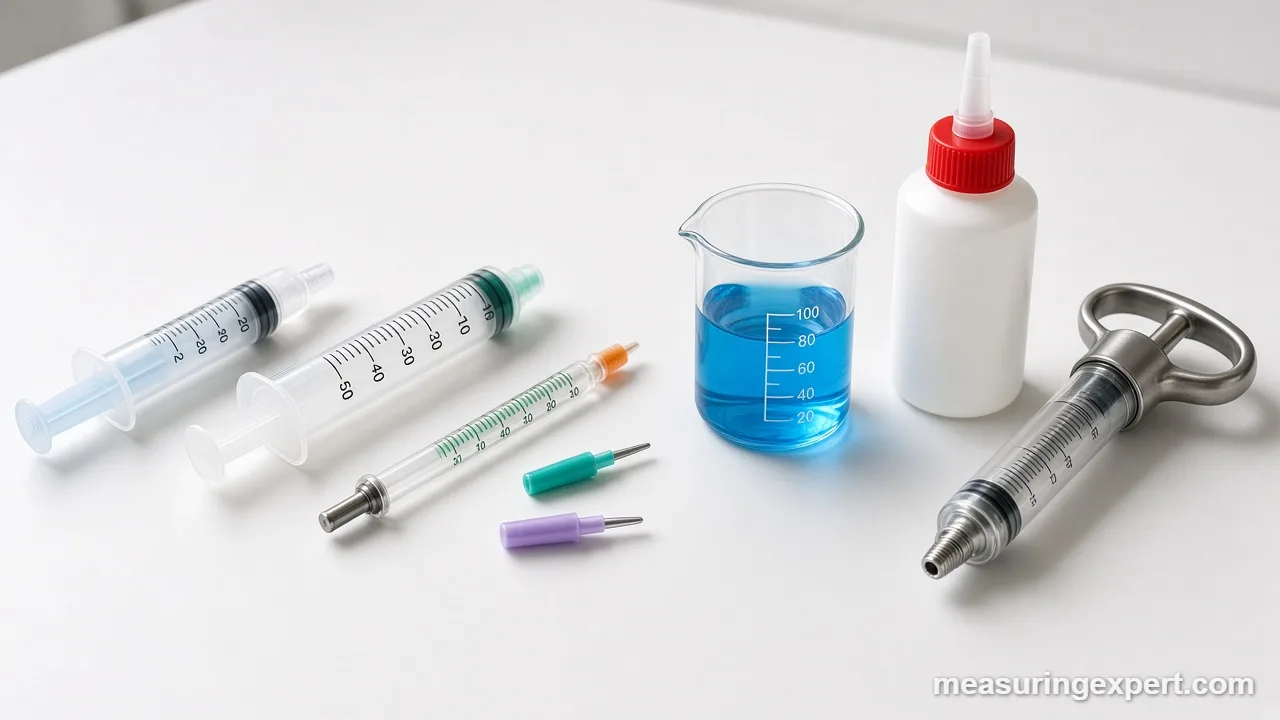
The best syringe for measuring liquids is a clear 10 mL Luer lock syringe with crisp 0.2 mL marks, such as the BH Supplies 10 mL Luer Lock pack. Still, the right choice depends on volume, tip style (Luer lock, blunt tip, catheter tip) and what the liquid is: lab reagent, glue, oil, marinade or plant food.
In short: buy BH Supplies 10 mL Luer lock for general measuring, a 1 mL Brandzig for tiny amounts, Kopperko glass for oils, BH Supplies 60 mL catheter tip for feeding, and Ofargo stainless for marinades.
As an Amazon Associate, Measuring Expert earns from qualifying purchases. Our picks are based on research, specifications and owner feedback, not paid placement.
Best Overall

Best Budget

Best Glass

Quick Answer: Best Syringe by Job
- General lab and hobby measuring: BH Supplies 10 mL Luer lock, sterile and wrapped one by one.
- Fractions of a milliliter: Brandzig 1 mL Luer lock, where each line is a hundredth of a mL.
- Cheap refills and crafts: Labfil 5 mL Luer slip in a 12-pack.
- Essential oils and solvents: Kopperko 1 mL borosilicate glass with a Luer lock.
- Glue, epoxy and ink: a Luer lock kit with 14G and 18G blunt dispensing tips.
- Plant food, pet feeding and big transfers: BH Supplies 60 mL catheter tip with caps.
- Marinades: Ofargo 2 oz stainless steel injector kit.
On This Page
- Comparison table
- The picks, reviewed
- How we chose
- Tip types explained
- Graduations and accuracy
- How to read and measure
- Syringe volume converter
- Cleaning and reuse
- Honest limits
- FAQ
- Bottom line
Best Syringe Comparison Table
First, match the tip to the job. Next, pick the smallest barrel that holds the full amount in one fill. Finally, the table below links to each review.
| # | Product | Best For | Standout Feature | Amazon |
|---|---|---|---|---|
| 1 | BH Supplies 10 mL Luer Lock | General measuring | Sterile, wrapped one by one, 100 count | View |
| 2 | Brandzig 1 mL Luer Lock | Tiny volumes | Finest scale in the lineup | View |
| 3 | Labfil 5 mL Luer Slip | Crafts and refills | Low-cost 12-pack | View |
| 4 | Kopperko 1 mL Glass Luer Lock | Oils and solvents | Borosilicate glass barrel | View |
| 5 | Blunt-Tip Dispensing Kit (1, 3, 10 mL) | Glue, epoxy, ink | 14G and 18G blunt tips with caps | View |
| 6 | BH Supplies 60 mL Catheter Tip with Caps | Feeding and big transfers | Tip caps included | View |
| 7 | Ofargo Stainless Marinade Injector | Marinades | 304 stainless barrel, 4 tips | View |
The 7 Best Syringe Picks, Reviewed
First, every pick below arrives without a sharp needle. In other words, these are tools for moving and measuring liquid. Also, we skipped the oral medicine syringes that we cover in our dosage syringe guide, so the two lists do not overlap.
Best Overall
1. BH Supplies 10 mL Luer Lock Tip Syringe
Best for: Anyone who needs one dependable size for lab work, hobby mixing, refilling and general liquid measuring.
To begin with, a 10 mL barrel is the sweet spot for most measuring jobs. For example, it holds two US teaspoons in a single fill, yet the scale is still fine enough for 1 mL steps. As a result, the BH Supplies 10 mL pack is our top pick and the best syringe to keep in a drawer. Also, the listing describes a Luer lock tip, no needle, sterile packing and individual wrappers, in a box of 100.
Moreover, the Luer lock thread matters more than it seems. Because the fitting screws on, a blunt tip, filter or tubing adapter stays put when you push thick liquid. Similarly, a fresh sterile barrel for each reagent removes the cross-contamination risk that ruins small lab batches.
- Capacity: 10 mL (10 cc)
- Tip: Luer lock, no needle included
- Sterile and individually wrapped, per the listing
- Pack size: 100 syringes
Pros
- Threaded tip accepts blunt tips and adapters
- One size covers most measuring jobs
- Fresh barrel for every liquid
Cons
- 100-count box is a lot for occasional use
- Too coarse for amounts under 1 mL
- Plastic barrel is not for strong solvents
Skip it if: you measure fractions of a milliliter, or you handle acetone and similar solvents, because they attack plastic.
Best for Small Volumes
2. Brandzig 1 mL Luer Lock Syringe

Best for: Measuring tiny amounts, such as fragrance drops, reagent spikes, flavor concentrates and resin tints.
In general, resolution comes from barrel size. For example, on a typical 1 mL syringe, each small line equals 0.01 mL, which is ten times finer than a 10 mL barrel. Therefore, a 1 mL syringe is the best syringe when the whole job is under a milliliter. In addition, Brandzig lists this one as a Luer lock syringe with no needle, sterile and individually wrapped, 100 per pack.
Also, the thin barrel makes small bubbles easy to see. This helps because one trapped bubble can be a large share of a 0.1 mL measurement.
- Capacity: 1 mL (1 cc)
- Tip: Luer lock, no needle
- Sterile, individually wrapped, 100 count, per the listing
Pros
- Finest readable scale here
- Locks onto blunt tips for drop-level dispensing
- Bubbles are easy to spot
Cons
- Many refills needed for larger amounts
- Small print is hard to read in dim light
Skip it if: most of your amounts are 3 mL or more, since repeated refills add error.
Best Budget
3. Labfil 5 mL Luer Slip, 12-Pack
Best for: Crafts, printer ink refills, classroom science and quick liquid transfers where a sterile wrapper is not needed.
Of course, not every job needs a box of 100. Instead, the Labfil 12-pack gives you a handful of 5 mL syringes for refilling, mixing and DIY work. Also, the listing names a Luer slip tip and no needle. In fact, a slip tip is a smooth taper, so it pushes onto a tip or tube by friction rather than a thread.
For example, a 5 mL barrel is a good middle size for paint, hydroponic nutrients and ink. However, the slip fit can pop off under heavy pressure. Therefore, keep it for thin liquids.
- Capacity: 5 mL (5 cc)
- Tip: Luer slip, no needle
- Pack size: 12, per the listing
Pros
- Small pack suits occasional users
- Good middle size for refills
- Slip tip fits many tubes and tips
Cons
- Slip tip can detach with thick liquids
- Not sold as sterile lab stock
Skip it if: you push glue or gel through a narrow tip; in that case, a Luer lock thread is safer.
Best Glass
4. Kopperko 1 mL Borosilicate Glass Luer Lock Syringe
Best for: Essential oils, solvents, flavor extracts and any liquid that clouds or swells plastic.
Above all, glass is the classic lab choice for chemistry. That is because borosilicate glass resists most solvents and heat, and it does not leach plastic into oils. As a result, Kopperko’s 1 mL glass syringe is the best syringe for oil work and repeat use. Specifically, the listing names a borosilicate glass barrel with a Luer lock tip.
In addition, printed glass scales stay sharp after many washes. On the other hand, glass is fragile. For this reason, store it in its box, since a dropped barrel can crack.
- Capacity: 1 mL
- Barrel: borosilicate glass
- Tip: Luer lock
- Pack size: 1, per the listing
Pros
- Handles oils and many solvents
- Reusable and easy to clean
- Fine 1 mL scale
Cons
- Breakable
- Single piece, so no spares
- Costs more per unit than plastic
Skip it if: the syringe travels in a toolbox or kids will handle it, since glass can break.
Best for Glue and Ink
5. Blunt-Tip Dispensing Kit (1, 3 and 10 mL)

Best for: Wood glue, epoxy, ink cartridges, lubricants and precise beads in tight gaps.
Overall, this nine-piece kit pairs 10 mL, 3 mL and 1 mL Luer lock syringes with 14G and 18G blunt dispensing tips and storage caps, according to the listing. As a result, you can pick a wide tip for thick wood glue and a narrow one for thin ink. Also note that blunt tips are flat at the end, which is why they suit benchwork rather than skin.
Keep in mind that gauge works backward: a higher number means a narrower bore. Therefore, an 18G tip lays a finer bead than a 14G tip. Also, cap the tip between uses so glue does not cure inside it.
- Sizes: 10 mL, 3 mL and 1 mL syringes
- Tips: 14G and 18G blunt dispensing tips
- Luer lock fit with storage caps, per the listing
Pros
- Three barrel sizes in one kit
- Two tip widths for thick and thin liquids
- Caps keep glue from drying in the tip
Cons
- Small kit runs out fast for big projects
- Cured epoxy ruins a barrel
Skip it if: you need clean lab stock, since a sterile wrapped box suits that better.
Best for Feeding
6. BH Supplies 60 mL Catheter Tip Syringe with Caps

Best for: Feeding plants, hand-feeding animals on a vet’s plan, filling reservoirs and moving larger volumes.
To begin with, a catheter tip is a long, wide taper. As a result, it slides into soft tubing and pushes thick liquid with little effort. For that reason, this BH Supplies 60 mL pack is the best syringe for plant food, aquarium dosing and pet feeding formulas. Also, the listing describes a catheter tip with caps, no needle, sterile and individually wrapped, in a 25-pack.
The caps are handy, too. For instance, you can fill several syringes in the morning, cap them, and use them later without drips. However, big barrels trade resolution for capacity. Typical 60 mL scales step in 1 mL, so measure small doses with a smaller syringe instead.
In addition, individual wrappers help when you keep the box in a barn, greenhouse or garage. Still, label each capped syringe, because clear barrels look alike.
- Capacity: 60 mL (60 cc), about 2 US fl oz
- Tip: catheter tip with caps, no needle
- Sterile, individually wrapped, 25 count, per the listing
Pros
- Moves thick liquid easily
- Fits soft tubing
- Caps stop drips during storage
Cons
- Coarse scale for small amounts
- Will not lock onto Luer fittings
- 25 is a lot to store for light use
Skip it if: you measure under 5 mL or need a threaded connection; instead, choose a Luer lock barrel.
Best for Cooking
7. Ofargo Stainless Steel Marinade Injector Kit, 2 oz

Best for: Brisket, turkey and pork shoulder cooks who want marinade spread evenly through a large cut.
Basically, a kitchen injector is a measuring syringe built for food. According to Ofargo’s product page, this kit has a 2 oz barrel, about 59 mL, with the barrel, plunger and marinade tips made of 304 stainless steel. Because of this, it will not stain or hold odors the way some plastic injectors do.
In addition, Ofargo lists four interchangeable tips, six spare silicone O-rings, two tip cleaners and a barrel brush. Furthermore, the maker says the kit is dishwasher safe. For even seasoning, then, split the full barrel across a grid of spots, for example about 10 mL in each of six spots.
- Capacity: 2 oz (about 59 mL)
- Barrel, plunger and tips: 304 stainless steel
- Four interchangeable marinade tips and 6 spare O-rings
- Dishwasher safe, per Ofargo
Pros
- All-metal barrel resists stains and odors
- Spare O-rings extend its life
- Cleaning tools included
Cons
- Steel barrel hides the liquid level
- Fine tips clog with chunky marinades
Skip it if: you want to see the liquid while you measure, because only a clear plastic syringe shows the level.
How We Chose the Best Syringe Picks
To be clear, we did not run hands-on tests. Instead, we compared listings and maker pages, read owner feedback for patterns, and checked each product against measuring needs. In particular, we looked at five points.
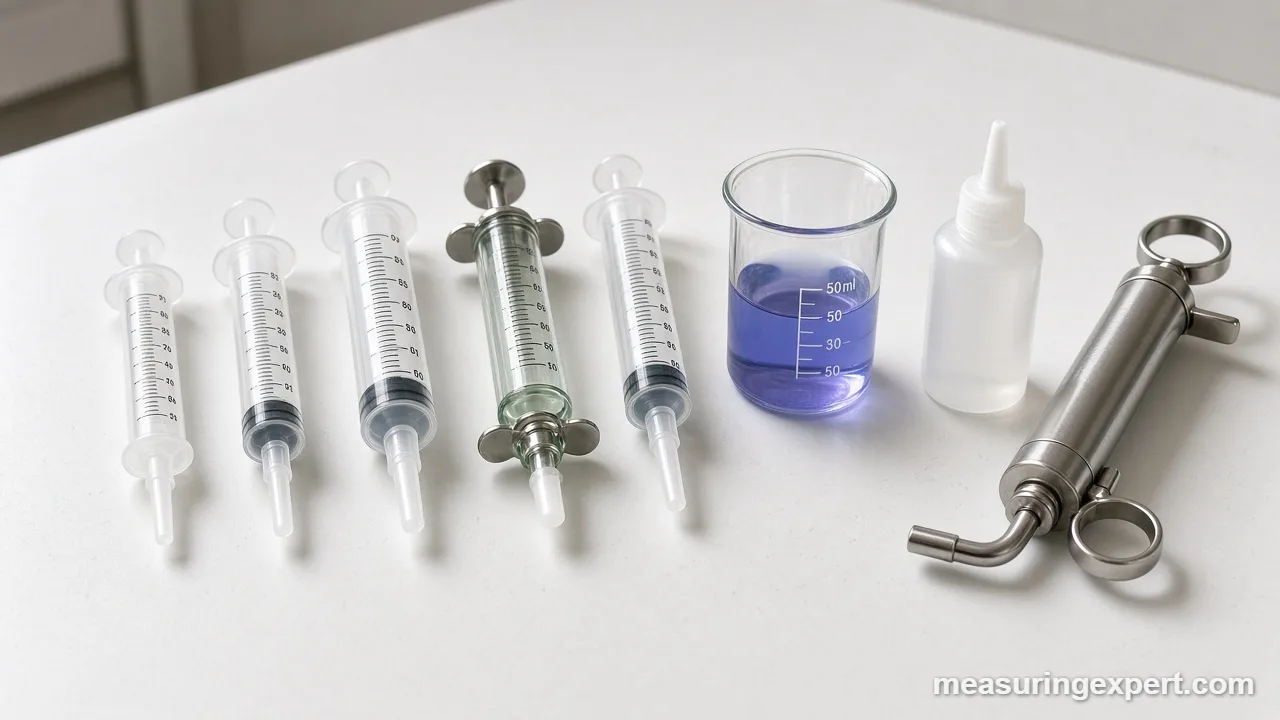
- Scale: readable marks and a size that fits the job.
- Tip: Luer lock, slip, catheter or blunt, matched to the liquid.
- Material: plastic for general use, glass for oils and solvents.
- Brand: established makers and medical suppliers, no junk listings.
- Scope: no sharp needles, and no overlap with oral medicine syringes.
We also used the syringe scope in ISO 7886-1, the standard for single-use plastic syringes, to frame what a graduated barrel should deliver. However, that standard excludes glass syringes, so glass picks rely on the maker’s own markings.
Luer Lock, Slip, Catheter or Blunt Tip?
First of all, the tip decides what your syringe can connect to. Therefore, choose it first and the size second.
| Tip | How it connects | Good for | Watch out for |
|---|---|---|---|
| Luer lock | Screw thread | Blunt tips, filters, thick liquids | Needs a matching thread |
| Luer slip | Friction taper | Quick transfers, thin liquids | Can pop off under pressure |
| Catheter tip | Long wide taper | Tubing, feeding, big volumes | Does not fit Luer parts |
| Blunt dispensing tip | Screws onto Luer lock | Glue, epoxy, ink, oil | Narrow gauges clog with thick glue |
| Kitchen injector | Threaded marinade tips | Marinades and brines | Food use only |
For example, a glue bottle and a printer cartridge both need a blunt tip. On the other hand, a plant feeder or a soft tube needs the catheter tip. In short, the wrong tip leaks, and a leak is a measuring error.
How Accurate Is the Best Syringe? Graduations Explained
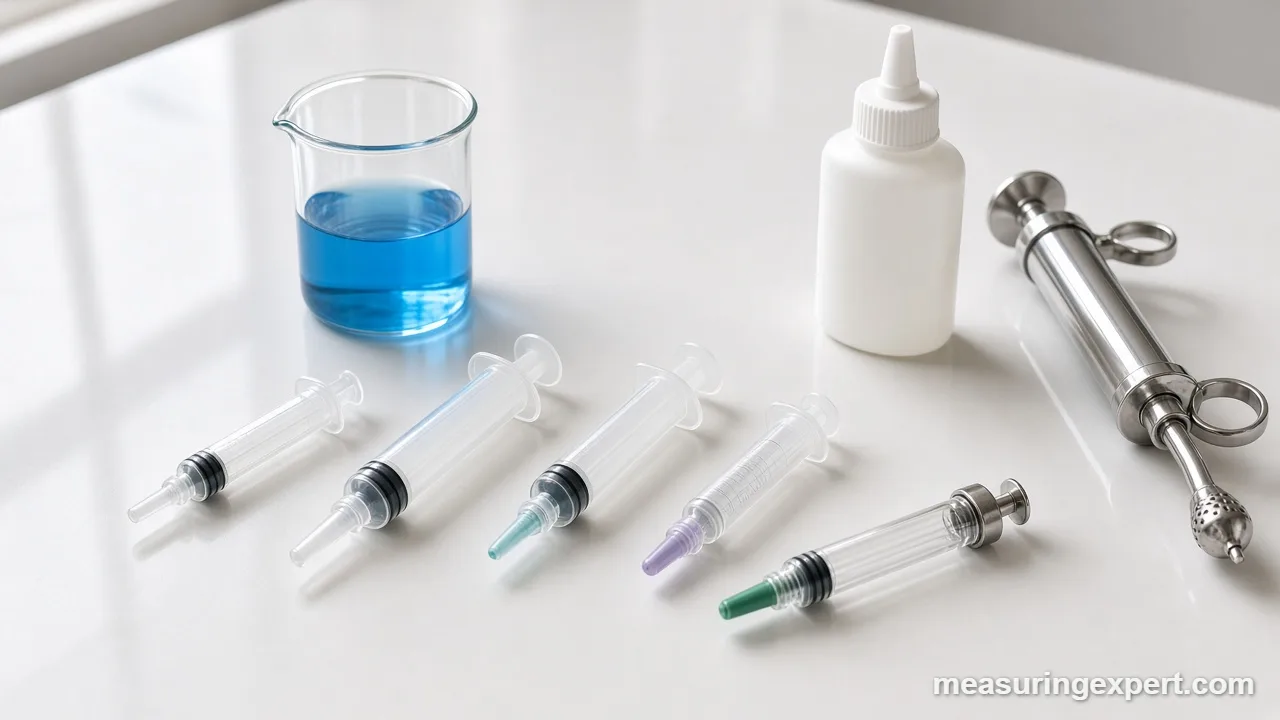
In practice, a syringe is only as precise as its smallest mark. As a rule of thumb, you can also read about half of one division by eye. So, a barrel marked every 0.2 mL gives you roughly 0.1 mL of reading uncertainty.
| Barrel size | Typical smallest mark | Practical reading limit | Good for |
|---|---|---|---|
| 1 mL | 0.01 mL | about 0.005 mL | Drops, tints, reagent spikes |
| 3 mL | 0.1 mL | about 0.05 mL | Small glue and ink jobs |
| 5 mL | 0.2 mL | about 0.1 mL | Refills, nutrients |
| 10 mL | 0.2 mL | about 0.1 mL | General measuring |
| 20 mL | 1 mL | about 0.5 mL | Larger mixes |
| 60 mL | 1 mL | about 0.5 mL | Feeding, transfers |
However, scales vary by maker, so check your own barrel. Also, keep in mind that 1 cc equals exactly 1 mL. In other words, the two labels mean the same volume.
Read the Front Edge of the Plunger
In fact, most reading errors come from the plunger seal. Usually, the rubber tip has two rings. So, always line up the ring closest to the tip with the mark, not the back ring. Next, hold the syringe at eye level so that parallax does not shift the line. Finally, count the minor marks between numbers before you read, because 5 and 10 mL barrels often skip labels.
Dead Space and Bubbles
Some liquid always stays in the tip and hub after you push the plunger home. Generally, this dead space is small. However, it matters when you measure under 0.5 mL, so draw and dispense with the same syringe and tip each time. Similarly, a bubble takes the place of liquid. Therefore, tap it to the tip and push it out before you read.
For more ways to handle tiny amounts, also see our guide on how to measure small quantities.
How to Measure Liquid with the Best Syringe
- Pick the smallest syringe that holds the full amount in one fill.
- Fit the right tip and lock it with a quarter turn if it is a Luer lock.
- Push the plunger all the way in, then dip the tip into the liquid.
- Pull slowly past your target line so you have a little extra.
- Point the tip up, tap the barrel and push out the air bubbles.
- Bring the front ring of the plunger seal to the mark at eye level.
- Dispense slowly, then rinse or cap the tip right away.
In addition, thick liquids such as honey or epoxy need a slow pull. Otherwise, the liquid lags behind the plunger and leaves a gap.
mL to Teaspoon and Ounce Converter
Often, recipes and labels mix units. So, use this converter to turn syringe milliliters into cc, teaspoons, tablespoons or fluid ounces.
For instance, a 60 mL syringe holds just over 2 US fluid ounces. Finally, if you want more on metric volume, read our guide to measuring volume in mL.
Cleaning, Reuse and Storage
First, rinse right after use, before glue cures or sugar dries. Then, pull warm water in and out several times. Next, take the plunger out. After that, wash both parts with mild soap and let them air-dry apart.
After that, store glass syringes in their box and plastic ones away from sunlight. Also, retire a syringe when the print fades, the plunger sticks or the barrel cracks. Above all, keep separate syringes for food, chemicals and pet use, and label them.
Honest Limits: What the Scale Cannot Do
Admittedly, a syringe is a great volume tool, but it is not a pipette or a balance. For example, a lab that needs certified accuracy should use calibrated volumetric glassware or weigh the liquid. Also, our laboratory beakers guide covers the glass side of the bench.
Also, plastic can swell with some solvents, and that changes the fit of the plunger. Likewise, thick liquids cling to the barrel wall. As a result, the amount delivered can be a little less than the amount drawn. In short, use the scale as a careful guide, and confirm critical amounts by weight.
Best Syringe FAQ
What is the best syringe for measuring liquids?
For most people, a 10 mL Luer lock syringe is the best all-round pick. It holds a useful amount, reads to about 0.1 mL, and accepts blunt tips and adapters.
Is 1 cc the same as 1 mL?
Yes. One cubic centimeter equals exactly one milliliter, so syringes use the two labels for the same volume.
How do I read the lines on a syringe?
Hold it at eye level and line up the front ring of the plunger seal with the mark. Also, count the small marks between numbers first.
Which best syringe size should I buy?
Choose the smallest size that holds the full amount in one fill. For example, use 1 mL for drops and 10 mL for everyday jobs.
What is the difference between Luer lock and Luer slip?
A Luer lock screws onto a tip or adapter, so it stays put under pressure. In contrast, a Luer slip pushes on by friction and can pop off.
What is a catheter tip syringe used for?
Its long, wide tip fits soft tubing. Therefore, it suits plant feeding, pet feeding formulas and moving larger volumes.
Is a glass syringe the best syringe for essential oils?
Usually, yes. Borosilicate glass resists oils and many solvents, while some plastics cloud or swell with them.
Can I use a blunt tip syringe for glue?
Yes. Fit a wide 14G tip for thick wood glue and a narrower 18G tip for thin glue or ink, then cap it between uses.
Can I reuse a plastic syringe?
For non-sterile jobs such as crafts or plant food, you can rinse and reuse it until the print fades or the plunger sticks.
Where is the best syringe for liquid medicine?
Medicine needs an oral syringe and the device that came with the bottle. See our separate dosage syringe guide, and follow your pharmacist.
Bottom Line: Our Best Syringe Pick
For most jobs, the BH Supplies 10 mL Luer Lock Tip Syringe is the best syringe to buy. After all, it has a readable scale, a secure thread and fresh sterile barrels. However, step down to a 1 mL barrel for tiny amounts, switch to glass for oils, and use a catheter tip for feeding.
2 thoughts on “Best Syringe for Measuring Liquids: 7 Needle-Free Picks for Lab, Glue, Kitchen and Feeding”