
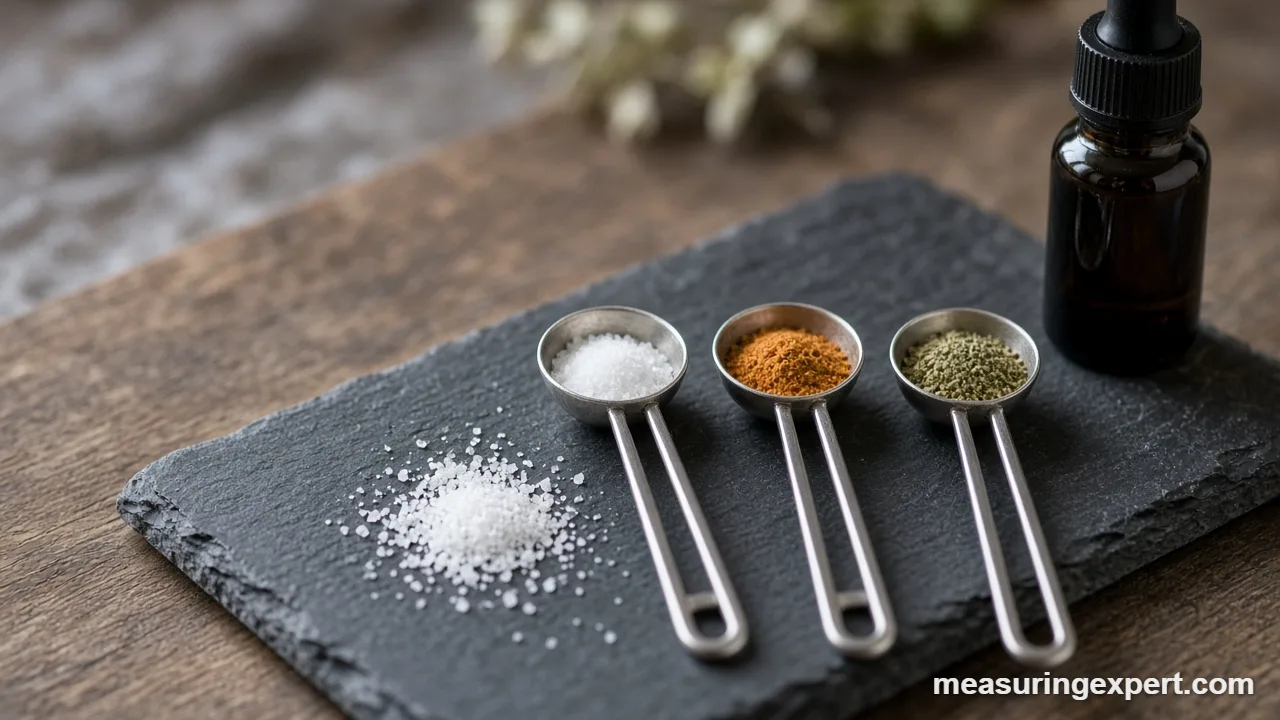
Small quantities in recipes follow a simple halving ladder. A tad is 1/4 teaspoon, a dash is 1/8 teaspoon, a pinch is 1/16 teaspoon, a smidgen is 1/32 teaspoon and a drop is 1/64 teaspoon. In metric terms, a pinch is about 0.31 mL and a dash about 0.62 mL.
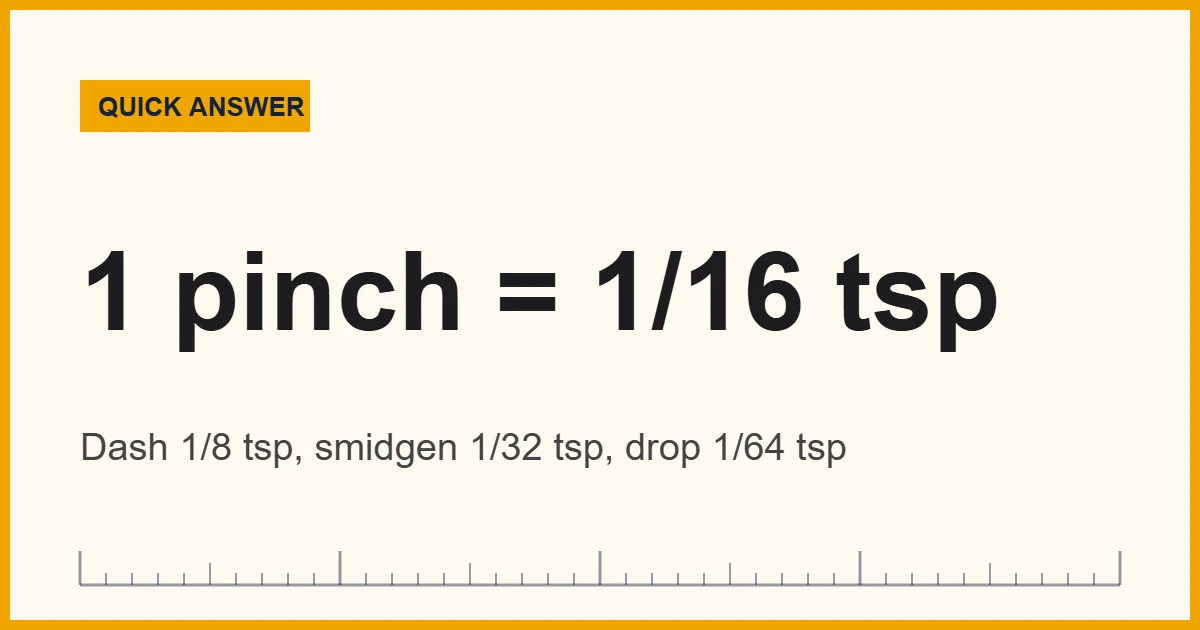
Old recipes love vague words. Grandma’s cards say “a pinch of salt”, cocktail books ask for “a dash of bitters”, and some bakers still write “just a smidgen of nutmeg”. Because none of these words is an official unit, cooks often guess. Of course, that usually works out. However, a guess can go wrong when the ingredient is strong, such as cayenne, clove, baking soda or almond extract.
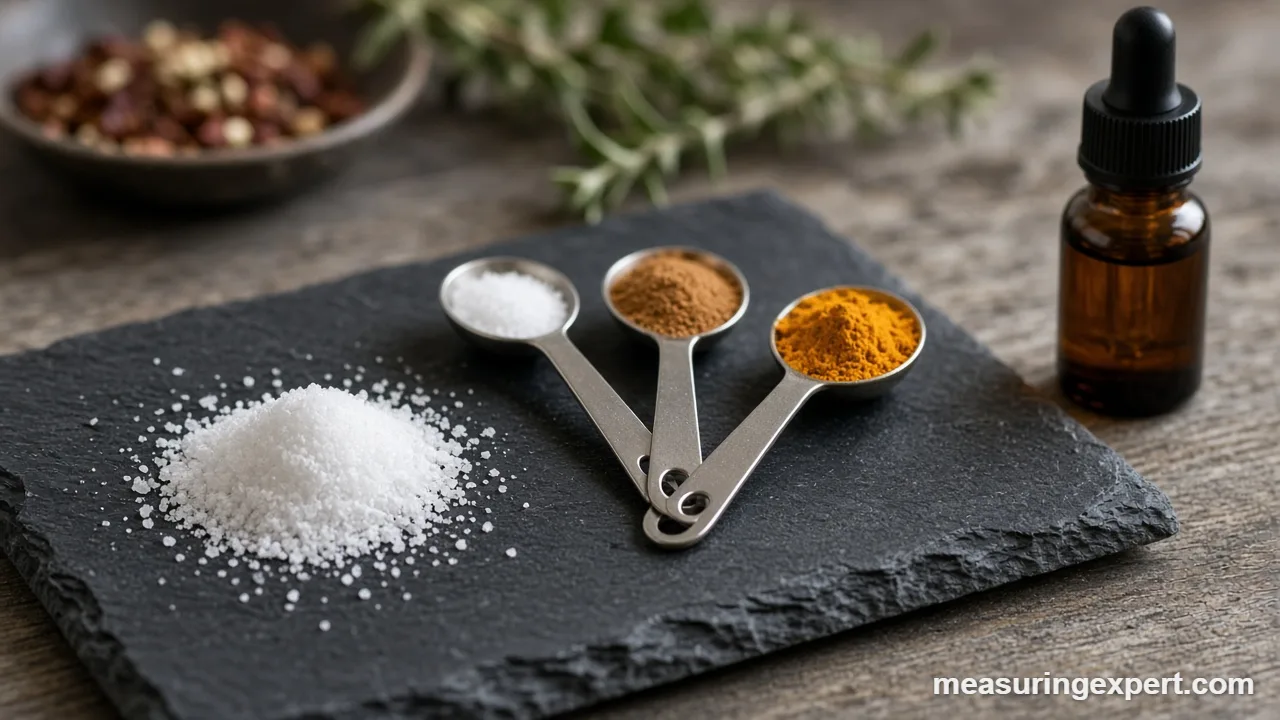
The good news is that small quantities now have widely accepted values. For instance, mini measuring spoon sets sold in the US are stamped tad, dash, pinch, smidgen and drop, and each spoon holds half of the one before it. So if you know that 1 teaspoon is about 4.93 mL, you can work out every smaller size by halving.
In short: treat a pinch as 1/16 teaspoon, a dash as 1/8 teaspoon and a smidgen as 1/32 teaspoon, then taste and adjust.
The US National Institute of Standards and Technology (NIST), which keeps the official US measurement standards, lists kitchen equivalents in its metric kitchen guide, for example 1.25 mL for 1/4 teaspoon and 5 mL for 1 teaspoon. However, NIST does not define a pinch or a dash. Instead, those values come from spoon makers and cookbook tradition, so this guide also explains where they can differ.
Below, you will find a converter, a chart, a step-by-step method, and tips for measuring tiny amounts with or without special spoons.
Convert Small Quantities From Teaspoons to Milliliters
The converter starts at 0.0625 teaspoon, which is one pinch. Type 0.125 for a dash, 0.03125 for a smidgen or 0.015625 for a drop. It then shows the same amount in milliliters, metric teaspoons and tablespoons.
Note that the converter has no “pinch” button, because a pinch is a convention rather than a defined unit. Therefore it works in teaspoons, which are defined exactly.
Recommended Tools for Measuring Small Quantities
In fact, two kinds of tools make tiny amounts easy. First, a mini spoon set stamped with tad, dash, pinch and smidgen gives repeatable volumes for dry spices. Second, a pocket scale that reads to 0.01 g lets you weigh salt, yeast or spice blends when a recipe gives grams. Also, look for engraved markings, since printed ones wear off in the dishwasher.


As an Amazon Associate, Measuring Expert earns from qualifying purchases.
- Each small spoon is half of the one above it: tad, dash, pinch, smidgen, drop.
- A pinch is 1/16 tsp (about 0.31 mL); a dash is 1/8 tsp (about 0.62 mL).
- A smidgen is 1/32 tsp and a drop is 1/64 tsp on most mini spoon sets.
- Older cookbooks sometimes used 1/8 tsp for a pinch, so context matters.
- A finger pinch varies a lot from cook to cook, so test your own.
- For grams, a 0.01 g pocket scale beats any spoon.
- Never use pinch-style guesses for medicine; use the device that comes with it.
Small Quantities Chart: Tad, Dash, Pinch, Smidgen and Drop
This chart uses the exact US teaspoon of 4.92892159375 mL. In addition, the salt column assumes table salt at roughly 6 g per level teaspoon, so treat it as a guide rather than a lab value.
| Name | Fraction of a teaspoon | Milliliters (US) | Table salt (approx.) | Equals |
|---|---|---|---|---|
| Tad (saltspoon) | 1/4 tsp | 1.23 mL | 1.5 g | 2 dashes |
| Dash | 1/8 tsp | 0.62 mL | 0.75 g | 2 pinches |
| Pinch | 1/16 tsp | 0.31 mL | 0.38 g | 2 smidgens |
| Smidgen | 1/32 tsp | 0.15 mL | 0.19 g | 2 drops |
| Drop | 1/64 tsp | 0.077 mL | 0.09 g | half a smidgen |
To go the other way, 16 pinches fill a level teaspoon and 48 pinches fill a US tablespoon. Similarly, 8 dashes make a teaspoon. If you need a refresher on the larger spoons, see our guide to the difference between a teaspoon and a tablespoon.
Pinch vs Dash vs Smidgen: Which Is Bigger?
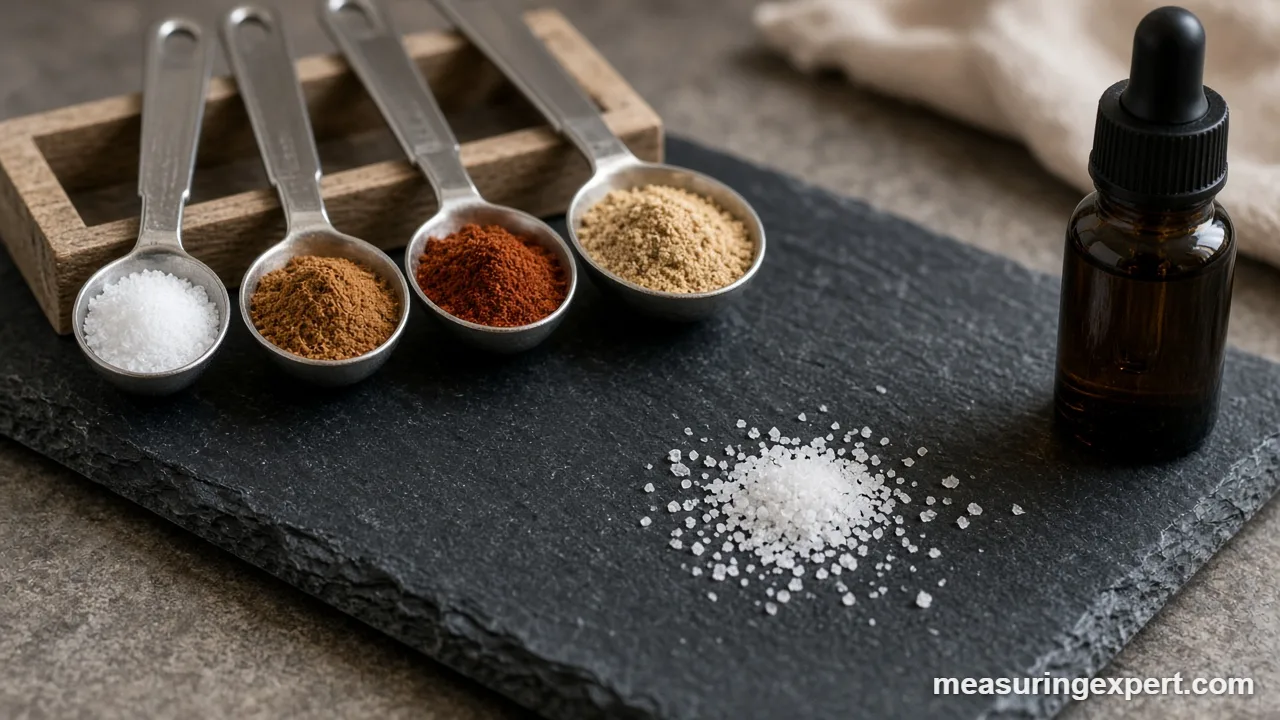
People mix these words up all the time, partly because the values have shifted over the years. For example, some nineteenth-century cookbooks treated a pinch as about 1/8 teaspoon. Today, by contrast, most spoon sets put the pinch at 1/16 teaspoon and give 1/8 teaspoon to the dash.
| Term | Modern spoon value | Usually used for | Where it differs |
|---|---|---|---|
| Dash | 1/8 tsp | Liquids (bitters, hot sauce) and dry spices | A bartender’s dash from a bitters bottle is a quick shake, so its size depends on the bottle |
| Pinch | 1/16 tsp | Dry ingredients (salt, pepper, herbs) | Older books sometimes used 1/8 tsp; a finger pinch varies with hand size |
| Smidgen | 1/32 tsp | Very strong spices (cayenne, clove, saffron) | Some writers use it loosely for “a tiny bit” |
| Drop | 1/64 tsp | Extracts, food coloring, essential flavor oils | A real drop from a dropper is often about 0.05 mL, smaller than the 0.077 mL spoon |
So, from biggest to smallest, the order is tad, dash, pinch, smidgen, drop. Meanwhile, an easy memory trick covers the middle three: D (dash), P (pinch) and S (smidgen) run in alphabetical order as the amounts get smaller.
How to Measure Small Quantities Like a Pinch
Whether you use a mini spoon or your fingers, the method is the same: control the amount, then check it.
- Read the recipe term. Decide whether it means a pinch (1/16 tsp), a dash (1/8 tsp) or a smidgen (1/32 tsp).
- Pick the matching spoon. Choose the stamped mini spoon, or use the converter above to find the mL value.
- Dip and overfill. Scoop the dry ingredient so it mounds slightly above the rim.
- Level the top. Next, sweep a flat knife or a leveler across the spoon so the surface is flat.
- Tap it in over the bowl. Then hold the spoon close to the food so light spices do not scatter.
- Taste before adding more. Finally, wait a moment, stir and taste, since salt and heat build as food sits.
For a finger pinch, use your thumb and first two fingers for a “chef’s pinch” or thumb and forefinger for a small pinch. As a result, the amount stays closer to what the recipe intends than a random shake from a jar.
Measuring Small Quantities of Liquid: Dashes and Drops
Of course, liquids behave differently from powders. For example, a dash of hot sauce or bitters usually means one quick shake from a bottle with a restricted pour spout. Because the opening size changes from brand to brand, the volume changes too. If you want consistency, pour into a 1/8 teaspoon instead.
In addition, drops are even trickier. A standard medicine dropper is often described as releasing about 20 drops per milliliter of water, which makes one drop about 0.05 mL. However, thick liquids such as vanilla extract or oils form bigger or smaller drops depending on the dropper, the temperature and how fast you squeeze. A “drop” spoon (1/64 tsp, about 0.077 mL) is therefore closer to one and a half dropper drops.
How to Measure Small Quantities Without Mini Spoons
Still, you do not need special spoons to get close. Here are four practical workarounds:
- Halve a 1/4 teaspoon. Fill and level a 1/4 tsp, then push half out with a knife for a dash, or a quarter for a pinch.
- Divide a pile. Pour a level 1/8 tsp onto a plate and split it into two equal piles; each pile is a pinch.
- Calibrate your fingers. Take five finger pinches of salt into a 1/4 tsp. If they fill it, your pinch is about 1/16 tsp.
- Use an oral syringe for liquids. A 1 mL syringe marked in 0.1 mL steps measures a dash (about 0.6 mL) easily.
Also, if your recipe is from the UK or Australia, small spoon fractions are based on a 5 mL teaspoon rather than 4.93 mL. That difference is tiny at this scale, but our page on US vs UK cooking measurements explains where it does matter.
Weighing Small Quantities With a Digital Scale
Volume is fine for seasoning, so spoons work there. For bread, cures and fermentation, though, recipes often give grams, and spoons cannot match that. By contrast, a pocket scale with 0.01 g resolution can show the difference between 0.3 g and 0.4 g of salt, which a pinch never will.
To weigh reliably, first place the scale on a flat, still surface away from fans. Next, put a small paper cup on the platform and press tare. Then add the ingredient slowly with a small spoon. Keep in mind that cheap scales are often less accurate near zero, so weigh a larger batch and divide when you can. For example, weigh ten pinches of salt and divide by ten to learn what one of your pinches weighs.
If grams still feel abstract, our explainer on how much 1 gram is compares it with everyday objects.
Do and Don’t for Small Quantities
Do
- Level mini spoons with a flat edge.
- Test how big your own finger pinch is.
- Add strong spices in small steps and taste.
- Weigh salt for bread, brines and cures.
- Keep extracts in bottles with drip caps.
Don’t
- Shake spices straight from a wide jar over the pot.
- Assume an old recipe’s pinch equals a modern one.
- Swap a dash of bitters for a dash of hot sauce blindly.
- Trust a scale reading near zero without checking.
- Use kitchen guesses for medicine doses.
Honest Limits of Pinch and Dash Measurements
First of all, these names are conventions, not legal units. In fact, no US standards body defines a pinch, and spoon makers simply settled on the halving ladder used here. Consequently, two sets from different brands can differ a little, and your own hand will differ more. In addition, volume says nothing about weight: a pinch of fine table salt weighs noticeably more than a pinch of flaky salt, because the flakes trap air. In short, the values on this page are good starting points for flavor, not precise doses.
When to Ask a Professional
In general, most kitchen mistakes with small quantities are easy to fix. Even so, a few situations need expert input. For medicine, ask a pharmacist and use the oral syringe or dosing cup supplied with the product; medication safety groups warn that kitchen spoons vary widely in how much they hold. For curing meat with nitrite salts, follow a tested recipe in grams. Likewise, if you work with essential oils or concentrated flavorings, check the supplier’s guidance before you use them in food. Our guide to pharmacy measurement units explains how pharmacists measure small volumes.
Small Quantities FAQs
How much is a pinch in teaspoons?
A pinch is 1/16 teaspoon on modern measuring spoons, or about 0.31 mL. Some older cookbooks used 1/8 teaspoon, so start small and taste.
Is a dash more than a pinch?
Yes. A dash is 1/8 teaspoon, which is two pinches. A pinch is 1/16 teaspoon.
How much is a smidgen?
A smidgen is 1/32 teaspoon, or about 0.15 mL. In other words, it is half a pinch.
How many drops are in a teaspoon?
On mini spoon sets, a drop is 1/64 teaspoon, so 64 drops fill a teaspoon. With a dropper that gives about 0.05 mL per drop, a US teaspoon is closer to 99 drops.
What is the order of small quantities from biggest to smallest?
The order is tad (1/4 tsp), dash (1/8 tsp), pinch (1/16 tsp), smidgen (1/32 tsp) and drop (1/64 tsp). Each one is half of the one before.
How many pinches are in a teaspoon?
There are 16 pinches in a level teaspoon, and 48 pinches in a US tablespoon.
How much does a pinch of salt weigh?
A 1/16 teaspoon pinch of table salt weighs roughly 0.38 g. Flaky or kosher salt weighs less for the same volume.
What tool measures small quantities of ingredients?
Mini measuring spoons stamped tad, dash, pinch, smidgen and drop measure small quantities by volume. A 0.01 g pocket scale measures them by weight.
Can I measure small quantities without special spoons?
Yes. Halve a level 1/4 or 1/8 teaspoon with a knife, or test how many finger pinches fill a 1/4 teaspoon. For liquids, a 1 mL oral syringe works well.
Is a dash of liquid the same as a dash of a dry spice?
On spoon sets, both are 1/8 teaspoon. A dash shaken from a bottle, however, depends on the spout, so it can be larger or smaller.
Small Quantities: The Bottom Line
Pinches, dashes and smidgens sound vague, but modern spoon sets give them clear values: 1/16, 1/8 and 1/32 teaspoon, with the tad at 1/4 and the drop at 1/64. Because each step halves the last, you can measure any of them with a 1/4 teaspoon and a knife.
So for everyday cooking, use those values as a starting point and trust your taste. For bread, cures or anything given in grams, weigh instead. And for medicine, skip the kitchen terms entirely and use the dosing device that comes with it.
1 thought on “How to Measure Small Quantities of Ingredients: Pinch, Dash, Smidgen and Drop”