

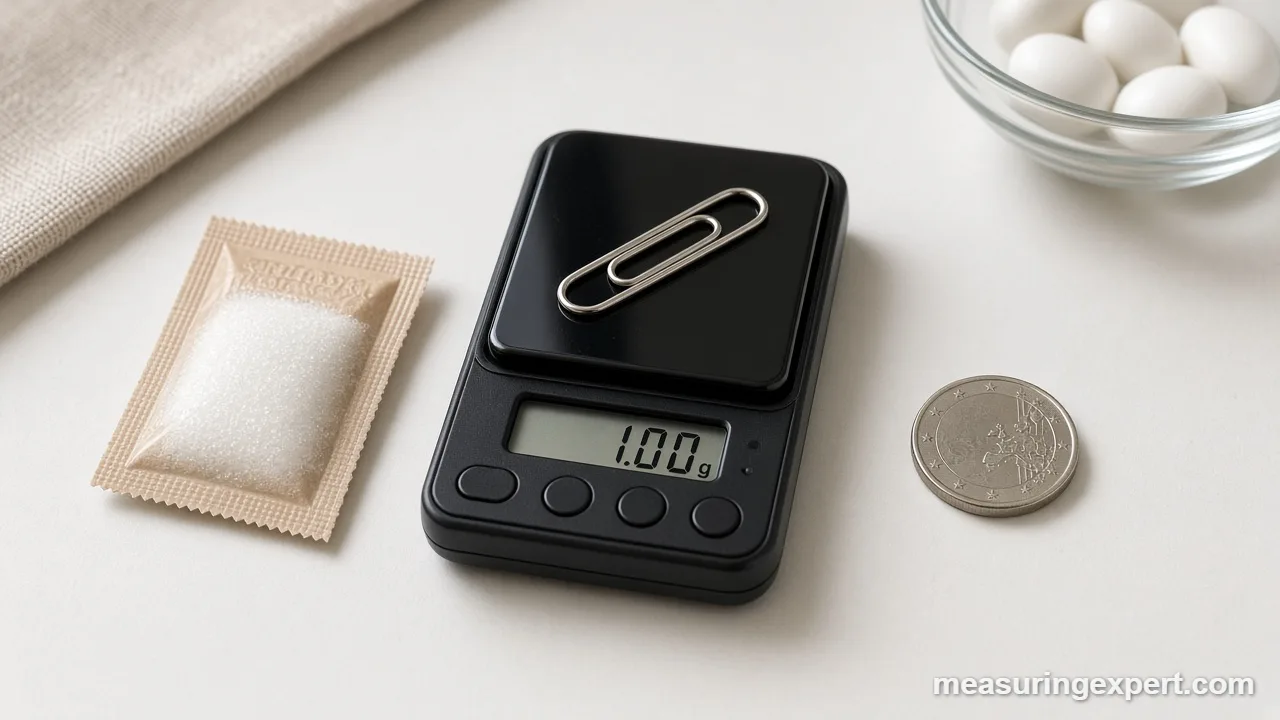
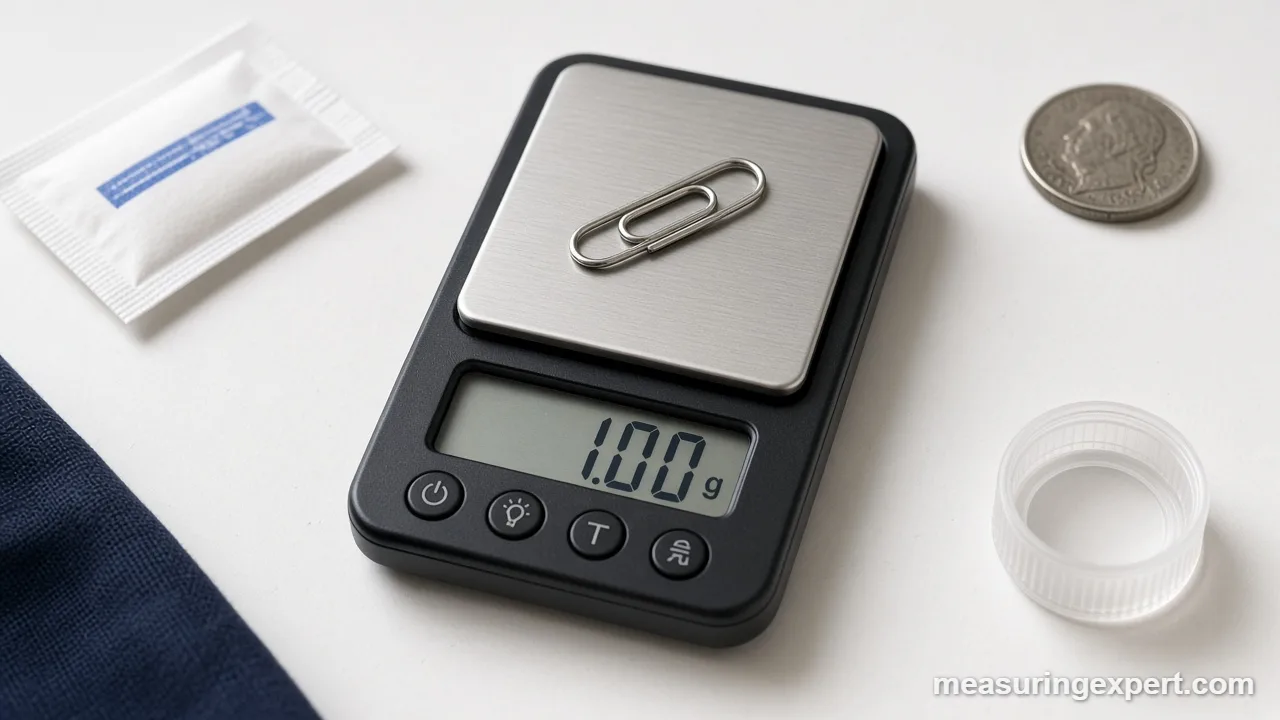
1 gram (g) is a small metric unit of mass: exactly 1/1,000 of a kilogram, or 1,000 milligrams. In US units, it also equals about 0.035 ounces (0.0353 oz) and about 15.43 grains. For a feel of the size, a standard paperclip or one milliliter of water weighs roughly 1 gram.
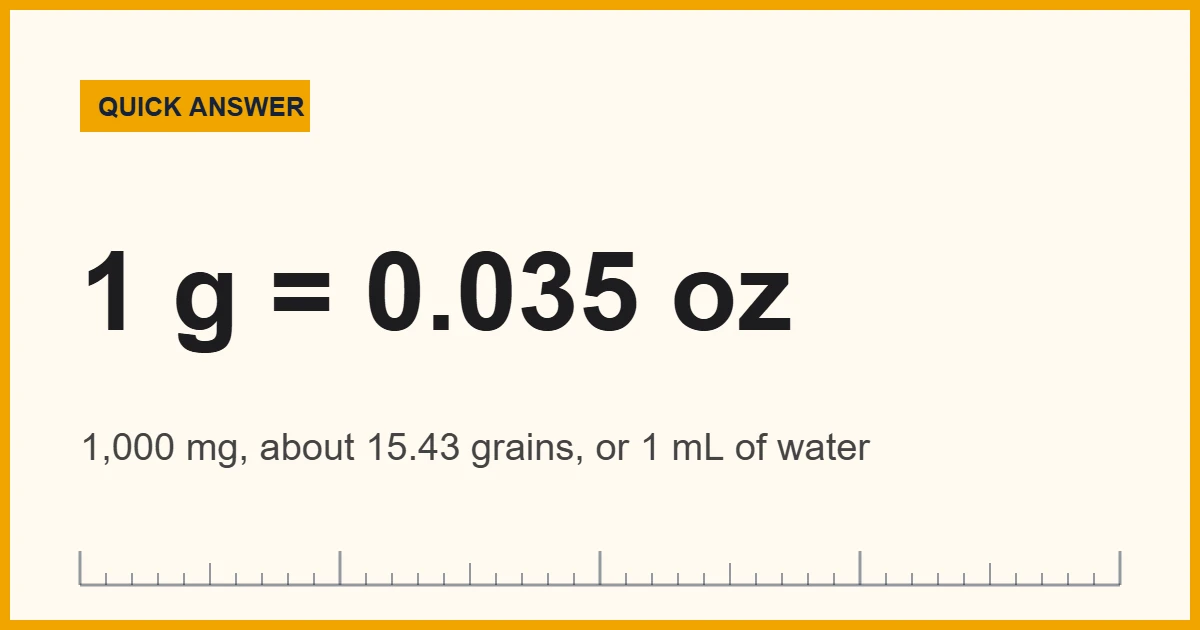
Convert 1 Gram to Ounces, Milligrams and More
First, type any amount below and choose the unit you start with. The converter then uses the exact NIST and BIPM definitions and shows ounces, milligrams, grains, pounds and carats at once.
Above all, the gram is the unit most of the world uses for food, mail, spices, coffee and jewelry. In the United States, for example, you see it on every nutrition label, where protein, fat and sugar appear in grams. Still, a single gram is hard to picture, because almost nothing in daily life weighs that little on its own.
The definition, however, is precise. In fact, the gram is one thousandth of a kilogram, and the kilogram is the SI base unit of mass. Since 2019, the International Bureau of Weights and Measures (BIPM) has defined the kilogram through a fixed value of the Planck constant instead of a metal cylinder in a vault. As a result, a gram is now tied to a constant of nature. On the US side, the avoirdupois ounce is exactly 28.349523125 g, so the math from grams to ounces is exact as well.
- 1 g = 1,000 mg = 0.001 kg.
- In US weight, 1 g is about 0.0353 oz, so 28.35 g make one ounce.
- Also, 1 g is about 15.43 grains and 5 metric carats.
- Similarly, one pound holds about 453.59 g.
- For example, for water 1 g takes up about 1 mL, or 0.2 teaspoon.
- Other ingredients differ, so a gram of flour fills more space than a gram of salt.
Grams to Ounces Chart
All these values come from the exact definitions and are rounded to four decimals for ounces and two for grains. In addition, you can print the chart or save it on your phone for the kitchen.
| Grams | Milligrams | Ounces (avdp) | Grains |
|---|---|---|---|
| 0.1 g | 100 mg | 0.0035 oz | 1.54 gr |
| 0.5 g | 500 mg | 0.0176 oz | 7.72 gr |
| 1 g | 1,000 mg | 0.0353 oz | 15.43 gr |
| 2 g | 2,000 mg | 0.0705 oz | 30.86 gr |
| 5 g | 5,000 mg | 0.1764 oz | 77.16 gr |
| 10 g | 10,000 mg | 0.3527 oz | 154.32 gr |
| 28.35 g | 28,350 mg | 1.0000 oz | 437.51 gr |
| 50 g | 50,000 mg | 1.7637 oz | 771.62 gr |
| 100 g | 100,000 mg | 3.5274 oz | 1,543.24 gr |
| 453.59 g | 453,592 mg | 16 oz (1 lb) | 7,000 gr |
| 1,000 g | 1,000,000 mg | 35.2740 oz | 15,432.36 gr |
Also, for the reverse direction, see our guide on how much an ounce weighs in grams.
Recommended Tools for Weighing Small Amounts
However, most kitchen scales read in 1 g steps, which is fine for flour but too coarse for spices, yeast or coffee dosing. For that reason, a pocket scale with 0.01 g resolution is the better choice for small amounts. Also, a small set of calibration weights lets you check either scale in seconds.


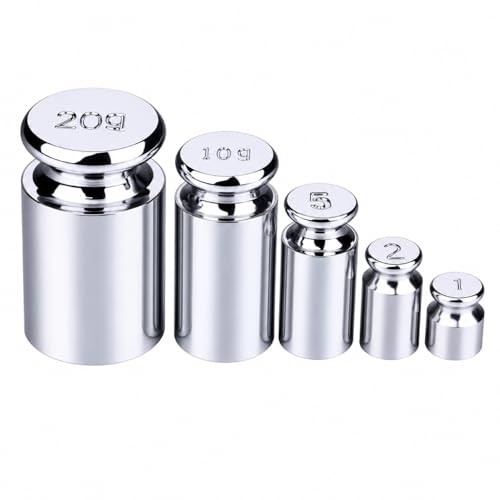
As an Amazon Associate, Measuring Expert earns from qualifying purchases.
What Weighs 1 Gram? Everyday Examples
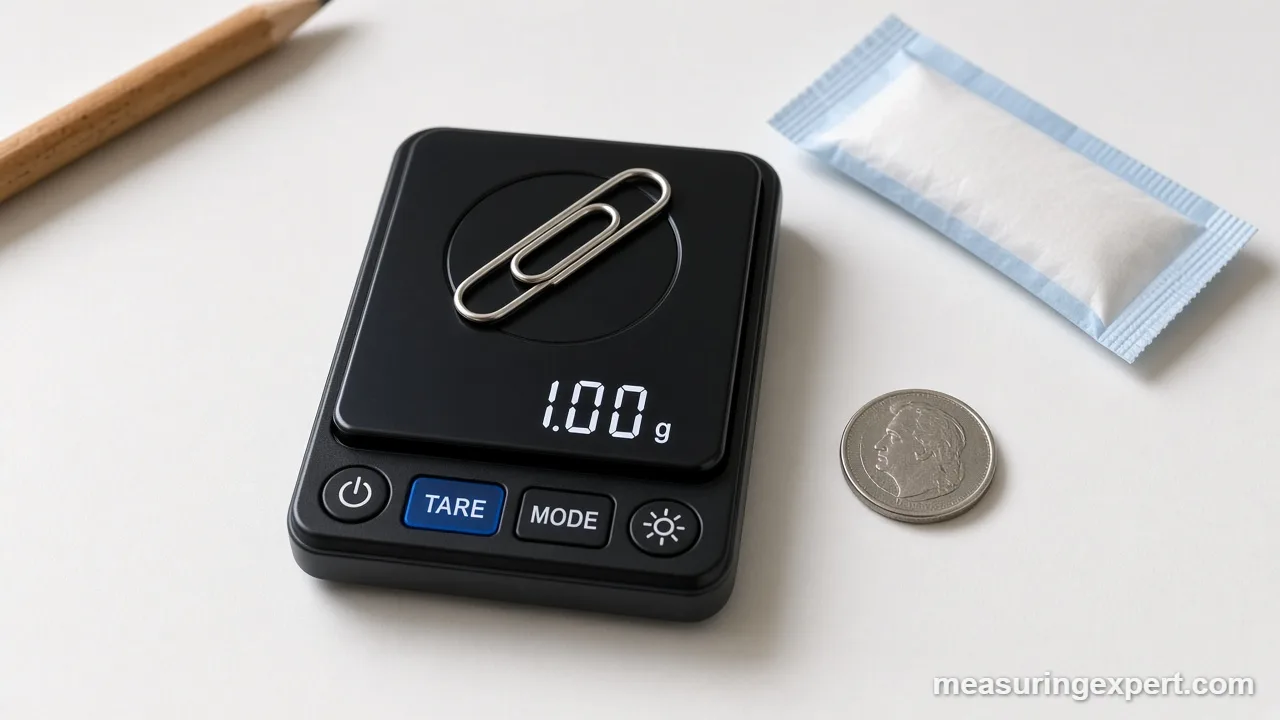
Real objects vary, so treat these as rough guides rather than reference weights. Even so, they give you a useful mental picture.
| Item | Typical weight | Compared with 1 gram |
|---|---|---|
| Standard metal paperclip | about 1 g | about the same |
| 1 mL of water | about 1 g | about the same |
| US dime | 2.268 g | a bit more than double |
| US penny (since 1982) | 2.5 g | 2 1/2 times |
| US nickel | 5.0 g | 5 times |
| 1 level tsp granulated sugar | about 4 g | about 4 times |
| A pinch of table salt | about 0.3 to 0.4 g | roughly a third |
In addition, the coin weights come from the US Mint coin specifications. So if you need a quick check for a scale, a nickel at 5 g works well. By contrast, the old idea that a pinch of salt weighs a gram is wrong: a pinch is closer to a third of that.
1 Gram in Teaspoons Depends on the Ingredient
Grams measure mass, while teaspoons, on the other hand, measure volume. Therefore, the answer changes with density. For water, the math is simple because 1 mL weighs very close to 1 g. Next, everything else needs a density figure, and loose powders vary with how you fill the spoon.
| Ingredient | Approx. grams per level tsp | About how much is 1 g |
|---|---|---|
| Water | 4.93 g | about 1/5 tsp (0.2 tsp) |
| Granulated sugar | about 4 g | about 1/4 tsp |
| Table salt | about 6 g | about 1/6 tsp |
| All-purpose flour | about 2.6 g | about 3/8 tsp |
First, the water row follows from the US teaspoon of 4.92892159375 mL. However, the other rows are typical figures, so expect a variation of 10 to 20 percent. For the science behind this, also read how dense water is.
How to Weigh 1 Gram Accurately
- Pick a scale with enough resolution: for example, use a 0.01 g or 0.1 g pocket scale; a 1 g kitchen scale can show 1 g for anything from 0.5 g to 1.4 g.
- Set it on a firm, level surface: also keep it away from fans and drafts, since moving air pushes on the pan.
- Warm it up and check it: first turn it on, wait a minute, and then place a known weight such as a 1 g or 5 g calibration weight on it.
- Tare the container: next, put your empty dish on the pan and press tare so the display reads zero.
- Add the material slowly: then tap it in from a spoon, and stop just before the target so you do not overshoot.
- Read the stable value: finally, wait for the stability mark, then note the reading or enter it in the converter above.
Do and Don’t When Measuring a Gram
Do
- Weigh small amounts on a 0.01 g or 0.1 g scale.
- Also check the scale with a known weight now and then.
- Tare the container before you add anything.
- Write grams as “g”, never “gm” or “gr”.
- Convert volume to weight only with a stated density.
Don’t
- Trust a 1 g kitchen scale to weigh exactly one gram.
- Confuse “gr” (grain) with “g” (gram).
- Assume one teaspoon of every powder weighs the same.
- Weigh on a soft tablecloth or a tilted counter, because it skews readings.
- Guess medicine doses with kitchen tools.
Gram vs Other Units People Mix Up
Several units sit close to the gram; moreover, some of them even share letters with it. So this table separates the ones that cause trouble.
| Unit | Symbol | Size in grams | Where you see it |
|---|---|---|---|
| Milligram | mg | 0.001 g | Vitamins, medicine labels |
| Microgram | mcg (ug) | 0.000001 g | Vitamin D, B12, folate |
| Grain | gr | 0.06479891 g | Bullets, arrows, old aspirin labels |
| Metric carat | ct | 0.2 g | Gemstones |
| Avoirdupois ounce | oz | 28.349523125 g | Food, mail |
| Troy ounce | ozt | 31.1034768 g | Gold and silver |
| Kilogram | kg | 1,000 g | Body weight, luggage |
Finally, for a wider look at how mass differs from weight, see what mass is.
Honest Limits of 1 Gram Measurements
A gram itself is exact, but your reading of it is not. First, every digital scale has a resolution and an accuracy rating, and cheap pocket scales often drift by a few hundredths of a gram. Second, a kitchen scale that shows whole grams rounds every reading, so it can hide almost half a gram either way. In addition, the everyday examples above are averages: paperclips come in several sizes, and a “pinch” depends on your fingers. Finally, gram-to-teaspoon figures for powders vary with packing, humidity and brand. In short, use the exact factors for conversions and a checked scale for real weighing.
When 1 Gram Really Matters
In everyday cooking, of course, a gram more or less makes no difference. Still, a few tasks deserve more care:
- Baking with yeast, salt or leaveners: for example, in bread, 1 to 2 g of yeast or salt changes rise and flavor noticeably.
- Coffee and tea: similarly, brew ratios such as 1:16 depend on a scale that reads to 0.1 g.
- Jewelry and precious metals: here, buyers and sellers also price by the gram or troy ounce, so a checked scale protects both sides.
- Medicine: doses are usually in milligrams, so remember that a gram is 1,000 mg. Because a slip of one decimal place changes the dose tenfold, use the dosing device that comes with the medicine.
1 Gram FAQs
How much is 1 gram in ounces?
In short, one gram is about 0.0353 ounces. In other words, one avoirdupois ounce is exactly 28.349523125 grams.
How many milligrams are in 1 gram?
There are exactly 1,000 milligrams in a gram, because the prefix milli means one thousandth.
What household items weigh 1 gram?
For example, a standard metal paperclip and 1 mL of water each weigh about a gram. By contrast, a US dime is heavier at 2.268 g.
Is 1 gram a lot?
No, in fact it is a very small mass, about 1/28 of an ounce and 1/454 of a pound.
How many teaspoons is 1 gram?
It depends on the ingredient: for example, for water, a gram is about 0.2 teaspoon. Similarly, for sugar it is about 1/4 teaspoon, and for table salt about 1/6 teaspoon.
Does 1 gram of water equal 1 mL?
Very nearly, because water is densest near 4 degrees C, where 1 g fills almost exactly 1 mL. At room temperature, however, it fills about 1.002 mL.
How many grains are in 1 gram?
There are about 15.43 grains in a gram, since one grain is exactly 64.79891 mg.
How can I measure 1 gram without a scale?
First, for water, use a medicine syringe marked in mL and draw 1 mL. For dry ingredients, however, the result is only an estimate, so a pocket scale is the reliable option.
What is the difference between g and gr?
The symbol g means gram, while gr means grain. Because a grain is far smaller (about 0.065 g), mixing them up is a large error.
How many grams are in a pound?
In short, a pound holds exactly 453.59237 grams, or about 454 g.
The Bottom Line
To sum up, a gram is one thousandth of a kilogram: 1,000 mg, about 0.0353 oz and about 15.43 grains. Meanwhile, a paperclip or a milliliter of water gives you a good feel for it, while a dime weighs a little more than two.
So for conversions, use the converter at the top of this page. For actual weighing, instead, use a pocket scale with 0.01 g or 0.1 g steps and check it with a known weight.
7 thoughts on “How Much Is 1 Gram? Ounces, Milligrams and Everyday Examples”