

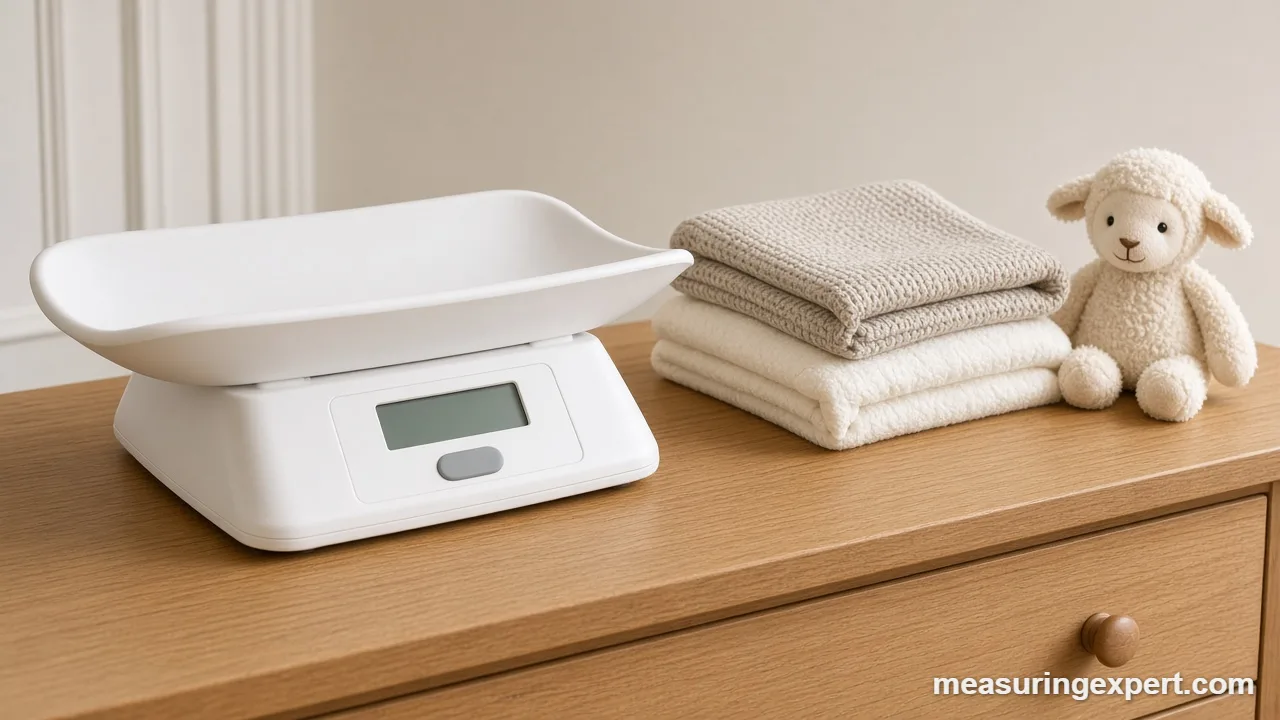
The best baby scale for most families is the Beurer BY80. It reads to 0.01 lb, has a curved tray and a hold mode that locks the number while your baby wiggles. However, the right choice depends on resolution, an app, and whether you need a clinic-grade tray.
In short: Beurer BY80 for simple home weighing, Safety 1st Smart Family Scale for app tracking, GROWNSY for a scale that grows into an adult scale, and Tanita BD-815U for 2 g clinic precision.
As an Amazon Associate, Measuring Expert earns from qualifying purchases. Our picks are based on research, specifications and owner feedback, not paid placement.
Best Overall
Best Smart

Best Pro
Quick Answer: Which Baby Scale Suits Your Home?
- Simple, steady readings: the Beurer BY80 shows 0.01 lb steps and has automatic or manual hold.
- Growth log for the whole family: the Safety 1st Smart Family Scale weighs babies on a tray and adults up to 330 lb over Wi-Fi.
- Babies, pets and adults: the GROWNSY scale has a lift-off tray, five units and a 27 in. height ruler.
- Clinic-level resolution: the Tanita BD-815U reads in 2 g steps up to 6 kg.
- Big tray for long babies: the Health o meter 522KL has a 24 in. tray and a 50 lb capacity.
- Toddlers who will not lie down: the Health o meter 524KL weighs them in a supportive seat.
- No batteries at all: the seca 725 is a mechanical sliding-weight scale with 5 g steps.
On This Page
- Comparison table
- The 7 picks, reviewed
- How we chose
- Resolution and accuracy
- Types of baby scales
- Pounds and ounces to kilograms
- How to weigh a baby at home
- Checking your scale
- Honest limits
- FAQ
- Bottom line
Best Baby Scale Comparison Table
First, decide whether you want plain weight, an app or a clinic-style tray. Then use the table to jump to the matching review.
| # | Product | Best For | Standout Feature | Amazon |
|---|---|---|---|---|
| 1 | Beurer BY80 | Most homes | 0.01 lb readout with auto or manual hold | View |
| 2 | Safety 1st Smart Family Scale | Growth tracking for the family | Wi-Fi app with percentile charts | View |
| 3 | GROWNSY Baby Scale | Babies, pets and adults | Five units and a 27 in. height ruler | View |
| 4 | Tanita BD-815U | Fine resolution | 2 g steps to 6 kg, feeding weight mode | View |
| 5 | Health o meter 522KL | Long babies and toddlers | 24-1/8 in. tray, 50 lb capacity | View |
| 6 | Health o meter 524KL | Toddlers who wriggle | Supportive seat with a raised display | View |
| 7 | seca 725 | No batteries | Mechanical sliding weights, 5 g steps | View |
The 7 Best Baby Scale Picks, Reviewed
We start with home scales that most parents will buy. Next come the smart and multi-use models. Finally, we cover four clinic-style scales for people who want finer steps or a bigger tray.
Best Overall
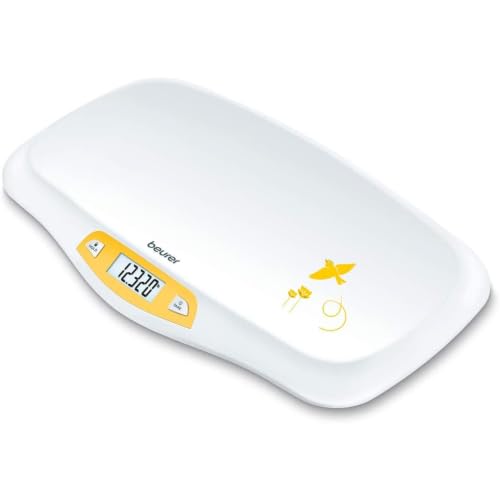
1. Beurer BY80 Digital Baby Scale
Best for: parents who want a plain, steady weight between checkups without an app.
The BY80 is our best baby scale for most homes because it keeps things simple. First, the curved platform cradles a newborn, and rubber feet stop it from sliding on a dresser or floor. In addition, the hold function can work automatically or by hand. As a result, the display locks the weight even when your baby kicks.
On the measuring side, Beurer lists a readout in 0.01 lb steps. That is about 4.5 g, so even small day-to-day changes show up. You can also switch between pounds, ounces and kilograms, and a tare key zeroes out a blanket or a diaper. Even so, keep in mind that a fine display step is not the same as accuracy, which we explain below.
- Readout: 0.01 lb steps (about 4.5 g)
- Units: lb, oz and kg
- Functions: automatic or manual hold, tare
- Size: 13.0 x 22.06 x 1.9 in.; about 3.48 lb
Pros
- Hold mode also makes wiggly weigh-ins easier
- Curved tray feels secure for newborns
- Light enough to move between rooms
Cons
- No app or memory, so you log readings yourself
- Beurer’s page lists two different capacities (44 lb and 66 lb), so check the manual
Skip it if: you want growth charts on your phone, since the Safety 1st scale below adds that.
Best Smart
2. Safety 1st Smart Family Scale
Best for: homes that want one scale for the baby and the adults.
In short, this scale works in two parts. A removable baby tray with a washable cork inlay holds children up to 44 lb, and the base alone weighs adults up to 330 lb (150 kg). Meanwhile, Wi-Fi sends each reading to the free Connected app, which plots weight, length and head size against percentile charts.
For measurement detail, Safety 1st lists 5 g steps up to 22 lb and 10 g steps above that. That is a sensible split, because a newborn needs finer steps than an adult. In addition, a measuring chart on the tray reaches 24 in. for length, and an automatic hold helps with wiggly babies.
- Capacity: 330 lb (150 kg); baby tray to 44 lb
- Resolution: 5 g to 22 lb, then 10 g
- Units: oz, lb and kg
- App: Wi-Fi sync to the Connected app with percentile charts
- Power: 4 AAA batteries (included)
Pros
- Grows from newborn to adult use
- Percentile charts in the app
- Washable cork tray insert
Cons
- Wi-Fi setup takes a few extra minutes
- Percentile charts can cause worry; read them with your doctor
Skip it if: you only need a baby scale for a few months.
Best Multi-Use
3. GROWNSY Multifunctional Baby Scale

Best for: families who also want to weigh a pet or use it as a floor scale later.
The GROWNSY has a lift-off baby tray on top of a flat base. For example, with the tray on, it weighs infants; with it off, it handles toddlers, pets and adults up to 330 lb. Also, a 27 in. height ruler is built in, so you can log length at the same time.
In addition, it offers five units (lb:oz, oz, lb, g and kg) and shows 0.1 oz steps, which is about 2.8 g. However, GROWNSY does not publish an accuracy tolerance, so treat that step as display detail. Automatic and manual hold, a tare key and a two-minute auto-off round out the features.
- Capacity: up to 330 lb
- Display step: 0.1 oz (about 2.8 g)
- Units: lb:oz, oz, lb, g, kg
- Extras: 27 in. height ruler, hold, tare, auto-off after 2 minutes
Pros
- Five units, including lb:oz like a clinic printout
- Also converts to a pet and adult scale
- Tool-free tray removal
Cons
- No published accuracy figure
- No app or memory
Skip it if: you want a tracked history, because this one has no app.
Best Pro
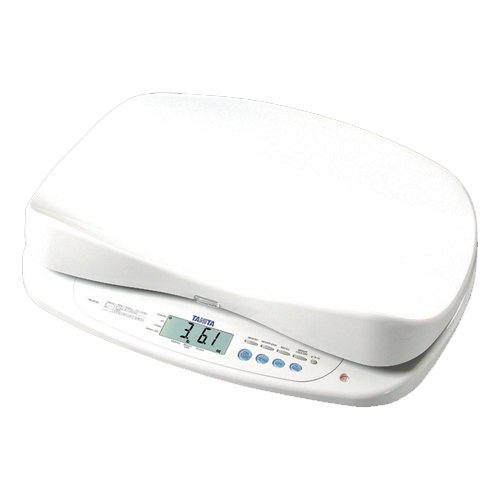
4. Tanita BD-815U Baby Scale
Best for: NICU graduates, lactation work and anyone who needs the finest steps.
Unlike the home picks, the BD-815U is a pediatric and neonatal scale, so it is built for clinics first. Tanita lists 2 g (0.1 oz) steps up to 6 kg (about 12 lb) and 4 g steps up to its 15 kg (33 lb) capacity. As a result, it resolves very small changes in a young baby.
It also has a weight gain mode for before-and-after feeding checks, plus memory, recall and a motion stop feature. In addition, an RS-232 port sends data to a computer. Because it weighs about 25 lb, though, it is a scale you set up once and leave in place.
- Capacity: 33 lb (15 kg)
- Resolution: 2 g to 6 kg, 4 g to 15 kg
- Modes: tare, memory, recall, weight gain, motion stop
- Power: 4 AA batteries; RS-232 output
Pros
- Finest resolution in this list
- Feeding weight mode built in
- Removable basket for cleaning
Cons
- Heavy at about 25 lb
- Costs far more than home scales
- Lower capacity than the toddler scales
Skip it if: you only want a weekly weight, since a home scale is plenty.
Best Big Tray
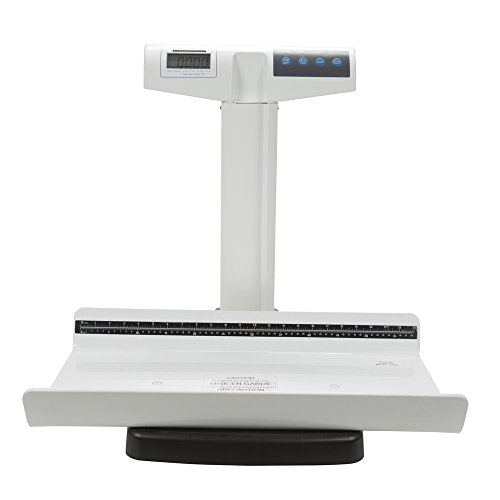
5. Health o meter 522KL Pediatric Tray Scale
Best for: long babies, toddlers and home-care settings.
The 522KL is a professional pediatric tray scale with a 24-1/8 x 14-1/2 in. tray (613 x 368 mm). As a result, that length matters once a baby stretches out. Also, its capacity is 50 lb (23 kg), so it lasts well into the toddler years.
Health o meter lists 0.2 oz (5 g) steps up to 20 lb and 0.5 oz (10 g) steps up to 50 lb. Besides tare and pre-tare, it has hold and release, an auto-weight hold, reweigh, recall and motion detection. So, it covers almost every way a clinic weighs a child.
- Capacity: 50 lb (23 kg)
- Resolution: 5 g to 9 kg, 10 g to 23 kg
- Tray: 24-1/8 x 14-1/2 x 2-5/8 in.
- Power: 6 AA batteries; optional ADPT31 adapter
Pros
- Long tray fits older babies
- Clinic feature set, including pre-tare
- Unit lock for shared use
Cons
- Large to store at home
- However, coarser steps than the Tanita
Skip it if: counter space is tight in your nursery.
Best for Toddlers
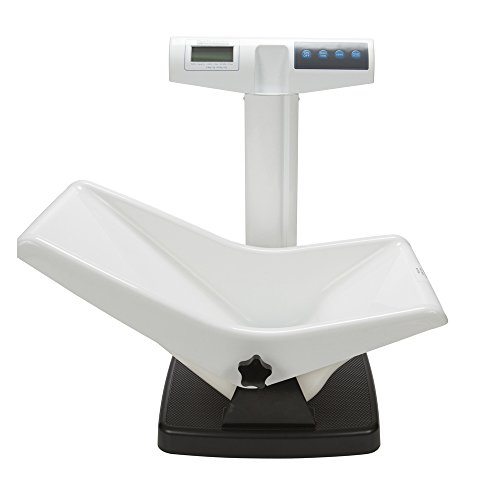
6. Health o meter 524KL Pediatric Seat Scale
Best for: toddlers who can sit up but will not lie still on a tray.
However, older babies often fight a flat tray. The 524KL solves that with a deep plastic seat that supports the head and body, so the child sits instead of rolling. As a result, there is less movement to filter out, and the reading settles faster.
It shares the 522KL’s weighing core: 50 lb (23 kg) capacity, 0.2 oz (5 g) steps up to 20 lb and 0.5 oz (10 g) steps above. Also, the display sits 17 in. above the base, so you can read it while you steady the child. Motion detection, tare, pre-tare, hold and release, recall and auto-off are all listed.
- Capacity: 50 lb (23 kg)
- Resolution: 5 g to 9 kg, 10 g to 23 kg
- Seat: 24-1/4 x 14-1/4 x 18-1/2 in. (616 x 362 x 470 mm)
- Power: 6 AA batteries; optional ADPT31 adapter
- Warranty: 2-year limited, per Health o meter
Pros
- Seat keeps active toddlers calmer
- Raised display is easy to read
- Clinic-grade feature set
Cons
- Bulky at 21 lb with a large footprint
- Not ideal for a newborn who cannot sit yet, so start with a tray
Skip it if: your baby is still a newborn, because a flat tray suits that stage better.
Best Mechanical
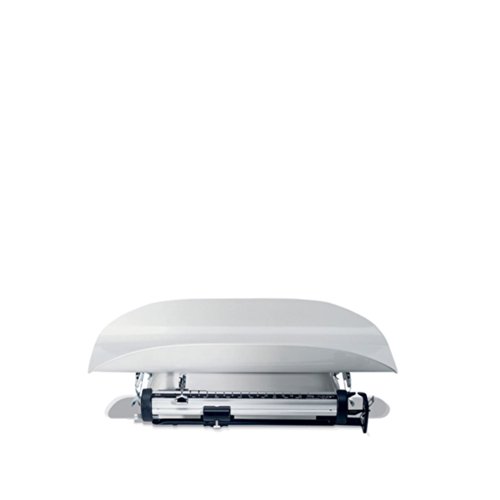
7. seca 725 Mechanical Baby Scale
Best for: off-grid use and people who like a scale with no electronics.
The seca 725 is a balance scale with sliding weights, so you read the result from a beam instead of a screen. Overall, it holds 16 kg (35 lb) and reads in 5 g (1/4 oz) steps. In addition, the curved tray lifts off for cleaning.
A mechanical scale has no battery to die and no hold mode either. Instead, you nudge the weights until the beam floats level. Of course, that takes a bit of practice with a moving baby. Even so, many clinics still use this design because it is simple and stable.
- Capacity: 16 kg (35 lb)
- Graduation: 5 g (1/4 oz)
- Type: mechanical, sliding weights
- Tray: curved, removable for cleaning
Pros
- No batteries or electronics to fail
- Proven clinic design
- Removable tray
Cons
- Slower to read than a digital display
- No hold, so a calm baby helps
- The beam needs a moment to settle
Skip it if: you want a fast reading with one button.
How We Chose the Best Baby Scale Picks
We did not run hands-on tests. Instead, these picks are research-based. First, we read each maker’s product page for capacity, resolution, hold modes and power. Next, we compared owner feedback on steady readings, tray comfort and app reliability. Finally, we kept one scale per job and no more than two per brand.
We also dropped listings with no clear brand or spec sheet. Similarly, we skipped scales whose makers no longer list them. For growth context, we relied on the CDC growth chart guidance and the WHO Child Growth Standards. In addition, we left out feeding or weight-gain targets, since those belong to your pediatrician.
Resolution vs Accuracy on a Baby Scale
Two numbers on a spec sheet look alike but mean different things. Resolution, also called graduation or division, is the smallest step the display can show. Accuracy, on the other hand, is how close that number is to the true weight. In other words, a scale can show 0.01 lb steps and still be off by more than that.
| Scale | Smallest step | Same step in grams |
|---|---|---|
| Tanita BD-815U | 0.1 oz (to 6 kg) | 2 g |
| GROWNSY | 0.1 oz | about 2.8 g |
| Beurer BY80 | 0.01 lb | about 4.5 g |
| Safety 1st, Health o meter, seca 725 | 0.2 to 0.25 oz | 5 g |
So, how much does this matter? For a weekly check, any step under 10 g is plenty. For before-and-after feeding checks, however, clinics prefer 2 g to 5 g steps, because a single feed can be a small change. In that case, follow your lactation consultant’s advice on equipment rather than guessing.
Also, look at how the step changes with load. Many scales switch to a coarser step above a set weight, such as 10 g past 22 lb. That is normal because older children gain weight in larger amounts.
Types of Baby Scale and Who Needs Each
Most scales fall into four groups. For this reason, the table below shows the trade-offs at a glance.
| Type | Good for | Watch out for |
|---|---|---|
| Digital tray scale | Home use, quick readings | Battery health; flat floor needed |
| Smart (app) scale | Automatic growth log | Phone pairing, app updates |
| Convertible baby-to-adult | Long-term family use | Large tray steps at high loads |
| Clinic or mechanical scale | Fine steps, heavy use | Size, weight and cost |
If you already own a good bathroom scale, you may wonder about the hold-the-baby method. First, you weigh yourself, then weigh yourself holding the baby, and subtract. However, most bathroom scales read in 0.1 lb or 0.2 lb steps, which is too coarse for a newborn. See our bathroom scale guide for adult models.
Baby Weight in Pounds, Ounces and Kilograms
US clinics often print weight in pounds and ounces, while growth charts and many apps use kilograms. For reference, one pound is exactly 453.59237 g, and one ounce is 28.349523125 g. Use the converter below to switch between them.
Note that 7.5 lb is 7 lb 8 oz, not 7 lb 5 oz. For more practice, see how many ounces are in a kilo and how much 1 gram is.
How to Weigh a Baby at Home
In practice, a good routine matters as much as a good scale. Follow these steps each time, so readings stay comparable.
- Pick a hard, level surface. A carpet or a soft mat can tilt the load cells and change the reading.
- Turn the scale on empty. Then wait for it to show zero before anything touches the tray.
- Tare any blanket. Next, lay the blanket or liner down and press tare so it reads zero again.
- Keep conditions the same. For example, weigh at the same time of day, ideally in a dry diaper or bare.
- Place your baby in the center. Keep one hand close but off the baby and the tray.
- Use hold or wait for a steady number. Hold mode locks a steady reading for you.
- Write it down right away. Also note the date, time, unit and what your baby wore.
- Share trends, not single readings. Bring the log to checkups and let the pediatrician interpret it.
Keeping Your Best Baby Scale Accurate
Home scales rarely need full calibration, but a quick check builds trust in the numbers. First, weigh something with a known mass. For example, a sealed 1 L bottle of water weighs close to 1 kg plus the bottle, and an unopened food package lists its net weight. Next, weigh it twice in the center and once near each corner. If the results drift, replace the batteries and try again.
Also, store the scale flat and keep it dry. Instead of spraying the base, wipe the tray with a damp cloth, because moisture can reach the electronics. Finally, compare a home reading with the clinic weight now and then. After all, a small gap is normal, since two scales and two diapers rarely match exactly.
Honest Limits of Any Baby Scale
- Movement adds error. Even with hold, a kicking baby can shift a reading by a few grams.
- Clothes count. A wet diaper or a sleeper can add more than the scale step itself.
- Display steps are not accuracy. In fact, makers rarely publish a tolerance for home models.
- Daily swings are normal. For instance, feeds, diapers and time of day all move the number.
- Charts need context. The CDC notes that growth charts should not be the only tool for a diagnosis.
For context, the CDC recommends the WHO growth standards for children from birth to 2 years and CDC growth charts from age 2 on. Your pediatrician uses those charts; therefore, a home scale is best as a log, not a verdict.
Best Baby Scale FAQ
What is the best baby scale for home use?
For most homes, the Beurer BY80 is the best baby scale. It shows 0.01 lb steps, has a curved tray and offers automatic or manual hold for wiggly babies.
Do I need a baby scale at home?
Most families do not. After all, your pediatrician weighs your baby at each visit. However, a home scale can help when your doctor or lactation consultant asks you to track weight between visits.
How accurate is a home baby scale?
Most home models show 0.1 oz to 0.01 lb steps, but makers rarely publish an accuracy tolerance. So, compare your readings with the clinic weight and focus on trends.
Which best baby scale has an app?
The Safety 1st Smart Family Scale syncs over Wi-Fi to the free Connected app, which charts weight, length and head size. The other home picks here have no app, so you log readings by hand.
Can I use a baby scale to check feeding amounts?
Some scales, such as the Tanita BD-815U, have a weight gain mode for before-and-after feeding checks. Even so, ask your pediatrician or lactation consultant before relying on it.
Why does my baby weigh less at home than at the doctor?
First of all, different scales, clothes, diapers and feeding times all change the number. Also, home scales are not certified like medical scales, so a small difference is normal.
How often should I weigh my baby?
Follow your pediatrician’s plan. Frequent weighing usually adds worry, because daily swings from feeds and diapers can hide the real trend.
Is a best baby scale worth it for twins?
It can be, because twins are often watched more closely. A scale with an app, like the Safety 1st Smart Family Scale, makes it easier to keep two separate logs.
How do I convert pounds and ounces to kilograms?
Multiply pounds by 16 and add the ounces, then multiply by 28.349523125 to get grams. For example, 7 lb 8 oz is 120 oz, or about 3,402 g (3.40 kg).
Can the best baby scale also weigh pets?
Yes. Convertible models like the GROWNSY weigh small pets on the tray and larger pets on the base, but clean the tray well between uses.
Bottom Line on the Best Baby Scale
For most parents, the Beurer BY80 is the best baby scale, thanks to its fine 0.01 lb steps and steady hold mode. If you want an automatic log, choose the Safety 1st Smart Family Scale instead. Meanwhile, the Tanita BD-815U suits anyone who needs clinic-level 2 g resolution. Whatever you pick, keep regular checkups as the real measure of growth.
2 thoughts on “Best Baby Scale: 7 Picks for Accurate Home and Clinic Weighing”