

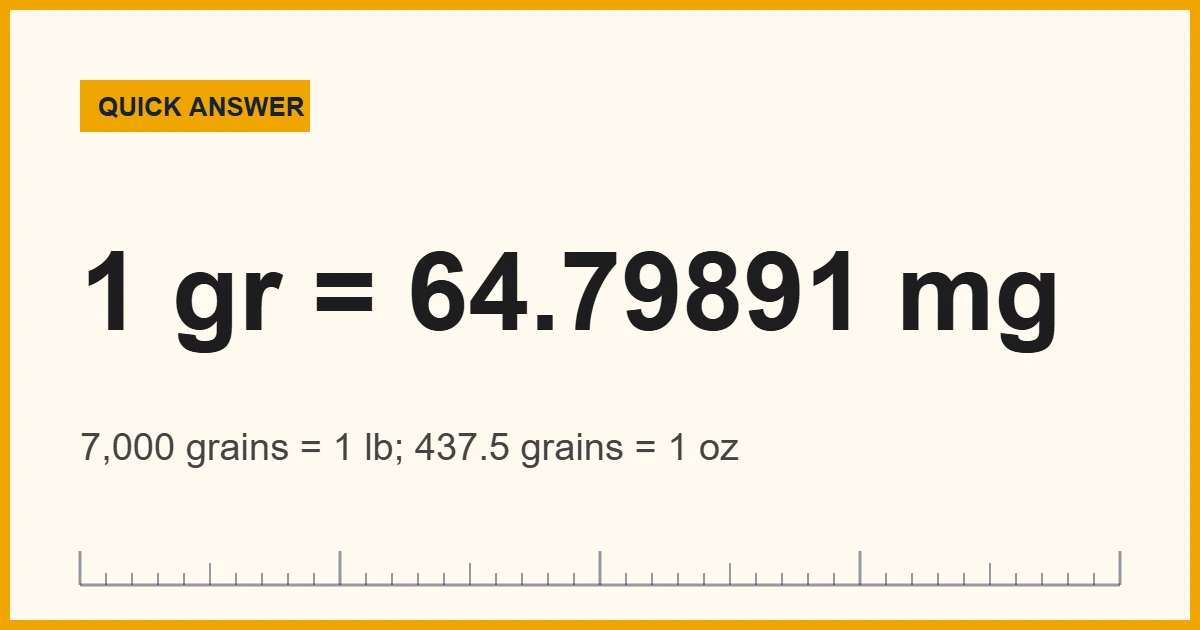
A grain measurement is a tiny unit of mass: 1 grain (gr) equals exactly 64.79891 milligrams, or about 0.0648 grams, by US and international definition. So 7,000 grains make 1 avoirdupois pound and 437.5 grains make 1 ounce. Today, grains also weigh bullets, gunpowder, arrows and some older medicine doses.
Convert Grains to Milligrams, Grams and Ounces
First, enter any number of grains below. Next, the converter uses the exact definition of 64.79891 mg per grain, so it also handles reloading charges, arrow weights and old pill strengths. In addition, you can switch the unit to start from grams or ounces instead.
In fact, the grain is the oldest unit of weight still in everyday use. At first, it was literally the weight of one seed of wheat or barley. Over centuries, however, those seed weights were fixed into an exact standard. Since 1959, the international yard and pound agreement has defined the pound as exactly 453.59237 grams. Therefore, because a pound is exactly 7,000 grains, one grain works out to exactly 64.79891 milligrams.
Likewise, the National Institute of Standards and Technology (NIST), which maintains US measurement standards, lists that same factor in its guide to SI conversion factors. In other words, the grain is not an estimate. Instead, it is a fixed fraction of the kilogram, just like the ounce.
Moreover, the grain is unusual because three old weight systems share it. So avoirdupois (everyday), troy (precious metals) and apothecaries (old pharmacy) weights all use the same 64.79891 mg grain. As a result, a grain measurement is a handy bridge between them.
Grain Measurement Conversion Chart
This chart covers the values readers ask about most. In addition, each milligram figure is the grain count times 64.79891, rounded to two decimals. Also, feel free to print it and keep it by your reloading bench.
| Grains (gr) | Milligrams (mg) | Grams (g) | Ounces (oz, avoirdupois) |
|---|---|---|---|
| 1 gr | 64.80 mg | 0.0648 g | 0.00229 oz |
| 5 gr | 323.99 mg | 0.3240 g | 0.0114 oz |
| 7 gr | 453.59 mg | 0.4536 g | 0.016 oz |
| 15 gr | 971.98 mg | 0.9720 g | 0.0343 oz |
| 15.43 gr | 1,000 mg | 1 g | 0.0353 oz |
| 40 gr | 2,591.96 mg | 2.592 g | 0.0914 oz |
| 55 gr | 3,563.94 mg | 3.564 g | 0.1257 oz |
| 100 gr | 6,479.89 mg | 6.480 g | 0.2286 oz |
| 124 gr | 8,035.06 mg | 8.035 g | 0.2834 oz |
| 150 gr | 9,719.84 mg | 9.720 g | 0.3429 oz |
| 300 gr | 19,439.67 mg | 19.44 g | 0.6857 oz |
| 437.5 gr | 28,349.52 mg | 28.35 g | 1 oz |
| 480 gr | 31,103.48 mg | 31.10 g | 1.097 oz (1 troy oz) |
| 7,000 gr | 453,592.37 mg | 453.6 g | 16 oz (1 lb) |
Similarly, to go the other way, divide milligrams by 64.79891, or multiply grams by about 15.432. For example, 2 g is about 30.86 grains. Also, for more on the ounce itself, see how much an ounce weighs.
Recommended Scales for Grain Measurement
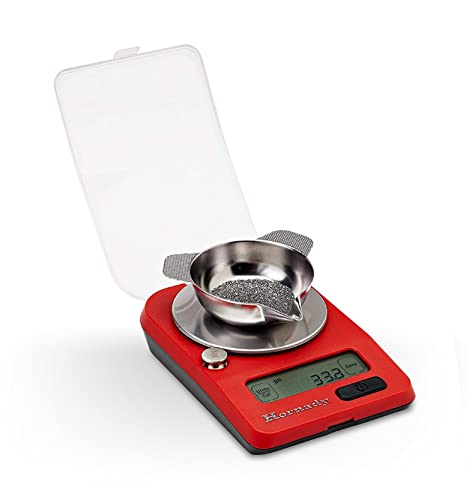
However, most kitchen scales stop at 1 g resolution, which is about 15 grains. As a result, that is far too coarse for powder charges or arrow tips. Instead, look for a scale that reads directly in grains with 0.1 gr resolution, and check that it comes with a calibration weight. Pocket jewelry scales that read to 0.01 g are a cheaper option, although 0.01 g is still about 0.15 grains.




As an Amazon Associate, Measuring Expert earns from qualifying purchases.
One Grain, Three Weight Systems
Older English weights came in three families. Moreover, each one built larger units on top of the same grain, so the grain is where they all meet. However, the ounce and pound differ between them.
| Unit | System | Grains | Metric value |
|---|---|---|---|
| Grain (gr) | All three | 1 | 64.79891 mg |
| Dram (dr) | Avoirdupois | 27.34375 | 1.772 g |
| Ounce (oz) | Avoirdupois | 437.5 | 28.35 g |
| Pound (lb) | Avoirdupois | 7,000 | 453.59 g |
| Pennyweight (dwt) | Troy | 24 | 1.555 g |
| Troy ounce (oz t) | Troy | 480 | 31.10 g |
| Scruple | Apothecaries | 20 | 1.296 g |
| Apothecaries dram | Apothecaries | 60 | 3.888 g |
| Apothecaries ounce | Apothecaries | 480 | 31.10 g |
Where Grain Measurement Is Used Today
Still, the grain survives in a few fields because small, repeatable weights matter there and long tradition keeps the unit alive.
Ammunition and Reloading
In the US, bullet weights and powder charges are almost always given in grains. For instance, a common 9 mm bullet weighs 115 or 124 grains, about 7.45 g or 8.04 g. Meanwhile, a typical .223 Remington bullet weighs 55 grains, or about 3.56 g. Likewise, reloading manuals list powder charges in grains, often to a tenth of a grain.
Archery Arrows
Archers also weigh arrow shafts, points and inserts in grains. For example, shafts are rated in grains per inch (GPI). So a 29-inch shaft at 9 GPI weighs about 261 grains before you add the point, nock and fletching. Finally, point weights of 100 or 125 grains are also standard.
Older Medicine Labels
Historically, pharmacists also dosed in apothecaries grains. Even so, you may still see “5 gr” aspirin, which is usually labeled as 325 mg. Strictly, 5 grains is 323.99 mg, so the label rounds. Today, however, prescribing uses metric units only, and safety groups such as ISMP recommend using the metric system instead of apothecary units to prevent mix-ups. In addition, our guide to measurement units in pharmacy covers mg, mcg and mL.
Water Hardness and HVAC
Water softener makers, for example, rate hardness in grains per gallon (gpg). In other words, one gpg is about 17.1 mg per liter. Similarly, HVAC engineers describe air moisture in grains of water per pound of dry air, because 7,000 grains make a pound.
Pearls and Gemstones (a Different Grain)
Jewelers also use a “pearl grain”, but it is not the same unit. In fact, a pearl grain is one quarter of a metric carat, or 50 mg. However, the true grain is 64.8 mg. In addition, gemstones are sold by the metric carat (200 mg), not by grains.
How to Take a Grain Measurement on a Scale
- Set the scale to grains. Press the mode button until the display shows “gr” or “GN”. Also, do not confuse it with “g” for grams.
- Warm up and level it. Next, turn the scale on a few minutes early and place it on a firm, level surface away from fans and drafts.
- Calibrate with a check weight. Use the weight that came with the scale, then confirm the reading before every session.
- Tare the pan. Next, place the empty pan or cup on the scale and zero it.
- Add the item slowly. For powder, trickle the last few grains in; for arrows, lay the shaft across the center.
- Read and record. Wait for the reading to settle, then write it down or enter it in the converter above to get grams.
Grain Measurement vs Units People Confuse With It
The grain is easy to mix up with other small units, mostly because the abbreviations look alike. For that reason, this table separates them.
| Unit | Symbol | Mass | In grains |
|---|---|---|---|
| Grain | gr, GN | 64.79891 mg | 1 |
| Gram | g | 1,000 mg | 15.432 |
| Milligram | mg | 0.001 g | 0.0154 |
| Metric carat | ct | 200 mg | 3.086 |
| Pearl grain | – | 50 mg | 0.772 |
Do and Don’t With Grains
Do
- Check that the display reads “gr” or “GN”.
- Calibrate with a known check weight.
- Use 0.1 gr resolution for powder charges.
- Write medicine doses in mg, never in grains.
- Quote gold and silver in troy ounces.
Don’t
- Mix up grains with grams.
- Treat a pearl grain as a true grain.
- Rely on a 1 g kitchen scale for grains.
- Weigh near fans, phones or drafts.
- Round 437.5 grains per ounce up to 480.
Honest Limits of the Grain
The definition is exact, but real measurements are not. For example, a scale with 0.1 gr resolution can only tell you the weight to the nearest tenth of a grain, about 6.5 mg. Also, cheap pocket scales can drift with temperature, battery level and static. Moreover, older medicine references sometimes treated a grain as 60 or 65 mg for convenience, so historical doses do not always match the exact 64.79891 mg. In short, trust the definition, then verify your scale against a check weight.
When Accuracy Really Matters
For most readers, however, a grain is just a number to convert. Still, three situations need more care. For example, reloaders should follow published load data exactly and never guess between grains and grams. Likewise, pharmacy staff and caregivers should use only the mg dose on the current label. Finally, labs should use a calibrated analytical balance in mg rather than grains. Similarly, for other micro units, see what mcg means.
Frequently Asked Questions
What is a grain measurement?
A grain is a unit of mass equal to exactly 64.79891 milligrams. In fact, it is the smallest unit in the avoirdupois, troy and apothecaries systems.
How many grains are in a gram?
There are about 15.432 grains in 1 gram. In other words, multiply grams by 15.432 to get grains.
How many grains are in an ounce?
A regular avoirdupois ounce is 437.5 grains. However, a troy ounce, used for gold and silver, is 480 grains.
How many grains are in a pound?
There are exactly 7,000 grains in an avoirdupois pound. In fact, that is how the grain is defined.
Is a grain measurement the same as a gram?
No. A gram is about 15.4 times heavier than a grain. Because the symbols gr and g look alike, check the unit carefully.
Why do bullets use grain measurement?
US gunsmiths used the grain long before metric units spread, and it gives fine steps for small weights. As a result, bullet and powder weights are still listed in grains.
How many mg is a 5 grain aspirin?
In short, five grains is 323.99 mg. Labels usually round it to 325 mg, so always dose by the mg value on the label.
Is a pearl grain the same as a grain?
No. In fact, a pearl grain is 50 mg, a quarter of a metric carat. A true grain, however, is 64.8 mg.
How many grains are in a carat?
In short, one metric carat (200 mg) is about 3.086 grains.
Where does the grain measurement come from?
It started as the weight of one cereal seed, such as wheat or barley. Later, it was fixed at exactly 1/7000 of a pound, or 64.79891 mg.
The Bottom Line on Grain Measurement
To sum up, one grain is exactly 64.79891 mg, about 0.0648 g. Also, there are 437.5 grains in an ounce and 7,000 in a pound, while the troy ounce for precious metals holds 480.
So use grains where your field expects them, such as bullets, powder and arrows, and switch to milligrams for medicine. Meanwhile, keep the converter above handy for any amount.