
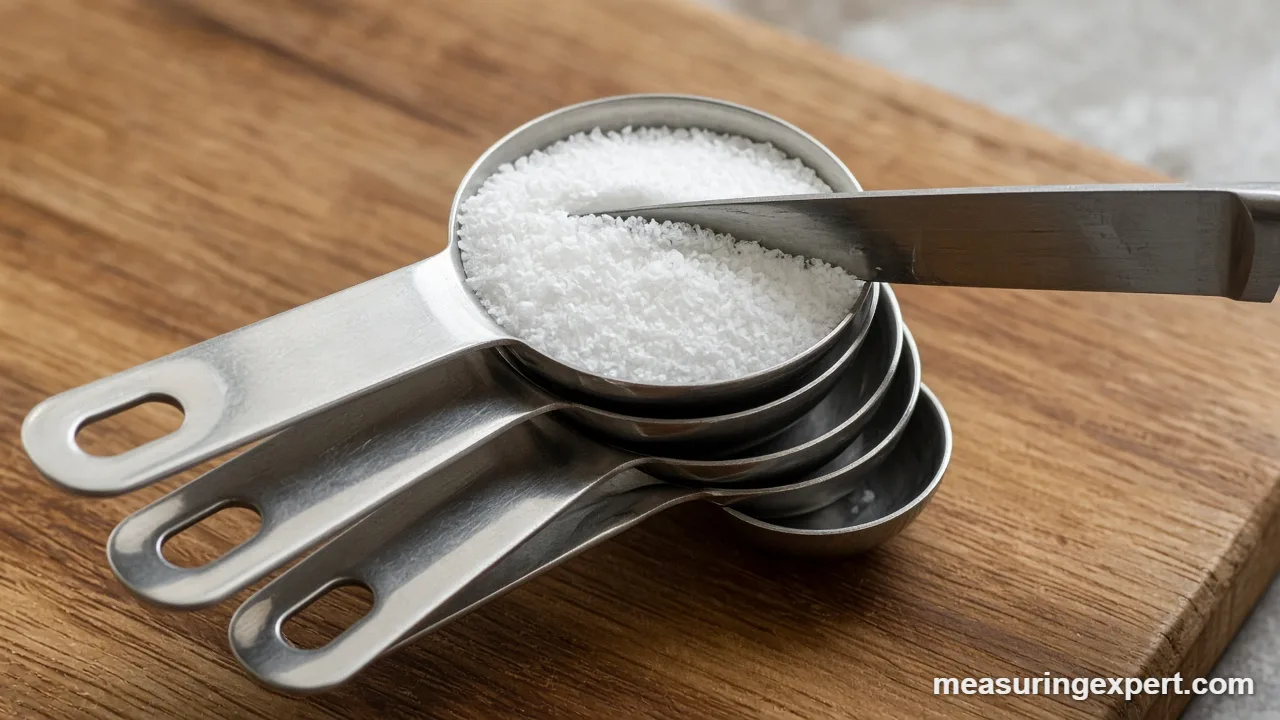
To use measuring spoons correctly, pick the spoon that matches the recipe (1/8 tsp up to 1 tbsp), overfill dry ingredients and sweep them level, and fill liquids right to the rim. One US teaspoon holds about 4.93 mL and one tablespoon about 14.79 mL, so 3 level teaspoons equal 1 tablespoon.
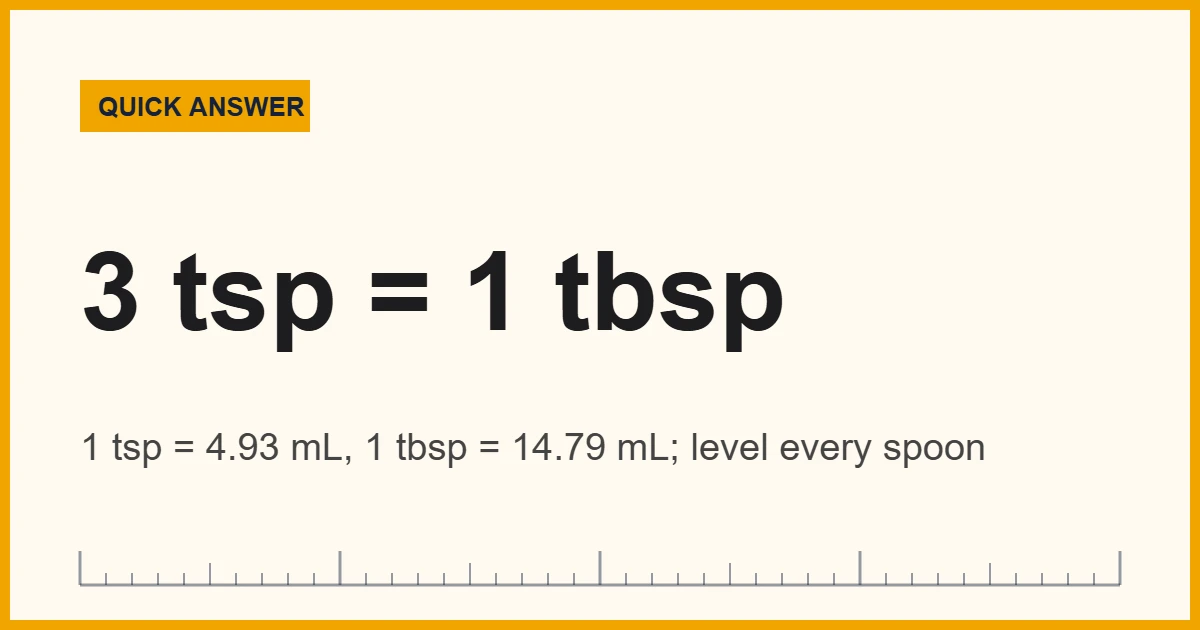
A measuring spoon set looks like the simplest tool in the kitchen. Even so, small habits decide whether it gives you the right amount. For example, a heaping scoop, a packed spoon of flour, or a dinner spoon grabbed from the drawer can easily add 50 percent or more to a recipe.
Here is the core method. First, read the recipe abbreviation and choose the spoon whose engraving matches it. Next, for dry ingredients, scoop or spoon until the ingredient mounds above the rim, then sweep a straight edge across so the top is flat. For thin liquids, hold the spoon level over a separate bowl and fill until the liquid reaches the rim. For sticky foods such as honey or peanut butter, coat the spoon lightly with oil first so everything slides out. Finally, never swap in eating spoons, because they are not standard sizes.
In short: measuring spoons are only accurate when you match the size, level the top and empty them completely.
The sizes themselves are fixed by definition. The US National Institute of Standards and Technology (NIST) lists the household equivalents in its metric kitchen guide: about 1.25 mL for 1/4 teaspoon, 2.5 mL for 1/2 teaspoon, 5 mL for a teaspoon and 15 mL for a tablespoon.
Below, you will find a size chart, a converter, step-by-step instructions, and the mistakes that cause most measuring errors.
Convert Spoon Sizes to Milliliters
Enter an amount and pick the spoon you have. The converter then shows the same amount in teaspoons, tablespoons, milliliters and fluid ounces, using the exact US definitions plus the rounded metric spoons.
Recommended Measuring Spoons and Tools
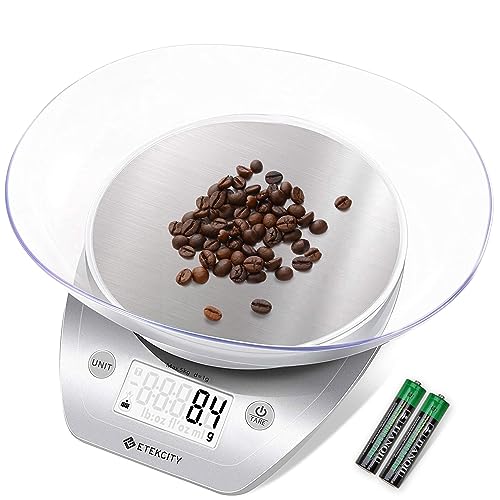
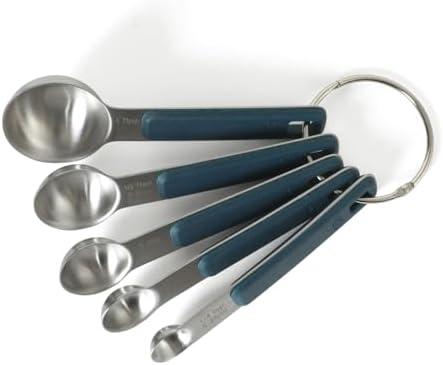
A good set does half the work for you. First, look for markings that are engraved or stamped into the metal, because printed numbers wear off in the dishwasher. Next, choose spoons with flat rims so you can level them, and narrow heads that fit inside spice jars. Also, a digital scale that reads in 0.1 g steps is a useful partner for baking.



As an Amazon Associate, Measuring Expert earns from qualifying purchases.
- A standard US set runs from 1/8 tsp to 1 tbsp; some sets add 1/2 tbsp or a pinch spoon.
- 1 US teaspoon is about 4.93 mL, and 1 tablespoon is about 14.79 mL.
- Level dry ingredients with a straight edge unless the recipe says heaping.
- Fill liquids to the rim while holding the spoon flat over a separate bowl.
- Grease the spoon for honey, syrup and molasses.
- Eating spoons vary widely in size, so they are not a substitute.
- Use the device that comes with a medicine, never kitchen spoons.
Measuring Spoons Sizes: 1/8 Teaspoon to 1 Tablespoon
Most US sets contain four to six spoons. The core four are 1/4 tsp, 1/2 tsp, 1 tsp and 1 tbsp. Many sets also add 1/8 tsp and 1/2 tbsp, and some include 3/4 tsp. The table shows each size in exact US milliliters and in the rounded metric values used on many spoons and food labels.
| Spoon | US mL (exact definition) | Metric spoon | Equal to |
|---|---|---|---|
| 1/8 tsp | 0.62 mL | 0.625 mL | half of 1/4 tsp |
| 1/4 tsp | 1.23 mL | 1.25 mL | 2 x 1/8 tsp |
| 1/2 tsp | 2.46 mL | 2.5 mL | 2 x 1/4 tsp |
| 3/4 tsp | 3.70 mL | 3.75 mL | 1/2 tsp + 1/4 tsp |
| 1 tsp | 4.93 mL | 5 mL | 1/3 tbsp |
| 1/2 tbsp | 7.39 mL | 7.5 mL | 1 1/2 tsp |
| 1 tbsp | 14.79 mL | 15 mL | 3 tsp, 1/2 fl oz |
The difference between 4.93 mL and 5 mL is about 1.4 percent, so it never matters in a recipe. For more on the teaspoon itself, see our guide to what a tsp measurement is. If you need amounts smaller than 1/8 tsp, our page on how to measure a pinch, dash or smidgen explains those terms.
How to Use Measuring Spoons Step by Step
These steps work for almost any ingredient. You can also check the converter above whenever a recipe uses a size your set does not have.
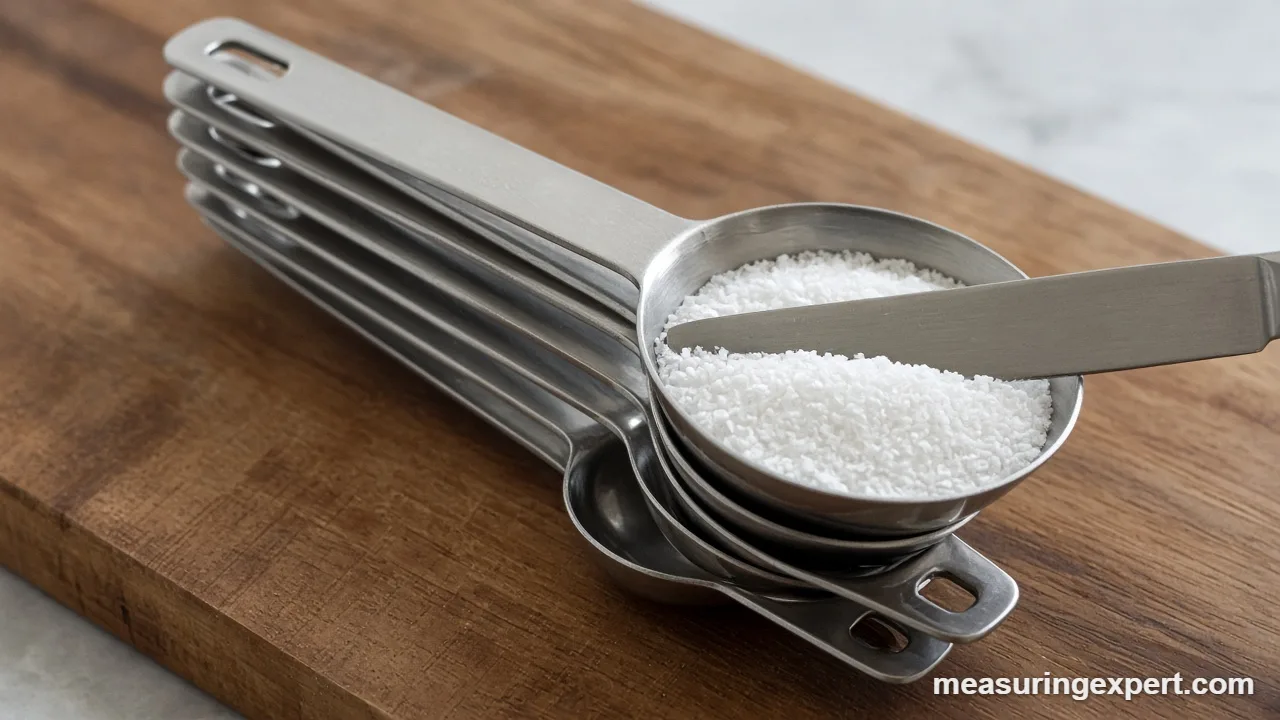
- Read the unit carefully. A capital T or “tbsp” means tablespoon, while a lowercase t or “tsp” means teaspoon.
- Choose the matching spoon. Use one spoon of the right size instead of several smaller scoops when you can, since each extra scoop adds a little error.
- Work over a separate bowl. Any spill then lands outside your batter or sauce.
- Fill dry ingredients past the rim. Dip the spoon in or sprinkle the ingredient on until it forms a small mound.
- Sweep it level. Pull the back of a knife or a flat leveler across the rim in one motion.
- Fill liquids to the brim. Hold the spoon flat and stop when the surface reaches the rim.
- Empty it completely. Tap dry ingredients out, and scrape sticky ones with a small spatula.
Level vs Heaping vs Rounded Measuring Spoons
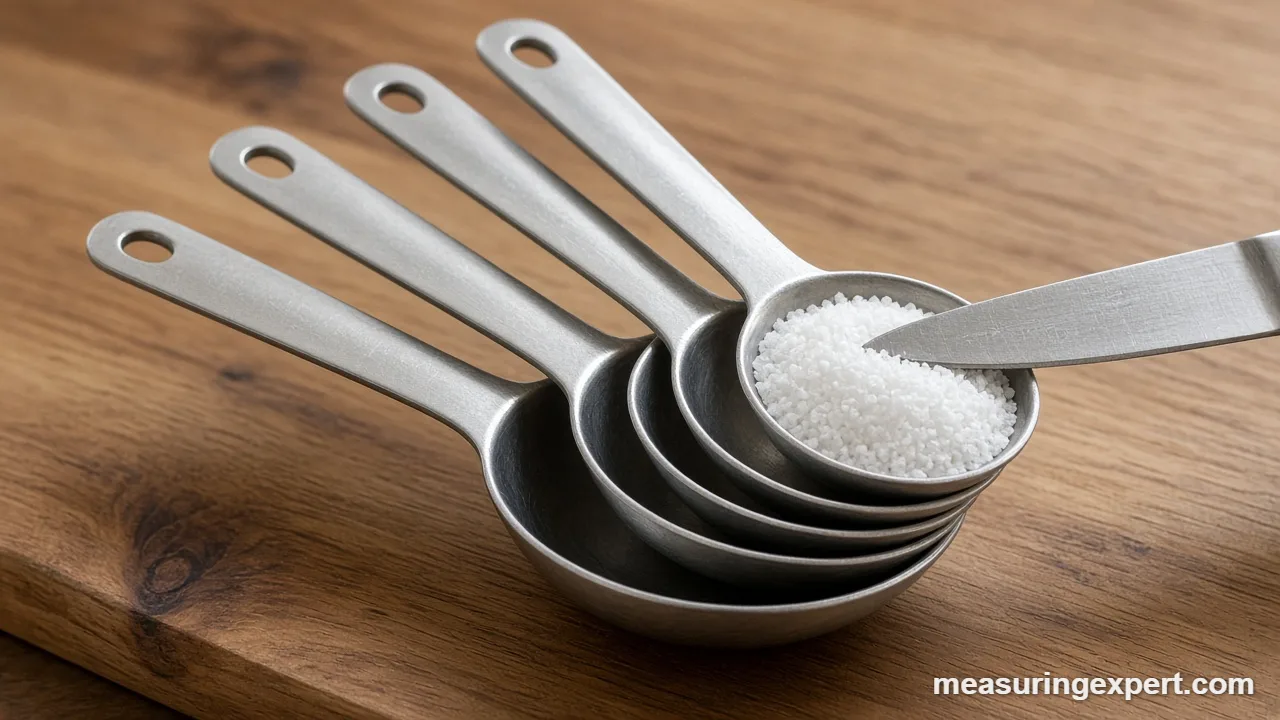
Unless a recipe says otherwise, every spoon measure is level. That is the standard modern recipe writers use. However, older and family recipes sometimes say “heaping” or “rounded”, and those terms are not defined in milliliters.
| Recipe term | What it means | How much it can hold |
|---|---|---|
| Level | Flat across the rim | The exact stated volume |
| Rounded | A gentle dome above the rim | Somewhat more than level |
| Heaping | As much as the spoon will carry | Often much more, depending on the ingredient |
| Scant | Slightly under the rim | A little less than level |
Because heaping amounts depend on grain size and how steady your hand is, treat them as a cue to be generous rather than as a number. As a result, if you want repeatable results, measure level and add a little extra on purpose.
Dry vs Liquid in Measuring Spoons
Unlike measuring cups, measuring spoons serve both dry and liquid ingredients. There is no separate “dry side” or “liquid side”. Instead, the technique changes.
For dry ingredients, overfill and level. Spoon flour in lightly rather than packing it, because packed flour can weigh noticeably more. Brown sugar is the exception, since recipes expect it packed firmly. Similarly, break up clumps in baking soda before you measure it.
For liquids, surface tension lets water bulge slightly above the rim. So stop when the liquid is flush with the edge, not domed. Also, oval spoons are easier to hold level than deep round ones, so they spill less.
Weight is another matter. A tablespoon of water weighs about 14.8 g. By contrast, a level teaspoon of table salt weighs roughly 6 g, while some flaky kosher salts weigh about half that. Therefore, swap salts by weight, not by spoon.
Sticky Ingredients and Measuring Spoons
Honey, molasses, corn syrup and nut butters cling to metal. As a result, a “tablespoon” of honey often leaves a good part behind in the spoon. A few tricks fix this:
- Oil the spoon first. A thin film of neutral oil or a quick spray lets syrup slide off.
- Measure oil before syrup. If the recipe uses both, the oily spoon is already prepared.
- Warm the jar slightly. Thick honey flows more easily when it is warm.
- Scrape, do not shake. A mini spatula gets the last bit out.
- Weigh large amounts. For more than a few tablespoons, tare a bowl on a scale and pour.
Why Flatware Spoons Are Not Measuring Spoons
The words “teaspoon” and “tablespoon” also name the spoons on your table. However, those are cutlery shapes, not units. Their bowls vary with the pattern and the maker, so one dinner spoon can hold far more than another.
Research on medicine dosing shows how large the gap can be. For instance, a 2023 study in Frontiers in Public Health measured household spoons and found that the teaspoons it tested held roughly 2.5 to 7.3 mL, against the 5 mL standard. In other words, a cutlery teaspoon can be half or nearly one and a half times the real unit.
Do and Don’t With Measuring Spoons
Do
- Level dry ingredients with a straight edge.
- Check whether a recipe is US, metric or Australian.
- Grease the spoon before measuring syrup.
- Pick engraved spoons that keep their markings.
- Weigh flour and salt when precision matters.
Don’t
- Measure over the mixing bowl.
- Pack flour unless the recipe says so.
- Assume t and T are the same spoon.
- Swap in cutlery from the drawer.
- Use kitchen spoons for medicine doses.
Honest Limits of Measuring Spoons
Spoons are quick, but they are not lab instruments. For one thing, two “1 tbsp” spoons from different brands can differ a little because of manufacturing tolerances. Moreover, your filling and leveling habit changes the result more than the spoon does. Then there is the label: some spoons are sized to 5 and 15 mL, while others follow the slightly smaller US definitions. For everyday cooking these gaps disappear. For yeast, leaveners and curing salt, however, a gram scale is more consistent. In short, the milliliter values on this page describe the definitions, not every spoon in every drawer.
When to Ask a Pharmacist or Expert
Most kitchen measuring is forgiving. Still, a few situations call for a professional rather than a spoon. First, ask a pharmacist how to measure any liquid medicine, especially for children. Next, follow the exact instructions from a dietitian if you are tracking sodium or other nutrients for a health reason. Finally, use the scoop or method the maker specifies for products such as infant formula.
Measuring Spoons FAQs
How do you use measuring spoons correctly?
Choose the spoon that matches the recipe, overfill dry ingredients and sweep them level, fill liquids to the rim, and empty the spoon completely.
Which side of measuring spoons is for dry ingredients?
There is no separate side. Use the same spoon for dry and liquid ingredients; only the filling technique changes.
What sizes come in a standard set of measuring spoons?
Most sets include 1/4 tsp, 1/2 tsp, 1 tsp and 1 tbsp. Many also add 1/8 tsp and 1/2 tbsp, and some include 3/4 tsp.
How many mL are in measuring spoons?
A US teaspoon holds about 4.93 mL and a tablespoon about 14.79 mL. Metric spoons are 5 mL and 15 mL.
Should you level measuring spoons?
Yes. Recipes assume a level spoon unless they say heaping or rounded.
How can you tell if measuring spoons are accurate?
Tare a cup on a 0.1 g scale and add level spoons of water. A US tablespoon of water should weigh about 14.8 g, and a teaspoon about 4.9 g.
Can I use a regular spoon instead?
Only as a rough guess for cooking. Eating spoons vary widely in size, so never use them for baking leaveners or medicine.
How do you measure half of 1/8 teaspoon?
Fill the 1/8 tsp spoon level, then push half out with a knife tip. That amount is close to a smidgen.
Are metal or plastic spoons more accurate?
Both can be accurate. Metal keeps its shape and engraved marks longer, while plastic can warp in a hot dishwasher.
How many teaspoons are in a tablespoon?
There are 3 teaspoons in a US or metric tablespoon and 4 in an Australian tablespoon.
Bottom Line
Good results with measuring spoons come from three habits: match the size to the recipe, level dry ingredients, and fill liquids to the rim. Also, remember that 3 teaspoons make a tablespoon, and that the US spoons hold about 4.93 and 14.79 mL.
Finally, keep cutlery out of it. A drawer spoon is fine for stirring, but not for measuring. If a recipe gives a size you do not own, the converter near the top of this page will translate it, and a gram scale handles anything bigger.