

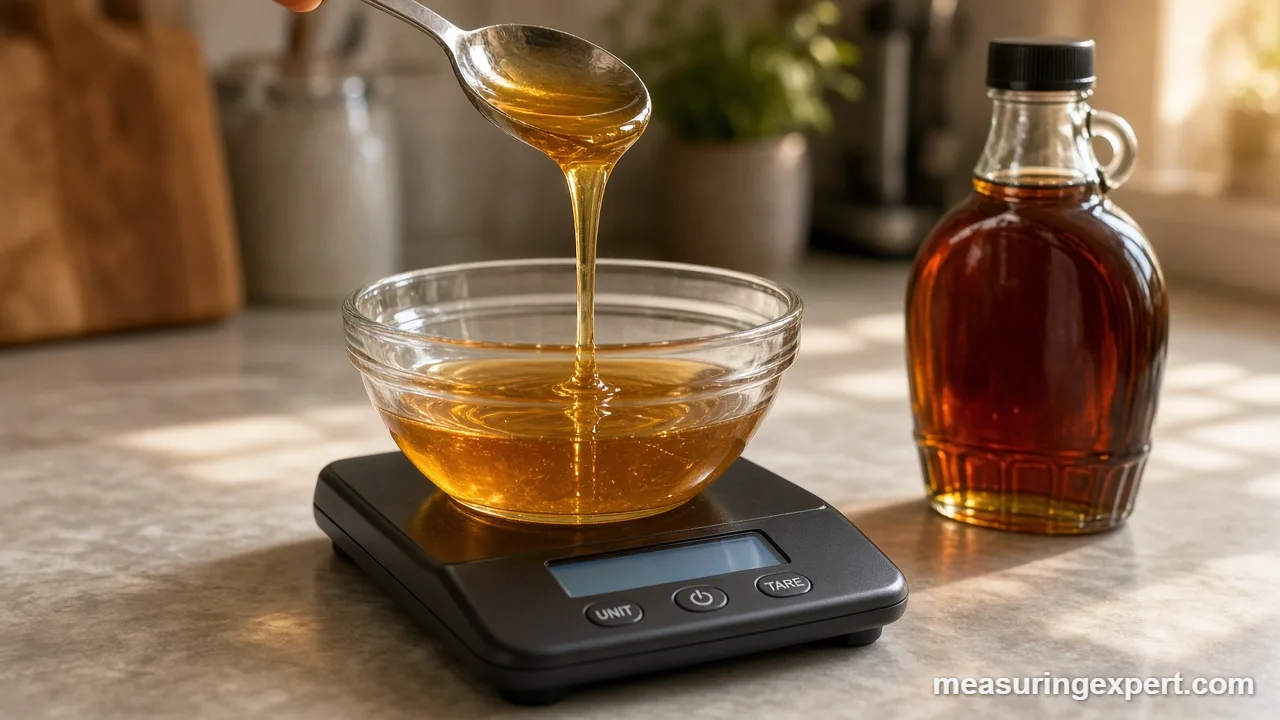
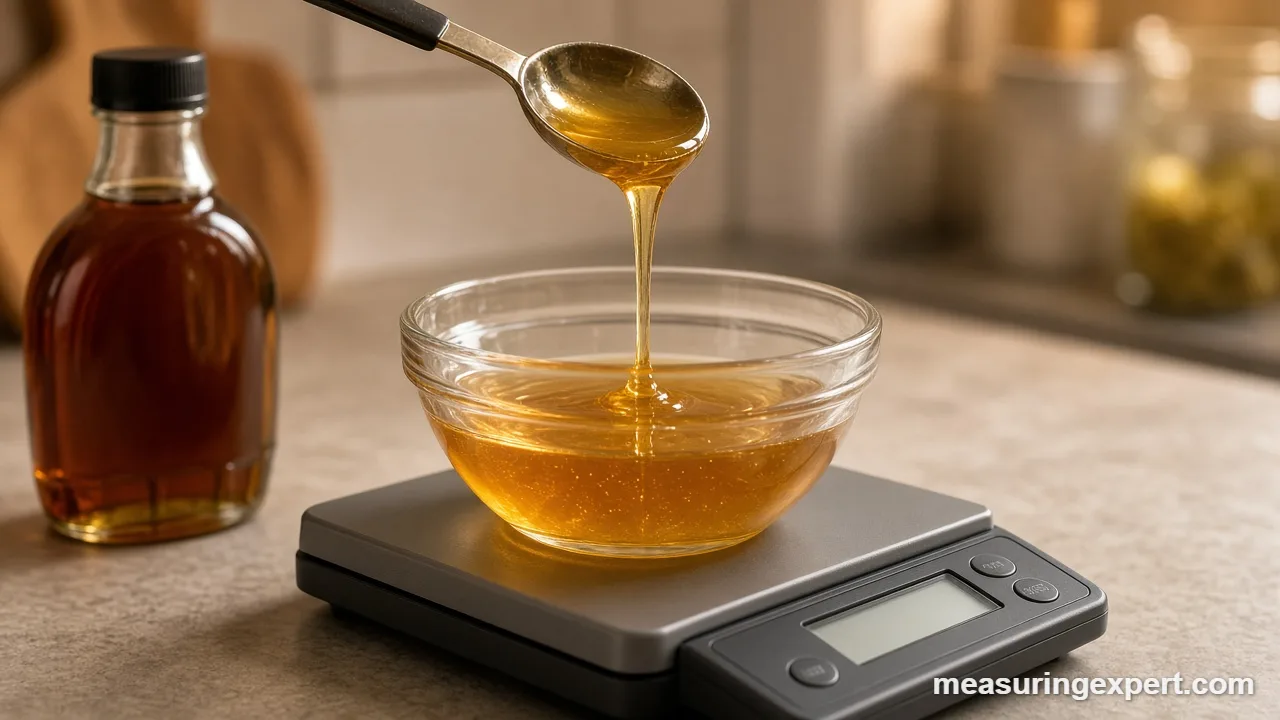
The best way to measure honey or syrup is to weigh it: set a bowl on a kitchen scale, press tare, and pour. Honey weighs about 21 g per tablespoon (336 g per cup), and maple syrup about 19.5 g per tablespoon. If you measure by volume instead, lightly oil the cup first so every drop slides out.
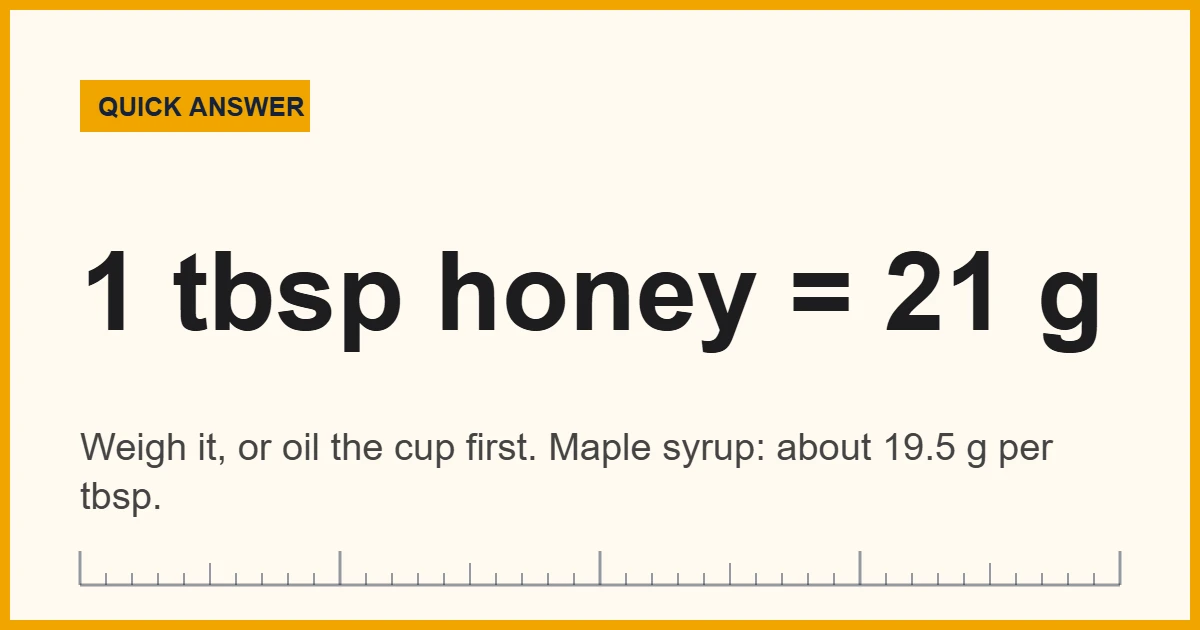
For example, honey, maple syrup, corn syrup and molasses all cause the same problem. Because they cling to the cup, part of what you measured never reaches the bowl. As a result, a recipe that asks for 1/2 cup of honey can end up a tablespoon or more short. Because these syrups add sweetness, moisture and browning, that missing amount changes the texture of cookies, granola and glazes.
This guide shows two reliable ways to measure honey or syrup. First, you will see how to weigh sticky liquids, which is fast and clean. Then you will learn how to use cups and spoons properly when you have no scale. The weights here come from the King Arthur Baking ingredient weight chart, which lists honey at 21 g per tablespoon and maple syrup at 156 g per half cup. In addition, the converter below handles the volume side, so you can switch between cups, tablespoons and milliliters.
Convert Cups, Tablespoons and Milliliters of Syrup
First, enter an amount and pick a unit. The converter then shows the same volume in other kitchen units, using the exact US definitions (1 cup = 236.59 mL, 1 tablespoon = 14.79 mL). To turn the volume into grams, multiply tablespoons by 21 for honey or by 19.5 for maple syrup.
Honey and Syrup Weights by Cup and Spoon
In general, weight beats volume for sticky liquids, because a scale only counts what lands in the bowl. The chart below uses King Arthur’s figures: honey at 21 g per tablespoon, and maple syrup and corn syrup at 312 g per cup. Also, values are rounded to the nearest gram, and ounces are weight ounces, not fluid ounces.
| Volume | Honey | Maple syrup | Corn syrup |
|---|---|---|---|
| 1 tsp | 7 g | 6.5 g | 6.5 g |
| 1 tbsp | 21 g (0.74 oz) | 19.5 g (0.69 oz) | 19.5 g (0.69 oz) |
| 1/4 cup | 84 g (3 oz) | 78 g (2.75 oz) | 78 g (2.75 oz) |
| 1/3 cup | 112 g (3.95 oz) | 104 g (3.67 oz) | 104 g (3.67 oz) |
| 1/2 cup | 168 g (5.93 oz) | 156 g (5.5 oz) | 156 g (5.5 oz) |
| 3/4 cup | 252 g (8.89 oz) | 234 g (8.25 oz) | 234 g (8.25 oz) |
| 1 cup | 336 g (11.85 oz) | 312 g (11 oz) | 312 g (11 oz) |
For other sweeteners, the same chart lists molasses at 85 g per 1/4 cup and agave syrup at 84 g per 1/4 cup. Honey is heavy, in other words, because it is dense: about 1.42 g/mL, as our guide on how dense honey is explains. As a result, that density times 14.79 mL gives the same 21 g per tablespoon. For a wider list of baking staples, see our cups to grams chart for baking.
How to Measure Honey or Syrup on a Kitchen Scale
Weighing is the quickest way to measure honey or syrup, and you never have to scrape a cup. Here is the method, step by step.
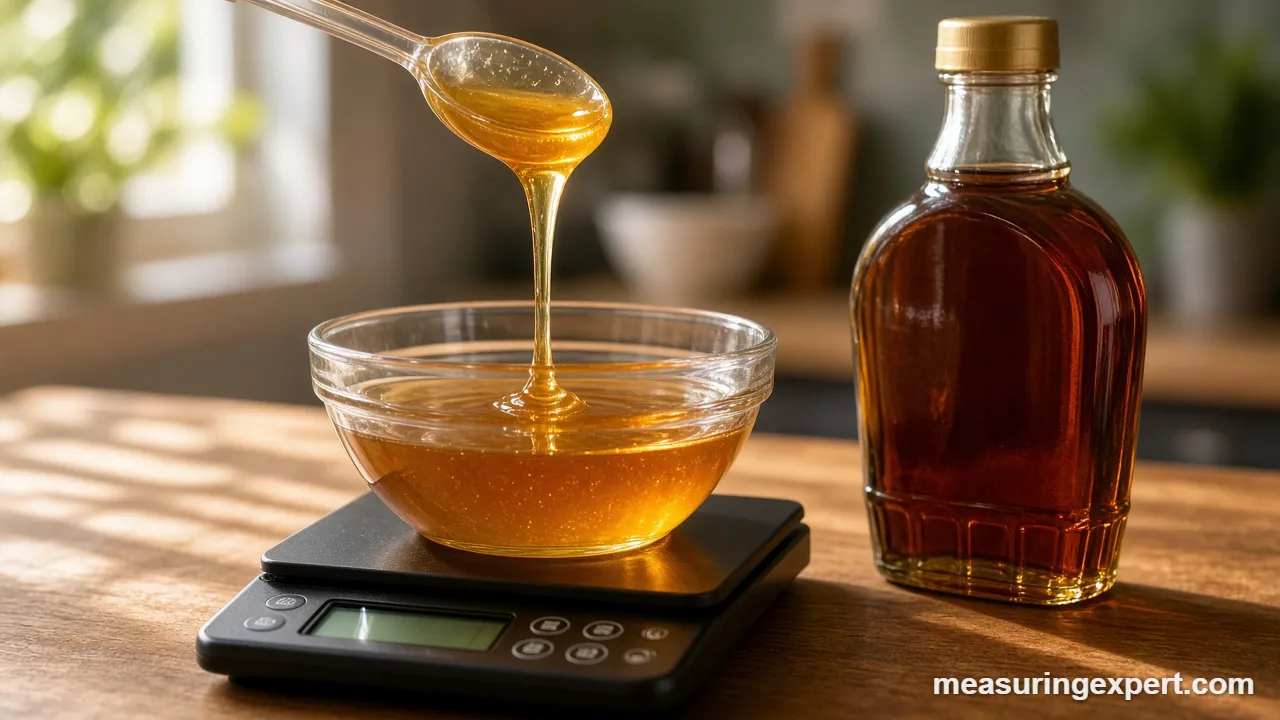
- Place your mixing bowl on the scale. Ideally, use the bowl the recipe already needs, so nothing has to be transferred.
- Press tare. After that, the display should read 0 g with the bowl on it.
- Look up the weight. Multiply tablespoons by 21 for honey or 19.5 for maple syrup, or read the chart above.
- Pour slowly near the target. This matters because thick syrup keeps flowing after you tip the jar back, so stop about 5 g early.
- Add the rest with a spoon. Then drip in the last few grams until the display hits your number.
- Tare again for the next ingredient. That way, you can add oil, eggs or milk to the same bowl.
Also, this is the easiest route when a recipe gives grams. For example, 100 g of honey is about 4 3/4 tablespoons, which is awkward by volume but simple on a scale.
Liquid vs Dry Cups: Which to Use to Measure Honey or Syrup
Honey and syrup are liquids; therefore, a liquid measuring cup is the standard tool. However, a dry cup can work better for very thick or cold honey, because you can fill it to the rim and scrape it clean. Below, the table shows the trade-offs at a glance.
| Tool | How it works | Best for | Watch out for |
|---|---|---|---|
| Liquid measuring cup (glass or plastic with a spout) | Fill to a line and read it at eye level | Runny honey, maple syrup, larger amounts | Syrup coats the walls and corners |
| Dry measuring cup (nesting set) | Fill to the rim and scrape level | Thick or cold honey, small amounts | Hard to fill to the brim without spilling |
| Adjustable plunger cup | Push the plunger to eject the contents | Honey, molasses, peanut butter | More parts to clean |
| Measuring spoons | Fill to the rim | 1 tablespoon or less | Drips over the edge |
| Kitchen scale | Weigh straight into the bowl | Any amount; baking | Needs a weight figure for the syrup |
Of course, volume itself does not change between cup styles. After all, a US cup holds 236.59 mL whether it has a spout or a flat rim. Instead, the difference is how easy it is to fill accurately and empty completely.
Oil, Spray or Warm the Cup to Measure Honey or Syrup by Volume
Otherwise, when a scale is not an option, the goal is simple: get everything out of the cup. So these steps help.
- Coat the cup with oil or spray. Above all, a thin film of neutral oil or cooking spray lets syrup slide out. Wipe off any pooled oil, because a thick layer takes up space.
- Measure the oil first. If the recipe also uses oil or melted butter, measure it in the same cup before the honey. As a result, the cup is already coated.
- Rinse with hot water. Warm water briefly heats the cup. Next, dry it and pour, because warm glass helps syrup flow.
- Warm the honey, not just the cup. For instance, set the jar in a bowl of warm water for a few minutes. As a result, thinner honey pours faster and leaves less behind.
- Scrape it out. Finally, use a flexible silicone spatula to clear the walls and the base.
Coating the cup also matters for spoons. For instance, an oiled tablespoon releases honey in one clean drop, so your teaspoon and tablespoon amounts stay accurate.
Recommended Tools to Measure Honey or Syrup
Admittedly, you do not need special gear, but a few tools make sticky liquids much easier. First, an adjustable cup pushes honey out with a plunger, so there is nothing to scrape. Second, an angled liquid cup lets you read the line from above. Finally, a digital scale with a tare button and 1 g steps is the most accurate option of all, and a silicone spatula handles the cleanup.


As an Amazon Associate, Measuring Expert earns from qualifying purchases.
Honey vs Maple Syrup vs Corn Syrup
At first glance, these syrups look alike in a recipe, but they differ in weight and thickness. Honey is the heaviest of the three, so a cup of honey weighs about 24 g more than a cup of maple syrup. By contrast, maple syrup is the thinnest and pours almost like water when warm. Meanwhile, corn syrup sits between them in thickness.
| Syrup | Grams per tbsp | Grams per cup | Approx. density | Handling |
|---|---|---|---|---|
| Honey | 21 | 336 | 1.42 g/mL | Very thick; oil the cup or weigh it |
| Maple syrup | 19.5 | 312 | 1.32 g/mL | Runny; a liquid cup works well |
| Corn syrup | 19.5 | 312 | 1.32 to 1.39 g/mL | Thick and clear; oil the cup |
| Molasses | 21.25 | 340 | about 1.44 g/mL | Very thick; weigh it if you can |
Note that the corn syrup range is wide because charts disagree. For example, King Arthur’s cup weight implies about 1.32 g/mL. By contrast, density tables list light corn syrup closer to 1.39 g/mL, as our article on how dense corn syrup is covers. Therefore, that higher figure gives about 329 g per cup.
Swapping One Syrup for Another
Because the weights differ, a cup-for-cup swap does not give the same weight. For example, replacing 1 cup of honey with 1 cup of maple syrup adds the same volume but about 24 g less sugar syrup. Still, in most recipes that is fine. Even so, honey browns faster and tastes stronger, so check baked goods a few minutes early when you use it.
If the recipe lists grams, swap by weight instead. That way, you keep the total amount of sweetener the same, and only the flavor changes.
Do and Don’t When You Measure Honey or Syrup
Do
- Weigh it whenever a scale is handy.
- Oil or spray cups and spoons first.
- Read a liquid cup at eye level.
- Warm crystallized honey gently before you pour.
- Scrape the cup with a silicone spatula.
Don’t
- Confuse fluid ounces with weight ounces.
- Leave a thick puddle of oil in the cup.
- Pour syrup straight from the jar over the bowl.
- Boil or scorch honey to thin it.
- Assume every syrup weighs the same per cup.
Honest Limits of These Numbers
To be clear, the gram figures above are good kitchen averages, not exact constants. Honey varies with its water content, so one jar can be slightly denser than another. Likewise, maple syrup grades and brands differ a little. Similarly, temperature changes how syrup flows, though it barely changes the weight of a given volume. In short, expect a few percent of spread. For cooking, that is far below what you would taste, so you can measure honey or syrup with these figures confidently. Meanwhile, the volume conversions in the converter are exact US definitions, not estimates.
When Accuracy Really Matters
Of course, for a drizzle on toast, eyeballing is fine. However, sticky syrups play a bigger role in some recipes:
- Candy, caramel and brittle. Here, sugar ratios control how the mixture sets, so weigh both the syrup and the sugar.
- Granola and bars. Here, honey binds the oats. Too little, and the bars crumble; too much, and they stay soft.
- Bread and cakes. In addition, syrups add moisture as well as sweetness, so a short measure can make the crumb dry.
Frequently Asked Questions
What is the best way to measure honey or syrup?
Weigh it on a kitchen scale. Put the bowl on the scale, tare it to zero, and pour until you reach the target. Honey is about 21 g per tablespoon and maple syrup about 19.5 g.
How much does 1 cup of honey weigh?
One US cup of honey weighs about 336 g, or 11.85 oz, based on 21 g per tablespoon. However, some charts round it to 340 g.
How much does a tablespoon of maple syrup weigh?
About 19.5 g, or roughly 20 g. A cup of maple syrup weighs about 312 g, or 11 oz.
Should I use a liquid or dry cup to measure honey or syrup?
A liquid cup is standard, especially for maple syrup. For thick or cold honey, a dry cup filled to the rim and scraped clean can be easier.
Why spray the measuring cup before adding honey?
A thin coat of oil or cooking spray stops honey from clinging, so all of it slides into the bowl and your measurement stays accurate.
Does oiling the cup change the measurement?
Barely. In fact, a thin film adds well under a gram. Even so, wipe out any pooled oil before you pour in the honey.
How do I measure honey or syrup without a scale?
Oil a measuring cup or spoon, fill it to the line, and scrape it out with a silicone spatula. Also, measuring any oil in the recipe first coats the cup.
How many tablespoons of honey are in 100 grams?
About 4 3/4 tablespoons, because honey weighs about 21 g per tablespoon.
Can I warm honey to make it easier to measure?
Yes. Set the jar in warm water for a few minutes. However, avoid boiling it or overheating it in the microwave, which can scorch it.
Is a fluid ounce of honey the same as an ounce of honey?
No. A fluid ounce is 2 tablespoons of volume, which weighs about 42 g or 1.48 oz. In contrast, a weight ounce is 28.35 g.
The Bottom Line on How to Measure Honey or Syrup
To sum up, a scale is the cleanest and most accurate tool: tare the bowl and pour 21 g per tablespoon of honey or 19.5 g per tablespoon of maple syrup. That way, nothing is left clinging to a cup.
Without a scale, you can still measure honey or syrup well: oil the cup, fill it to the line, and scrape it out completely. Also warm thick honey gently, and remember that fluid ounces and weight ounces are not the same thing.