

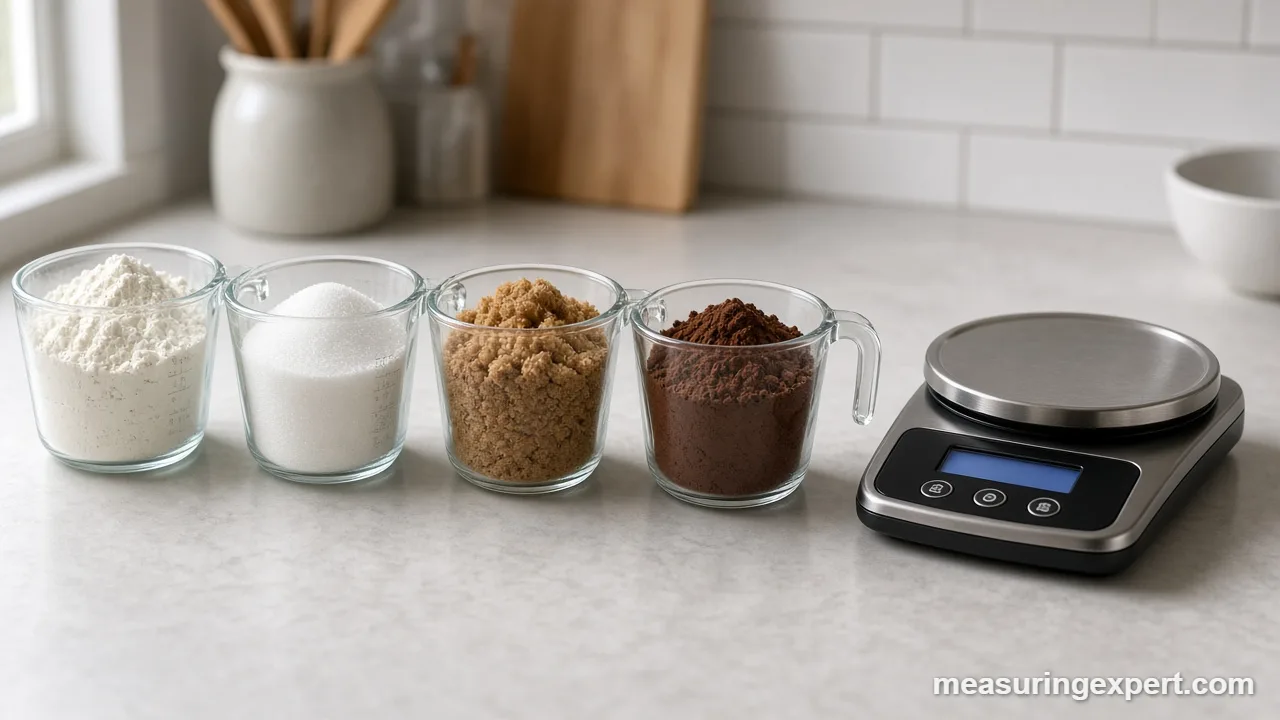
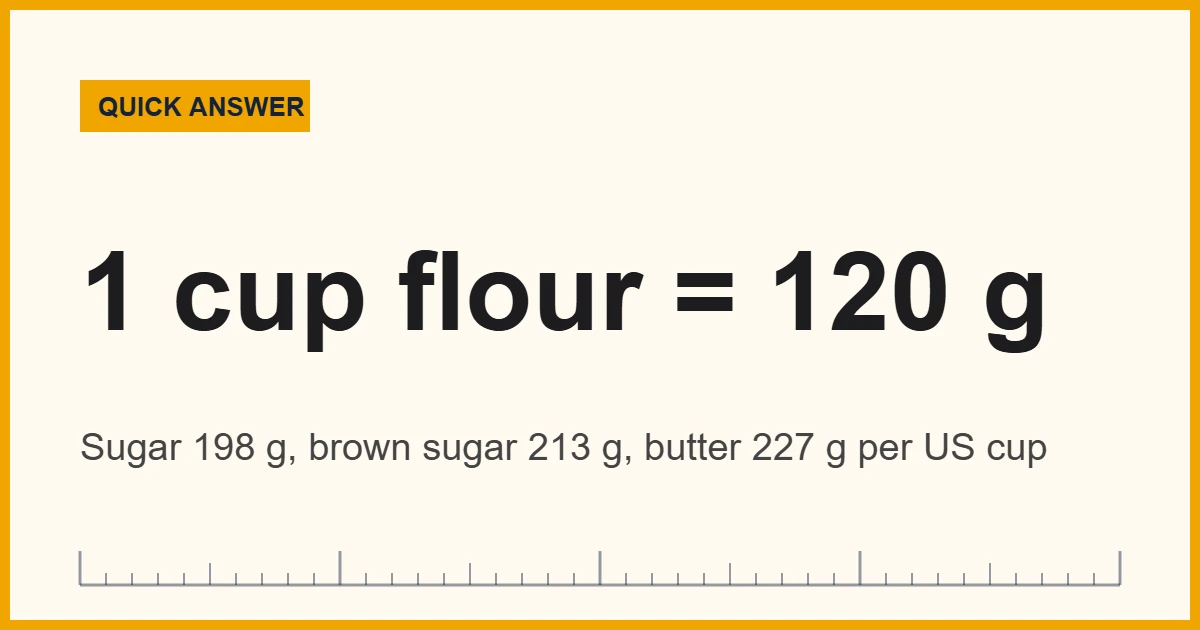
To convert cups to grams, multiply the number of cups by what one cup of that ingredient weighs. There is no single factor. According to King Arthur Baking, 1 US cup of all-purpose flour weighs about 120 g, granulated sugar 198 g, packed brown sugar 213 g and butter 227 g, while water comes to about 236 g.
Convert Your Cup Size to Milliliters First
Because a cup is a volume, the first job is knowing which cup a recipe means. Then enter an amount below, and the converter shows it in milliliters, metric cups, nutrition-label cups, fluid ounces and spoons. Next, multiply by the gram weights in the chart further down.
Most American recipes measure flour, sugar and butter by the cup. Meanwhile, most of the rest of the world weighs them in grams. So if you bake from a British blog, a European cookbook or a pastry class, you will need to translate one into the other, and that is where people get stuck.
The reason is simple: a cup measures space, while a gram measures mass. For instance, a cup of feathery flour and a cup of dense honey take up the same space but weigh very different amounts. For that reason, every honest cups to grams table lists ingredients one by one. In this guide, we use the published King Arthur Baking ingredient weight chart as the main reference, because it is one of the most widely used weight tables for home bakers in the US.
Below you will find the chart, the difference between US and metric cups, a step-by-step method, and finally the limits of any conversion table. If you want the bigger picture first, our explainer on weight vs volume in cooking covers why weighing wins.
Why There Is No Single Cups to Grams Number
You will often see “1 cup = 240 grams” online. However, that figure is really the weight of 240 mL of water, and it only works for water and other thin, water-like liquids. For everything else, the answer depends on density, which is how much mass fits into a given space.
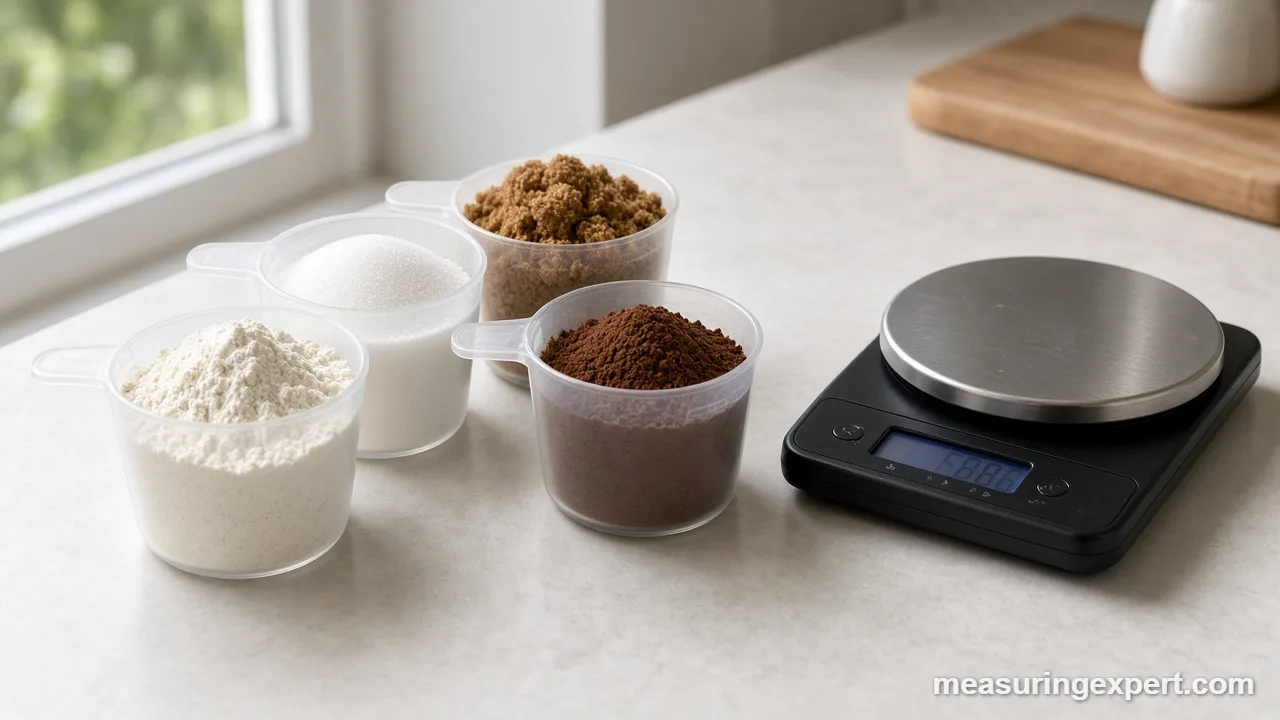
Flour, for example, is full of tiny air pockets, so one cup weighs only about half as much as a cup of water. By contrast, granulated sugar packs into tight crystals and lands near 198 g. Similarly, honey is heavier than water, so a cup of it comes to roughly 336 g. In other words, the same cup can hold anywhere from about 85 g to well over 300 g, depending on what you put in it.
Also, how you fill the cup matters. Scooping flour straight from the bag compresses it, and as a result a “cup” can weigh 140 g or more. Spooning flour into the cup and leveling it, on the other hand, gives a result close to the 120 g that King Arthur lists. Brown sugar, however, is the opposite case: recipes expect it pressed firmly into the cup.
Cups to Grams Chart for Common Baking Ingredients
The weights below come from the King Arthur Baking chart, scaled to one US cup where the chart lists a smaller amount. In addition, ounces are rounded to the nearest quarter. Finally, water and the milk density note are our own calculations.
| Ingredient (1 US cup) | Grams | Ounces (weight) |
|---|---|---|
| All-purpose flour (spooned and leveled) | 120 g | 4 1/4 oz |
| Bread flour | 120 g | 4 1/4 oz |
| Unbleached cake flour | 120 g | 4 1/4 oz |
| Granulated (white) sugar | 198 g | 7 oz |
| Brown sugar, packed | 213 g | 7 1/2 oz |
| Confectioners’ (powdered) sugar, unsifted | 113 g | 4 oz |
| Butter (2 sticks) | 227 g | 8 oz |
| Unsweetened cocoa powder | 84 g | 3 oz |
| Rolled oats | 113 g | 4 oz |
| Chocolate chips | 170 g | 6 oz |
| Vegetable oil | 198 g | 7 oz |
| Milk (chart value) | 227 g | 8 oz |
| Heavy cream | 227 g | 8 oz |
| Honey | 336 g | 11 3/4 oz |
| Water (calculated) | about 236 g | 8 1/4 oz |
Want a printable version? Print this page, or copy the rows you use most onto an index card and tape it inside a cabinet door. For small amounts of leaveners, moreover, the same chart lists 1 teaspoon of baking powder at 4 g and 1/2 teaspoon of baking soda at 3 g.
Recommended Tools for Weighing Baking Ingredients
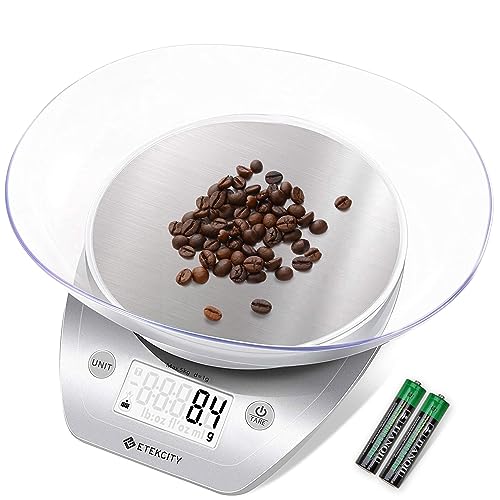
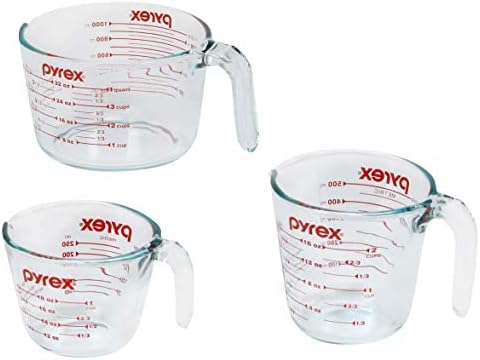
In fact, a digital kitchen scale is the single best fix for conversion headaches. First, look for 1 g resolution (0.1 g is a bonus for yeast and salt). Next, check for a tare button and a capacity of at least 5 kg (11 lb) so a full mixing bowl fits. Also, keep a set of sturdy measuring cups for recipes that still use volume. Note that the picks below are based on manufacturer specs and buyer reports.



As an Amazon Associate, Measuring Expert earns from qualifying purchases.
US Cup vs Metric Cup vs Nutrition Label Cup
Before you convert anything, check which cup the recipe uses. After all, there are three in common use, and they differ by up to about 6 percent.
| Cup type | Volume | Where you see it | All-purpose flour in that cup |
|---|---|---|---|
| US customary cup | 236.59 mL | US recipes and measuring cups | about 120 g |
| US nutrition-label cup | 240 mL | Food labels (NIST and FDA rounding) | about 122 g |
| Metric cup | 250 mL | Australia, New Zealand, Canada, UK recipes | about 127 g |
The US government’s NIST metric kitchen table rounds a cup to 240 mL for everyday use. By definition, though, the US customary cup is exactly 236.5882365 mL. As a result, a metric cup holds about 5.7 percent more, so a metric cup of sugar comes to roughly 209 g rather than 198 g.
Does that difference matter? For one cup, usually not. However, it adds up in a recipe that calls for four or five cups of flour. Next, to see how smaller cup measures work, read our guide to how much 1/4 cup is in tablespoons and milliliters.
How to Convert Cups to Grams Step by Step
- Identify the ingredient exactly. Bread flour, cake flour and cocoa all weigh differently, so first note the precise name.
- Check the cup type. Decide whether the recipe uses US cups (236.59 mL) or metric cups (250 mL); the converter above helps.
- Find the weight of one cup. Look the ingredient up in the chart, for example 198 g for granulated sugar.
- Multiply by the number of cups. For instance, 2 1/2 cups of flour times 120 g gives 300 g.
- Adjust for metric cups if needed. Multiply the result by 1.057 when the recipe was written with 250 mL cups.
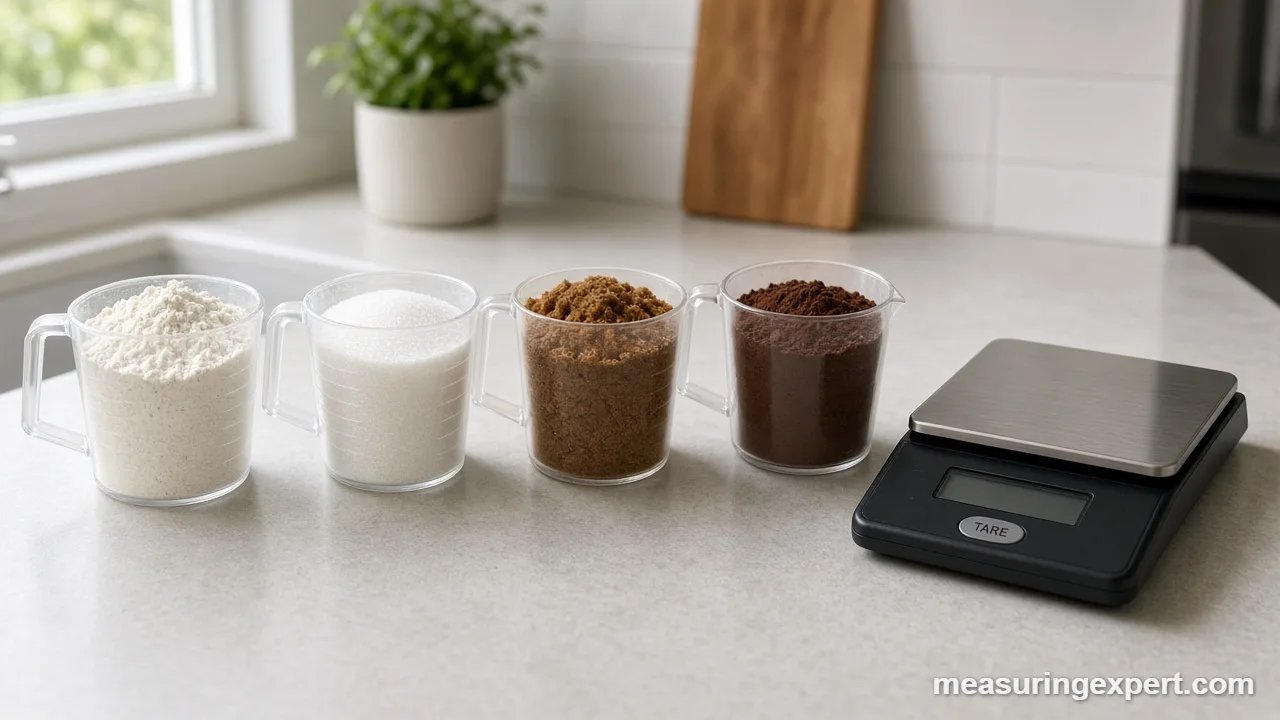
- Weigh it on a tared scale. Set the bowl on the scale, press tare, then add the ingredient until you reach the target.
Likewise, going the other way is just as easy. Divide the grams by the weight of one cup: 300 g of sugar divided by 198 g equals about 1 1/2 cups.
Cups to Grams for Half, Third and Quarter Cups
Of course, recipes rarely ask for neat whole cups. So here are the fractions bakers reach for most, worked out from the chart values and rounded to the nearest gram.
| Amount | All-purpose flour | Granulated sugar | Packed brown sugar | Butter |
|---|---|---|---|---|
| 1/4 cup | 30 g | 50 g | 53 g | 57 g |
| 1/3 cup | 40 g | 66 g | 71 g | 76 g |
| 1/2 cup | 60 g | 99 g | 107 g | 113 g |
| 2/3 cup | 80 g | 132 g | 142 g | 151 g |
| 3/4 cup | 90 g | 149 g | 160 g | 170 g |
For example, one US stick of butter equals 1/2 cup, or about 113 g (4 oz). Meanwhile, if you also need to swap grams for ounces, see how much an ounce weighs in grams.
Do and Don’t for Accurate Conversions
Do
- Weigh flour whenever a recipe gives grams.
- Spoon flour into the cup, then level it off.
- Press brown sugar firmly into the cup.
- Note whether the recipe uses US or metric cups.
- Tare the scale before every new ingredient.
Don’t
- Use 240 g as a universal cup weight.
- Scoop flour straight from the bag.
- Mix weights from several different charts in one recipe.
- Confuse fluid ounces (volume) with ounces (weight).
- Forget that cocoa and powdered sugar are light.
Honest Limits of Any Cups to Grams Chart
First of all, every number on this page is an average. In practice, flour settles in the bag, brown sugar dries out, and oats vary by brand and cut. Therefore, a cup you measure at home can easily land 5 to 15 percent away from the chart. Humidity has a small effect as well, because flour absorbs moisture from the air.
In addition, different test kitchens measure differently. Some charts, for instance, list a cup of all-purpose flour at 125 g or even 130 g because they dip and sweep. Even so, none of them is wrong; instead, they simply describe a different technique. In short, the chart tells you what the recipe developer most likely meant, while a scale tells you what actually went into the bowl.
When Accuracy Really Matters
For cookies and quick breads, a few grams either way rarely shows. Still, some bakes are less forgiving:
- Bread and pizza dough. Hydration (water as a percentage of flour) controls texture, so weigh both.
- Macarons and genoise. These delicate batters often fail because of small ratio changes.
- Scaling a recipe. Doubling or halving magnifies any cup error, because the mistake repeats with every cup.
Frequently Asked Questions
How many grams are in 1 cup?
Overall, it depends on the ingredient. A US cup of water weighs about 236 g, all-purpose flour about 120 g, and granulated sugar about 198 g.
How do you convert cups to grams for flour?
Multiply the number of cups by 120 g for all-purpose flour that you spooned and leveled. For example, 3 cups equals 360 g.
What does 1 cup of sugar weigh in grams?
One US cup of granulated sugar weighs about 198 g. By comparison, packed brown sugar is heavier at about 213 g, and unsifted powdered sugar is lighter at about 113 g.
What does 1 cup of butter weigh in grams?
A cup of butter, or two US sticks, weighs about 227 g (8 oz). So half a cup is one stick, about 113 g.
Is a cup of water 250 grams?
Only in a metric cup. A 250 mL metric cup of water weighs about 250 g, while a US customary cup holds about 236 g.
Why do cups to grams charts disagree?
Mostly, that is because test kitchens fill cups differently. Spooning and leveling flour gives about 120 g, but scooping can push it past 130 g.
What is 1/2 cup of flour in grams?
Half a US cup of all-purpose flour weighs about 60 g, based on the King Arthur Baking figure of 120 g per cup.
Should I spoon or scoop flour into a cup?
Spoon it in and level it, unless the recipe says otherwise. Otherwise, scooping packs the flour and adds weight.
Can I use cups to grams for liquids like milk?
Yes. Thin liquids weigh close to water, so a US cup of milk is roughly 227 to 244 g depending on the chart. Oil, on the other hand, is lighter at about 198 g per cup.
Are UK and Australian cups to grams the same as US values?
No. Those countries use a 250 mL metric cup, so multiply US cup weights by about 1.057. For example, flour becomes about 127 g.
The Bottom Line on Cups to Grams
To sum up, cups to grams is never one fixed number, because each ingredient has its own density. Use 120 g for a cup of all-purpose flour, 198 g for granulated sugar, 213 g for packed brown sugar and 227 g for butter, and adjust upward by about 6 percent for metric cups.
Finally, the simplest way to stop converting is to bake by weight. A basic digital scale takes the guesswork out of every recipe and makes your results repeatable.
1 thought on “How to Convert Cups to Grams for Baking: Ingredient Chart and Cup Sizes”