

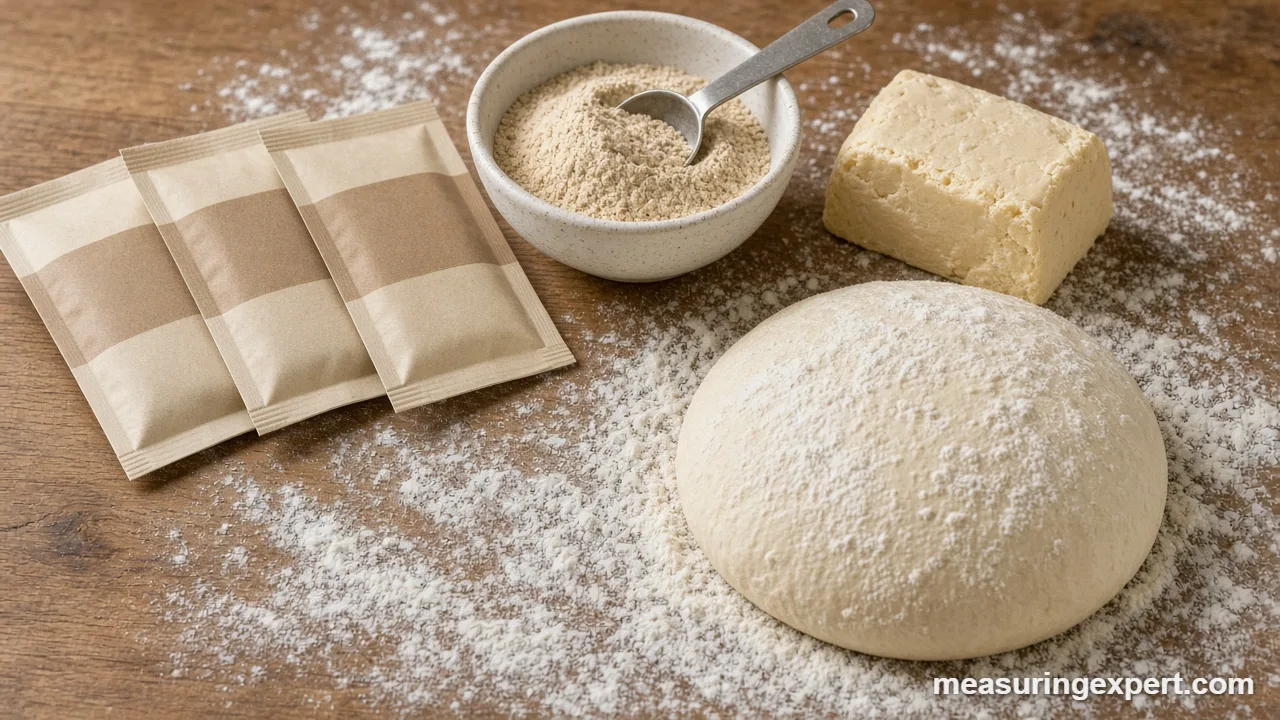
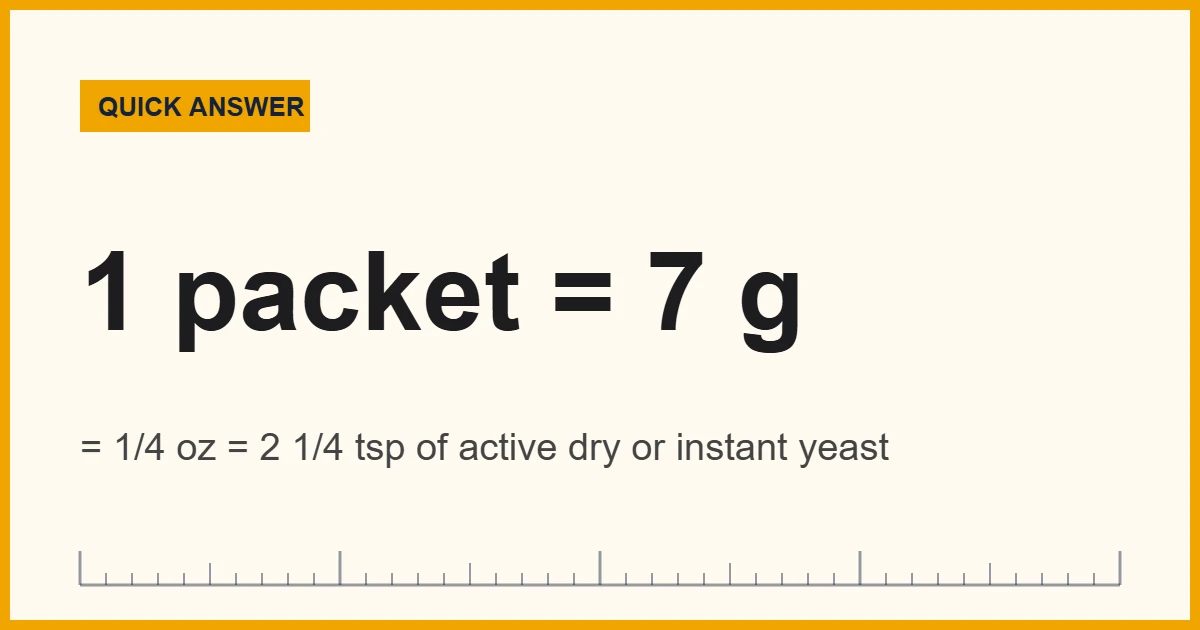
How to measure yeast: one standard packet of active dry or instant yeast holds 1/4 oz, which is 7 g or 2 1/4 teaspoons, so 1 level teaspoon weighs about 3.1 g. For accuracy, weigh it on a 0.1 g scale. Instant and active dry swap 1:1, while fresh yeast takes about 2.5 to 3 times the weight.
Convert Yeast Grams to Ounces and Milligrams
Enter the amount of yeast your recipe lists, then pick the unit. This is how to measure yeast when the recipe and your scale disagree. The converter uses the exact avoirdupois ounce (28.349523125 g), so it also helps when a recipe gives yeast in ounces and your scale only shows grams.
Yeast is the smallest amount in most bread recipes, yet it controls how fast the dough rises and how the loaf tastes. For example, a loaf made with 500 g of flour may need only 3 to 7 g of yeast. As a result, a small slip with a spoon can change the rise time by an hour or more.
The good news is that the standard amounts are simple. According to the Red Star yeast conversion chart, one 1/4 oz package equals 7 g or 2 1/4 teaspoons, and one package raises up to about 4 cups of flour. Likewise, Fleischmann’s lists the same 2 1/4 teaspoons per packet. So once you know these anchors, learning how to measure yeast comes down to choosing the right tool for the amount.
- 1 packet = 1/4 oz = 7 g = 2 1/4 tsp of active dry or instant yeast.
- 1 level teaspoon of dry yeast weighs about 3.1 g.
- Instant and active dry yeast can replace each other 1:1 in most recipes.
- Fresh (cake) yeast is about 2.5 to 3 times the weight of dry yeast.
- Bread recipes often use roughly 1% to 2% dry yeast relative to flour weight.
- For amounts under 2 g, a 0.01 g pocket scale beats any spoon.
How to Measure Yeast by Packet, Teaspoon and Gram
This chart follows the packet figures from Red Star and Fleischmann’s. In addition, the gram values for partial teaspoons are calculated from 7 g per 2 1/4 tsp, so they assume level, loosely filled spoons.
| Dry yeast (volume) | Weight (g) | Weight (oz) | Packets |
|---|---|---|---|
| 1/4 tsp | 0.78 g | 0.03 oz | about 1/9 |
| 1/2 tsp | 1.56 g | 0.06 oz | about 2/9 |
| 3/4 tsp | 2.33 g | 0.08 oz | 1/3 |
| 1 tsp | 3.11 g | 0.11 oz | about 4/9 |
| 1 1/2 tsp | 4.67 g | 0.16 oz | 2/3 |
| 2 1/4 tsp | 7 g | 1/4 oz | 1 |
| 4 1/2 tsp | 14 g | 1/2 oz | 2 |
| 6 3/4 tsp | 21 g | 3/4 oz | 3 |
| 9 tsp (3 tbsp) | 28 g | 1 oz | 4 |
Strictly speaking, 1/4 oz is 7.09 g, but manufacturers print 7 g on the packet. Even so, the gap is about 1%, which no bread dough will notice. Printable tip: save this chart with your recipes. Also, if you need a refresher on spoon sizes, see our guide to what a tsp measurement is.
Active Dry vs Instant vs Fresh Yeast Conversions
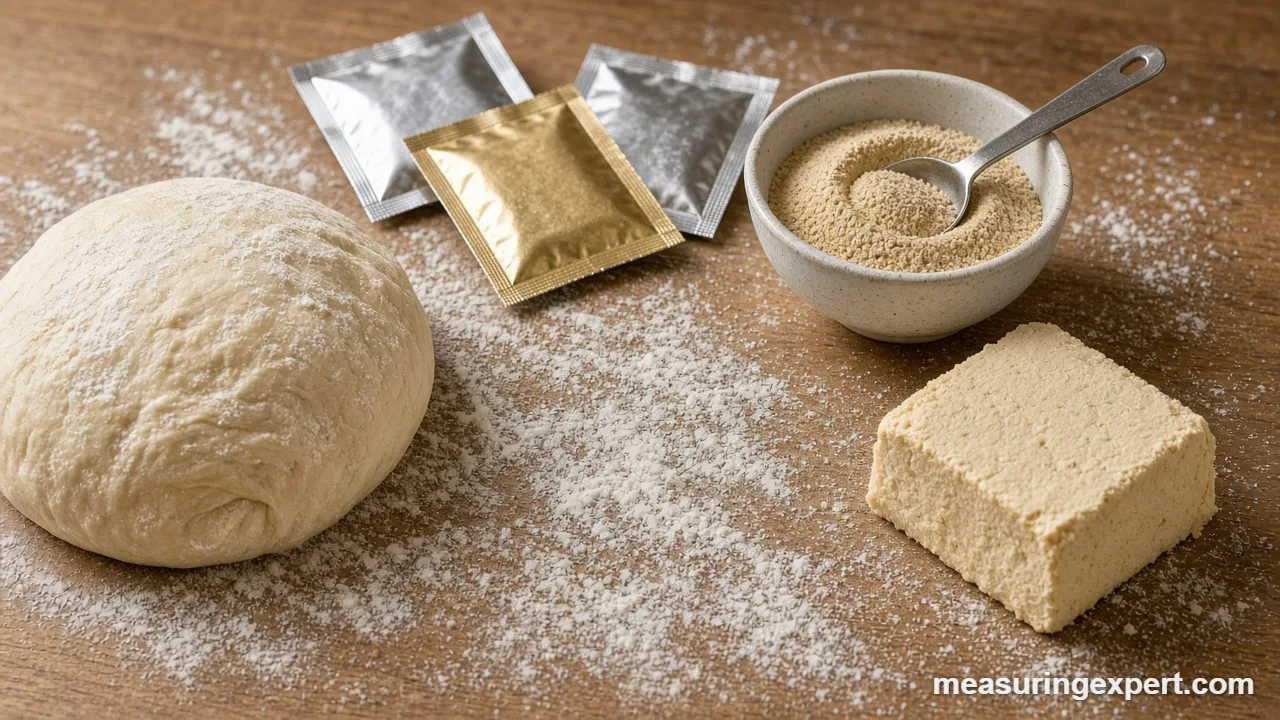
The three common yeasts do the same job, but they are not packed the same way. For one thing, fresh yeast still holds a lot of water, so you need more of it by weight. Dry yeasts, by contrast, are concentrated and nearly interchangeable.
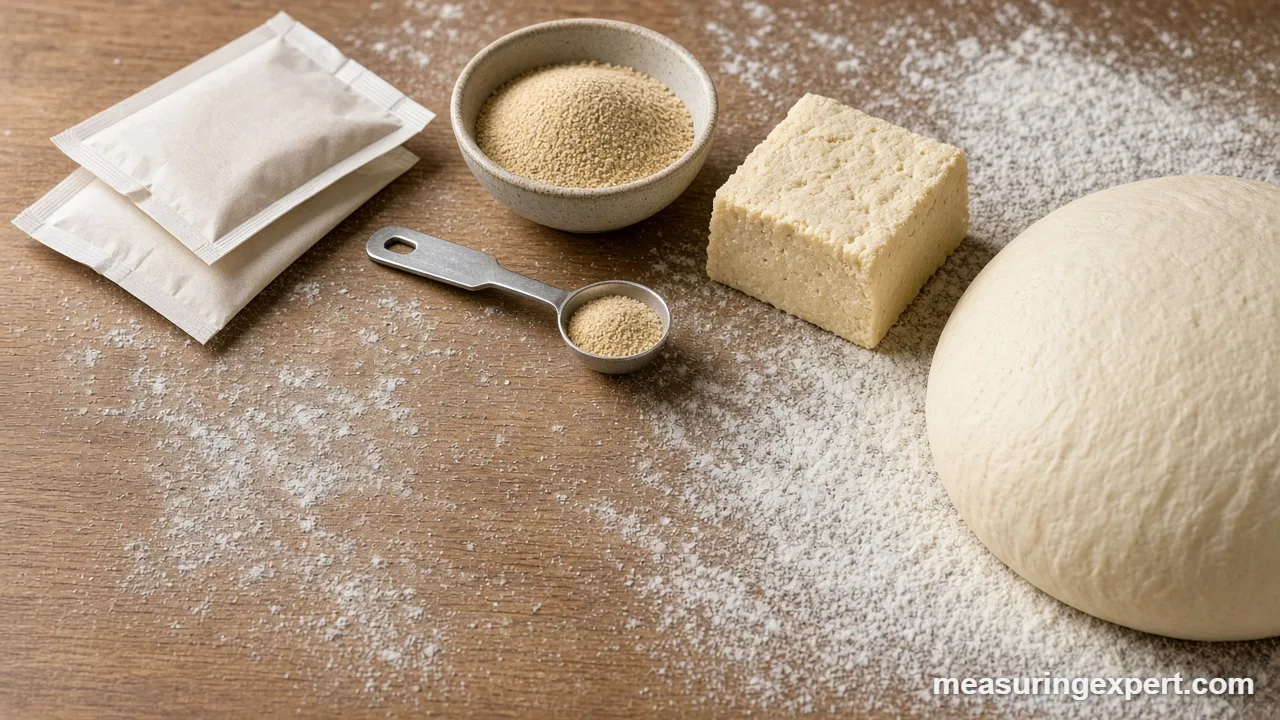
| If the recipe says | Active dry | Instant (rapid rise) | Fresh (cake) |
|---|---|---|---|
| 1 packet active dry (7 g) | 7 g / 2 1/4 tsp | 7 g / 2 1/4 tsp | about 17 to 21 g |
| 1 packet instant (7 g) | 7 g, or up to 8.75 g | 7 g / 2 1/4 tsp | about 17 to 21 g |
| 1 small fresh cake (0.6 oz, 17 g) | 7 g | 7 g | 17 g |
| 1 large fresh cake (2 oz, 57 g) | 21 g (3 packets) | 21 g (3 packets) | 57 g |
Where do these numbers come from? First, King Arthur Baking says to substitute instant yeast 1:1 for active dry, by weight or volume. However, the Fleischmann’s Yeast 101 guide suggests 25% more active dry when it replaces their RapidRise instant yeast, plus about 20 extra minutes of rising. Next, for fresh yeast, Fleischmann’s equates one packet to one 0.6 oz cake, Red Star equates it to 2/3 oz, and King Arthur says to divide the dry amount by 0.33. In short, use roughly 2.5 to 3 grams of fresh yeast for every gram of dry yeast.
If you swap yeast types often, our separate guide on converting yeast measurements for different recipes covers more scenarios.
Recommended Tools for How to Measure Yeast
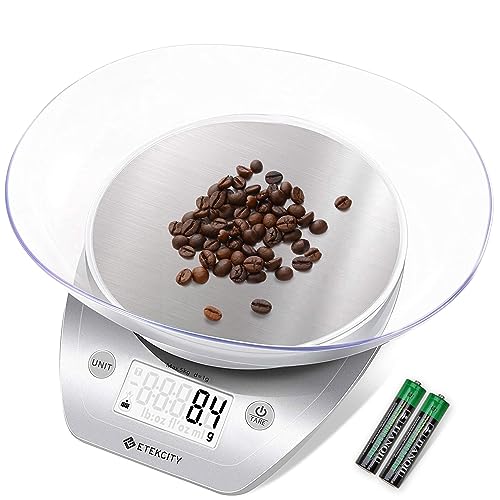
When people ask how to measure yeast, two tools cover almost every case. First, a kitchen scale with 1 g or 0.1 g steps handles flour, water and full packets of yeast. Meanwhile, a pocket scale that reads 0.01 g is the better choice for the tiny amounts in overnight doughs and small batches. Finally, a good set of measuring spoons, including a 1/4 tsp or 1/8 tsp, works well when you only need a rough amount.




As an Amazon Associate, Measuring Expert earns from qualifying purchases.
How to Measure Yeast Step by Step
Here is how to measure yeast with a scale, which is the method to use whenever you can. If you only have spoons, steps 5 and 6 explain the backup approach.
- Check the yeast type. Read the label so you know whether it is active dry, instant or fresh, and convert the recipe amount if needed.
- Set the scale to grams. Grams give finer steps than ounces, which matters for a 3 g or 5 g amount.
- Place a small cup on the scale and tare it. Press tare so the display reads 0.0 g with the empty cup on it.
- Add yeast slowly. Tap it in from a spoon until the display reaches the target weight, and then stop.
- Without a scale, spoon and level. Scoop dry yeast with a measuring spoon and sweep the top flat with a knife, without packing it.
- Keep yeast away from salt at first. Add yeast and salt to opposite sides of the flour, and then mix them in together.
Baker’s Percentage for Yeast
Professional recipes often list yeast as a baker’s percentage, which changes how to measure yeast for big batches. In this system, flour is always 100%, and then every other ingredient is a percentage of the flour weight. For example, 500 g of flour with 1% instant yeast means 5 g of yeast.
The Red Star chart also gives a useful benchmark: one 7 g packet raises up to 4 cups of flour. At King Arthur’s figure of 120 g per cup of all-purpose flour, 4 cups weigh about 480 g, so one packet works out to roughly 1.5% yeast. Similarly, 3 cups (360 g) with one packet is about 1.9%.
| Flour weight | 0.5% yeast | 1% yeast | 1.5% yeast | 2% yeast |
|---|---|---|---|---|
| 250 g | 1.25 g | 2.5 g | 3.75 g | 5 g |
| 500 g | 2.5 g | 5 g | 7.5 g | 10 g |
| 750 g | 3.75 g | 7.5 g | 11.25 g | 15 g |
| 1,000 g | 5 g | 10 g | 15 g | 20 g |
Lower percentages suit long, cool rises, so overnight doughs often sit near the low end. Higher percentages, on the other hand, speed things up and are common in rich, sweet doughs. Of course, these are general ranges, so always follow your recipe first. To work out any amount, multiply the flour weight by the percentage and divide by 100.
How to Measure Yeast in Very Small Amounts
Many artisan recipes call for 1 g of yeast or less. That is about 1/3 of a teaspoon, and most kitchen scales cannot show it reliably. For instance, a typical 1 g kitchen scale may read 0 g, 1 g or 2 g for the same pinch. Therefore, a 0.01 g pocket scale is the right tool for these doughs.
If you do not own one, try the dilution method. First, weigh 3 g of yeast, which most kitchen scales can handle. Next, stir it into 30 g of water. As a result, each 10 g of that mixture holds 1 g of yeast. This trick works because the mixture is ten times heavier than the yeast alone. For more ideas, read our guide on how to measure small quantities.
Do and Don’t When You Measure Yeast
Do
- Weigh yeast in grams when the recipe gives grams.
- Level spoonfuls with a straight edge.
- Tare the scale with the cup already on it.
- Check the expiry date before you bake.
- Write down the exact amount that worked.
Don’t
- Pack yeast into a spoon or heap it.
- Treat fresh and dry yeast as equal by weight.
- Trust a 1 g scale for amounts below 2 g.
- Leave an open jar of yeast in a warm cupboard.
- Guess when a recipe lists yeast in ounces.
Honest Limits of Yeast Measurements
Even if you know how to measure yeast carefully, the 3.1 g per teaspoon figure is still an average. For example, granule size varies by brand, so a teaspoon of fine instant yeast can weigh a little more than a teaspoon of coarser active dry yeast. Also, how you scoop matters: a heaped teaspoon can hold noticeably more than a level one. In addition, the fresh yeast ratio is a range rather than a single number, because the three big sources above use slightly different figures. Finally, temperature, sugar, salt and flour type all affect the rise, so the same weight of yeast will not behave identically in every kitchen. For that reason, watch the dough as well as the clock.
When Accuracy Really Matters
For a standard sandwich loaf, a slightly generous teaspoon rarely ruins anything. Still, a few situations need closer care:
- Overnight and cold-fermented doughs. Because the yeast amount is tiny, a 0.5 g error can double the yeast and over-proof the dough.
- Scaling a recipe up or down. Halving 2 1/4 tsp gives 1 1/8 tsp, which spoons handle poorly, so weigh 3.5 g instead.
- Bread machines. Because machines run fixed cycles, too much yeast can overflow the pan.
Yeast Measuring FAQs
How many teaspoons are in a packet of yeast?
One standard packet holds 2 1/4 teaspoons of dry yeast, which is 1/4 oz or 7 g. This applies to both active dry and instant yeast.
How to measure yeast in grams: how much is 1 teaspoon?
One level teaspoon of active dry or instant yeast weighs about 3.1 g, based on 7 g per 2 1/4 teaspoons. Brands vary slightly.
How to measure yeast without a scale?
Use measuring spoons, fill them loosely, and level the top with a knife. For 1 packet, use 2 1/4 teaspoons, or simply use the whole packet.
Can I use instant yeast instead of active dry?
Yes. King Arthur Baking recommends a 1:1 swap by weight or volume. Dough made with active dry yeast may need 15 to 20 minutes longer to rise.
How much fresh yeast equals a packet of dry yeast?
About 17 to 21 g of fresh yeast replaces one 7 g packet. Fleischmann’s uses one 0.6 oz cake, and King Arthur divides the dry weight by 0.33.
How much yeast do I need for 4 cups of flour?
Red Star’s chart lists one 7 g packet for up to 4 cups of flour. That is roughly 1.5% of the flour weight.
What is the best tool for how to measure yeast in small amounts?
A pocket scale that reads 0.01 g is best for amounts under 2 g. A standard kitchen scale with 1 g steps is too coarse for that job.
How do I convert a recipe that lists yeast in ounces?
Multiply the ounces by 28.35 to get grams. For example, 1/4 oz is about 7 g, and 1 oz is about 28 g, or four packets.
Why does my bread taste too yeasty?
Usually there is too much yeast or the dough over-proofed. Weigh the yeast, check the recipe percentage, and shorten the rise if the room is warm.
Does salt kill yeast when I measure them together?
Direct, prolonged contact with lots of salt can slow yeast. Add them to separate sides of the flour and mix, and the dough will be fine.
The Bottom Line on How to Measure Yeast
To sum up, remember the anchor: one packet is 1/4 oz, 7 g or 2 1/4 teaspoons, and a teaspoon of dry yeast weighs about 3.1 g. Instant and active dry yeast trade 1:1, whereas fresh yeast needs about 2.5 to 3 times the weight.
So for everyday loaves, a level measuring spoon is fine. For small batches, overnight doughs and baker’s percentage recipes, however, a scale in grams makes the result repeatable. Finally, use the converter at the top whenever a recipe switches units.