

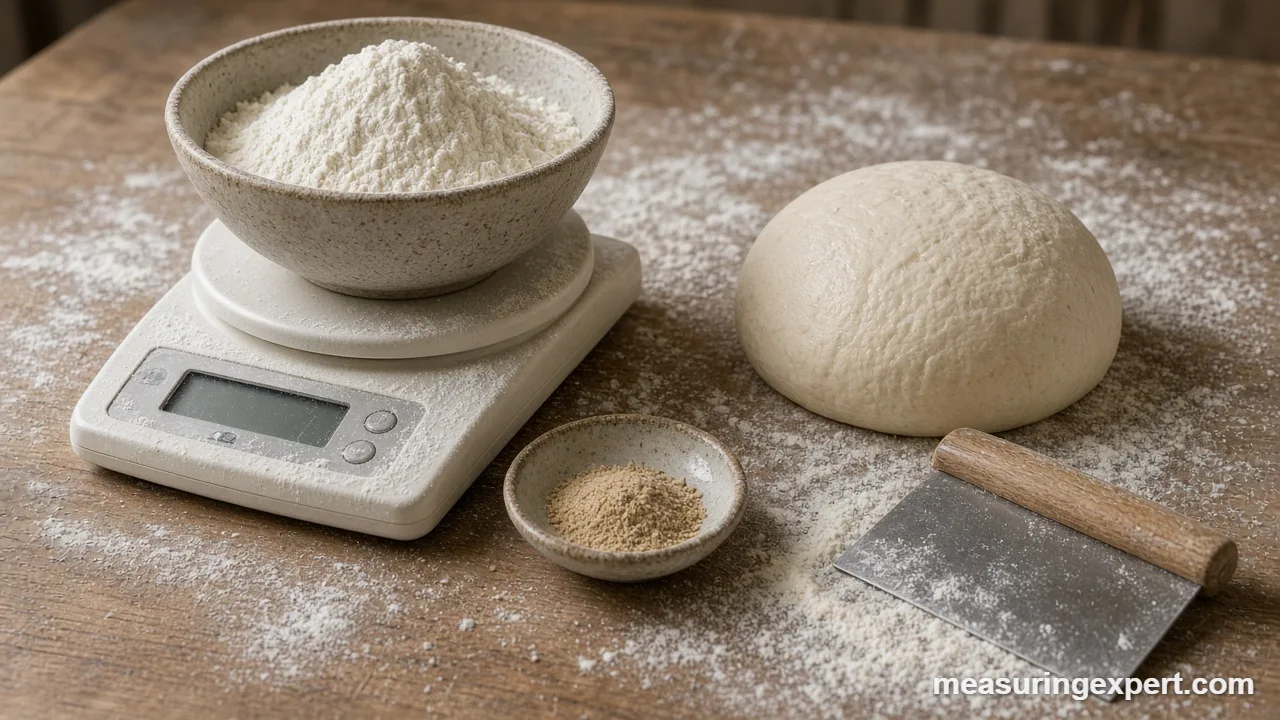
The best baking scale for most home bakers is the OXO Good Grips 11 lb scale, because its pull-out display stays readable under wide bowls and it reads in 1 g steps. Still, the right choice depends on resolution for yeast and salt, capacity for big dough batches, and whether you work in baker’s percentages.
In short: get the OXO for everyday baking, the My Weigh KD-8000 for bread formulas, the KitchenAid dual platform for flour and yeast in one, and a 0.1 g Triton for small doses.
As an Amazon Associate, Measuring Expert earns from qualifying purchases. Our picks are based on research, specifications and owner feedback, not paid placement.
Best Overall
Best Budget
Best Pro
Quick Answer: Best Baking Scale for Each Kind of Baker
- Most home bakers: OXO Good Grips 11 lb, with a display that slides out from under the bowl.
- Bread formulas: My Weigh KD-8000, which shows each ingredient as a baker’s percentage.
- Flour and yeast on one device: KitchenAid KQ909, with a second platform that reads to 0.01 g.
- Yeast, salt and levain: My Weigh Triton T3-660, at 0.1 g up to 660 g.
- Big dough batches: Etekcity 22 lb rechargeable, with room for a heavy mixer bowl.
- A first scale for little money: Amazon Basics 11 lb digital scale.
On This Page
- Comparison table
- The 8 picks, reviewed
- How we chose
- Platform, dual or pocket scale
- Baker’s percentages explained
- How to weigh a bread formula
- Grams to ounces converter
- Calibration and care
- Honest limits
- FAQ
- Bottom line
Best Baking Scale Comparison Table
First, decide how small your smallest dose is. Next, check how heavy your biggest bowl of dough gets. Then use the table below to jump to each review.
| # | Image | Product | Best For | Standout Feature | Amazon |
|---|---|---|---|---|---|
| 1 | 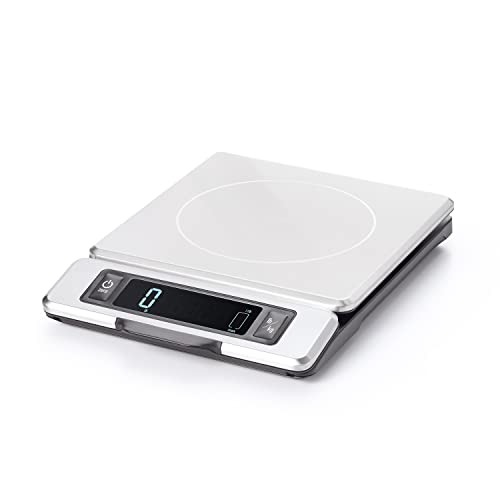 | OXO Good Grips 11 lb Pull-Out | Everyday bread and cake bakers | Display slides out from under wide bowls | View |
| 2 |  | My Weigh KD-8000 | Bread formulas and scaling | Baker’s percentage mode, 8 kg capacity | View |
| 3 | 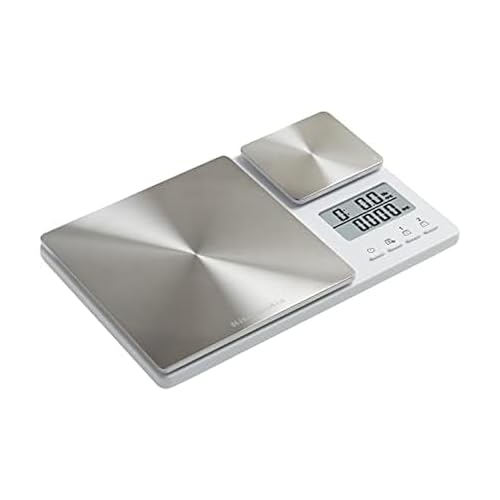 | KitchenAid KQ909 Dual Platform | Flour and yeast in one session | Second 0.01 g platform for small doses | View |
| 4 | 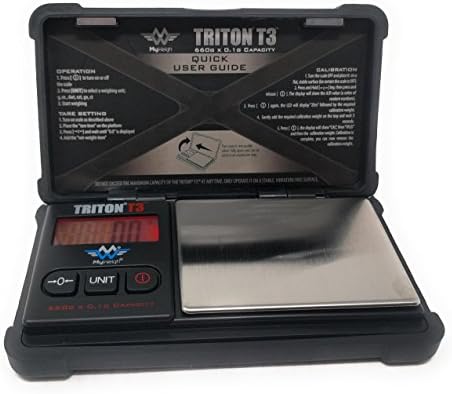 | My Weigh Triton T3-660 | Yeast, salt and levain | 0.1 g steps up to 660 g | View |
| 5 |  | Etekcity 22 lb Rechargeable | Large batches and pizza dough | 22 lb capacity, USB charging | View |
| 6 | 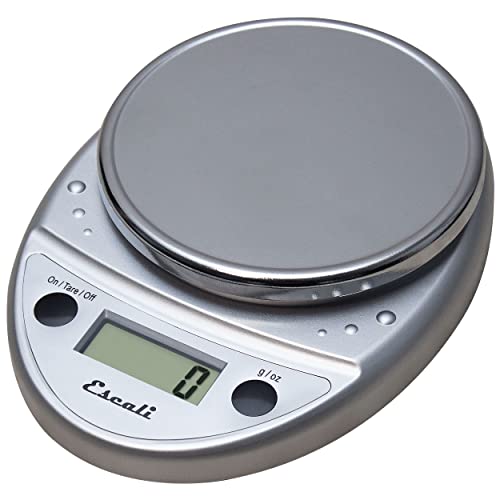 | Escali Primo | Bakers who want two buttons | Sealed buttons and display | View |
| 7 |  | Amazon Basics Digital Kitchen Scale | First scale on a tight budget | Plain 11 lb scale with tare | View |
| 8 |  | American Weigh Scales AWS-100 | Micro doses and small test batches | 0.01 g steps up to 100 g | View |
Best Baking Scale Reviews: 8 Picks for Bread, Cakes and Pizza
Note that each pick below fills a different job at the bench. So, read the “Best for” line first, and then check the specs against your own recipes.
Best Overall
1. OXO Good Grips 11 lb Food Scale with Pull-Out Display
Best for: home bakers who weigh into big mixing bowls and want a display they can always see.
The OXO Good Grips 11 lb scale is our best baking scale for most kitchens. In fact, its key feature is simple, yet it fixes a real baking problem. Specifically, the display slides forward on a short arm, so a wide mixing bowl or a sheet pan no longer hides the numbers while you add flour.
On the measuring side, it covers 0 to 11 lb (5 kg) and reads in 1 g or 0.1 oz steps. As a result, that suits loaves, cakes and cookie dough, where most ingredients weigh 50 g or more. However, 1 g steps are coarse for a 2 g pinch of yeast, so pair it with a 0.1 g pocket scale if you bake small loaves. Also, the stainless steel top lifts off for washing.
- Capacity: 11 lb (5 kg)
- Readability: 1 g or 0.1 oz
- Pull-out display that slides back for storage
- Removable stainless steel platform
- Power: four AAA batteries, included
Pros
- Display stays visible under large bowls
- Platform lifts off for cleaning
- Simple tare and unit buttons
Cons
- 1 g steps are too coarse for small yeast doses
- Base is not dishwasher safe
- No baker’s percentage mode
Skip it if: you mostly bake big batches over 11 lb, or you want the scale to do percentage math for you.
Best for Baker’s Percentages
2. My Weigh KD-8000 Bakers Math Scale
Best for: bread bakers who write formulas in baker’s percentages and scale them up or down.
Notably, the My Weigh KD-8000 is sold as the Bakers Math scale, and the name tells you why bread bakers like it. First, in percentage mode you weigh the flour and set it as 100 percent. After that, each ingredient you add shows as a share of the flour weight, so you can check a 70 percent hydration dough without a calculator.
In addition, it weighs up to 8 kg (about 17.6 lb) in 1 g steps and switches between g, kg, oz, lb and lb:oz. Meanwhile, the 7 x 7 in (175 x 175 mm) tray takes a big bowl, and a clear cover shields the keypad from flour. Also, it runs on three AA batteries or an optional 5 V adapter, which suits long dough sessions.
- Capacity: 8,000 g in 1 g steps (8 kg x 0.001 kg)
- Units: kg, g, lb:oz, lb, oz
- Tray: 7 x 7 in (175 x 175 mm)
- Power: 3 x AA batteries or a 5 V DC adapter
- Protective cover over the display and keys
Pros
- Percentage mode built for bread formulas
- Larger capacity than most home scales
- Cover keeps flour out of the buttons
Cons
- Bulkier than slim kitchen scales
- Percentage mode takes a few tries to learn
- 1 g steps, like most big-capacity scales
Skip it if: you bake from cup-based recipes and never plan to work in baker’s percentages.
Best Dual Platform
3. KitchenAid KQ909 Dual Platform Digital Scale
Best for: bakers who want flour and yeast on one device, each with its own tare.
Essentially, KitchenAid puts two scales in one body, and for baking that is a smart pairing. The large platform holds up to 11 lb (5 kg) and reads in 1 g or 0.1 oz steps, so it handles flour, water and butter. Next to it, meanwhile, a small platform holds up to 500 g (about 16 oz) and reads to two decimal places in grams.
As a result, you can weigh 500 g of flour on the big side and 3.5 g of salt or 1.2 g of yeast on the small side without swapping devices. Better still, each platform has its own tare, and the backlit display shows both readings at once. However, the batteries are not in the box, so buy three AAA cells with it.
- Large platform: 11 lb (5 kg) in 1 g or 0.1 oz steps
- Small platform: 500 g (16 oz), two decimal places in grams
- Dual backlit display with a tare for each side
- Power: three AAA batteries, not included
Pros
- Fine readings for yeast, salt and spices
- Both readings visible at once
- One device instead of two
Cons
- Batteries not included
- Takes more counter space than a single scale
- Large platform still reads in 1 g steps
Skip it if: you already own a 0.1 g pocket scale, since a plain platform scale would cost less.
Best for Yeast and Salt
4. My Weigh Triton T3-660 (660 g x 0.1 g)
Best for: bakers who already own a 1 g kitchen scale and need fine readings for small doses.
A 1 g kitchen scale cannot weigh a 1.5 g dose of instant yeast well. In contrast, the Triton T3-660 reads to 0.1 g up to 660 g (23.3 oz), so it handles yeast, salt, baking soda, diastatic malt and spice blends. Also, 660 g is enough for a small bowl or a sourdough starter feed.
Meanwhile, the tray measures 3.15 x 2.4 in (80 x 60 mm), and a rubber-padded case helps it survive a busy counter. In addition, it runs on two AAA cells that come in the box. Because it turns off after 60 seconds, set the bowl on it right before you weigh. For more on small yeast weights, see our guide on how to measure yeast.
- Capacity x readability: 660 g x 0.1 g
- Units: g, oz, dwt, ozt, gn, ct
- Tray: 3.15 x 2.4 in (80 x 60 mm)
- Power: 2 x AAA (included); auto-off after 60 seconds
Pros
- Ten times finer than a 1 g scale
- Enough capacity for a starter feed
- Tough padded case
Cons
- Small tray needs a light cup or paper
- Short auto-off timer
- Not big enough for a full dough
Skip it if: you want one scale for everything; then the dual-platform KitchenAid is the better fit.
Best for Big Dough Batches
5. Etekcity 22 lb Rechargeable Kitchen Scale
Best for: bakers who mix double batches, pizza dough for a crowd or heavy Dutch ovens full of dough.
Generally, most kitchen scales stop at 11 lb, which is tight once you add a heavy stand mixer bowl. However, this Etekcity model doubles that to 22 lb (10 kg). As a result, you can tare a big bowl and still have plenty of room for a large batch of bread or pizza dough.
In addition, it charges over USB instead of eating AAA cells, and the listing gives an IPX6 water-resistance rating for splashes. Consequently, that helps when wet dough or a spill lands on the scale. Still, read the 1 g steps as a dough-sized tool, and keep a fine scale for yeast.
- Capacity: 22 lb (10 kg)
- Readability: 1 g (0.05 oz)
- Power: built-in battery, USB rechargeable
- Water resistance: IPX6 rating for splashes
Pros
- Room for big bowls and double batches
- No disposable batteries
- Splash-resistant for messy dough work
Cons
- Coarse for small doses
- Needs charging before long sessions
- Do not submerge it, despite the rating
Skip it if: you rarely weigh more than 5 kg at a time; then a smaller 11 lb scale is easier to store.
Best Simple Scale
6. Escali Primo Digital Food Scale
Best for: bakers who want a sealed, no-fuss scale that just works next to the mixer.
The Escali Primo is about as simple as a digital scale gets. First, you get a power button, a tare button and a unit switch, and nothing else. Even so, it still covers 11 lb (5 kg) in 1 g or 0.1 oz steps, so it handles everyday cakes, cookies and sandwich loaves.
Also, Escali seals the buttons and display against spills, which matters when flour dust and butter fly around. In addition, it runs on two AA batteries and turns itself off after about four minutes. Therefore, tare and add each ingredient without long pauses.
- Capacity: 11 lb (5 kg)
- Readability: 1 g or 0.1 oz
- Sealed buttons and display
- Power: two AA batteries
- Size: about 8 x 6 x 1.25 in (21 x 15.5 x 3 cm)
Pros
- Very easy to use
- Sealed face handles flour and splashes
- Compact footprint
Cons
- Large bowls can cover the display
- Auto-off can cut in during slow additions
- No fine 0.1 g mode
Skip it if: you weigh into very wide bowls; then the OXO pull-out display is easier to read.
Best Budget
7. Amazon Basics Digital Kitchen Scale
Best for: new bakers who want to switch from cups to grams for very little money.
Similarly, if you are just leaving measuring cups behind, this plain scale is a low-cost start. For example, it has a stainless steel platform, a tare button and an LCD, and it weighs up to 11 lb (about 5 kg). So, for a first sourdough loaf or a pound cake, that is enough.
However, it lists a 2 g minimum load rather than a published step size. So use it for flour, sugar, butter and water, and do not trust it for a gram of yeast. Also, its mL modes assume water density, so treat mL readings for milk or oil as estimates.
- Capacity: 11 lb (about 5 kg); 2 g minimum load listed
- Units: lb, oz, g, fl oz and mL
- Size: 8.3 x 7 x 1.3 in (21 x 18 x 3.3 cm)
- Power: two AAA batteries (included)
Pros
- Low cost way to start baking by weight
- Stainless steel top wipes clean
- Batteries included
Cons
- No published step size
- Not suited to small doses
- Basic display
Skip it if: you bake bread often; the extra features of the OXO or My Weigh pay off quickly.
Best for Tiny Amounts
8. American Weigh Scales AWS-100 (100 g x 0.01 g)
Best for: bakers who test half-size formulas or weigh very small additions, such as diastatic malt or ascorbic acid.
Occasionally, though, 0.1 g is still too coarse. For example, a quarter-size test loaf may call for 0.6 g of yeast. Fortunately, the AWS-100 weighs up to 100 g (3.5 oz) in 0.01 g steps, so it shows that dose clearly.
Besides, its platform is 2.5 x 3.0 in, and a hinged cover protects it in a drawer. Also, it switches between grams, ounces, carats and grains. However, it calibrates with a 100 g weight that is not in the box, so plan to buy one. Finally, keep in mind that 100 g is the limit, which is too small for most bowls.
- Capacity x readability: 100 g x 0.01 g
- Units: g, oz, ct, gn
- Platform: 2.5 x 3.0 in
- Power: 2 x AAA (included); calibrates with a 100 g weight
Pros
- Finest readings in this list
- Low cost
- Cover protects the pan
Cons
- 100 g limit
- Calibration weight sold separately
- Overkill for most home recipes
Skip it if: you bake full-size loaves only; the Triton T3-660 is the more practical small-dose scale.
How We Chose the Best Baking Scale Picks
To be clear, we did not run hands-on tests. Instead, we compared maker spec pages and listings, read owner feedback for patterns, and checked each scale against real baking tasks. In particular, we scored five points.
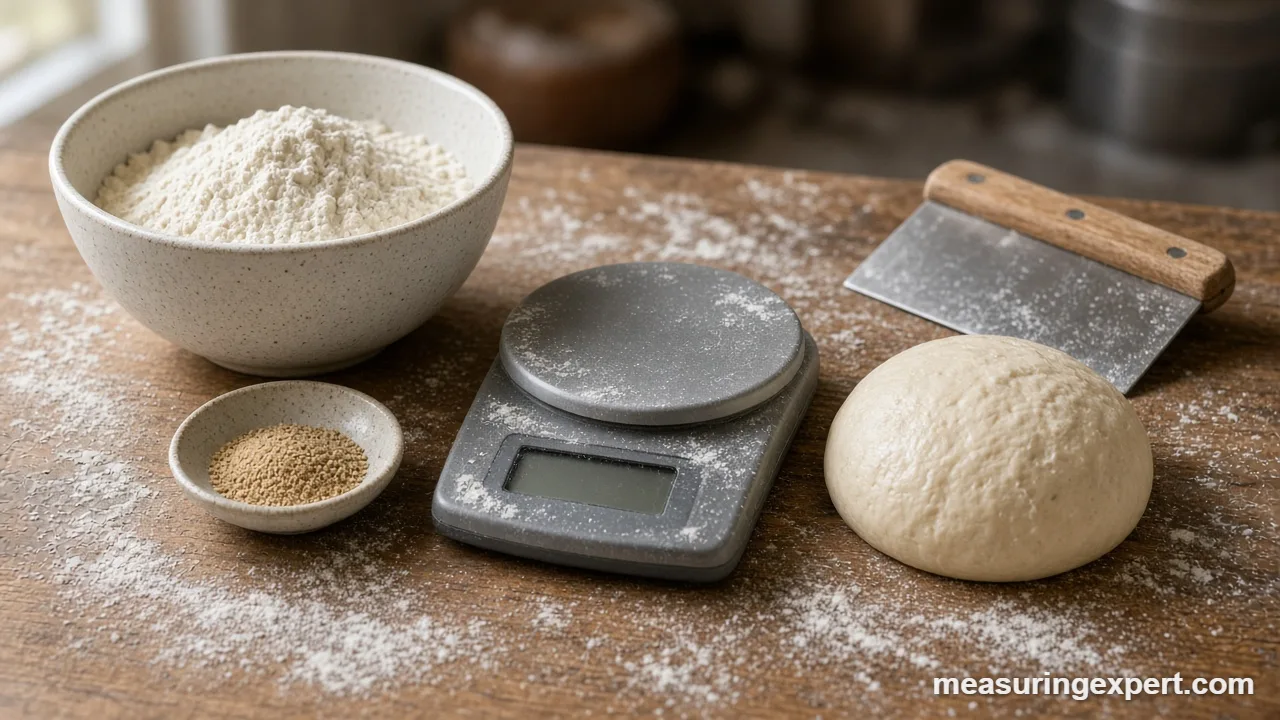
- Resolution: 1 g for bulk ingredients, and 0.1 g or finer for yeast and salt.
- Capacity: enough room for a bowl plus a full batch of dough.
- Readability: a display that stays visible under wide bowls.
- Baking features: fast tare, percentage mode, dual platforms and covers that keep flour out.
- Brand: established makers only, with no more than two picks per brand.
We also leaned on the NIST culinary measurement tips, which call weighing by mass a best practice for recipe accuracy. For the bread math, we used the definition of baker’s percentage from King Arthur Baking. Specs come from maker pages, such as the My Weigh KD-8000 spec page, or from the product listing when no maker page was available.
Besides baking, do you want a scale for general cooking too? Our best kitchen scale guide covers smart, app and everyday models, so this list stays focused on baking.
Platform, Dual or Pocket: Choosing the Best Baking Scale Type
Above all, a baking scale has to cover two very different jobs. On one hand, it must hold a heavy bowl of dough. On the other hand, it must also read a 2 g pinch of yeast. Yet few single platforms do both well, so it helps to know the main types.
| Type | Typical capacity | Typical step | Best for | Trade-off |
|---|---|---|---|---|
| Flat platform | 5 kg (11 lb) | 1 g | Flour, sugar, butter, water | Coarse for yeast and salt |
| High capacity | 8 to 10 kg (17.6 to 22 lb) | 1 g | Big dough batches, mixer bowls | Bigger and heavier |
| Dual platform | 5 kg + 500 g | 1 g + 0.01 g | Flour and yeast in one session | More counter space |
| Pocket scale | 100 to 660 g | 0.1 or 0.01 g | Yeast, salt, malt, spices | Too small for a bowl |
Why Resolution Matters for Yeast and Salt
To begin with, a scale that reads in 1 g steps rounds every reading to the nearest gram. So, the true weight can be up to about 0.5 g away from what you see. On 500 g of flour, for instance, that error does not matter. However, on a 1.25 g dose of yeast, half a gram is a 40 percent error, which can change rise times a lot.
By contrast, a 0.1 g scale narrows that error to about 0.05 g. This is why many bread bakers keep a fine pocket scale next to the main platform. Alternatively, a dual-platform scale puts both on one device.
Capacity Includes the Bowl
Also, remember that the bowl counts toward the limit, even after you tare it. For example, a stand mixer bowl can weigh well over 1 kg on its own. Therefore, if you mix 2 kg of dough in it, an 11 lb (5 kg) scale still works, but a double batch may not. In that case, a 22 lb (10 kg) scale gives you room.
Baker’s Percentages Explained
In essence, baker’s percentages describe a dough by ratio instead of by fixed amounts. First, the total flour is always 100 percent. Then, every other ingredient is its weight divided by the flour weight, times 100. As a result, the same formula works for one loaf or for twenty.
| Ingredient | Baker’s % | For 500 g flour | For 1,000 g flour |
|---|---|---|---|
| Bread flour | 100% | 500 g (17.6 oz) | 1,000 g (35.3 oz) |
| Water | 70% | 350 g (12.3 oz) | 700 g (24.7 oz) |
| Salt | 2% | 10 g | 20 g |
| Instant yeast | 1% | 5 g | 10 g |
In this example, the water line means 70 percent hydration. Similarly, if you halve the flour to 250 g, the yeast drops to 2.5 g. At that size, a 1 g scale shows either 2 g or 3 g, so a 0.1 g scale is the safer tool. Better yet, a scale with a percentage mode, such as the KD-8000, simply does the division for you on the display.
Of course, percentages only work if the flour weight is right. So, if you still scoop flour by cup, read our guide to the best way to measure flour first.
How to Weigh a Bread Formula on the Best Baking Scale
- Put the scale on a flat, dry counter away from drafts and set the unit to grams.
- Place your mixing bowl on the platform and press tare so the display reads 0 g.
- Add the flour slowly until you reach the formula weight, then press tare again.
- Pour in the water or other liquid to its weight, and tare once more.
- Weigh yeast and salt on a 0.1 g scale or the small platform, using a light cup.
- Add the small ingredients to the bowl, then check the total against your formula.
- Wipe the platform, and switch the scale off or let it shut down on its own.
Grams to Ounces Mass Converter for Bakers
Often, a European formula lists grams while an American recipe lists ounces. So, use this converter to switch between grams, ounces, pounds and kilograms before you weigh.
For reference, one avoirdupois ounce is exactly 28.349523125 g, and one pound is exactly 453.59237 g. Thus, 500 g of flour is about 17.6 oz, or just over 1.1 lb.
Calibration and Care
First, keep the scale level and away from the oven door, since heat and drafts can make the last digit wander. Next, test it now and then with a known mass. For instance, a new US nickel weighs 5 g, so ten of them should read 50 g. Likewise, if your scale has a calibration mode, use a certified weight of the size the manual names.
Also, weak batteries are the most common cause of drifting readings, so swap them as soon as the numbers start to jump. Then, after each bake, wipe flour from the gaps around the platform with a dry brush. Finally, never press down hard on the platform or store heavy pans on it, because overload can damage the load cell.
Honest Limits of Kitchen Scales
Admittedly, a home scale is not a lab balance. For one thing, most consumer models list readability, not certified accuracy, and the two are different things. In other words, a 1 g display can still be a gram or two off at full load, especially on cheap units.
Also, readings can drift with temperature and battery level. So, for the steadiest numbers, let the scale sit on the counter for a minute after you switch it on. In short, use a scale as a precise guide, and test it against a known weight if a recipe ever comes out wrong. To convert old cup recipes into grams, also see our guide to converting recipe measurements.
Best Baking Scale FAQ
What is the best baking scale for most home bakers?
For most kitchens, the OXO Good Grips 11 lb scale is the best choice. It reads in 1 g steps up to 5 kg, and its pull-out display stays visible under a wide mixing bowl.
What resolution should a baking scale have?
For flour, water, sugar and butter, 1 g is enough. For yeast, salt and leaveners, use 0.1 g, because a 1 g scale can be off by about half a gram on a 1 to 2 g dose.
Is a best baking scale with 0.1 g worth it?
Yes, if you bake bread or small batches. Yeast and salt doses are often under 10 g, so 0.1 g steps cut the reading error by a factor of ten.
What are baker’s percentages?
Each ingredient is written as a percentage of the total flour weight, with flour at 100 percent. For example, 350 g of water with 500 g of flour is 70 percent hydration.
How much capacity does a baking scale need?
An 11 lb (5 kg) scale covers most home recipes. However, choose 8 to 10 kg if you weigh dough in a heavy stand mixer bowl or mix double batches.
Why does a pull-out display matter on a baking scale?
A wide bowl or sheet pan can cover a fixed display. A pull-out or forward-mounted display keeps the numbers visible while you pour flour.
How do I check if my best baking scale is accurate?
Weigh a known mass, such as a sealed 500 g bag or a set of new US nickels at 5 g each. If the reading drifts, replace the batteries and recalibrate if your model allows it.
Can I weigh liquids on a baking scale?
Yes. Water weighs about 1 g per mL, so 250 g of water is about 250 mL. Milk and oil have different densities, so weigh them in grams rather than using the mL mode.
Should I measure flour by weight or by cup?
By weight. A cup of flour can vary by 20 g or more depending on how you fill it, while a scale gives the same 125 g every time.
Is a best baking scale different from a kitchen scale?
Not really, but baking puts more weight on fine resolution, tare speed, capacity for heavy bowls and features such as baker’s percentage mode.
Bottom Line on the Best Baking Scale
For most kitchens, the OXO Good Grips 11 lb Food Scale with Pull-Out Display is the one to get. Above all, its display stays visible under a big bowl, and 1 g steps suit nearly every bulk ingredient. Then, add a 0.1 g Triton for yeast and salt. If you bake bread by formula, however, the My Weigh KD-8000 is worth the extra size.
Black Friday is coming: shop the deals with Prime
7 thoughts on “Best Baking Scale: 8 Picks for Bread, Cakes and Pizza (2026)”