

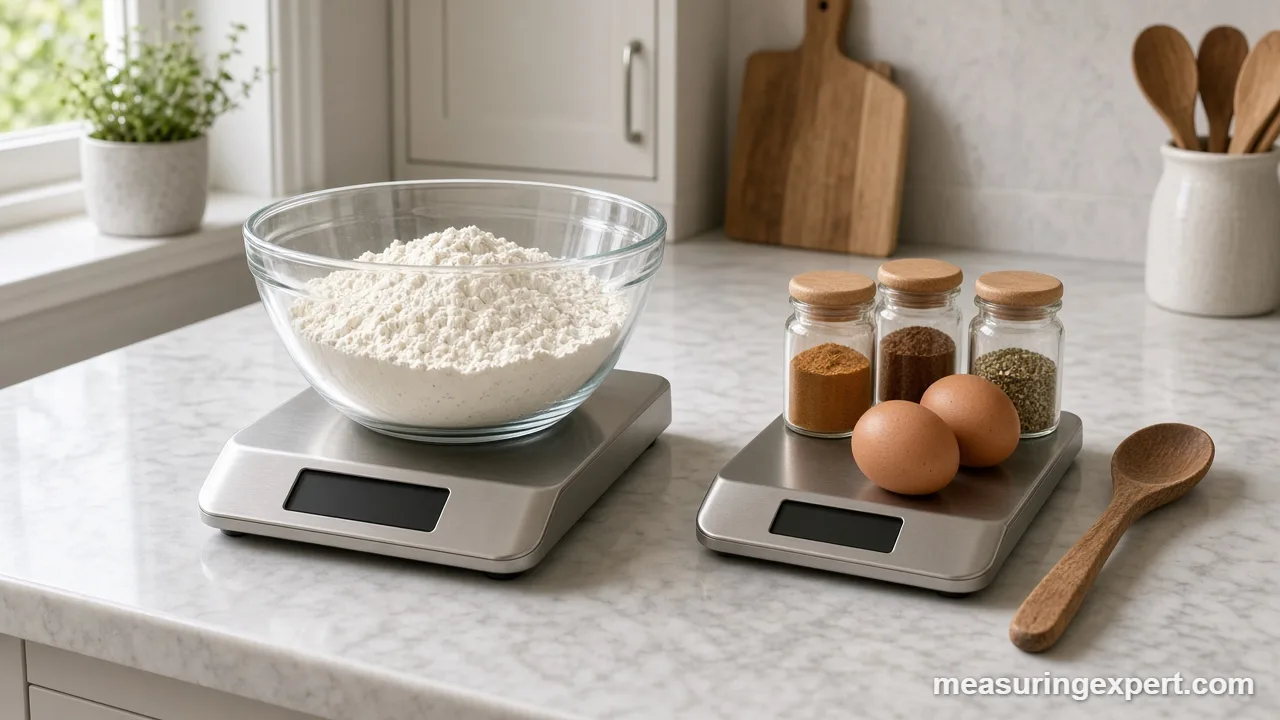
The best kitchen scale for most homes is the OXO Good Grips 11 lb scale, because its pull-out display stays readable under big bowls and it weighs in 1 g steps. Beyond that, your choice comes down to three things: capacity, how finely it reads, and whether you want app tracking.
In short: buy the OXO for everyday cooking, the Etekcity 11 lb on a budget, and the My Weigh KD-8000 for big bread doughs.
As an Amazon Associate, Measuring Expert earns from qualifying purchases. Our picks are based on research, specifications and owner feedback, not paid placement.
Best Overall

Best Budget

Best Pro

Quick Answer: The Best Kitchen Scale by Need
- Everyday cooking: OXO Good Grips 11 lb with its pull-out display.
- Lowest cost: the slim Etekcity 11 lb scale.
- Bread and big batches: My Weigh KD-8000, which adds baker’s percentage.
- Grams down to 0.01: KitchenAid KQ909, thanks to its second small platform.
- Canning and stock pots: Greater Goods 22 lb.
- Meal logging: Cosori Smart Food Scale with the VeSync app.
- Fine readings on a big pan: BOMATA 0.1 g large scale.
On This Page
- Comparison table
- The 9 picks, reviewed
- How we chose
- Specs that matter
- Scale styles compared
- Grams, ounces and pounds converter
- How to weigh ingredients
- Calibration and care
- Do and don’t
- Honest limits
- FAQ
- Bottom line
Best Kitchen Scale Comparison Table
| # | Product | Best For | Standout Feature | Amazon |
|---|---|---|---|---|
| 1 | OXO Good Grips 11 lb Food Scale with Pull-Out Display | Most home kitchens | Pull-out display that clears big bowls | View |
| 2 | Etekcity Food Kitchen Scale (11 lb) | Tight budgets and meal prep | Five units on a slim steel platform | View |
| 3 | My Weigh KD-8000 Digital Food Scale | Bread bakers and big batches | Baker’s percentage mode and 8 kg capacity | View |
| 4 | Escali Primo Digital Food Scale | No-fuss, spill-prone kitchens | Sealed buttons and two-button control | View |
| 5 | KitchenAid KQ909 Dual Platform Digital Scale | Spices, yeast and big bowls together | Second platform that reads to 0.01 g | View |
| 6 | Greater Goods 22 lb High Capacity Kitchen Scale | Bulk cooking and canning | 22 lb capacity with a Hold function | View |
| 7 | Cosori Smart Food Scale with Nutritional Calculator | Nutrition and macro tracking | App tracks 19 nutrients; USB-C rechargeable | View |
| 8 | BOMATA Large Kitchen Scale (0.1 g, 11 lb) | 0.1 g readings on a big pan | 0.1 g resolution with percentage mode | View |
| 9 | Etekcity 0.1 g Food Kitchen Scale with Bowl | Small doses plus a mixing bowl | Bowl that flips over as a cover | View |
The 9 Best Kitchen Scale Picks, Reviewed
Best Overall
1. OXO Good Grips 11 lb Food Scale with Pull-Out Display
Best for: everyday cooks who weigh flour, meat, produce and coffee, and who often use a wide bowl that hides a normal display.
The OXO Good Grips 11 lb scale is our best kitchen scale for most homes. Its main trick, however, is simple. The display slides out from the base on a short arm, so a wide mixing bowl or a sheet pan does not cast a shadow over the numbers.
On the measuring side, it covers 0 to 11 lb (5 kg) and reads in 1 g or 0.1 oz steps. In addition, the stainless steel platform lifts off for cleaning. However, the scale itself is not dishwasher safe, so wipe the base by hand.
- Capacity: 11 lb (5 kg)
- Readability: 1 g or 0.1 oz
- Pull-out display that slides back for storage
- Power: four AAA batteries, included
Pros
- Display stays readable, even under large bowls
- Zero function handles containers easily
- Also, the platform lifts off for washing
Cons
- Pricier than basic 11 lb scales
- Uses four batteries instead of two
- Still reads in whole grams only
Skip it if: you mostly weigh spices, yeast or coffee doses under 10 g; a 0.1 g scale suits that work better.
Best Budget
2. Etekcity Food Kitchen Scale (11 lb)
Best for: meal preppers, students and first-time buyers who want a reliable digital scale for very little money.
Etekcity’s slim 11 lb scale is the one many people buy first, and it holds up well as a budget pick. It reads in 1 g steps up to 11 lb (5 kg). Also, it offers five units: g, oz, lb:oz, fl oz and mL.
Also, the top is 304 food-grade stainless steel, which wipes clean in seconds. On the other hand, the small platform means a large bowl will cover the screen. So use a medium bowl, or tare a plate that leaves the display clear.
- Capacity: 11 lb (5 kg)
- Readability: 1 g
- Units: g, oz, lb:oz, fl oz and mL
- Power: two AAA batteries, included
- Top surface: 304 stainless steel
Pros
- Very low cost for a branded scale
- Slim enough to store in a drawer, so it saves space
- Liquid modes help with water-based recipes
Cons
- Large bowls can hide the display
- Fluid modes only hold for water-like liquids
Skip it if: you bake big batches in wide bowls; instead, the OXO pull-out display handles that better.
Best Pro
3. My Weigh KD-8000 Digital Food Scale
Best for: serious bakers, home brewers and soap makers who need more capacity than 11 lb and want a baker’s percentage mode.
The My Weigh KD-8000 is a favorite in bakery and craft circles, and the specs explain why. It weighs up to 8 kg (about 17.6 lb) in 1 g steps. In addition, it switches between g, kg, oz, lb and lb:oz.
Above all, its standout feature is the Baker’s Percentage Function. First, you weigh the flour as 100 percent. Then each later ingredient shows as a percentage of that flour weight, which makes scaling a formula easy. Meanwhile, the backlit display sits forward of the platform, and a clear cover protects the buttons from flour and sticky fingers.
- Capacity: 8 kg (about 17.6 lb)
- Readability: 1 g (0.05 oz)
- Baker’s Percentage Function
- Power: AA batteries or an AC adapter
- Removable stainless platform and a display cover
Pros
- High capacity, so big doughs fit
- Baker’s percentage saves math
- Display cover keeps flour out of the keys
Cons
- Bulky, so it suits larger kitchens
- Overkill for simple portion checks
- May not register the first gram or two
Skip it if: you only weigh small portions; the Escali Primo or Etekcity is lighter and easier to store.
Best Simple
4. Escali Primo Digital Food Scale
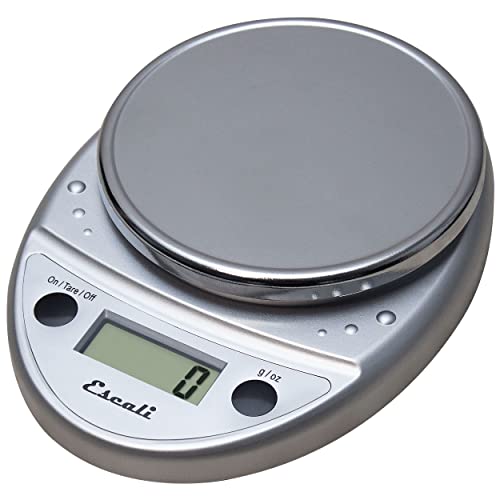
Best for: cooks who want two buttons, a sealed face and a scale that just works year after year.
The Escali Primo is about as simple as a digital scale gets. First, you get a power button, a tare button and a unit switch. After that, there is nothing else. Yet it still covers 11 lb (5 kg) in 1 g or 0.1 oz steps, so it handles everyday recipes and portion control without fuss.
Escali seals the buttons and display against spills, which matters next to a sink or a stand mixer. Also, it runs on two AA batteries and turns itself off after about four minutes to save power.
- Capacity: 11 lb (5 kg)
- Readability: 1 g or 0.1 oz
- Sealed buttons and display
- Power: two AA batteries
- Size: about 8 x 6 x 1.25 in (21 x 15.5 x 3 cm)
Pros
- Very easy to use, even for beginners
- Sealed face shrugs off spills, so it suits busy counters
- Comes in many colors
Cons
- Small platform for large bowls
- Auto-off can cut in during slow prep
- Also lacks liquid or percentage modes
Skip it if: you work slowly with long pauses, because the four-minute auto-off can reset your reading.
Best Dual Platform
5. KitchenAid KQ909 Dual Platform Digital Scale

Best for: bakers and cooks who weigh both big ingredients and tiny ones, such as salt, yeast or spices, in the same session.
Overall, KitchenAid solves a common problem with two scales in one body. The large platform holds up to 11 lb (5 kg) and reads in 1 g or 0.1 oz steps. Next to it, a small platform holds up to 500 g (about 16 oz) and reads to two decimal places in grams.
Each platform has its own tare, and the backlit display shows both readings at once. However, it runs on three AAA batteries that are not included, so buy them with the scale.
- Large platform: 11 lb (5 kg) in 1 g or 0.1 oz steps
- Small platform: 500 g (16 oz), two decimal places in grams
- Dual backlit display with a tare for each platform
- Power: three AAA batteries, not included
- Auto shut-off with a power button
Pros
- Two scales in one footprint
- Fine readings for yeast and spices
- Both weights show at the same time
Cons
- Takes more counter space than a single scale
- Batteries not included, so buy them separately
- Small platform has a low 500 g limit
Skip it if: you never weigh anything under a few grams; a single-platform scale is simpler and smaller.
Best High Capacity
6. Greater Goods 22 lb High Capacity Kitchen Scale
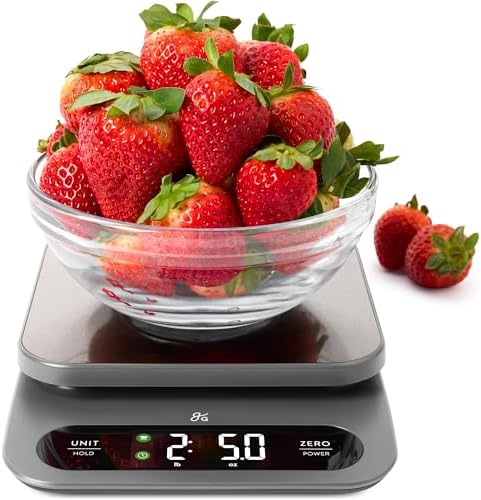
Best for: bulk cooks, canners and anyone who weighs a full stock pot, a whole turkey or a large batch of dough.
Most kitchen scales, by contrast, stop at 11 lb. This Greater Goods model doubles that to 22 lb (10 kg) and still reads in 1 g steps. As a result, you can weigh a big pot of sauce, or a large dough batch with room to spare.
Meanwhile, it has flat touch buttons and a high-contrast VA LCD screen that reads from wide angles. In addition, a Hold function freezes the reading on screen after you lift the item off, which helps when a tall pot hides the display.
- Capacity: 22 lb (10 kg)
- Readability: 1 g
- Units: g, oz, lb:oz and mL
- Hold function locks the last reading
- Five-year limited warranty listed by the maker
Pros
- Double the capacity of most home scales
- Hold function helps with large containers
- Long listed warranty, as well
Cons
- Not suited to weights under about 5 g
- Touch buttons can be fussy, especially with wet fingers
Skip it if: your heaviest job is a mixing bowl of cookie dough; an 11 lb scale covers that.
Best Smart
7. Cosori Smart Food Scale with Nutritional Calculator
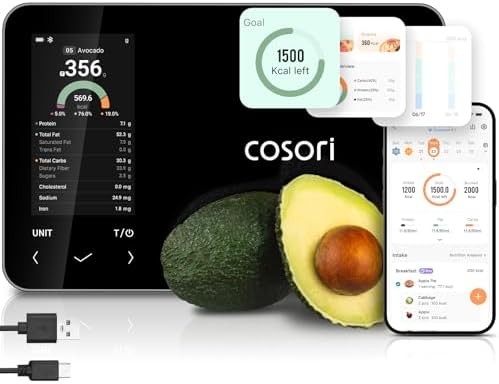
Best for: people who log meals and want weights to flow straight into a nutrition app instead of typing them in.
The Cosori smart scale pairs with the VeSync app over Bluetooth. You weigh a food, pick it in the app, and the app logs calories, protein, carbs, fat and other nutrients, 19 in total. Therefore it removes most of the typing from food tracking.
As a scale, it reads up to 11 lb (5 kg) in 1 g or 0.1 oz steps. It also offers milk and water modes in mL and fl oz, plus lb:oz. Better still, this version charges over USB-C from a built-in battery, so you never hunt for AAA cells.
- Capacity: 11 lb (5 kg)
- Readability: 1 g or 0.1 oz
- Bluetooth link to the VeSync app (19 nutrients)
- Power: built-in 800 mAh battery, USB-C charging
- Units: g, oz, lb:oz, plus mL and fl oz for water or milk
Pros
- Logs nutrition with little typing
- Rechargeable, so no batteries to buy
- Still works as a plain scale, even without the app
Cons
- App setup takes a few minutes
- Small portions can read less reliably
- Pricier than a basic scale
Skip it if: you never track food; the plain Etekcity does the weighing for less.
Best Precision
8. BOMATA Large Kitchen Scale (0.1 g, 11 lb)

Best for: bakers, coffee fans and candy makers who want 0.1 g readings without giving up an 11 lb capacity.
Typically, 0.1 g scales are pocket-sized and top out at a few hundred grams. BOMATA’s large model instead pairs 0.1 g readings with an 11 lb (5 kg) capacity and a roomy 7.2 x 7.2 in (18 x 18 cm) stainless pan.
It also packs extras that lab-style users like. For example, there is a percentage mode, a Hold function, a counting mode and a calibration routine with a 100 g weight in the box. Finally, power comes from a built-in battery that charges by USB, or from two AAA cells.
- Capacity: 11 lb (5 kg)
- Readability: 0.1 g
- Stainless steel pan: 7.2 x 7.2 in (18 x 18 cm)
- Percentage, Hold, counting and calibration modes
- Power: USB rechargeable battery or two AAA cells
Pros
- 0.1 g readings with a large capacity
- Calibration weight included
- Rechargeable, so no spare cells needed
Cons
- Lesser-known brand than OXO or Escali
- More buttons and modes to learn at first
Skip it if: you want the simplest possible scale; the Escali Primo has only a few buttons.
Best with Bowl
9. Etekcity 0.1 g Food Kitchen Scale with Bowl
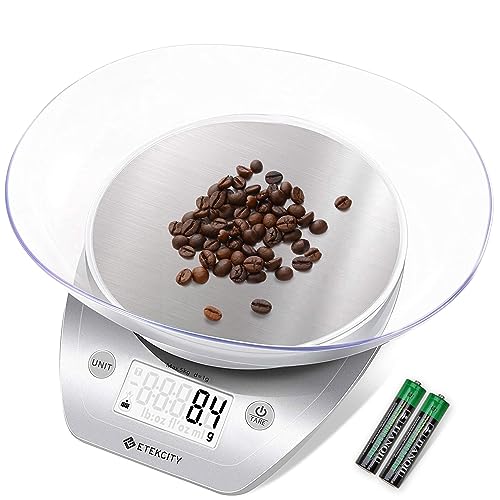
Best for: cooks who want a matched bowl and fine readings for small amounts in a compact package.
Unlike most picks, this Etekcity model comes with its own bowl. When you weigh, the bowl sits on the platform. When you store it, the bowl flips over the scale as a dust cover. It reads in 0.1 g steps up to 1,000 g, then in 1 g steps up to its 11 lb (5 kg) limit.
In short, that split is a sensible design. Small amounts like yeast and spices get fine readings, while heavy loads still fit. Also, it has water and milk modes in mL and fl oz, a backlit screen and a two-minute auto-off.
- Capacity: 11 lb (5 kg)
- Readability: 0.1 g to 1,000 g, then 1 g
- Units: g, lb:oz, fl oz and mL
- Power: two AAA batteries, pre-installed
- Included bowl doubles as a storage cover
Pros
- Bowl included and stores on top
- 0.1 g steps for small amounts
- Backlit screen, too
Cons
- Short two-minute auto-off
- Bowl adds height and bulk
Skip it if: you already own good bowls and want a thin scale for a drawer.
How We Chose the Best Kitchen Scale Picks
We did not test these scales in a lab. Instead, this list is research-based. First, we looked at the kitchen scales buyers actually find on Amazon, and we favored established brands such as OXO, Escali, KitchenAid, My Weigh, Greater Goods and Etekcity. Next, we checked each spec against the maker’s listing, manual or a reliable retailer spec sheet. If we could not confirm a figure, we left it out.
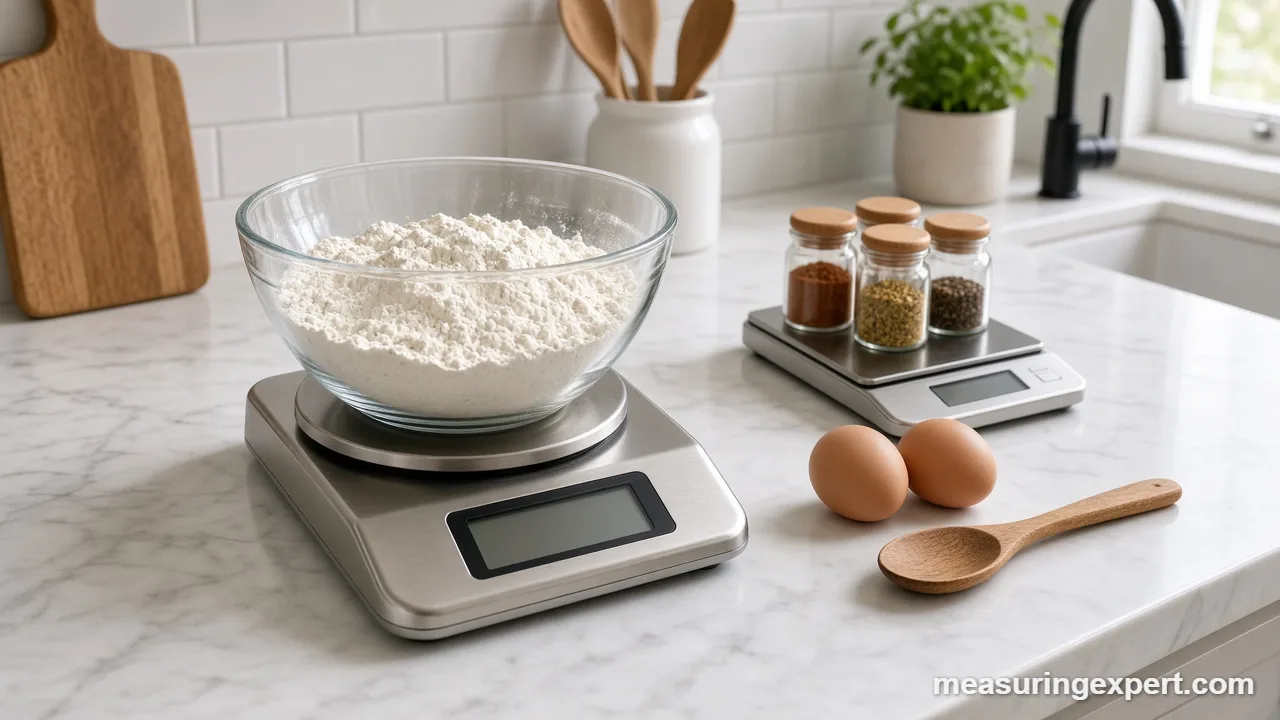
In addition, we read independent reviews and owner feedback to spot repeat problems, such as short auto-off timers or displays hidden by bowls.
- Readability: the smallest step the display shows, such as 1 g or 0.1 g.
- Capacity that fits real cooking, from 11 lb up to 22 lb.
- Usability: display position, tare, units and auto-off timing.
- Cleaning and build: stainless or glass tops, sealed buttons, removable platforms.
- Distinct use cases, with no more than two models from one brand.
What Makes the Best Kitchen Scale: Specs Explained
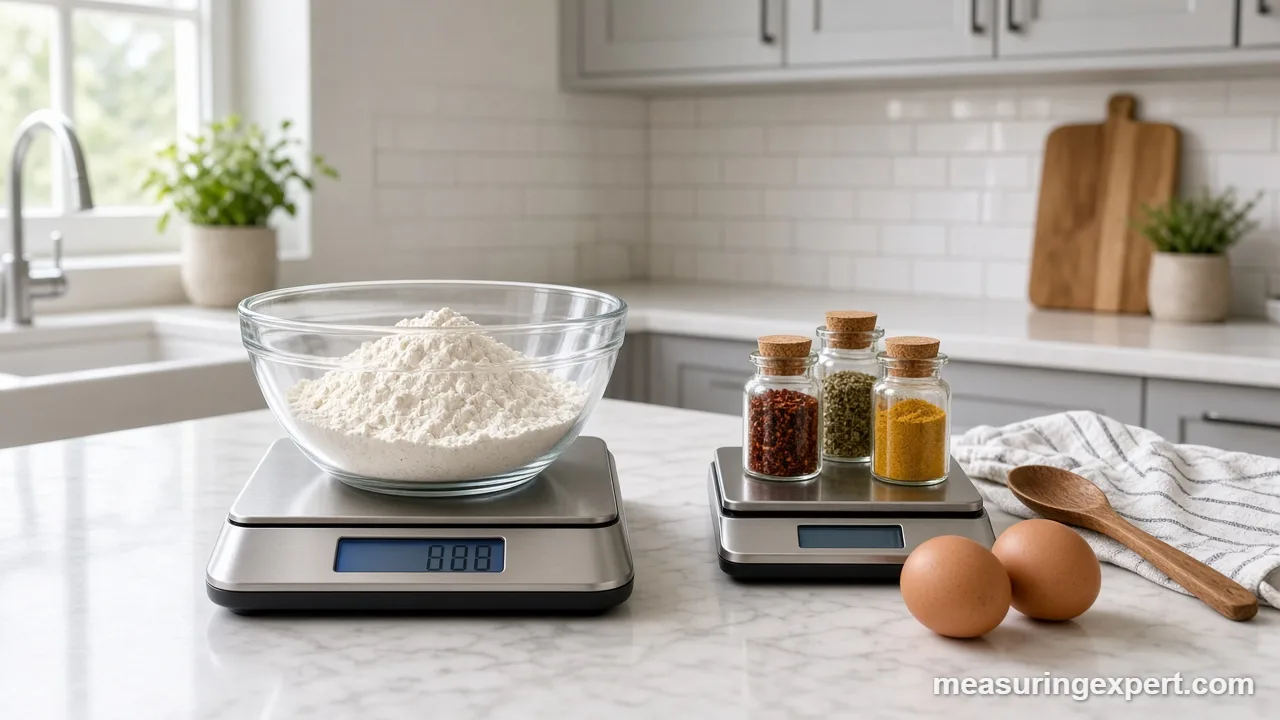
However, scale listings mix several ideas together. So it helps to separate them before you compare models.
| Spec | What it means | What to look for |
|---|---|---|
| Capacity | The heaviest load the scale can weigh, including the bowl | 11 lb (5 kg) for most homes; 8 to 10 kg for big batches |
| Readability (resolution) | The smallest step on the display | 1 g for general cooking; 0.1 g for yeast, spices and coffee |
| Accuracy | How close the reading is to the true mass | Often not listed, so check it yourself with coins |
| Units | g, oz, lb:oz, plus mL and fl oz modes | Grams first; liquid modes assume water or milk |
| Auto-off | Minutes of idle time before shutdown | Longer timers suit slow prep, because idle pauses happen |
| Power | AAA, AA, USB rechargeable or AC adapter | Rechargeable or AC for heavy daily use |
Readability and accuracy are not the same thing. For example, a scale can show 0.1 g steps and still be off by a gram on a heavy load.
Also note the ounce step. A 0.1 oz step equals about 2.8 g, so grams give you more detail on a 1 g scale. If you are converting between units, our guide to how many ounces are in a kilo covers the math.
Platform, Bowl, Dual or Smart: Which Best Kitchen Scale Style Fits?
In general, kitchen scales come in a few physical styles.
| Style | Strength | Weakness | Example |
|---|---|---|---|
| Flat platform | Slim, cheap, easy to store | However, big bowls can hide the display | Etekcity 11 lb, Escali Primo |
| Pull-out or forward display | Readable under wide bowls | Larger and pricier | OXO Good Grips, My Weigh KD-8000 |
| Bowl scale | Matched bowl doubles as a cover | Taller to store | Etekcity 0.1 g with bowl |
| Dual platform | Fine and coarse weighing at once | Wider footprint | KitchenAid KQ909 |
| Smart (app) | Logs nutrition automatically | Also needs a phone and setup | Cosori Smart Food Scale |
| High capacity | Handles pots and large batches | Less useful for tiny doses | Greater Goods 22 lb |
Grams, Ounces and Pounds Converter
Of course, recipes switch between grams, ounces and pounds all the time. So use this converter to move between them before you weigh.
For reference, 1 oz equals exactly 28.349523125 g, and 1 lb equals exactly 453.59237 g. NIST explains the kilogram and gram on its SI units of mass page.
How to Weigh Ingredients With the Best Kitchen Scale
Overall, weighing is faster than cups once you get the rhythm. In fact, NIST’s culinary measurement tips call a kitchen scale a best practice for recipe accuracy. Follow these steps:
- Set up on a flat surface. Place the scale on a firm, level counter away from the edge, drafts and hot stove burners.
- Turn it on empty. Switch the scale on with nothing on the platform, so it zeroes itself correctly.
- Pick your unit. Choose grams for the most detail; for example, 1 g is finer than the 0.1 oz step (about 2.8 g).
- Add the container and tare. Set your bowl in the center and press tare, so the display returns to zero.
- Add the first ingredient. Pour or spoon slowly as you near the target, because many scales lag a second behind.
- Tare again between ingredients. Press tare after each ingredient, then add the next one to the same bowl.
- Read and record. Wait for the reading to settle, then note it if you are scaling or logging a recipe.
Flour is where weighing pays off most, because cup measures vary with how you scoop. Our guide on the best way to measure flour shows the difference. Likewise, if a recipe only gives cups, see how to convert recipe measurements to weight first.
Calibration and Care for Your Kitchen Scale
A home scale drifts over time, mostly because of weak batteries, knocks and heat. Fortunately, you can check it at home with coins. According to the U.S. Mint coin specifications, a nickel weighs 5.00 g and a penny made after 1982 weighs 2.50 g.
- Warm up: first, turn the scale on and wait about a minute.
- Zero it: next, press tare with the platform empty.
- Load known weights: add five nickels. The display should read close to 25 g.
- Repeat: try ten nickels (50 g) to check that the error does not grow.
Worn coins can weigh slightly less, so allow about a gram of difference. If the error is larger, first change the batteries. Then run the maker’s calibration routine if your scale has one; the BOMATA, for instance, ships with a 100 g weight for this.
Finally, for daily care, wipe the platform with a damp cloth and never submerge a scale unless the maker says it is waterproof.
Kitchen Scale Do and Don’t
Honest Limits of a Home Kitchen Scale
Even the best kitchen scale is a consumer tool, not a lab balance. Here is what to keep in mind:
- Small doses: a 1 g scale may not register the first gram or two, so use a 0.1 g model for yeast and spices.
- Listed accuracy: most makers list readability, not a tested tolerance. So check your scale with coins.
- Liquid modes: mL and fl oz modes assume water or milk density. Therefore other liquids will read wrong.
- Edge loading: weight near the edge of a small platform can read low or high. So center the load instead.
Best Kitchen Scale FAQ
What is the best kitchen scale for most people?
For most homes, the OXO Good Grips 11 lb scale is the best kitchen scale because its pull-out display stays readable under big bowls. It reads in 1 g steps up to 11 lb, which covers nearly every recipe.
Is 1 g resolution enough for a kitchen scale?
Yes, for most cooking it is enough. Flour, sugar, meat and produce rarely need finer steps. However, for yeast, salt, spices or coffee doses under about 10 g, a 0.1 g scale gives more useful readings.
How much capacity does a kitchen scale need?
An 11 lb (5 kg) scale handles most home recipes. Choose 8 to 10 kg (about 17.6 to 22 lb) if you bake large doughs, can produce or weigh a full stock pot.
How do I check if my kitchen scale is accurate?
First, weigh something with a known mass. A US nickel weighs 5.00 g when new, so five nickels should read 25 g. If the reading is off by more than a gram or two, change the batteries and recalibrate if your model allows it.
What does the tare button do?
Simply put, tare sets the current weight to zero. Put a bowl on the scale, press tare, and then add food. As a result, the display shows only the food, not the bowl.
Can a kitchen scale measure liquids?
Yes. Many scales have mL or fl oz modes that assume the density of water, so 1 mL reads as 1 g. Similarly, milk modes adjust for milk. For oil or syrup, weigh in grams instead, because their densities differ from water.
Is a smart kitchen scale worth it?
A smart scale is worth it if you log meals. That is because it sends weights to an app and fills in the nutrition for you. If you only follow recipes, a plain scale does the same weighing for less.
Why does my kitchen scale give different readings?
Common causes are weak batteries, an uneven counter, drafts, or a load placed near the edge. Also, scales drift as they warm up. So use a flat, firm surface and place items in the center.
Should I weigh flour instead of using cups?
Yes. NIST calls weighing with a kitchen scale a best practice for recipe accuracy. A cup of flour can vary a lot depending on how you fill it, while 120 g is always 120 g.
Which is the best kitchen scale for small amounts?
For small amounts, the best kitchen scale is one with 0.1 g steps, such as the BOMATA large scale or the Etekcity bowl scale. The KitchenAid KQ909 also adds a small platform that reads to two decimal places in grams.
Bottom Line on the Best Kitchen Scale
For most cooks, the OXO Good Grips 11 lb Food Scale is the best kitchen scale to buy. It reads in 1 g steps, covers 11 lb, and its pull-out display solves the big-bowl problem that trips up cheaper scales.
If money is tight, the Etekcity 11 lb does the core job well. Bakers who mix big doughs should look at the My Weigh KD-8000, while people who track food will get more from the Cosori smart scale.
5 thoughts on “9 Best Kitchen Scales of 2026 for Cooking, Baking and Meal Prep”