

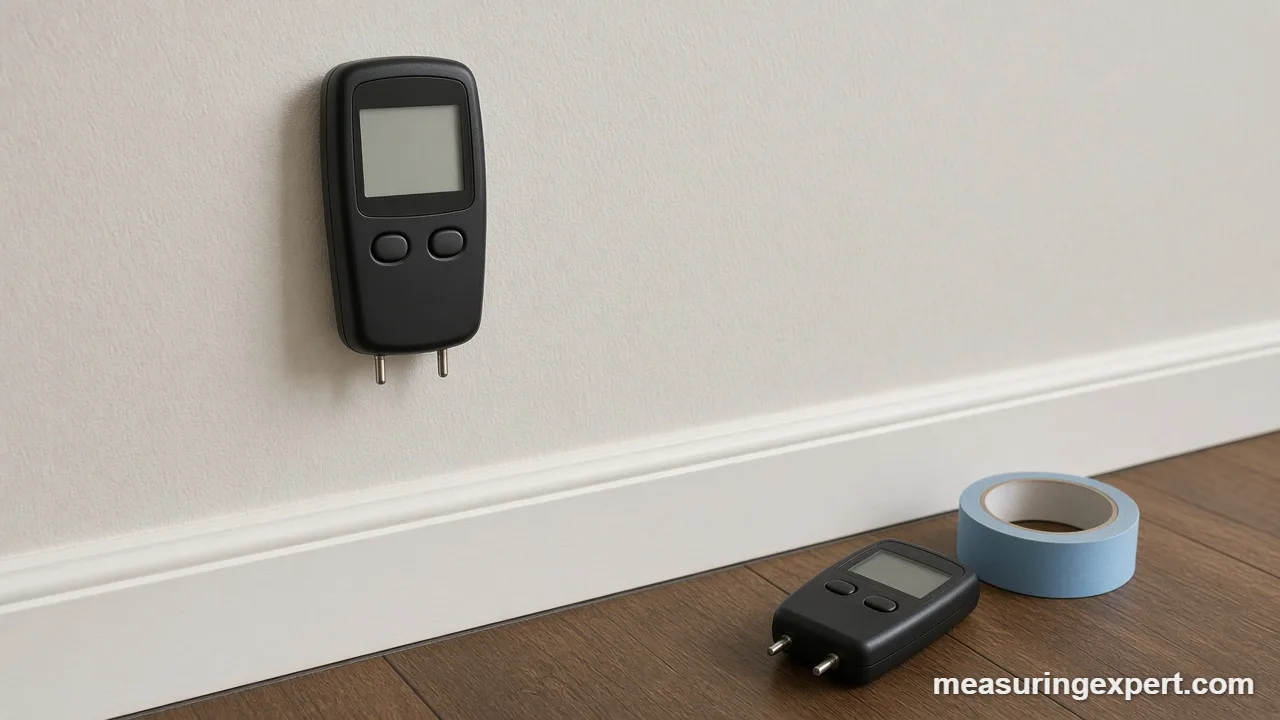
The best wall moisture meter for most serious users is the Protimeter MMS3, because it combines pin readings, a deep non-invasive scan and data logging in one tool. However, the right pick depends on three things: whether you can make pin holes, which materials you check, and how much proof you need to record.
In short: choose the Protimeter MMS3 for pro inspections, the Klein ET140 for quick budget scans, and the Delmhorst BDX-30 for true drywall readings.
As an Amazon Associate, Measuring Expert earns from qualifying purchases. Our picks are based on research, specifications and owner feedback, not paid placement.
Best Overall
Best Budget
Best Pin Meter
Quick Answer: Which Best Wall Moisture Meter Fits Your Job?
- Protimeter MMS3: pin, deep scan and logging in one kit, so it suits inspectors and restorers.
- Delmhorst BDX-30: a dedicated drywall scale plus a 3-inch electrode for checking behind the wall.
- Protimeter Aquant: a fast pinless scanner for mapping wet areas on finished walls.
- Extech MO290: also reads air humidity and surface temperature, which helps after a leak.
- Klein ET140: the simplest low-cost way to scan drywall without leaving holes.
- General Tools MMD4E and Extech MO50A: compact pin meters with clear dry, at-risk and wet zones.
On This Page
- Best Wall Moisture Meter Comparison Table
- The 9 Best Wall Moisture Meters, Reviewed
- How We Chose
- Pin vs Pinless on Drywall, Plaster and Wood
- What the Numbers on the Screen Mean
- Moisture, Mold and the 48-Hour Window
- How to Check a Wall for Moisture
- Honest Limits of Any Meter
- FAQ
- Bottom Line
Best Wall Moisture Meter Comparison Table
| # | Image | Product | Best For | Standout Feature | Link |
|---|---|---|---|---|---|
| 1 |  | Protimeter MMS3 Standard Kit | Inspectors and restorers | Pin, non-invasive and Bluetooth logging | View |
| 2 |  | Delmhorst BDX-30/P01 | Drywall and wall cavities | Dedicated 0.1 to 6% drywall scale | View |
| 3 |  | Protimeter Aquant BLD5770 | Scanning finished walls | Field calibration of the scan mode | View |
| 4 | 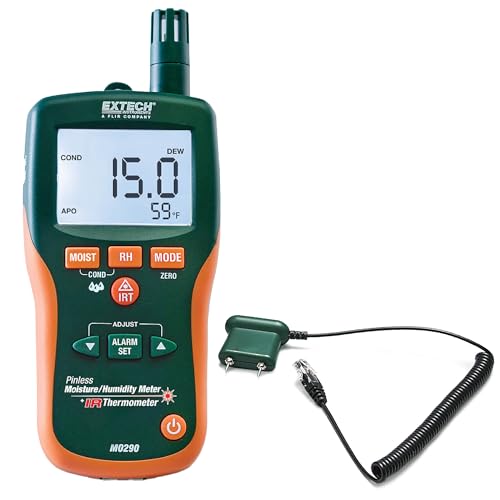 | Extech MO290 | Water damage checks | Moisture, humidity and IR temperature | View |
| 5 |  | Wagner Orion 930 | Wood trim, subfloors, flooring | Two scan depths and a 7-year warranty | View |
| 6 |  | General Tools MMD4E | Budget pin readings | Separate wood and building scales | View |
| 7 |  | Klein Tools ET140 | Quick pinless scans | Drywall and masonry modes | View |
| 8 | 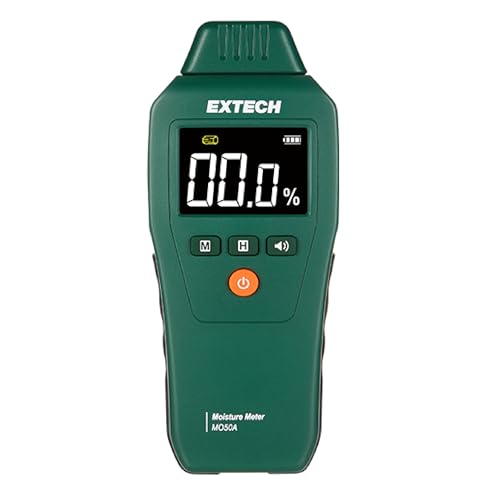 | Extech MO50A | Pocket pin checks | Color display and rising beep alert | View |
| 9 |  | Triplett MS245 | Pin and pinless on a budget | Ten pinless material settings | View |
The 9 Best Wall Moisture Meters, Reviewed
Best Overall
1. Protimeter MMS3 Standard Kit
Best for: home inspectors, water restoration crews and anyone who has to document what they found.
The MMS3 is a full moisture measurement system rather than a single-mode meter. First, the pin mode reads in Wood Moisture Equivalent (WME) from 6% to 100%, so plaster, drywall and wood all show on one comparable scale. Next, the non-invasive mode scans to about 3/4 inch (19 mm) in standard mode and up to about 5 inches (12 cm) in its sensitivity mode, depending on the material.
In addition, the meter streams live data over Bluetooth to the Protimeter app and stores up to 10,000 records. As a result, you can attach readings to photos for a report. It also accepts Protimeter hygrometer probes for relative humidity checks, so one handset covers the whole survey.
- Pin range: 6% to 100% WME (readings above 30% are relative)
- Non-invasive range: 60 to 999 relative, about 3/4 in (19 mm) standard depth
- Display: 2.4 in color TFT screen with an outdoor mode
- Power: 2 AA batteries; Bluetooth with app and PC software
Pros
- Pin, scan and humidity checks in one handset, so you carry less
- Also reads deeper through thick plaster or tile
- Logging makes client reports easier because readings are stored
Cons
- However, it costs far more than a homeowner meter
- Many features take time to learn at first
Skip it if: you only want to confirm one damp patch under a sink; a simple pinless meter will do.
Best for Drywall
2. Delmhorst BDX-30/P01 Behind the Wall Package
Best for: contractors and inspectors who want a true drywall reading, not just a relative number.
Delmhorst builds the BDX-30 around three scales: wood from 6% to 60%, a reference scale from 1 to 100, and a drywall scale from 0.1% to 6%. That drywall scale matters because gypsum holds very little water when it is sound. Therefore, a small number on this scale can still flag a real leak.
The P01 package adds the 21-E electrode, which reaches about 3 inches (76 mm) through a small hole. So you can check the cavity behind a baseboard or the bottom plate without opening the wall. Meanwhile, the EDGE app adds timestamps, geotags and CSV export.
- Scales: wood 6% to 60%, drywall 0.1% to 6%, reference 1 to 100
- Bluetooth to the EDGE app with unlimited saved readings
- On-meter statistics for up to 100 readings
- Power: 2 AA batteries with an adjustable auto-off timer
Pros
- Real drywall scale, so readings mean actual gypsum moisture
- Also reaches into wall cavities with the long electrode
- Strong app tools for reports
Cons
- Pin-only, so every reading leaves holes
- Slow on large walls because it has no scan mode
Skip it if: you need to sweep a whole finished room fast; pair it with a pinless scanner instead.
Best Pinless Scanner
3. Protimeter Aquant BLD5770
Best for: mapping the edges of a wet area on painted drywall, plaster or tile.
Unlike a pin meter, the Aquant is fully non-invasive. It reads on a relative scale from 60 to 1000 and senses to about 3/4 inch (19 mm) below the surface. Because it never touches the material with pins, it suits finished walls, wallpaper and tile, where holes would be a problem.
The BLD5770 update adds an automatic calibration check and lets you field-calibrate the non-invasive mode. It also has a larger backlit display, and Protimeter quotes about three times the battery life of the earlier model. In short, it is the tool to grab when you need to trace a stain back to its source.
- Range: 60 to 1000 relative
- Depth: up to about 3/4 in (19 mm)
- Automatic calibration check and user field calibration
- Power: 2 AA batteries
Pros
- No holes, so finished surfaces stay clean
- Field calibration, so readings are easier to trust
- Quick to sweep a whole wall
Cons
- However, it shows a relative scale only
- Metal behind the surface can push readings up
Skip it if: you need a percent moisture figure for a report; add a pin meter for that.
Best for Water Damage
4. Extech MO290 Pinless Moisture Psychrometer
Best for: drying jobs where you track the wall, the room air and surface temperatures together.
The MO290 combines a pinless sensor, a pin probe, a humidity sensor and an infrared thermometer. As a result, one tool tells you how wet the wall is and how dry the air around it is. That pairing helps after a leak, because a wall dries slowly when room humidity stays high.
The pin mode reads from 0 to 99.9% with a listed accuracy of plus or minus 5%. Meanwhile, the pinless mode reads 6 to 99.9 on a relative scale to about 0.75 inch (19 mm). The IR thermometer has an 8:1 distance-to-spot ratio and a fixed emissivity of 0.95.
- Relative humidity: 0 to 100%, plus or minus 3%
- Air temperature: -20 to 170 degrees F (-29 to 77 degrees C)
- IR temperature: -4 to 392 degrees F (-20 to 200 degrees C)
- Includes a pin probe, a 9V battery and a case
Pros
- Moisture, humidity and IR in one tool, so drying checks are faster
- Pin and pinless modes
- Also useful for tracking drying progress
Cons
- Bulkier than a single-mode meter because of the extra sensors
- Wider pin accuracy band than lab-style meters
Skip it if: you never deal with leaks or drying; the extra sensors add cost you will not use.
Best for Wood Trim
5. Wagner Meters Orion 930
Best for: flooring installers and finish carpenters who check trim, subfloors and wall sheathing.
The Orion 930 is mainly a wood meter, but it earns a spot here for two reasons. First, it scans at two depths: about 1/4 inch (6.4 mm) and about 3/4 inch (19 mm). Second, it has a 0 to 100 relative mode for drywall, plywood, OSB and MDF.
For wood, it reads 4% to 32% moisture content with species settings from 0.20 to 1.0 specific gravity. Also, the kit includes an On-Demand Calibrator, so you can check the meter before a job. Finally, Wagner backs it with a 7-year warranty.
- Depths: about 0.25 in (6.4 mm) and 0.75 in (19 mm)
- Wood range: 4% to 32% moisture content
- Relative mode: 0 to 100 for drywall and panels
- Scan area: 2.0 x 2.5 in (50 x 63 mm); 9V battery
Pros
- Two depths, so you can separate surface and deep moisture
- Species settings give true wood readings
- Also includes a calibrator and a long warranty
Cons
- However, drywall readings are relative only
- Wood range tops out at 32%
Skip it if: walls are your only concern; a drywall-focused meter is simpler.
Best Budget Pin Meter
6. General Tools MMD4E
Best for: homeowners and handymen who want a percent reading without paying pro prices.
The MMD4E is a classic two-pin meter with separate wood and building material scales. On the building scale it reads 1.5% to 33%, and it splits that range into low (1.5 to 16.9), medium (17 to 19.9) and high (20 to 33). Those zones line up with the dry, at-risk and wet bands that pro meters use.
General Tools lists accuracy at plus or minus 2% with 0.1% resolution. In addition, the backlit LCD and tones for each zone make it easy to read in a dark closet. Also, its 0.3 inch (8 mm) pins leave small holes that a dab of filler hides.
- Wood range: 5% to 50%; building materials: 1.5% to 33%
- Accuracy: plus or minus 2%; resolution 0.1%
- Backlit LCD; auto power-off after 3 minutes
- Power: 9V battery
Pros
- Clear low, medium and high zones, so results are easy to read
- Low cost, yet it still gives a percent reading
- Simple to use because it has only two buttons
Cons
- However, pins mark painted surfaces
- Also reads only where the pins touch
Skip it if: you cannot leave any marks in the wall; use a pinless meter.
Best Budget Pinless
7. Klein Tools ET140
Best for: homeowners, electricians and remodelers who want a fast scan before they open a wall.
First, the ET140 is a pinless meter with four modes: drywall, masonry, hardwood and softwood. Next, it senses to about 3/4 inch (1.9 cm) and shows a 0 to 100% reading with 0.1% resolution. Klein lists accuracy at plus or minus 4%, and a nine-LED bar graph gives a quick visual of the range.
Because it is light and simple, it is the meter most people will actually carry. For example, you can sweep a bathroom wall in a minute and mark the high spots with tape. However, treat its numbers as relative: compare a suspect area with a known dry section of the same wall.
- Depth: up to 0.75 in (1.9 cm)
- Modes: drywall, masonry, hardwood, softwood
- Range: 0 to 100%; resolution 0.1%; accuracy plus or minus 4%
- Audible and visual alerts; 9V battery; auto power-off
Pros
- No holes, so drywall and paint stay intact
- Drywall and masonry modes
- Easy for first-time users
Cons
- However, there is no pin mode for confirmation
- Also lacks data logging
Skip it if: you need recorded readings for an insurance claim or a client report.
Best Compact
8. Extech MO50A
Best for: tradespeople who want a small pin meter that rides in a pocket or tool pouch.
The MO50A is a compact resistance-type meter with replaceable 0.3 inch (8 mm) threaded pins. Also, it reads wood from 5% to 50% and building materials from 1.5% to 33%. On the building scale, it marks 17% to 19.9% as medium and 20% and up as high, the same at-risk and wet bands found on many pro meters.
Extech lists accuracy at plus or minus (3% + 5 digits) at 72 to 77 degrees F. Also, the backlit color screen uses icons, and the beeper speeds up as moisture rises. So you can find the wettest spot by sound without staring at the display.
- Wood: 5% to 50%; building materials: 1.5% to 33%
- Resolution: 0.1%
- Backlit color LCD with moisture icons
- Power: 3 AAA batteries; auto power-off
Pros
- Small and light, so it fits a pocket
- Beep rate tracks moisture level
- Also has replaceable threaded pins
Cons
- However, it is a pin-only design
- However, there is no app or memory
Skip it if: you need to scan large finished walls without holes.
Best Budget Combo
9. Triplett MS245
Best for: DIY users who want both pin and pinless modes in one low-cost tool.
The MS245 pairs a pin mode with a pinless pad that has ten material settings. In pin mode, the building material scale runs from 0.2% to 2.0%, which reflects how little water sound gypsum holds. Meanwhile, the pinless mode reads wood from 0 to 55% and building materials on a 0 to 100 relative scale.
For quick checks, green, yellow and red LEDs plus a beeper show low, medium and high moisture. In addition, a Data Hold button freezes the reading when you check low outlets or awkward corners. Overall, it is a sensible first combo meter, although Triplett does not publish a pinless depth.
- Pin: wood 6% to 99%; building materials 0.2% to 2.0%
- Pinless: wood 0 to 55%; building materials 0 to 100 relative
- Backlit LCD with Data Hold; 0.1% resolution
- Power: 9V battery with low-battery indicator
Pros
- Pin and pinless in one body
- Also offers ten pinless settings
- Color LEDs, so quick checks are easy
Cons
- No published pinless depth or accuracy
- Also has a basic display and no logging
Skip it if: you need documented accuracy figures for professional work.
How We Chose the Best Wall Moisture Meter Picks
These are research-based picks, not lab tests. First, we shortlisted meters from established instrument makers, including Protimeter, Delmhorst, Tramex, Wagner, Extech, General Tools, Klein Tools and Triplett. Next, we checked each spec against the maker’s own page or spec sheet, and we left out any figure we could not confirm.
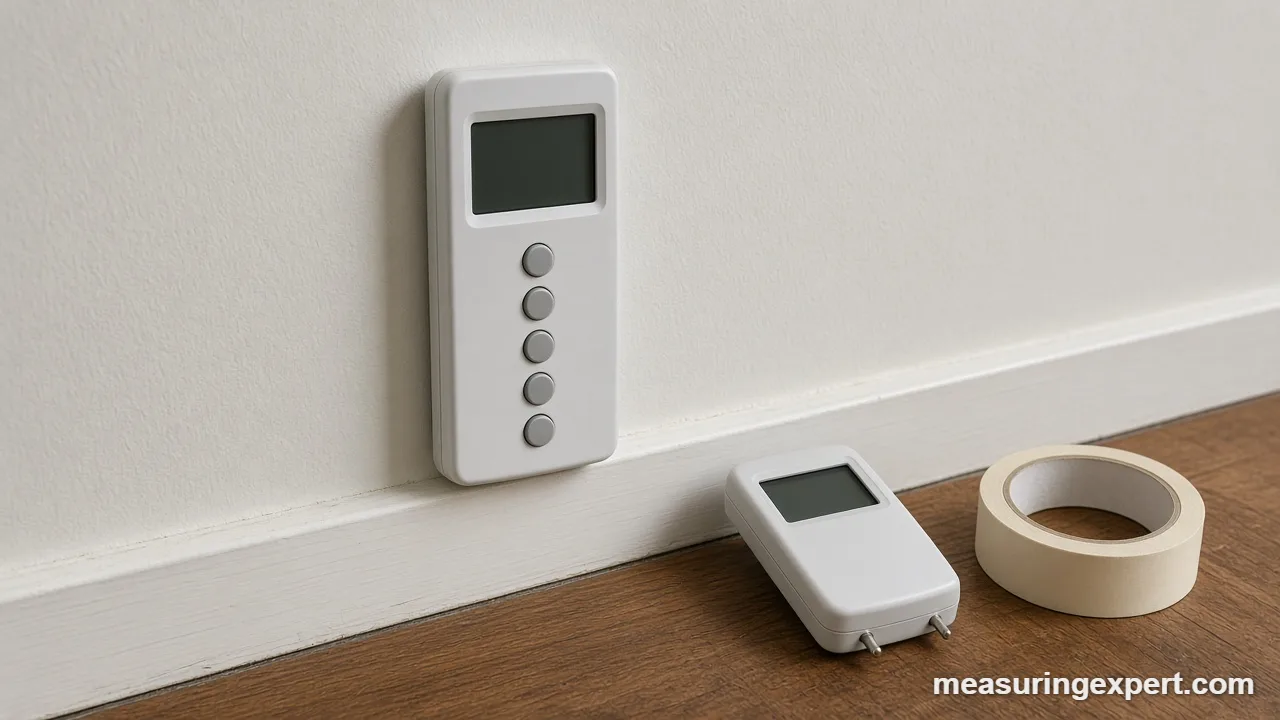
We then scored each meter on the things that matter for walls:
- Drywall and plaster support: a dedicated drywall scale, a WME scale or at least a relative mode for building materials.
- Depth: how far a pinless pad reads, because drywall is usually 1/2 inch (12.7 mm) or 5/8 inch (15.9 mm) thick.
- Proof: logging, an app or a hold button for jobs that need records.
- Calibration: a check box, calibrator or field calibration.
- Clear zones: color or tone bands that mark dry, at-risk and wet readings.
We also left out unbranded listings, parts-only sensors and models a maker lists as discontinued. For example, the Extech MO55 is now listed as discontinued, so it did not make the cut. Tramex makes excellent Moisture Encounter wall meters, too; however, we could not find a standard US listing for its wall models when we checked, so it is not ranked here.
Pin vs Pinless on Drywall, Plaster and Wood
A pin meter measures electrical resistance between two pins. Because water conducts better than dry material, the reading rises as the material gets wetter. By contrast, a pinless meter sends a small electromagnetic field into the surface and reads how the material changes it. Extech describes its pinless mode as capacitance-based, while Protimeter calls its version radio frequency.
| Material | Pin meter | Pinless meter | What to watch |
|---|---|---|---|
| Drywall (gypsum) | Use a drywall or WME scale; the holes are small | Fast sweep through paint; relative numbers | Foil facing, metal studs and corner bead can raise scans |
| Plaster | Good on a WME scale | Works, but thick coats may exceed the depth | Salts from old leaks can raise pin readings |
| Wood trim and framing | Best for true moisture content | Good with species settings | Wood temperature and species shift readings |
| Tile and masonry | Hard to pin; grout only | Usually the better choice | Use a masonry mode or compare to a dry area |
In practice, most pros scan first and pin second. First, the scan finds the wet zone quickly. Then a pin reading confirms how wet it is and gives a number you can record.
What the Numbers on the Screen Mean
Moisture meters show three kinds of scales, and mixing them up causes most bad calls. So check which scale your meter is on before you read anything into a number.
| Scale | What it shows | Typical example | How to read it |
|---|---|---|---|
| Wood moisture content (%MC) | Water as a percent of dry wood weight | Wagner Orion 930, 4% to 32% | Needs the right species setting |
| Wood Moisture Equivalent (WME) | The %MC that wood would reach if it sat in contact with the material | Protimeter MMS3, 6% to 100% | Lets drywall, plaster and wood share one scale |
| Drywall %MC | Actual water in gypsum | Delmhorst BDX-30, 0.1% to 6% | Small numbers matter; do not compare with wood % |
| Reference or relative | An unitless 0 to 100 (or 60 to 1000) index | Klein ET140, Protimeter Aquant | Compare a suspect spot with a known dry spot |
On WME and building material scales, many meters use the same three bands. For instance, Protimeter’s Digital Mini marks 6 to 16.9 as dry (green), 17 to 19.9 as at risk (yellow) and 20 and above as wet (red). Similarly, the General Tools MMD4E and Extech MO50A call 17% to 19.9% medium and 20% and up high.
A relative scale is different. For example, a reading of 40 means nothing by itself. Instead, scan a dry interior wall in the same room, note that baseline, and look for spots that rise well above it.
Moisture, Mold and the 48-Hour Window
A moisture meter does not detect mold. However, it finds the water that mold needs. The EPA puts it plainly: “The key to mold control is moisture control.” Its guide to mold, moisture and your home also says to dry water-damaged areas and items within 24 to 48 hours, and to keep indoor relative humidity below 60%, ideally between 30% and 50%.
So a meter helps in three ways. First, it shows how far water spread behind a stain. Next, it tells you when a wall has dried back to its baseline. Finally, it confirms that a repair actually stopped the leak.
For room air, a hygrometer or a home weather station with an indoor humidity sensor tracks that 30% to 50% target over days rather than one moment.
How to Check a Wall for Moisture
- Check the battery and run the meter’s calibration check, if it has one.
- Pick the correct mode or scale for drywall, plaster or wood.
- Take a baseline reading on a dry interior wall of the same material.
- Scan the suspect wall in a grid, holding the pinless pad flat and still.
- Mark high readings with tape and keep moving until readings fall back to baseline.
- Confirm the wettest spots with a pin reading, low on the wall and near fixtures.
- Record each reading with a photo, then recheck daily while the wall dries.
Also, avoid scanning right over studs, screws, outlets and corner bead, because metal can raise a pinless reading. A stud finder helps you mark framing before you scan. Similarly, if you open a wall later, check the batts as you measure insulation thickness, since wet insulation compresses and loses R-value.
Caring for the Best Wall Moisture Meter: Do and Don’t
Most meters need little care, but a few habits keep readings honest. For example, the Wagner Orion 930 includes an On-Demand Calibrator, and the Protimeter Aquant runs an automatic calibration check. Delmhorst documents its scales and correction tables on its BDX-30 product page.
Honest Limits of Any Best Wall Moisture Meter
Even the best wall moisture meter has blind spots. A pinless pad reads only to its rated depth, which is about 3/4 inch (19 mm) on most models here. As a result, it may miss water on the back face of thick plaster or behind a tiled backer board.
Pin meters, however, have their own limits. They read only between the pins, and salts left by old leaks can keep readings high after a wall dries. Therefore, use both methods when the stakes are high, and treat any meter as a guide rather than a final verdict.
Best Wall Moisture Meter FAQ
What is the best wall moisture meter for homeowners?
For most homeowners, the Klein Tools ET140 is a simple pinless choice for quick scans. If you also want a percent reading, add a low-cost pin meter such as the General Tools MMD4E.
Is a pin or pinless meter better for drywall?
Pinless meters are faster and leave no holes, so they suit the first sweep. Pin meters give a number you can record, so many pros scan first and then confirm with pins.
What is a normal moisture reading for drywall?
It depends on the scale. For example, on WME scales, many meters treat readings under about 17 as dry, 17 to 19.9 as at risk and 20 or more as wet. On a relative scale, compare with a dry wall nearby.
Which best wall moisture meter reads drywall directly?
The Delmhorst BDX-30 has a dedicated drywall scale from 0.1% to 6%. That scale shows actual water in gypsum, so even small numbers can point to a leak.
How deep can a pinless moisture meter read?
Most pinless meters in this guide read to about 3/4 inch (19 mm). The Protimeter MMS3 adds a sensitivity mode that can reach about 5 inches (12 cm), depending on the material.
Can a moisture meter detect mold?
No, because a meter finds moisture, not mold. However, moisture is what mold needs, so finding and drying wet areas within 24 to 48 hours is the main way to prevent growth.
Why does my best wall moisture meter read high near outlets?
Pinless meters react to metal such as screws, wiring boxes, corner bead and foil-faced insulation. So move off the metal and compare with a nearby dry spot before you assume a leak.
Do I need to calibrate a wall moisture meter?
Check it before each job. In addition, some models include a calibration check or calibrator, and the Protimeter Aquant lets you field-calibrate its non-invasive mode.
What does WME mean on a moisture meter?
WME stands for Wood Moisture Equivalent. In other words, it is the moisture content that wood would reach if it sat in contact with the material, which lets drywall, plaster and wood share one scale.
Is the best wall moisture meter worth it for a single leak?
Often, yes, because a basic meter costs less than opening the wrong wall, and it shows when the area has dried back to its baseline before you patch and paint.
Bottom Line
For most serious users, the Protimeter MMS3 Standard Kit is the best wall moisture meter, because it scans, pins and logs in one handset. However, choose the Delmhorst BDX-30 if you want a true drywall scale, or the Klein ET140 if you just need a quick, low-cost scan.
Black Friday is coming: shop the deals with Prime