

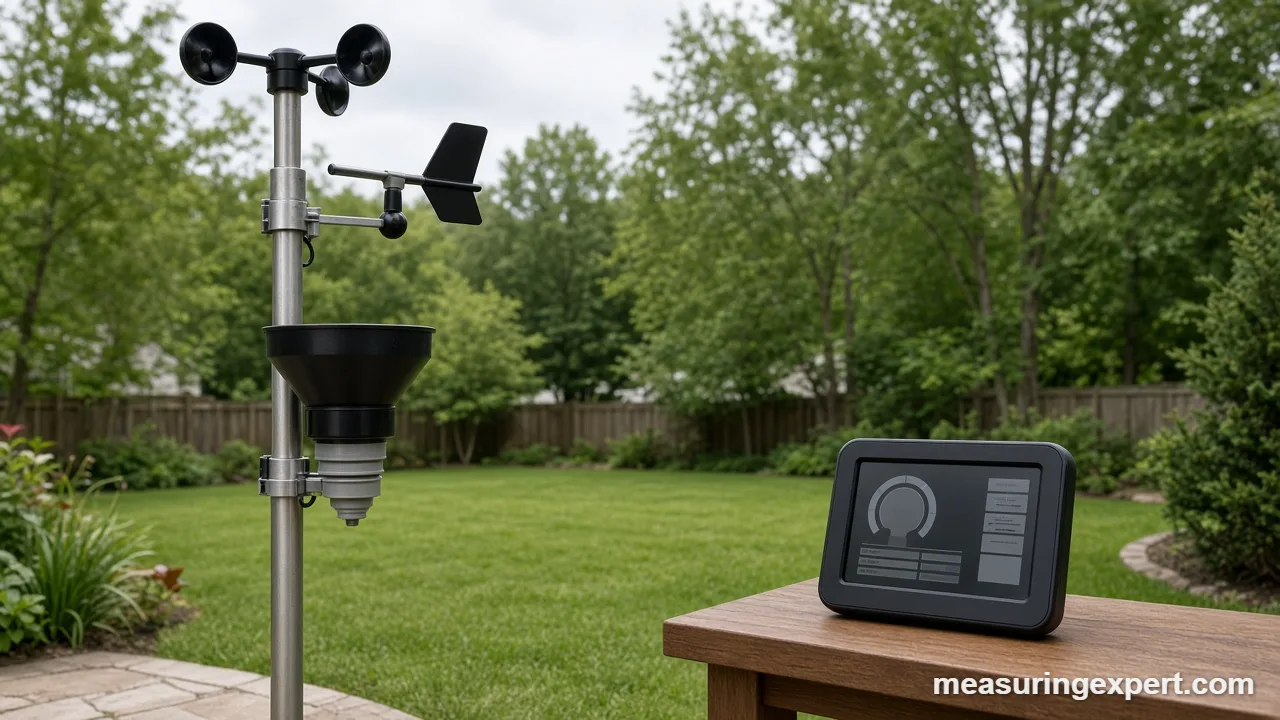
The best weather station for most homes is the Ambient Weather WS-2902, because one solar sensor array covers wind, rain, temperature, humidity, UV and solar radiation and sends it all to Wi-Fi apps. However, the right choice comes down to three things: the sensors you need, the distance to your console, and your budget.
In short: pick the Ambient WS-2902 for most yards, the AcuRite Iris for value, and the Davis Vantage Pro2 for pro-grade data.
As an Amazon Associate, Measuring Expert earns from qualifying purchases. Our picks are based on research, specifications and owner feedback, not paid placement.
Best Overall
Best Value
Best Weather Station Picks at a Glance
- Ambient Weather WS-2902: the most complete sensor set for the money, with UV and solar radiation included.
- AcuRite Iris 5-in-1: a cheaper way into full wind and rain data, and AcuRite publishes clear accuracy figures.
- Davis Vantage Pro2: the long-range, fast-updating choice that serious hobbyists and farms rely on.
- Ambient WS-2000: the same style of array as the WS-2902, but with a large color console and microSD export.
- AcuRite Atlas Professional: also adds lightning detection, plus UV and light intensity.
- Sainlogic SA68: a full outdoor sensor set with no Wi-Fi and no app to manage.
- TempPro TP62B and TP50: simple temperature and humidity displays for people who do not need wind or rain, with the TP50 aimed at damp basements.
On This Page
- Comparison table
- The 8 picks, reviewed
- How we chose
- Types of home weather stations
- Specs that matter
- Siting and setup steps
- Pressure unit converter
- Calibration and care
- Honest limits
- FAQ
- Bottom line
Compare Every Best Weather Station Pick Side by Side
This table sums up each model in one line. Next, the reviews below explain the measurement details behind each pick.
| # | Image | Product | Best For | Standout Feature | Amazon |
|---|---|---|---|---|---|
| 1 |  | Ambient Weather WS-2902 | Most backyards | Solar array with UV and solar radiation, 16-second updates | View |
| 2 |  | AcuRite Iris 5-in-1 with Direct-to-Wi-Fi Display | First full station | Solar power pack and published sensor accuracy | View |
| 3 |  | Davis Instruments Vantage Pro2 (Wireless) | Serious hobbyists | 2.5-second wind updates and up to 1,000 ft range | View |
| 4 | 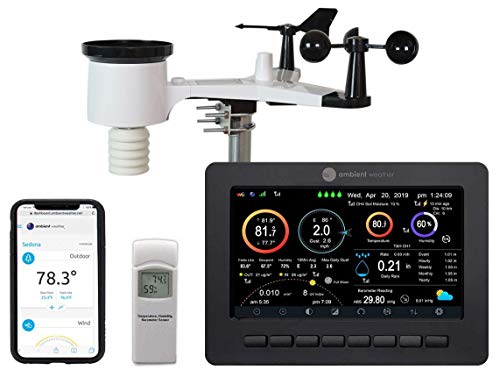 | Ambient Weather WS-2000 | Data lovers | Color TFT console with microSD export | View |
| 5 |  | AcuRite Atlas Professional | Storm watchers | Lightning detection from 1 to 25 miles | View |
| 6 | 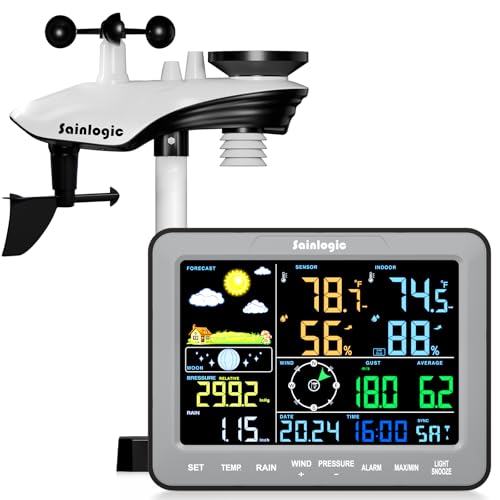 | Sainlogic SA68 | Offline homes | Full sensor set on a standalone console | View |
| 7 |  | TempPro TempAir PLUS TP62B | Temperature and humidity only | Indoor and outdoor readings with room for 3 sensors | View |
| 8 |  | TempPro TP50 Digital Hygrometer | Basements and humidity | Calibratable humidity with a 10-second refresh | View |
The 8 Best Weather Station Picks, Reviewed
We ordered the list by how well each station serves a typical home. So the full outdoor stations come first, and the simpler temperature and humidity stations come last.
Best Overall
1. Ambient Weather WS-2902
Best for: homeowners, gardeners and weather fans who want the full picture without pro-level cost.
The WS-2902 puts wind speed, wind direction, rain, outdoor temperature, humidity, UV and solar radiation on one sensor array. Meanwhile, the console reads indoor temperature, humidity and barometric pressure. It also works out dew point, heat index and wind chill for you. As a result, one purchase covers nearly every reading a home observer needs.
Its strength is the data path. The console updates every 16 seconds and then sends readings over 2.4 GHz Wi-Fi to the Ambient Weather Network. From there, you can share to Weather Underground and connect Alexa, IFTTT or Home Assistant. Ambient notes that the wind sensor resolves gusts in steps of about 1.1 mph, so treat small gust changes with care.
- Sensor link: 915 MHz radio, up to 330 ft (100 m) line of sight in open air and about 100 ft (30 m) in most homes.
- Readings: wind, rain, UV, solar radiation, indoor and outdoor temperature and humidity, and pressure.
- Updates: every 16 seconds, so trends stay current.
- Console power: 5 V adapter with AAA battery backup.
- Mounting: fits poles from 1.25 to 2 in (31.75 to 50.8 mm).
Pros
- UV and solar radiation also come standard.
- Because the app is strong, sharing and smart-home links are easy.
- Optional add-on sensors, such as extra thermo-hygrometers and air quality, show up online.
Cons
- Add-on sensors appear online, not on the console.
- All sensors sit together, so the thermometer often ends up higher than the ideal 5 feet.
- Real-world radio range drops near walls and metal roofs, so plan the mount.
Skip it if: you want a large color console or data export to a memory card; look at the WS-2000 instead.
Best Value
2. AcuRite Iris 5-in-1 with Direct-to-Wi-Fi Display
Best for: a first full station that still gives honest, published accuracy numbers.
The Iris sensor reads temperature, humidity, wind speed, wind direction and rain. In addition, its display adds indoor temperature, humidity and barometric pressure. This bundle includes a solar power pack, so the outdoor sensor does not drain AA batteries as quickly. The display then sends data straight to the AcuRite NOW app over 2.4 GHz Wi-Fi, and you can share it to Weather Underground.
AcuRite lists the accuracy plainly, which helps a measuring-minded buyer. For example, outdoor temperature is plus or minus 1 F, and humidity is plus or minus 2 percent from 0 to 90 percent. Rain resolves in 0.01-inch (0.25 mm) steps with plus or minus 0.05 inch per inch of rainfall. However, the Iris skips UV and solar radiation.
- Temperature range: -40 to 158 F (-40 to 70 C), plus or minus 1 F.
- Wind speed: 0 to 99 mph (0 to 159 km/h), with accuracy that widens at higher speeds.
- Radio: 433 MHz, up to 330 ft (100 m) depending on construction.
- Solar pack: one 18650 rechargeable cell on a 30 ft (9.1 m) cord.
Pros
- Clear, published accuracy specs.
- Solar pack cuts battery swaps, so upkeep stays low.
- Large-font display with trend arrows and rain history.
Cons
- Also, there are no UV or solar radiation readings.
- Wind accuracy loosens to plus or minus 5 mph above 50 mph.
Skip it if: you want lightning detection or UV data; the Atlas covers both.
Best Pro
3. Davis Instruments Vantage Pro2 (Wireless)
Best for: serious hobbyists, farms and schools that want fast, long-range data.
The Vantage Pro2 has a long record among private weather observers. Its sensor suite places temperature and humidity inside a radiation shield, and the separate anemometer can mount up to 40 ft (12 m) away from the rest of the suite. That split matters, because you can raise the wind sensor high while you keep the thermometer near the ideal height.
Speed is also a draw. Davis updates wind every 2.5 seconds and temperature every 10 seconds. Also, the radio reaches up to 1,000 ft (300 m). In addition, the suite runs on solar power with a battery backup. Davis sells add-ons too, such as a UV and solar radiation kit and a fan-aspirated shield that moves air past the thermometer during the day. Consoles have changed over the years, so check which console ships with the listing.
- Wind updates: every 2.5 seconds.
- Wireless range: up to 1,000 ft (300 m).
- Power: solar with battery backup.
- Anemometer: mounts up to 40 ft (12 m) from the sensor suite.
Pros
- Separate anemometer allows better siting.
- Fast updates, and also the longest range here.
- Wide range of spare parts and upgrades.
Cons
- However, it costs far more than consumer stations.
- UV, solar radiation and the fan shield are extra.
- Internet sharing may need an added Davis hub, depending on the console.
Skip it if: you only want backyard trends; the WS-2902 does that for much less.
Best Display
4. Ambient Weather WS-2000
Best for: people who read the console every day and like to keep records.
The WS-2000 uses an outdoor array that reads wind, rain, temperature, humidity, UV and solar radiation. Pressure, indoor temperature and humidity come from a separate WH32B indoor sensor. Still, the big change is the console: a 7.75 by 5.75 inch (197 by 146 mm) full color TFT screen with light and dark themes.
It also suits record keepers. You can export history to a microSD card (4 to 32 GB) and open it in a spreadsheet. On top of that, the console accepts many add-on sensors, including up to eight extra thermo-hygrometers, soil moisture probes, leak detectors and a lightning detector. Ambient also lists calibration for every measured value.
- Display: color TFT, 7.75 x 5.75 in.
- Data: microSD export plus Ambient Weather Network upload.
- Updates: 16 seconds over 915 MHz radio.
- Array power: solar panel with a supercapacitor and optional batteries.
Pros
- Easy-to-read color screen.
- Offline records on microSD.
- Broad add-on sensor support, shown on the console.
Cons
- Costs more than the WS-2902 for a similar array.
- Also, Wi-Fi must be 2.4 GHz.
Skip it if: you mostly check your phone; the WS-2902 gives the same core data.
Best for Lightning
5. AcuRite Atlas Professional
Best for: storm watchers and anyone who wants a warning before thunder arrives.
Atlas goes further than Iris. Its outdoor sensor adds UV index and light intensity to temperature, humidity, wind and rain. Then the lightning detector counts strikes and estimates the distance to the latest one, from 1 to 25 miles (1.6 to 40 km). Wind speed also updates every 10 seconds, and AcuRite lists the wind range up to 160 mph (257 km/h).
The bundle includes a Wi-Fi display and a solar power pack. So it sends data to AcuRite NOW or Weather Underground and shows a 12 to 24 hour forecast. However, lightning distance is only an estimate. So use it as a cue to head indoors, not as a safety guarantee.
- Lightning: 1 to 25 miles (1.6 to 40 km).
- Wind direction: 360 degrees, plus or minus 3 degrees.
- UV index: 0 to 15, plus or minus 1.
- Temperature: plus or minus 1 F over -40 to 158 F (-40 to 70 C).
Pros
- Built-in lightning detection.
- UV and light readings are also included.
- Fast 10-second wind updates.
Cons
- All-in-one array has the same height trade-off as other combined sensors.
- Range of 330 ft (100 m) shrinks through walls.
Skip it if: you never see thunderstorms; the Iris covers the basics for less.
Best Without Wi-Fi
6. Sainlogic SA68
Best for: cabins, sheds and homes where you do not want an app or account.
The SA68 reads indoor and outdoor temperature and humidity, barometric pressure, wind speed, gusts, wind direction and rain on its own console. It also shows dew point, feels-like temperature and a basic forecast. Because there is no Wi-Fi, setup is simple, and nothing depends on a cloud service.
Sainlogic lists rain accuracy of plus or minus 1 mm up to 15 mm, then plus or minus 7 percent for heavier rain, with manual calibration available. The pressure range runs from 300 to 1,100 hPa. However, the brand gives fewer accuracy figures than AcuRite does, so expect to check it against a nearby official station.
- No Wi-Fi and no app.
- Pressure range: 300 to 1,100 hPa (8.86 to 32.48 inHg).
- Outdoor sensor: solar powered with battery backup.
- Rain calibration in the menu.
Pros
- Full sensor set with no account needed.
- Solar-assisted outdoor sensor.
- Rain calibration built in.
Cons
- Because there is no Wi-Fi, you get no history, phone alerts or data sharing.
- Fewer published specs than the bigger brands.
Skip it if: you want phone alerts while away from home.
Best Simple Display
7. TempPro TempAir PLUS TP62B
Best for: a kitchen or hallway display of indoor and outdoor temperature and humidity.
This is not a full outdoor station. Instead, it pairs a 3.3-inch LCD base with one remote sensor that reads outdoor temperature and humidity. The base also shows indoor readings, trend arrows and max and min records. In addition, it can show up to three remote sensors, so you can add a greenhouse, garage or basement later.
TempPro lists temperature accuracy of plus or minus 2.0 F (1.1 C) from 32 to 158 F. Humidity accuracy is plus or minus 2 percent from 30 to 80 percent RH, widening to 3 percent outside that band. The 915 MHz link reaches up to 500 ft (150 m) with no obstructions, so walls will shorten it. Because the base refreshes every 30 seconds and the sensor in under 60 seconds, it suits trend watching rather than fast changes.
- Temperature range: -4 to 158 F (-20 to 70 C), base and sensor.
- Humidity range: 10 to 99 percent RH.
- Wireless: 915 MHz, up to 500 ft (150 m) in open air.
- Sensors: shows up to 3 remote sensors (extra sensors sold separately).
- Power: 2 AAA batteries in the base and in the sensor.
Pros
- Simple to set up and read.
- Room for up to three remote sensors.
- Battery powered, so it can sit anywhere.
Cons
- However, it gives no wind, rain or pressure readings.
- Its plus or minus 2 F rating is looser than the full stations above.
- TempPro’s own page is unclear on whether the screen is backlit.
Skip it if: you care about wind or rain; any station above covers them.
Best for Damp Rooms
8. TempPro TP50 Digital Hygrometer
Best for: basements, laundry rooms and other spaces where humidity matters most.
The TP50 is an indoor thermometer and hygrometer, not an outdoor station. Even so, it earns a spot because humidity is the reading that decides whether a basement grows mold. Its display shows temperature, relative humidity and a three-level comfort icon (dry, comfortable or wet). It also refreshes every 10 seconds, so you can watch a dehumidifier pull the number down.
TempPro rates humidity at plus or minus 2 percent from 30 to 80 percent RH, and plus or minus 3 percent outside that band. Temperature reads within plus or minus 1 F (0.5 C). The unit can also be calibrated, and TempPro describes a salt test that holds the air near 75 percent RH. However, TempPro does not publish the cutoffs behind the comfort icon, so use the humidity number itself as your main guide.
- Humidity: 10 to 99 percent RH, plus or minus 2 percent from 30 to 80 percent.
- Temperature: -58 to 158 F (-50 to 70 C), plus or minus 1 F.
- Refresh rate: every 10 seconds.
- Mounting: tabletop stand, magnetic back or hanging mount.
- Power: one AAA battery.
Pros
- Fast 10-second refresh.
- Can be checked and calibrated with a salt test.
- Small enough to stick on a dryer or a metal shelf.
Cons
- Indoor only, with no remote sensor.
- Also, the comfort icon thresholds are not published.
Skip it if: you need outdoor weather data rather than home comfort data.
How We Chose the Best Weather Station Models
These are research-based picks, not hands-on lab tests. First, we shortlisted widely reviewed stations from established brands. Then we read each manufacturer’s spec page for sensors, ranges, update rates, radio range and power. We also left out any spec we could not confirm. Finally, we kept no more than two models per brand and avoided near-duplicate bundles.
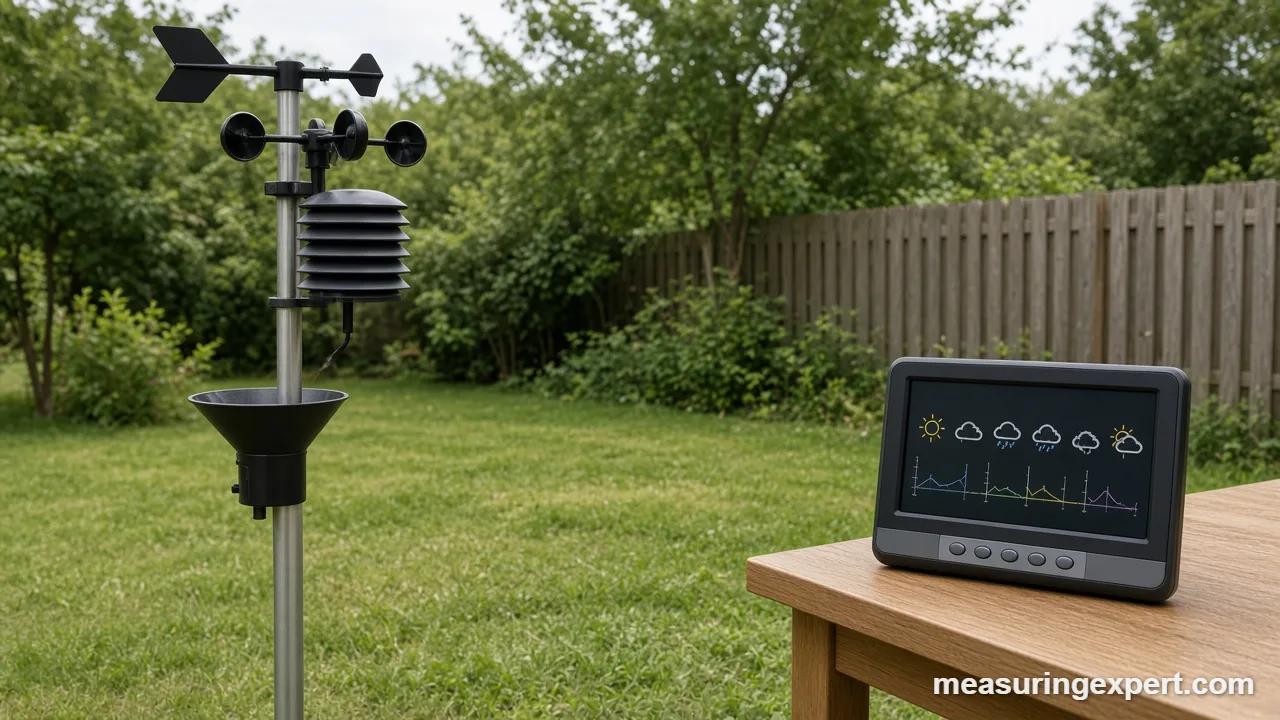
We also weighed siting. A station that lets you separate the wind sensor from the thermometer can give better data. So we checked each design against the National Weather Service siting policy for temperature sensors and rain gauges. In short, we favored stations with published accuracy, long sensor life and good data sharing.
All-in-One Array, Split Suite or Indoor Display: Which Type Fits?
Home weather stations fall into three broad designs. Also, each one trades cost against siting freedom.
| Type | Examples here | Strength | Weak spot |
|---|---|---|---|
| All-in-one array | WS-2902, WS-2000, Iris, Atlas, SA68 | One mast, easy install, full sensor set | Wind and temperature share one height |
| Split sensor suite | Davis Vantage Pro2 | Anemometer mounts high, thermometer stays low | Higher cost, more cabling |
| Temperature and humidity display | TempPro TP62B, TP50 | Simple, cheap, good for comfort | No wind, rain or pressure |
For most yards, an all-in-one array is the practical middle ground. However, if wind data matters to you, the split design wins, because wind near rooftops is turbulent and slower than wind at 33 feet.
Specs That Decide the Best Weather Station for You
Spec sheets can look alike, so focus on the numbers that change your data.
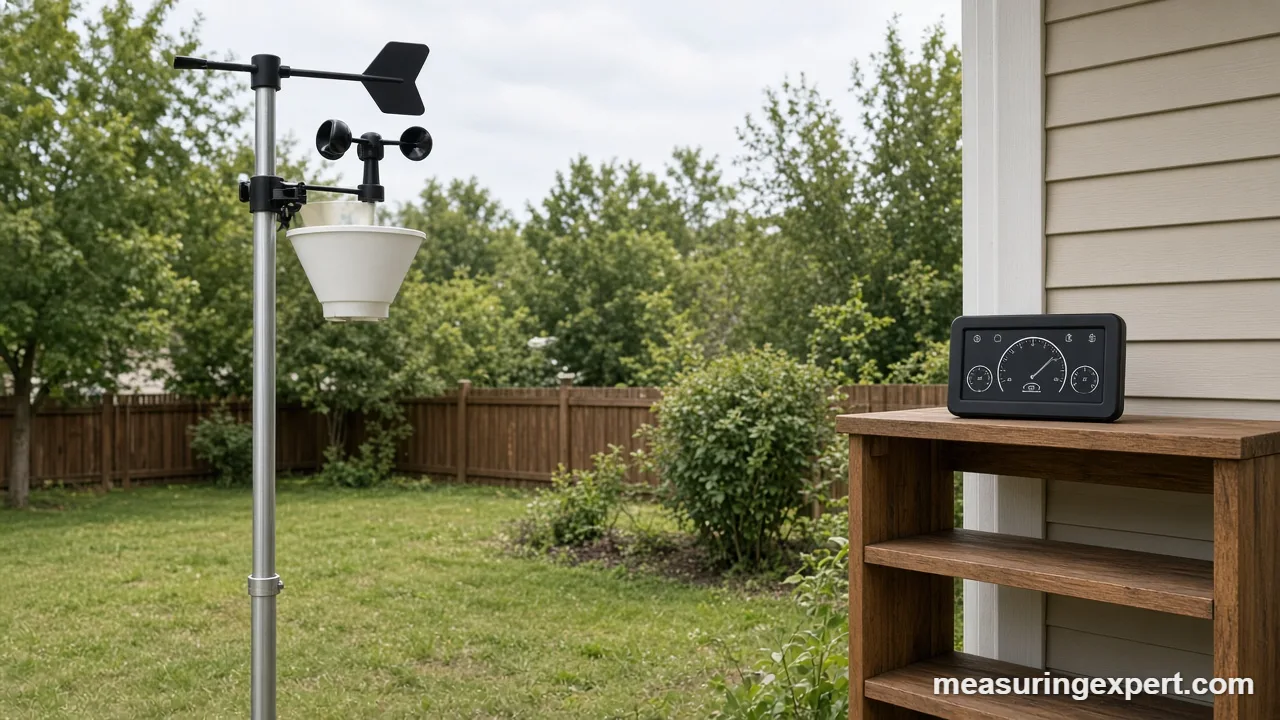
- Accuracy: how close a reading is to the true value, such as plus or minus 1 F. Brands that publish it, like AcuRite, give you a clear baseline.
- Resolution: the smallest step the sensor shows, such as 0.01 inch of rain. Even so, fine resolution does not mean high accuracy.
- Update interval: how often new data arrives. For example, Davis wind updates every 2.5 seconds, while Ambient updates every 16 seconds.
- Radio range: line-of-sight figures run high. However, walls, foil insulation and metal roofs cut range sharply.
- Units: every station here shows F or C. Most full stations also offer inHg, hPa or mmHg for pressure.
- Power: solar packs and supercapacitors reduce battery swaps, which matters for a sensor 10 feet up a pole.
- Data: Wi-Fi apps, microSD export and sharing to Weather Underground or CWOP decide how useful the history is.
Pressure is the easiest reading to misread. A barometer at altitude shows absolute pressure, which runs far below sea-level reports. Our guide to how air pressure drives the weather explains highs, lows and pressure trends in more detail.
How to Site and Set Up a Home Weather Station
Good placement improves data more than any upgrade. So follow these steps on install day.
- Choose an open site. Pick a grassy spot away from walls, decks and driveways, with clear sky above the rain gauge.
- Set the sensor height. Mount the temperature and humidity sensor about 5 feet (1.5 m) above the ground, plus or minus 1 foot.
- Respect obstruction distances. Keep the sensor at least four times the height of nearby trees or buildings away from them, and the rain gauge at least twice their height away.
- Mount the wind sensor high. Put the anemometer as high and clear as you safely can; the standard height is 10 m (33 ft).
- Level and align the array. Use a bubble level on the rain collector and point the wind vane north as the manual directs.
- Set the pressure offset. Enter your elevation or a relative pressure offset so the barometer matches sea-level reports.
- Connect and compare. Join Wi-Fi, link the app, then compare a week of readings with the nearest official station.
Convert Barometric Pressure Readings
Because consoles and apps use different pressure units, a converter helps. Enter a reading in inches of mercury to see it in other units. Note that 1 kPa equals 10 hPa (millibars).
The math is simple: 1 inHg equals 3,386.389 Pa, or about 33.86 hPa. So a standard sea-level reading of 29.92 inHg equals 1,013.2 hPa.
Calibration and Care Over the Years
Even good sensors drift, so plan a quick check each season. First, compare temperature and pressure with the nearest airport or NWS station on a calm, cloudy day. Next, adjust the offsets in the console or app. Most full stations here, including Ambient and Sainlogic models, offer calibration menus.
However, rain gauges need the most care. For instance, leaves, insects and bird droppings clog the funnel and cause low totals. Also, a tipping-bucket gauge that is not level will miscount. Clean the funnel monthly in the growing season, and check the bubble level after storms. Meanwhile, wipe the solar panel and the radiation shield so they work as designed.
Honest Limits of Any Home Station
A home station measures your yard, not the region. Therefore, its numbers will often differ from the forecast and from an airport miles away. For example, wind is the clearest case. A sensor on a short pole near trees reads lower and gustier than a 33-foot mast in an open field.
Forecast icons on consoles rely mostly on pressure trends. As a result, they work as a rough guide only. Lightning detectors estimate distance, so they cannot promise safety. Finally, no consumer station replaces official warnings. For severe weather, follow the National Weather Service and local officials.
If you want your data to help others, join the Citizen Weather Observer Program (CWOP). CWOP forwards member data to NOAA’s MADIS system, where it goes through quality checks before forecasters use it.
Best Weather Station FAQ
What is the best weather station for most homes?
For most homes, the best weather station is the Ambient Weather WS-2902. It measures wind, rain, temperature, humidity, pressure, UV and solar radiation, and it shares data over Wi-Fi. However, the AcuRite Iris costs less and still covers the five core readings.
Is the best weather station always one with Wi-Fi?
No. Wi-Fi adds phone alerts, history and data sharing, so most buyers want it. Still, the best weather station for a cabin or a home without reliable internet is a standalone model such as the Sainlogic SA68, which shows everything on its own console.
How accurate is a home weather station?
Good consumer stations publish figures such as plus or minus 1 F for temperature and plus or minus 2 percent for humidity. In practice, placement matters more. A sensor in sun, near a wall or over pavement can read several degrees high even when the sensor itself is accurate.
Where should I put the best weather station sensor?
Mount the temperature sensor about 5 feet (1.5 m) above grass, in an open spot. NWS guidance keeps it at least four times the height of nearby obstructions away from them and, ideally, 100 feet (30 m) from pavement. Even the best weather station reads poorly in a bad spot.
How high should a home anemometer be mounted?
The standard exposure height for wind sensors is 10 meters (33 feet) over open ground. Most homes cannot reach that safely, so mount it as high and clear of the roof and trees as you can. Then expect lower wind readings than the nearest airport reports.
Why does my station’s pressure differ from the airport reading?
Airports report pressure corrected to sea level. Your console shows absolute pressure unless you set a relative offset. Because pressure falls about 1 inHg per 1,000 feet (about 36 hPa per 300 m) near sea level, an uncorrected reading at altitude looks far too low.
Can I share my data with the National Weather Service?
Yes, through the Citizen Weather Observer Program (CWOP). Members send data over the internet, and CWOP forwards it to the NOAA MADIS system for quality checks. Ambient, AcuRite and Davis stations can also upload to Weather Underground.
What is the best weather station for lightning alerts?
The AcuRite Atlas Professional is the best weather station here for lightning, because its built-in detector counts strikes and estimates distance from 1 to 25 miles (1.6 to 40 km). The Ambient WS-2000 can add a lightning sensor as an option.
How long do weather station sensors last?
Many arrays run for years, but parts wear out. Wind cups and vanes face constant weather, batteries and supercapacitors age, and humidity sensors drift. Davis and Ambient sell replacement parts, which helps keep a station running.
What is the best weather station without Wi-Fi?
The Sainlogic SA68 is the best weather station on this list without Wi-Fi. It reads wind, rain, pressure, temperature and humidity on its own console with no app. For temperature and humidity alone, the TempPro TP62B also works offline.
Bottom Line: The Best Weather Station for Most Homes
For most yards, the Ambient Weather WS-2902 is the best weather station to buy. It covers wind, rain, temperature, humidity, pressure, UV and solar radiation, and it shares everything over Wi-Fi. If you want to spend less, the AcuRite Iris covers the five core readings with clear accuracy specs. And if you want pro-grade wind data and long range, the Davis Vantage Pro2 is the one to save for.
Black Friday is coming: shop the deals with Prime
5 thoughts on “8 Best Weather Station Picks for 2026: Home Setups Compared”