

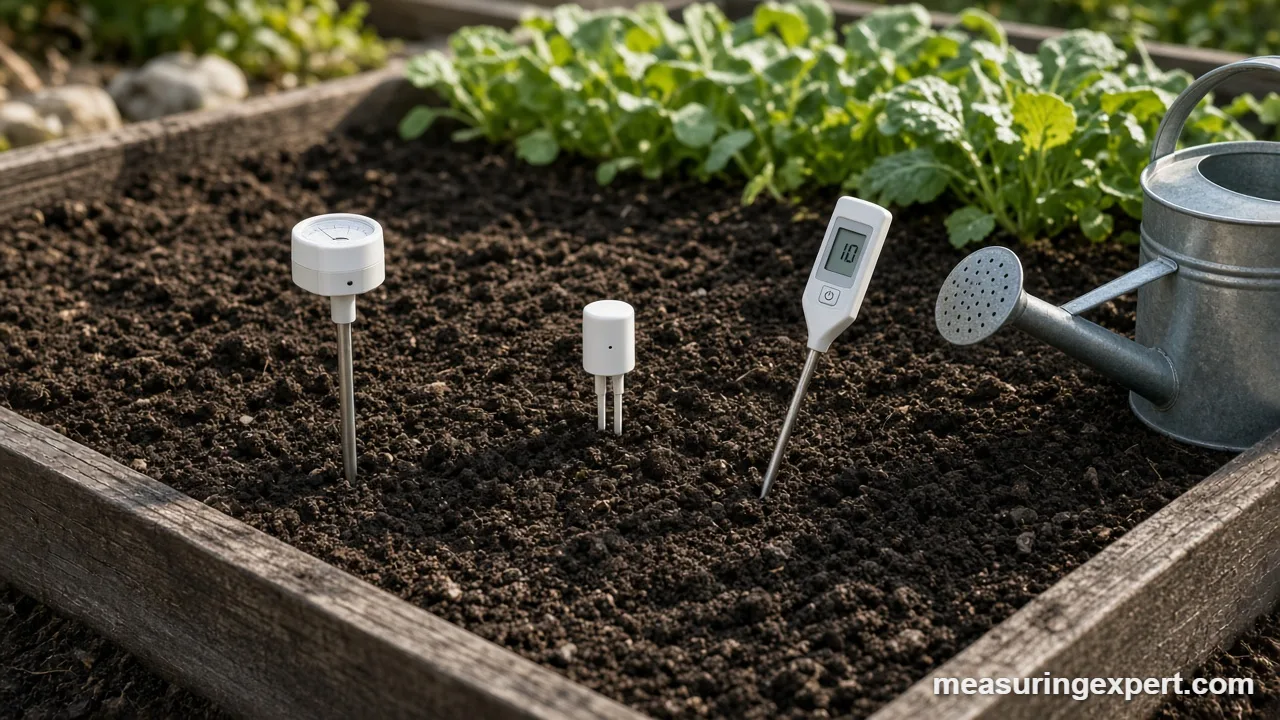
The best soil moisture sensor for most gardens is the Ecowitt GW1206 kit, a wireless probe that logs readings to your phone every 70 seconds. Your choice comes down to sensor type (analog probe, digital VWC meter or smart sensor), the depth of your roots and whether you want alerts or quick spot checks.
In short: get the Ecowitt kit for hands-off tracking, the XLUX meter for cheap spot checks and the EarthScout Soil Cub Plus when you need true VWC and EC data.
As an Amazon Associate, Measuring Expert earns from qualifying purchases. Our picks are based on research, specifications and owner feedback, not paid placement.
Quick Answer: The Best Soil Moisture Sensor for You
- Overall pick: Ecowitt GW1206, a Wi-Fi gateway plus a wireless probe with 1% resolution.
- Research-grade data: EarthScout Soil Cub Plus, which reports VWC, soil temperature and EC.
- Cheapest useful tool: XLUX battery-free meter with a 10-step dial.
- Raised beds: Ecowitt WH51L kit, with a wired probe and an LCD on the sensor.
- Tension instead of percent: Blumat Digital, a tensiometer that reads 0 to 250 mbar.
- Houseplants: SUSTEE Aquameter, a leave-in stick that turns white when the pot is dry.
- Key rule: measure in the root zone, then learn your own soil’s wet and dry numbers.
On This Page
- Soil Moisture Sensor Comparison Table
- The 8 Best Soil Moisture Sensor Picks, Reviewed
- How We Chose
- Probe Meters vs Digital VWC Meters vs Smart Sensors
- Resistive vs Capacitive Sensing
- Volumetric Water Content, Explained
- Specs That Matter
- How to Read a Soil Moisture Sensor
- Do and Don’t
- Honest Limits
- FAQ
- Bottom Line
Best Soil Moisture Sensor Comparison Table
| # | Image | Product | Best For | Standout Feature | Link |
|---|---|---|---|---|---|
| 1 |  | Ecowitt GW1206 Wi-Fi Soil Moisture Kit | Gardens and lawns you want to track from a phone | Up to 16 wireless probes per gateway | View |
| 2 |  | EarthScout Soil Cub Plus | Growers who need real VWC and EC numbers | TDR sensing with GPS-tagged logs | View |
| 3 | 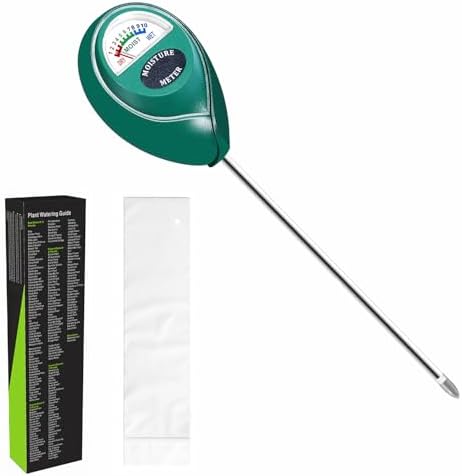 | XLUX Soil Moisture Meter | Quick spot checks on a budget | Battery-free 10-step dial | View |
| 4 | 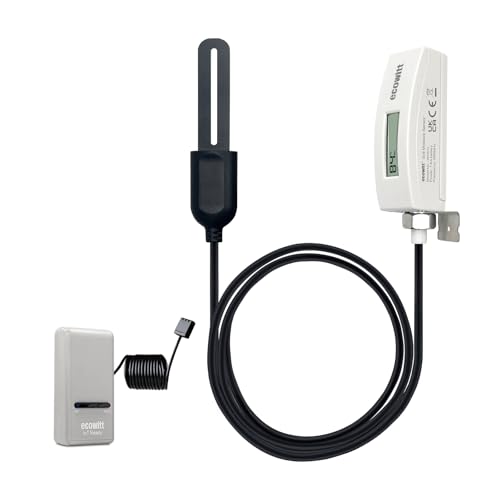 | Ecowitt GW1200 Kit With WH51L Probe | Raised beds and deep root zones | LCD on the sensor and a wired probe | View |
| 5 | 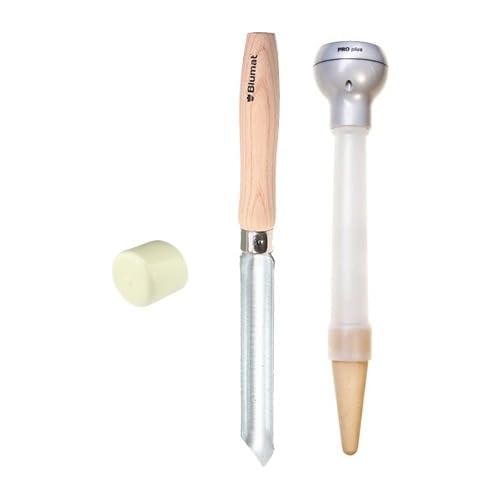 | Blumat Digital Moisture Meter | Living soil and container growers | Reads soil water tension in mbar | View |
| 6 |  | SUSTEE Aquameter | Houseplants and forgetful waterers | Leave-in color indicator | View |
| 7 |  | XLUX Long Probe Soil Moisture Meter | Large pots and deep planters | 40 cm (15.7 in) probe option | View |
| 8 |  | Luster Leaf Rapitest 1825 Moisture Meter | Beginners who want a plant guide | Printed watering list for common plants | View |
The 8 Best Soil Moisture Sensor Picks, Reviewed
First, a note on scope. We mixed three kinds of tools: analog probe meters, digital meters and wireless smart sensors. As a result, you can match the tool to a single houseplant, a vegetable bed or a whole lawn.
Best Overall
1. Ecowitt GW1206 Wi-Fi Soil Moisture Kit
Best for: Gardeners who want to watch soil moisture from a phone and add more probes over time.
The GW1206 is the best soil moisture sensor for most people because it removes the guesswork of when to read. First, the kit pairs a WH51 wireless probe with a GW1200 Wi-Fi gateway. So, the probe stays in the bed and sends a fresh reading about every 70 seconds.
In addition, the data goes to the Ecowitt app and the free ecowitt.net server, where you get history graphs, downloads and email alerts. Also, one gateway handles up to 16 WH51 probes, so you can cover a lawn, a greenhouse and a few beds with one hub. Finally, you can set custom low and high calibration points (0%AD and 100%AD) to match your own soil.
- Moisture range: 0 to 100%, 1% resolution
- Update rate: about 70 seconds
- Sensor rating: IP66; power: 1 AA battery (not included)
- Gateway capacity: up to 16 WH51 probes
- RF band: 915 MHz in North America
Pros
- Readings and alerts on your phone
- Custom two-point calibration
- Cheap to expand with more probes
Cons
- No display on the probe itself
- Ecowitt does not publish an accuracy figure for the WH51
Skip it if: you only own three houseplants and never forget to water; instead, a simple probe meter does that job.
Best Pro
2. EarthScout Soil Cub Plus
Best for: Market gardeners, turf managers and serious growers who need volumetric numbers they can log and compare.
Most garden meters show only a relative scale. By contrast, the Soil Cub Plus reports soil moisture as volumetric water content in percent. Also, EarthScout describes its sensors as research-grade TDR (time domain reflectometry), the method extension specialists rate as very accurate without site calibration.
Moreover, the meter adds soil temperature plus bulk and pore water electrical conductivity in dS/m, which helps you spot salt build-up from fertilizer. In addition, each reading can carry a GPS location or a zone name in the companion app. Finally, logs export as CSV files.
- Measures: VWC (%), soil temperature, bulk EC and pore water EC (dS/m)
- Sensing method: TDR, per the maker
- GPS or zone tag on each reading
- CSV report export from the app
Pros
- True VWC instead of a 1 to 10 scale
- EC readings flag salty soil
- Logs are easy to share or chart
Cons
- Costs far more than a probe meter
- Overkill for a few pots
Skip it if: you only want to know whether a pot is dry today; a basic meter or the SUSTEE stick is enough.
Best Budget
3. XLUX Soil Moisture Meter
Best for: Spot checks on houseplants and small beds when you want a reading in seconds for very little money.
The XLUX meter is the classic analog probe tool. First, you push the single probe into the soil, and then the needle swings across a color-coded, 10-step dial from dry to wet. Also, because it needs no batteries, it lives happily in a drawer for years.
However, treat the number as a relative guide. Analog meters respond to dissolved salts as well as water, so a freshly fed pot can read wetter than it is. Still, if you check the same plant the same way each time, you will quickly learn which number means it is time to water.
- Type: analog, battery-free
- Readout: 10-step dial with dry, moist and wet zones
- Overall length: about 10 in (26 cm)
- Single probe to limit root damage
Pros
- Very low cost and no batteries
- Instant reading
- Easy for kids and beginners
Cons
- Relative scale, not a true percent
- Probe corrodes if left in soil
Skip it if: you want logged data or alerts, because the dial only shows the moment you look.
Best for Raised Beds
4. Ecowitt GW1200 Kit With WH51L Probe
Best for: Raised beds, big containers and root zones you want to read without walking out with a phone.
This kit uses the same GW1200 gateway as our top pick, but the WH51L sensor is a different design. For example, its probe sits on a 1 m (3.3 ft) PVC cable, so the probe can go deep while the transmitter stays above the mulch. Also, a small LCD on the transmitter shows the reading right in the bed.
Unlike the WH51, the WH51L has a published accuracy of plus or minus 5%. In addition, it reports every 70 seconds and switches to a 10-second quick mode when moisture changes fast, such as right after watering. Meanwhile, Ecowitt lists an open-air range of up to 100 m (about 300 ft).
- Range: 0 to 99%, 1% resolution, accuracy plus or minus 5%
- Probe cable: 1 m (a 5 m version is sold separately)
- Housing IP66; probe IP68
- Factory calibrated, with optional custom calibration
Pros
- Readable on the sensor and on the app
- Wired probe reaches deeper roots
- Stated accuracy figure
Cons
- Cable needs protection from mowers and tools
- Same Ecowitt app learning curve
Skip it if: your beds are shallow, since the standard WH51 kit does the same job for less.
Best Tension Reader
5. Blumat Digital Moisture Meter
Best for: Living soil, organic container growers and anyone who wants to know how hard roots must pull for water.
The Blumat Digital is a tensiometer, so it measures soil water tension instead of water content. First, a water-filled ceramic tip sits in the soil. As the soil dries, it pulls on that water, and the digital top shows the pull in millibars (mbar).
Retailer BuildASoil lists a range of 0 mbar (fully wet) to 250 mbar (very dry), which equals 0 to 25 kPa. Also, it suggests a target of 40 to 80 mbar for living soil. Because tension tracks what roots feel, the same number means the same stress in sand or in loam.
- Measures: soil water tension, 0 to 250 mbar (0 to 25 kPa)
- Sensor: water-filled ceramic tip
- Setup: soak the tip 15 minutes, fill the tube, then wait 10 to 20 minutes for a stable reading
- Length: about 9.5 in (24 cm)
Pros
- Reading reflects plant stress, not just wetness
- Not thrown off by fertilizer salts
- Great for containers
Cons
- Slow to settle
- Needs refilling and periodic resets
Skip it if: you want an instant answer, because a tensiometer needs patience.
Best for Houseplants
6. SUSTEE Aquameter
Best for: Busy plant owners who want a stick that stays in the pot and changes color when it is time to water.
The SUSTEE is the simplest tool here. Basically, its core wicks water from the soil near the roots and turns blue when the soil is moist. Then, as the pot dries, the indicator fades to white, which is your cue to water.
In practice, wait about 10 minutes after watering for the blue to appear. Also, the core is replaceable. Then choose the size that matches your pot: the medium suits pots about 12 to 18 cm (5 to 7 in) across, and the large suits bigger pots.
- Type: leave-in wicking indicator
- Signal: blue when moist, white when dry
- No batteries; replaceable core
- Sizes: small, medium and large
Pros
- No reading to interpret
- Stays in the pot all the time
- Quiet, cheap and simple
Cons
- Only says wet or dry
- Cores wear out and need replacing
Skip it if: you grow in garden beds; it is built for pots.
Best for Large Pots
7. XLUX Long Probe Soil Moisture Meter
Best for: Big planters, patio trees and deep tubs where a standard probe never reaches the roots.
Deep root balls can stay soggy while the top reads dry. For this reason, the 40 cm (15.7 in) option is about 5.5 in (14 cm) longer than the regular style, so you can read the lower root zone.
Just like the standard model, it shows three zones across a 10-step dial. However, XLUX warns against leaving it in the soil for more than about 5 minutes, because the metal tip corrodes.
- Type: analog, single long probe
- Size option: 40 cm (15.7 in)
- Readout: dry, moist and wet zones, 10 steps
- Care: remove within 5 minutes and wipe clean
Pros
- Reaches deep root balls
- No batteries
- Single probe limits root damage
Cons
- Long probe can bend in compacted soil
- Same relative scale as cheap meters
Skip it if: your pots are under 8 in (20 cm) deep, because the standard XLUX is easier to handle.
Best Plant Guide
8. Luster Leaf Rapitest 1825 Moisture Meter
Best for: Beginners who want a meter plus a list that tells them the right reading for each plant.
Luster Leaf has made home soil test kits for decades, and the Rapitest 1825 keeps things simple. Specifically, it reads on a 1 (dry) to 10 (wet) scale through a stainless steel probe. Also, a printed plant list tells you the ideal moisture band for common houseplants and garden plants.
So, it suits people who do not yet know how wet a fern should be compared with a cactus. Like any probe meter, however, it gives a relative reading.
- Scale: 1 (dry) to 10 (wet)
- Stainless steel probe
- Printed watering guide for common plants
- For soil use only
Pros
- Plant list removes guesswork
- Simple to read
- Long-running brand
Cons
- Relative scale only
- Listings differ on the display style, so check the photos
Skip it if: you already know your plants’ needs; the plain XLUX does the same job for less.
How We Chose the Best Soil Moisture Sensor Picks
We did not run hands-on tests. Instead, our picks are research-based. First, we listed tools from brands with a track record in garden and weather sensing, such as Ecowitt, EarthScout, XLUX, Blumat, SUSTEE and Luster Leaf. Next, we checked each spec on maker pages, app listings and retailer spec sheets. Also, when we could not confirm a figure, we left it out.
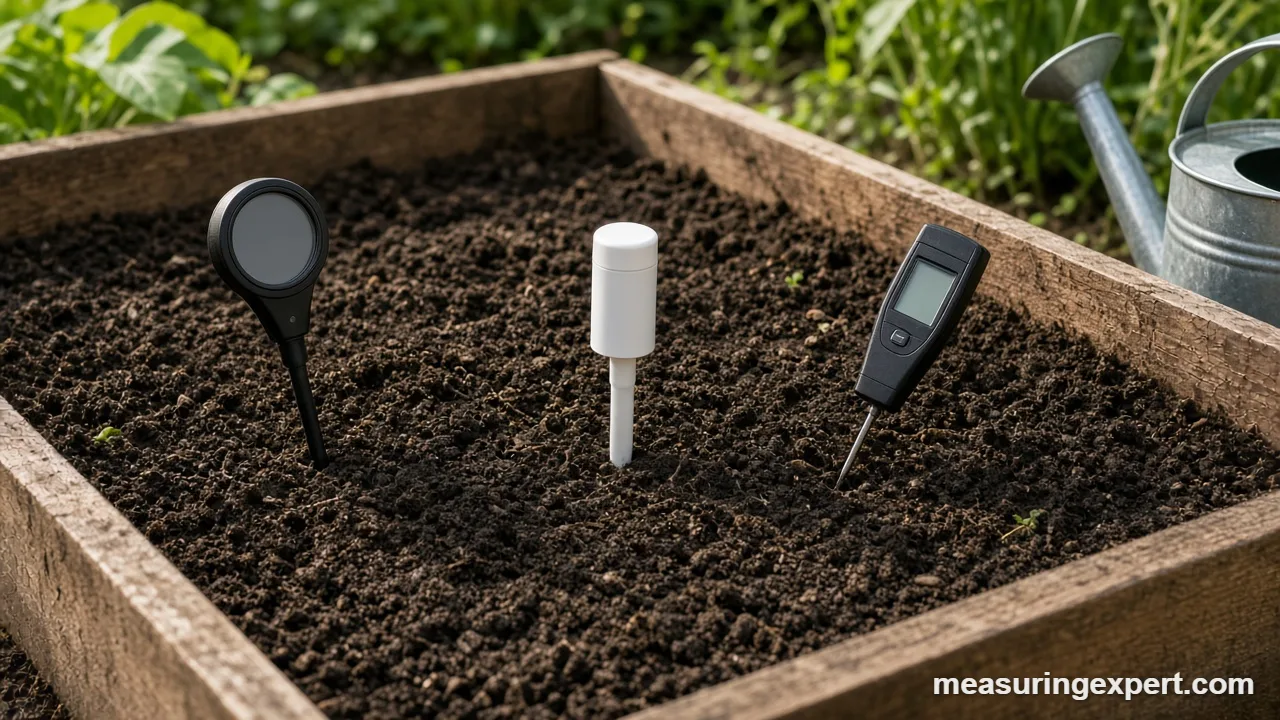
Then we judged what each tool measures, its stated resolution and accuracy, probe depth, sealing, power and data features. We also read owner feedback for common failures. Finally, we kept two picks per brand at most and dropped bare circuit-board modules, since they need wiring and coding to give any reading.
Finally, for the measurement science, we leaned on two university extension services: the University of Minnesota Extension guide to soil moisture sensors and the Virginia Cooperative Extension guide to interpreting sensor data.
Best Soil Moisture Sensor Types: Probe vs Digital VWC vs Smart
First pick the family, then the model.
| Type | What it reports | Strengths | Weak spots | Example |
|---|---|---|---|---|
| Analog probe meter | Relative 1 to 10 scale | Cheap, instant, no batteries | Salts shift the needle; tips corrode | XLUX, Luster Leaf |
| Digital VWC meter | Volumetric water content in % | Comparable numbers, often EC and temperature too | Higher cost; small sensing volume | EarthScout Soil Cub Plus |
| Tensiometer | Soil water tension (mbar, kPa or cb) | Tracks plant stress; ignores salts | Slow; narrow range; needs upkeep | Blumat Digital |
| Wireless smart sensor | Moisture % to an app, with history | Alerts, logs, many zones | Needs a gateway and batteries | Ecowitt WH51, WH51L |
Where do the big smart-home names fit? Ecowitt and Ambient Weather sell true wireless soil probes, and Ambient’s WH31SM works with several of its weather stations. Meanwhile, Rachio smart sprinkler controllers estimate soil moisture from weather data. According to Rachio support, a wired soil sensor acts like a rain sensor and pauses watering when the ground is wet. By contrast, Govee and SwitchBot focus on air temperature and humidity sensors, and we found no soil probe from either brand. So, an air hygrometer cannot stand in for a soil moisture sensor. If you want weather data too, see our weather station picks.
Resistive vs Capacitive: Inside the Best Soil Moisture Sensor
Inside the probe, two main ideas are at work. First, resistive (or conductive) sensors pass a small current between two bare metal electrodes. Because wet soil conducts better, the reading rises. However, fertilizer salts also raise conductivity, and the bare metal slowly corrodes. Battery-free analog meters work in a related way: two different metals in the probe act like a tiny battery whose output rises with moisture and salts.
Capacitive sensors, in contrast, measure how well the soil stores an electric field. For instance, water has a dielectric constant near 80, while dry mineral soil sits around 3 to 5 and air is 1. As a result, even a few percent of water changes the signal strongly. Because the electrodes sit behind a coating, capacitive probes resist corrosion and can stay in the ground all season.
TDR sensors, finally, time a fast electrical pulse along metal rods. The University of Minnesota Extension notes that TDR is very accurate and usually needs no site calibration, while capacitance sensors are most accurate when calibrated to your soil.
Volumetric Water Content: What a Soil Moisture Sensor Number Means
Volumetric water content (VWC) is the volume of water divided by the total volume of soil. For example, if 100 cm3 of soil holds 25 cm3 of water, its VWC is 25%. Therefore, it is the number most digital meters and research probes report.
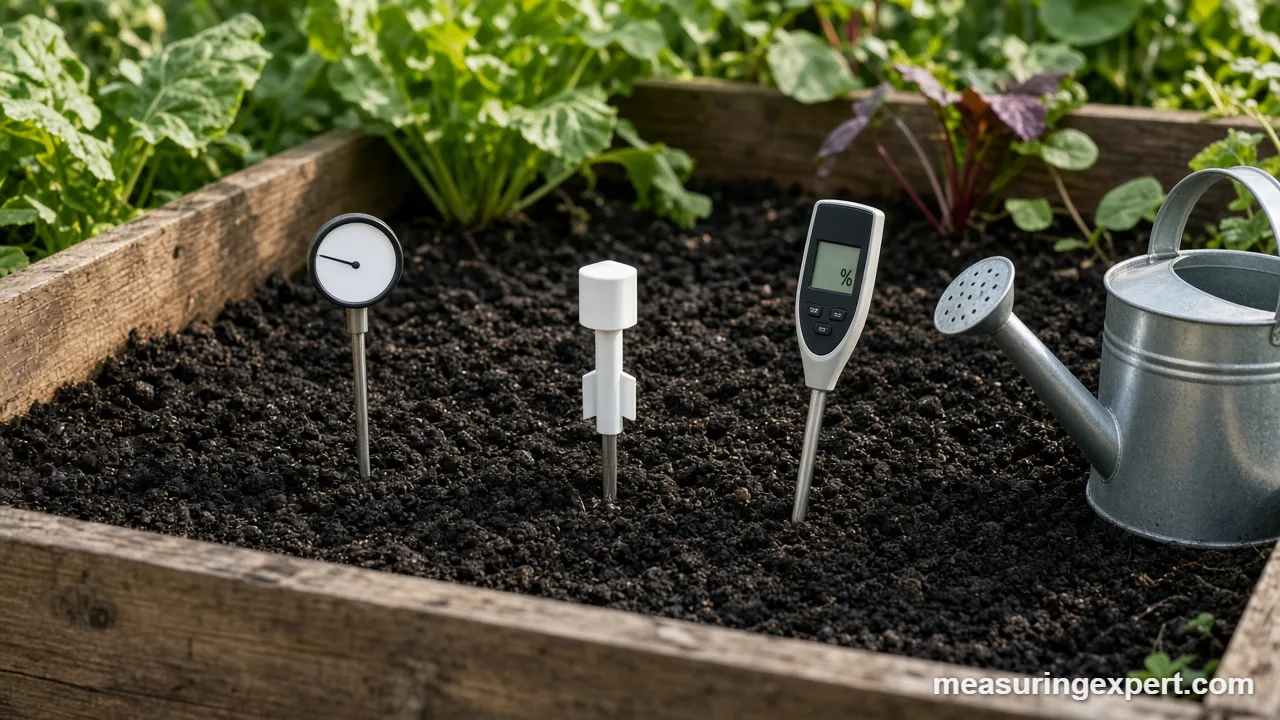
However, a VWC reading only makes sense next to your soil’s limits. Field capacity is the water left after a soaking drains for a day or so. Meanwhile, the wilting point is where roots can no longer pull water out. As a result, the gap between them is plant-available water. Virginia Cooperative Extension lists these typical values:
| Soil texture | Field capacity (VWC) | Wilting point (VWC) | Plant-available water |
|---|---|---|---|
| Loamy sand | 16% | 7% | 9% |
| Sandy loam | 21% | 9% | 12% |
| Loam | 27% | 12% | 15% |
| Silt loam | 30% | 15% | 15% |
| Clay loam | 29% | 18% | 11% |
Now turn a percent into a watering amount. To do this, multiply the gap by the root depth. For example, a sandy loam with a 24 in (61 cm) root zone holds (21% minus 9%) x 24 in = 2.9 in (73 mm) of available water. Similarly, if your loam reads 18% against a 27% field capacity across 12 in (30 cm) of roots, the deficit is 9% x 12 in = 1.1 in (27 mm). In short, that is roughly how much water refills the zone.
Most crops start to show stress once they use 30 to 50% of the available water, according to the extension guides. So, a practical rule is to water when the reading falls about halfway between field capacity and the wilting point. Heavy clay holds more water but releases it slowly; our clay moisture meter guide covers that soil in detail.
Specs That Matter on the Best Soil Moisture Sensor
Accuracy vs resolution. First, resolution is the smallest step the display shows, such as 1%. Accuracy, by contrast, is how close that number is to the truth, such as plus or minus 5%. Many garden sensors publish only resolution, so treat their readings as trends.
Units. Expect a 1 to 10 scale on analog meters, VWC in percent on digital and smart sensors, and tension in mbar, kPa or centibars on tensiometers. Note that 1 kPa equals 1 centibar and 10 mbar. In addition, tension rises as soil dries, while VWC falls.
Probe depth. After all, a reading only reflects the soil around the tip. Therefore, match the probe to the root zone, and use a wired probe like the WH51L or a long probe for deep pots.
Calibration. Ideally, look for two-point calibration, which sets the dry and saturated values for your soil. Ecowitt lets you set both, for example, while analog meters cannot be calibrated at all.
Durability and power. First, for any sensor that stays outside, look for an IP66 or better rating. Also check battery type, since a single AA is easy to swap. For soil acidity, a separate tool works better; see our soil pH meter picks.
How to Use the Best Soil Moisture Sensor Correctly
In practice, good technique matters more than the brand. So, follow these steps the first week you own any sensor.
- Pick a spot in the root zone that represents the bed, away from drip emitters, sprinkler heads and pot edges.
- Push the probe in vertically to the depth the maker specifies, and firm the soil so there are no air gaps.
- Wait for the reading to settle: seconds for a probe meter, 15 to 20 minutes for a tensiometer, one update cycle for a wireless sensor.
- Record the number, then water deeply and read again after 12 to 24 hours to find your field capacity value.
- Water again when the reading falls about halfway between field capacity and the dry point you see plants wilt.
- Pull and wipe analog probes after each test, and leave only sealed wireless probes in place.
Care and Calibration Tips
To begin with, wipe metal probes dry and store them indoors. Then, for a wireless probe, swap batteries before winter, and pull the sensor before the ground freezes. Also, recheck calibration each spring. Next, read the probe in air-dry soil, then in soil soaked to field capacity, and enter those points if the app allows it. For a tensiometer, refill and reset it as the maker directs, since an air bubble in the tube ruins the reading.
Do and Don’t
Similarly, a few habits keep readings honest for years.
- Measure at root depth, not at the surface.
- Take readings at the same time of day.
- Compare trends from one sensor rather than numbers across brands.
- Use two sensors per zone if beds vary.
- Leave a bare-metal probe in damp soil.
- Force a probe into rocks or hardpan.
- Read right after fertilizing with an analog meter.
- Trust an air humidity sensor for soil decisions.
Honest Limits of Even the Best Soil Moisture Sensor
Above all, remember that a sensor reads a small volume of soil, often just a few centimeters around the tip. Consequently, an air gap, a rock or a nearby emitter can skew the number. In addition, salts, temperature, clay content and compaction shift capacitance readings, as the Minnesota guide points out. So, pair it with your eyes, a finger test and a rain gauge to see how much water actually fell.
Best Soil Moisture Sensor FAQ
What is the best soil moisture sensor for most gardens?
For most gardens, the best soil moisture sensor is a wireless kit such as the Ecowitt GW1206. It logs moisture every 70 seconds, sends alerts and grows to 16 probes on one gateway.
What does volumetric water content mean?
Volumetric water content (VWC) is the volume of water divided by the volume of soil, shown as a percent. For example, 25 cm3 of water in 100 cm3 of soil is 25% VWC.
What is a good soil moisture reading?
It depends on soil texture. For example, a loam holds about 27% VWC at field capacity and about 12% at the wilting point, so most plants do well in the upper half of that band.
Are capacitive sensors better than resistive ones?
Usually, yes. Capacitive sensors measure the soil’s dielectric response through a coated surface, so they corrode far less than bare resistive probes and drift less over a season.
Do cheap analog moisture meters work?
They work as rough wet or dry indicators. However, salts, fertilizer and soil type shift the needle, so treat the 1 to 10 scale as a relative guide, not a calibrated percent.
Can I leave a probe meter in the soil?
No. Most analog meters have bare metal tips that corrode if they stay in damp soil. XLUX, for instance, advises pulling its probe out within about 5 minutes.
How deep should I place a soil moisture sensor?
Place it in the active root zone. Extension guides suggest sensors at one third and two thirds of root depth, and Rachio suggests about 3 in (7.6 cm) for turf.
Does a smart sprinkler controller need a soil sensor?
Not always. Rachio, for example, estimates soil moisture from weather data, while a wired soil sensor can still pause watering when the ground is already wet.
Do Govee or SwitchBot sell a soil moisture sensor?
At the time of writing, we could not find a soil probe from either brand. Both sell air temperature and humidity sensors, which cannot tell you how wet the root zone is.
How often should I calibrate a soil moisture sensor?
Check it at the start of each season. Read it in dry soil and in soil soaked to field capacity, then set the low and high points if your sensor allows custom calibration.
Bottom Line: The Best Soil Moisture Sensor for Most Gardens
For most gardens, the Ecowitt GW1206 kit is the best soil moisture sensor, because it logs readings, sends alerts and expands to 16 probes. If you only need quick checks, the XLUX meter costs little; and if you need true VWC data, choose the EarthScout Soil Cub Plus.
Black Friday is coming: shop the deals with Prime
2 thoughts on “8 Best Soil Moisture Sensors of 2026: Probe, Digital and Smart Picks”