

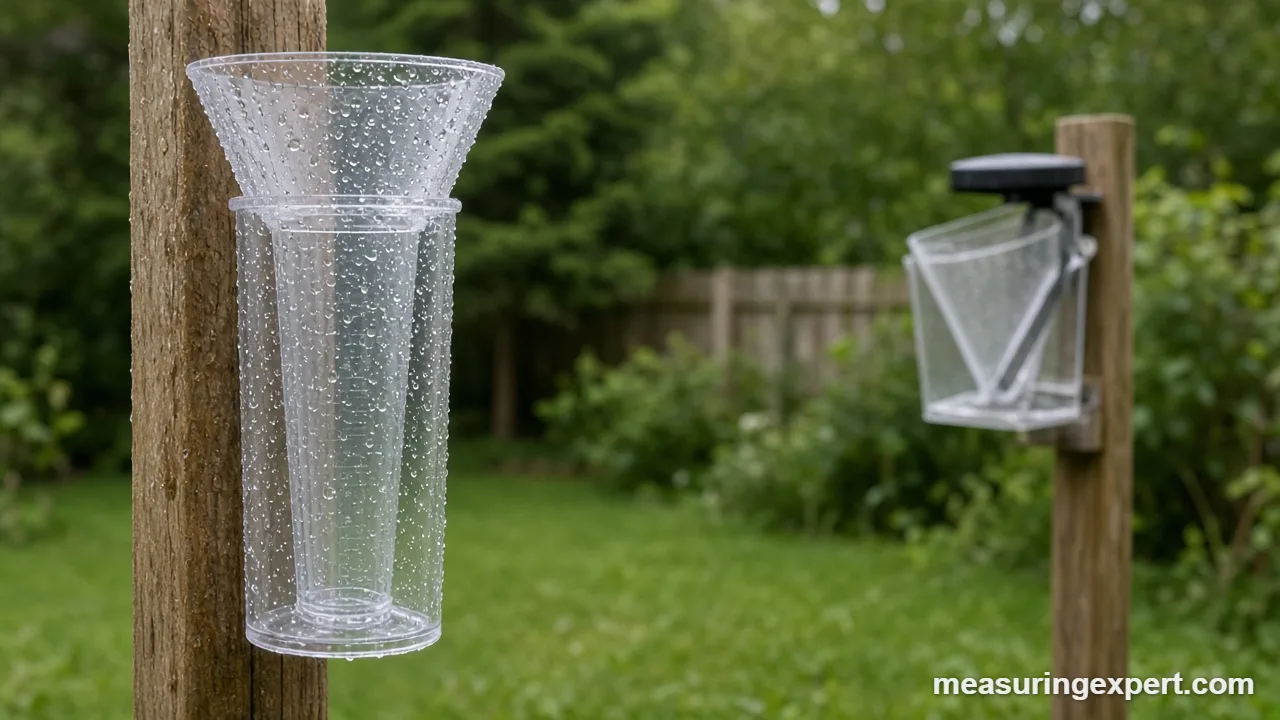
The best rain gauge for most homes is the Stratus 4-inch manual gauge, because it reads to 0.01 in, holds about 11 in of rain and needs no batteries. However, what really decides your pick is how you want to read it: by hand outdoors, on a wireless display, or on your phone.
In short: buy the Stratus for accuracy, the AcuRite 00850A3 on a budget, and the Ambient Weather WS-5000 if you want phone alerts.
As an Amazon Associate, Measuring Expert earns from qualifying purchases. Our picks are based on research, specifications and owner feedback, not paid placement.
Best Overall
Best Budget
Best Smart
Quick Answer: Best Rain Gauge by Need
- Most accurate for the money: Stratus 4-inch manual gauge, read to 0.01 in.
- Cheap garden check: AcuRite 00850A3 with magnified numbers.
- Totals on an indoor screen: AcuRite 00899 wireless tipping bucket.
- Premium manual with mm marks: TROPO by Climalytic.
- Phone alerts and online history: Ambient Weather WS-5000.
- Winter-proof garden gauge: Taylor 7 in silicone gauge.
- Whatever you buy: mount it in the open, away from roofs and trees.
On This Page
- Comparison table
- The 8 picks, reviewed
- How we chose
- Manual vs tipping bucket vs smart
- Resolution, capacity and accuracy
- Where to mount a rain gauge
- Inches to mm converter
- How to read a 4-inch gauge
- Winter care and cleaning
- Honest limits
- FAQ
- Bottom line
Rain Gauges Compared Side by Side
First, decide how you want to read the total. Next, scan the standout feature. Then jump to the full review below.
| # | Image | Product | Best For | Standout Feature | Amazon |
|---|---|---|---|---|---|
| 1 |  | Stratus Precision Rain Gauge (4-inch manual) | Accurate daily totals | CoCoRaHS-style 4 in gauge read to 0.01 in | View |
| 2 | 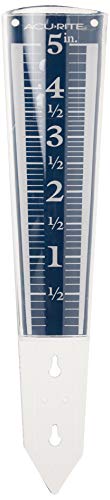 | AcuRite 00850A3 Easy-to-Read Magnifying Rain Gauge | Quick checks in the garden | Magnified numbers on a 5 in acrylic tube | View |
| 3 |  | AcuRite 00899 Wireless Digital Rain Gauge | Reading rain totals indoors | Self-emptying tipping bucket with a 7-day history | View |
| 4 |  | TROPO Precision Rain Gauge by Climalytic | Metric and imperial readings | Dual-unit tubes and about 13.5 in capacity | View |
| 5 | 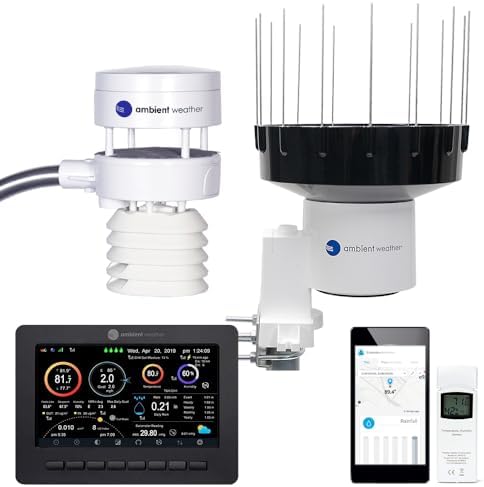 | Ambient Weather WS-5000 Ultrasonic Smart Weather Station | Phone alerts and online rain history | Rain cup plus Wi-Fi console and apps | View |
| 6 | 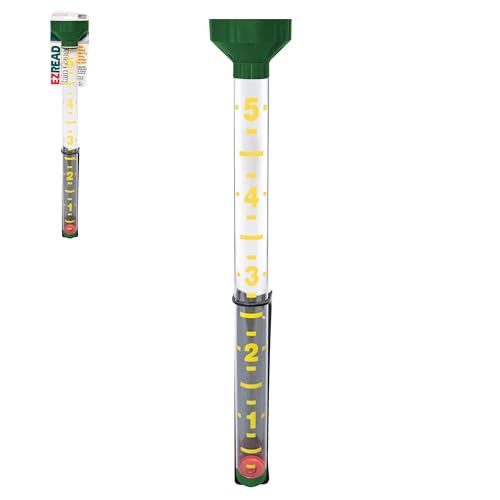 | Headwind EZRead 26 in Professional Rain Gauge (820-0019) | Reading from the porch | 26 in tall body with a floating marker | View |
| 7 | 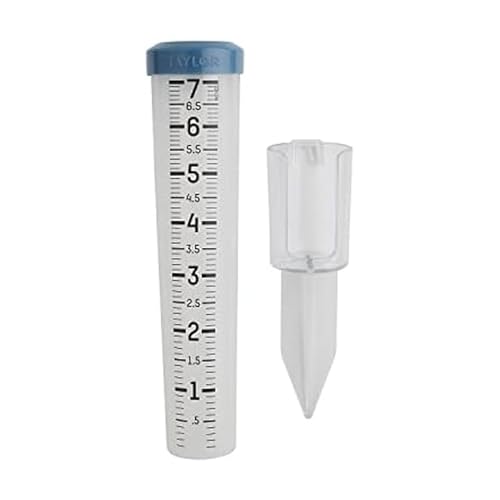 | Taylor 7 in Silicone Freeze-Proof Rain Gauge | Cold climates and forgetful owners | Flexible silicone tube that will not crack if water freezes | View |
| 8 |  | La Crosse 705-109 Waterfall Rain Gauge | Decks, fences and small gardens | Floating marker in a slide-off collector | View |
The 8 Best Rain Gauge Picks, Reviewed
We start with the manual gauges that weather volunteers trust. Then we move to wireless and smart options, and finish with easy-read garden gauges. Specs come from the maker or the listing, with metric values in brackets.
Best Overall
1. Stratus Precision Rain Gauge (4-inch manual)
Best for: Weather watchers, gardeners and anyone who wants official-style daily totals they can trust and compare with nearby reports.
The Stratus is the classic clear 4-inch manual gauge, and CoCoRaHS lists it among the gauges its volunteers use. First, rain falls into a 4 in (102 mm) funnel. Next, the funnel feeds a narrow inner tube that holds exactly 1 in (25.4 mm) of rain. Because the tube is narrow, each hundredth of an inch shows as a clear step on the scale. As a result, you can read 0.01 in (0.254 mm) by eye, with no batteries and no calibration.
For most yards, this is the best rain gauge because it measures the way the volunteer networks do. When rain tops 1 in, the excess spills into the outer cylinder, so the full gauge can hold about 11 in (279 mm). In addition, the listing says it is made in the USA.
- Opening: 4 in (102 mm) diameter funnel
- Inner tube: holds 1 in (25.4 mm), graduated in 0.01 in steps
- Total capacity of the classic 4-inch design: about 11 in (279 mm)
- Height: about 14 in (356 mm), with a post-mount bracket
- Power: none (manual)
Pros
- Reads to 0.01 in, the same unit volunteers report
- No batteries, apps or calibration to manage
- Large overflow capacity for tropical downpours
Cons
- You must read and empty it by hand
- Must come indoors before freezing nights
- Inch scale only on the inner tube
Skip it if: you want rain totals on a screen indoors, or you cannot visit the gauge every day.
Best Budget
2. AcuRite 00850A3 Easy-to-Read Magnifying Rain Gauge
Best for: Gardeners who want a rough weekly total for watering, and anyone who needs a cheap second gauge.
The AcuRite 00850A3 is a simple wedge-style acrylic gauge. AcuRite says the numbers are magnified by over 35 percent, so you can read the level from a few steps away. In addition, it holds up to 5 in (127 mm) of rain. Also, an integrated keyhole hanger lets you hang it on a fence, deck post or garden stake.
However, a wedge gauge is a convenience tool, not a precision instrument. Its tapered shape makes small totals easy to see, yet its markings are coarser than the 0.01 in steps on a 4-inch gauge. So use it to decide whether the lawn needs water, rather than to report official totals.
- Capacity: 0 to 5 in (0 to 127 mm)
- Material: weather-resistant acrylic
- Magnified numbers (over 35 percent, per AcuRite)
- Mounting: keyhole hanger for a fence or post
- Size: 12.4 in (315 mm) tall
Pros
- Very low cost for a branded gauge
- Large, easy-to-read numbers
- Light and easy to hang anywhere
Cons
- Inch scale only, no millimeters
- Coarser markings than a 4-inch gauge
- Small opening catches less rain, so wind matters more
Skip it if: you report to CoCoRaHS or need hundredths of an inch.
Best Wireless
3. AcuRite 00899 Wireless Digital Rain Gauge
Best for: People who want totals on a tabletop display without walking outside, and who live where it rarely freezes in the rainy season.
The AcuRite 00899 pairs a self-emptying collector with an indoor display. Inside the collector, a tipping bucket counts rain in 0.01 in (0.25 mm) steps. Then the display updates every 60 seconds over 433 MHz. Also, AcuRite rates the range at 100 ft (30 m), depending on your walls.
Next, the display shows daily rain and history for the current event, 1 day and the last 7 days. In addition, there are two resettable totals, a rain-start alarm and a flood-watch alarm. AcuRite lists accuracy as +/- 0.05 in per inch of rain, which is about 5 percent. Meanwhile, AcuRite notes that the gauge cannot be used in below-freezing weather, so plan to store it in winter.
- Resolution: 0.01 in (0.25 mm)
- Accuracy: +/- 0.05 in per inch of rainfall (AcuRite)
- Range: 0 to 99.99 in (0 to 2,540 mm)
- Wireless: 433 MHz, up to 100 ft (30 m)
- Units: inches or millimeters
Pros
- No emptying; the bucket tips and drains itself
- Rain history and alarms on the display
- Switches between inches and millimeters
Cons
- Not for use in freezing weather
- Less accurate than a good manual gauge
- Batteries not included
Skip it if: you need winter readings, or you want phone alerts over Wi-Fi.
Best Premium Manual
4. TROPO Precision Rain Gauge by Climalytic
Best for: Serious observers who want a sturdier CoCoRaHS-approved manual gauge, or who log rain in millimeters.
The TROPO is a newer 4-inch manual gauge from Climalytic Instruments. CoCoRaHS headquarters approved it as another manual 4-inch gauge for its network. Like the classic design, the inner tube holds 1 in (25 mm). However, the outer cylinder holds another 12.5 in (317.5 mm), so total capacity is about 13.5 in (342.9 mm). As a result, it copes with extreme storms better than most gauges.
In addition, both tubes carry inch and metric marks, so you can log rain in millimeters without math. Meanwhile, the funnel and cylinders are UV-stabilized polycarbonate, and stainless steel rods on the funnel help keep birds off the rim. Climalytic lists resolution as +/- 0.01 in (0.25 mm). In short, it is the best rain gauge here for observers who want a premium manual build.
- Opening: 4 in (102 mm)
- Inner tube: 1 in (25 mm); total about 13.5 in (342.9 mm)
- Resolution: +/- 0.01 in (0.25 mm)
- Units: inch and metric marks on both tubes
- Materials: UV-stabilized polycarbonate, stainless bird-deterrent rods
Pros
- Approved by CoCoRaHS for network reports
- Dual inch and metric scales
- Highest capacity in this list
Cons
- Costs more than the classic 4-inch gauge
- Still a manual, read-by-hand tool
- Tall at 18.19 in (462 mm), so it needs a solid post
Skip it if: you only want a casual garden reading; a cheaper gauge will do.
Best Smart
5. Ambient Weather WS-5000 Ultrasonic Smart Weather Station
Best for: Data fans who want rain totals on a phone, shared online, and tied to smart home routines.
Most dedicated smart rain gauges are add-on sensors that need a hub. So for a complete smart setup, we chose the Ambient Weather WS-5000. It is a full station, yet its rain side is the main reason to list it here. Specifically, Ambient describes an extra-large rain cup with a built-in bird spike. Then the sensor array sends data to the console on 915 MHz, up to 1,000 ft (305 m) in open air or about 300 ft (91 m) in most yards.
Over Wi-Fi, the console posts to the Ambient Weather Network. As a result, you can check rain on the Ambient Weather Dashboard or AWNET apps and link alerts to IFTTT, Alexa or Google Home. Also, the wind sensor is ultrasonic with no moving parts. If you want a full station comparison, see our best weather station guide.
- Rain: extra-large rain cup with integrated bird spike
- Wireless: 915 MHz, up to 1,000 ft (305 m) line of sight
- Connectivity: Wi-Fi to the Ambient Weather Network
- Apps: Ambient Weather Dashboard and AWNET; IFTTT, Alexa, Google Home
- Power: solar panel on the sensor array
Pros
- Rain totals and alerts on your phone
- Online history you can share
- Also measures wind, temperature and more
Cons
- Far more than you need for rain alone
- Rain resolution and accuracy are not published on the product page
- Mounting the array takes more work
Skip it if: rain is the only thing you want to measure; a manual 4-inch gauge is more accurate for far less.
Easiest to Read
6. Headwind EZRead 26 in Professional Rain Gauge (820-0019)
Best for: Older eyes, busy mornings and anyone who wants to glance at the total from a window or porch.
The Headwind EZRead is a tall gauge with a colored float. Also, the listing gives a height of 26 in (660 mm) and describes it as heavy duty, freeze proof and made in the USA. Because the float rides on the water, you read the top of the float instead of squinting at a meniscus.
However, a float gauge trades fine resolution for convenience. So it suits garden watering and casual records better than official reports.
- Height: 26 in (660 mm), per the listing
- Floating marker for easy reading
- Listed as freeze proof and made in the USA
- Model: 820-0019
Pros
- Easy to read from a distance
- Listing says it is freeze proof
- Built for permanent mounting
Cons
- Coarser readings than a 4-inch gauge
- Capacity is not stated in the listing
- Tall body can catch wind if not secured
Skip it if: you need hundredths of an inch or want a small, discreet gauge.
Best Freeze-Proof
7. Taylor 7 in Silicone Freeze-Proof Rain Gauge
Best for: Gardeners in cold regions who want to leave a gauge outside without cracked tubes.
Most plastic and glass gauges crack when water freezes in them. However, the Taylor gauge solves that with a flexible silicone body. Taylor says it will not break if water freezes inside. In addition, it holds 7 in (177.8 mm) of rain and is marked in 1/10 in steps.
Also, it comes with a removable ground stake, and a bracket on the back of the collar lets you hang it from a nail or post. However, tenths of an inch are coarse for science. So treat it as a sturdy garden gauge, and pair it with a 4-inch gauge if you report rain.
- Capacity: 7 in (177.8 mm)
- Markings: 1/10 in increments
- Material: flexible silicone
- Mounting: removable ground stake or rear hanging bracket
- Size: about 12 in (305 mm) tall
Pros
- Will not crack if water freezes inside, per Taylor
- Stake and post mounting options
- Holds a big storm without emptying
Cons
- Reads only to 0.1 in
- No metric scale
- Ice still blocks readings until it melts
Skip it if: you need hundredths, or you want to measure snow water equivalent.
Best Compact
8. La Crosse 705-109 Waterfall Rain Gauge
Best for: Renters and deck gardeners who want a small, tidy gauge on a rail or fence.
The La Crosse 705-109 is a compact waterfall-style gauge. La Crosse says it measures up to 5 in (127 mm) of rain, and a floating marker shows the level. Then, when you need to empty it, the collector slides off the bracket for emptying and cleaning.
At 8.45 in long, 3.5 in wide and 8 in tall (about 215 x 89 x 203 mm), it fits a deck rail or fence. However, small decorative gauges are easy to place in poor spots. So follow the siting rules below, because a deck next to the house wall will read low.
- Capacity: up to 5 in (127 mm)
- Floating level marker
- Mounting bracket for a post or fence
- Size: 8.45 x 3.5 x 8 in (215 x 89 x 203 mm)
Pros
- Small and tidy on a rail or fence
- Slide-off collector is easy to empty
- Float makes the level easy to spot
Cons
- Coarse reading compared with a 4-inch gauge
- Material and scale units are not listed by La Crosse
- Easy to mount too close to the house
Skip it if: you want official-style totals or a gauge for a wide open yard.
How We Chose the Best Rain Gauge Picks
We did not run hands-on tests. Instead, our picks are research-based. First, we read the published specs from AcuRite, Taylor, La Crosse, Climalytic and Ambient Weather. Next, we compared them with the measuring rules that weather networks use. Finally, we weighed owner feedback on durability, freezing and ease of reading.
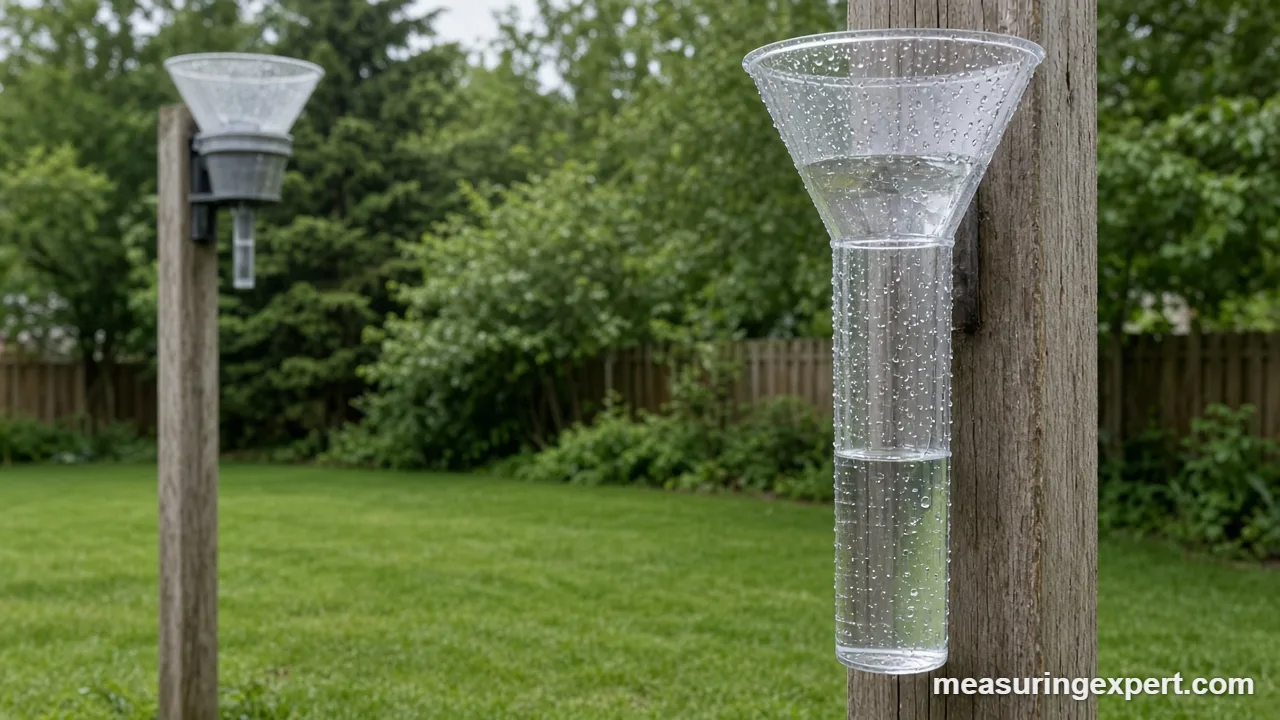
- Resolution: we favored gauges that read to 0.01 in (0.254 mm), the unit used by the CoCoRaHS volunteer network.
- Opening size: a wider funnel catches more drops, so wind and splash matter less.
- Capacity: a gauge should hold a big storm without overflowing.
- Reading method: we included manual, tipping-bucket and smart options for different habits.
- Brand and variety: established brands only, at most two per brand, and no near-duplicates.
Also, we left out sensor-only listings that need a separate hub, because they are not complete rain gauges on their own.
Manual, Tipping-Bucket or Smart: Which Best Rain Gauge Type Fits?
First, every gauge collects rain through an opening of known size. However, the way it turns that water into a number differs. So the type you choose decides your accuracy, your effort and your winter routine.
| Type | How it measures | Typical resolution | Good for | Watch out for |
|---|---|---|---|---|
| 4-inch manual (CoCoRaHS style) | Funnel feeds a narrow inner tube; you read the scale | 0.01 in (0.254 mm) | Accurate daily totals, volunteer reports | Daily reading, must come in before freezes |
| Wedge or float garden gauge | Water rises in a tapered or straight tube; a float may mark the level | Often 0.1 in (2.5 mm) or coarser | Watering decisions, quick looks | Small opening, coarse marks |
| Wireless tipping bucket | A small seesaw bucket tips at a set volume; each tip is counted | 0.01 in (0.25 mm) per tip on many models | Indoor display, rain history | Can undercount in very heavy rain; most cannot freeze |
| Smart (Wi-Fi) gauge or station | Tipping bucket or similar sensor, data sent to the cloud | Varies by model | Phone alerts, online history | Setup, power and cost |
Resolution, Capacity and Accuracy Explained
Resolution: the smallest step you can read
Rain is reported in inches to two decimal places in the US. So 0.01 in, or 0.254 mm, is the step that matters. A manual 4-inch gauge reaches it by funneling rain into a narrow tube, which stretches each hundredth into a visible mark. The National Weather Service uses the same idea in its 8-inch standard gauge, where the funnel area is 10 times the tube area, according to the NWS description of the standard rain gauge.
Capacity: how much rain before it overflows
Capacity is the total depth a gauge can hold. For instance, a 5 in (127 mm) garden gauge can overflow in a slow-moving tropical storm. By contrast, a 4-inch gauge with an outer cylinder holds about 11 in (279 mm), and the TROPO about 13.5 in (342.9 mm). Self-emptying tipping buckets have no practical limit, because they drain as they count.
Accuracy: how close the total is to the truth
Above all, resolution and accuracy are not the same thing. For example, the AcuRite 00899 counts in 0.01 in steps, yet AcuRite lists accuracy as +/- 0.05 in per inch, or about 5 percent. Moreover, a gauge in the rain shadow of a house can read far low, whatever its resolution.
Where to Mount Your Best Rain Gauge: NWS and CoCoRaHS Siting Rules
Placement matters more than price. Even the best rain gauge reads low behind a fence or under a tree.
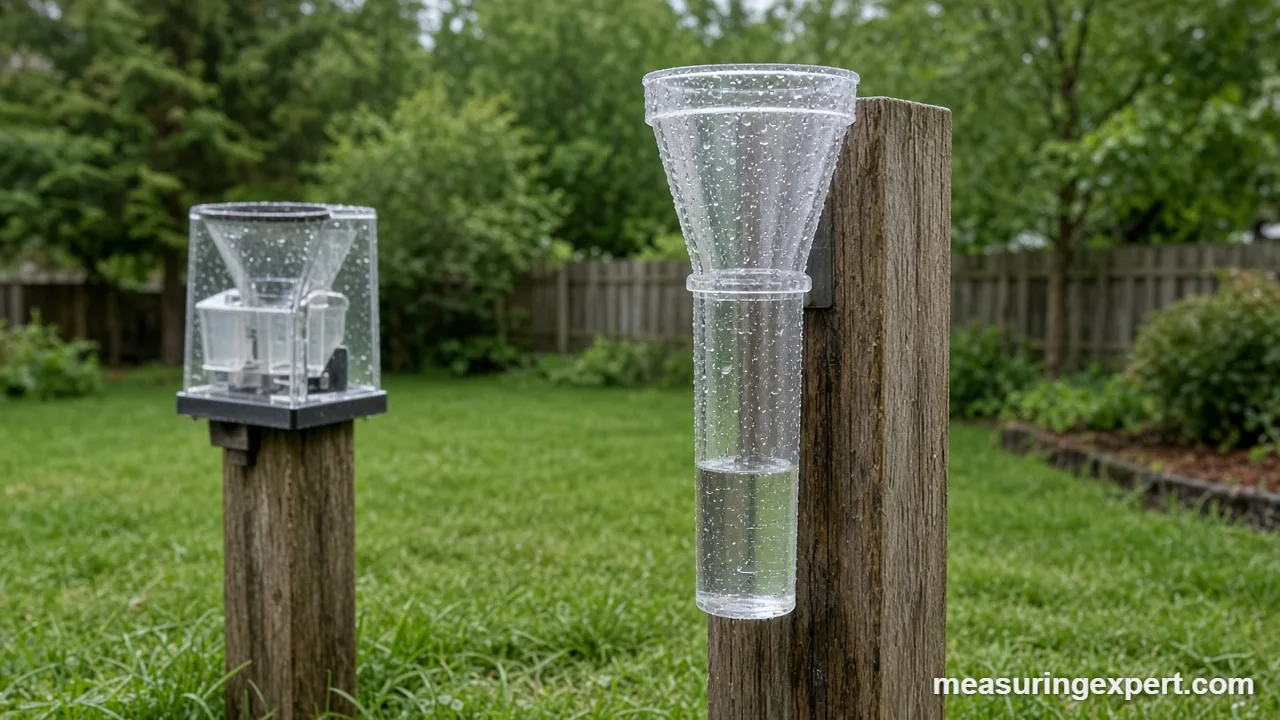
- Distance from obstructions: the NWS says an object’s height should not exceed half its distance from the gauge. In other words, keep the gauge at least twice as far from a tree or building as that object is tall. CoCoRaHS gives the same example: a 40 ft (12 m) tree means at least 80 ft (24 m) away.
- Height: CoCoRaHS installation guidance calls for a gauge 2 to 5 ft (0.6 to 1.5 m) above the ground, mounted on the side of a single post.
- Post top: the top of the gauge should extend several inches above the post, and the post top should be rounded, pointed or slanted to limit splash.
- Level: keep the opening level, or the gauge catches too much or too little.
- Shelter: an open yard with some protection from wind is ideal; avoid rooftops and wide, windy hilltops.
- Water sources: keep it away from sprinklers, gutters and roof drips.
Rainfall Converter: Inches to Millimeters
Many forecasts and gauges mix inches and millimeters. So use the converter below to switch a reading in either direction. For more length units, see our guide to length units.
How to Read a 4-Inch Manual Rain Gauge
The steps below follow the CoCoRaHS measuring method. In addition, they work for any clear gauge with an inner tube.
- Read the gauge at the same time each day, ideally in the morning, so each total covers about 24 hours.
- Stand level with the inner tube, so your eye is at the same height as the water.
- Read the bottom of the curved water surface, called the meniscus, to the nearest 0.01 in.
- Write the reading down, then empty the inner tube.
- If the inner tube is full, read and empty it first, and leave the overflow in the outer cylinder.
- Pour the overflow into the inner tube a little at a time, read each pour, and add every reading to the first one.
- Put the inner tube and funnel back, check that the gauge is level, and record the total.
For example, suppose the inner tube is full at 1.00 in and the overflow fills it twice more, to 1.00 in and then 0.37 in. Then the total is 2.37 in, or about 60.2 mm.
Winter Care and Cleaning
Freezing water expands, so it can split a plastic tube. Therefore CoCoRaHS advises against letting water freeze inside the gauge. Before a hard freeze, bring a manual gauge inside, or remove the funnel and inner tube so snow collects in the outer cylinder. Then melt the snow indoors and pour the water into the inner tube to read the water equivalent.
Also, clean the gauge now and then with mild detergent and a soft bottle brush.
Honest Limits of Any Best Rain Gauge
No gauge measures rain perfectly. First, wind blows drops past the opening, so most gauges catch a little less than truly fell, especially in snow. Second, a tipping bucket can miss water while it tips during a downpour.
Also, rain itself varies over short distances. As a result, your total can differ from a neighbor a few blocks away, and that is real data, not an error. In short, a well-sited 4-inch gauge read every morning beats any fancy gauge in a poor spot. For background on how forecasters use these numbers, see our article on weather forecast measurements.
Best Rain Gauge FAQ
What is the best rain gauge for accuracy?
A 4-inch manual gauge such as the Stratus or the TROPO is the most accurate choice for home use. It reads to 0.01 in, and CoCoRaHS volunteers use the same design.
Is a wireless rain gauge as accurate as a manual one?
Usually not. For example, AcuRite lists its 00899 at +/- 0.05 in per inch of rain, while a well-sited manual 4-inch gauge reads to 0.01 in. However, a wireless gauge saves a daily trip outside.
Where should I put the best rain gauge in my yard?
Put it in the open, at least twice as far from trees and buildings as they are tall. Also mount it 2 to 5 ft above the ground on the side of a post, with the opening level.
How high should a rain gauge be mounted?
CoCoRaHS recommends 2 to 5 ft (0.6 to 1.5 m) above the ground. The top of the gauge should rise a few inches above the post so the post does not splash water in.
What does 0.01 inch of rain mean?
It means a layer of water 0.01 in (0.254 mm) deep would cover flat ground if none soaked in or ran off. It is the smallest amount most US observers report.
How many millimeters are in an inch of rain?
One inch of rain is exactly 25.4 mm. So 0.5 in is 12.7 mm, and 2 in is 50.8 mm.
Can the best rain gauge stay outside in winter?
Most cannot. Manual plastic gauges and most tipping buckets should come inside before a hard freeze. The Taylor silicone gauge is built not to crack, but ice still blocks readings until it melts.
How do I measure snow with a rain gauge?
Remove the funnel and inner tube so snow falls into the outer cylinder. Then melt it indoors and pour the water into the inner tube to read the water equivalent.
Why does my rain gauge read less than the weather report?
Rain varies over short distances, so some difference is normal. However, a big gap often points to poor siting, such as a gauge near a roof, fence or tree.
Do I need a smart rain gauge?
Only if you want phone alerts or online history. Otherwise, a manual 4-inch gauge is cheaper and more accurate. A smart station suits people who also want wind and temperature data.
Bottom Line: The Best Rain Gauge for Most Yards
For most people, the Stratus Precision Rain Gauge is the best rain gauge to buy. It reads to 0.01 in, holds a big storm and needs no power. However, choose the AcuRite 00899 if you want totals indoors, or the Ambient Weather WS-5000 for phone alerts. Above all, mount whichever gauge you pick in the open.
Black Friday is coming: shop the deals with Prime
1 thought on “8 Best Rain Gauge Picks for 2026: Manual, Wireless and Smart”