

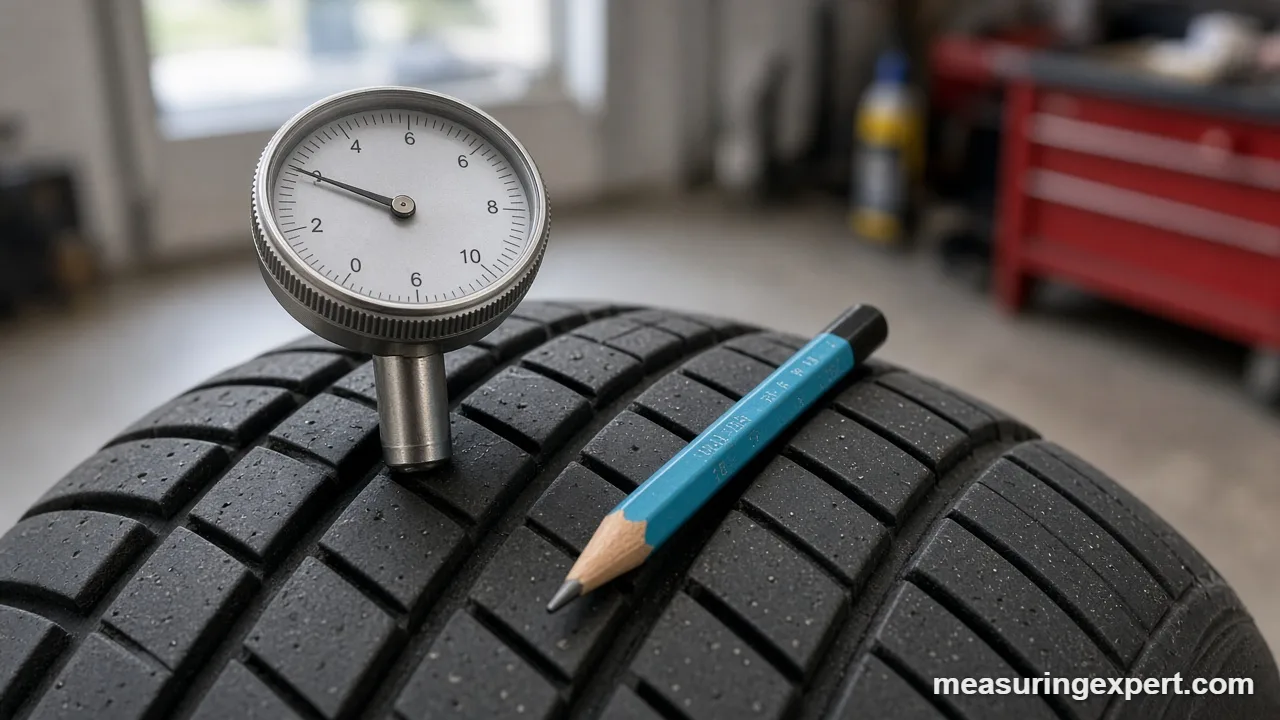
The best tread depth gauge for most drivers is the JACO TreadPro dial gauge, because a dial reads 32nds of an inch at a glance and never needs batteries. Still, the right choice depends on whether you want a dial, a digital readout in millimeters, or a simple pencil gauge for the glovebox.
In short: buy the JACO TreadPro for easy home checks, the GODESON 3-mode digital for mm and decimal readings, the Milton S-448 for shop work, and a GODESON 88702 color-coded pair if you only need a quick pass or fail.
As an Amazon Associate, Measuring Expert earns from qualifying purchases. Our picks are based on research, specifications and owner feedback, not paid placement.
Best Overall
Best Budget

Best Pro

Best Tread Depth Gauge Picks in Brief
- Easiest everyday reading: JACO TreadPro, a dial gauge with no batteries to replace.
- Digital display in three units: GODESON 3-mode digital gauge (fractional inch, decimal inch and mm).
- Shop and inspection work: Milton S-448, a classic pencil-style gauge made in the USA.
- Color zones plus two scales: Steelman color-coded gauge that reads in mm and 32nds.
- Cheapest quick check: GODESON 88702 color-coded gauges, sold as a pair.
- Low-cost dial option: SAFELIFE dial gauge for drivers who like a needle.
- Fleets and giveaways: BBTO color-coded gauges in a 100-piece box.
On This Page
- Comparison table
- The 7 picks, reviewed
- How we chose
- Dial, digital or pencil
- 32nds vs millimeters
- The 2/32 inch legal limit
- Penny and quarter tests
- How to measure tread depth
- Tread depth converter
- Care and accuracy checks
- Do and don’t
- Honest limits
- FAQ
- Bottom line
Best Tread Depth Gauge Comparison Table
First, decide how you like to read a number: a needle, a digital screen or a sliding scale. Then use the table to jump to the matching review.
| # | Product | Best For | Standout Feature | Amazon |
|---|---|---|---|---|
| 1 | JACO TreadPro Dial | Most drivers | Dial readout, no batteries | View |
| 2 | GODESON 3-Mode Digital | Metric and decimal readings | Fractional inch, decimal inch and mm modes | View |
| 3 | Milton S-448 | Shops and inspections | 0 to 1 inch range in 1/32 steps | View |
| 4 | Steelman Color Coded | Mixed-unit households | Reads in mm and 32nds | View |
| 5 | GODESON 88702 | Tight budgets | Color zones, two gauges per pack | View |
| 6 | SAFELIFE Dial | Budget dial fans | Needle-style dial readout | View |
| 7 | BBTO 100-Piece | Fleets and dealers | Color-coded gauges in bulk | View |
The 7 Best Tread Depth Gauge Picks, Reviewed
Every gauge below measures the same thing: the distance from the top of the tread rib down to the bottom of a main groove. However, they show that number in different ways, and that changes how fast and how reliably you can read it. Also, none of them checks air pressure. For that job, see our guide to the best backlit LCD tire gauge.
Best Overall
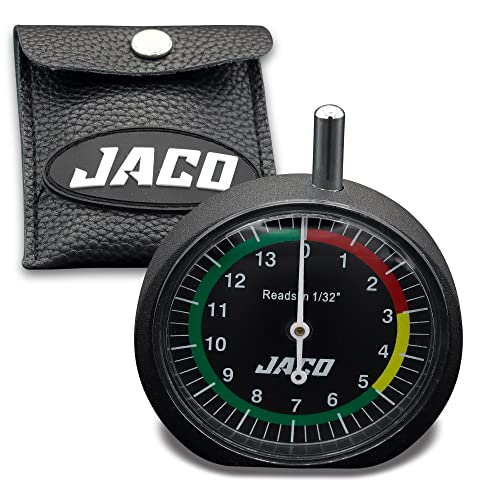
1. JACO TreadPro Tire Tread Depth Gauge, Dial Type
Best for: Drivers who check all four tires once a month and want a reading they can trust without squinting.
The JACO TreadPro is our pick as the best tread depth gauge for most garages. First, it is a dial gauge, so a needle points straight at the depth once the probe touches the bottom of the groove. As a result, you skip the fiddly step of reading tiny lines on a sliding pencil scale. In addition, a dial gauge is fully mechanical, which means it works in the cold, never needs a battery and is ready the moment you pull it from the glovebox.
In addition, JACO is a US brand known for tire pressure gauges, and the TreadPro follows the same simple idea. Because the needle stays put after you lift the gauge, you can also read it in better light. Overall, it suits anyone who wants clear numbers rather than a simple green, yellow or red result.
- Type: mechanical dial gauge
- Reads tread depth directly; no battery or charging
- Pocket size for a glovebox or tool drawer
- Works on car, SUV, light truck and motorcycle tires
Pros
- Needle is faster to read than a pencil scale
- No batteries to die in winter
- Compact and easy to store
Cons
- Dial lens can scratch in a loose toolbox
- Costs more than basic pencil gauges
- No direct metric display like a digital gauge
Skip it if: you want readings in millimeters on a screen, or you only need a rough pass or fail check.
Best Digital
2. GODESON Digital Tire Tread Depth Gauge, 3 Modes

Best for: Owners who log tread depth in a spreadsheet, or who work in millimeters.
This GODESON gauge shows tread depth on a digital screen in three modes: fractional inch, decimal inch and millimeters, according to the listing. Therefore, it removes the mental math between 32nds and mm. For example, you can read a groove in mm, then switch to fractions to compare it with the 2/32 inch federal guideline.
Similarly, digital gauges make it easy to spot small changes over time, since a number like 4.8 mm is harder to misread than a line on a scale. On the other hand, the screen needs a battery, and you should zero the gauge on a flat surface before each session. In short, it is the best tread depth gauge here for people who like data.
- Type: digital gauge with LCD screen
- Modes: fractional inch, decimal inch and millimeters (per the listing)
- Zero it on a flat surface before each session
- Battery powered
Pros
- Three units with no conversion math
- Easy to log and compare readings
- Clear screen for tired eyes
Cons
- Needs a battery
- Must be zeroed for best results
- Bulkier than a pencil gauge
Skip it if: the gauge will live in a hot or freezing car for months, where a dead battery is likely.
Best Pro
3. Milton S-448 Tread Depth Gage
Best for: Tire shops, fleet techs and used-car buyers who check many tires in a row.
Milton is a long-running US maker of tire and air tools, and the S-448 is its pencil-style tread gauge. For example, a retailer spec sheet lists a 0 to 1 inch range in 1/32 inch increments and a Made in the USA badge. As a result, that range covers passenger tires and deep truck treads alike.
Because it has no needle and no screen, there is very little to break. Instead, you press the base flat on the tread, push the pin into the groove and read the scale. However, the trade-off is that small markings take practice to read. Even so, many shops still keep a pencil gauge on every bench.
- Type: pencil-style bar gauge
- Range: 0 to 1 inch
- Graduations: 1/32 inch
- Made in the USA (per retailer listing)
Pros
- Simple, tough design
- Range covers deep truck treads
- No battery and no dial to damage
Cons
- Fine lines are harder to read
- Inch scale only per the spec we found
Skip it if: you have trouble reading small print, or you need metric readings.
Best for Two Scales
4. Steelman Color Coded Tread Depth Gauge

Best for: Households that drive both US and imported cars and want mm and 32nds on one tool.
Steelman, a J.S. Products brand, makes this color-coded gauge that reads in millimeters and 32nds of an inch, according to the listing. So, you get a quick color verdict and a real number at the same time. That combination helps when a tire shop quotes depth in mm but your owner’s manual uses 32nds.
In practice, color bands are handy for a fast walk around the car. However, treat the colors as a guide, and read the number before you buy new tires. Also, check each tire in more than one groove, since uneven wear can hide in a single spot.
- Type: color-coded pencil gauge
- Scales: millimeters and 32nds of an inch (per the listing)
- Color zones for a quick wear check
Pros
- Two scales on one tool
- Color zones speed up checks
- From an established tool brand
Cons
- Plastic body is less rugged than metal
- Small print on the mm side
Skip it if: you want a needle or a screen instead of a printed scale.
Best Budget
5. GODESON 88702 Smart Color Coded Tire Tread Depth Gauge, 2 Pieces
Best for: Drivers who want one gauge in each car for very little money.
The GODESON 88702 comes as a pair of color-coded pencil gauges. Therefore, you can keep one in each vehicle or give one to a new driver. Meanwhile, the color zones flag tires that are fine, getting low or due for replacement, which is all many people need between oil changes.
Like any pencil gauge, it is only as accurate as your technique. For example, if the base rocks on a curved tread, the reading drifts. Still, for a low-cost tool it beats guessing with a coin, because it shows depth in steps rather than a simple yes or no.
- Type: color-coded pencil gauge
- Pack: 2 gauges
- Pocket size; no battery
Pros
- Very low cost per gauge
- Two gauges for two cars
- Color zones are easy for new drivers
Cons
- Light plastic build
- Fine readings take care
- Less precise than a dial or digital gauge
Skip it if: you track exact wear over time or check tires for a living.
Best Budget Dial
6. SAFELIFE Tire Tread Depth Gauge, Dial Type

Best for: Drivers who like a dial but want to spend less than they would on the JACO.
SAFELIFE sells this gauge as a dial-type tread depth tool, and it works the same way as our top pick. First, you set the base on two tread ribs, let the probe drop into the groove and read the needle. As a result, it is easier for many people to use than a pencil gauge.
On the other hand, budget dials vary more from unit to unit. So, check that the needle returns to zero on a flat table before you trust it. If it does, it makes a solid second gauge for a spouse’s car or a camper.
- Type: mechanical dial gauge
- No battery needed
- Compact pocket size
Pros
- Dial reading at a lower cost
- Simple to use
- No power source
Cons
- Lesser-known brand
- Zero point should be checked before use
Skip it if: you want the most proven dial, in which case the JACO is the safer bet.
Best for Fleets
7. BBTO Color Coded Tire Tread Depth Gauge, 100 Pieces

Best for: Fleet managers, dealers and driving schools that hand out gauges.
This BBTO box holds 100 green color-coded tread gauges, per the listing. In other words, it is a supply item rather than a precision tool. For instance, fleet staff can keep one in every van, and service writers can hand one to each customer with a reminder about tire safety.
Because the gauges are basic, they suit pass or fail checks best. For exact numbers, pair the box with a dial or digital gauge at the shop. That way, drivers catch low tires early, and techs confirm the depth before ordering tires.
- Type: color-coded pencil gauge
- Pack: 100 pieces (per the listing)
- Green body, easy to spot in a cab
Pros
- One gauge for every vehicle
- Good for driver training and giveaways
Cons
- Far more gauges than a household needs
- Basic accuracy only
Skip it if: you only own one or two cars.
How We Chose the Best Tread Depth Gauge
We did not run hands-on lab tests. Instead, our picks are research-based. First, we listed tread gauges from established tool and tire brands that are sold on Amazon right now. Next, we removed unbranded clones, near-duplicate listings and parts. Then we kept no more than two models per brand.
After that, we scored each gauge on four points:
- Readability: how easily a normal driver can read the result in a driveway.
- Units: whether it shows 32nds, millimeters or both.
- Range: whether it covers deep truck treads as well as worn car tires.
- Durability and power: metal vs plastic, and battery vs mechanical.
For the safety rules, we used the NHTSA tire safety page and the federal motor carrier rule in 49 CFR 393.75. We also checked specs on maker and retailer pages, and we left out any spec we could not confirm.
Which Best Tread Depth Gauge Type Fits You?
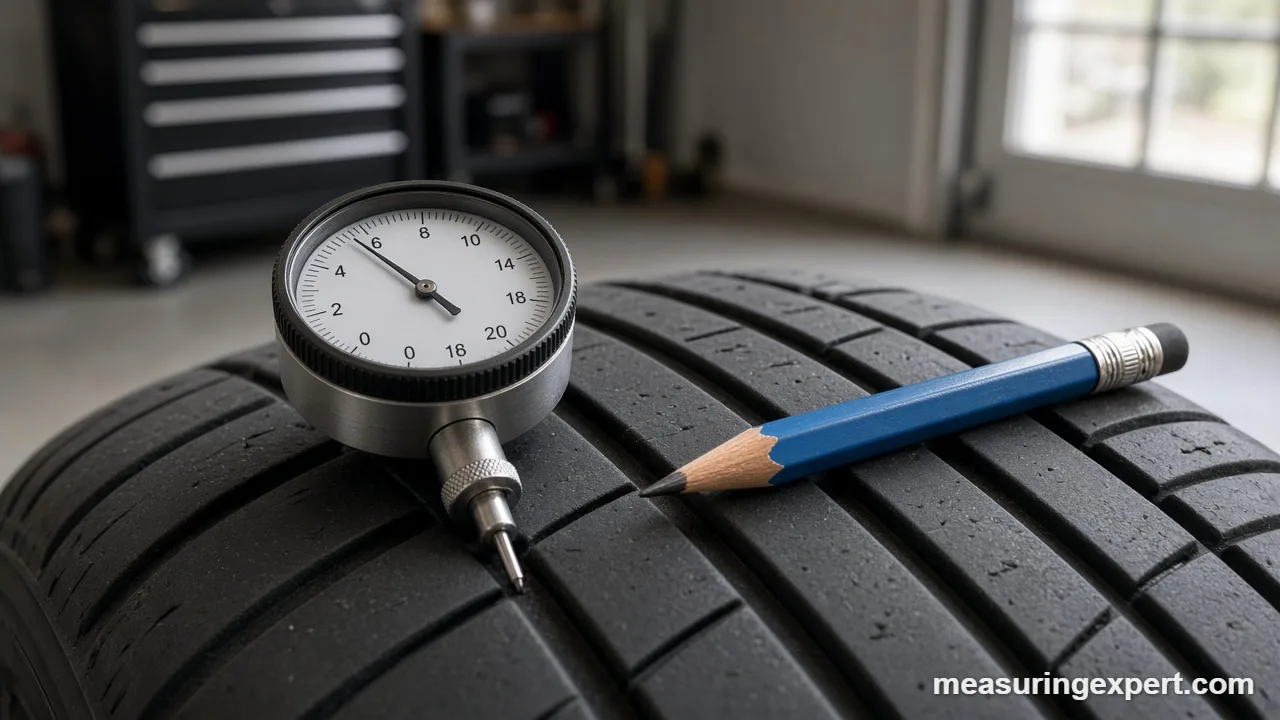
Tread gauges come in three main styles. Although each one measures the same depth, the reading experience differs a lot.
| Type | How you read it | Power | Good for | Watch out for |
|---|---|---|---|---|
| Pencil (bar) | Sliding scale, often 32nds and mm | None | Glovebox, low cost, shops | Small markings |
| Color-coded pencil | Green, yellow and red zones plus a scale | None | Quick pass or fail checks | Colors hide exact depth |
| Dial | Needle on a round face | None | Fast, clear home checks | Lens can scratch |
| Digital | LCD number in mm or inches | Battery | Logging and metric users | Dead batteries, zeroing |
In practice, a dial gauge is the easiest upgrade from a coin. Meanwhile, a digital gauge suits people who like to record numbers, and a pencil gauge suits people who want a tool that never fails.
Reading 32nds of an Inch vs Millimeters
In the US, tread depth is usually quoted in 32nds of an inch. In contrast, elsewhere it is quoted in millimeters. One 32nd of an inch equals 0.79375 mm, because an inch is exactly 25.4 mm. So, 2/32 inch is about 1.6 mm, and 4/32 inch is about 3.2 mm.
| 32nds of an inch | Decimal inch | Millimeters | What it usually means |
|---|---|---|---|
| 2/32 | 0.0625 | 1.6 | Replace now (NHTSA guideline) |
| 3/32 | 0.094 | 2.4 | Plan new tires soon |
| 4/32 | 0.125 | 3.2 | Wet grip is reduced; truck steer-tire minimum |
| 6/32 | 0.1875 | 4.8 | Snow grip starts to fade |
| 8/32 | 0.25 | 6.4 | Healthy tread on most car tires |
| 10/32 | 0.3125 | 7.9 | Typical of many new passenger tires |
For example, if your digital gauge reads 3.0 mm, divide by 0.79375 to get about 3.8/32 inch. In other words, that tire is just under 4/32 and is close to the point where many drivers start shopping for new tires.
The 2/32 Inch Legal Minimum, Explained
NHTSA says tires should be replaced when the tread wears down to 2/32 of an inch. Also, every tire has tread wear indicator bars molded into the grooves. When the tread is level with those bars, the tire has reached that 2/32 inch point.
For commercial vehicles, the federal rule is stricter. Under 49 CFR 393.75, front tires on a bus, truck or truck tractor need at least 4/32 inch of tread, while other tires need at least 2/32 inch. In addition, the rule says to measure in a major groove, not on a tie bar, hump or fillet. Most states use 2/32 inch for passenger cars, but check your own state rules before an inspection.
Penny and Quarter Tests: Useful but Limited
The penny test is the classic free check. NHTSA describes it this way: put a penny into the tread with Lincoln’s head upside down, and if you can see the top of his head, replace the tire. That works because the distance from the coin’s edge to the top of Lincoln’s head is roughly 2/32 inch.
Similarly, the quarter test uses the same idea with a deeper target. Put a quarter in the groove with Washington’s head down. If you can see the top of his head, the tread is roughly 4/32 inch or less. As a result, the quarter gives you an earlier warning than the penny.
However, coins have real limits:
- They only give a yes or no answer, not a number.
- Coin wear and your viewing angle change the result.
- They cannot track slow, uneven wear from bad alignment.
- It is hard to read a coin in a narrow or worn groove.
For this reason, a real gauge is worth the small cost. For more tire care tools, our best tire inflator guide covers keeping the pressure right, which slows uneven wear.
How to Measure Tread Depth Step by Step
- Park on level ground, set the brake and turn the front wheels so you can reach the tread.
- Zero or check the gauge: press it on a flat surface and confirm it reads 0.
- Pick a major groove, away from the wear bars, ribs and small sipes.
- Set the gauge base flat across two tread ribs and push the probe straight down to the groove floor.
- Read the depth in 32nds or mm, then measure the outer, center and inner grooves.
- Repeat in two or three spots around each tire, and record the lowest reading.
Finally, compare the results. If the inner groove is much lower than the outer, ask a shop to check alignment. Likewise, if the center is low, the tire may run overinflated.
Tread Depth Converter: Inches to Millimeters
Use this converter to turn a decimal inch reading into millimeters. For fractions, divide first: for example, 4/32 inch is 0.125 inch.
Care, Zeroing and Accuracy Checks
A tread gauge is a simple depth tool, so a few habits keep it honest:
- Zero check: before each session, press the gauge on a glass table or a flat steel rule. It should read 0.
- Clean the probe: grit on the pin adds a false fraction of a millimeter.
- Store it dry: keep dial gauges in a pouch so the lens does not scratch.
- Swap batteries: replace digital gauge cells when the screen dims.
- Cross-check: once a year, compare two gauges on the same groove.
In addition, remember that resolution is not accuracy. A digital screen may show 0.01 mm steps, yet rubber, debris and probe angle limit what any gauge can truly measure.
Also, pair tread checks with pressure checks. Low pressure wears the outer edges, and a tire pressure monitoring system can warn you between gauge checks.
Do and Don’t
Honest Limits of Any Tread Gauge
In short, a gauge tells you how much rubber is left, but it cannot tell you everything. For instance, it will not find a hidden belt problem, a bulge in the sidewall or a tire that is simply too old. Rubber also ages, so check the date code on the sidewall as well.
Likewise, small gauges can misread on deep off-road lugs or on very narrow motorcycle grooves. In those cases, take several readings and use the lowest one. When in doubt, ask a tire shop to confirm.
FAQ About the Best Tread Depth Gauge
What is the best tread depth gauge for most drivers?
For most drivers, the best tread depth gauge is a dial model like the JACO TreadPro, because it is fast to read and needs no battery. Pick a digital gauge instead if you want millimeters.
What is the legal minimum tread depth in the US?
NHTSA says to replace tires at 2/32 inch, which is about 1.6 mm. Commercial trucks and buses need at least 4/32 inch on front tires under 49 CFR 393.75.
Why buy the best tread depth gauge when a penny is free?
A penny only shows whether you are near 2/32 inch. In contrast, a gauge gives a real number, so you can track wear and spot alignment problems early.
What does the quarter test show?
If you can see the top of Washington’s head, the tread is roughly 4/32 inch or less. Therefore, it is a good early warning for wet roads.
How do I convert 32nds of an inch to millimeters?
Multiply the number of 32nds by 0.79375. For example, 4/32 inch is about 3.2 mm and 6/32 inch is about 4.8 mm.
Does the best tread depth gauge need to be digital?
No. Dial and pencil gauges measure the same depth. Digital gauges simply make reading and switching units easier, but they need batteries.
How deep is the tread on a new tire?
Many new passenger tires start at about 10/32 to 11/32 inch. Truck and winter tires are often deeper, so check the tire maker’s spec for your size.
Where should I measure tread depth?
Measure in a major groove, not on a wear bar or tie bar. Also, check the inner, center and outer grooves in several spots around the tire.
How often should I check tread depth?
NHTSA advises checking tread at least once a month, at the same time you check tire pressure. Also check before long trips and winter.
Can the best tread depth gauge measure truck tires?
Yes, as long as its range is deep enough. For example, the Milton S-448 reads from 0 to 1 inch, which covers deep truck treads.
Bottom Line: Our Best Tread Depth Gauge Pick
For most drivers, the JACO TreadPro dial gauge is the best tread depth gauge to buy. It reads fast, needs no batteries and fits in a glovebox. However, choose the GODESON 3-mode digital if you work in millimeters, and the Milton S-448 if you check tires all day.
3 thoughts on “7 Best Tire Tread Depth Gauges for 2026 (Dial, Digital and Pencil)”