

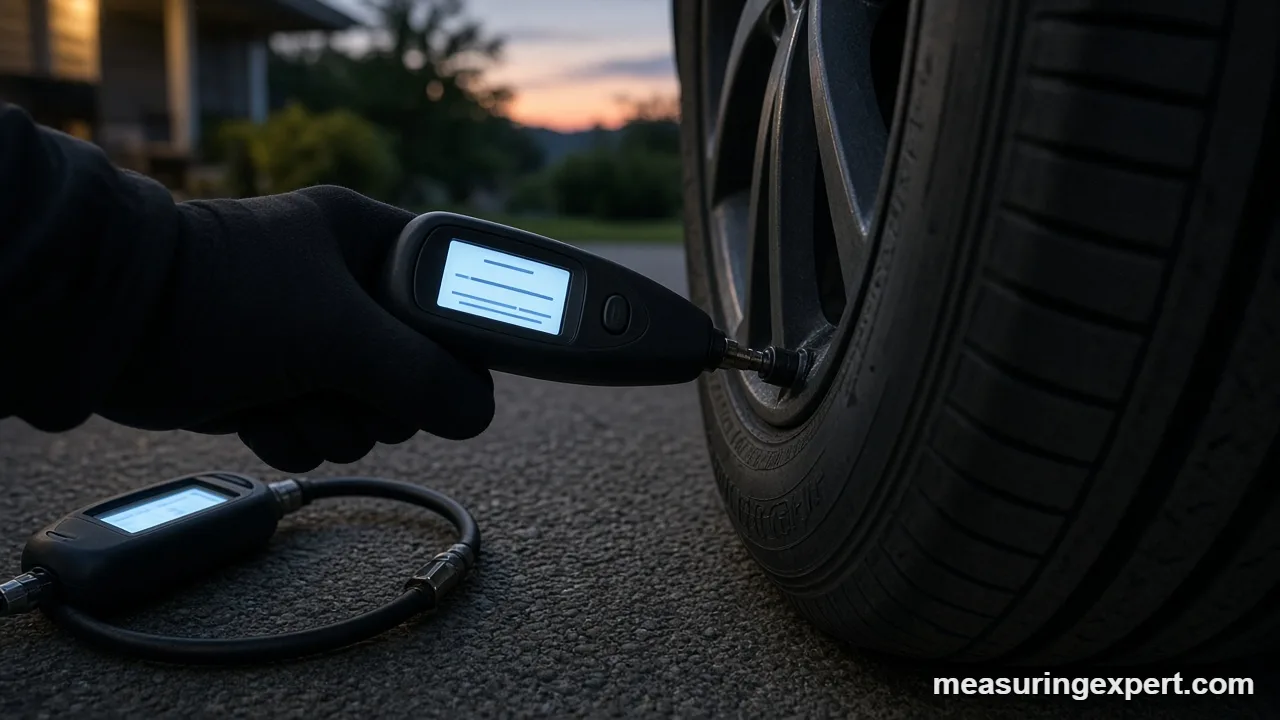
The best backlit tire gauge for most drivers is the Rhino USA 150 PSI digital gauge, because it lights both the screen and the valve and reads in four units. Still, the right choice depends on stated accuracy, pressure range and whether you need a hose, a bleeder or a dual-head chuck.
In short: get the Rhino USA 150 for night checks, the AstroAI 150 on a tight budget, and the Steelman 99469 when accuracy matters most.
As an Amazon Associate, Measuring Expert earns from qualifying purchases. Our picks are based on research, specifications and owner feedback, not paid placement.
Best Overall

Best Budget
Best Pro

Quick Picks: Which Best Backlit Tire Gauge Suits You
- Night checks on a car or SUV: Rhino USA 150 PSI.
- Lowest cost with a lit screen: AstroAI 150 PSI.
- Tightest stated accuracy: Steelman 99469 inflator gauge.
- Dually trucks and RVs: AstroAI 230 PSI heavy duty.
- A named accuracy grade on a budget: ETENWOLF T300.
- Setting pressure with a bleeder: ETENWOLF T600.
- Track days and race garages: Longacre Pro digital.
On This Page
- Comparison table
- The 7 gauges, reviewed
- How we chose
- Accuracy grades explained
- Features that matter
- Tire pressure unit converter
- How to check tire pressure
- Care and calibration
- Honest limits
- FAQ
- Bottom line
Best Backlit Tire Gauge Comparison Table
First, find your use in the Best For column. Then compare the standout feature and jump to the full review below.
| # | Product | Best For | Standout Feature | Link |
|---|---|---|---|---|
| 1 | Rhino USA 150 PSI Digital Tire Gauge | Most drivers who check car, SUV and bike tires at night | Backlit LCD plus a lighted nozzle | View |
| 2 | AstroAI 150 PSI Digital Tire Gauge | A low-cost backlit gauge for the glove box | Plus or minus 1 psi in 0.1 psi steps | View |
| 3 | Steelman 99469 High Accuracy Digital Gauge Tire Inflator | Shops and enthusiasts who want the tightest stated accuracy | Plus or minus 0.25% with a certificate of conformance | View |
| 4 | AstroAI Heavy Duty Digital Tire Pressure Gauge 230 PSI | Dual rear wheels, RVs and trailers | Dual-head chuck, backlit LCD and flashlight | View |
| 5 | ETENWOLF T300 Digital Tire Pressure Gauge | Drivers who want a stated accuracy grade at a small price | ANSI B40.7 Grade 2A, plus or minus 0.5% of span | View |
| 6 | ETENWOLF T600 Digital Tire Pressure Gauge 250 PSI | Setting exact pressure with a bleed valve | Air bleeder plus 0 to 250 psi range | View |
| 7 | Longacre 52-53026 Pro Digital Tire Pressure Gauge 0-125 psi | Track days and garages that log pressures | Racing-grade build with a hard case | View |
The 7 Best Backlit Tire Gauge Picks, Reviewed
Also, each review below lists only specs we could confirm on the maker page. Where a maker does not publish a number, we say so instead of guessing.
Best Overall
1. Rhino USA 150 PSI Digital Tire Gauge
Best for: Most drivers who check car, SUV and bike tires at night.
The Rhino USA 150 PSI gauge is a small handheld digital gauge with a backlit LCD and a lighted nozzle, so you can see both the valve stem and the number in a dark driveway. Also, it reads from 0 to 150 psi and switches between psi, bar, kPa and kg/cm2. As a result, it covers passenger cars, light trucks, motorcycles and Schrader-valve bike tires with one tool.
On accuracy, Rhino USA says the gauge is calibrated to ASME B40.1 Grade B. That grade comes from the dial gauge standard and allows about 2% of span in the middle of the scale, which works out to roughly 3 psi on a 150 psi gauge. In other words, it is a sound everyday gauge, but it is not a shop reference. For that reason, it earns the top spot for most drivers who mainly want a readable number in poor light, while the Steelman below is the pick when precision matters most.
- Range: 0 to 150 psi
- Units: psi, bar, kPa and kg/cm2
- Display: backlit LCD with a lighted nozzle
- Accuracy claim: ASME B40.1 Grade B calibration (maker image caption)
- Power: one CR2032 coin cell, included, with automatic shut-off
Pros
- Lights both the screen and the valve
- Four units for imported vehicles and bikes
- Also small enough for a glove box
Cons
- Grade B is a loose tolerance for a digital gauge
- Coin cell runs down faster than AAA cells
- No hose, so tight valves can be awkward
Skip it if: you need a certified reference gauge for a shop, or you run high-pressure truck tires above 150 psi.
Best Budget
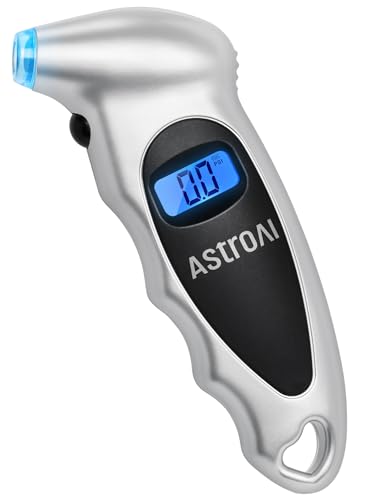
2. AstroAI 150 PSI Digital Tire Gauge
Best for: A low-cost backlit gauge for the glove box.
The AstroAI 150 PSI gauge is the familiar pocket-size digital gauge that many drivers keep in a door pocket. It has a backlit LCD and reads up to 150 psi in 0.1 psi steps. Also, AstroAI states an error of plus or minus 1 psi in its FAQ, which is tighter than the Rhino’s Grade B claim at the middle of the scale.
However, keep the difference between resolution and accuracy in mind. The screen shows tenths, yet the gauge only promises to be within 1 psi of the true value. So a reading of 34.6 psi means the tire is somewhere between about 33.6 and 35.6 psi. In addition, the gauge shuts itself off after 30 to 40 seconds to save power.
- Range: 0 to 150 psi
- Stated error: plus or minus 1 psi (maker FAQ)
- Display: backlit LCD with 0.1 psi increments
- Auto-off: about 30 to 40 seconds
- Presta adapter: bundled with AstroAI’s silver kit; check the listing you buy
Pros
- Very low cost for a backlit screen
- Clear accuracy statement from the maker
- Also light and compact
Cons
- Maker pages disagree on battery type
- No lighted nozzle
- Plastic body is less rugged than metal gauges
Skip it if: you want a lighted tip for finding the valve in the dark, or a hose for dual rear wheels.
Best Pro
3. Steelman 99469 High Accuracy Digital Gauge Tire Inflator
Best for: Shops and enthusiasts who want the tightest stated accuracy.
The Steelman 99469 is a digital inflator gauge, so it reads pressure and also adds or bleeds air from a shop compressor. It covers 0 to 100 psi and Steelman rates it at plus or minus 0.25%. On a 100 psi span, that is about 0.25 psi, which is the tightest figure in this roundup. Moreover, it ships with a certificate of conformance that you can keep with your shop records.
In addition, the backlit LCD switches between psi, bar, kPa and kg(f)/cm2. Also, an 18 in whip hose with a swivel chuck and a pressure relief valve lets you fine-tune pressure without moving the gauge. Next, it runs on a 9V battery and turns the display off after 3 minutes of non-use. Because it needs compressed air to inflate, it fits a garage better than a glove box. If you want a portable compressor instead, see our best tire inflator guide.
- Range: 0 to 100 psi
- Stated accuracy: plus or minus 0.25%
- Units: psi, bar, kPa and kg(f)/cm2 on a backlit LCD
- Hose: 18 in whip with swivel chuck and relief valve; 1/4 in NPT inlet
- Power: 9V battery, included; 1-year limited warranty
Pros
- Tightest stated accuracy here
- Inflate, bleed and read with one tool
- Certificate of conformance included
Cons
- Needs a shop compressor to inflate
- 100 psi limit rules out many truck tires
- Also larger than a pocket gauge
Skip it if: you only need a quick roadside check, because a pocket gauge is simpler to carry.
Best for Trucks and RVs
4. AstroAI Heavy Duty Digital Tire Pressure Gauge 230 PSI

Best for: Dual rear wheels, RVs and trailers.
By contrast, this AstroAI model trades pocket size for reach. It has a stainless steel body with a 30 degree dual-head chuck, so you can push onto inner and outer dually valves without a valve extender. Also, it reads up to 230 psi, which covers RV and medium-duty truck tires that pass the limit of a 150 psi gauge.
For night checks, it combines a backlit LCD with a built-in flashlight. As a result, you can light the valve stem behind a deep wheel and still read the screen. However, AstroAI does not list an accuracy figure on its product page. So treat it as a convenient check gauge and confirm critical loads against a known reference.
- Range: 0 to 230 psi
- Chuck: 30 degree dual head, stainless steel
- Display: backlit LCD plus built-in flashlight
- Auto-off: about 30 to 40 seconds (maker FAQ)
Pros
- Reaches inner dually valves
- High range for RV and truck tires
- Flashlight also helps inside deep wheels
Cons
- No accuracy figure on the maker page
- Long body is awkward in a glove box
- Maker page is inconsistent on battery type
Skip it if: you only check passenger car tires, because a compact gauge is easier to handle.
Best Value Accuracy
5. ETENWOLF T300 Digital Tire Pressure Gauge
Best for: Drivers who want a stated accuracy grade at a small price.
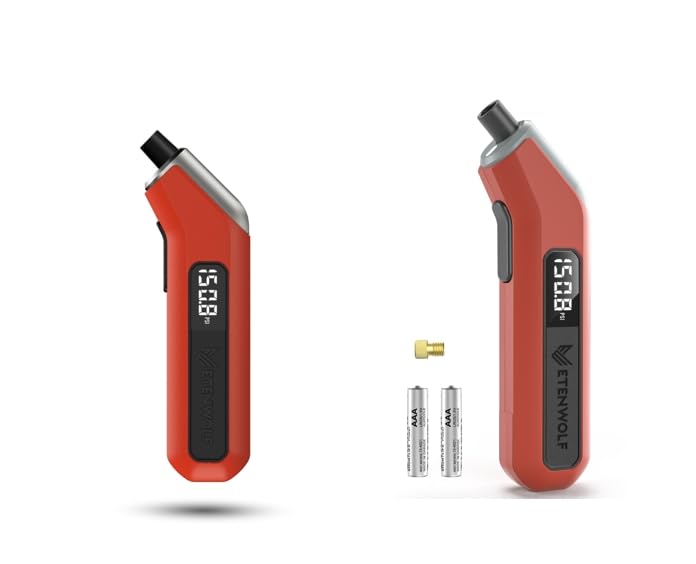
The ETENWOLF T300 is a compact digital gauge that reads from 3 to 200 psi in 0.1 psi steps. ETENWOLF says it is calibrated to ANSI B40.7 Grade 2A, which is a grade from the digital gauge standard, and lists plus or minus 0.5% of span. On a 200 psi span, that works out to about 1 psi. Therefore, it matches the AstroAI 150 on paper, but with a named standard behind the claim.
In addition, it has a built-in LED light for dim garages and night checks. Moreover, it auto-calibrates each time you power it on and lists an operating range of -4 to 130 F. Note that ETENWOLF’s own page describes a bright display but does not spell out a backlit LCD. So look at the current listing if a lit screen is the feature you care about most.
- Range: 3 to 200 psi
- Stated accuracy: plus or minus 0.5% of span, ANSI B40.7 Grade 2A
- Resolution: 0.1 psi
- Light: built-in LED for night checks
- Power: two AAA batteries, included
Pros
- Named accuracy standard
- AAA cells are easy to replace
- Also a wide 3 to 200 psi range
Cons
- Backlight is not stated on the maker page
- Presta valves need an adapter
- Only psi is confirmed as a unit
Skip it if: you need a lighted screen for sure, because the Rhino and AstroAI picks state it clearly.
Best With Hose and Bleeder
6. ETENWOLF T600 Digital Tire Pressure Gauge 250 PSI
Best for: Setting exact pressure with a bleed valve.
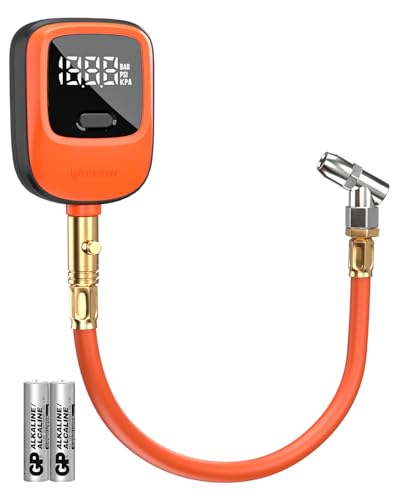
The ETENWOLF T600 adds a flexible rubber hose, a 360 degree rotating angled chuck and a built-in air bleeder. So you can seat the chuck once, read the pressure and let air out in small steps until you hit the target. Also, the chuck can be swapped for any standard 1/4 in NPT chuck, which helps if you prefer a lock-on style.
The T600 reads up to 250 psi in psi, bar and kPa and, like the T300, is rated at plus or minus 0.5% under ANSI B40.7 Grade 2A. On a 250 psi span, that is about 1.25 psi. Meanwhile, the reading stays locked on screen until you press the power button again. Owners describe a bright blue display, although the maker spec list does not name a backlight.
- Range: up to 250 psi
- Stated accuracy: plus or minus 0.5%, ANSI B40.7 Grade 2A
- Units: psi, bar and kPa
- Hose and chuck: rubber hose, 360 degree angled chuck, 1/4 in NPT
- Power: two AA batteries, included; -14 to 140 F operating range
Pros
- Bleeder lets you set pressure exactly
- Replaceable standard chuck
- High range also covers RVs and trailers
Cons
- Wider span means a larger error in psi
- Bulkier than a pocket gauge
- Backlight is not in the maker spec list
Skip it if: you want the smallest gauge for a glove box.
Best for Racing
7. Longacre 52-53026 Pro Digital Tire Pressure Gauge 0-125 psi

Best for: Track days and garages that log pressures.
First, Longacre builds gauges for racing teams, where small pressure changes alter handling. The 52-53026 is the 0 to 125 psi Pro version with a foot valve and 0.5 lb (0.5 psi) resolution. Also, the Pro series includes an air pressure release button, an external bumper to protect the gauge and a hard case. Longacre notes that the Pro gauges now come with back lights.
However, this is a specialist tool. The 0-60 and 0-25 psi Pro versions read in 0.1 psi steps, so they suit racers who chase tenths. In contrast, the 0-125 version suits garages that handle a wider mix of tires. In addition, it uses AAA batteries with auto-off, so it is easy to keep in service.
- Range: 0 to 125 psi, foot valve
- Resolution: 0.5 psi
- Features: air release button, gauge bumper, hard case
- Power: AAA batteries with auto-off
- Lighting: Pro series now includes back lights (maker page)
Pros
- Built for frequent shop and pit use
- Bleed button and protective bumper
- Also a hard case for storage
Cons
- Costs far more than a pocket gauge
- 0.5 psi steps on this range version
- No published accuracy grade on the maker page
Skip it if: you only check a family car once a month.
How We Chose the Best Backlit Tire Gauge Picks
We did not run hands-on tests. Instead, these picks are research-based. First, we kept only gauges from established brands with a backlit or lighted display, or a clear night-use feature. Next, we read each maker product page and FAQ and noted only the specs those pages state. Then we compared stated accuracy, the standard behind it, range, resolution, units, chuck style and power source. Finally, we read owner feedback for patterns.
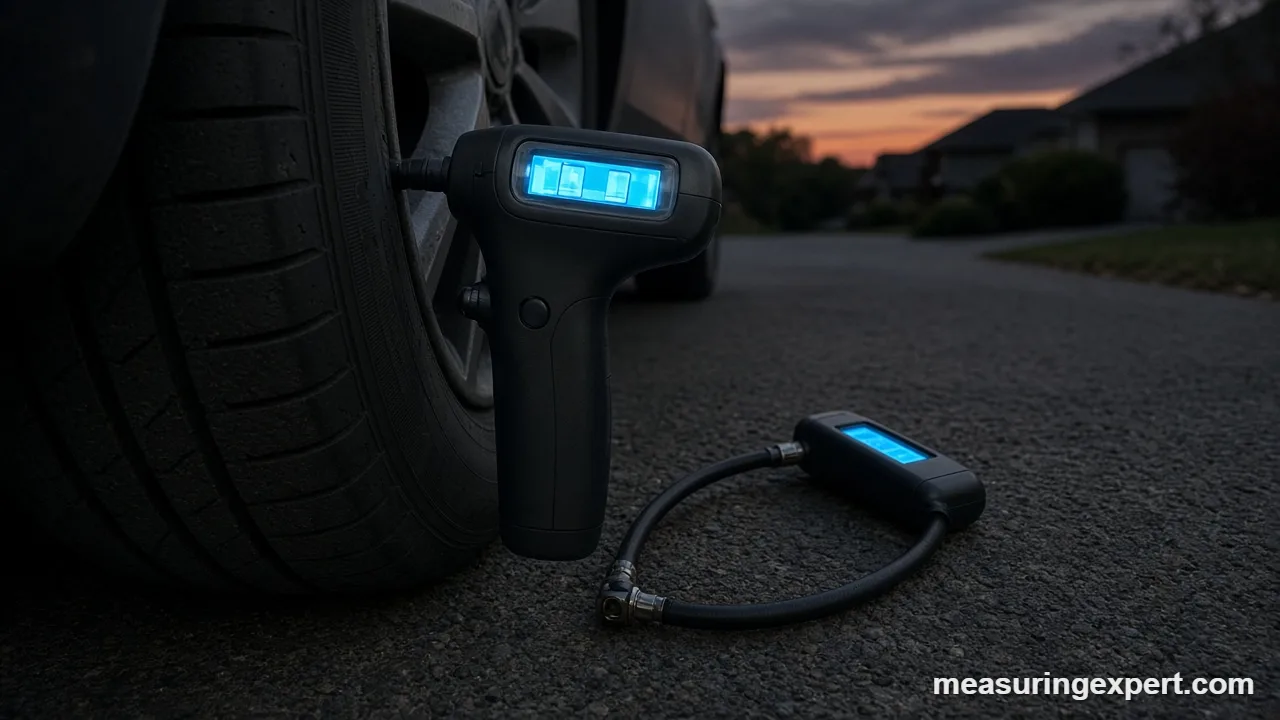
We also used NHTSA guidance on tire safety and pressure checks to decide which features matter for everyday drivers. In addition, we left out unbranded listings, parts-only listings and gauges that maker sites no longer list.
Accuracy Grades Explained for the Best Backlit Tire Gauge
Of course, a backlit screen makes a number easy to read. However, the number is only useful if it is close to the true pressure. So here is how to read the accuracy claims on a tire gauge box.
Resolution is not accuracy
Resolution is the smallest step the display shows, such as 0.1 or 0.5 psi. Accuracy, on the other hand, is how far the reading may stray from the true value. For example, a gauge can show 0.1 psi steps and still be rated at plus or minus 1 psi. In that case, the last digit is mostly for show.
Percent of span vs. percent of reading
Most gauge grades state error as a percent of span, which is the full range of the gauge. As a result, a wide-range gauge allows a larger error in psi. The table below shows how the stated figures in this guide turn into psi.
| Gauge | Stated accuracy | Span | Approx. error in psi |
|---|---|---|---|
| Steelman 99469 | Plus or minus 0.25% | 0 to 100 psi | 0.25 psi |
| AstroAI 150 PSI | Plus or minus 1 psi | 0 to 150 psi | 1 psi |
| ETENWOLF T300 | Plus or minus 0.5% of span (Grade 2A) | 3 to 200 psi | About 1 psi |
| ETENWOLF T600 | Plus or minus 0.5% (Grade 2A) | Up to 250 psi | About 1.25 psi |
| Rhino USA 150 PSI | ASME B40.1 Grade B | 0 to 150 psi | About 3 psi mid-scale |
ANSI/ASME B40.1 vs. B40.7
ASME B40.1 covers dial (Bourdon tube) pressure gauges, while ASME B40.7 covers digital gauges. Even so, both use letter grades. Grade 2A allows 0.5% of span across the scale, and Grade 1A allows 1%. Grade A allows 1% in the middle half and 2% near the ends, while Grade B allows 2% in the middle and 3% near the ends. So when a digital gauge cites a B40.1 grade, read it as a rough tolerance, not a lab rating.
Best Backlit Tire Gauge Features That Matter
Beyond accuracy, a few features decide whether a backlit tire gauge is pleasant to use at night or on a big rig.
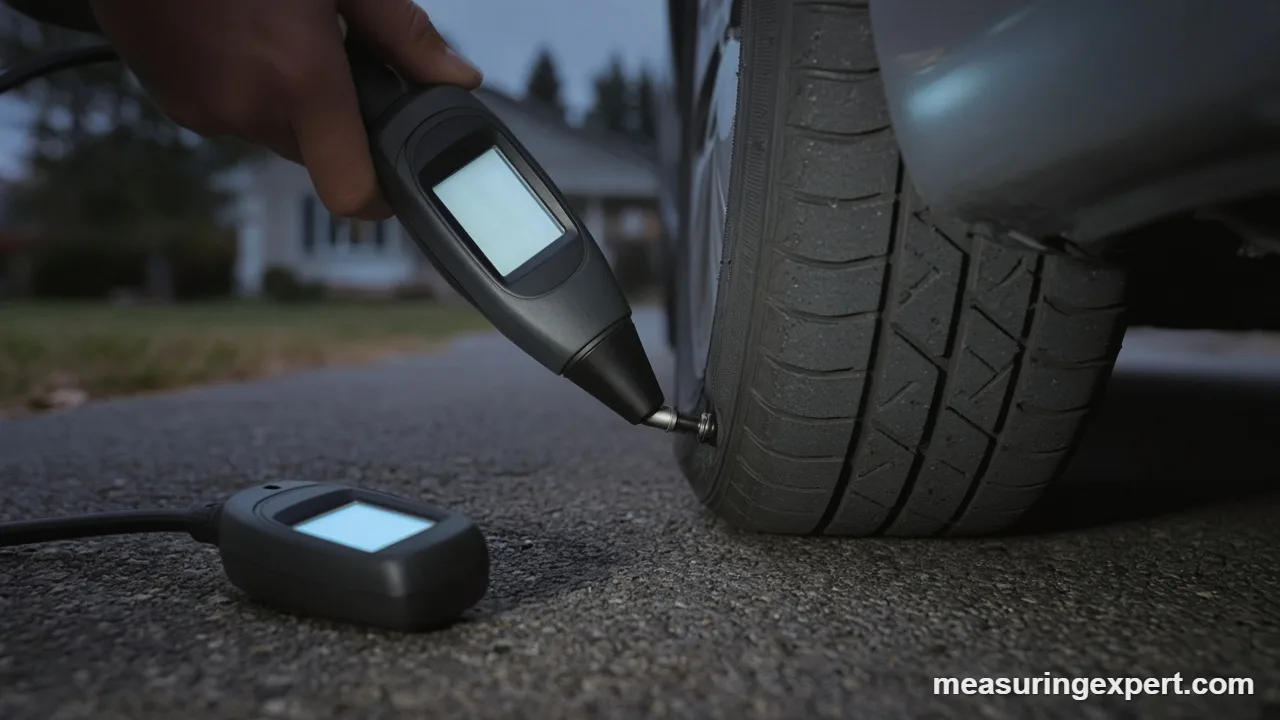
| Feature | Why it matters | Example here |
|---|---|---|
| Backlit LCD | Readable in a dark driveway or garage | Rhino USA 150, AstroAI 150, Steelman 99469 |
| Lighted nozzle or flashlight | Helps you find and seat the valve stem | Rhino USA 150, AstroAI 230, ETENWOLF T300 |
| Hose and bleeder | Lets you lower pressure while you watch the reading | ETENWOLF T600, Steelman 99469 |
| Dual-head chuck | Reaches inner and outer dually valves | AstroAI 230 |
| Several units | Matches placards in psi, bar or kPa | Rhino USA 150, Steelman 99469, ETENWOLF T600 |
| Battery type | AAA or AA cells are easy to find; coin cells keep gauges small | ETENWOLF T300 (AAA), Rhino USA 150 (CR2032) |
Also, think about where the gauge lives. For example, a glove box gets hot in summer and cold in winter, so a gauge with a stated operating range, such as the ETENWOLF T300 at -4 to 130 F, is a safer bet for a car. Meanwhile, a garage gauge can be larger and use a hose. If you would rather watch pressure while you drive, a tire pressure monitoring system adds a live warning, but it does not replace a hand gauge.
Tire Pressure Unit Converter: psi, kPa and bar
Many placards on imported vehicles list kPa or bar, while most US gauges default to psi. So enter a value below to convert it. The default is 35 psi.
For example, 35 psi equals about 241.3 kPa or 2.41 bar, because 1 psi is 6.894757 kPa. Likewise, a 2.5 bar placard is about 36.3 psi. To see why gas pressure rises with heat, read our explainer on the pressure of a gas.
How to Check Tire Pressure with the Best Backlit Tire Gauge
Above all, good technique matters as much as the gauge. So follow these steps at least once a month, as NHTSA recommends, and before long trips.
- Wait until the tires are cold, which NHTSA defines as not driven for at least three hours.
- Find the recommended pressure on the tire and loading label on the driver door edge or post, or in the owner manual.
- Turn on the gauge and let the backlight and any self-zero finish before you touch the valve.
- Remove the valve cap and press the chuck straight and firmly onto the stem until the hiss stops.
- Read the backlit display, then remove the gauge and take a second reading to confirm it.
- Add air or press the bleeder until the reading matches the placard, then check again.
- Replace the valve cap and repeat for every tire, including the spare.
Need to add air away from a gas station? Our tire inflator guide compares portable compressors, and many of them have built-in gauges you can cross-check with a hand gauge.
Care and Calibration for Your Best Backlit Tire Gauge
In general, digital gauges use a small pressure sensor, and its reading can drift with drops, heat and weak batteries. Therefore, check your gauge now and then against a second good gauge or a shop reference.
Do
- Compare readings with a second gauge on the same cold tire twice a year.
- Replace batteries early, since low voltage can dim the backlight and skew readings.
- Keep the chuck clean so grit does not damage the valve seal.
- Store the gauge in a case, away from direct sun on the dashboard.
Don’t
- Drop the gauge on concrete or toss it into a toolbox loose.
- Trust a single reading if the chuck hissed while you pressed it on.
- Check pressure right after a highway drive and then let air out.
- Use a car gauge above its rated range on truck tires.
Honest Limits of Any Tire Gauge
Above all, a tire gauge measures the pressure in that tire at that moment. After all, pressure changes with temperature, so a reading at noon in the sun will run higher than one at dawn. For instance, a common rule of thumb is about 1 psi for every 10 F of change. As a result, set pressure when the tires are cold and the vehicle is in the shade.
In addition, a bright display does not prove accuracy. Two backlit gauges can disagree by 1 to 3 psi and both still meet their stated grades. So if you need repeatable numbers, use the same gauge every time. Finally, NHTSA notes that a TPMS warning light is not a substitute for monthly checks, so keep a hand gauge in the car even if your vehicle has sensors.
Best Backlit Tire Gauge FAQ
What is the best backlit tire gauge for most drivers?
For most drivers, the Rhino USA 150 PSI digital gauge is the best backlit tire gauge. It lights both the screen and the valve, reads up to 150 psi and switches between psi, bar, kPa and kg/cm2.
Which is the best backlit tire gauge for accuracy?
Among these picks, the Steelman 99469 has the tightest stated accuracy at plus or minus 0.25% on a 0 to 100 psi span, or about 0.25 psi. It also ships with a certificate of conformance.
How accurate should a tire pressure gauge be?
For passenger cars, a gauge within about 1 psi is enough for routine checks. However, racers and shops often want 0.25 to 0.5 psi, because small changes affect handling and tire wear.
What does ANSI B40.1 Grade A or B mean on a tire gauge?
It is an accuracy grade from the ASME B40.1 dial gauge standard. Grade A allows about 1% of span mid-scale and Grade B about 2%, with looser limits near the ends of the scale.
Is a digital tire gauge better than a dial gauge?
A digital gauge is easier to read, especially with a backlit screen, and it removes parallax error. However, a good dial gauge needs no batteries, so many drivers keep one of each.
When should I check tire pressure?
NHTSA recommends checking at least once a month and before long trips, with the tires cold, meaning the vehicle has not been driven for at least three hours.
Where do I find the right tire pressure for my car?
Use the tire and loading information label on the driver door edge or post, or the owner manual. The number on the tire sidewall is the maximum pressure, not the recommended one.
Can I use a car tire gauge on a bicycle?
Yes, on Schrader valves. For Presta valves, you need an adapter, and you should check that the gauge range covers your tire, since road bike tires can exceed 100 psi.
Why do two digital tire gauges show different readings?
Each gauge has its own tolerance, so two gauges can differ by 1 psi or more and both be within spec. Also, a poor chuck seal or a warm tire can change the result.
Does the best backlit tire gauge use more battery power?
Yes, the backlight draws extra current. That is why most models, including the AstroAI and Rhino USA picks, shut off automatically after a short time.
Bottom Line: The Best Backlit Tire Gauge to Buy
For monthly checks and dark driveways, the Rhino USA 150 PSI is the best backlit tire gauge for most drivers. In short, it lights the screen and the valve, reads four units and fits in a glove box. However, if you want the tightest stated accuracy, choose the Steelman 99469, and if you drive a dually or an RV, choose the AstroAI 230 PSI heavy duty gauge.
2 thoughts on “Best Backlit Tire Gauge: 7 Digital Gauges for Night Pressure Checks”