

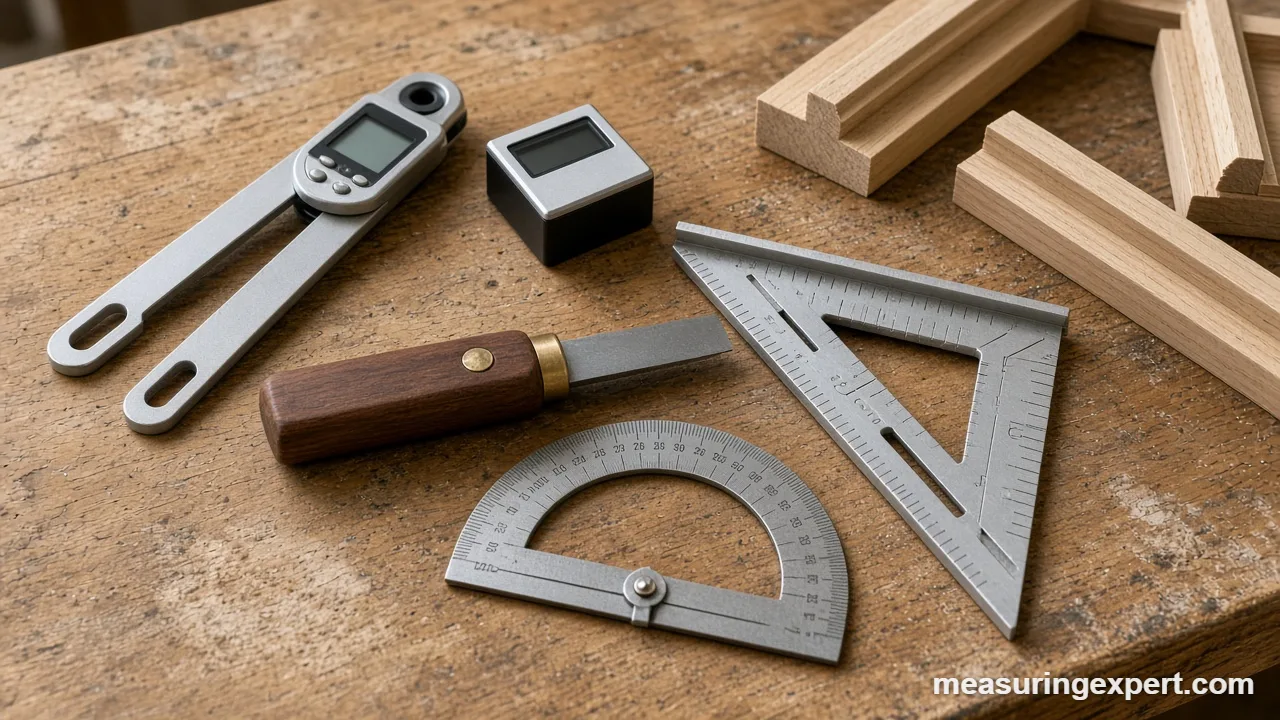
The best angle measuring tool for most people is a two-arm digital angle finder such as the Klein Tools 935DAF, because it reads inside and outside corners and converts them to miter settings. However, the right type depends on the job: tilt, layout, copying a bevel, or machining.
In short: get the Klein 935DAF for corners and miters, a Swanson Speed Square for layout on a budget, and the Bosch GAM 270 MFL for crown, stairs and site work.
As an Amazon Associate, Measuring Expert earns from qualifying purchases. Our picks are based on research, specifications and owner feedback, not paid placement.
Best Overall

Best Budget

Best Pro

Quick Answer: The Best Angle Measuring Tool for Each Job
- Corners, trim and miters: first choice is the Klein Tools 935DAF digital angle finder.
- Saw blades, conduit and pipe tilt: Klein Tools 935DAA digital angle gauge.
- Rafters, stairs and quick layout: Swanson S0101 Speed Square.
- Copying an odd bevel: instead of a number, use the Stanley 46-825 sliding T-bevel.
- Steel beams and pipe slope with no batteries: Johnson Level 700 angle locator.
- Machined parts to a fraction of a degree: Mitutoyo 187-904 bevel protractor.
- Crown, stair rails and site layout: Bosch GAM 270 MFL with laser; for bench layout, a PEC combination square set.
On This Page
- Comparison table
- The 8 picks, one per tool type
- How we chose
- Angle tool types compared
- Specs that matter
- Angle, grade and pitch calculator
- How to measure and cut a corner
- Calibration and care
- Honest limits
- FAQ
- Bottom line
Best Angle Measuring Tool Comparison Table
First, find your job in the Best For column. Then jump to the review, or follow the link inside each review to our full roundup of that tool type.
| # | Product | Best For | Standout Feature | Amazon |
|---|---|---|---|---|
| 1 | Klein Tools 935DAF | Inside and outside corners, trim and miters | Miter calculator, +/-0.2 degree edges, IP54 | View |
| 2 | Klein Tools 935DAA | Blade tilt, conduit bends and pipe | V-grooves, magnet and LED angle alerts | View |
| 3 | Swanson S0101 Speed Square | Rafters, stairs and saw guide | Degree and pitch scales on one triangle | View |
| 4 | Stanley 46-825 T-Bevel | Copying and transferring bevels | 8 in stainless blade with a lock | View |
| 5 | Johnson Level 700 | Steel, pipe and framing slope | Battery-free needle and magnet | View |
| 6 | Mitutoyo 187-904 | Machined bevels and chamfers | 5 minute vernier resolution | View |
| 7 | Bosch GAM 270 MFL | Crown, stair rails and site work | Laser transfer plus compound miter math | View |
| 8 | PEC 4-Piece Combination Set | Bench and machine layout | Square, 180 degree protractor and center head | View |
The Best Angle Measuring Tool of Each Type, Reviewed
In short, this page is our hub. Instead of ten near-identical gadgets, we chose one standout from each tool type. Then each review links to a deeper roundup, so you can compare more models once you know which type you need.
Best Digital Angle Finder
1. Klein Tools 935DAF Digital Angle Finder
Best for: DIYers, trim carpenters and remodelers who need to read a real corner and turn it into a saw setting.
A digital angle finder has two hinged rulers and a display in the pivot. Then you open the arms against both faces of a corner, and the screen shows the angle between them. That makes it the best angle measuring tool for out-of-square walls, because it measures the actual corner rather than tilt relative to gravity.
Also, Klein rates the machined ruler edges at plus or minus 0.2 degrees for inside and outside angles. In addition, a built-in miter saw calculator does the “divide by two” math for you. For example, a 92 degree inside corner needs two cuts at 44 degrees on the saw scale, not 45. For more two-arm models, see our best angle protractor guide.
- Accuracy: +/-0.2 degree on the machined edges (Klein)
- Overall length: 8.5 in (21.6 cm); weight 6.9 oz (196 g)
- Display: reverse-contrast white LED; locking knob for the rulers
- Durability: IP54, 6.6 ft (2 m) drop protection; stainless steel and ABS
- Power: one AAA battery
Pros
- Reads the real corner, so trim fits the wall you have
- Miter calculator removes the halving step
- Also rated IP54 for dusty job sites
Cons
- However, short arms struggle on wavy drywall corners
- Also, no published resolution figure
- Not meant for blade tilt on a saw
Skip it if: you mostly set table saw bevels, because a magnetic angle gauge (next pick) zeroes to the table and clings to the blade.
Best Bevel Gauge
2. Klein Tools 935DAA Digital Level and Angle Gauge

Best for: woodworkers and electricians who set saw bevels, check conduit bends or level pipe.
This is a “bevel box,” a small cube with a gravity sensor. First, you set it on a reference surface, press zero, and then move it to the part you want to measure. As a result, it reads the tilt of a saw blade relative to the saw table, even when the saw itself is not level.
For range, Klein lists two spans, 0 to 90 and 0 to 180 degrees, so it covers most jobs. Accuracy is 0.1 degree near 0, 90 and 180 degrees and 0.2 degree elsewhere, measured from the magnetic base. Also, a buzzer and three-color LEDs signal when you hit a set angle, and V-grooves on both faces seat it on round conduit. Our best magnetic angle finder roundup compares more cube gauges.
- Range: 0 to 90 and 0 to 180 degrees
- Accuracy: 0.1 degree at 0-1, 89-91 and 179-180 degrees; 0.2 degree elsewhere
- Rare-earth magnet base; V-grooves on top and bottom
- IP54; 6.6 ft (2 m) drop protection; two AAA cells
Pros
- Audible and LED alerts at the target angle
- V-grooves suit conduit and pipe
- Zero mode measures relative to any surface
Cons
- Measures tilt only, not the angle between two faces
- Also too small to span a long, uneven surface
- Needs a steel part for the magnet to hold
Skip it if: you need to copy a wall corner, because a cube cannot touch both faces at once.
Best Speed Square
3. Swanson S0101 7 in Speed Square
Best for: framers, deck builders and anyone who wants one cheap, tough angle tool in a tool belt.
The Speed Square is a right triangle with a thick lip on one leg. First, hold the lip on a board edge, then pivot the square on its corner, and read the degree scale along the long side. In addition, a second scale reads rafter pitch as rise per 12 in of run, so you can mark a 6 in 12 cut with no math.
In fact, Swanson lists five jobs for it: try square, miter square, protractor, line scriber and saw guide. Because the die-cast body is 3/16 in (4.8 mm) thick, it also makes a solid fence for a circular saw. Compare more triangles in our best angle ruler guide, or see longer L-squares in our best framing square roundup.
- Die-cast aluminum, 7 in (178 mm) legs, 3/16 in thick
- Scales: 0 to 90 degrees plus common, hip, valley and jack rafter marks
- 1/4 in scribing notches; Swanson Blue Book included
Pros
- No battery and almost impossible to break
- Degree and pitch scales on one tool
- Also doubles as a circular saw guide
Cons
- Reads to about the nearest degree
- Engraved marks are hard to see in shade, so check your light
- Only 7 in long
Skip it if: you need tenths of a degree for trim or furniture; instead, use a digital angle finder.
Best Sliding T-Bevel
4. Stanley 46-825 8 in Sliding T-Bevel

Best for: woodworkers who copy an existing angle from a chair leg, a stair stringer or a roof and repeat it.
A sliding T-bevel has no scale at all. Instead, it stores an angle. To use it, you loosen the lock, set the blade against the two faces, lock it, and then carry that exact angle to the saw or the workpiece. Because nothing is read or rounded, it avoids the reading errors that creep in when you convert to a number and back.
As for build, Stanley lists a stainless steel blade, a tough plastic handle and a built-in blade lock. As a result, the 8 in (200 mm) size covers most furniture and trim work. However, you still need a protractor or digital gauge if you must know the number, for example to set a saw scale.
- Blade: 8 in (200 mm) stainless steel
- Handle: impact-resistant plastic
- Built-in blade lock for transferring angles
- Limited lifetime warranty (Stanley)
Pros
- Copies any angle with no reading error
- No battery, no calibration
- Also useful for repeated dovetail and splay marks
Cons
- However, it gives no number by itself
- Also, a loose lock lets the blade creep
Skip it if: you need to write the angle down or share it, since a T-bevel only holds it.
Best Inclinometer
5. Johnson Level 700 Magnetic Angle Locator

Best for: welders, plumbers and framers who want a rugged, battery-free slope reading on steel or pipe.
An inclinometer reads tilt against gravity. In this case, a weighted needle swings over a 0 to 90 degree scale printed in all four quadrants. Because nothing is electronic, it never needs a battery or a reset, and it works in cold trucks and hot shops alike.
In addition, Johnson lists an extra-strong ceramic magnet, a V-groove edge for pipe and conduit, and inch and metric edge marks. However, a needle on a printed dial reads to about the nearest degree, so it suits steel and framing better than fine trim. For digital and smart models, see our best inclinometer roundup.
- Scale: 0 to 90 degrees in four quadrants
- Ceramic magnet for ferrous metal; V-groove for pipe
- Inch and metric edge graduations
- No batteries required
Pros
- Works anywhere, with no power
- Tough molded body for steel work
- Also very low cost
Cons
- Reads only to about 1 degree
- Also, no published accuracy figure
- No zero or relative mode
Skip it if: you set saw bevels or crown cuts that need tenths of a degree.
Best Protractor
6. Mitutoyo 187-904 Universal Bevel Protractor
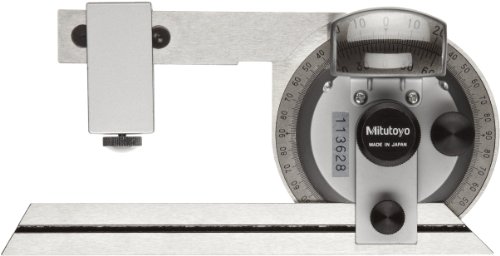
Best for: machinists, toolmakers and inspectors who check bevels and chamfers on metal parts.
A universal bevel protractor has a stock, a sliding blade and a rotating dial with a vernier. Specifically, Mitutoyo lists this model with a 6 in blade and 5 minute vernier resolution. For reference, 5 arc-minutes is 1/12 of a degree, or about 0.083 degree, which is finer than any other tool on this page.
Because the blade slides and locks, it reaches bevels on cutting tools, shaft chamfers and fixture tapers. In short, it is a precision instrument, although a vernier takes practice to read. To learn the parts, read what a bevel protractor is, and for school and drafting models see our best protractor roundup.
- Type: universal bevel protractor with vernier
- Blade: 6 in (152 mm)
- Resolution: 5 minutes (1/12 degree)
- No battery required
Pros
- Finest mechanical resolution here
- Reaches bevels a flat protractor cannot
- Also built to last decades
Cons
- However, costly for home use
- Vernier reading takes practice
- Therefore slower than a digital tool
Skip it if: you work in wood, where wood movement swamps the extra precision.
Best Laser Angle Finder
7. Bosch GAM 270 MFL Digital Angle Finder and Inclinometer
Best for: finish carpenters and remodelers who cut crown, stair rails and compound miters on site.
The GAM 270 MFL combines five tools: an angle finder, an inclinometer, a miter calculator, a protractor and a digital level. Also, Bosch lists a 0 to 270 degree range with plus or minus 0.1 degree accuracy. In addition, the miter calculator turns a measured corner and a spring angle into saw settings for compound cuts.
Next, the built-in laser projects an inclination up to 100 ft, so you can carry a stair or ceiling slope across a room. Meanwhile, two lit flip displays and an IP54 rating suit job sites. However, at 26.9 in long and 2.4 lb, it is far too big for blade setup.
- Range: 0 to 270 degrees; accuracy +/-0.1 degree
- Vial leveling accuracy: +/-0.05 degree
- Laser transfers inclination up to 100 ft
- Power: 4 AA cells, about 50 hours; IP54; 2.4 lb
Pros
- Does compound miter math on the tool
- Laser carries a slope across a room
- Reads degrees and percent grade
Cons
- However, large and heavy
- Also costs far more than a basic finder
- More modes than a DIYer needs
Skip it if: you only measure small corners at a bench; the Klein 935DAF does that in a pocket size.
Best Combination Set
8. PEC 12 in 4-Piece Combination Square Set

Best for: machinists and furniture makers who want a square, a protractor and a center finder on one hardened rule.
In short, a combination set slides different heads onto one steel rule. The square head marks 90 and 45 degrees, the center head finds the middle of round stock, and the 180 degree protractor head sets any other angle. Meanwhile, PEC builds these sets in Torrance, California, and lists a blade tolerance of plus or minus 0.0025 in.
Also, the square head carries a level vial and a hardened scriber. Similarly, the blades get a satin chrome finish for glare and rust control. Because every head rides on the same rule, you can lay out a line, check its angle and measure its length without changing tools.
- Pieces: blade, square/miter head, 180 degree protractor, center head
- Blade: 12 in, 16R graduation (1/32, 1/64, 1/100 and 1/10 in)
- Tolerance: +/-0.0025 in (PEC)
- Level vial and hardened scriber in the square head
Pros
- Four layout tools on one rule
- Made in the USA with a published tolerance
- Also no battery to fail
Cons
- Protractor head reads to whole degrees
- Heavy in a tool belt, so it stays on the bench
- Finally, overkill for rough framing
Skip it if: you only frame houses; a Speed Square does that job for much less.
How We Chose the Best Angle Measuring Tool Picks
We did not test these tools by hand. Instead, we compared published specifications, maker manuals and owner feedback, then picked one standout per tool type. First, each pick had to come from an established maker that publishes real specs. Next, we checked accuracy, range, readability, durability ratings and power needs. Finally, we dropped unbranded clones, discontinued models and near-duplicates.
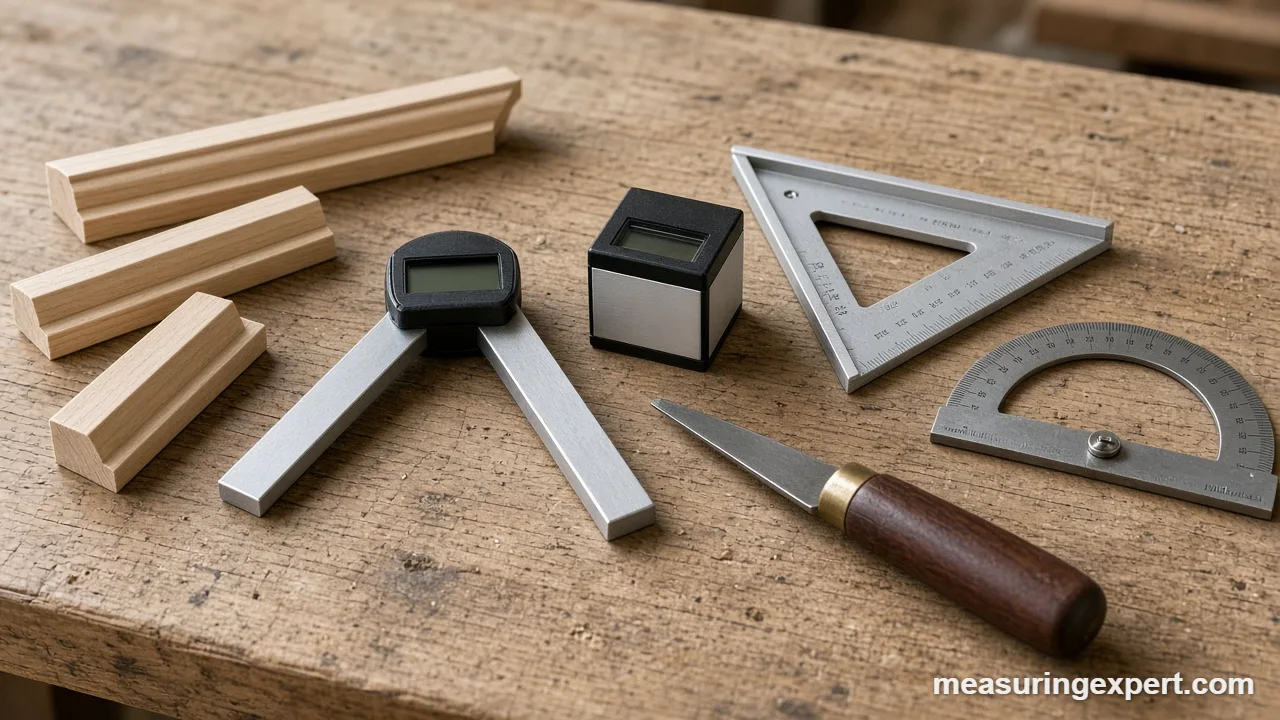
Sources included the Klein Tools product pages for the 935DAF and 935DAA, the Bosch GAM 270 MFL page, PEC, Stanley, Swanson, Johnson and Mitutoyo listings. For unit definitions, we used the NIST Guide to the SI, which defines 1 degree as pi/180 radian.
Angle Tool Types Compared
Basically, every angle tool answers one of three questions. Does it read tilt against gravity, the angle between two faces, or simply store an angle? So pick the question first, and the type follows. For a broader overview, read our guide to tools for measuring angles.
| Type | What it reads | Typical reading | Best use | Deep dive |
|---|---|---|---|---|
| Digital angle finder | Angle between two arms | 0.1 degree display | Corners, trim, miters | Angle gauges |
| Digital bevel gauge | Tilt vs gravity or a zeroed surface | 0.1 degree display | Saw blades, conduit | Magnetic angle finders |
| Inclinometer | Tilt vs gravity | 1 degree (analog) to 0.1 degree (digital) | Slopes, pipe, steel | Inclinometers |
| Protractor | Angle on a printed or vernier scale | 1 degree to 5 minutes | Layout, machining | Protractors |
| Speed square | Degrees and roof pitch | About 1 degree | Framing, rafters | Angle rulers |
| Sliding T-bevel | Nothing; it copies | Exact copy | Repeating odd angles | This page |
| Laser or combination | Angles plus projection or layout | 0.1 degree (Bosch); 1 degree (protractor head) | Site work, bench layout | This page |
Specs That Matter in the Best Angle Measuring Tool
Resolution vs accuracy. First, resolution is the smallest step the display shows, such as 0.1 degree. In contrast, accuracy is how close that number is to the truth, such as plus or minus 0.2 degree. A tool can show tenths and still be off by two tenths, so always look for the accuracy line.
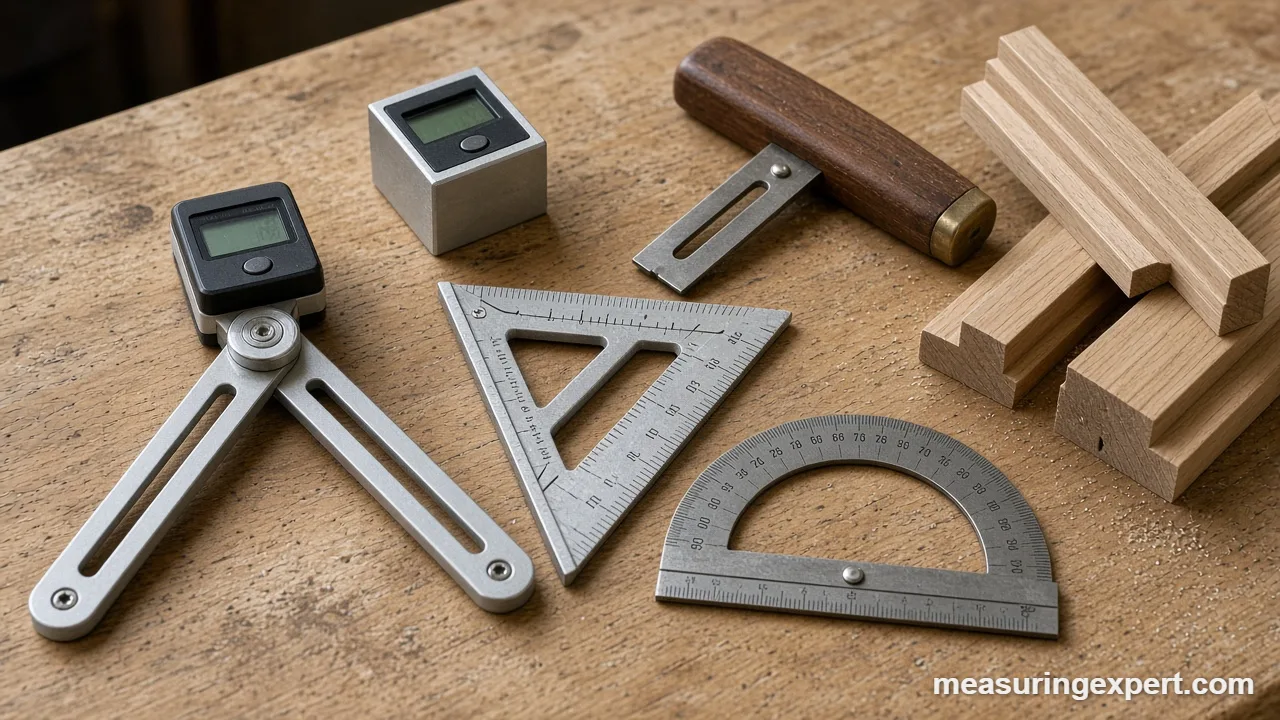
What the error means at length. That matters because small angle errors grow with distance. For example, a 0.2 degree error is about 0.084 in (2.1 mm) over 24 in. Over an 8 ft (96 in) rafter, however, a 1 degree error opens a gap of about 1.68 in (42.6 mm).
Range and units. Generally, most digital tools read 0 to 90 or 0 to 180 degrees. Some also show percent grade or roof pitch, which saves a conversion for ramps and drains. Meanwhile, a vernier protractor reads in degrees and minutes, where 1 minute is 1/60 degree.
Reference. For instance, gravity tools read tilt, so they need a zero or relative mode for an unlevel saw. In contrast, two-arm tools read the angle between faces, so the level of the floor does not matter.
Durability and power. For example, IP54 means protection against dust and splashing water. Also, check the battery type, auto shut-off and backlight. Analog tools skip all of this, which is why many pros carry one as a backup.
Angle, Grade and Pitch Calculator
Your best angle measuring tool may read degrees while a plan lists roof pitch or percent grade. So use this converter to switch between them.
For example, a 6 in 12 roof is 26.57 degrees, a 4 in 12 roof is 18.43 degrees, and a 1:12 ramp is about 4.76 degrees (8.33%).
How to Measure and Cut a Corner with a Digital Angle Finder
Of course, good technique matters as much as the tool. So follow these steps whenever you fit trim to a real corner.
- Clean dust and paint ridges off both faces of the corner.
- Open the arms and press them flat against both walls, near the floor where the trim sits.
- Lock the arms, then read the angle, for example 92 degrees.
- Divide the corner by two to get each piece’s angle, here 46 degrees.
- Subtract that from 90 to get the miter saw setting, here 44 degrees.
- Next, cut both pieces in scrap and dry-fit them in the corner.
- Finally, adjust by a few tenths if needed, then cut the real trim.
Want a non-digital method? Our guide on how to measure angles using a protractor walks through the classic approach.
Calibration and Care for Your Angle Tool
First, check any digital gauge with a reversal test. To do that, set it on a flat surface, note the reading, then turn it 180 degrees in the same spot. If the two readings differ, run the maker’s calibration routine. Similarly, check a square by drawing a line, flipping the square and drawing again; the lines should match.
- First, remove batteries before long storage to avoid leaks.
- Wipe steel blades with a light oil to stop rust.
- Also, store squares flat or hung, so the blade cannot bend.
- Finally, keep magnets clean of steel chips, because they tilt the base.
For a step-by-step routine, see our guide to calibrating angle tools.
Honest Limits of the Best Angle Measuring Tool Types
Above all, no tool on this page fixes a bad reference. For instance, a digital finder on a wavy drywall corner reads the wave, not the wall. In addition, gravity tools read tilt, so on a moving boat or truck the reading drifts. Phone apps are fine for rough checks; however, phone sensors are not calibrated to a known standard. Finally, wood moves with humidity, so a joint cut to 0.1 degree can still open a little by next season.
Best Angle Measuring Tool FAQ
What is the best angle measuring tool for woodworking?
For most woodworkers, a digital angle finder like the Klein 935DAF is the best angle measuring tool for corners, while a magnetic bevel gauge is better for setting saw blades.
What is the most accurate angle measuring tool?
Among the tools here, the Mitutoyo universal bevel protractor reads finest, at 5 minutes. For digital tools, the Bosch GAM 270 MFL lists plus or minus 0.1 degree.
What is the difference between an angle finder and an inclinometer?
First, an angle finder measures the angle between its two arms. An inclinometer measures tilt relative to gravity, so it needs only one surface.
Is a speed square accurate enough for trim?
Usually not. For example, a speed square reads to about 1 degree, which is fine for framing. However, trim joints show gaps at that level, so use a digital finder instead.
What does a sliding T-bevel do?
It copies an angle. In other words, you lock the blade to match an existing angle and then transfer it to the saw or workpiece, with no number in between.
How do I convert degrees to roof pitch?
Multiply the tangent of the angle by 12. For example, 26.57 degrees equals a 6 in 12 pitch, and 45 degrees equals 12 in 12.
How do I find the miter angle for a corner?
Divide the measured corner by two, then subtract the result from 90. For example, a 92 degree corner needs a 44 degree saw setting on each piece.
Can I use my phone as an angle measuring tool?
Yes, for rough checks. However, the case and camera bump tilt the phone, and its sensor is not calibrated, so a dedicated tool is more repeatable.
How many minutes are in a degree?
In angle units, there are 60 minutes in 1 degree and 60 seconds in 1 minute. So a 5 minute vernier reads to 1/12 of a degree.
Do I need more than one angle tool?
Most shops benefit from two: a digital finder or bevel gauge for numbers, and a square or T-bevel for marking. That is because no single type does every job well.
Bottom Line: The Best Angle Measuring Tool to Buy
For trim, corners and miters, the Klein Tools 935DAF is the best angle measuring tool for most buyers. That is because it reads the real corner and does the miter math. However, add a Swanson Speed Square for framing, and step up to the Bosch GAM 270 MFL if you cut crown and stairs on site.
3 thoughts on “Best Angle Measuring Tool in 2026: One Top Pick for Each Tool Type”