
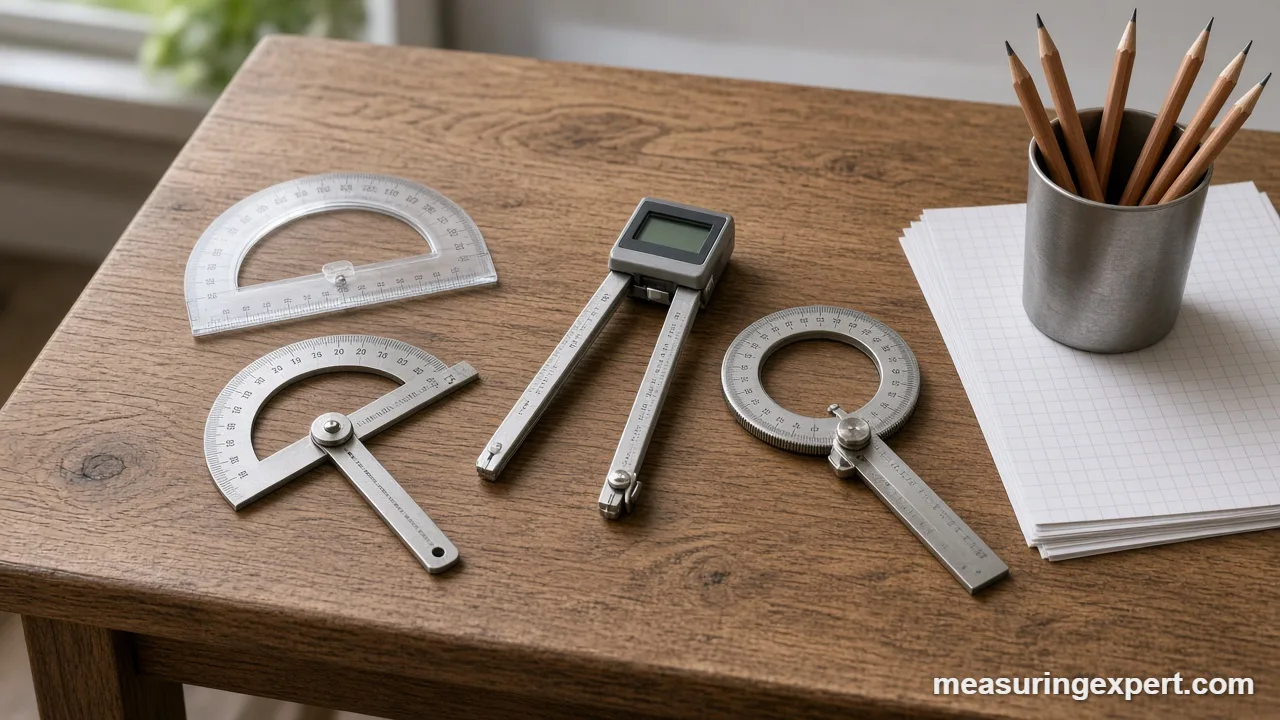
The best protractor for most people is a clear 6 in swing arm model such as the Helix, because it reads and draws angles from 0 to 180 degrees with almost no setup. Beyond school, the job decides the choice: metal for drafting, digital for woodworking, and a vernier bevel protractor for machining.
In short: get the Helix for homework, the Wixey WR410 for saw and trim setup, and the Mitutoyo 187-904 for precision metalwork.
As an Amazon Associate, Measuring Expert earns from qualifying purchases. Our picks are based on research, specifications and owner feedback, not paid placement.
Best Overall

Best Digital

Best Pro Bevel
Quick Answer: The Best Protractor for Each Job
- Homework and tests: Helix swing arm protractor.
- A full school kit: Mr. Pen 15-piece geometry set.
- Drafting and design: STAEDTLER stainless steel math set.
- Woodworking and trim: Wixey WR410 digital protractor.
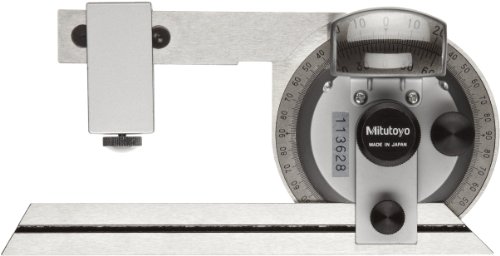
- Machining and inspection: Mitutoyo 187-904 bevel protractor.
On This Page
- Comparison table
- The 8 picks, reviewed
- How we chose
- Protractor types compared
- Specs that matter
- Angle converter
- How to measure an angle
- Accuracy checks and care
- Do and don’t
- Honest limits
- FAQ
- Bottom line
Best Protractor Comparison Table
| # | Product | Best For | Standout Feature | Amazon |
|---|---|---|---|---|
| 1 | Helix Swing Arm Protractor, 180 Degree | Homework, tests and everyday geometry | Clear 180 degree scale with a rotating swing arm | View |
| 2 | Mr. Pen Geometry Set, 15 Piece | A complete set for middle and high school | 6 in swing arm protractor plus compass and rulers | View |
| 3 | STAEDTLER Stainless Steel Math Set | Drafting, design and college courses | Stainless 6 in protractor, 12 in ruler and two set squares | View |
| 4 | Mr. Pen Metal Protractor and Compass Set | Durable basics on a small budget | Metal protractor plus metal compass | View |
| 5 | Wixey WR410 8 in Digital Protractor | Woodworking, trim and miter setup | 0.1 degree resolution with a set-miter mode | View |
| 6 | Mitutoyo 187-904 Universal Bevel Protractor | Machining, inspection and metal layout | 6 in blade with 5 minute vernier resolution | View |
| 7 | General Tools Stainless Steel Protractor | Layout and angle checks in a home shop | Stainless head and arm, 0 to 180 degree scale | View |
| 8 | Saker 7 in Aluminum Miter Saw Protractor | Crown, baseboard and miter cuts | 7 in aluminum arms that fold to read a corner | View |
The 8 Best Protractor Picks, Reviewed
Each best protractor pick below suits a different user, from a fourth grader to a toolmaker. So, we ranked by how many people each tool fits, not by price.
Best Overall
1. Helix Swing Arm Protractor
Best for: students, teachers and parents who want one clear, simple tool that reads angles quickly and also helps draw them.
For most people, the best protractor is a plain half-circle model, and the Helix swing arm version improves that design in one useful way. Here, a pivoting arm is fixed at the center point, so you swing it to the angle you want and read the scale where the arm crosses it. As a result, you do not need to lay a separate ruler along the second ray, and the tool is less likely to slip while you mark the point.
Moreover, Helix is a long-running UK maker of school math sets, and this protractor is transparent, so the lines on your page stay visible under the scale. In addition, the 180 degree range covers every angle in a typical geometry course. For example, for a reflex angle over 180 degrees, measure the smaller angle and subtract it from 360.
- Range: 0 to 180 degrees (half circle)
- Swing arm pivots from the center point
- Transparent body so the drawing shows through
- Graduation: 1 degree marks, the usual school standard
Pros
- Swing arm makes drawing an angle a one-tool job
- Clear plastic lets you line up the baseline
- Light, so it fits any pencil case
- Simple scale that young students learn fast
Cons
- Plastic scratches and can warp if left in heat
- Only 1 degree marks, so it is not a shop tool
- No compass or ruler in the box
Skip it if: you need a full kit for a new school year; instead, the Mr. Pen geometry set below adds a compass, rulers and triangles.
Best Student Kit
2. Mr. Pen 15-Piece Geometry Set

Best for: middle and high school students who need angle, circle and line tools in one case.
Next, if a teacher hands you a supply list, this set probably covers it. In fact, Mr. Pen lists it as a 15 piece kit built around a 6 inch swing arm protractor, and it adds a compass and other drawing tools.
Also, the protractor works the same way as the Helix: the arm pivots from the center, so you can read and draw an angle without moving the tool. However, budget kits vary in finish, so check the compass hinge when it arrives and tighten it if it feels loose. After all, a loose compass leg drifts while you draw, and that error shows up later in constructions.
- Protractor: 6 in swing arm style
- Set size: 15 pieces per Mr. Pen’s listing
- Includes a drawing compass
- Built for standard school geometry work
Pros
- Covers a typical geometry supply list
- Swing arm protractor speeds up angle drawing
- Low cost per tool, because the set is bundled
Cons
- Plastic parts are not as stiff as metal
- Compass is basic, so check the hinge
- Some pieces may go unused in lower grades
Skip it if: you only need the protractor itself; in that case, the Helix alone is simpler and takes less space.
Best for Drafting
3. STAEDTLER Stainless Steel Math Set

Best for: drafting students, designers and engineers who want metal tools that keep a straight, clean edge.
First, STAEDTLER is a German drawing-instrument brand, and this set swaps soft plastic for stainless steel. According to its listing, it includes a 12 in ruler, two triangle set squares (45/90 and 30/60 degree) and a 6 in protractor. As a result, it covers clean drafting work in one kit.
Also, metal has two real advantages for drafting. First, the edges do not nick when a pen or blade runs along them. Second, the scale does not warp in a hot car or under a lamp, so 90 degrees stays 90 degrees. On the other hand, you cannot see through steel, so you must align the baseline by eye along the edge rather than through the tool.
- Material: stainless steel
- Protractor: 6 in
- Ruler: 12 in
- Set squares: 45/90 and 30/60 degree
Pros
- Edges stay straight for inking and cutting
- Stays flat in heat because it is steel
- Two set squares give fast standard angles
- Trusted drawing-tool brand
Cons
- Not transparent, so aligning takes more care
- Metal can slide on glossy paper
- Heavier than plastic, so it is less handy in a backpack
Skip it if: you are buying for a young child; after all, clear plastic is easier to line up and safer to drop.
Best Budget Metal
4. Mr. Pen Metal Protractor and Compass

Best for: students who break plastic tools and want a sturdier pair of basics for little money.
Meanwhile, plastic protractors tend to crack at the thin center notch, especially in a crowded backpack. Fortunately, this Mr. Pen pair solves that with a metal protractor and a metal compass.
A metal protractor still reads whole degrees. In other words, its benefit is durability, not finer resolution. So, if you need tenths of a degree, look at the digital or bevel picks further down.
- Metal protractor with a 0 to 180 degree scale
- Metal drawing compass included
- Two-piece set sized for a pencil case
- Graduation: whole degrees
Pros
- Survives drops and backpacks better than plastic
- Compass holds a radius well for the price
- Very low cost
Cons
- Not see-through, so align by the edge
- No ruler or set squares
- Edges can be sharp on budget metal parts
Skip it if: you need set squares and rulers too; instead, the STAEDTLER metal set is more complete.
Best Digital
5. Wixey WR410 Digital Protractor
Best for: woodworkers and trim carpenters who want to read an angle on a digital display and transfer it straight to a saw.
First of all, a digital protractor replaces the printed scale with an electronic angle sensor and an LCD. Wixey lists the WR410 at 0.1 degree resolution and plus or minus 0.1 degree accuracy, and it runs on a CR2032 coin cell with automatic shutoff. In practice, that is roughly ten times finer than reading a 1 degree school scale by eye.
Equally useful, the WR410 has a set-miter function. For example, you can measure the corner of a wall, and the tool shows the miter setting you need for each half of the joint. As a result, trim carpenters save a step at every corner. For tools that only read tilt from level, see our angle gauge guide.
- Resolution: 0.1 degree (per Wixey)
- Accuracy: plus or minus 0.1 degree (per Wixey)
- Size: about 2 in wide x 9 in long
- Power: CR2032 battery with auto shutoff
- Set-miter mode for corner joints
Pros
- Reads tenths of a degree without squinting
- Miter mode removes the divide-by-two step
- Long legs span real wall corners
- Coin cell lasts a long time with auto shutoff
Cons
- Needs a battery, so keep a spare
- Overkill for school geometry, because 1 degree is enough there
- Electronics dislike drops and sawdust
Skip it if: you work on paper; instead, a clear plastic protractor is faster and needs no battery.
Top Bevel Pick
6. Mitutoyo 187-904 Universal Bevel Protractor
Best for: machinists, toolmakers and inspectors who need to measure bevels and chamfers to a fraction of a degree.
To begin with, a universal bevel protractor is a precision tool with a stock, a sliding blade and a rotating dial. In this case, Mitutoyo lists this model with a 6 in blade and 5 minute vernier resolution. For reference, five arc-minutes equals 1/12 of a degree, or about 0.083 degree, so the vernier lets a trained eye read well past the 1 degree main scale.
Because the blade slides and locks at any angle, it can check the bevel on a cutting tool, the chamfer on a shaft, or the taper on a fixture. In short, it suits metal parts, although a vernier takes practice to read. To learn how the parts work together, read our guide to what a bevel protractor is.
- Type: universal bevel protractor with vernier
- Blade: 6 in (152 mm)
- Resolution: 5 minutes (1/12 degree), per Mitutoyo’s listing
- Blade slides and locks for inside and outside angles
Pros
- Finest mechanical resolution in this list
- No battery, so it works anywhere
- Mitutoyo build quality and parts support
- Measures bevels a flat protractor cannot reach
Cons
- Expensive, so it rarely pays off for home use
- Vernier reading has a learning curve
- Heavier and slower than a digital tool
Skip it if: you only set saw angles in a woodshop; instead, the Wixey is easier and still accurate for wood.
Top Shop Pick
7. General Tools Stainless Steel Protractor

Best for: DIYers and metalworkers who want a tough, battery-free tool with an arm for marking angles on stock.
Above all, General Tools is a long-established US maker of layout tools, and this stainless protractor sits between a school protractor and a bevel protractor. Specifically, it has a head with a 0 to 180 degree scale and an arm that you set to the angle, then use as a straightedge to scribe a line.
Because it is steel, it survives a toolbox and works with a scribe as well as a pencil. On the other hand, it reads to whole degrees, and its accuracy depends on how carefully you line up the arm with the scale. For more angle tools built for the shop, see our angle protractor roundup.
- Material: stainless steel
- Range: 0 to 180 degrees
- Arm doubles as a straightedge for marking
- No battery required
Pros
- Tough enough for a toolbox because it is steel
- Arm makes marking angles on stock easy
- Readable etched scale
- Low cost for a metal shop tool
Cons
- Whole-degree resolution only
- Arm lock can loosen over time
- Not clear, so it hides the work below
Skip it if: you need tenths of a degree; therefore, choose the Wixey or the Mitutoyo.
Best for Trim Work
8. Saker Miter Saw Protractor

Best for: DIYers installing baseboard, crown or picture frames who need to read a corner and set a miter saw.
Finally, a miter saw protractor is built for one job: reading the angle of a real corner. For its part, Saker lists this one as a 7 in aluminum angle finder. First, you open its two legs against the walls; then you lock them and read the angle. Besides that, most miter protractors of this style also carry a scale that converts the corner angle into the saw setting, so check the markings before your first cut.
This matters, because walls are rarely a true 90 degrees. For example, if a corner reads 92 degrees, each piece of trim needs a 46 degree cut, not 45. In short, that 1 degree difference is the gap you see in a sloppy joint.
- Size: 7 in legs
- Material: aluminum
- Opens and locks against inside or outside corners
- Battery-free analog scale
Pros
- Reads real corners, not ideal ones
- Aluminum is light and also rust resistant
- No battery to die mid-job
- Low cost compared with digital tools
Cons
- Analog scale is harder to read than an LCD
- Short legs, so long, wavy walls can mislead it
- No use for schoolwork
Skip it if: you trim many rooms a year; instead, the Wixey reads faster and does the miter math for you.
How We Chose the Best Protractor Picks
To be clear, we did not run hands-on tests. Instead, our best protractor picks are research-based. First, we sorted protractors by job: school geometry, drafting, woodworking and precision metalwork. Next, we looked for established brands with clear product listings and a long record in drawing or measuring tools.
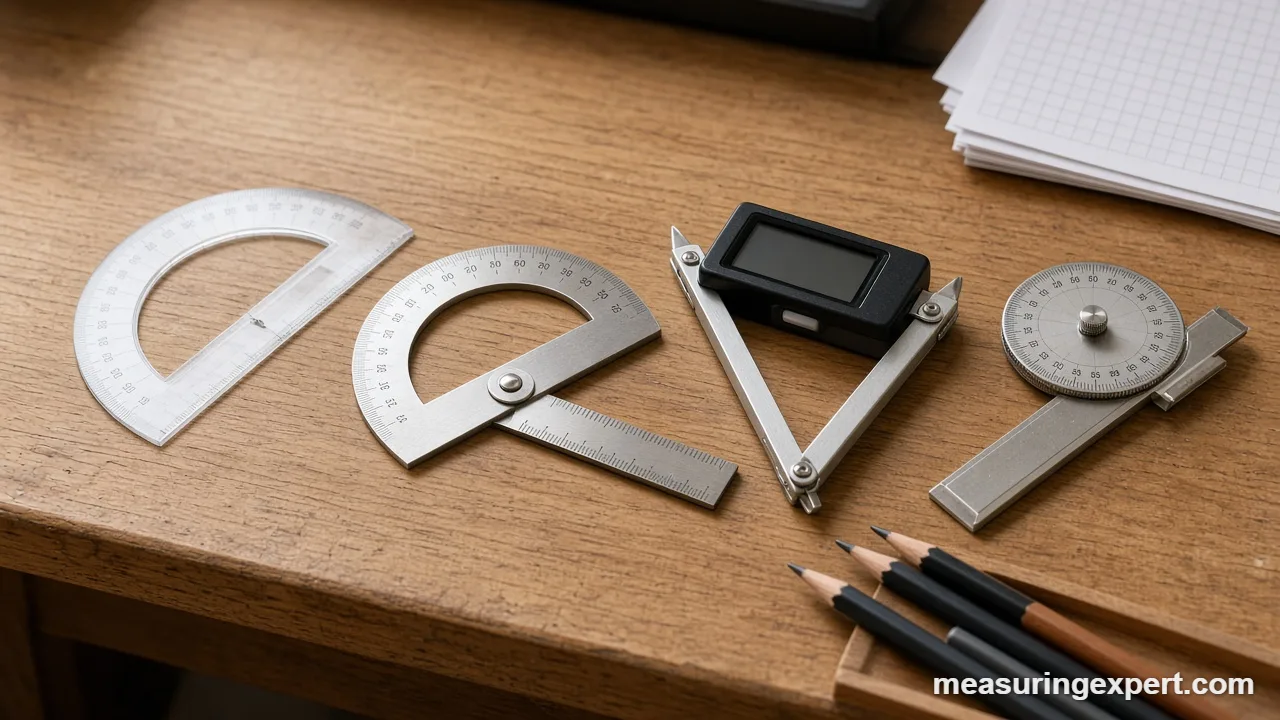
After that, we compared the specs that change a reading: scale range, graduation, resolution, material and how the tool sits on the work. Where a maker published accuracy, such as Wixey’s digital protractor page, we used that figure. Otherwise, where a spec was not published, we left it out. Finally, we kept no more than two picks per brand and dropped near-duplicates, so every tool here earns its place.
- Fit for the job: does the scale and form suit the work?
- Readability: clear marks, a sharp center point, or a legible display.
- Durability: resistance to warping, cracking and wear.
Protractor Types Compared
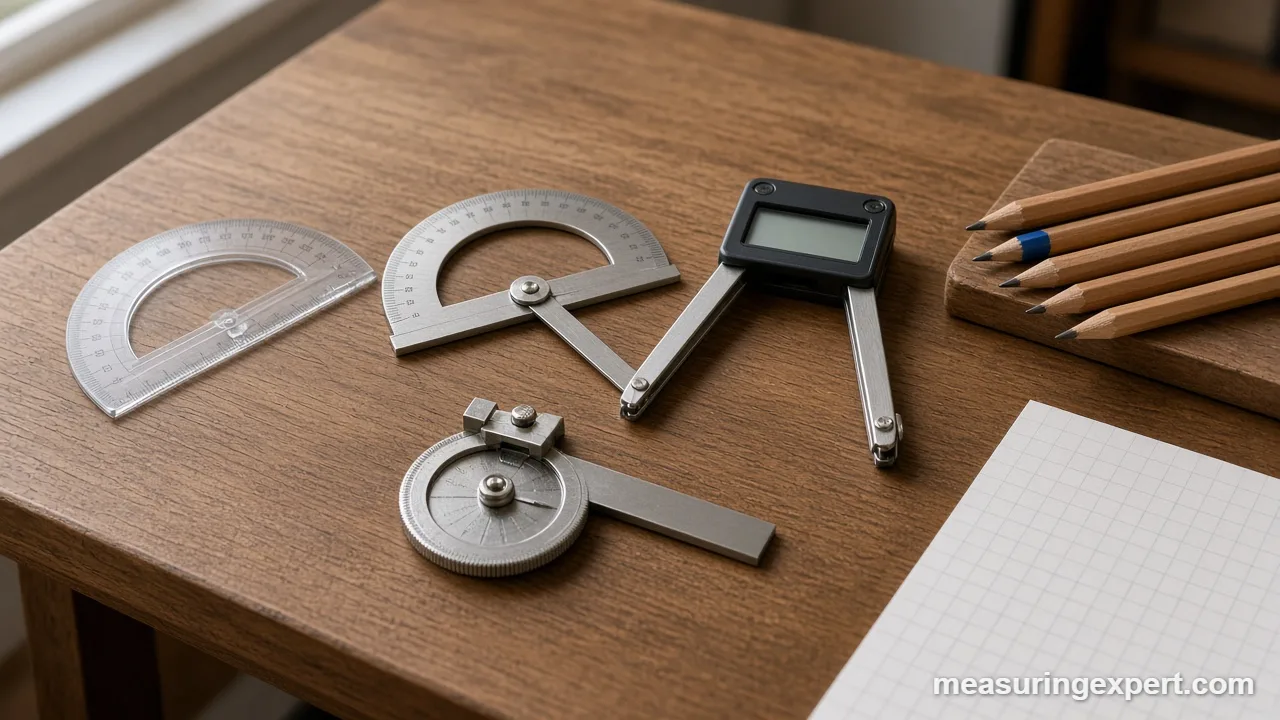
The best protractor for you depends on the type of work, because the word covers several quite different tools. Therefore, the table below shows how they differ.
| Type | Typical resolution | Range | Best use |
|---|---|---|---|
| Half-circle school protractor | 1 degree | 0-180 degrees | Homework, tests, sketching |
| Full-circle drafting protractor | 1 degree or 0.5 degree | 0-360 degrees | Drafting, navigation charts, pie charts |
| Swing arm protractor | 1 degree | 0-180 degrees | Drawing angles quickly |
| Steel head-and-arm protractor | 1 degree | 0-180 degrees | Layout on wood and metal stock |
| Miter saw protractor | 1 degree or 0.5 degree | Inside and outside corners | Trim, baseboard, crown |
| Digital protractor | 0.1 degree | Model dependent | Saw setup, woodworking, metal fabrication |
| Vernier bevel protractor | 5 arc-minutes (1/12 degree) | Full circle in quadrants | Machining, inspection, tool grinding |
In addition, note what a protractor is not. An inclinometer or digital angle gauge reads tilt against gravity, whereas a protractor reads the angle between two lines or faces. Both are useful; however, they answer different questions.
Specs That Make the Best Protractor for Your Work
Resolution Versus Accuracy in the Best Protractor
Resolution is the smallest step the tool shows. In contrast, accuracy is how close that reading is to the true angle. For example, a display can show 0.1 degree steps and still be off by 0.1 degree, which is why Wixey lists both numbers. Similarly, a plastic protractor has 1 degree marks, yet a warped one can be wrong by more than a degree.
Why small angle errors matter
Angle errors grow with distance. For instance, a 1 degree error over a 12 in (305 mm) board moves the end about 0.21 in (5.3 mm). Then, over 36 in (914 mm), the same error grows to about 0.63 in (16 mm). Therefore, the best protractor for long trim and framing work is a finer tool than the one you use on paper.
Material and units
Clear plastic is easy to line up but can warp in heat. By contrast, stainless steel stays flat and survives a toolbox. As for units, nearly every protractor reads degrees. In theory, one full turn is 360 degrees, which equals 2 pi radians, and NIST lists the radian as the SI unit of plane angle.
Angle Converter: Degrees, Grade and Pitch
Meanwhile, builders often need a protractor reading in another form. For instance, a roofer talks in pitch and a road engineer in percent grade. So, enter an angle below to convert it.
In fact, the math is simple: grade equals tan(angle) x 100, and pitch equals tan(angle) x 12. Likewise, to convert degrees to radians, multiply by pi/180.
How to Measure an Angle With a Protractor
In general, these steps work for any flat protractor, from a school model to a steel shop tool. For a longer walkthrough with diagrams, see our guide on how to measure angles using a protractor.
- Draw or find the vertex. Mark the point where the two rays of the angle meet. Then extend short rays with a ruler so they reach past the edge of the scale.
- Place the center mark. Put the protractor’s center hole or crosshair exactly on the vertex. After all, even a 1 mm shift moves the reading on a small protractor.
- Align the baseline. Turn the protractor so its zero line runs along one ray. Look straight down through the scale to avoid parallax.
- Pick the right scale. Follow the scale that starts at 0 on your baseline ray. Use the inner scale if 0 sits on the inner ring, and the outer one if it sits outside.
- Read where the second ray crosses. Read the number where the other ray crosses the scale. Also, if it falls between marks, estimate to the nearest half degree.
- Sanity check the result. Compare the reading with your eye. An acute angle must read under 90 degrees and an obtuse angle over 90, so a wrong scale shows up at once.
Accuracy Checks and Care
Even the best protractor drifts or wears eventually, so check yours now and then. Fortunately, you do not need a lab for this. Instead, a good carpenter’s or machinist’s square gives you a reliable 90 degrees, and a 45/90 set square gives you 45 degrees.
- First, lay the protractor on the square and read the 90 degree mark.
- Next, repeat at 45 degrees with a set square.
- Then, for a digital tool, zero it on a flat surface, flip it and read again.
- Finally, write down any error and correct for it, or replace a warped plastic tool.
In addition, store plastic protractors flat and away from heat, wipe steel tools with a light oil film, and keep the battery fresh in a digital model. Our guide to calibrating angle tools covers the full process.
Do and Don’t
Do:
- Extend short rays with a ruler first, so they cross the scale.
- Look straight down on the scale to avoid parallax.
- Use a sharp pencil or a scribe, because thick lines hide the vertex.
Don’t:
- Read from the scale that does not start at 0 on your baseline.
- Leave a plastic protractor on a car dashboard, because heat warps it.
- Trust a digital reading after a hard drop without a check.
- Pay for vernier precision if the best protractor for your needs is a school model.
Honest Limits
Even the best protractor cannot fix a poor setup. For example, a thick pencil line can be 0.5 mm wide, and that alone can shift a reading on a small scale. Likewise, a digital protractor reads the angle between its own legs, so a bowed wall or a bump of drywall mud changes the result.
Also, even the best protractor on a budget can arrive with a slightly off-center mark, so check yours against a square on day one.
Best Protractor FAQ
What is the best protractor for school?
For most students, a clear 6 in half-circle protractor with a swing arm is the best protractor for school. It reads 0 to 180 degrees in 1 degree steps, shows the drawing through the scale, and the arm helps draw angles. For example, the Helix swing arm model fits that description.
What is the best protractor for woodworking?
A digital protractor such as the Wixey WR410 is the best protractor for most woodworking because it reads 0.1 degree and can give you a miter setting directly. On the other hand, a simple aluminum miter protractor is a cheaper choice for occasional trim jobs.
What is the best protractor for drafting?
For drafting, a metal set with a protractor, a straight ruler and 45/90 and 30/60 set squares works best. Also, steel edges stay straight for inking and cutting, and they do not warp in heat like thin plastic.
Is a digital protractor the best protractor for accuracy?
Not always. A digital protractor reads 0.1 degree, which is easy to use. However, a vernier bevel protractor reads 5 arc-minutes, about 0.083 degree, with no battery. For machining and inspection, the vernier tool is usually the more trusted choice.
How accurate is a plastic school protractor?
Typically, a school protractor has 1 degree marks, so a careful reader can usually estimate to about half a degree. Parallax, a thick pencil line and a worn center mark add error, so expect about 1 degree in everyday use.
What is the difference between a protractor and a bevel protractor?
A standard protractor is a flat printed scale. In contrast, a bevel protractor adds a stock and a sliding, lockable blade, often with a vernier, so it can measure bevels and chamfers on solid parts to a fraction of a degree.
Why does a protractor have two scales?
In short, the inner and outer scales run in opposite directions so you can measure an angle that opens to the left or the right. So, always use the scale that reads 0 on your baseline ray.
How do I measure an angle larger than 180 degrees?
Measure the smaller angle on the other side of the vertex, then subtract it from 360. For example, if the inside angle reads 130 degrees, the reflex angle is 360 – 130 = 230 degrees.
How many radians is a degree?
One degree equals pi/180 radians, about 0.01745 rad. As a result, 30 degrees is about 0.5236 rad, and 90 degrees is pi/2, about 1.5708 rad.
How do I check if my protractor is accurate?
Check it against a known angle. For example, a good square gives 90 degrees, and the two acute angles of a 45/90 set square give 45 degrees. If the reading is off, note the error, or replace a plastic protractor that has warped.
Bottom Line on the Best Protractor
For most readers, the Helix Swing Arm Protractor is the best protractor to buy. Above all, it is clear, simple and quick, and its arm turns measuring and drawing into one step. Then add the Mr. Pen set if you also need a compass and rulers.
Outside the classroom, however, match the tool to the material. The Wixey WR410 suits wood and trim, the STAEDTLER set suits drafting, and the Mitutoyo 187-904 suits metal parts that must be right to a fraction of a degree. Finally, whichever you choose, put the center on the vertex, read the right scale, and check it against a square now and then.
3 thoughts on “Best Protractor for School, Drafting, Digital and Bevel Work (2026)”