


A bevel protractor is a precision angle tool with a flat stock, a sliding blade and a rotating degree dial. You set the stock on one surface, swing the blade onto the other, lock it, and read the angle. On vernier models, a second small scale splits each degree into 5-minute steps (1/12 of a degree).
Have you ever tried to check a chamfer or a dovetail with a school protractor? Then you know the problem. For one thing, the plastic half-circle has no long straight edge to sit on the part. Also, its marks are too coarse to trust. A bevel protractor, by contrast, solves both issues. It has a solid stock that rests against the work and a long steel blade that reaches across it. In addition, its scale is fine enough for shop inspection.
How a Bevel Protractor Works in Brief
Here is the short version of how a bevel protractor works. The stock and the dial body are one piece, while the blade clamps to a rotating turret. When you swing the blade, the turret turns inside the dial. As a result, an index line or vernier scale moves along the degree marks. In other words, the angle between the stock edge and the blade edge is the reading. Because the blade can slide and reverse, one tool measures inside and outside angles all the way around the circle. Both the blade and the dial lock, too. So you can set an angle once and transfer it to another part.
In short: think of it as a protractor built like a machinist’s square. Its vernier reads twelve times finer than the main scale.
The fine reading is not marketing language. Starrett is a long-established US tool maker. Its catalog page for the 359 universal bevel protractor states that the vernier reads to 5 minutes, or 1/12 of a degree. Also, the US National Institute of Standards and Technology (NIST) covers angle units in its guide to units used with the SI. There, one minute of arc is defined as 1/60 of a degree.
Next, you will find an angle converter and the parts of the tool. After that come a worked vernier example and steps for a clean reading.
Convert a Bevel Protractor Reading to Grade or Pitch
Enter the angle you read in degrees. The converter then shows the same slope as a percent grade and as a roof pitch. Pitch here means rise per 12 units of run. If you have minutes, divide them by 60 first: 41 degrees 20 minutes is 41.333 degrees.
Recommended Tools for Measuring Angles
For machining and inspection, a vernier universal protractor from an established maker is the classic choice. Woodworkers, however, often do better with a digital protractor or a sliding T-bevel. After all, they mostly transfer angles rather than inspect them. In between sits a protractor head for a combination square, which gives you a degree scale on a steel rule. So pick the tool that matches the job, not the most expensive one.
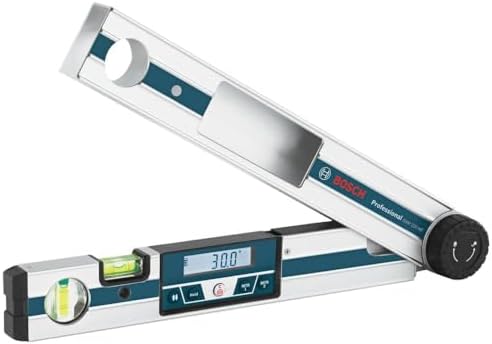


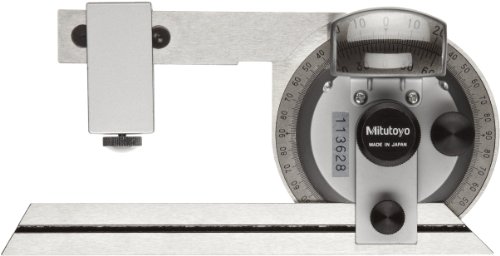
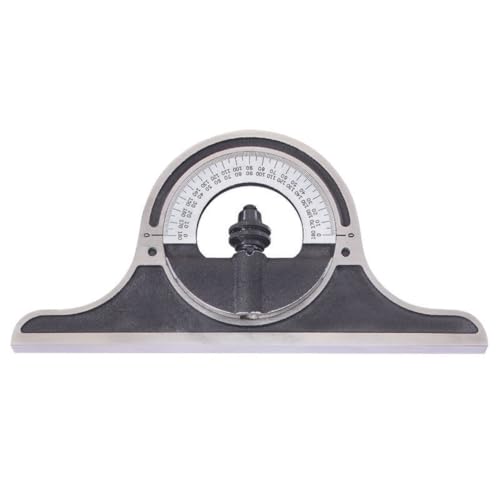
As an Amazon Associate, Measuring Expert earns from qualifying purchases.
Key Takeaways
- A bevel protractor measures the angle between two flat surfaces using a stock, a blade and a degree dial.
- Vernier models read to 5 minutes of arc, which is 1/12 of a degree.
- The main dial reads 0 to 90 degrees each way. Therefore, decide whether the true angle is the reading or 180 minus it.
- Digital models show the angle on a screen and often switch between degrees and decimal formats.
- A sliding T-bevel copies an angle but has no scale; this tool measures it.
- Clean, burr-free surfaces matter more than the tool’s resolution.
- Check the tool against a known square or angle block before critical work.
Parts of a Bevel Protractor
Overall, every universal model shares the same basic layout. Once you know what each part does, the readings start to make sense.
- Stock (body). The fixed, flat edge that rests against your reference surface. It also carries the main degree dial.
- Main scale (dial). Graduated in whole degrees and usually marked 0-90-0-90. So it reads up to 90 degrees on either side of zero.
- Turret (disc). The rotating center part. It carries the blade clamp and the vernier scale, so it turns whenever you move the blade.
- Blade. A hardened steel straightedge that slides through the clamp and can be reversed. Common lengths are about 6, 7 and 12 inches (150, 175 and 300 mm).
- Vernier scale. A short scale on the turret with 12 divisions on each side of zero. It splits one degree into 5-minute steps.
- Locks. One knob locks the blade in its clamp; another locks the turret to the dial. As a result, you can set an angle and carry it to another part.
- Acute angle attachment. An optional edge that bolts to the stock. It reaches small, sharp angles the stock alone cannot.
Types of Bevel Protractor Compared
There are four common designs, and each one fits a different kind of work. The table below, therefore, sums up how they differ.
| Type | How you read it | Typical resolution | Best for |
|---|---|---|---|
| Plain (simple) model | Index line on a degree dial | 1 degree | General layout, quick checks |
| Vernier (universal) bevel protractor | Main scale plus vernier | 5 minutes (1/12°) | Machining, inspection, tool rooms |
| Digital model | LCD screen | Varies by model; check the spec sheet | Fast readings, poor light, decimal output |
| Optical model | Magnified internal scale | Finer than vernier on some models | Lab and calibration work |
For most shops, the vernier type is the reference. It needs no battery and lasts for decades with basic care. Also, its 5-minute resolution suits most mechanical drawings. A digital model, by contrast, is quicker to read. It also avoids the “which side of zero?” question. However, you then depend on the battery and on the electronics staying calibrated.
How to Read a Bevel Protractor Vernier Scale
The vernier is the part that confuses most beginners, yet the idea is simple. On the Starrett 359, for example, 12 vernier divisions span the same distance as 23 degrees on the main dial. So each vernier division is 23/12 = 1 11/12 degrees. That is exactly 1/12 of a degree (5 minutes) short of 2 degrees. Because of that small difference, only one vernier line at a time lines up with a main-scale line. Its number tells you how many 5-minute steps to add.
Here is a worked example. First, read the whole degrees: the vernier zero has passed the 41-degree mark on the main scale. Next, look along the vernier on the same side as the direction you moved. Suppose the line marked 20 (the fourth line) lines up best with a main-scale line. That adds 4 x 5 = 20 minutes. Therefore, the reading is 41 degrees 20 minutes, or 41.333 degrees in decimal form.
| Step | What you see | Value |
|---|---|---|
| Main scale | Vernier zero just past 41 | 41° |
| Vernier | Fourth line (marked 20) aligns | +20′ |
| Reading | 41° + 20′ | 41° 20′ (41.333°) |
| Supplement, if needed | 180° – 41° 20′ | 138° 40′ |
The last row matters because the dial only reads to 90 degrees on each side. Consequently, 138 degrees 40 minutes and 41 degrees 20 minutes look identical on the scale. So look at the part and decide which one you are measuring. For a refresher on angle names, see our guide to types of angles.
How to Use a Bevel Protractor Step by Step
- Clean the part and the tool. Wipe chips, oil and dust off both surfaces, and remove any burr from the edges you will measure.
- Check zero. Close the blade flat against the stock or a surface plate. Then confirm the vernier zero lines up with the main-scale zero.
- Loosen both locks. Free the blade clamp and the turret lock so the blade slides and rotates smoothly.
- Seat the stock. Press the stock firmly against the reference surface of the part, with no light showing underneath.
- Bring the blade onto the second surface. Rotate and slide the blade until it touches along its full length. Then hold the part up to a light to check for gaps.
- Lock the turret. Tighten the dial lock so the angle cannot change while you read it.
- Read the scales. Note the whole degrees and add the vernier minutes. Then decide if the true angle is the reading or 180 degrees minus it.
- Record and repeat. Write the value down, then take a second reading at another spot on the part to confirm it.
Bevel Protractor vs Similar Angle Tools
Several tools measure or copy angles, so people mix them up all the time. The key difference is whether the tool measures relative to another surface or relative to gravity.
| Tool | Measures against | Gives a number? | Typical use |
|---|---|---|---|
| Bevel protractor | A second surface (stock edge) | Yes, in degrees and minutes | Angles on parts, layouts, setups |
| Sliding T-bevel | A second surface | No; it only copies | Transferring angles in carpentry |
| Inclinometer or digital angle gauge | Gravity (level) | Yes | Saw blade tilt, slopes, alignment |
| Sine bar with gauge blocks | Calculated from a height | Yes, very precisely | Inspection and setting precise angles |
| School protractor | A drawn line | Yes, about 1 degree | Drawings and geometry |
In practice, a sine bar works differently from a bevel protractor. Instead of reading a scale, you stack gauge blocks under one roller. Then you calculate the angle from the block height and the bar length. That method is slower, but it can reach much finer accuracy. For that reason, tool rooms use it to set or check precise angles. For tilt measured against gravity, our article on how a clinometer measures angles covers the gravity-based approach.
Where This Tool Is Used in Practice
The tool started in machine shops. Today, however, it shows up anywhere an angle is measured against a straight edge.
- Machining and tool rooms. Checking chamfers, tapers, dovetail slides and cutter angles against a drawing.
- Quality inspection. Verifying that formed or welded parts meet the angle tolerance on the print.
- Metal fabrication and welding. Setting and checking bevels on plate edges before welding.
- Woodworking. Measuring an existing angle on furniture or trim, then setting a miter saw or T-bevel to match.
- Layout work. Marking accurate angles on flat stock with the tool laid flat.
Meanwhile, if you only need a rough angle on paper, a standard protractor is enough. Our guide on measuring angles with a protractor walks through that simpler method.
Do and Don’t for Clean Angle Readings
Do
- Clean and deburr surfaces before measuring.
- Check zero before each session.
- Lock the turret before reading.
- Read the scale square on, not at an angle.
- Store the tool in its case, lightly oiled.
Don’t
- Force the blade if it binds.
- Measure over burrs, paint drips or chips.
- Forget to decide between the reading and its supplement.
- Drop the tool or use it as a scraper.
- Assume a digital screen is right without a zero check.
Honest Limits: Resolution vs Accuracy
First of all, resolution is not the same as accuracy. A 5-minute vernier tells you how finely you can read the scale. It does not tell you how close the reading is to the true angle. For scale, 5 minutes of arc is about 0.00145 radians. That step equals roughly 0.44 mm of offset at the end of a 300 mm blade, or about 0.017 inch over 12 inches. Meanwhile, a tiny burr or a rocking stock can easily add more error than that. In addition, readings depend on your eyesight and lighting, and two people can judge vernier alignment slightly differently. Digital models remove the reading problem, but they bring battery and sensor drift instead. Therefore, check the tool against a precision square or an angle block before tight-tolerance work. Our guide to calibrating angle tools explains simple checks you can do yourself.
When to Call a Professional
This tool is ideal for shop checks, but some jobs need more. For example, aerospace and medical parts often need formal inspection. Tolerances tighter than a few minutes of arc are another case. These jobs usually call for a sine bar, an optical comparator or a coordinate measuring machine run by a trained inspector. Likewise, your protractor may fail a zero check or read differently at different angles. In that case, send it to an accredited calibration lab instead of adjusting it yourself.
Frequently Asked Questions
What is a bevel protractor used for?
It measures the angle between two flat surfaces, such as a chamfer, taper or dovetail. You can also lock it at an angle and transfer that angle to another part or to a layout.
How does a bevel protractor work?
The stock rests on one surface and the blade swings onto the other. As the blade turns, the turret moves an index or vernier along a degree dial. The angle between stock and blade is the reading.
How accurate is a bevel protractor?
Vernier models read to 5 minutes of arc, or 1/12 of a degree. Real accuracy also depends on clean surfaces, a good zero and careful reading. So check the tool against a known angle.
What is the least count of a vernier bevel protractor?
The least count is 5 minutes. Twelve vernier divisions span 23 degrees on the main scale, so each one is 1/12 of a degree short of 2 degrees.
What is the difference between a bevel protractor and a sine bar?
A bevel protractor reads an angle directly from a scale. A sine bar sets or checks an angle with gauge blocks under one roller. It is slower but much more precise.
Is a bevel protractor the same as a sliding T-bevel?
No. A sliding T-bevel has no scale; it only copies an angle from one place to another. A protractor measures the angle and gives you a number.
Can it measure obtuse angles?
Yes. The dial reads 0 to 90 degrees on each side. So for an obtuse angle, subtract the reading from 180 degrees. For example, a reading of 41 degrees 20 minutes can mean 138 degrees 40 minutes.
How do I convert minutes to decimal degrees?
Divide the minutes by 60 and add them to the degrees. In this way, 41 degrees 20 minutes becomes 41 + 20/60 = 41.333 degrees.
Which bevel protractor should a beginner buy?
Woodworkers usually find a digital protractor the easiest to read. For machining or inspection, however, a vernier universal model from an established maker is the better long-term choice.
How should I store a bevel protractor?
Wipe it clean and apply a light film of oil to steel parts. Then loosen the locks and keep it in its case, away from moisture.
Bevel Protractor: The Bottom Line
To sum up, a bevel protractor is a protractor built for real parts. It combines a flat stock, a long steel blade and a degree dial. On vernier models, it also reads to 5 minutes. Seat the stock, swing the blade, lock it, and read the degrees plus the vernier minutes.
Finally, remember the two habits that matter most. Keep surfaces clean, and always decide whether you need the reading or its supplement. Then use the converter above if you need the angle as a grade or a pitch.