

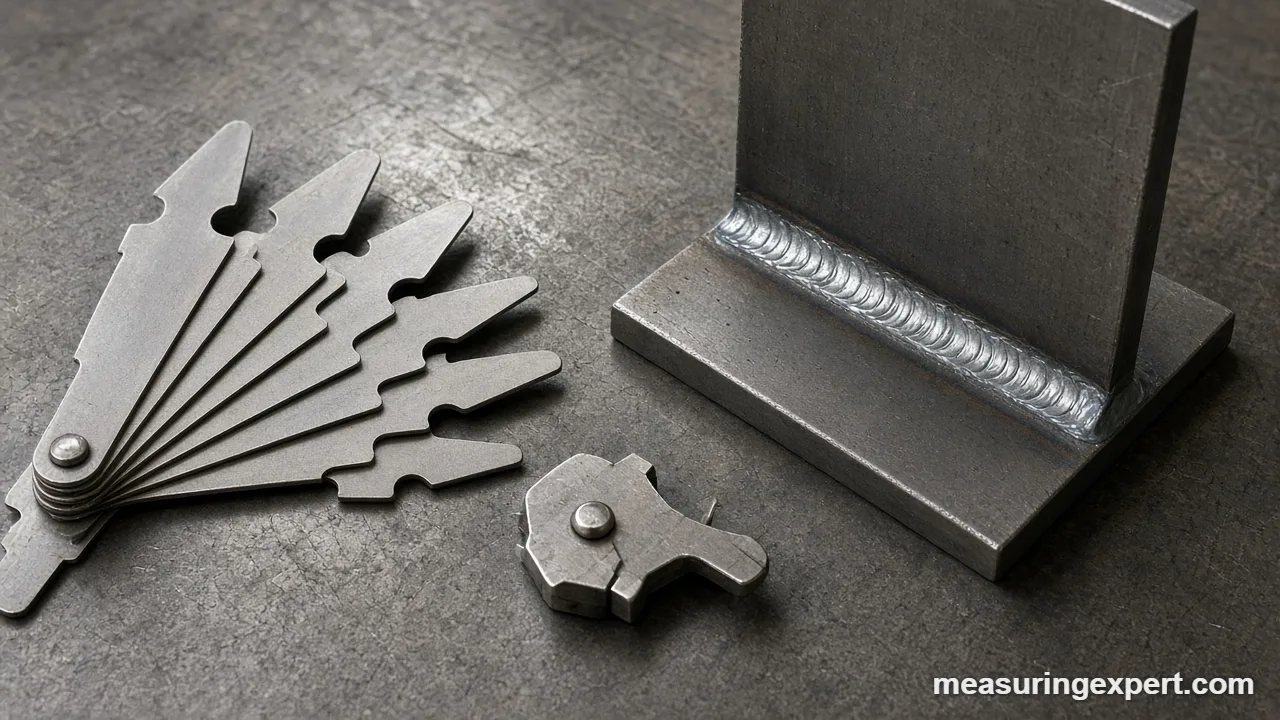
The best weld fillet gauge for most shops is the G.A.L. Gage 7-piece fillet set, because its leaves give a fast go/no-go check of leg and throat. However, the right tool depends on the job: leaf sets for fillet size, a Bridge Cam for readings, a V-WAC for undercut and a Hi-Lo for pipe fit-up.
In short: buy the G.A.L. set for daily fillet checks, the YESWELDER MG-11 on a budget, and the RIVERWELD Bridge Cam when you need actual numbers.
As an Amazon Associate, Measuring Expert earns from qualifying purchases. Our picks are based on research, specifications and owner feedback, not paid placement.
Best Overall
Best Budget
Best Multi-Tool
Quick Answer: Which Tool Do You Need?
- Daily fillet checks: G.A.L. Gage 7-piece set, a go/no-go leaf for each size.
- Lowest cost: YESWELDER MG-11, the classic 7-leaf layout from 1/8 in to 1 in.
- Actual readings: RIVERWELD Bridge Cam for leg, throat, reinforcement and bevel angle.
- Undercut and porosity: RIVERWELD V-WAC with a locking depth pointer.
- Pipe fit-up: WeldingStop Hi-Lo for internal misalignment and root gap.
- Rust-prone field kits: CZMOONSEE stainless MG-11 set.
- Remember: fillet throat = 0.707 x leg for an equal-leg, flat-faced weld.
On This Page
- Comparison table
- The 7 picks, reviewed
- How we chose
- Gauge types compared
- Leg vs throat size
- Inch to mm converter
- How to check a fillet weld
- AWS D1.1 visual checks
- Care and limits
- FAQ
- Bottom line
Best Weld Fillet Gauge Picks Side by Side
| # | Image | Product | Best For | Standout Feature | Amazon |
|---|---|---|---|---|---|
| 1 |  | G.A.L. Gage 7-Piece Fillet Set | Shop inspectors who check the same fillet sizes all day | Made by the company that sells the original weld gauge line | View |
| 2 |  | YESWELDER MG-11 Set | Hobby welders and students on a tight budget | Common MG-11 pattern with inch and metric marks | View |
| 3 |  | RIVERWELD Bridge Cam | Inspectors who need readings, not just pass or fail | One gauge reads leg, throat, reinforcement, undercut and bevel angle | View |
| 4 |  | RIVERWELD V-WAC Gage | Measuring undercut depth and counting surface porosity | Pointer reads pit depth; holes size up pores | View |
| 5 | 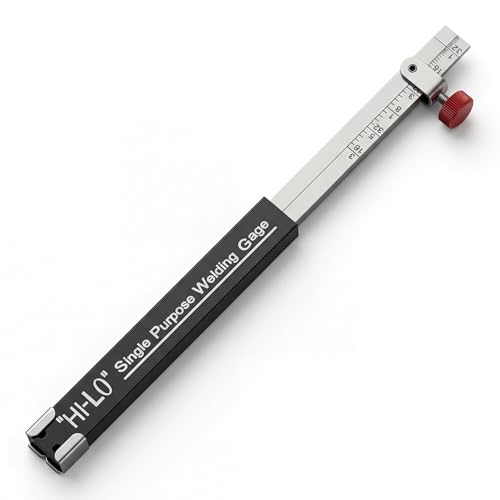 | WeldingStop Hi-Lo Gauge | Pipe fitters checking internal misalignment and root gap | Reads inside high-low before you strike an arc | View |
| 6 | 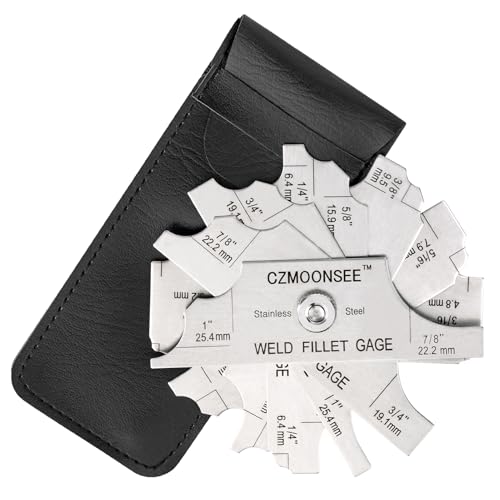 | CZMOONSEE MG-11 Stainless | Outdoor and wet work where carbon steel leaves rust | Stainless leaves with inch and metric marks | View |
| 7 |  | Ally Tools 7-Piece Set | Welding programs that need several identical sets | Plain 7-leaf set that is simple to teach | View |
The 7 Best Weld Fillet Gauge Options, Reviewed
This list mixes fillet leaf sets with the other gauges a weld inspector carries, because fillet size is only one line on a visual inspection report. Also, if you are still setting up your torch or rod position, start with our guide to the best welding rod angle tool.
Best Overall
1. G.A.L. Gage Co. Fillet Weld Gage Set (7 pc.) GAL-8A
Best for: Structural shops, inspectors and welding students who want go/no-go leaf gauges from an established gauge maker.
G.A.L. Gage Company of Michigan builds a whole family of weld gauges, and this 7-piece leaf set is its everyday fillet tool. Each leaf is cut to one nominal size. Then you hold the matching leaf against the joint, and the weld either fits the profile or it does not. As a result, a check takes seconds and needs no reading or math.
G.A.L. explains on its own product page that you check leg length with the leaf of the same size, then turn the leaf over to check the throat. In addition, the company sells 8-piece and 12-piece sets, and its sizes run from 1/8 in up to 3 in across the range. Because of that, it is easy to add a large-weld set later. For most shops, this is the best weld fillet gauge set to standardize on.
- 7 leaf gauges, one nominal fillet size per leaf (G.A.L. catalog item Cat # 8)
- Checks leg length on one side and throat on the reverse
- Maker also offers 8-piece and 12-piece sets; sizes from 1/8 in to 3 in across the line
- Inch and metric sizes are available from the maker
Pros
- Fast go/no-go checks because there is no scale to read
- Clear maker documentation and how-to videos
- Also expandable with larger G.A.L. sets
Cons
- Only checks the sizes printed on the leaves, so gaps between sizes go unmeasured
- Does not measure undercut or misalignment
- However, the maker does not publish material or tolerance online
Skip it if: you need actual readings in between sizes; a Bridge Cam gauge gives a number instead of a pass or fail.
Best Budget
2. YESWELDER MG-11 Metal Weld Fillet Gages Set
Best for: Beginners, garage fabricators and welding students who want a full leaf set without paying for a name-brand inspection kit.
YESWELDER is best known for welding machines and helmets, and this MG-11 set copies the classic 7-leaf layout. In fact, the listing describes sizes from 1/8 in to 1 in with both inch and metric marks. Therefore, it covers the fillet sizes you meet on most farm, trailer and shop jobs.
Because the leaves follow the standard pattern, the method is the same as on a premium set. First, pick the leaf that matches the drawing. Next, hold it square to the joint and look for light under the edge. Finally, flip it over for the throat. For a home shop, it is the best weld fillet gauge value on this list.
- MG-11 pattern, 7 leaves
- Listed range: 1/8 in to 1 in (about 3 to 25 mm)
- Inch and metric markings on the leaves
- Leg and throat check on each leaf
Pros
- Low cost, so a full leaf set fits a hobby budget
- Same proven MG-11 layout as many shop sets
- Also covers the most common fillet sizes
Cons
- No published tolerance from the brand
- Thin leaves can bend if dropped, so store them on the ring
- Only go/no-go, with no actual reading
Skip it if: you sign off structural work for a client; buy a set with traceable documentation instead.
Best Multi-Tool
3. RIVERWELD Bridge Cam Gauge (Hi-Lo Misalignment)
Best for: Inspectors, CWI candidates and fabricators who want one pocket tool that gives a real number for several weld features.
In short, a Bridge Cam gauge is the multi-tool of weld inspection. G.A.L. shows its own version measuring the bevel angle, outside misalignment, weld reinforcement, actual throat, fillet leg and undercut depth, in inches or millimeters. Likewise, this RIVERWELD copy uses the same cam-and-slide layout, and the listing names high-low misalignment as one of its jobs.
In practice, the Bridge Cam is slower than a leaf gauge, because you rotate the cam and read a scale. However, it tells you how far off a weld is. For example, a leaf only says a 3/8 in weld failed; the Bridge Cam can show it measured 5/16 in. So for reports and training, it is the best weld fillet gauge style to own alongside a leaf set.
- Bridge Cam pattern (often sold as MG-8 style)
- Measures fillet leg, actual throat, reinforcement, undercut depth and misalignment
- Bevel angle scale for groove preparation
- Inch and metric scales on this design
Pros
- Gives actual readings, so reports show real numbers
- Covers butt and fillet welds
- Pocket size; also replaces several single tools
Cons
- Slower than a leaf gauge because you must read a scale
- Takes practice to read the cam correctly
- However, small scale marks are hard to read in poor light
Skip it if: you only check two or three standard fillet sizes; a leaf set is faster.
Best for Undercut
4. RIVERWELD V-WAC Single Weld Gage (Inch)
Best for: Inspectors who need to measure undercut and pits, or grade surface porosity, against a code limit.
Fillet size, however, is only half of a visual inspection. In addition, codes limit undercut depth and surface porosity, and a leaf gauge cannot measure either one. Above all, the V-WAC fills that gap. According to G.A.L., you rest the base on the plate, drop the pointer tip into the undercut and read the depth. After that, a locking screw holds the reading.
The same tool also reads butt weld reinforcement and outside misalignment. Meanwhile, the G.A.L. design has 1/8 in and 1/16 in holes for sizing pores, plus scale marks in 1/16 in steps for counting pores per inch. This RIVERWELD version is the inch model, so pick a metric V-WAC if your drawings are in millimeters.
- Measures undercut and pit depth with a locking pointer
- Reads butt weld reinforcement and outside misalignment
- Porosity holes of 1/8 in and 1/16 in (V-WAC design)
- Inch scale on this listing
Pros
- Only common tool that measures undercut depth
- Simple to read, and then lock in place
- Also small enough for a shirt pocket
Cons
- Inch only on this listing
- Does not check fillet leg size, so you still need a leaf set
- However, fine undercut limits push the scale to its limit
Skip it if: your work never calls for undercut or porosity limits, such as simple non-structural repairs.
Best for Pipe
5. WeldingStop Hi-Lo Single Purpose Gauge (Inch, Stainless)
Best for: Pipe welders and fitters who must keep internal misalignment and root opening within the procedure before welding.
In contrast, a Hi-Lo gauge works before the weld, not after it. For example, on pipe, internal misalignment (high-low) causes root problems that no fillet gauge can see later. G.A.L. describes the single-purpose design this way: you slip the legs into the fit-up gap, rotate the gauge 90 degrees, and read the indicator against the scale.
The other end measures the fit-up gap, which G.A.L. lists at 1/32 in to 3/16 in on its version. This WeldingStop model is a stainless, inch-only copy of that single-purpose pattern. Therefore, it suits pipe shops that already use a leaf set or Bridge Cam for the finished weld.
- Single-purpose Hi-Lo pattern for pipe fit-up
- Measures internal misalignment and fit-up gap
- Stainless steel body
- Inch scale
Pros
- Catches high-low before welding starts, so you avoid repairs
- Stainless body resists shop corrosion
- Simple two-function design
Cons
- Inch only, so metric shops should look elsewhere
- Not useful for plate fillet welds, since it only fits pipe gaps
- However, it adds a third tool to carry
Skip it if: you mostly weld plate and structural shapes; it is a pipe tool first.
Best Stainless
6. CZMOONSEE Stainless Steel MG-11 7-Piece Fillet Weld Gauge (Convex Type)
Best for: Field welders and pipeline crews who want leaves that resist rust in a damp truck box.
This CZMOONSEE set follows the same MG-11 7-leaf layout, but the listing specifies stainless steel and a convex profile. Still, stainless matters more than it sounds: as a result of rust, a pitted leaf edge no longer sits flush, and your check gets less reliable.
In addition, the listing gives inch and metric marks on each leaf. Similarly to the other MG-11 sets, it checks leg and throat by fit, not by scale. Keep in mind that a convex-type leaf is meant for welds with a crowned face. So pair it with a Bridge Cam or an AWS-style gauge if you also need to judge concave welds.
- MG-11 pattern, 7 pieces
- Stainless steel leaves
- Inch and metric markings
- Convex-type profile for crowned fillets
Pros
- Stainless resists rust, so it suits field kits
- Dual units on every leaf
- Also uses the familiar MG-11 sizes
Cons
- Newer brand; as a result, documentation is thin
- Convex profile only
- No published tolerance
Skip it if: you want a maker with a long track record and support; G.A.L. is the safer choice.
Best for Classrooms
7. Ally Tools 7-Piece Fillet Welding Inspection Gauge Set
Best for: Welding instructors and apprentices who need a simple 7-leaf set for practice coupons and bend-test prep.
Ally Tools sells a plain 7-piece fillet inspection set that is easy to buy in multiples. For a classroom, above all, that consistency matters: when every student holds the same leaves, the instructor can teach one method and grade one way.
Like the other leaf sets, it checks leg length and throat on standard fillet sizes. In short, it is not fancy, but it does the core job. Then, as students move on to code work, they can add a Bridge Cam and a V-WAC for undercut and reinforcement.
- 7 fillet leaves
- Checks leg length and throat
- Simple go/no-go method for training
Pros
- Easy to buy in multiples, so every student gets the same set
- Simple for new welders to learn
- Also a cheap spare for the truck
Cons
- Few published specs, so buyers rely on the listing
- No undercut or angle functions
- Leaves can scatter without a ring or case
Skip it if: you already own an MG-11 set; it adds nothing new.
How We Chose the Best Weld Fillet Gauge Picks
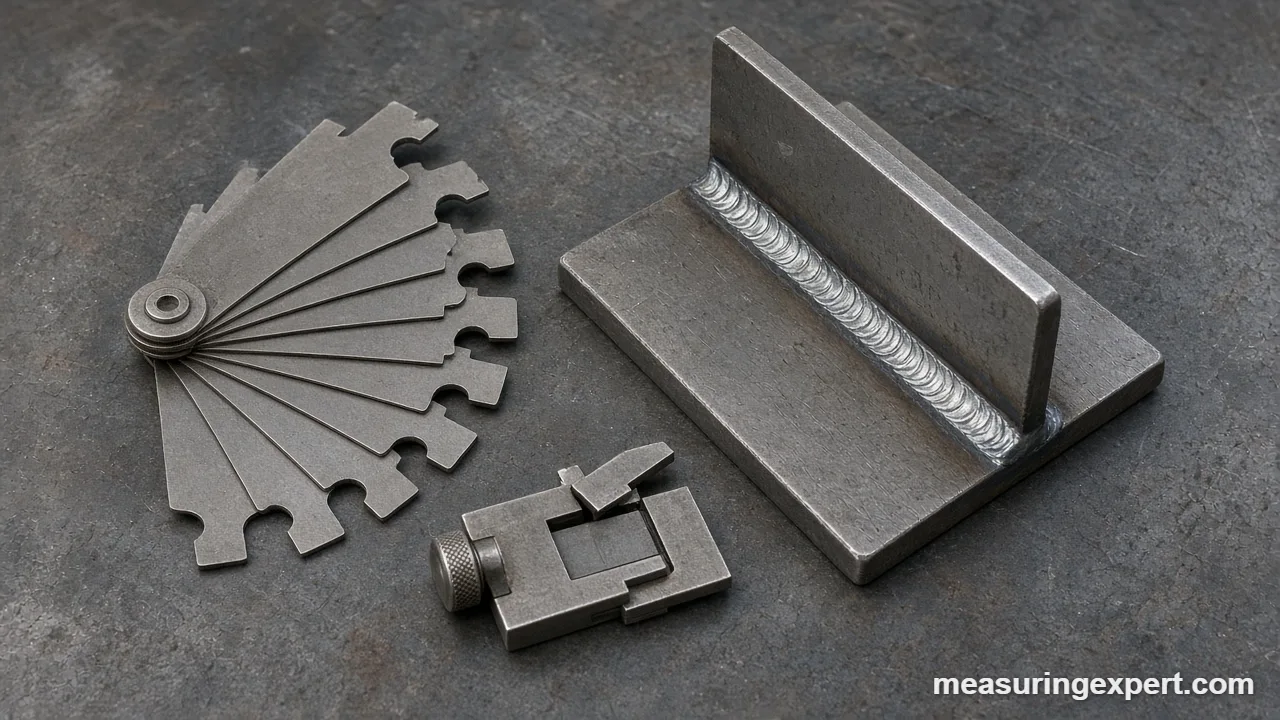
To be clear, we did not run hands-on tests for this list. Instead, our picks are research-based. First, we read the maker pages from G.A.L. Gage Company, which explain how its leaf gauge set, V-WAC gauge and single-purpose Hi-Lo gauge work. In fact, many brands now sell copies of these designs, so the maker pages show what each pattern should do. Then we compared listing specs and owner feedback for patterns such as bent leaves or worn marks.
After that, we scored each gauge on five points:
- Job fit: each pick had to win a real inspection task, from fillet size to undercut to pipe fit-up.
- Clear units: inch, metric or both, stated plainly on the listing or the maker page.
- Material: stainless steel ranked higher for field kits, since rust ruins a leaf edge.
- Readability: etched marks that you can still read under a welding hood light.
- Brand mix: established sellers, a maximum of two gauges per brand, and no unbranded copies.
Finally, we cut near-duplicate leaf sets and any listing that had stopped working on Amazon.
Best Weld Fillet Gauge Types: Leaf, Bridge Cam, V-WAC or Hi-Lo?
Of course, each gauge type answers a different question. So most inspectors carry two or three of them in one pouch. Here is how they split the work.
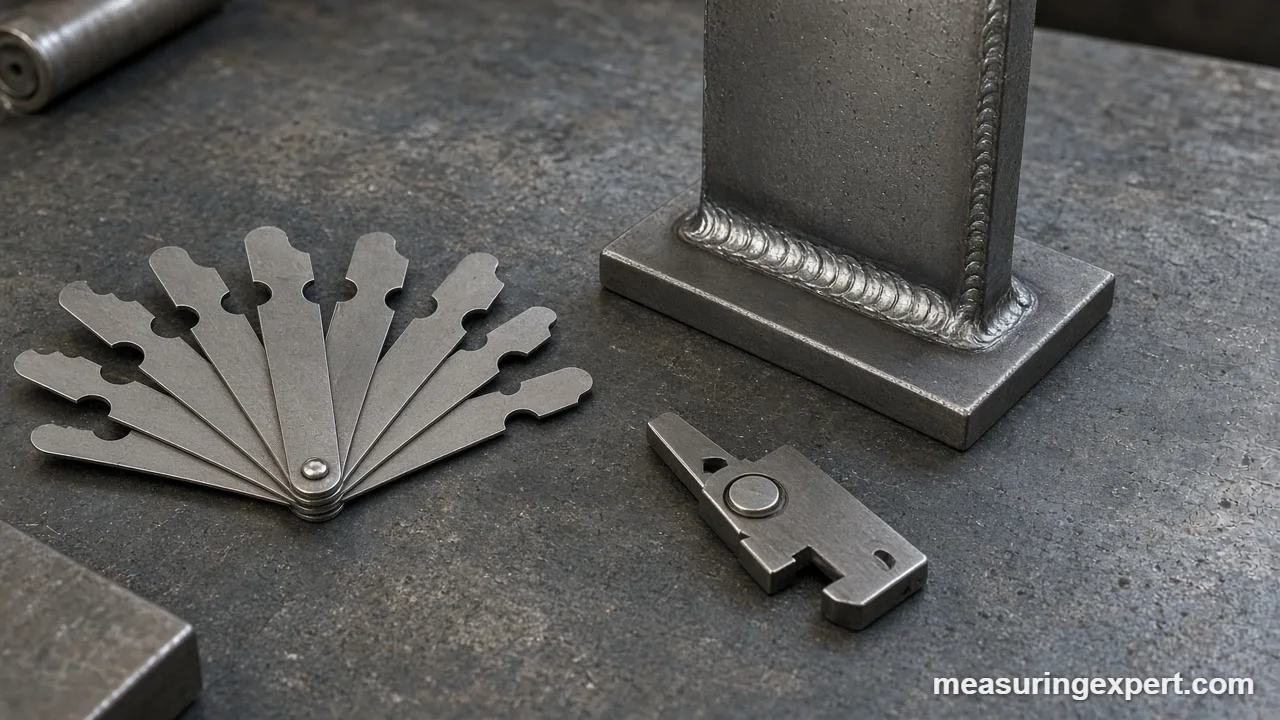
| Gauge type | What it measures | Reading style | Pick here |
|---|---|---|---|
| Fillet leaf set (MG-11 style) | Fillet leg and throat at fixed sizes | Go/no-go by fit | G.A.L. 7 pc, YESWELDER, CZMOONSEE, Ally Tools |
| Bridge Cam | Leg, actual throat, reinforcement, undercut, misalignment, bevel angle | Scale reading | RIVERWELD Bridge Cam |
| V-WAC | Undercut and pit depth, reinforcement, porosity size and count | Locking pointer | RIVERWELD V-WAC |
| Hi-Lo | Internal misalignment and fit-up gap on pipe | Scale reading | WeldingStop Hi-Lo |
| Automatic weld size (AWS) gauge | Leg size plus max concavity and convexity | Sliding pointer | Not listed; consider it as an add-on |
In addition, groove welds need a bevel angle check before welding. A Bridge Cam has a scale for that, but a protractor is more precise; see our explainer on what a bevel protractor is.
Leg vs Throat: The Math Behind the Numbers
A fillet weld has two sizes, and mixing them up is the most common mistake on a report. The leg is the distance from the root of the joint to the toe of the weld, along each plate. The throat is the shortest distance from the root to the face of the weld. Engineers size welds by throat because, in the end, the throat carries the load. However, drawings and weld symbols usually call out the leg.
For an equal-leg fillet on a 90 degree joint with a flat face, the throat is the leg times the sine of 45 degrees. In other words, throat = 0.707 x leg. Therefore, a 1/4 in fillet has a theoretical throat of about 0.177 in. For instance, a convex weld has more metal than that, while a concave weld can have the right legs but a short throat. That is why leaf gauges check both.
| Leg size (in) | Leg (mm) | Theoretical throat (in) | Throat (mm) |
|---|---|---|---|
| 1/8 | 3.2 | 0.088 | 2.2 |
| 3/16 | 4.8 | 0.133 | 3.4 |
| 1/4 | 6.4 | 0.177 | 4.5 |
| 5/16 | 7.9 | 0.221 | 5.6 |
| 3/8 | 9.5 | 0.265 | 6.7 |
| 1/2 | 12.7 | 0.354 | 9.0 |
| 5/8 | 15.9 | 0.442 | 11.2 |
| 3/4 | 19.1 | 0.530 | 13.5 |
| 1 | 25.4 | 0.707 | 18.0 |
Note that these values hold only for equal legs at 90 degrees. For skewed T-joints the math changes, so G.A.L. sells a separate Skew-T gauge and calculator for those angles.
Convert Sizes: Inches to Millimeters
For example, drawings from overseas often list fillet sizes in millimeters, while many leaf sets are marked in fractions of an inch. So use this converter to match a size before you pick a leaf. For example, a 6 mm fillet is about 0.236 in, so the nearest inch leaf is 1/4 in (6.4 mm).
How to Check a Fillet Weld With a Leaf Gauge
In general, the method below works with any MG-11 style set. First, let the weld cool and brush off slag and spatter, because debris lifts the gauge and gives a false pass.
- Read the weld symbol or drawing and note the required leg size.
- Pick the leaf that matches that size, and check that its edges are straight and clean.
- Hold the leaf square to the joint, with one edge flat on each plate, to check the leg.
- Look for light: the weld toe should meet the leaf, and no gap should show under the edge.
- Turn the leaf over and use the throat profile to confirm the weld face is not too concave.
- Repeat the check at the start, middle and end of the weld, and at any spot that looks thin.
- Record the result, and use a Bridge Cam to measure any weld that fails so you know how far off it is.
Also, check in good light. For instance, a small flashlight held low across the joint shows gaps clearly, and an inspection mirror helps on the far side of a joint you cannot see directly.
What AWS D1.1 Visual Inspection Asks Your Gauge to Check
AWS D1.1, the Structural Welding Code for steel, sets visual acceptance limits in its inspection clause (Table 8.1 in recent editions). However, those limits cover more than fillet size. As a result, a single leaf set is not enough for code inspection. Typical items include:
- Fillet size: a weld may run under the specified size by a small amount (1/16 in for small fillets, more for larger ones) for no more than 10% of its length.
- Undercut: on statically loaded plate under 1 in thick, the usual limit is 1/32 in, with short exceptions to 1/16 in. A V-WAC measures this.
- Weld profile: limits on convexity and concavity, which a Bridge Cam or automatic weld size gauge reads.
- Porosity and cracks: no cracks are allowed, and visible porosity is limited by size and count per length.
Similarly, pipe codes have their own fit-up and misalignment limits. For wall thickness checks on pipe, see our guide to the best pipe thickness gauge.
Caring for the Best Weld Fillet Gauge: Calibration and Limits
Leaf gauges have no moving parts, so care is simple. Even so, a few habits keep them accurate for years.
Now for the limits. First, a leaf gauge only gives a pass or fail at fixed sizes; it cannot tell you a weld is 0.29 in. Second, none of the low-cost copies on this list publish a tolerance, so they are fine for shop control but not proof of compliance on their own. Likewise, for formal inspection, your employer or client may require gauges with a traceable calibration record. Finally, no gauge sees inside a weld. In other words, visual checks find surface defects only, while internal flaws need methods such as ultrasonic or radiographic testing.
Best Weld Fillet Gauge FAQ
What is the best weld fillet gauge for most welders?
For most shops, the best weld fillet gauge is the G.A.L. Gage 7-piece fillet set. Also, each leaf checks one size of leg and throat by fit, so a check takes seconds and needs no math.
How do you calculate throat from leg size?
For an equal-leg fillet on a 90 degree joint with a flat face, multiply the leg by 0.707. For example, a 3/8 in leg gives a theoretical throat of about 0.265 in, or 6.7 mm.
What is the difference between leg and throat on a fillet weld?
The leg runs from the joint root to the weld toe along each plate. Meanwhile, the throat is the shortest distance from the root to the weld face. Drawings usually give the leg, while strength depends on the throat.
Is a Bridge Cam gauge the best weld fillet gauge for inspectors?
It is the most flexible single tool, because it reads leg, throat, reinforcement, undercut, misalignment and bevel angle. However, a leaf set is faster for repeated checks of the same size, so many inspectors carry both.
What does a V-WAC gauge measure?
A V-WAC measures undercut and pit depth with a locking pointer. It also reads butt weld reinforcement and outside misalignment, and it has small holes for sizing surface pores.
What is a Hi-Lo gauge used for?
A Hi-Lo gauge checks internal misalignment between two pipe ends after fit-up. Most versions also measure the root gap, so you can fix the joint before you weld it.
Can a fillet gauge measure convex and concave welds?
Yes, within limits. The leg side checks size on both shapes. Then the throat side shows whether a concave face is too thin. For actual convexity readings, use a Bridge Cam or an automatic weld size gauge.
Does the best weld fillet gauge need calibration?
Because leaf gauges are fixed, they rarely drift, but bent or burred edges cause errors. So inspect edges often. Also, if your contract requires it, buy gauges with a traceable calibration record.
Which code covers visual weld inspection in the US?
For structural steel, AWS D1.1 sets visual acceptance limits for fillet size, undercut, profile, cracks and porosity. Pipe and pressure work follow other codes, so always use the code named in your contract.
Should I buy inch or metric markings?
First, match the units on your drawings. Many MG-11 sets show both units, while some V-WAC and Hi-Lo copies are inch only. Use a converter if a drawing gives a size your leaves do not show.
Bottom Line on the Best Weld Fillet Gauge
For most welders and inspectors, the G.A.L. Gage Co. Fillet Weld Gage Set (7 pc.) GAL-8A is the best weld fillet gauge to buy first. After all, it gives quick, repeatable go/no-go checks of leg and throat, and the maker documents how to use it. Later, add a Bridge Cam for actual readings and a V-WAC for undercut once you inspect to a code.
Black Friday is coming: shop the deals with Prime
1 thought on “Best Weld Fillet Gauge: 7 Picks for Leg, Throat and Undercut Checks”