

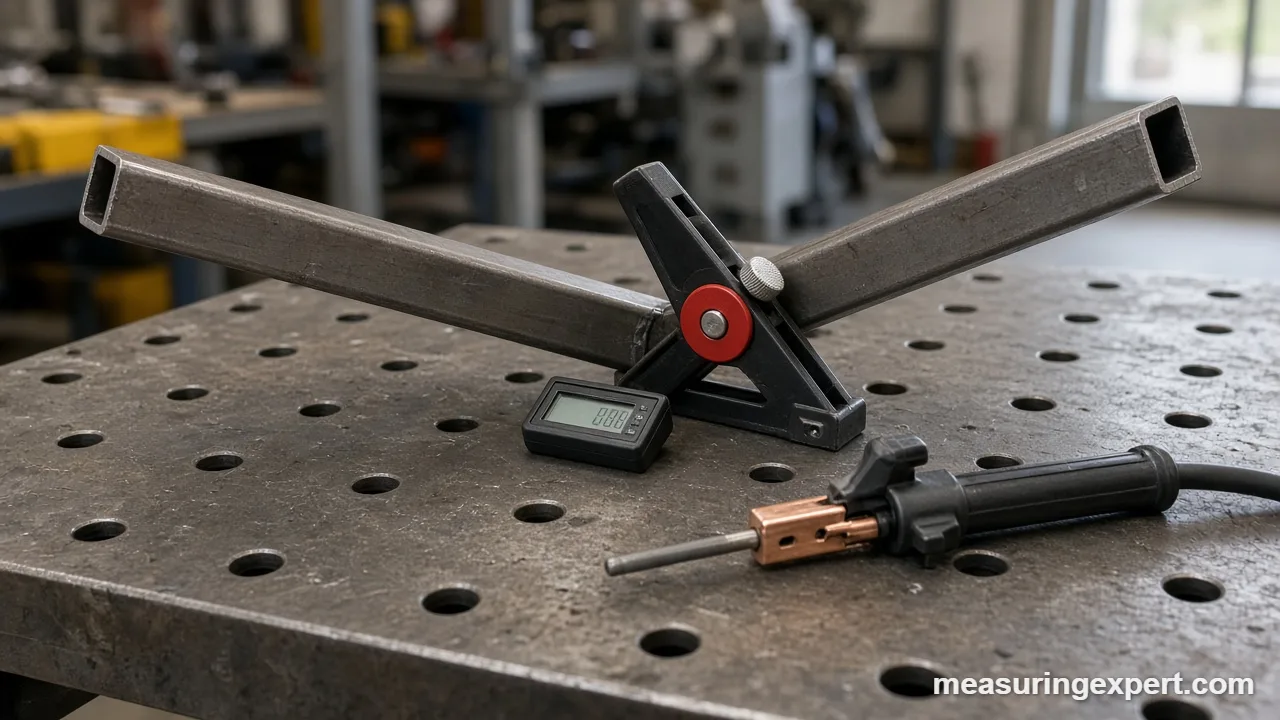
The best welding angle tool for most shops is the Strong Hand Tools MLA600, because it locks two magnets at any angle from 30 to 270 degrees and holds the parts while you tack. What decides your pick is whether you need to hold an angle, read it, or copy it.
In short: get the MLA600 to hold parts at an angle, the Klein 935DAG to check it digitally, and the General Tools 822 to copy angles on a budget.
As an Amazon Associate, Measuring Expert earns from qualifying purchases. Our picks are based on research, specifications and owner feedback, not paid placement.
This guide covers tools that set, hold and measure the angles in a weld joint: magnetic welding squares, digital angle gauges and bevel protractors. However, it does not cover gauges that size a finished weld. For those, see our best weld fillet gauge guide.
Best Overall
Best Pro
Quick Answer: The Best Welding Angle Tool by Job
- Hold parts at any angle: Strong Hand Tools MLA600 adjustable magnetic square.
- Read the angle off the magnet: YESWELDER AJM with a 20 to 200 degree scale.
- Check fit-up digitally on steel: Klein Tools 935DAG with a rare earth magnet base.
- Measure bevels between two faces: Wixey WR410 digital protractor.
- Keep a gauge in your pocket: Wixey WR300 Type 2.
- Copy angles for little money: General Tools 822 ANGLE-IZER.
- Square corners with zero setup: Strong Hand Tools MLDT350 kit.
On This Page
- Comparison table
- The 7 picks, reviewed
- How we chose
- Work angle vs travel angle
- Holder, gauge or protractor?
- Specs that matter
- How to set and check a weld angle
- Bevel angle converter
- Keeping angle tools accurate
- Honest limits
- FAQ
- Bottom line
Best Welding Angle Tool Comparison Table
First, decide what you need the tool to do. Some tools hold parts at an angle, some read the angle, and a few do both. So, scan the “Best For” column and then jump to the matching review.
| # | Image | Product | Best For | Standout Feature | Amazon |
|---|---|---|---|---|---|
| 1 |  | Strong Hand Tools MLA600 Adjustable Angle Magnetic Square | Holding parts at any set angle | Locks from 30 to 270 degrees with a setting pin | View |
| 2 |  | YESWELDER AJM Adjustable Angle Welding Magnet | Reading the set angle off a scale | Built-in angle scale from 20 to 200 degrees | View |
| 3 |  | Klein Tools 935DAG Digital Level and Angle Gauge | Checking bevels and fit-up on steel | Rare earth magnet base and a reverse-contrast screen | View |
| 4 |  | Wixey WR410 8 in Digital Protractor | Measuring bevels and joint angles directly | Two-arm protractor with +/-0.1 degree accuracy | View |
| 5 | 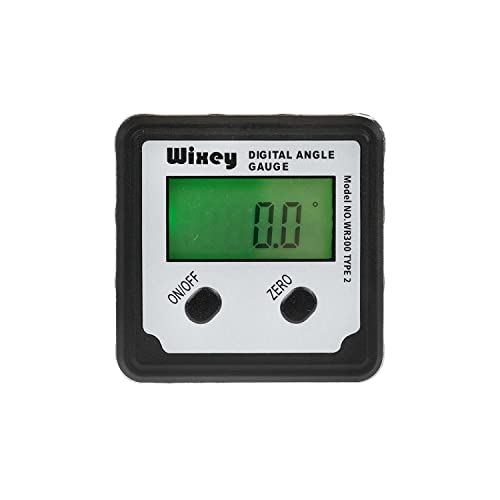 | Wixey WR300 Type 2 Digital Angle Gauge | Pocket checks of plate and torch setups | Small magnetic cube that zeros on any surface | View |
| 6 |  | General Tools 822 ANGLE-IZER Digital Angle Finder | Copying joint angles on a budget | 360 degree hinge with lock and reverse modes | View |
| 7 |  | Strong Hand Tools MLDT350 Angle Magnetic Square Kit | Fast, repeatable 90, 30 and 60 degree tacks | Two fixed-angle magnets, small and medium | View |
The 7 Best Welding Angle Tool Picks, Reviewed
To start with, two adjustable magnets hold parts at an angle. After that come four digital tools that measure angles and a fixed-angle magnet kit. In other words, the best welding angle tool for you depends on whether you set angles, check them or both.
Best Overall
1. Strong Hand Tools MLA600 Adjustable Angle Magnetic Square
Best for: fabricators and hobby welders who need to tack steel at 30, 45, 90 or any odd angle without a helper.
The Strong Hand Tools MLA600 is our best welding angle tool for most shops, because it solves the angle problem before the arc starts. Specifically, two independent magnets sit on hinged arms. So, you set the angle, lock it, and the square holds both pieces while you tack. In addition, a setting pin snaps the arms to 30, 45 or 90 degrees for the common joints.
In fact, Strong Hand Tools lists an adjustable range of 30 to 270 degrees and a pull force of 33 lb on the 6.0 in model. Also, it works from the outside of a joint, which helps on tube and pipe where you cannot reach inside.
- Angle range: 30 to 270 degrees, per Strong Hand Tools
- Angle setting pin for 30, 45 and 90 degrees, plus an angle lock
- Pull force: 33 lb; size 6.0 x 6.0 x 0.8 in; weight 2.0 lb
- Two independent magnets; hex hole for breakaway leverage
Pros
- Holds any angle in a wide range
- Pin gives fast, repeatable 45 and 90 degree setups
- Works on sheet, flat bar, tube and pipe
Cons
- No printed degree scale for odd angles
- 33 lb pull is modest on thick plate
- Magnets collect spatter and grinding dust
Skip it if: you mostly weld heavy plate; a heavier fixed-angle magnet or a clamp holds thick stock better.
Best Angle Scale
2. YESWELDER AJM Adjustable Angle Welding Magnet
Best for: welders who want to read the angle right on the magnet instead of guessing at the hinge.
The YESWELDER AJM adds something the MLA600 lacks: a printed angle scale. First, you swing the two magnetic plates to the mark you want. Then, you lock the hinge with the included hex wrench. As a result, the same setting is easy to repeat on the next part in a batch.
Similarly, YESWELDER lists an adjustable range of 20 to 200 degrees. It comes in two sizes, a small rated at 48 lb and a medium rated at 77 lb, so check which size the listing ships. However, treat the scale as a setup guide, not a precision instrument. Instead, confirm critical angles with a digital gauge once the parts are tacked.
- Angle range: 20 to 200 degrees, per YESWELDER
- Visible angle scale on the hinge
- Hex-wrench lock with onboard wrench storage
- Small: 48 lb, 4.33 x 2.48 x 0.55 in; medium: 77 lb, 4.72 x 3.07 x 0.63 in
Pros
- Printed scale makes odd angles repeatable
- Strong holding force on the medium size
- Lock holds the setting during tacking
Cons
- Scale is coarse compared with a digital gauge
- Ferrous metal only, so no aluminum
- Two sizes, so read the listing carefully
Skip it if: you mostly weld aluminum or stainless, since magnets do not grip them.
Best Digital Gauge
3. Klein Tools 935DAG Digital Level and Angle Gauge
Best for: pipe and structural welders who check bevels, slopes and joint angles on steel before and after tacking.
By contrast, a digital gauge does the job that a magnet square cannot. In short, it tells you the real angle. The Klein 935DAG clamps to steel with a rare earth magnet base, so it stays put on pipe, angle iron or a saw blade. Also, its reverse-contrast screen is easy to read in a dim booth, and it flips when you use it upside down.
Specifically, Klein lists two ranges, 0 to 90 degrees and 0 to 180 degrees. Accuracy is plus or minus 0.1 degree near 0, 90 and 180 degrees and plus or minus 0.2 degree elsewhere. Therefore, it is precise where welders care most: level, plumb and square.
- Accuracy: +/-0.1 degree at 0 to 1, 89 to 91 and 179 to 180 degrees; +/-0.2 degree elsewhere
- Ranges: 0 to 90 and 0 to 180 degrees
- Permanent rare earth magnet base
- Power: two AAA batteries, included
Pros
- Tightest listed accuracy at level and square
- Magnet holds it on pipe and plate
- Readable display that auto-rotates
Cons
- Reads tilt against gravity, so the part must sit still
- Not built to sit near the arc or heat
- Batteries die at the worst time
Skip it if: you need to measure the angle between two parts that are not level; a two-arm protractor fits that job.
Best for Bevel Prep
4. Wixey WR410 8 in Digital Protractor
Best for: welders who cut and check bevels, gussets and miters and want the angle between two arms, not just tilt.
The Wixey WR410 measures the angle between its two arms, so it works on a bench, a wall or a pipe on stands. That makes it a strong bevel protractor for weld prep. For example, you can lay one arm on the plate face and the other on the bevel, then read the bevel angle directly.
Moreover, Wixey lists a range of plus or minus 180 degrees, 0.1 degree resolution and plus or minus 0.1 degree accuracy. In addition, the arms are about 9 in long, which spans a wide bevel or a long gusset.
- Range: +/-180 degrees
- Resolution: 0.1 degree; accuracy: +/-0.1 degree, per Wixey
- Length: about 9 in (229 mm), 2 in wide
- Power: one CR2032 cell; auto shutoff
Pros
- Reads the angle between two surfaces directly
- Tight listed accuracy for bevel checks
- Long arms bridge rough edges
Cons
- Costs more than a basic angle finder
- Not magnetic, so it needs a hand or a clamp
- Delicate next to grinding and spatter
Skip it if: you only check level and plumb; the cheaper gauges on this list cover that.
Best Compact
5. Wixey WR300 Type 2 Digital Angle Gauge
Best for: welders who want a small digital gauge in an apron pocket for quick slope and fixture checks.
The WR300 Type 2 is a small cube with magnets hidden in its base. So, it sticks to a steel table, a fixture or a part. Then you press ZERO on one surface and set it on the next. As a result, it reads the angle between the two, even when the table itself is not level.
Likewise, Wixey lists a range of plus or minus 180 degrees, 0.1 degree resolution and plus or minus 0.2 degree accuracy. Also, it is handy for practice. For instance, you can set a scrap plate at a known slope and learn how a 10 or 15 degree travel angle looks over it.
- Range: +/-180 degrees; resolution 0.1 degree
- Accuracy: +/-0.2 degree; repeatability +/-0.1 degree, per Wixey
- Size: 2.3 x 2.3 x 1.1 in (58 x 58 x 28 mm)
- Power: one AAA; backlight and auto shutoff
Pros
- Fits in a pocket
- Zero function reads relative angles
- Backlit screen for darker shops
Cons
- Small base rocks on rough mill scale
- Looser accuracy than the Klein near 90 degrees
- Same brand as the WR410, so less variety
Skip it if: you work mostly on curved pipe; a wider magnet base like the Klein sits more steadily.
Best Budget
6. General Tools 822 ANGLE-IZER Digital Angle Finder
Best for: hobby welders and gate or railing builders who need to copy an existing angle and cut parts to match.
The General Tools 822 is a digital angle finder with two stainless legs on a hinge. First, you open the legs into the corner you need to match. Next, you press lock, carry the tool to the saw or the layout table, and read the number. Because the hinge swings a full 360 degrees, it reads inside, outside and reverse angles.
General Tools lists a range of 0 to 360 degrees, 0.1 degree resolution and plus or minus 0.3 degree accuracy. However, that is looser than the Wixey WR410. Still, it is close enough for most fence, gate and trailer work.
- Range: 0 to 360 degrees
- Accuracy: +/-0.3 degree; resolution: 0.1 degree, per General Tools
- Stainless steel legs, 7 in long and 1-3/8 in wide
- Lock and reverse-angle modes; zero at any point
- Power: one CR2032 cell, included
Pros
- Low cost for a digital reading
- Reads inside, outside and reverse angles
- Lock holds the number while you walk
Cons
- Widest accuracy band on this list
- Short legs on long members
- Not magnetic
Skip it if: you need tenth-degree accuracy on pipe bevels; the Wixey WR410 is tighter.
Best Fixed Angles
7. Strong Hand Tools MLDT350 Angle Magnetic Square Kit
Best for: beginners and production work where most joints are square and you want zero setup time.
In contrast, the MLDT350 kit pairs two fixed-angle magnet squares, a small MLD300 and a larger MLD500. Because nothing moves, the 90 degree corner is the same every time. Meanwhile, the angled edges give you 30 and 60 degree references as well.
Specifically, Strong Hand Tools lists 20 lb of pull for the 3 in MLD300 and 33 lb for the 5 in MLD500. Like the MLA600, the magnets work from the outside of a corner, so they suit tube and pipe frames. However, fixed squares only help if your stock is straight. So, check the finished corner with a digital gauge or a framing square.
- Kit: one MLD300 (3 in, 20 lb pull) and one MLD500 (5 in, 33 lb pull)
- Fixed angles: 90 degrees, with 30 and 60 degree references
- Two independent magnets per square
- Kit weight: 1.0 lb, per Strong Hand Tools
Pros
- No setup; square every time
- Two sizes for small and medium parts
- Low cost for a branded magnet kit
Cons
- Fixed angles only
- Light pull force for heavy stock
- Second Strong Hand Tools pick on this list
Skip it if: your work has many odd angles; the MLA600 or the YESWELDER AJM adjusts.
How We Chose the Best Welding Angle Tool Picks
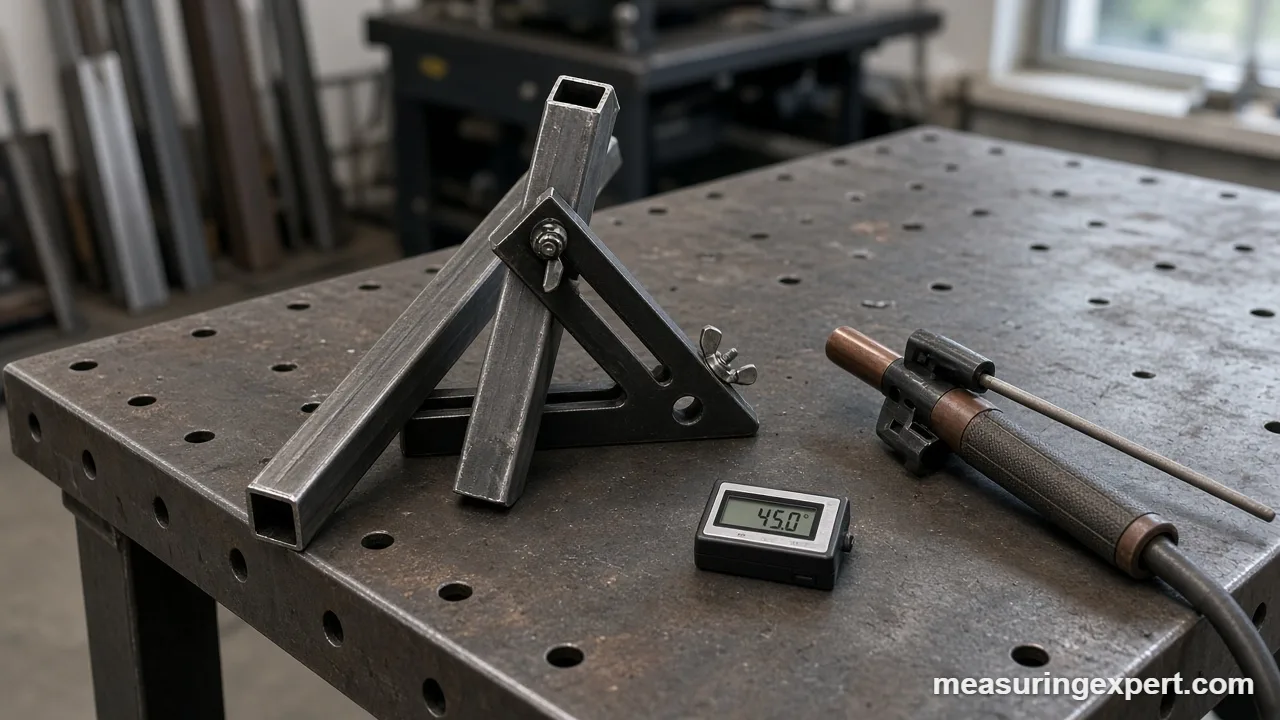
To be clear, we did not run hands-on tests. Instead, we compared maker spec pages and product listings, read owner feedback for patterns, and matched each tool to real welding jobs. In particular, we weighed five points.
- Job fit: the tool must hold, read or copy the angles in a weld joint.
- Published specs: a stated angle range, and for digital tools a plus or minus accuracy figure.
- Shop toughness: magnets, steel legs and bases that cope with mill scale and dust.
- Variety: holders, digital gauges and protractors, so each pick does a different job.
- Brand: established makers only, with no more than two picks per brand.
For specs, we used maker pages we could open, such as the Wixey angle gauge spec page and the Klein Tools 935DAG page, plus the Strong Hand Tools, YESWELDER and General Tools product pages. For joint and torch angles, we relied on the Miller Electric guide to MIG welding mild steel.
Work Angle vs Travel Angle, Explained
Two angles shape every bead. First, the work angle is the tilt of the rod or gun across the joint, measured from the plate. Meanwhile, the travel angle is the lean along the joint, either back toward the finished weld or forward toward the cold metal.
For example, Miller Electric gives a travel angle of 5 to 15 degrees for MIG welding in all positions. It also warns that angles past 20 to 25 degrees can bring more spatter, less penetration and an unstable arc. Stick welders usually drag the rod back at a similar modest angle, so the same range makes a sensible practice target.
| Joint | Work angle (Miller guide) | Tool that helps |
|---|---|---|
| Butt joint | 90 degrees to the plate | Digital gauge zeroed on the plate |
| T-joint (fillet) | 45 degrees | 45 degree magnet setting as a visual guide |
| Lap joint | 60 to 70 degrees | Digital protractor on scrap |
| Any position | Travel angle 5 to 15 degrees | Pocket gauge on a practice plate |
So where does the best welding angle tool fit in? No tool holds your hand at the right angle during a pass. Instead, it gets the joint right and lets you rehearse the rod angle on scrap.
Holder, Gauge or Protractor? Angle Tool Types Compared
In general, welding angle tools fall into three families, and many fabricators own one of each.
| Type | What it does | Typical precision | Watch out for |
|---|---|---|---|
| Adjustable magnetic square | Holds two parts at a set angle for tacking | Set by pin or printed scale | Ferrous metal only; spatter on magnets |
| Fixed-angle magnet | Holds 90, 45 or 30/60 degree corners | Fixed by the casting | Only as square as your stock |
| Digital angle gauge | Reads tilt against gravity, or relative to a zeroed surface | +/-0.1 to 0.2 degree on our picks | Part must be still; keep away from heat |
| Digital protractor or angle finder | Reads the angle between two arms | +/-0.1 to 0.3 degree on our picks | Arms must sit flat on clean faces |
For background on the classic mechanical version, see our explainer on what a bevel protractor is.
Specs That Matter on a Welding Angle Tool
Angle range. A magnet square should cover at least 30 to 180 degrees. The MLA600 reaches 270 degrees, which also handles outside corners. Meanwhile, a digital protractor should read a full plus or minus 180 degrees.
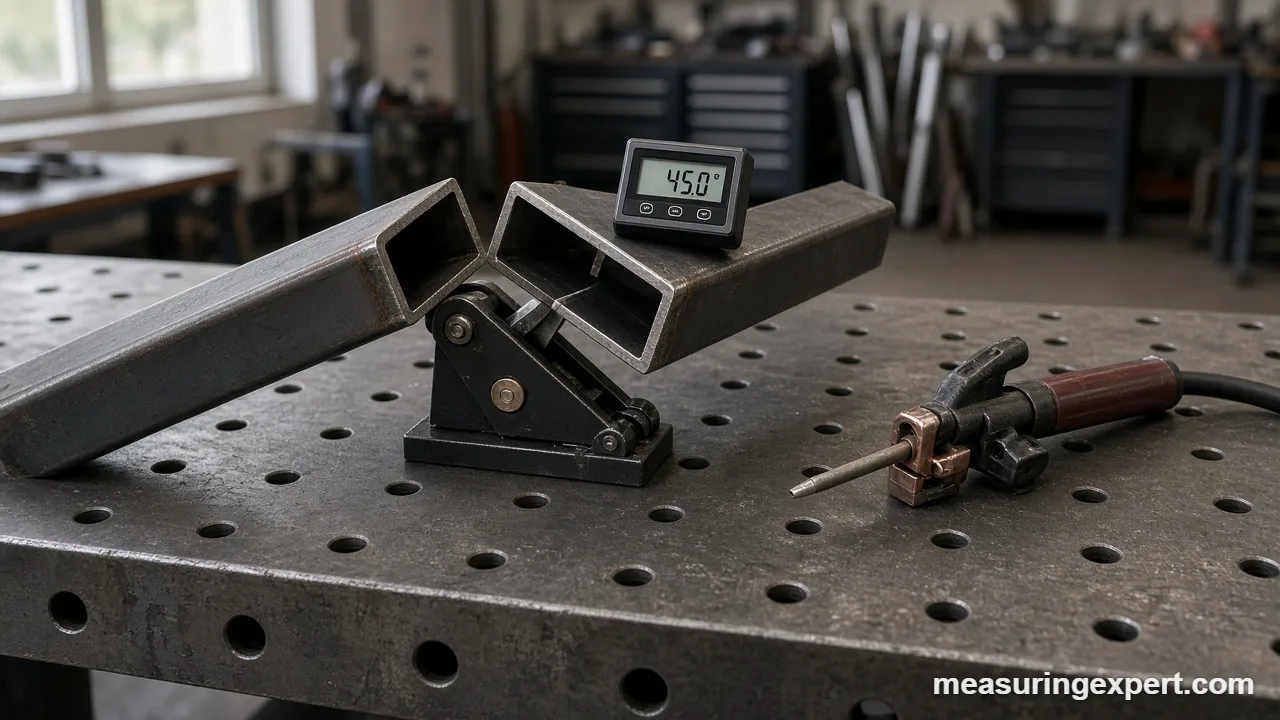
Accuracy and resolution. These are not the same thing. First, resolution is the smallest step on the screen, usually 0.1 degree. In contrast, accuracy is how far the reading can sit from the truth. For example, the General Tools 822 shows 0.1 degree steps but lists plus or minus 0.3 degree accuracy.
What 0.3 degree means. Over a 12 in (305 mm) leg, a 0.3 degree error moves the far end about 1/16 in (1.6 mm). By contrast, a 1 degree error moves it about 0.21 in (5.3 mm). So, the tighter tools matter most on long frames.
Pull force. However, magnet ratings assume clean, flat, thick steel with full contact. Therefore, expect less on thin sheet, rusty plate or round tube. Strong Hand Tools lists 33 lb for the MLA600, while YESWELDER lists 77 lb for the medium AJM.
How to Set and Check a Weld Joint Angle
This routine works with any magnet square and digital gauge. In addition, the last steps help you build a steady rod angle.
- Clean the steel. Wipe or grind off mill scale, rust and spatter where the magnet or gauge will sit, so it seats flat.
- Zero your gauge. Set the digital gauge on the welding table or the base part and press zero, so later readings are relative to that surface.
- Set the magnet angle. Lock the adjustable magnet square at the joint angle, or snap the pin to 30, 45 or 90 degrees.
- Place and tack the parts. Pull both parts onto the magnets, check the gap, and put small tacks on opposite sides of the joint.
- Check the tacked angle. Move the gauge or protractor onto the part and read the angle; if it is off, break the tack and reset.
- Practice the rod angle on scrap. Before the real pass, hold the electrode or gun over scrap at the work angle for the joint and a 5 to 15 degree travel angle.
- Recheck after cooling. Let the joint cool, then read the angle again, because weld shrinkage pulls parts toward the weld side.
New to digital gauges? Our guide on how to use a digital angle finder explains zeroing and relative readings step by step.
Bevel Angle to Rise and Grade Converter
In fact, bevels, gussets and sloped braces all come back to one formula: rise equals run times the tangent of the angle. So, type a bevel angle in degrees below to see the percent grade and the pitch in inches per 12 in.
For example, take 1/2 in (12.7 mm) plate with a 37.5 degree bevel and a 1/16 in (1.6 mm) land. The bevel face then spans about 0.34 in (8.5 mm) across the plate surface. Similarly, a 45 degree gusset rises exactly 1 in for every inch of run.
Keeping Angle Tools Accurate in a Weld Shop
First, check every new digital gauge against a known square. Set it on a flat table, zero it, then place it on the face of a good machinist or framing square. It should read 90.0 degrees within its listed accuracy. Next, repeat the check every few months, and also after any drop.
Second, keep magnets clean. This matters because spatter balls and grinding dust stick to them and tilt the part by a fraction of a degree. So, wipe the faces with a rag, or pull fines off with tape.
Third, protect the electronics. In particular, keep gauges out of the spark stream, off hot parts and away from the work lead while the arc is running. Likewise, pull the battery before long storage. For a full routine, see our guide to calibrating angle tools.
Honest Limits of Welding Angle Tools
- They do not weld for you. Indeed, rod angle during a pass is still hand skill. Tools only make the setup and the practice measurable.
- Magnets need ferrous steel. Therefore, aluminum and most 300-series stainless need clamps or fixtures instead.
- Gravity gauges read tilt. If the table is not level, zero on the table first, or the reading will be off by the table slope.
Best Welding Angle Tool FAQ
What is the best welding angle tool for most people?
For most shops, the Strong Hand Tools MLA600 is the best pick. It locks two magnets anywhere from 30 to 270 degrees, so parts stay at the angle you set while you tack.
Is there a tool that holds the welding rod at the right angle?
Not really. No clip-on gadget holds an electrode at a fixed angle while you weld, because your hand must move with the puddle. Instead, use magnets to hold the parts, and use a gauge on scrap to learn how the angles look.
What travel angle should I use?
Miller Electric gives a travel angle of 5 to 15 degrees for MIG work in all positions. It also warns that angles beyond 20 to 25 degrees can cause more spatter, less penetration and an unstable arc.
What work angle should I use for a T-joint?
Miller Electric recommends about 45 degrees for a T-joint, 90 degrees for a butt joint, and 60 to 70 degrees for a lap joint. Therefore, a 45 degree magnet or gauge setting is a useful reference for fillet practice.
Can a digital angle gauge go near the arc?
No. Measure before you strike the arc and after the part cools, because heat, spatter and the work lead can harm the screen and electronics.
How do I check a pipe bevel angle?
Lay one arm of a digital protractor on the pipe surface and the other on the bevel face, then read the angle. Also, compare it with the joint drawing. A common pipe bevel is 37.5 degrees with a small land at the root.
How do I convert a bevel angle to rise and run?
Multiply the run by the tangent of the angle. For instance, a 37.5 degree bevel rises about 0.77 in per inch of run, and the converter on this page does the math.
Do welding magnets work on aluminum or stainless steel?
No for aluminum, and usually no for austenitic stainless such as 304. That is because magnets need ferrous steel. For those metals, use clamps, fixtures or a non-magnetic angle gauge instead.
Is the best welding angle tool also a fillet gauge?
No. Angle tools set and measure joint and bevel angles, while a fillet gauge checks weld size after you finish. Our guide to the best weld fillet gauge covers those tools, and most welders end up with both.
How accurate does the best welding angle tool need to be?
For fit-up, plus or minus 0.2 to 0.3 degree is plenty. For example, over a 12 in (305 mm) leg, a 0.3 degree error moves the end about 1/16 in (1.6 mm).
Bottom Line on the Best Welding Angle Tool
For most welders, the Strong Hand Tools MLA600 Adjustable Angle Magnetic Square is the one to buy first. Above all, it holds the parts at the angle you choose, which is where most angle errors begin. Next, add the Klein 935DAG to check the result. However, if money is tight, the General Tools 822 copies and reads angles for much less.
Black Friday is coming: shop the deals with Prime
2 thoughts on “7 Best Welding Angle Tools for Rod, Bevel and Fit-Up Work”