

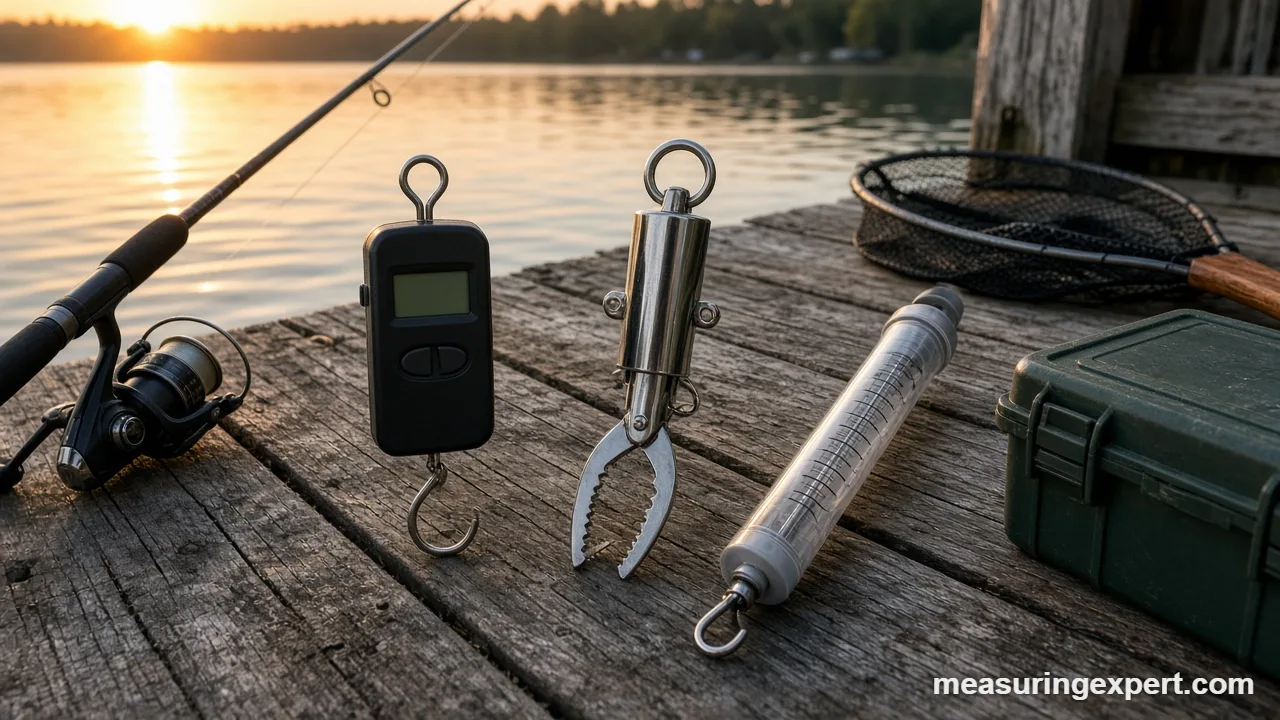
The best fish scale for most anglers is the Rapala Touch Screen Tournament Scale, because it stores eight weights and does the culling math for you. What decides your pick is capacity, how fine the readings are, whether you need a lip grip, and whether the scale can be certified for records.
In short: Rapala for tournaments, BogaGrip for record hunters, BUBBA for app logging and a Booms spring scale as a cheap backup.
As an Amazon Associate, Measuring Expert earns from qualifying purchases. Our picks are based on research, specifications and owner feedback, not paid placement.
Best Overall
Best Budget
Best Pro

Best Fish Scale Picks at a Glance
- Overall: Rapala Touch Screen, with eight memory bins and cull floats.
- Records: BogaGrip 130, a stainless lip grip that IGFA can certify.
- Accuracy claim: BUBBA Smart Fish Scale, rated plus or minus 0.3% to 60 lb.
- Phone logging: BUBBA Lite, with Bluetooth and a GPS catch log.
- Sunlight: Rapala High Contrast, with a reverse-image screen for glare.
- Budget: Booms Fishing TS1, a battery-free spring scale.
On This Page
- Comparison table
- The picks, reviewed
- How we chose
- Digital, spring or lip grip
- Specs that matter
- IGFA certification
- Length-to-weight formulas
- Weight converter
- How to weigh a fish
- Calibration and care
- Do and don’t
- Honest limits
- FAQ
- Bottom line
Compare Every Best Fish Scale Side by Side
First, skim the table for the style you want. Then jump to the full review for specs, pros and cons.
| # | Image | Product | Best For | Standout Feature | Amazon |
|---|---|---|---|---|---|
| 1 |  | Rapala Touch Screen Scale 50 lb | Bass anglers and tournament crews who cull fish all day | 8 memory bins with matching cull floats | View |
| 2 | | BogaGrip 130 | Saltwater and big-game anglers who may chase an IGFA record | Stainless lip grip with built-in spring scale | View |
| 3 |  | BUBBA Smart Fish Scale | Anglers who want a tight accuracy claim and a big capacity | Plus or minus 0.3% accuracy claim | View |
| 4 |  | BUBBA Smart Fish Scale Lite | Anglers who log catches on their phone | Bluetooth link to the BUBBA app | View |
| 5 | 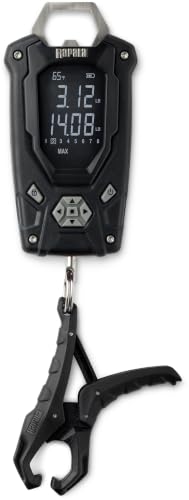 | Rapala High Contrast Scale | Anglers who struggle to read a screen in midday glare | Reverse-image LCD readable in direct sun | View |
| 6 |  | BogaGrip 315 | Bass, trout and walleye anglers who want Boga quality in a smaller size | Finer 1/4 lb increments | View |
| 7 |  | Booms Fishing TS1 | Anglers who want a battery-free backup scale | Peak marker holds the top reading | View |
The Seven Best Fish Scale Picks, Reviewed
Overall, the list mixes digital scales, mechanical lip grips and a classic spring scale. As a result, there is a fit for bass boats, surf rods, kayaks and big-game charters.
Best Overall
1. Rapala Touch Screen Tournament Scale, 50 lb
Best for: Bass anglers and tournament crews who cull fish all day.
Rapala built the Touch Screen Tournament Scale around one job: tracking a limit of fish in the livewell. For instance, it stores up to eight weights in numbered bins, and it ships with eight numbered cull floats so each clip matches a bin. As a result, the screen always shows your running total and the lightest fish to cull next.
In addition, you can switch between pounds and ounces, decimal pounds or kilograms, and a tare key subtracts the weight of a bag or bucket. Also, the backlight helps at dawn, and backup memory keeps your stored weights if the batteries die. For a rough sense of accuracy, Rapala rates the 15 lb version of this scale at plus or minus 1 oz, so read the 50 lb model as a tournament tool rather than a lab balance.
- Capacity: 50 lb (about 22.7 kg) on this listing; a 15 lb version also exists
- Units: lb/oz, decimal lb or kg
- Memory: 8 bins, total weight, backup memory
- Power: two AA batteries, rated up to 400 hours
- Extras: tare, backlight, temperature readout, stainless hook
Pros
- Culling math done for you
- Three unit modes, including kg
- Keeps weights if power drops
- Storage bag with printed instructions
Cons
- Larger and heavier than a pocket scale
- Overkill for casual catch-and-release
Skip it if: you fish for fun and only want a quick photo weight now and then.
Best for Record Hunters
2. BogaGrip Model 130 (30 lb)
Best for: Saltwater and big-game anglers who may chase an IGFA record.
The BogaGrip is the lip grip most guides picture when you say “Boga.” First, it clamps the lower jaw, and a spring scale in the handle then reads the weight in 1/2 lb steps up to 30 lb. In fact, BogaGrip says its scales have been used to certify the weight of more than 4,100 IGFA world record fish.
Also, the maker states that each scale is calibrated to read within one increment, which on the Model 130 means within 1/2 lb. In other words, that is coarse next to a digital scale. However, the all-stainless, mechanical design has no battery or screen to fail, and you can send it to IGFA for certification before a record attempt.
- Capacity: 30 lb (about 13.6 kg)
- Increment: 1/2 lb
- Length: 10 3/4 in (27.3 cm); weight: 1 lb
- Material: non-rusting stainless steel
- Calibration: within one increment, per BogaGrip
Pros
- Built to last for decades
- No batteries to fail on the water
- Can be IGFA-certified for records
- Secure jaw lock for landing fish
Cons
- Coarse 1/2 lb readings
- Premium price for a grip
Skip it if: you mostly weigh panfish or trout under a few pounds.
Best Tournament Digital
3. BUBBA Smart Fish Scale (60 lb)
Best for: Anglers who want a tight accuracy claim and a big capacity.
BUBBA is known for saltwater knives, and its Smart Fish Scale brings the same grippy, rugged styling to weighing. Also, it reads up to 60 lb and claims accuracy of plus or minus 0.3 percent. For example, on a 5 lb bass that works out to about 0.015 lb, or roughly a quarter ounce.
Moreover, it has two modes. For example, Tournament mode manages up to eight fish with smart culling and an automatic bag weight, while Rally mode logs up to 99 fish for anglers fishing solo. In addition, the screen adjusts itself to the light, and BUBBA describes the design as waterproof. Still, some owners report drift after a soaking.
- Capacity: 60 lb (about 27.2 kg)
- Accuracy claim: plus or minus 0.3%
- Modes: Tournament (8 fish) and Rally (99 fish)
- Power: AA batteries (not included)
- Included: lip clip and gill hook
Pros
- High 60 lb ceiling
- Two useful logging modes
- Non-slip grip in wet hands
Cons
- Some owner reports of drift after soaking
- Bulky to carry on a wading belt
Skip it if: you want a pocket scale for small trout streams.
Best App-Connected
4. BUBBA Smart Fish Scale Lite
Best for: Anglers who log catches on their phone.
The Lite version keeps the 60 lb capacity and the plus or minus 0.3 percent claim, but it adds Bluetooth. Moreover, it pairs with the BUBBA app, which records weights, species, weather and the GPS spot of each catch. In addition, the scale auto-locks the weight, so you can read it after the fish settles.
However, the app splits features into tiers. For example, live weighing and catch logs are free, while Tournament, Rally and Competition modes need the paid Pro Plan. So if you only want a culling scale, the standard model or the Rapala is simpler. Also note the IPX4 rating, which covers splashes rather than a dunking.
- Capacity: 60 lb
- Accuracy claim: plus or minus 0.3%
- Water resistance: IPX4 (splash resistant)
- Display: full-color backlit LCD
- Power: three AAA, or an optional 18650 rechargeable cell
Pros
- Catch log with GPS and weather
- Auto-lock holds the reading
- Rechargeable battery option
Cons
- Best modes need a subscription
- Splash-rated only, not submersible
Skip it if: you dislike phone apps or subscription features.
Best in Bright Sun
5. Rapala High Contrast Digital Scale (50 lb)
Best for: Anglers who struggle to read a screen in midday glare.
Rapala aimed this scale at one common complaint: a gray screen you cannot read at noon. Its reverse-image LCD shows light digits on a dark field, and Rapala says it stays readable even in direct sunlight. In addition, it handles fish up to 50 lb.
Also, it keeps the tournament basics. You get eight storage locations, memory backup, a tare key and a choice of pounds, ounces, decimals or kilograms. A directional pad runs the menus, and a battery gauge warns you before the two AAA cells give out. However, it lacks the numbered cull floats that come with the Touch Screen model.
- Capacity: 50 lb (about 22.7 kg)
- Units: lb, oz, decimal lb or kg
- Memory: 8 storage locations with backup
- Power: two AAA batteries with a battery gauge
- Hardware: fish-friendly grip plus a stainless hook
Pros
- Easy to read in glare
- Tare and culling memory
- Low-battery warning
Cons
- No cull floats in the box
- Directional pad takes practice
Skip it if: you want a lip grip rather than a hanging scale.
Best for Lighter Fish
6. BogaGrip Model 315 (15 lb)
Best for: Bass, trout and walleye anglers who want Boga quality in a smaller size.
Next, the Model 315 is the smaller BogaGrip. Of course, it tops out at 15 lb, but in exchange it reads in 1/4 lb steps instead of 1/2 lb. So for fish in the 2 to 10 lb range, it gives a finer reading than the Model 130.
In addition, it weighs only 9 oz and measures 9 in long, which suits a kayak or a wading belt. Like its big brother, it is stainless steel, calibrated to read within one increment, and can be sent to IGFA for certification.
- Capacity: 15 lb (about 6.8 kg)
- Increment: 1/4 lb
- Length: 9 in (22.9 cm); weight: 9 oz
- Material: non-rusting stainless steel
Pros
- Finer steps than the Model 130
- Light enough for kayaks
- Mechanical, no batteries
Cons
- Tops out at 15 lb
- Expensive next to digital grips
Skip it if: your target fish regularly top 15 lb.
Best Budget Spring Scale
7. Booms Fishing TS1 Spring Scale (50 lb)
Best for: Anglers who want a battery-free backup scale.
Meanwhile, spring scales still earn a spot in the tackle box, and the Booms Fishing TS1 shows why. It is an aluminum tube with a stainless steel spring, so there is no battery to die and no screen to fog. In addition, a marker slide stays at the peak weight until you push it back, so you can read it after the fish is back in the water.
Also, it doubles as a tension gauge for checking drag settings and comparing knot strength. However, the maker recommends loads of at least 2 lb (1 kg), so it is a poor match for small panfish. For more on hanging scales built for bags, see our guide to the best luggage scale.
- Capacity: 50 lb (a 25 lb size is also sold)
- Units: lb and kg
- Build: aluminum tube, stainless steel spring
- Minimum suggested load: 2 lb (1 kg)
- Peak-hold marker slide
Pros
- No batteries, nothing to fog
- Doubles as a drag and knot tester
- Light and rust-resistant
Cons
- Coarse to read on small fish
- No memory or culling
Skip it if: you need fine readings for fish under 2 lb.
How We Chose the Best Fish Scale Picks
To be clear, we did not run hands-on tests. Instead, these picks are research-based. First, we listed scales from established fishing brands such as Rapala, BogaGrip, BUBBA and Booms Fishing. Next, we read maker and retailer spec pages and kept only figures we could confirm. Then we scanned owner feedback for repeat complaints.
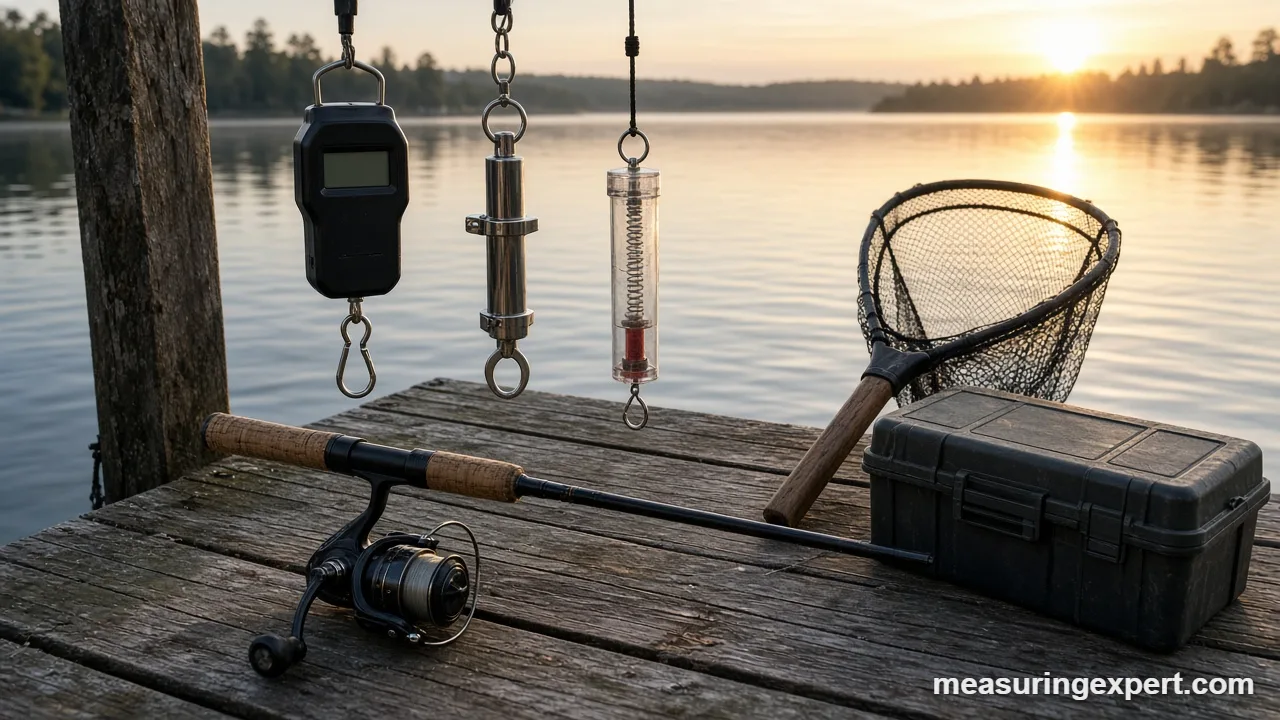
In addition, we checked the IGFA scale certification rules for record anglers, and the Florida Fish and Wildlife Conservation Commission bass weight calculator for length-to-weight estimates. Our criteria were:
- Stated capacity and resolution that match real target species.
- Published accuracy or calibration claims where the maker gives them.
- Fish-friendly handling, such as lip clips and grips.
- Durability in wet, salty conditions.
- Distinct uses, so no two picks do the same job.
Digital, Spring or Lip Grip: Which Type Fits You?
To begin with, every fish scale measures the same thing: the pull of the fish on a spring or a load cell. However, the three main styles handle that pull in different ways.
| Type | How it reads | Strength | Weak spot |
|---|---|---|---|
| Digital hanging scale | Load cell and LCD | Fine resolution, memory, unit switching | Batteries and water damage |
| Spring scale | Spring and printed dial or tube | No power needed, very cheap | Coarse, springs drift with age |
| Mechanical lip grip | Spring inside the grip handle | Holds and weighs in one step | Coarse steps, premium price |
| Digital lip grip | Load cell in a grip | Digital number plus a secure hold | Mixed accuracy reports |
In short, tournament anglers lean digital, record hunters lean toward a BogaGrip, and a spring scale is a smart backup.
Specs That Separate a Good Scale From a Guess
Size the Best Fish Scale to Your Species
First, pick a capacity at least a little above the biggest fish you expect. For example, a 15 lb scale covers most bass and trout, while catfish, stripers and tuna call for 50 to 110 lb.
Resolution vs Accuracy
Resolution is the smallest step the scale shows, such as 0.01 lb or 1/4 lb. Accuracy, on the other hand, is how close that number sits to the true weight. For instance, a screen that shows 0.01 lb can still be off by an ounce or more. So look for a stated accuracy, such as the plus or minus 0.3% that BUBBA claims, rather than trusting extra digits.
Units
Also, most digital scales switch between pounds and ounces, decimal pounds and kilograms. In addition, decimal pounds are handy for adding up a five-fish limit. For the metric side, our page on how many ounces are in a kilo covers the conversion.
Water Resistance and Power
For example, a splash rating such as IPX4 handles spray, but not a dunk in the lake. Therefore, a floating or fully waterproof design matters if you fish from a kayak. Also, AA and AAA cells are easier to replace on a trip than coin cells.
IGFA Certification and Record Fish
If a catch might be a record, the scale matters as much as the fish. According to the IGFA, the organization certifies digital and spring scales up to 100 lb (45.35 kg) at its headquarters in Dania Beach, Florida, by appointment. However, heavier scales need a reputable private scale company or a local certifying body.
Also, the IGFA states that an outside certification must be dated within one year of the catch. In fact, you can certify a scale after the catch, but the fish will not qualify if the accuracy cannot be verified.
No Scale? Estimate Weight From Length and Girth
Because time matters in catch-and-release, a quick length and girth measurement lets the fish go back faster. The Florida Fish and Wildlife Conservation Commission bass weight calculator lists three rough formulas, with length (L) and girth (G) in inches and the answer in pounds:
- L x L x G / 1,200 for torpedo-shaped fish like bass.
- L x L x G / 1,000, a “California” version for full-bodied or egg-laden bass.
- L x G x G / 800, a long-used angler formula that FWC credits to Outdoor Life and Hal Schramm.
For example, take a 20 in (50.8 cm) bass with a 14 in (35.6 cm) girth. The first formula gives 20 x 20 x 14 / 1,200 = 4.67 lb (2.12 kg), while the third gives 20 x 14 x 14 / 800 = 4.9 lb (2.22 kg). Similarly, FWC’s own example of 22.5 in by 18.5 in works out to 7.8 lb with the first formula and 9.63 lb with the third.
However, FWC notes that these are estimates for typical bass and that length and girth cannot certify an official weight. Our guide to girth measurements shows how to wrap a soft tape around the thickest part of a body.
Pounds, Ounces and Kilograms Converter
For instance, tournament slips use pounds, while record forms often ask for kilograms. Therefore, use this mass converter to switch between them.
In fact, one pound is exactly 0.45359237 kg, so 1 kg is about 2.205 lb.
How to Weigh a Fish With the Best Fish Scale
Above all, speed is the goal. In fact, the quicker the fish goes back, the better its odds. Therefore, follow these steps:
- Wet your hands and keep the fish in or near the water while you get the scale ready.
- Turn on the scale, choose your unit and press tare if you will weigh in a bag or sling.
- Clip the lip grip or hook through the lower jaw, never through the gills.
- Support the belly with your other hand for larger fish, so the jaw does not carry the full load.
- Lift gently, hold the scale vertical and wait for the reading to lock or settle.
- Note the weight, take a quick photo and release the fish head-first into the water.
Calibration Checks and Saltwater Care
First, check your scale against a known weight at the start of each season. For example, a sealed 1 gallon jug of water weighs about 8.3 lb (3.8 kg) plus the jug, and gym plates are another easy reference. After that, if the reading is off, look for a calibration mode in the manual, or send a high-end scale to the maker.
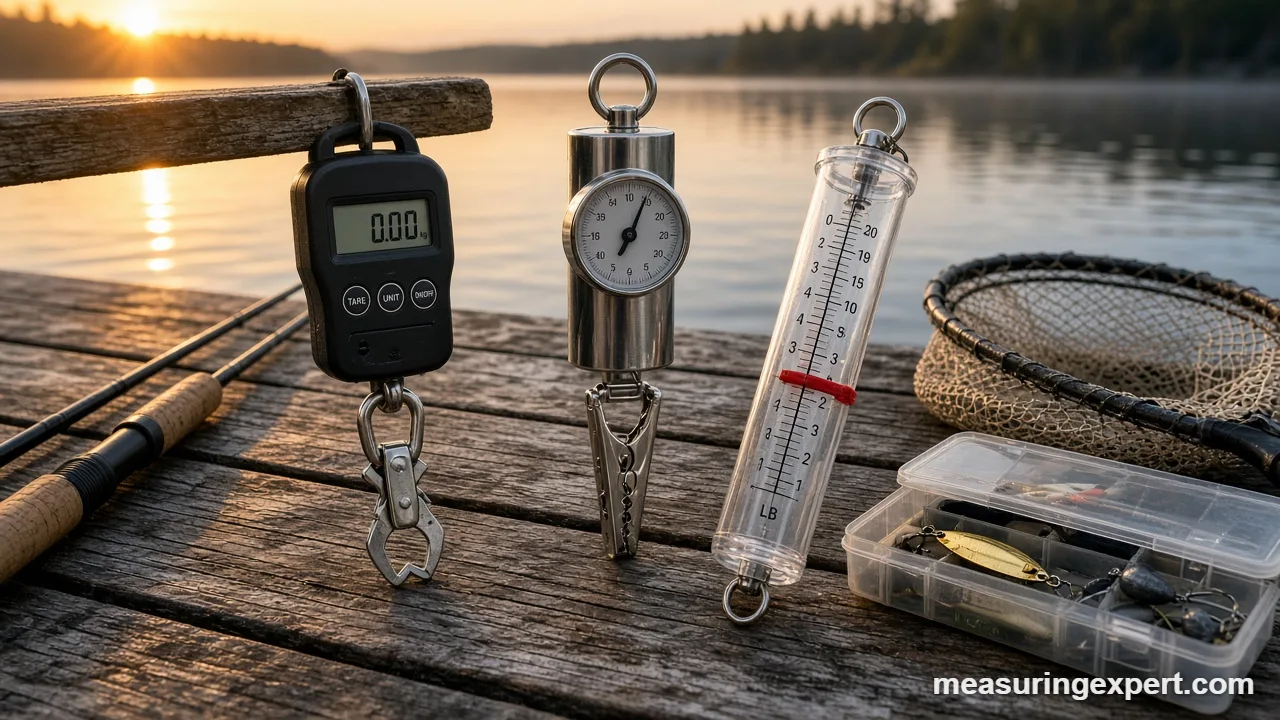
Next, rinse every scale in fresh water after a saltwater trip and let it air-dry with the battery door open. In addition, remove batteries before long storage, because leaking cells ruin contacts. Finally, store spring scales unloaded, since a spring left under tension slowly loses its calibration.
Do and Don’t for Weighing Fish
Honest Limits of the Best Fish Scale
Of course, even the best fish scale has limits. For example, a swinging fish or a rocking boat adds force, so the number jumps until everything settles. Also, cheap load cells drift with temperature, and spring scales lose tension with age. In short, treat any boat scale as a good estimate, and use a certified scale when the number really counts.
Best Fish Scale FAQ
What is the best fish scale for tournaments?
The Rapala Touch Screen Tournament Scale is our tournament pick because it stores eight weights, shows your running total and comes with eight numbered cull floats. The BUBBA Smart Fish Scale is a strong alternative with a plus or minus 0.3% accuracy claim.
Is a Boga Grip IGFA certified?
A BogaGrip can be sent to the IGFA for certification, and the maker says its scales have weighed more than 4,100 IGFA world record fish. Certification is per scale, and the IGFA wants an outside certificate dated within one year of the catch.
Which best fish scale type is most accurate?
A quality digital scale usually gives finer readings than a spring scale or a mechanical lip grip. However, accuracy depends on the specific model and calibration, so look for a stated tolerance and check it against a known weight.
How do I estimate fish weight without a scale?
Measure total length and maximum girth in inches. The Florida FWC calculator lists length x length x girth / 1,200 as a rough bass estimate, and length x girth x girth / 800 as another common formula.
Can a luggage scale weigh fish?
Yes, a digital luggage scale can weigh a fish in a bag or sling. However, most are not waterproof and lack a lip clip, so a fishing scale is the better long-term choice.
What capacity should the best fish scale have?
A 15 lb scale covers most bass, trout and walleye, while 30 to 60 lb suits redfish, stripers and big catfish. For offshore species, look at 110 lb or more.
Do digital fish scales work in the rain?
Many are water resistant, but ratings vary. An IPX4 scale handles splashes, while a waterproof or floating model is safer for kayaks and wading. Dry the scale after each trip either way.
Why does my fish scale give different readings?
A moving fish, a swaying boat, low batteries, cold temperatures or a scale near its top limit can all change the reading. Let the weight settle, use the auto-lock if your scale has one and check it against a known weight.
Is the best fish scale safe for catch and release?
Yes, if you use it with care. Clip the lower jaw, support the belly of large fish with a sling, keep the fish wet and release it quickly.
How often should I calibrate a fish scale?
Check it against a known weight at least once a season and after any hard drop. For record attempts, the IGFA requires a certification dated within one year of the catch.
Bottom Line: The Best Fish Scale for Most Anglers
For most anglers, the Rapala Touch Screen Tournament Scale is the best fish scale to keep in the boat. It handles culling, unit switching and backup memory in one tool. On the other hand, record hunters should add a BogaGrip, and every angler can tuck a spring scale in the tackle box as a backup.
Black Friday is coming: shop the deals with Prime