

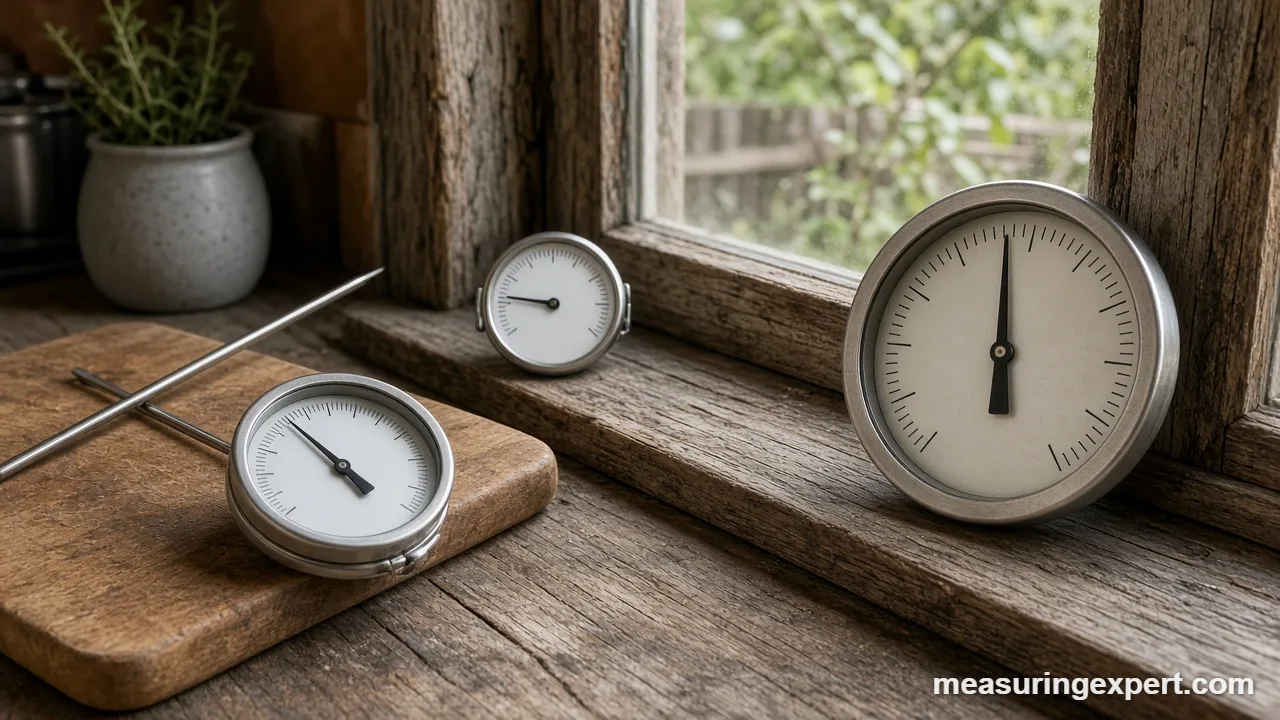
The best analog thermometer for most homes is the Rubbermaid Commercial Pocket Instant-Read, a tough, dishwasher-safe bimetal dial that covers 0 to 220 F. What decides your pick is where it lives: a pocket dial for food, a -20 to 80 F dial for the fridge, or a big weatherproof dial outdoors.
In short: Rubbermaid for cooking, Taylor 3512FS on a budget, CDN for a big readable dial, Rubbermaid again for the fridge, and La Crosse or Taylor outdoors.
As an Amazon Associate, Measuring Expert earns from qualifying purchases. Our picks are based on research, specifications and owner feedback, not paid placement.
Best Overall
Best Budget
Best Outdoor
Quick Answer: Which Dial Fits Your Job?
- Cooking all-rounder: Rubbermaid Pocket Instant-Read, NSF and dishwasher safe.
- Cheap spare: Taylor 3512FS, a 1 in dial with a 4.5 in stem.
- Easiest to read: CDN IRXL220, a 1.75 in waterproof dial you can recalibrate.
- Coffee and milk: KT THERMO B-2C, which clips onto a frothing pitcher.
- Fridge and freezer: Rubbermaid Monitoring Thermometer, -20 to 80 F.
- Porch or shed: La Crosse 104-1522, an 8 in dial from -60 to 120 F.
- Room comfort: Springfield ColorTrack, temperature plus humidity.
On This Page
- Comparison table
- Reviews of each pick
- How we chose
- Bimetal coil vs liquid
- Specs that matter
- Where to put each type
- Ice-point calibration
- F, C and K converter
- Honest limits
- FAQ
- Bottom line
Best Analog Thermometer Comparison Table
First, scan the table for the job you have in mind. Then jump to the full review for verified specs, pros and cons.
| # | Image | Product | Best For | Standout Feature | Amazon |
|---|---|---|---|---|---|
| 1 |  | Rubbermaid Pocket Instant-Read | Everyday cooking | Dishwasher safe at commercial temperatures | View |
| 2 |  | Taylor 3512FS | Budget spare | 1 in dial with magnified lens | View |
| 3 |  | CDN IRXL220 Large Dial | Easy reading | 1.75 in dial, waterproof and recalibratable | View |
| 4 |  | KT THERMO B-2C | Milk and coffee | Adjustable clip holds it on a pitcher | View |
| 5 |  | Rubbermaid Fridge/Freezer | Fridge and freezer | -20 to 80 F dial that hangs or stands | View |
| 6 |  | La Crosse 104-1522 | Porch or shed | 8 in dial reading -60 to 120 F | View |
| 7 |  | Taylor 12 in Dial | Patio or pool deck | 12 in dial for long-distance reading | View |
| 8 | 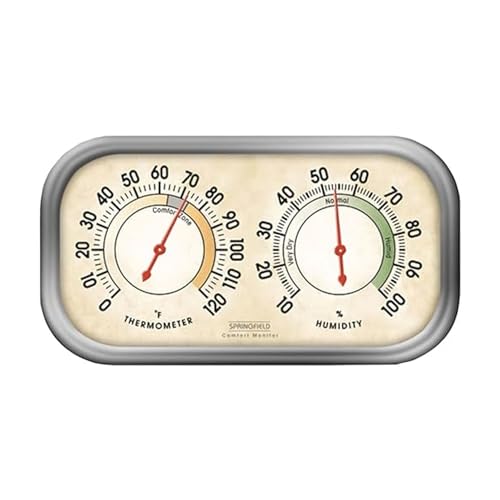 | Springfield ColorTrack | Indoor comfort | Color-coded temperature and humidity dials | View |
The Eight Best Analog Thermometer Picks, Reviewed
This list covers both halves of the analog world. On one side are bimetal dial cooking thermometers; on the other are dial thermometers for the fridge, the house and the yard. So start with the badge that matches your use.
Best Overall
1. Rubbermaid Commercial Pocket Instant-Read Thermometer
Best for: Home cooks who want one tough, dishwasher-safe dial thermometer for meat and leftovers.
Rubbermaid Commercial builds this pocket dial thermometer for restaurant kitchens, and that is exactly why it works so well at home. The scale runs from 0 to 220 F (about -18 to 104 C), so it covers chilled food checks, roast chicken and a pot of simmering soup. In addition, the stainless steel body and shatterproof lens shrug off drawer life.
Above all, the detail that sets it apart is cleanup. Rubbermaid lists it as dishwasher safe at commercial temperatures, which most cheap dial thermometers are not. Also, it is NSF certified and ships with a protective sheath and pocket clip. Like every bimetal instant-read, though, it needs about 15 to 20 seconds to settle, so it is a check-near-the-end tool rather than a leave-in probe.
- Range: 0 to 220 F (about -18 to 104 C)
- Display: analog dial, no batteries
- Build: stainless steel with shatterproof lens
- Cleaning: dishwasher safe at commercial temperatures
- Certification: NSF; sheath and clip included
Pros
- Survives the dishwasher
- Commercial-grade, food-safe build
- Covers cold holding through boiling
- Never needs a battery
Cons
- Small dial is harder to read at arm’s length
- Slower than a digital instant-read
Skip it if: you want a reading in two or three seconds; a digital thermocouple is faster.
Best Budget
2. Taylor 3512FS Instant-Read Pocket Thermometer
Best for: Budget buyers who want a spare dial thermometer for the grill, a picnic cooler or a second kitchen drawer.
To start with, Taylor has made kitchen thermometers for well over a century, and the 3512FS is its classic pocket test model. Specifically, it reads 0 to 220 F on a 1 in dial, and a magnified lens makes the small numbers easier to read. As a result, it is a cheap, sensible backup for anyone who cooks outdoors or wants one thermometer per cooler.
Also, the stainless stem is 4.5 in (about 11.4 cm) long, which keeps your fingers farther from a hot pan than a stubby probe does. In addition, it is NSF listed and comes in a pocket case with a clip. However, the dial is the smallest on this list, so it suits close-up reading.
- Range: 0 to 220 F (about -18 to 104 C)
- Dial: 1 in with magnified lens
- Stem: 4.5 in (11.4 cm) stainless steel
- Case: pocket sleeve with clip
- Certification: NSF
Pros
- Low cost, easy to buy several
- Long stem for hot pans
- Clip sleeve protects the tip
Cons
- Tiny dial
- No published accuracy figure on the listing
Skip it if: your eyesight makes a 1 in dial hard to read.
Best Easy-Read Dial
3. CDN ProAccurate IRXL220 Large Dial Cooking Thermometer
Best for: Cooks who struggle with tiny pocket dials and want a waterproof, recalibratable tool.
CDN is a food-service thermometer specialist, and the IRXL220 is its answer to the squint test. The dial measures 1.75 in (4.4 cm) across, so it is far easier to read than a 1 in pocket model. Meanwhile, the range is the usual 0 to 220 F, which fits meat, poultry, custards and reheated food.
Also, CDN rates it waterproof and shatterproof, and it is recalibratable, so you can reset it after an ice-point check. Also, the manual explains that the sensor sits between the dimple and the tip of the 5 in stem. Therefore, push the stem in at least to the dimple for a true reading.
- Range: 0 to 220 F (about -18 to 104 C)
- Dial: 1.75 in (4.4 cm), polycarbonate lens
- Stem: 5 in (12.7 cm) stainless steel
- Waterproof, shatterproof, NSF approved
- Recalibratable after an ice-point test
Pros
- Big, clear dial
- Waterproof for easy cleanup
- Can be recalibrated
- Sheath works as a handle extension
Cons
- Not for leaving in a hot oven
- Needs deep insertion, so thin cuts are awkward
Skip it if: you mostly cook thin burgers and fillets; a thin-tip digital probe suits those better.
Best for Milk Frothing
4. KT THERMO B-2C Instant-Read 2 in Dial Thermometer
Best for: Home baristas steaming milk and anyone tempering chocolate or warming liquids.
To begin with, KT THERMO’s B-2C is built for coffee bars. It clips onto a frothing pitcher, so the stem stays in the milk while you steam and your hands stay free. The scale covers 0 to 220 F and -10 to 100 C, so it also handles hot chocolate, yogurt and candle wax.
Although the listing calls it a 2 in dial, KT lists the exact diameter as 1.77 in. In addition, the casing and stem are stainless steel, and the multi-stage clip lets you tilt the face toward you. However, KT does not publish an accuracy figure, so an ice-point check before first use is a smart idea.
- Range: 0 to 220 F and -10 to 100 C
- Dial: 1.77 in (about 4.5 cm)
- Body and stem: stainless steel
- Clip: multi-stage, adjustable reading angle
- Warranty: 1 year per the maker
Pros
- Dual F and C scale
- Clip frees both hands
- Readable dial for its size
Cons
- No published accuracy figure
- Clip limits use in thick foods
Skip it if: you need a meat thermometer first; the clip design favors liquids.
Best for Fridge and Freezer
5. Rubbermaid Commercial Fridge/Freezer Monitoring Thermometer
Best for: Households that want proof the fridge sits at 40 F or below and the freezer at 0 F.
The FDA calls appliance thermometers the best way to know your fridge and freezer temperatures, and this is the kind of dial it means. The scale spans -20 to 80 F (about -29 to 27 C), which neatly brackets the 40 F (4.4 C) fridge target and the 0 F (-17.8 C) freezer target.
In addition, it hangs from a shelf or stands on its own, and the stainless case with a shatter-resistant lens copes with cold and condensation. Similarly, it is NSF listed and needs no battery. For a full picture, buy two: one for the fridge and one for the freezer, as the FDA suggests.
- Range: -20 to 80 F (about -29 to 27 C)
- Mounting: hangs or stands
- Build: stainless steel, shatter-resistant lens
- Power: none (mechanical dial)
- Certification: NSF
Pros
- Range centered on food-safety targets
- Hangs or stands
- No battery to die in the cold
Cons
- No min/max memory like a digital logger
- Reads air, which swings when the door opens
Skip it if: you want alerts on your phone when the freezer fails; that needs a wireless sensor.
Best Outdoor Wall
6. La Crosse Technology 104-1522 8 in Analog Dial Thermometer
Best for: Porches, sheds, greenhouses and garages where you want a quick look at the air temperature.
First of all, La Crosse is one of the best-known home weather brands, and this 8 in round dial is its simple, no-battery option. Notably, the scale runs from -60 to 120 F (about -51 to 49 C), so it handles a Minnesota winter and a desert summer alike. In addition, the maker lists it as weather resistant and suited to indoor or outdoor use.
Moreover, setup is easy: it hangs on a single screw or nail. Also, La Crosse backs it with a 2-year limited warranty. Just as important, place it in the shade on a north-facing wall, because sun on the dial can push the reading well above the true air temperature.
- Dial: 8 in (20.3 cm) diameter
- Range: -60 to 120 F (about -51 to 49 C)
- Use: indoor or outdoor, weather resistant
- Mounting: hangs on a screw or nail
- Warranty: 2-year limited
Pros
- Readable from across a yard
- Wide outdoor range
- No batteries or setup
Cons
- Fahrenheit-focused dial
- No humidity or min/max
Skip it if: you want the day’s high and low or remote readings; a digital weather station does that.
Best Big Patio Dial
7. Taylor 12 in Indoor/Outdoor Round Dial Thermometer
Best for: Pool decks, patios and barns where you read the dial from a distance.
If the La Crosse feels small, Taylor’s 12 in dial is the step up. In fact, its face is half again as wide, so you can read the temperature from a kitchen window or across a pool deck. Moreover, it is a mechanical coil dial, so it needs no batteries and no pairing.
For example, Taylor’s commercial listing for its 12 in large-dial model, the 6700, gives a range of -60 to 120 F and accuracy within 1 degree, with a weather-resistant, shatterproof plastic case and wall mounting. However, confirm the model number on the listing you buy, because Taylor sells several similar 12 in to 13 in dials.
- Dial: 12 in, indoor or outdoor
- Range (model 6700): -60 to 120 F (about -51 to 49 C)
- Accuracy (model 6700): within 1 degree
- Case: weather resistant, shatterproof plastic
- Mounting: wall hanging
Pros
- Biggest dial on this list
- Stated accuracy on the commercial version
- Classic look for a patio wall
Cons
- Several similar Taylor models can confuse buyers
- Large size needs a clear wall
Skip it if: you only need a small window or porch thermometer.
Best for Indoor Comfort
8. Springfield ColorTrack Indoor Thermometer and Humidity Meter
Best for: Bedrooms, nurseries, closets and wine or cigar storage where humidity matters as much as heat.
Springfield’s ColorTrack pairs a temperature dial with a humidity dial, and both use colored bands so you can see at a glance whether a room is too dry, too damp, too hot or too cold. As a result, it is a handy tool for spotting dry winter air or a damp basement before it causes trouble.
Better still, both dials are mechanical, so there is nothing to charge, and the compact body sits on a desk or hangs on a wall. However, mechanical humidity dials are rough guides rather than lab instruments. Therefore, check it with the salt test in the calibration section.
- Readouts: temperature plus relative humidity
- Display: color-coded analog dials
- Placement: desktop or wall
- Power: none (mechanical)
- Use: indoor rooms and storage areas
Pros
- Two readings in one
- Color zones are easy for anyone to read
- Small enough for a shelf
Cons
- Humidity dial is approximate
- Not built for outdoor exposure
Skip it if: you need precise humidity numbers for a humidor or lab; choose a calibrated digital hygrometer.
How We Chose the Best Analog Thermometer Picks
To be clear, we did not run hands-on tests. Instead, these picks are research-based. First, we listed dial thermometers from established brands such as Rubbermaid Commercial, Taylor, CDN, La Crosse and Springfield. Next, we read maker manuals and retailer spec sheets and kept only figures we could confirm. Then we scanned owner feedback for repeat complaints.
In addition, we checked the food-safety guidance from the USDA Food Safety and Inspection Service on kitchen thermometers and the FDA advice on fridge and freezer temperatures. Our criteria were:
- A range that fits the job, such as 0 to 220 F for food or -60 to 120 F outdoors.
- Readability, meaning dial size, contrast and lens quality.
- Calibration options or at least a clear way to check accuracy.
- Build quality, including stainless stems, shatterproof lenses and NSF listing for food tools.
- Distinct uses, so no two picks do the same job.
We also left out a few sibling categories on purpose. For liquid-in-glass candy and lab thermometers, see our guide to the best glass thermometer. Likewise, oven dials have their own roundup of the best oven thermometer picks.
Bimetal Coil vs Liquid: How an Analog Thermometer Works
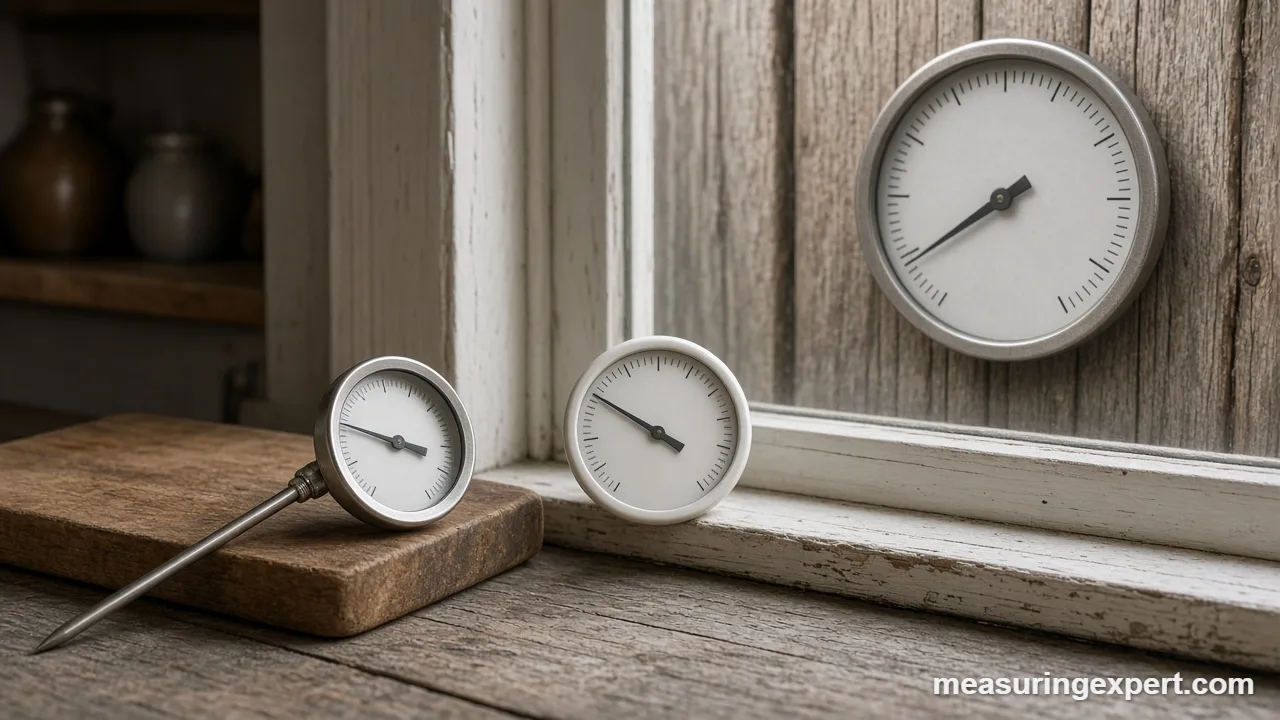
To begin with, almost every dial thermometer on this list uses a bimetal coil. Two strips of metal that expand at different rates are bonded together and wound into a spiral. When the temperature rises, one metal grows more than the other, so the coil twists. In turn, that twist moves the needle on the dial. In a pocket cooking thermometer, the coil sits inside the lower part of the stem, which is why you must push the stem in deep.
By contrast, a liquid thermometer works differently. A colored liquid, usually dyed alcohol today, expands up a thin glass tube, and you read the top of the column against a printed scale. Because the liquid responds along a short bulb at the tip, it can read shallow liquids well. However, the glass can break, and the column can separate after a knock.
| Feature | Bimetal dial | Liquid-in-glass |
|---|---|---|
| Sensing area | Coil along the lower stem, often 2 in or more | Small bulb at the tip |
| Response time | About 15 to 20 seconds for instant-read dials (USDA) | Often slower in air, quick in liquid |
| Durability | Metal stem, shatterproof lens on good models | Glass can break |
| Calibration | Many pocket dials have an adjustment nut | Usually fixed; check and note any offset |
| Best use | Meat, fridges, walls, patios | Candy, deep frying, labs, aquariums |
In short, a bimetal dial is tougher, while liquid-in-glass often suits sugar work and shallow liquids.
Specs That Matter on the Best Analog Thermometer
Range and Resolution
First, match the range to the job. For example, a 0 to 220 F food dial is useless in a freezer, while a -20 to 80 F fridge dial cannot read a roast. Also, look at the tick marks. A 1 in dial usually shows 2 F steps, so you can read it only to about 1 F at best.
Accuracy and Calibration
Second, accuracy is how close the needle sits to the true temperature, and few makers publish it for cheap dials. Therefore, a recalibration nut matters more than a claim. For instance, CDN states that the IRXL220 is recalibratable, so a quick ice-point test can bring it back into line after a drop.
Dial Size and Lens
Next, think about reading distance. A 1 in pocket dial is fine at arm’s length, but a 1.75 in dial is easier over a steaming pot. Outdoors, an 8 in or 12 in face is readable from a window.
Units
Finally, many US dials print only Fahrenheit, while some, such as the KT THERMO B-2C, add a Celsius ring. If you follow European recipes, our page on Fahrenheit to Celsius for baking covers the conversion, and the converter below handles any value.
Where to Put Each Type of Analog Thermometer
Even so, the best analog thermometer gives a bad number in the wrong spot. So use these simple placement rules:
- Meat: insert the stem 2 to 2.5 in into the thickest part, away from bone, as the USDA advises for bimetal dials. For thin foods, go in sideways.
- Fridge: hang the dial in the middle of a central shelf, not in the door. The target is 40 F (4.4 C) or colder.
- Freezer: place it among the food, not against the wall. The target is 0 F (-17.8 C).
- Outdoors: mount it in shade, ideally on a north-facing wall, and away from dryer vents, windows and dark siding.
- Indoors: keep it at chest height, away from radiators, lamps and sunny windows.
How to Calibrate the Best Analog Thermometer With Ice Water
In practice, the ice point is the easiest reference you own. Because a well-stirred glass of ice water sits at 32 F (0 C) at normal pressure, it works anywhere, unlike boiling water. So check a cooking dial before first use, after any drop and every few months:
- Fill a tall glass to the top with crushed ice, then add cold drinking water and stir.
- Let the glass sit for about a minute so the ice water settles at 32 F (0 C).
- Push the stem at least 2 in into the ice water, without touching the sides or bottom of the glass.
- Wait at least 30 seconds, or until the needle stops moving.
- Read the dial straight on; it should show 32 F (0 C).
- If it is off, hold the hex nut under the dial with a wrench or the sheath tool and turn the dial until the needle reads 32 F.
- If your thermometer has no adjustment, write the offset on a label and add or subtract it from every reading.
Checking Wall, Fridge and Humidity Dials
For wall and fridge dials without a nut, use the same idea. For example, set the fridge dial next to a calibrated pocket thermometer in a glass of water on the same shelf for a few hours, then compare. Meanwhile, you can check a mechanical humidity dial by sealing it in a bag with a damp paste of table salt and water for 8 to 12 hours. In fact, the air over saturated salt settles near 75 percent relative humidity, so any difference is your offset.
Fahrenheit, Celsius and Kelvin Converter
For instance, a food dial may show only Fahrenheit, while a recipe or a lab note uses Celsius. Therefore, type a reading below to convert it.
In fact, the formula is simple: C = (F – 32) x 5/9, and K = C + 273.15. For example, 165 F works out to 73.9 C, or 347.04 K.
Caring for the Best Analog Thermometer
Honest Limits of Any Analog Thermometer
Of course, dials have trade-offs. First, a bimetal pocket thermometer reads an average along its coil, so it can miss a cold center in a thin steak. Second, it is slower than a digital probe, taking about 15 to 20 seconds. Third, outdoor dials read whatever the case feels, including sun and wall heat. Finally, mechanical humidity dials drift with dust and age. In short, analog is reliable, battery-free and cheap, but it rewards a little care and a regular ice-point check. If you need speed or alarms, compare our picks for the best food thermometer.
Best Analog Thermometer FAQ
What is the best analog thermometer for cooking?
Our cooking pick is the Rubbermaid Commercial Pocket Instant-Read, a 0 to 220 F bimetal dial that is NSF certified and dishwasher safe at commercial temperatures. However, the CDN IRXL220 is the better choice if you want a larger 1.75 in dial.
How accurate is a bimetal dial thermometer?
A good bimetal dial is accurate enough for cooking and room checks, but few makers publish a tolerance for cheap models. So the best habit is to test it in ice water, where it should read 32 F (0 C), and adjust or note any offset.
How do I calibrate an analog thermometer?
Stir a glass of crushed ice and water, push the stem at least 2 in in without touching the glass, and wait 30 seconds. Then, if it does not read 32 F, turn the hex nut under the dial until it does, or record the offset.
Is a bimetal or liquid thermometer better?
A bimetal dial is tougher and easier to read, so it suits meat, fridges and walls. By comparison, a liquid-in-glass thermometer reads with a small tip bulb, so it is often better for candy, frying oil and shallow liquids.
Can I leave a dial thermometer in the oven?
Only if it is labeled oven-safe. Instant-read dials such as the CDN IRXL220 should not stay in a hot oven, while oven-safe dials are built to remain in the food while it cooks.
Where should I place the best analog thermometer outdoors?
Mount it in the shade, ideally on a north-facing wall, away from windows, vents and dark surfaces. Otherwise, sun on the dial can make it read several degrees too high.
What temperature should my fridge thermometer show?
The FDA advises 40 F (4.4 C) or colder for the refrigerator and 0 F (-17.8 C) for the freezer. As a result, a dial with a -20 to 80 F range covers both targets.
Why is my analog thermometer slow?
A bimetal coil must warm up along its length before the needle settles. The USDA says instant-read dials take about 15 to 20 seconds, so wait for the needle to stop moving before you read it.
Does the best analog thermometer need batteries?
No. Bimetal and liquid thermometers are fully mechanical, so they need no batteries or charging. Because of that, they are good backups for power cuts and coolers.
How long does an analog thermometer last?
A well-kept dial can last for years. However, replace it if the lens fogs inside, the stem bends, or it fails an ice-point check and cannot be adjusted.
Bottom Line on the Best Analog Thermometer
For most kitchens, the Rubbermaid Commercial Pocket Instant-Read Thermometer is the best analog thermometer to own. It is tough, food-safe, dishwasher safe and covers everything from chilled food to boiling soup. Meanwhile, add the Rubbermaid fridge dial for food storage and a La Crosse or Taylor dial outside, and check every one of them in ice water now and then.
Black Friday is coming: shop the deals with Prime
1 thought on “Best Analog Thermometer: 8 Dial Picks for Kitchen, Fridge and Patio”