

The best candy thermometer for most home cooks is the TempPro TP511, a digital model with a pot clip, a target alert and a calibration function. However, the right choice depends on your pot and your sugar work: a glass tube, a metal dial or a long paddle can suit you better.
In short: pick the TP511 for digital ease, the Escali AHC3 for a battery-free glass tube, and the Taylor 6084J8 for a tough dial.
As an Amazon Associate, Measuring Expert earns from qualifying purchases. Our picks are based on research, specifications and owner feedback, not paid placement.
Best Overall
Best Glass Tube
Best Analog Dial

Quick Answer: Which Pick Fits Your Kitchen?
- Digital with an alert: TempPro TP511, which flashes when your target is reached.
- Simple digital for small pots: TempPro TP510, with a rotating backlit head.
- Battery-free glass: Escali AHC3, marked in F and C.
- Unbreakable dial: Taylor 6084J8, with a recalibratable 2 in. face.
- Deep pots and big batches: Taylor 5983N, a 12 in. stainless paddle.
- Easy reading for beginners: OXO Good Grips, with large markings and a big clip.
- Backup for spot checks: Cuisinart LCD, an instant-read probe.
On This Page
- Comparison table
- The 7 picks, reviewed
- How we chose
- Digital, dial or glass
- Sugar stages in F and C
- Boiling water test and altitude
- Temperature converter
- How to use one
- Small pots and probe depth
- Care and honest limits
- FAQ
- Bottom line
Best Candy Thermometer Comparison Table
First, find your use in the Best For column.
| # | Product | Best For | Standout Feature | Amazon |
|---|---|---|---|---|
| 1 | TempPro TP511 | Cooks who want a digital reading, a target alert and a pot clip in one tool. | Programmable alert and calibration | View |
| 2 | TempPro TP510 | Small saucepans, jam batches and cooks who want digital simplicity. | Simple digital readout with a clip | View |
| 3 | Escali AHC3 | Traditional candy makers who want F and C on a battery-free tube. | Battery-free glass tube with F and C | View |
| 4 | Taylor 6084J8 | Cooks who want an unbreakable, easy-to-read dial with no battery. | 2-inch dial with 8 in. stem | View |
| 5 | Taylor 5983N | Big batches, deep pots and anyone who wants to keep hands away from steam. | 12 in. stainless paddle | View |
| 6 | OXO Good Grips | Beginners who want big markings and a secure clip. | Large markings and extra-large clip | View |
| 7 | Cuisinart LCD | Cooks who want one tool for meat, oil and an occasional batch of candy. | Instant-read with calibration setting | View |
The 7 Best Candy Thermometer Picks, Reviewed
Above all, every pick below is a complete thermometer you can clip or hold in a pot. First, we start with digital models, move to glass and dial, and end with the instant-read backup.
Best Overall
1. TempPro TempDip Elite TP511 Programmable Digital Candy Thermometer
Best for: Cooks who want a digital reading, a target alert and a pot clip in one tool.
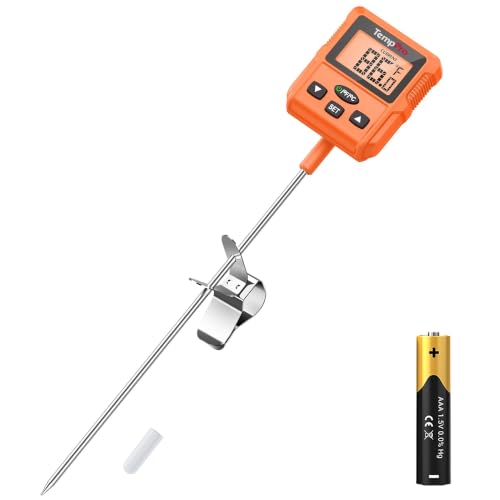
The TempPro TP511 is our best candy thermometer pick for most home cooks because it solves the usual pain points of a glass tube. First, it has a backlit digital display, so you read a number instead of squinting at a thin line. In addition, you can set a target temperature, and the backlight flashes when the syrup reaches it.
Also, TempPro’s own page lists a built-in calibration function, which matters because every candy recipe depends on the number being right. Meanwhile, the adjustable clip holds the probe on the side of the pot. However, the same page gives two accuracy figures, so we quote the more cautious one below and suggest you run the boiling water test before your first batch.
- Range: -58 to 572 F (-50 to 300 C), per TempPro
- Accuracy: up to +/-1.8 F (+/-1 C) in the specifications section; the comparison table lists a tighter figure
- Probe: 304 stainless steel, about 8 in. (205 mm), with an adjustable pot clip
- Programmable target temperature with a flashing backlight alert
- IPX5 splash rating: rinse under running water, but do not submerge
- Power: 1 AAA battery, included
Pros
- Target alert frees you to keep stirring
- Built-in calibration function
- Wide range covers sugar, frying and general cooking
Cons
- Needs a battery
- The manufacturer page gives two accuracy figures
- Not for full submersion
Skip it if: you prefer a simple glass or dial tool with no battery.
Best for Small Pots
2. TempPro TempDip TP510 Digital Candy Thermometer with Pot Clip
Best for: Small saucepans, jam batches and cooks who want digital simplicity.
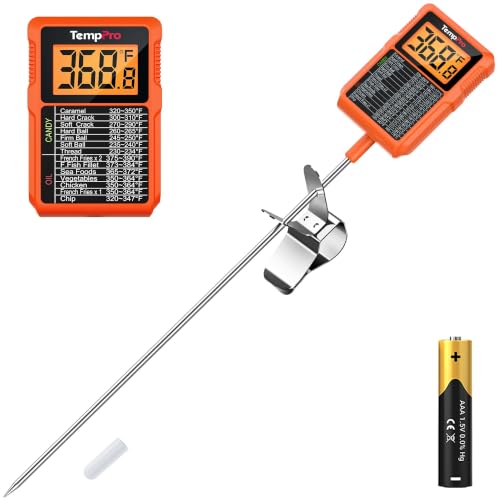
In short, the TempPro TP510 is the simpler sibling of the TP511. Specifically, it has the same wide range, the same stainless probe and the same pot clip, but it skips the programmable alert. As a result, it suits cooks who only want a clear digital number. Because the probe is a slim stainless stem, it also works in a small saucepan where a long paddle would tip over.
For example, TempPro’s page says the head rotates 90 degrees and has a backlit LCD, so you can read it from the side of the stove. Note that the listing and the manufacturer page describe the probe length slightly differently. Therefore, check the length on the Amazon page if your pot is very shallow.
- Range: -58 to 572 F (-50 to 300 C), per TempPro
- Accuracy: up to +/-1.8 F (+/-1 C) in the specifications section
- Backlit LCD; the head rotates 90 degrees
- Pot clip; no alarm, so you must watch the display
- IPX5 splash rating; 1 AAA battery included
Pros
- Easy digital readout
- Rotating backlit head
- Works in small pots
Cons
- No temperature alarm
- Needs a battery
- Probe length is described inconsistently
Skip it if: you want an audible or visual target alert, since the TP511 adds one.
Best Glass Tube
3. Escali AHC3 Candy and Deep Fry Glass Tube Thermometer
Best for: Traditional candy makers who want F and C on a battery-free tube.
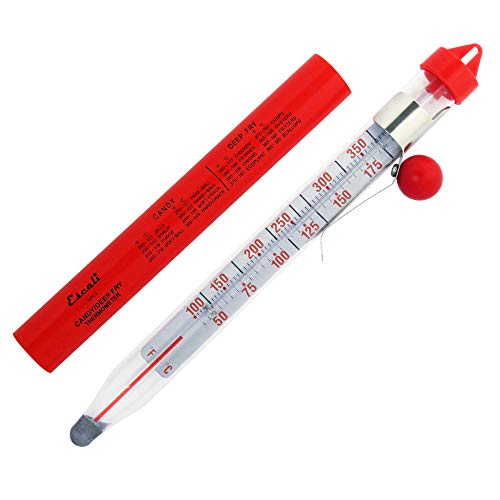
First, the Escali AHC3 is the classic choice for sugar work. It is a glass tube thermometer, so it needs no battery and has no electronics to fail.
Specifically, a listing at Everything Kitchens gives a 100 to 392 F (40 to 200 C) range and an 8.5 in. length. It also lists a stainless pot clip with a heat-resistant wooden knob for moving it. In fact, that range covers every sugar stage up to dark caramel. However, a glass tube reacts more slowly than a digital probe, so give it time to settle before you act.
- Range: 100 to 392 F (40 to 200 C), per a retail listing
- Dual F and C scale on the column
- Length: 8.5 in., with a stainless pot clip and wooden knob
- Glass tube with a protective sheath; the Amazon title lists NSF certification
- Hand wash only
Pros
- No battery needed
- F and C on one scale
- Clip holds it steady in the pot
Cons
- Glass can break
- Slower to settle than a digital probe
- Hard to read in steam
Skip it if: you want a fast digital reading or a built-in alert.
Best Analog Dial
4. Taylor Professional 6084J8 Candy and Deep Fry Dial Thermometer
Best for: Cooks who want an unbreakable, easy-to-read dial with no battery.
In contrast, the Taylor 6084J8 swaps glass for a metal stem and a round dial. Therefore, it will not shatter if you knock it, and the pointer is easy to read at a glance. The dial is 2 in. wide, and the stem is 8 in. long, so it reaches into most saucepans and stockpots.
Also, one useful feature is that this model can be recalibrated. The retailer’s FAQ says to hold the stem in boiling water for at least a minute, check for a reading near 212 F, and adjust if it is off. However, the stated accuracy is within 5 F, which is looser than the digital picks.
- Range: 50 to 550 F, per a retailer listing
- Accuracy: within +/-5 F, per the listing
- Stem: 8 in., stainless steel, with a pan clip
- 2-in. analog dial; recalibratable
- Do not submerge the head or use a dishwasher
Pros
- No battery and no glass
- Can be recalibrated
- Covers candy and frying ranges
Cons
- Accuracy of +/-5 F is looser
- Dial is small compared with a paddle
- Head must stay out of the liquid
Skip it if: you need tight control for hard crack or tempering work.
Best for Deep Pots
5. Taylor 5983N Candy, Jelly and Deep Fry Paddle Thermometer, 12 in.

Best for: Big batches, deep pots and anyone who wants to keep hands away from steam.
Next, the Taylor 5983N is a 12 in. stainless paddle thermometer with an insulated handle. Because it is long, it keeps your hand farther from steam and splatter, and it suits deep stockpots. In addition, it has a sliding pan clip, so it hangs on the pot hands-free.
Specifically, a retailer listing gives a 100 to 400 F range with accuracy within 2 F. Overall, that is tighter than the Taylor dial, and the range covers all the usual candy stages. However, the listing names Fahrenheit only in its overview, so check the face if you cook in Celsius. Also, do not immerse the whole paddle or put it in the dishwasher.
- Range: 100 to 400 F, per a retailer listing
- Accuracy: within 2 F, per the listing
- Length: 12 in., stainless frame with an insulated handle
- Sliding pan clip and hanging loop
Pros
- Long reach for deep pots
- Tighter stated accuracy than the dial
- Clip and loop included
Cons
- Too long for small saucepans
- Fahrenheit is the main scale
- Cannot be submerged
Skip it if: you mostly cook in small pots, where a short probe is easier.
Best Easy-Read Glass
6. OXO Good Grips Glass Candy and Deep Fry Thermometer

Best for: Beginners who want big markings and a secure clip.
Above all, the OXO Good Grips candy and deep fry thermometer is built around readability. For example, the markings are large, and the printed guide names candy, caramel and chocolate stages beside the temperatures. The clip is extra large, too.
OXO lists a 100 to 400 F range on both scales, which covers the whole sugar range from soft ball to dark caramel. Also, the top has a large loop, and that makes it easier to lift out of a hot pot. However, it is hand wash only, and the range stops at 400 F. As a result, it fits candy and shallow frying better than turkey fryer oil.
- Range: 100 to 400 F, with Fahrenheit and Celsius markings
- Large, easy-to-read markings with suggested stages printed on it
- Extra-large clip and a large loop for lifting
- Hand wash only
Pros
- Clear, large markings
- Strong clip
- F and C scales
Cons
- Glass, so handle it with care
- Stops at 400 F
- Hand wash only
Skip it if: you need a reading above 400 F or a digital display.
Best Instant-Read Backup
7. Cuisinart LCD Digital Instant-Read Thermometer
Best for: Cooks who want one tool for meat, oil and an occasional batch of candy.
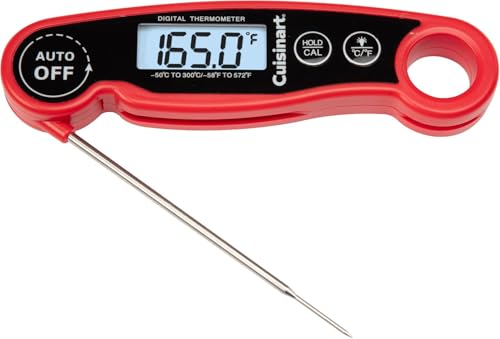
Finally, the Cuisinart LCD is an instant-read thermometer, not a dedicated candy thermometer. We include it because its listing names oil and candy as uses and because the range is wide. It reads fast, so it is handy for spot checks between stirs, and the listing mentions a calibration setting.
Still, the key trade-off is that an instant-read probe has no pot clip. In other words, you must hold it in the syrup while you read, which is awkward with a hot pot. However, it also checks meat, bread and oil, so it earns its drawer space. Treat it as a backup to a clip-on model.
- Range: -58 to 572 F (-50 to 300 C), per a retail listing
- Response: about 2 to 3 seconds, per the listing
- Water resistance: IP66, per the listing
- Calibration setting and MAX/MIN function; auto on/off
- No pot clip is described
Pros
- Fast reading
- Calibration setting
- Useful beyond candy
Cons
- No clip means you hold it in the pot
- The listing gives no accuracy figure
- Short probe near hot sugar
Skip it if: you want to clip the thermometer to the pot and walk away.
How We Chose the Best Candy Thermometer
First, these picks are research-based. We did not run hands-on lab tests. Instead, we compared manufacturer pages, retailer spec listings and published candy guidance. Specifically, we looked at five things.
- Range: it must reach at least 340 F (171 C) so you can work up to dark caramel.
- Mounting: a pot clip, so you can stir with both hands.
- Readability: large markings or a backlit display that works in steam.
- Calibration: a way to check or adjust the reading against boiling water.
- Brand and fit: established makers, with no more than two picks from one brand.
Also, we only state specs that we found on a manufacturer page or a retailer spec listing. Where two sources disagreed, we say so. Our best food thermometer guide covers meat and general cooking, which this guide skips.
Digital, Dial or Glass: Which Best Candy Thermometer Type Wins?
Each type reads temperature in a different way, so each has its own strengths.
| Type | Strength | Weakness | Examples here |
|---|---|---|---|
| Digital probe | Fast, clear number; often has an alert | Needs a battery | TempPro TP511, TP510 |
| Glass tube | No battery; two scales | Fragile; slow to settle | Escali AHC3, OXO Good Grips |
| Metal dial or paddle | Tough; no battery | Looser stated accuracy on some | Taylor 6084J8, 5983N |
| Instant-read | Very fast; multi-use | No clip; you hold it | Cuisinart LCD |
In short, a digital probe is easiest, a glass tube is simplest, and a dial is the sturdiest. For a deeper look at dial gauges, read our best analog thermometer guide.
Sugar Stages in Fahrenheit and Celsius
Candy recipes name a stage instead of a single number. For example, “soft ball” means the syrup forms a soft ball when dropped in cold water. WebstaurantStore’s candy temperature chart gives one starting temperature per stage. Also, we converted each to Celsius.
| Stage | F | C | Typical use |
|---|---|---|---|
| Thread | 230 | 110.0 | Syrups and some glazes |
| Soft ball | 235 | 112.8 | Fudge, pralines, fondant |
| Firm ball | 245 | 118.3 | Caramels |
| Hard ball | 250 | 121.1 | Marshmallows, nougat |
| Soft crack | 270 | 132.2 | Taffy, butterscotch |
| Hard crack | 300 | 148.9 | Lollipops, brittle, toffee |
| Light caramel | 320 | 160.0 | Caramel sauce, flan |
| Dark caramel | 340 | 171.1 | Deep caramel color and flavor |
However, treat these as starting points. Recipes vary by a few degrees, so follow your recipe first and use the chart as a cross-check.
Calibrate Your Best Candy Thermometer: Boiling Water and Altitude
Because accuracy matters, a thermometer that reads 5 degrees off will ruin a batch of fudge. So test yours before each candy season. According to the WebstaurantStore guide, hold the tip in boiling water for about five minutes without touching the pot. At sea level it should read 212 F (100 C).
Next, if it reads higher or lower, adjust your recipe targets by the same amount. Altitude matters too. Likewise, the same guide says to subtract 2 F for every 1,000 ft above sea level. In metric terms, that is roughly 1.1 C for every 300 m.
Similarly, jam works the same way. An Illinois Extension jelly recipe says to boil to 8 F above the boiling point of water. As a result, a thermometer that reads the boiling point correctly also gives you the right jam target. Our guide to measuring ingredients for jam covers quantities.
Candy Temperature Converter
Also, use this converter to switch between Fahrenheit, Celsius and Kelvin.
How to Use the Best Candy Thermometer Step by Step
Indeed, good technique matters as much as the tool. Follow these steps for any model in this guide.
- Test it in boiling water: Hold the tip in boiling water for several minutes. At sea level, it should read 212 F (100 C). Then note any difference.
- Adjust for altitude: Subtract 2 F from your target for every 1,000 ft above sea level, or use your boiling water reading as the baseline.
- Clip it to the pot: Next, attach the clip so the tip sits in the syrup. Also, keep the tip off the bottom and the sides of the pot.
- Start on medium heat: Stir until the sugar dissolves, then stop stirring if your recipe says so. Then watch the reading rise.
- Read at eye level: Next, look straight at the scale or display. With glass, line your eye with the top of the column to avoid parallax error.
- Pull the pot at the target: Remove the pot from the heat a few degrees early if the thermometer is slow. Sugar keeps heating after you stop, so plan ahead.
- Cool and clean: Let the thermometer cool, then wash it by hand. Finally, store it upright, away from heat.
Small Pots and Shallow Syrup
If the syrup is shallow, the probe tip may sit above the liquid or touch the bottom. As a result, both give a wrong reading. Therefore, tilt the pot slightly or make a larger batch.
For example, a short digital probe such as the TempPro TP510 handles shallow pots well. By contrast, the 12 in. Taylor 5983N is built for deep stockpots.
Care and Honest Limits
- Cool before washing: because a hot glass tube can crack in cold water.
- Replace the battery: because a weak battery can make a digital display fade or drift.
- We did not test these, so our picks come from specs and published guidance, not our own bench tests.
Best Candy Thermometer FAQ
What is the best candy thermometer for beginners?
For most beginners, a clip-on model with a clear display is the best candy thermometer. The TempPro TP511 adds a target alert, while the OXO Good Grips and Escali AHC3 are simple tubes with large markings. Also, whichever you pick, test it in boiling water first.
What temperature range do I need for sugar work?
In general, it needs to cover at least 230 to 340 F (110 to 171 C) to reach thread through dark caramel. Therefore, a 100 to 400 F model works for candy. If you also fry oil for doughnuts, look for a range that reaches at least 400 F.
How do I test my thermometer for accuracy?
First, place it in boiling water for several minutes without touching the pot. At sea level, it should read 212 F (100 C). If it reads higher or lower, note the difference and adjust your recipe targets by that amount.
How do I adjust a candy thermometer for altitude?
In fact, water boils at a lower temperature as you climb. WebstaurantStore advises subtracting 2 F for every 1,000 ft above sea level from your recipe temperatures. In metric terms, that is about 1.1 C for every 300 m. However, a boiling water test on the day is the safest check.
Can I use a regular meat thermometer for candy?
You can, if the range reaches the stage you need. However, many meat probes lack a pot clip, so you must hold them in the syrup. In addition, some probes are rated well below 300 F, so check the range first.
Is a digital or glass candy thermometer better?
Digital models read quickly and often offer alerts, while glass tubes need no battery and have no electronics. In short, digital suits busy cooks, and glass suits traditionalists. See our best glass thermometer guide for the glass side.
Can I use one for deep frying?
Often yes, since many cover 100 to 400 F or more. However, deep frying and turkey fryers benefit from a longer stem and a higher range. Because of that, we cover oil use in a separate guide on deep fry thermometers.
What temperature is the gel point for jam?
For jam, one extension service recipe says to boil jelly to 8 F above the boiling point of water. At sea level, that is about 220 F (104 C). Meanwhile, the sheeting test off a spoon is a good second check.
How should I clean it after use?
Let it cool first, because a hot glass tube can crack in cold water. Then wash the stem by hand with warm soapy water and wipe the head with a damp cloth. Do not put it in the dishwasher unless the maker says it is safe.
How do I keep the probe off the pot bottom?
First, clip it so the tip sits in the syrup but off the bottom. The bottom of a pot, for instance, runs hotter than the liquid. As a result, a tip that touches it reads too high.
Bottom Line: Our Best Candy Thermometer Pick
For most kitchens, the TempPro TP511 is the best candy thermometer to start with. In short, it combines a clear digital display, a pot clip, a target alert and a calibration function. Alternatively, if you prefer glass, choose the Escali AHC3. If you want a tough dial, choose the Taylor 6084J8. Whichever you buy, run the boiling water test first.