

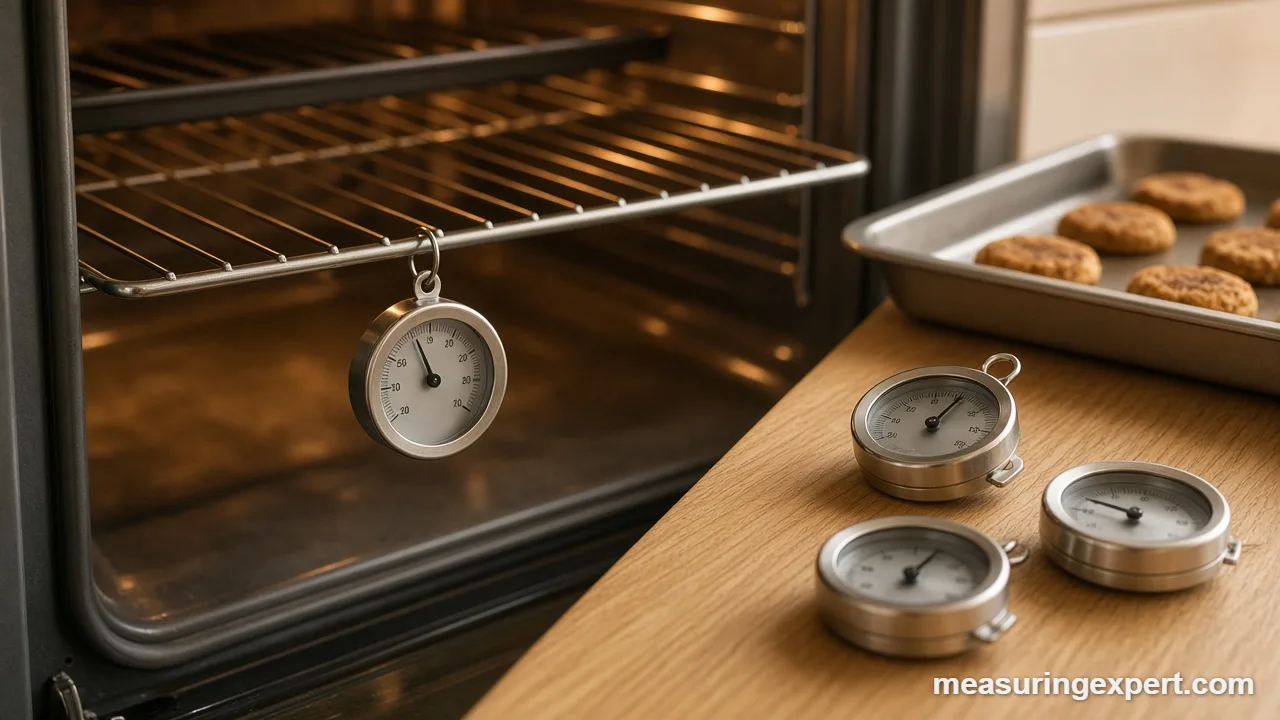
The best oven thermometer for most kitchens is the Rubbermaid FGTHO550, a stainless, NSF-listed dial that hangs or stands and reads 60 to 580 F. Still, the right pick depends on three things: how easily you can read it, whether you need Celsius, and whether you want food and oven temperatures on your phone.
In short: get the Rubbermaid for daily use, the AcuRite 00620A2 on a budget, and the MEATER Plus if you want smart readings.
As an Amazon Associate, Measuring Expert earns from qualifying purchases. Our picks are based on research, specifications and owner feedback, not paid placement.
Best Overall
Best Budget
Best Smart
Quick Answer: Which Oven Thermometer Fits Your Kitchen?
- Everyday baking and roasting: the Rubbermaid FGTHO550, built for food-service ovens.
- Tight budget: the AcuRite 00620A2, one of the few cheap dials with a stated tolerance.
- Reading through the door glass: the Taylor 5932 and its 3-inch face.
- Racks you move often: the OXO Good Grips with its clip, hook and stand.
- Metric recipes: the TempPro dual-scale dial or the Taylor.
- Watching a roast from the counter: the TempPro TP16 probe or the wireless MEATER Plus.
On This Page
- Comparison table
- The 7 picks, reviewed
- How we chose
- Why oven dials drift
- Dial vs digital vs smart
- Specs that matter
- How to test your oven
- Oven temperature converter
- Care and honest limits
- FAQ
- Bottom line
Best Oven Thermometer Comparison Table
| # | Product | Best For | Standout Feature | Amazon |
|---|---|---|---|---|
| 1 | Rubbermaid Commercial FGTHO550 Oven Monitoring Thermometer | Most kitchens | NSF listed, 60-580 F range, hangs or stands | View |
| 2 | Taylor 5932 Large Dial Oven Thermometer | Large dial | 3-inch dial, 100-600 F and 50-300 C | View |
| 3 | OXO Good Grips Oven Thermometer | Easy placement | Clip, hook and stand in one body | View |
| 4 | AcuRite 00620A2 Stainless Steel Oven Thermometer | Budget pick | Stated accuracy of +/- 5 F from 300 to 400 F | View |
| 5 | TempPro Oven Thermometer (431 Stainless Steel) | Dual-scale dial | 431 stainless body with a tempered glass lens | View |
| 6 | TempPro TempTrack CORE TP16 Digital Probe Thermometer | Digital readout | Probe rated to 716 F with a 99-hour timer | View |
| 7 | MEATER Plus Wireless Smart Thermometer | Smart pick | Two sensors: food up to 212 F, ambient up to 527 F | View |
The 7 Best Oven Thermometer Picks, Reviewed
In short, each pick below fills a different need. First come the stainless dials that live on the rack, and then the digital and smart probes that show the number outside the oven.
Best for most kitchens
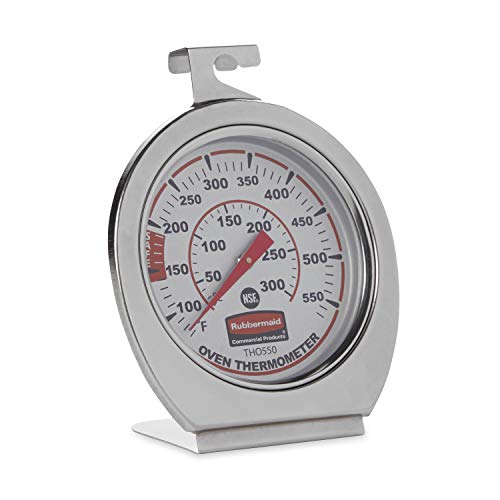
1. Rubbermaid Commercial FGTHO550
Best for: Home bakers and busy cooks who want a sturdy, food-service grade dial that stays in the oven.
To start, this is the dial you see in many restaurant kitchens, and that is the main reason it tops our list. Rubbermaid builds the FGTHO550 for food-service use, so the body is 304 stainless steel and the lens is shatter-resistant. As a result, it shrugs off the bumps, spills and heat cycles that crack cheaper dials. It also hangs from a rack or stands on its own, so you can move it to the spot where your food actually sits.
On the measurement side, the scale runs from 60 to 580 F (about 16 to 304 C) and is marked in 10 F steps. Even so, that resolution is fine for an oven, because a home oven swings more than 10 F as the burner or element cycles anyway. However, the dial is Fahrenheit-first, so metric cooks may prefer a dual-scale model.
- Range: 60 to 580 F (about 16 to 304 C)
- Resolution: 10 F increments on an oversized dial
- Body: 304 stainless steel with a shatter-resistant lens
- Mounting: hangs from a rack or stands on its base
- Certification: NSF listed
Pros
- Commercial build that survives daily use
- Large, clear numbers
- Hangs or stands, so placement is flexible
- NSF listing for food-service kitchens
Cons
- Fahrenheit is the main scale
- 10 F marks are coarse for candy or sugar work
- Dial thermometers lag a few minutes after you open the door
Skip it if: you cook mainly in Celsius, or you want a reading outside the oven without opening the door.
Best large dial
2. Taylor 5932 Large Dial

Best for: Cooks who want a big 3-inch face that is easy to read through the oven window.
Of course, Taylor has made kitchen thermometers for a long time, and the 5932 is its classic large-dial oven model. Above all, the face measures 3 inches across, which is the main selling point. For example, you can often read it through the door glass without opening the oven and dumping heat.
The scale covers 100 to 600 F and 50 to 300 C, so both US and metric recipes are covered. In addition, Taylor lists it as NSF certified. Plus, the housing is stainless steel, and it either hangs from a rack or stands on a flat shelf.
- Range: 100 to 600 F (50 to 300 C)
- Dial: 3 inches
- Body: stainless steel
- Mounting: hangs or stands
- Certification: NSF
Pros
- Big face that suits older eyes and dim ovens
- Dual scale for US and metric recipes
- Simple, battery-free design
Cons
- Taylor does not publish a tolerance figure
- The large body takes up more rack space
Skip it if: you need a stated accuracy figure, or your oven is too small for a 3-inch dial.
Best for easy placement
3. OXO Good Grips Dial

Best for: Bakers who move racks often and want a thermometer that stays put.
First of all, the OXO stands out for how it attaches. An inverted V-shaped clip sits on the oven rack, and a two-point hook grips thin or thick wires. Alternatively, an angled, wide base lets it stand on its own. Because it is designed to stay in place when the door opens and closes, it is a good match for cooks who check often.
Besides that, the face shows both Fahrenheit and Celsius with large numbers. OXO also says it tested the design in more than five oven models. However, OXO does not publish a tolerance figure, so treat it like any dial: compare it with a second thermometer once in a while.
- Scale: Fahrenheit and Celsius
- Clip: inverted V-shape for oven racks
- Hook: two-point grip for thin or thick wires
- Base: angled and wide for standing
Pros
- Most secure mounting on our list
- Large numbers on both scales
- Stays in place when the door opens
Cons
- No published accuracy spec
- Costs more than basic dials
Skip it if: you only need a cheap spot check and never move your racks.
Best budget pick
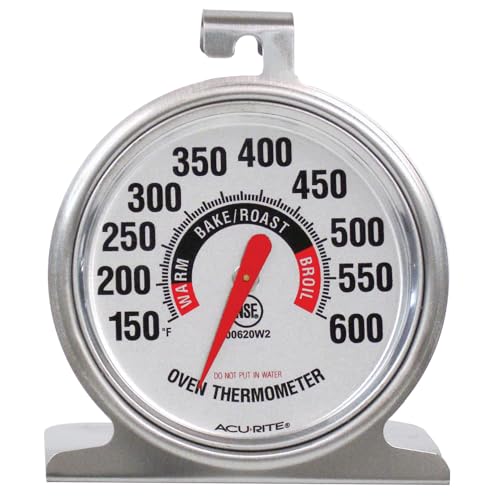
4. AcuRite 00620A2 Stainless Dial
Best for: Anyone who wants a low-cost dial with a published accuracy figure.
Unlike most cheap dials, the AcuRite comes with a stated accuracy. In fact, the 00620A2 reads within plus or minus 5 F between 300 and 400 F, and within plus or minus 10 F outside that band. Since most baking happens between 325 and 375 F, the tighter band covers the temperatures that matter most.
Likewise, it uses a bimetal coil, the same design found in most dial oven thermometers. The housing is stainless steel with a glass lens, and it measures about 3.1 by 2.6 by 1.8 inches. In addition, it hangs from an integrated hanger or stands upright. Note, though, that the scale is Fahrenheit only, from 150 to 600 F.
- Range: 150 to 600 F (about 66 to 316 C)
- Accuracy: +/- 5 F from 300 to 400 F; +/- 10 F elsewhere
- Sensor: bimetal coil
- Body: stainless steel with a glass lens
- Size: about 3.1 x 2.6 x 1.8 in (7.9 x 6.6 x 4.6 cm)
Pros
- Published tolerance, which is rare at this level
- Compact enough for small ovens and toaster ovens
- No batteries
Cons
- Fahrenheit only
- Smaller dial is harder to read through the glass
- Starts at 150 F, so it is not useful for proofing temperatures
Skip it if: you work in Celsius or want to read the dial through a dark oven window.
Best dual-scale dial
5. TempPro 431 Stainless Dial
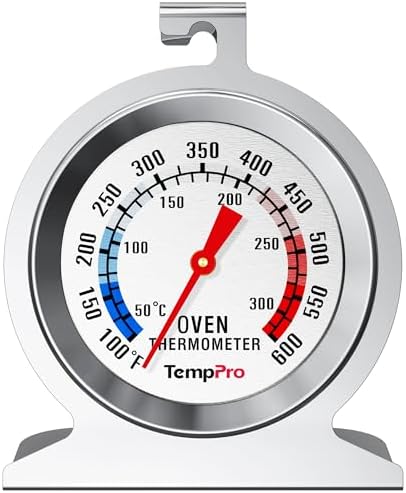
Best for: Metric and US cooks who want both scales on a rust-resistant dial.
TempPro is the brand formerly sold as ThermoPro, and this is its analog oven dial. Specifically, TempPro lists a range of 100 to 600 F (50 to 300 C), a 431 stainless steel body and a tempered glass lens. It also uses an anti-rust dial, two hooks for hanging and a wide base for standing.
Because the dial prints both scales, it suits cooks who switch between US and European recipes. On the other hand, TempPro does not give a numeric tolerance, and some boxes may still show the old ThermoPro name.
- Range: 100 to 600 F (50 to 300 C)
- Body: 431 stainless steel
- Lens: tempered glass
- Mounting: two hooks plus a wide base
- Power: none needed (mechanical)
Pros
- Fahrenheit and Celsius on one face
- Two hooks hold it firmly on the rack
- Battery-free
Cons
- No published accuracy spec
- Branding change can confuse buyers
Skip it if: you want a model with a stated tolerance, such as the AcuRite.
Best digital readout
6. TempPro TempTrack CORE TP16

Best for: Cooks who want to watch a roast or the oven without opening the door.
In fact, this is the long-running ThermoPro TP16, now sold under the TempPro name. Instead of a dial inside the oven, a stainless probe goes in the food and a cable runs out to a backlit LCD on the counter. As a result, you can track progress without opening the door and losing heat.
TempPro lists a range of 32 to 572 F (0 to 300 C) and accuracy of plus or minus 1.8 F (1 C). Moreover, the probe tolerates up to 716 F (380 C). In addition, you get a 99-hour, 59-minute timer and stopwatch, a magnetic back and a stand. Some owners clip the probe to a rack to watch oven air, but remember the readout tops out at 572 F.
- Range: 32 to 572 F (0 to 300 C)
- Accuracy: +/- 1.8 F (+/- 1 C)
- Probe heat limit: 716 F (380 C)
- Timer: 99 h 59 min plus stopwatch
- Power: 1 x AAA battery
Pros
- Reads without opening the oven
- Tight stated accuracy
- Alarm and timer in one unit
- Magnet and stand for easy mounting
Cons
- Cable can be pinched by the door seal
- Not for broiling above its limits
- Needs a battery
Skip it if: you only want to check the oven air temperature, since a simple dial does that for less.
Best smart pick
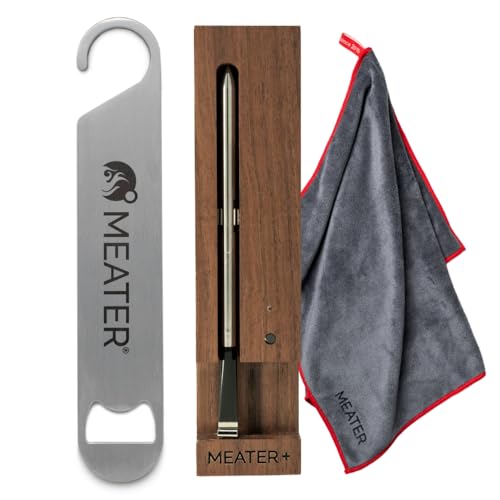
7. MEATER Plus Wireless Probe
Best for: Roasting cooks who want food and oven readings on a phone.
The MEATER Plus is a truly wireless probe with two sensors. First, one reads the food, up to 212 F. Second, the other reads the ambient air around the meat, up to 527 F. So, for roasting, it gives you both numbers at once without any cable through the door.
Furthermore, the app offers a guided cook mode and estimates cook and rest times. MEATER lists a wireless range of up to 165 feet (about 50 m), though walls and your phone model affect it. Also, the probe is rechargeable, runs more than 24 hours per charge, and is dishwasher safe. Meanwhile, the charger runs on one AAA battery that can last up to a year.
- Food sensor: up to 212 F (100 C)
- Ambient sensor: up to 527 F (275 C)
- Range: up to 165 ft (about 50 m)
- Battery: more than 24 hours per charge
- Cleaning: dishwasher safe
Pros
- Oven and food temperature in one probe
- No wires through the door
- App estimates when food is done
Cons
- Needs a phone and a charged probe
- Ambient limit of 527 F rules out very hot pizza ovens
- Costs far more than a dial
Skip it if: you mainly bake bread and cakes, where a dial on the rack tells you what you need.
How We Chose the Best Oven Thermometer Models
We did not run hands-on lab tests. Instead, our picks are research-based. We read the maker’s spec page for each model and compared range, scale, mounting, build and any stated tolerance. We also read owner feedback for patterns, such as foggy lenses, loose hooks or dials that drift over time.
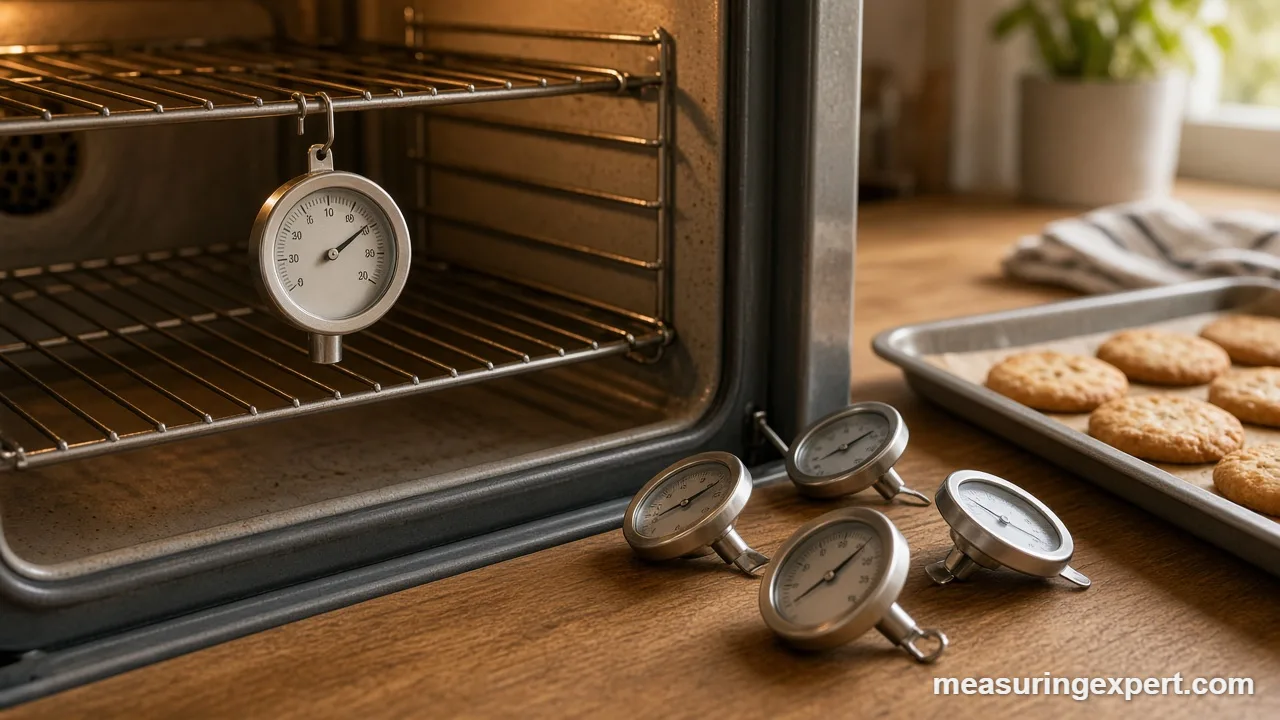
To sum up, these were the main criteria:
- Range that covers real cooking: at least 150 to 550 F, so the dial handles low roasts and hot pizza bakes.
- Readable scale: large numbers, clear marks and, ideally, a Celsius scale too.
- Published specs: we favored brands that state a tolerance or a certification such as NSF.
- Stable mounting: a hook, clip or base that keeps the dial upright when the rack slides.
- Brand track record: established names, a maximum of two models per brand, and no unbranded listings.
For food safety targets we used the official FoodSafety.gov safe minimum temperature chart. For thermometer types and checks, we used the USDA guide to kitchen thermometers.
Why Your Oven Dial Is Probably Off
Indeed, an oven never holds one steady temperature. Instead, the control turns the burner or element on and off, so the air swings above and below the set point. As a result, a set point of 350 F can mean air that moves between roughly 330 and 370 F during one cycle.
In addition, the oven’s own sensor sits in one spot, usually near the back wall or the top. Meanwhile, the center of the rack, where your cake sits, can run hotter or cooler. Age makes it worse, because sensors drift and door seals wear out. So a separate thermometer on the rack is the only way to know what the food actually feels.
For example, suppose the oven is set to 350 F, but your thermometer settles at 325 F. That is an offset of 25 F, or about 13.9 C. Therefore, cookies bake slower, cakes sink, and roasts take longer than the recipe says. Our guide to precision in cooking measurements explains why small errors like this add up.
Dial, Digital Probe or Smart: Choosing the Best Oven Thermometer Type
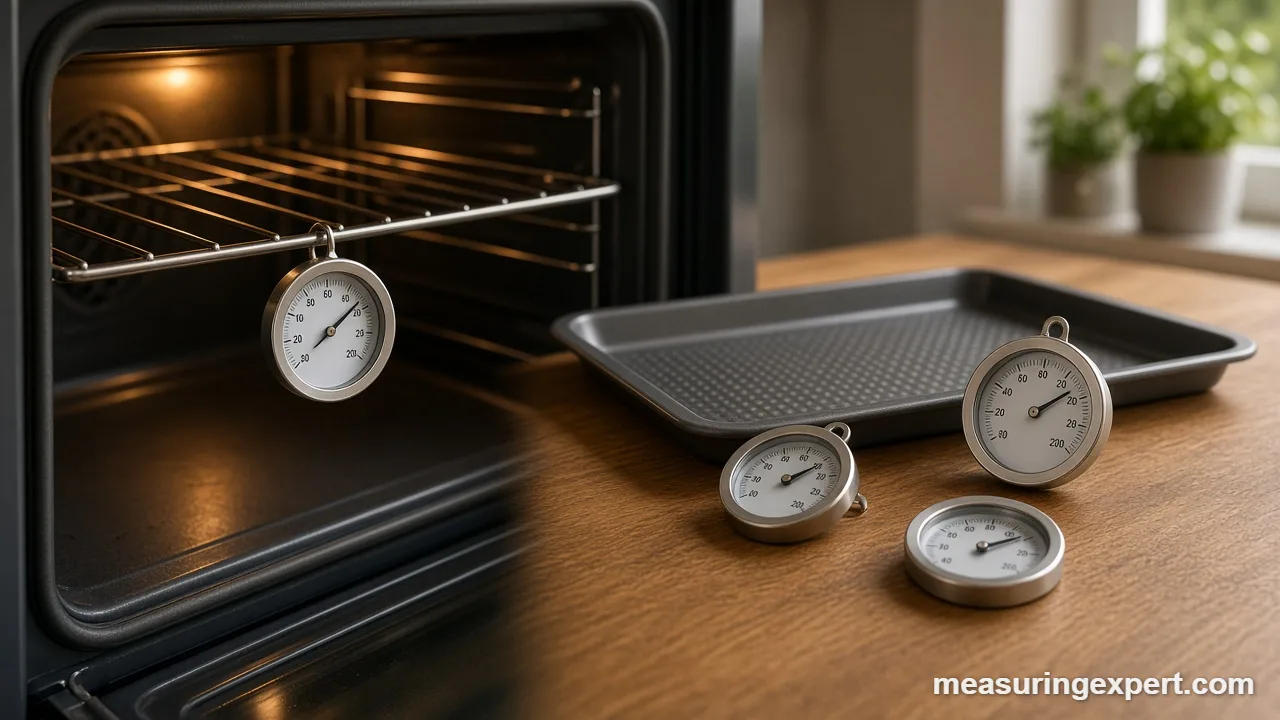
In other words, every type has a job. Simply put, a dial tells you what the oven air is doing. By contrast, a probe tells you what the food is doing. Overall, the table sums up the trade-offs.
| Type | What it measures | Strengths | Weak spots |
|---|---|---|---|
| Bimetal dial | Oven air at the rack | No battery, lives in the oven, cheap | Slow to settle, coarse marks, hard to read in a dark oven |
| Wired digital probe | Food core or clipped-on air | Fast, precise, reads outside the oven | Cable through the door, battery, heat limit |
| Wireless smart probe | Food core plus ambient air | No wires, two readings, app alerts | Cost, charging, ambient limit |
To begin with, most dials use a bimetal coil. In this design, two metals that expand at different rates are bonded together and wound into a spring. When heat rises, the coil twists and turns the needle. That design is simple and tough. However, it reacts slowly, so give it time to settle after you close the door.
Digital probes, on the other hand, use a thermistor (an NTC sensor in the TP16). The resistance changes with temperature, and the chip turns it into a number. This is why digital models can list tighter accuracy, such as plus or minus 1.8 F.
Specs That Decide Accuracy
Still, most listings bury the useful numbers. These are the specs to look for, and what each one tells you.
- Range: the span the scale covers. Look for at least 150 to 550 F (66 to 288 C). Also, check the low end if you proof dough or dehydrate food.
- Accuracy (tolerance): how far the reading can be from the truth. Yet few dials state it. AcuRite gives plus or minus 5 F from 300 to 400 F, for instance.
- Resolution: the smallest step you can read. On dials it is the spacing of the marks, often 10 F. By comparison, digital units usually show 1 degree or finer.
- Units: dual scales help if you cook from European or Australian recipes.
- Build: stainless bodies with glass lenses last longer in steam and grease. Meanwhile, plastic parts have no place inside an oven.
- Mounting: a hook, clip or wide base keeps the face toward the door.
- Power and app: dials need nothing. In contrast, probes need a AAA cell or a charger, and smart models need a phone.
How to Test Your Oven Temperature, Step by Step
This routine takes about 45 minutes, and it tells you how far your oven runs from its dial.
- Pick the spot: Put the thermometer on the center rack, in the middle, where food usually sits.
- Preheat fully: Set the oven to 350 F (177 C) and wait for the preheat signal.
- Let it settle: Then wait another 15 to 20 minutes so the walls and air reach a steady state.
- Read through the glass: Next, read the dial through the window, or open the door briefly and read straight on.
- Repeat the reading: Take two more readings 10 minutes apart, because the heat cycles up and down.
- Average and compare: Average the three readings and subtract the set point to find your offset.
- Adjust or compensate: Finally, follow your oven manual to calibrate it, or simply set the dial higher or lower by the offset.
Later, run the test again at 425 F (218 C) if you roast or bake bread often, because some ovens drift more at high heat. Also, write the offset on a piece of tape inside a cabinet door so the whole family knows it.
Oven Temperature Converter: F, C and Gas Mark
First, use the converter to switch a recipe between Fahrenheit and Celsius. For background on the formula, see our guide to Fahrenheit to Celsius for baking.
The math is short: C = (F – 32) x 5/9, and F = C x 9/5 + 32. British and Australian recipes may also use gas marks. Accordingly, the table shows the usual matches, with exact Celsius values next to the rounded ones printed in recipes. Our page on converting Australian recipes to US covers the rest of the units.
| Gas mark | Fahrenheit | Exact Celsius | Recipe Celsius | Oven feel |
|---|---|---|---|---|
| 1 | 275 F | 135.0 C | 140 C | Very low |
| 2 | 300 F | 148.9 C | 150 C | Low |
| 3 | 325 F | 162.8 C | 160 to 170 C | Moderately low |
| 4 | 350 F | 176.7 C | 180 C | Moderate |
| 5 | 375 F | 190.6 C | 190 C | Moderately hot |
| 6 | 400 F | 204.4 C | 200 C | Hot |
| 7 | 425 F | 218.3 C | 220 C | Hot |
| 8 | 450 F | 232.2 C | 230 C | Very hot |
| 9 | 475 F | 246.1 C | 240 C | Very hot |
Care, Checks and Honest Limits
An oven thermometer is a simple tool, but a few habits keep it honest for years.
- Remove it before self-clean. The cycle runs far above any dial’s top mark.
- Wipe, do not soak. Otherwise, water can get behind the lens and fog the face. Instead, hand-wash with a damp cloth once the dial is cool.
- Handle it with mitts. After all, stainless dials stay hot long after the oven is off.
- Cross-check once a season. Put a calibrated probe next to the dial, let both settle, and then compare.
- Replace a dial that sticks. A needle that jumps or will not return to room temperature has a tired coil.
Now for the honest limits. First, a dial shows the air in one spot, not the whole oven. Second, every dial lags, so a reading taken right after you open the door is low. Third, few cheap dials publish a tolerance, so you cannot assume plus or minus 5 F. Finally, an oven thermometer does not tell you when food is safe. For that, you need a probe in the food and the safe temperatures from FoodSafety.gov, such as 165 F (74 C) for poultry and 145 F (63 C) for whole cuts of beef and pork.
Best Oven Thermometer FAQ
What is the best oven thermometer for most people?
For most kitchens, the best oven thermometer is a sturdy stainless dial such as the Rubbermaid FGTHO550. It is NSF listed, hangs or stands, and reads from 60 to 580 F. If you want a stated tolerance on a budget, the AcuRite 00620A2 is the alternative.
Where should I put an oven thermometer?
In general, place it on the center rack, near where the food will sit. Ovens are hotter near the walls, the back and the heating element, so a reading from the center tells you the most. Later, move it around to map hot spots.
How long should an oven thermometer stay in before I read it?
Preheat the oven fully, then wait about 15 to 20 minutes after the preheat signal. Dial thermometers react slowly, so an early reading often shows a number that is still climbing.
Can I leave an oven thermometer in the oven all the time?
Yes, oven dial thermometers are made to stay in. However, take it out before the self-clean cycle, because that cycle runs far hotter than the dial’s top mark and can ruin it.
Is a digital oven thermometer better than a dial?
Not always. Indeed, a digital probe reads faster and shows the number outside the oven. On the other hand, a good dial needs no battery and lives on the rack. That is why many cooks use one of each.
How accurate is the best oven thermometer?
A good dial is often within about 5 to 10 F of the true temperature. For example, AcuRite states plus or minus 5 F from 300 to 400 F and plus or minus 10 F elsewhere. Digital probes such as the TP16 list plus or minus 1.8 F.
Why does my oven thermometer disagree with the oven display?
Most ovens cycle the heat on and off, so the air swings above and below the set point. In addition, the oven sensor sits in one spot, often near the back wall. A small gap is normal; a steady gap of 25 F or more means the oven needs adjusting.
Can I use the best oven thermometer in a grill or smoker?
Most stainless dial models also work in a grill or smoker, as long as the heat stays under the top of the scale. Also, keep the lens out of direct flame and away from grease drips.
How do I check if my oven thermometer is accurate?
First, compare it with a second thermometer in the same spot. For instance, place a calibrated probe next to the dial, let both settle for 15 minutes, and then compare. If they differ by more than about 10 F, trust the probe and note the offset.
Do I need an oven thermometer for an air fryer?
Small dial thermometers can fit in some air fryer baskets, but fast airflow can move or tip them. So check the manual first. A probe thermometer in the food is usually the better choice for air fryers.
Bottom Line: The Best Oven Thermometer for Most Kitchens
For most home cooks, the Rubbermaid FGTHO550 is the best oven thermometer to buy. Above all, it is tough, NSF listed, easy to read and flexible to place. If you want a published tolerance for less, choose the AcuRite 00620A2. And if you roast more than you bake, the MEATER Plus adds food and oven readings on your phone.
3 thoughts on “Best Oven Thermometer: 7 Research-Based Picks for Accurate Baking and Roasting”