

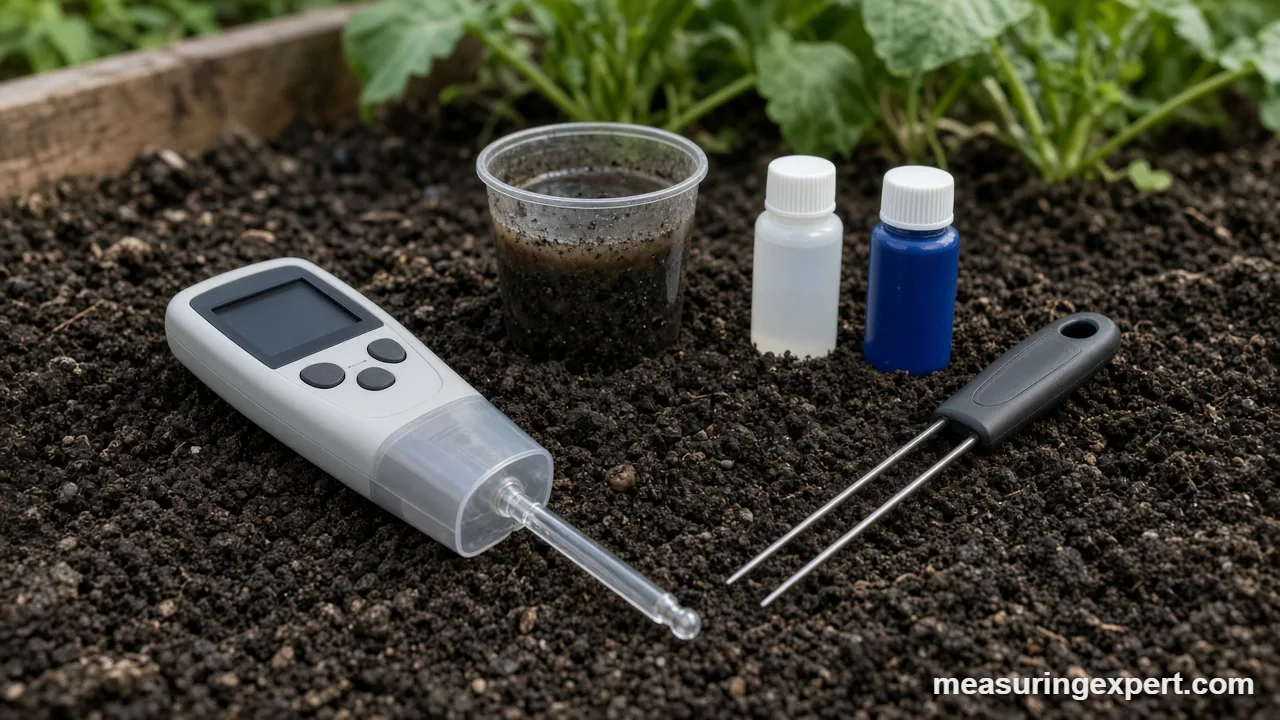
The best soil pH meter for most gardeners is the Hanna HI981030, because it uses a real glass electrode built for soil instead of a cheap metal probe. What decides your choice is how much accuracy you need, whether you will calibrate, and whether a lab test fits better.
In short: get the Hanna HI981030 for direct soil readings, the Apera PH20 on a budget, and the Hanna HI99121 kit for professional field work.
As an Amazon Associate, Measuring Expert earns from qualifying purchases. Our picks are based on research, specifications and owner feedback, not paid placement.
Best Overall

Best Budget

Best Pro
Quick Answer: Which Soil pH Tester Fits Your Garden?
- Direct readings in garden beds: the Hanna HI981030 GroLine tester.
- Lowest outlay for a real electrode: the Apera PH20, used with a soil slurry.
- Many beds or paid work: the Hanna HI99121 kit with its auger.
- Coco, potting mix and grow rooms: the Bluelab Soil pH Pen.
- Lime and fertilizer decisions: a lab test such as MySoil or your state extension lab.
- pH plus NPK at home: the Rapitest Digital kit.
- Watering only: a cheap probe such as the VIVOSUN, but ignore its pH dial.
On This Page
- Comparison table
- The 7 picks, reviewed
- How we chose
- Probe, electrode, kit or lab
- Specs that decide accuracy
- How to test soil pH
- Honest limits of cheap meters
- Calibration and electrode care
- From reading to lime or sulfur
- FAQ
- Bottom line
Best Soil pH Meter Comparison Table
| # | Product | Best For | Standout Feature | Amazon |
|---|---|---|---|---|
| 1 | Hanna HI981030 GroLine Soil pH Tester | Most gardeners who want real numbers | Built-in soil electrode, plus or minus 0.05 pH | View |
| 2 | Hanna HI99121 Direct Soil pH Kit | Farms, nurseries and consultants | IP67 meter, auger and soil prep solution | View |
| 3 | Apera Instruments AI209 PH20 pH Tester Kit | Low-cost slurry testing | IP67 pen with 3-point calibration | View |
| 4 | Bluelab Soil pH Pen | Coco, potting mix and grow rooms | Fully waterproof pen with temperature reading | View |
| 5 | MySoil Soil Test Kit | pH plus full nutrient report | Mail-in lab analysis with recommendations | View |
| 6 | Luster Leaf Rapitest Digital Soil Test Kit | pH plus N, P and K at home | Optical reader instead of color matching | View |
| 7 | VIVOSUN 3-in-1 Soil Tester | Moisture and light checks | Battery-free moisture, light and pH dial | View |
The 7 Best Soil pH Meter Picks, Reviewed
We split the list by method. First come electrode meters, then lab and chemical tests, and last a cheap probe so you can see its limits. Also, every spec below comes from the maker or a dealer spec sheet.
Best Overall
1. Hanna HI981030 GroLine Soil pH Tester
Best for: vegetable growers, lawn owners and community gardeners who want a true electrode reading without a lab bench.
Hanna designed the HI981030 for soil, so the tip is a real glass pH electrode inside a removable PVDF sleeve. That matters, because a glass electrode actually responds to hydrogen ion activity. In contrast, the cheap two-prong probes further down this list do not. As a result, this is the best soil pH meter for most home growers who want numbers they can act on.
Hanna lists a range of 0.00 to 12.00 pH, a resolution of 0.01 pH and an accuracy of plus or minus 0.05 pH at 25 C (77 F). Also, it calibrates automatically at one or two points, and the kit ships with pH 4.01 and 7.01 buffer sachets plus two cleaning solutions, one for mineral soil and one for humus.
- Range: 0.00 to 12.00 pH
- Resolution: 0.01 pH; accuracy plus or minus 0.05 pH at 25 C
- Calibration: automatic, 1 or 2 points (buffers included)
- Battery: one CR2032, about 1,000 hours of use
- Size: 50 x 151 x 21 mm (2 x 5.9 x 0.9 in)
Pros
- Real glass electrode built for soil, not a galvanic probe
- Cleaning solutions for both mineral and organic deposits
- Tight listed accuracy for a pocket tester
Cons
- You must calibrate it and keep the tip moist
- Hanna does not list a waterproof rating
- Rocky or very dry soil can damage the tip, so a slurry or pilot hole is safer
Skip it if: you only want a rough yes or no once a season; a mail-in lab test may cost less over time.
Best Pro
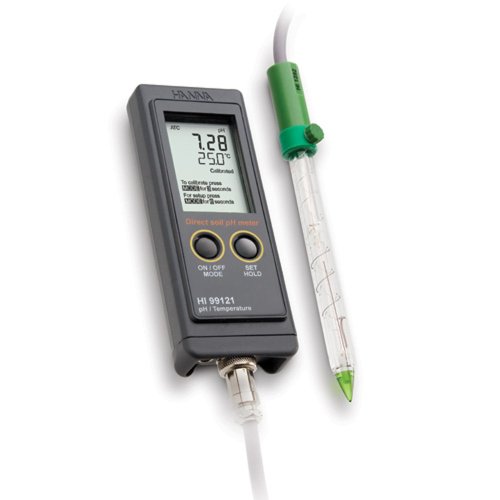
2. Hanna HI99121 Direct Soil pH Kit
Best for: market gardeners, agronomy students and landscapers who test many beds and want a complete field kit.
The HI99121 (listed on Amazon as HI99121N) is a full field kit rather than a single pen. Specifically, it pairs a waterproof meter with a glass-body electrode on a 1 m (3.3 ft) cable, a soil auger to drill a pilot hole, and a bottle of soil preparation solution.
Hanna lists a range of -2.00 to 16.00 pH with 0.01 pH resolution and plus or minus 0.02 pH accuracy. In addition, the electrode has a built-in temperature sensor, and the meter calibrates at one or two points. Hanna rates the meter IP67 and lists about 1,400 hours of use on three AAA cells. Therefore, it is the best soil pH meter here for heavy, repeated field work.
- Range: -2.00 to 16.00 pH; resolution 0.01 pH
- Listed accuracy: plus or minus 0.02 pH
- Temperature: -5.0 to 105.0 C (23 to 221 F)
- Protection: IP67 meter
- Kit: electrode, soil auger, prep solution, buffers, cleaners, case
Pros
- Complete kit, so you can start testing the day it arrives
- Auger protects the glass bulb in firm soil
- Built-in temperature sensor and IP67 meter
Cons
- More gear and more outlay than a pocket tester
- Electrode on a cable is more to carry and store
- Still needs routine calibration and cleaning
Skip it if: you test one small bed a year; the Apera PH20 with a slurry does that job for much less.
Best Budget Electrode
3. Apera Instruments AI209 PH20 pH Tester Kit
Best for: budget-minded gardeners who are happy to mix soil with distilled water in a cup.
The PH20 is a general pocket pH tester, not a soil spike. However, that is not a drawback if you use the slurry method, which mirrors how many labs work. You mix dried soil with distilled water, stir, wait, then dip the pen. Because the reading comes from a real glass electrode, it is far more trustworthy than any probe meter at a similar outlay.
Apera lists a range of 0 to 14.0 pH, 0.1 pH resolution and plus or minus 0.1 pH accuracy. Also, the pen calibrates at 1 to 3 points, compensates for temperature from 0 to 50 C (32 to 122 F) and is rated IP67. The kit includes calibration solutions and a carrying case.
- Range: 0 to 14.0 pH; resolution 0.1 pH
- Listed accuracy: plus or minus 0.1 pH
- Calibration: automatic, 1 to 3 points
- ATC: 0 to 50 C (32 to 122 F)
- Protection: IP67, and it floats
Pros
- Real electrode reading for little outlay
- Waterproof and floats, so a dropped pen survives
- Three-point calibration covers acid and alkaline soils
Cons
- Not built to push into soil, so you must make a slurry
- Electrode is not replaceable
- Only 0.1 pH resolution
Skip it if: you want to stab the meter straight into a bed; pick the Hanna HI981030 instead.
Best for Growing Media
4. Bluelab Soil pH Pen
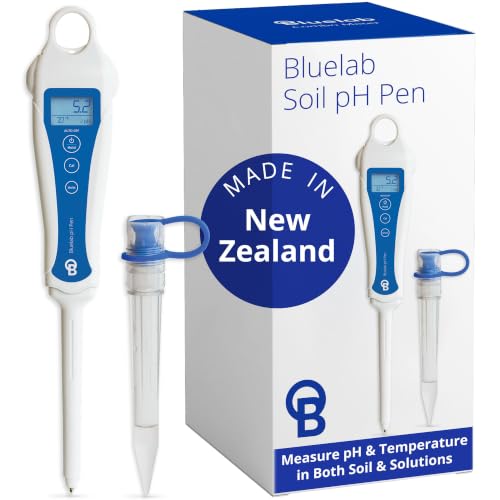
Best for: container growers, greenhouse staff and hydroponic growers who test potting mixes and coco as well as garden soil.
Bluelab is a grow-room brand, and its Soil pH Pen reflects that. The company lists soil, coco coir, potting mixes and solutions as uses, so one pen covers beds, pots and the nutrient tank.
Bluelab lists a range of 0.0 to 14.0 pH, 0.1 pH resolution and plus or minus 0.1 pH accuracy. Calibration uses two points, pH 7.0 and either pH 4.0 or pH 10.0, and the pen compensates for temperature automatically. Bluelab calls it fully waterproof but gives no IP number, and it runs on one AAA cell with a one-year warranty.
- Range: 0.0 to 14.0 pH; resolution 0.1 pH
- Listed accuracy: plus or minus 0.1 pH
- Temperature: 0 to 50 C (32 to 122 F), plus or minus 1 C
- Calibration: 2 points (pH 7.0 plus 4.0 or 10.0)
- Power: one AAA cell
Pros
- Works in soil, coco, potting mix and solutions
- Temperature shown on screen with the pH
- Automatic temperature compensation
Cons
- Coarser 0.1 pH resolution than the Hanna HI981030
- No published IP rating
- One-year warranty is short for the outlay
Skip it if: you grow only in garden soil and want finer resolution; the Hanna HI981030 reads to 0.01 pH.
Best Lab Test
5. MySoil Soil Test Kit

Best for: new homeowners, lawn owners and anyone about to spend money on lime, sulfur or fertilizer.
MySoil is not a meter at all. Instead, you collect soil with the included tools, register the kit with a QR code and mail the sample in a prepaid envelope to a certified lab.
We include it because a lab test is the honest benchmark for any soil pH meter. In fact, extension sources advise confirming field readings with a lab, and lime rates depend on buffer capacity, not just pH. So, run one lab test first, then use a meter between lab tests.
- Type: mail-in soil test kit
- Reports: pH, NPK and a broader nutrient panel
- Shipping: prepaid return envelope included
- Results: online, with fertilizer guidance
Pros
- Lab-grade pH plus nutrient levels in one sample
- Clear recommendations, so you know what to buy
- No calibration or electrode care
Cons
- One test per kit, so repeat checks add up
- You wait for mail and lab time
- Not a live reading in the field
Skip it if: your state extension lab offers a soil test; it is often cheaper and includes local lime advice.
Best Chemical Kit
6. Luster Leaf Rapitest Digital Soil Test Kit

Best for: gardeners who want a quick pH and NPK check at the kitchen table without guessing at color charts.
The Rapitest Digital kit uses reagent capsules, like a classic color kit. However, instead of asking you to match a tube to a chart, it reads the color in an optical test chamber and shows the result on an LED display.
The kit tests pH, nitrogen, phosphorus and potassium, and it ships with 25 reagent capsules, four color-coded test tubes and a plant guide for more than 450 plants. Still, keep expectations modest. Color kits read in broad steps, and extension labs often skip nitrogen because soil nitrate swings so much from week to week.
- Tests: pH, nitrogen, phosphorus, potassium
- Capsules: 25 reagent tests
- Reading: optical chamber with LED display
- Includes: 4 color-coded tubes and a guide to 450+ plants
Pros
- No color matching by eye
- Covers NPK as well as pH
- Uses capsules, so there is no electrode to look after
Cons
- Broad steps, not decimal pH
- Capsules run out and age over time
- Nitrogen results are only a snapshot
Skip it if: you need decimal pH for blueberries or lime math; use an electrode meter or a lab.
Best Cheap Probe
7. VIVOSUN 3-in-1 Soil Tester
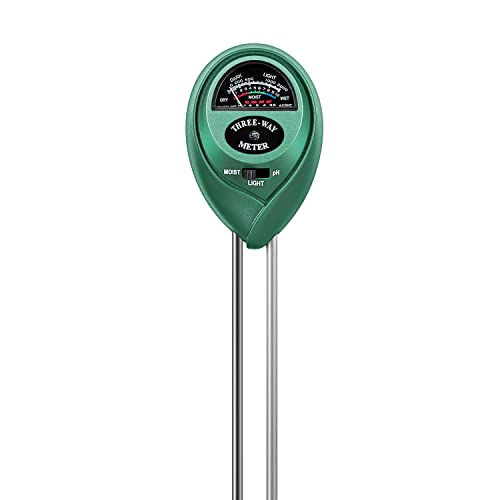
Best for: houseplant owners who mainly want a moisture check and treat the pH scale as a rough hint.
This is the classic two-prong probe meter, and it is here so you know exactly what you get. VIVOSUN lists a pH scale of 3.5 to 8, a moisture scale of 1 to 10 and a light scale of 0 to 2,000, all with no battery. The maker gives no accuracy figure and warns not to test pure water or other liquids.
Moisture is the real strength of these probes. In contrast, the pH dial is weak. An Oregon State University review of field methods called probes unacceptable for pH estimates, and a University of Missouri study found one probe read 6.0 in every soil, limed or not. So, buy it as a watering aid, not as the best soil pH meter.
- pH scale: 3.5 to 8 (no accuracy listed)
- Moisture scale: 1 to 10
- Light scale: 0 to 2,000
- Power: none needed
Pros
- Handy watering guide for pots and beds
- No battery and very little to go wrong
- Simple dial anyone can read
Cons
- pH reading is not reliable enough to guide lime or sulfur
- No calibration, so you cannot check it
- Probe tips corrode and wear
Skip it if: you plan to add lime or sulfur based on the reading; use an electrode meter or a lab test instead.
How We Chose the Best Soil pH Meter
We did not run hands-on tests. Instead, these picks are research-based. First, we read spec pages and manuals from Hanna, Apera, Bluelab, Luster Leaf, MySoil and VIVOSUN. Next, we compared those claims with university extension studies of field pH methods. Finally, we read owner feedback for patterns such as drift, clogged junctions and cracked tips.
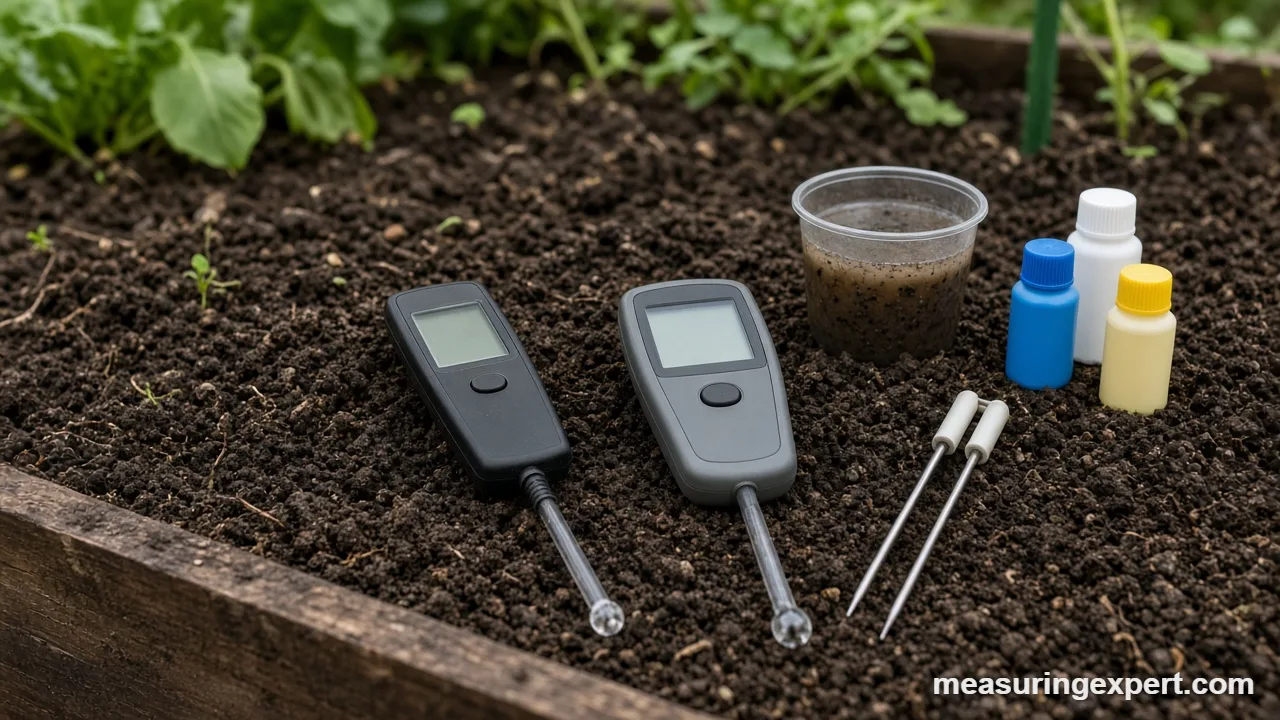
These were the main criteria:
- Sensing method: a glass electrode ranked far above a two-prong metal probe, because only the electrode responds to pH in a way you can calibrate.
- Published accuracy: we favored meters with a stated tolerance, such as plus or minus 0.05 or 0.1 pH.
- Calibration: buffer calibration at two or more points, so you can prove the meter is right.
- Soil fit: sleeves, augers, cleaning solutions and junctions that cope with dirt.
- Honest alternatives: we also included a lab test and a chemical kit, because a meter is not always the right tool.
In addition, we capped each brand at two picks and left out unbranded clones and parts-only listings.
Probe, Electrode, Kit or Lab: What Each Method Can Tell You
To begin, pH is a log scale. So, soil at pH 5.5 has about ten times the hydrogen ion activity of soil at pH 6.5. That is why a one-unit error is not small.
| Method | How it works | Typical resolution | Field accuracy (extension findings) | Best use |
|---|---|---|---|---|
| Two-prong probe meter | Two metal tips create a small voltage in moist soil | Dial, often 3.5 to 8 in coarse marks | Poor; could not separate soils 2 pH units apart | Watering checks only |
| Color kit or strips | A dye changes color with pH | Whole units on most charts | Fair; useful for screening | Quick checks before a lab test |
| Glass electrode meter | A glass membrane responds to hydrogen ion activity | 0.1 or 0.01 pH | Good when calibrated; closest to lab results | Regular monitoring |
| Lab soil test | Bench electrode under a set method, plus buffer pH | 0.1 pH or finer | The reference | Lime and fertilizer rates |
The field accuracy column comes from two extension sources. First, an Oregon State University Small Farms article on measuring soil pH summarized a University of Arkansas comparison with 82 labs. Hand-held electrode meters came closest to the lab average, color kits fell in between, and probes performed poorly. Second, a Journal of Extension study from the University of Missouri Delta Center found that one probe read 6.0 in every soil it tested.
Best Soil pH Meter Specs That Decide Accuracy
Accuracy and resolution. Resolution is the smallest step the screen shows, such as 0.01 pH. Accuracy is how close that number is to the truth, such as plus or minus 0.05 pH. However, a meter can show two decimals and still be wrong if you skip calibration. So, judge a meter by its listed accuracy first and its resolution second.
Calibration points. A glass electrode slowly changes as it ages. Calibration with buffer solutions corrects that drift. Two points are the minimum for soil, usually pH 7 plus pH 4. Meanwhile, a third point at pH 10 helps if your soil is alkaline. Also, a meter with no calibration at all cannot be checked, which is a warning sign.
Temperature compensation. Electrode output changes with temperature. Therefore, automatic temperature compensation (ATC) matters when you test cold spring soil or a slurry made with cold water. Most meters here compensate between about 0 and 50 C (32 and 122 F).
Electrode build and junction. Soil is a dirty sample. As a result, clay and humus coat the glass and clog the reference junction. Meters made for soil use open or replaceable junctions, sleeves and special cleaning solutions. In contrast, a general pocket tester works fine in a slurry but should not be pushed into hard ground.
Water resistance and power. Garden meters get wet and muddy, so an IP67 rating is a real plus. Battery life matters less, because most pens run for hundreds of hours.
How to Test Soil pH With an Electrode Meter
Even the best soil pH meter gives poor numbers from a poor sample. So, follow the same steps each time, and you can compare readings year to year. The sampling depths below follow Clemson Cooperative Extension soil testing guidance.
- Collect several cores. First, take 8 to 10 cores across the bed, about 6 in (15 cm) deep for gardens or 2 to 4 in (5 to 10 cm) for lawns, and mix them in a clean bucket.
- Dry and sieve the soil. Next, spread the mix to air-dry, then crush it and pick out stones, roots and mulch.
- Calibrate the meter. Then calibrate with fresh pH 7 buffer and a second buffer, pH 4 for acid soil or pH 10 for alkaline soil.
- Make a slurry. Measure one part soil and one part distilled water by volume into a clean cup, for example 30 mL (2 tbsp) of each, and stir for 30 seconds.
- Let it settle. After that, wait about 30 minutes, stirring once or twice, so the soil and water reach balance.
- Read the pH. Dip the electrode into the slurry, swirl gently and record the value once it stops changing.
- Clean and store. Finally, rinse the tip with distilled water, clean off soil film and cap it with storage solution.
Also, write down the soil to water ratio. Labs use different ratios, such as 1:1 or 1:2, and Oregon State notes that extra water raises the reading by roughly 0.1 to 0.2 units. Therefore, compare only results made the same way.
Honest Limits of Cheap Probe Meters (and of Any Meter)
This is the part most roundups skip. Two-prong probe meters are sold as pH meters, and many sell for very little. However, they do not contain a glass electrode, so they cannot be calibrated and they do not track pH well. Oregon State University calls them unacceptable for field pH estimates. Similarly, the University of Missouri study saw a probe read 6.0 whether the soil was limed or not.
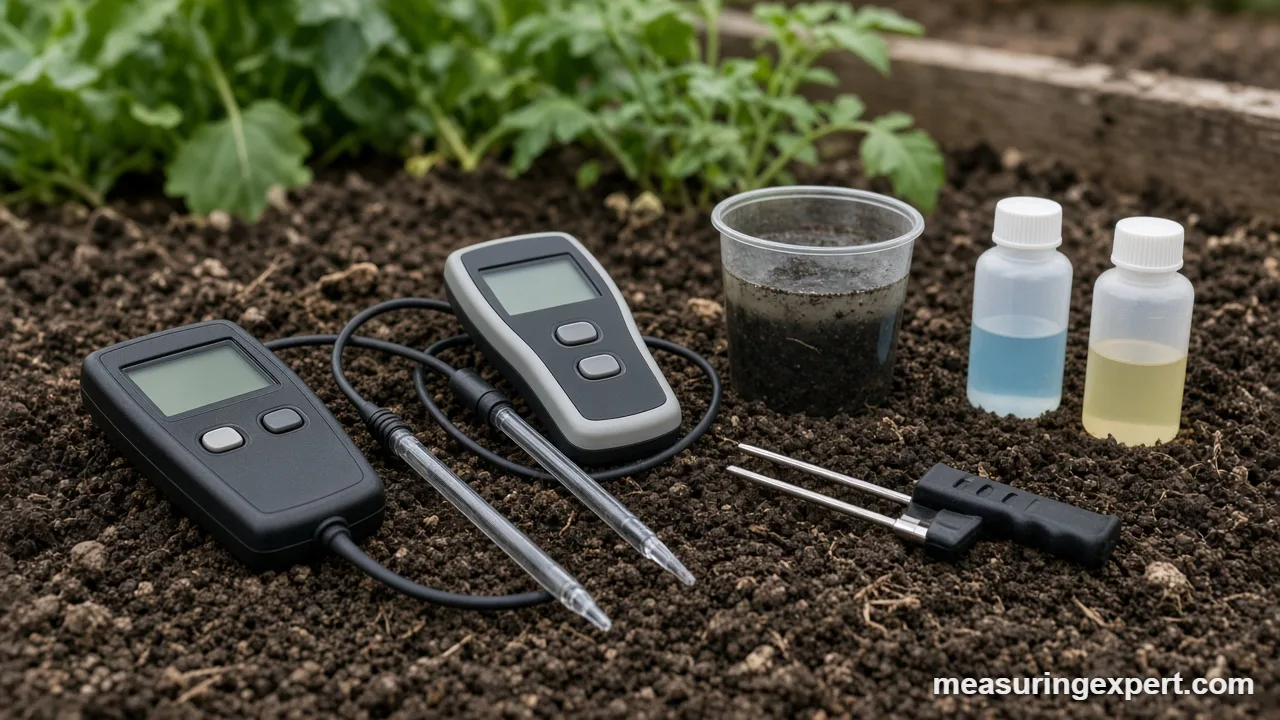
That does not make probes useless. In fact, their moisture readings are a handy guide for watering. So, if you already own one, use it for moisture and ignore the pH dial.
Electrode meters have limits too:
- They need care. Oregon State notes that hand-held meters need fresh buffer calibration and careful electrode storage, and a neglected electrode may need replacing.
- Users add error. In the Missouri study, untrained users landed near the lab median, but their spread was more than twice as wide, and calibration was not done consistently.
- pH is not a lime rate. Two soils at pH 5.5 can need very different amounts of lime, because clay and organic matter buffer pH. Only a lab buffer test answers that.
- pH moves through the year. According to Oregon State, sandy soils can shift by more than one unit in a year, so test at the same season each time.
Calibration and Electrode Care
A glass electrode is a consumable. However, good habits stretch its life a long way.
- Calibrate often: calibrate before each session with fresh buffer, and never pour used buffer back into the bottle.
- Keep it wet: store the tip in storage solution, not distilled water, because pure water pulls ions out of the glass.
- Clean after soil: rinse, then use a soil or humus cleaning solution when readings turn slow.
- Do not force it: drill a pilot hole or use a slurry instead of pushing into dry, stony ground.
From Reading to Lime or Sulfur: The Area Math
Soil labs usually give lime or sulfur rates per 1,000 sq ft, or per acre for fields. So, you need your bed area before you can scale the rate. With a simple rectangle, just multiply length by width. For odd shapes, see our guide to the area of a shape, and for larger plots, read how land area is measured.
For example, a 10 by 20 ft bed is 200 sq ft, or about 18.58 sq m. If a lab recommends 50 lb per 1,000 sq ft, that bed needs 10 lb, which is about 4.5 kg. Use the converter below to switch between square feet, square meters and acres.
Best Soil pH Meter FAQ
What is the best soil pH meter for home gardens?
For most home gardens, the Hanna HI981030 is the best soil pH meter, because it uses a real glass electrode built for soil and lists plus or minus 0.05 pH accuracy. On a tighter budget, the Apera PH20 with a soil slurry also gives electrode-grade readings.
Is a cheap 3-in-1 probe the best soil pH meter?
No, not for pH. Extension studies found probe meters could not separate soils that differed by 2 pH units, and one probe read 6.0 in every sample. However, their moisture readings are still useful for watering.
Is a soil pH meter as good as a lab test?
No. A calibrated electrode meter can come close to a lab on pH alone, but only a lab measures buffer pH and nutrients, so only a lab can tell you how much lime to add. Therefore, use the lab first and the meter between lab tests.
How do I test soil pH with a meter?
Mix one part dry, sieved soil with one or two parts distilled water, stir, wait about 30 minutes, stir again and dip a calibrated electrode. Also, note the ratio you used, because more water reads slightly higher.
How often should I calibrate a soil pH meter?
Calibrate before each testing session with fresh buffers, usually pH 7 and pH 4. For alkaline soils, use pH 7 and pH 10 instead.
What pH do most plants need?
Most vegetables, lawns and ornamentals do best at about pH 6.0 to 6.5. Meanwhile, blueberries and azaleas prefer about pH 5.0 to 5.5.
Can I push the best soil pH meter straight into the ground?
Only if it is built for soil, such as the Hanna HI981030, and only in moist, stone-free soil. Otherwise, drill a pilot hole with an auger or make a slurry, because a cracked bulb ends the meter.
Why does my soil pH meter drift?
Usually the electrode is dirty, dry or old. So, clean it with the right solution, store it in storage solution rather than water, and replace it when calibration slopes stay poor.
Does the best soil pH meter also measure nutrients?
No. A pH meter reads pH only. For nitrogen, phosphorus and potassium, use a lab test or a chemical kit like the Rapitest Digital.
When is the best time to test soil pH?
Test at the same time each year, ideally a few months before planting so lime has time to react. Also, avoid testing right after you fertilize, because fresh fertilizer can shift the reading.
Bottom Line: Our Best Soil pH Meter Pick
For most gardens, the Hanna HI981030 GroLine Soil pH Tester is the best soil pH meter, because a calibrated glass electrode built for soil gives numbers you can trust. Still, pair it with one lab test, so you know your lime needs too. Meanwhile, the Apera PH20 suits tight budgets, and the Hanna HI99121 suits pros.
4 thoughts on “7 Best Soil pH Meters for 2026: Electrode Testers, Kits and Lab Tests”