
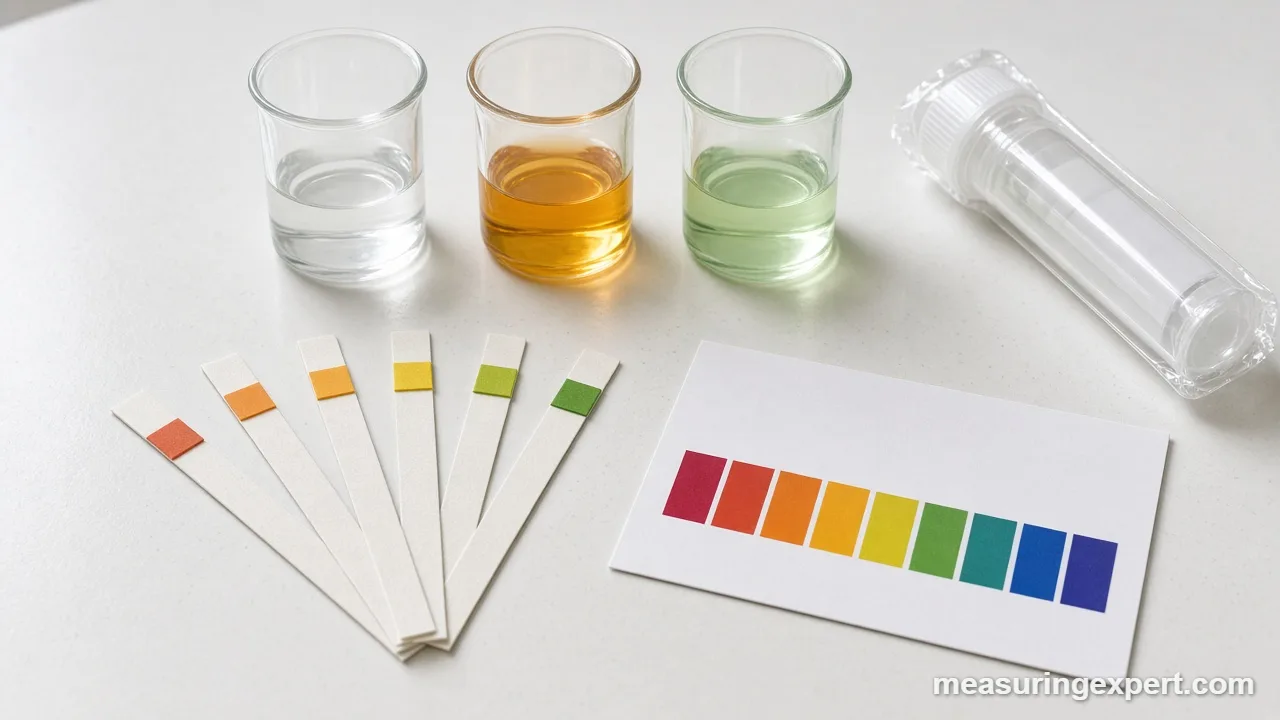
The best pH test strips for most people are the MilliporeSigma MColorpHast 0-14 strips, because their non-bleeding indicator reads any liquid cleanly. However, the right choice depends on your sample (lab, water, pool, aquarium or body fluid) and on resolution: wide strips step in whole pH units, while narrow papers step near 0.2.
In short: get MColorpHast for general liquids, Hydrion 1-12 on a budget, LaMotte Insta-Test 3 Plus for pools, and a pH meter when you need decimals.
As an Amazon Associate, Measuring Expert earns from qualifying purchases. Our picks are based on research, specifications and owner feedback, not paid placement.
Best Overall

Best Budget

Best for Pools
Quick Answer: The Best pH Test Strips at a Glance
- Any liquid, clean sample: MColorpHast (MQuant) 0-14, non-bleeding.
- Cheapest sorting tool: Hydrion 1-12 vial for classrooms and kitchens.
- Finer steps near neutral: Hydrion 067 paper, 5.5 to 8.0 in 0.2 to 0.3 steps.
- Pools and spas: LaMotte Insta-Test 3 Plus, or AquaChek Yellow if you use stabilizer.
- Fish tanks: Tetra EasyStrips 6-in-1 for pH plus hardness and nitrates.
- Need 0.1 pH or better? Use a calibrated pH meter instead of strips.
On This Page
- Comparison table
- The 8 picks, reviewed
- How we chose
- Strip resolution vs pH meters
- Which strip for which sample
- How to read a pH strip
- Urine and saliva strips
- Storage and shelf life
- Honest limits
- FAQ
- Bottom line
Best pH Test Strips Compared
First, scan the table for your sample type. Then, jump to the review for the details.
| # | Product | Best For | Standout Feature | Amazon |
|---|---|---|---|---|
| 1 | MilliporeSigma MColorpHast (MQuant) 0-14 | Labs, schools and any liquid sample | Non-bleeding indicator with four reaction zones | View |
| 2 | Hydrion 1-12 Wide Range Vial | Classrooms, kitchens and quick checks | 100 strips per vial with a full-unit color chart | View |
| 3 | Macherey-Nagel pH-Fix 0-14 | Colored or cloudy liquids in the lab | Fixed indicator that prevents bleeding | View |
| 4 | Whatman (Cytiva) CF Indicator 0-14 | Schools and teaching labs | Dyes chemically bonded to the paper | View |
| 5 | Hydrion 067 Urine and Saliva Paper 5.5-8.0 | Urine and saliva logs, near-neutral water | Color match every 0.2 to 0.3 pH unit | View |
| 6 | LaMotte Insta-Test 3 Plus | Pool and spa owners who want pro strips | pH blocks from 6.2 to 9.0 plus chlorine and alkalinity | View |
| 7 | AquaChek Yellow 4-in-1 Pool and Spa | Outdoor chlorine pools with stabilizer | Adds a cyanuric acid (CYA) pad | View |
| 8 | Tetra EasyStrips 6-in-1 Aquarium | Freshwater aquariums | pH plus GH, KH, nitrite, nitrate and chlorine | View |
The 8 Best pH Test Strips, Reviewed
We grouped the list by job. Specifically, picks 1 to 4 are general indicator strips, pick 5 is a narrow-range paper, and picks 6 to 8 are multi-pad strips for pools and aquariums.
Best Overall
1. MilliporeSigma MColorpHast (MQuant) 0-14
Best for: Students, lab techs, brewers and hobbyists who want one strip that reads any liquid from pH 0 to 14 without staining the sample.
Overall, these are the best pH test strips for general work because the indicator is fixed to the strip. As a result, the dye does not bleed, so you can leave the strip in a sample until the color settles. Also, MilliporeSigma now sells the line under its MQuant name, while many listings still use the older MColorpHast label.
In addition, each strip carries four reaction zones that you compare with a 0 to 14 color scale. However, the graduation is 1 pH unit, so a reading of “7” really means somewhere near 6.5 to 7.5. Even so, that is fine for sorting acids from bases. So, for tighter work, pair it with a narrow-range paper or a meter.
- pH range 0 to 14, graduated in 1 pH unit steps
- Four reaction zones read against one color scale
- Non-bleeding indicator, so the strip can stay in the sample
- Works with the MQuant StripScan app for camera reading
- Storage at 2 to 30 C (36 to 86 F)
Pros
- No dye runs into the sample
- Four zones make color matching easier
- Trusted lab supplier with published specs
Cons
- 1 pH unit steps are coarse
- Costs more per strip than plain paper
- Pack size varies by listing
Skip it if: you need to tell 7.2 from 7.6, because a 1-unit scale cannot split that gap.
Best Budget
2. Hydrion 1-12 Wide Range Vial
Best for: Teachers, home cooks and DIYers, especially those who only need to know whether something is acidic, neutral or basic.
Micro Essential Laboratory has made Hydrion papers for decades, and this vial is its simple wide-range option. First, you dip a strip, and then you match the color against the chart on the vial. Also, the color steps fall at full pH units from 1 to 12.
For example, it will clearly separate vinegar, tap water and a baking soda solution. However, it will not tell you whether a pool sits at 7.2 or 7.8. In short, treat it as a sorting tool, and switch to a narrow-range paper when the decimal matters.
- pH range 1 to 12
- Color matches at full pH unit intervals
- 100 strips per vial with matching color chart
- Listed uses include classrooms, labs, food service and water testing
Pros
- Low cost per test
- Simple chart that kids can read
- Long-running lab brand
Cons
- Coarse full-unit steps
- Does not reach pH 0, 13 or 14
- Plain paper strips can bleed in some samples
Skip it if: you test strong cleaners or drain openers above pH 12.
Best Lab Value
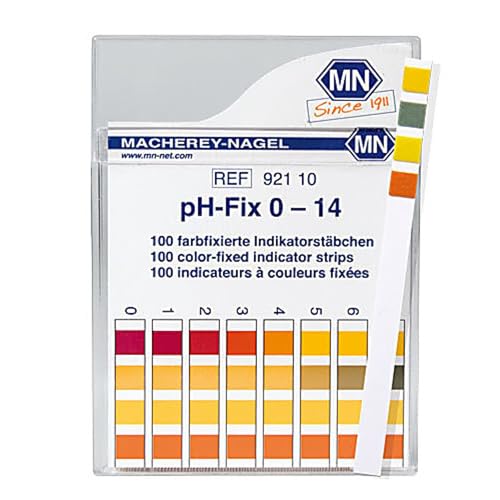
3. Macherey-Nagel pH-Fix 0-14
Best for: Lab users and serious hobbyists, especially those testing samples that must not be contaminated by dye.
In addition, Macherey-Nagel is a German lab supplier, and pH-Fix is its non-bleeding strip line. Because the indicator is fixed, the color stays on the strip, and the sample stays clean. As a result, you can return the sample to a batch after a reading.
Next, the scale covers pH 0 to 14 in steps of 1, much like the MColorpHast. Also, each strip is 85 mm long and 6 mm wide (about 3.3 x 0.24 in), so your fingers stay well clear of the liquid. Meanwhile, the flat box holds the color scale on its label.
- pH 0 to 14 in steps of 1
- Fixed indicator prevents bleeding into the sample
- Strip size 85 x 6 mm (about 3.3 x 0.24 in)
- 100 strips per box with color scale
Pros
- Sample stays clean
- Long strip keeps fingers dry
- Clear published specifications
Cons
- Same 1-unit limit as other wide strips
- Fewer retail listings than Hydrion
- Color scale is on the box only
Skip it if: you already own the MColorpHast, since the two cover the same job.
Best for Teaching Labs
4. Whatman (Cytiva) CF Indicator 0-14
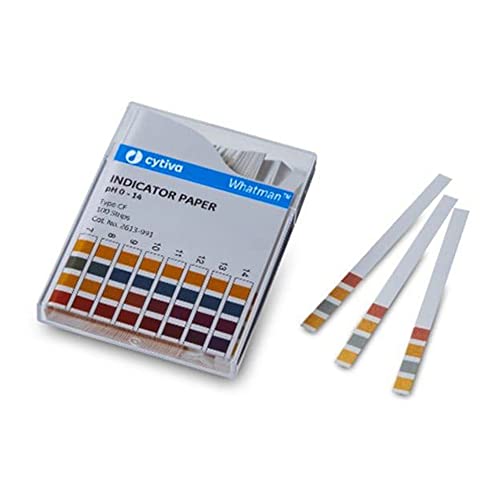
Best for: Science teachers and lab managers, especially those who want stiff, plastic-backed strips that survive student handling.
First, Whatman CF strips mount four segments of indicator paper on a plastic support. Therefore, the strip stays stiff when wet, which helps in beakers and test tubes. Also, the dyes are chemically bonded to the paper, so they do not leach into the solution.
Similarly to the other wide-range picks, the scale runs from 0 to 14 in 1 pH unit steps. However, Whatman pairs it with complementary indicator charts, and each strip measures 80 x 6 mm (about 3.1 x 0.24 in).
- pH 0 to 14, graduated in 1 pH units
- Four dye segments on a plastic support
- Dyes bonded to the paper so they do not leach
- Strip size 80 x 6 mm; packs of 100
Pros
- Stiff when wet
- No leaching into the sample
- Respected lab brand
Cons
- Wide steps limit precision
- Usually sold through lab channels
- Overkill for a quick kitchen check
Skip it if: you only need a cheap vial for a science fair, because the Hydrion 1-12 does that for less.
Best Narrow Range
5. Hydrion 067 Urine and Saliva Paper 5.5-8.0
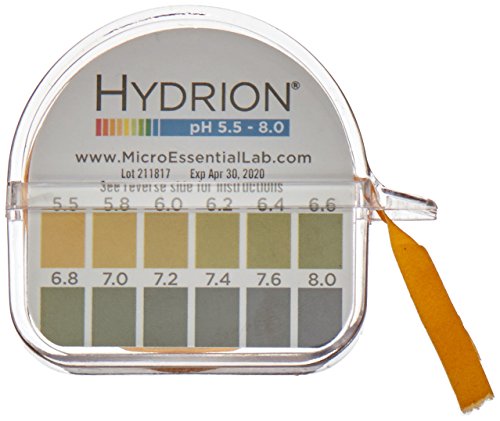
Best for: People who log urine or saliva pH at a doctor’s request, and anyone who needs finer steps between 5.5 and 8.0, such as for tap water.
In contrast, this roll covers only pH 5.5 to 8.0. As a result, the color blocks sit much closer together, with a match every 0.2 to 0.3 pH unit. Therefore, it is three to five times finer than a 0 to 14 strip, which explains why narrow papers suit near-neutral samples.
Micro Essential sells it for urine and saliva, and it states that its products are not intended to diagnose, treat, cure or prevent any disease. So, use the readings only as a log to share with your clinician. Also, it reads near-neutral water well, but anything above 8.0 simply shows the top color.
- pH range 5.5 to 8.0
- Color match every 0.2 to 0.3 pH unit
- About 100 tests per roll with a color chart
- Roll paper in a dispenser; tear off what you need
Pros
- Much finer steps than wide-range strips
- Compact dispenser
- Same paper works for near-neutral water
Cons
- Off scale below 5.5 and above 8.0
- Paper can bleed in colored samples
- Urine and saliva readings swing with meals and time of day
Skip it if: you expect a health verdict from it, because body-fluid pH strips do not diagnose anything.
Best for Pools
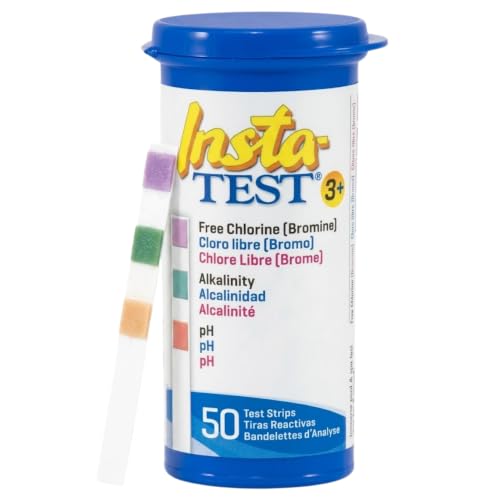
6. LaMotte Insta-Test 3 Plus
Best for: Pool and spa owners who want pro-grade strips with clearly published color blocks.
Above all, LaMotte makes test kits for pool professionals, and Insta-Test 3 Plus checks four things at once: free chlorine, bromine, total alkalinity and pH. Also, LaMotte publishes every color block, which is rare. For pH, the blocks are 6.2, 6.8, 7.2, 7.8, 8.4 and 9.0.
Those blocks are 0.4 to 0.6 pH apart, so you interpolate between them. For instance, a color halfway between 7.2 and 7.8 suggests about 7.5. In addition, free chlorine reads 0 to 10 ppm and total alkalinity reads 0 to 240 ppm.
- pH 6.2 to 9.0 (blocks 6.2, 6.8, 7.2, 7.8, 8.4, 9.0)
- Free chlorine 0 to 10 ppm; bromine 0 to 20 ppm
- Total alkalinity 0 to 240 ppm
- 50 strips per bottle; dip-and-read
Pros
- Published color blocks for every pad
- Covers chlorine and bromine pools
- Pro test-kit brand
Cons
- No cyanuric acid pad
- Interpolating between blocks takes practice
- Only 50 strips per bottle
Skip it if: you run an outdoor chlorine pool with stabilizer, because the AquaChek Yellow adds a CYA pad.
Best for Stabilized Pools
7. AquaChek Yellow 4-in-1 Pool and Spa
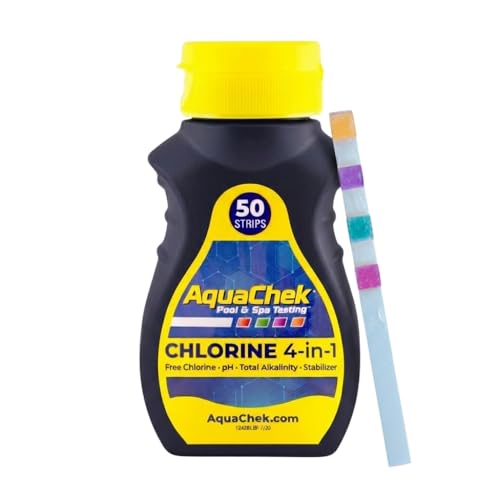
Best for: Owners of outdoor chlorine pools, especially those who add stabilizer and want to track it with every test.
Specifically, AquaChek Yellow reads free chlorine, pH, total alkalinity and cyanuric acid. The CYA pad matters because stabilizer protects chlorine from sunlight, yet too much of it slows chlorine down. Thus, one strip shows both sides of that balance.
To use it, dip for about 2 seconds, then hold the strip level for 15 seconds before matching colors. Also, the color chart sits on the back of the bottle. Finally, the maker suggests testing pools at least twice a week and spas before each use.
- Tests free chlorine, pH, total alkalinity and cyanuric acid
- 50 strips per bottle
- Color chart printed on the bottle
- Dip about 2 s, hold level for 15 s, then read
Pros
- CYA pad included
- Widely sold at pool stores
- Quick routine test
Cons
- No bromine reading
- Maker does not publish pH block values on the page we checked
- Strips degrade if the cap is left open
Skip it if: you run a bromine spa, since LaMotte Insta-Test 3 Plus reads bromine.
Best for Aquariums
8. Tetra EasyStrips 6-in-1 Aquarium
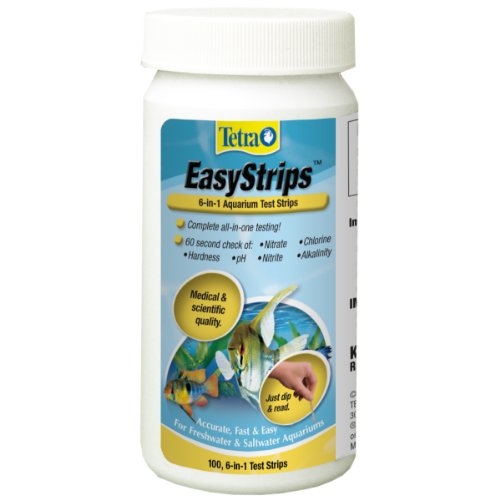
Best for: Freshwater aquarium keepers, especially those who want a fast weekly check of the main water values.
Of course, fish care needs more than pH. Accordingly, Tetra puts six pads on one strip: pH, general hardness (GH), carbonate hardness (KH), nitrite, nitrate and chlorine. Also, KH matters for pH, because it buffers the water against sudden swings.
First, dip the strip for one or two seconds, shake off the excess and read after about 60 seconds. However, Tetra lists these strips for freshwater tanks only. For saltwater or for an exact pH value, a liquid kit or meter is the better tool.
- Tests pH, GH, KH, nitrite, nitrate and chlorine
- Read after about 60 seconds
- Listed for freshwater aquariums
- 100 strips in this pack
Pros
- Six values in one minute
- KH pad explains pH swings
- Easy to find in pet stores
Cons
- No ammonia pad
- Not listed for saltwater
- pH pad is coarser than a liquid kit
Skip it if: you keep a reef tank, because reef work needs liquid kits or a meter.
How We Chose the Best pH Test Strips
We did not run hands-on lab tests. Instead, our picks are research-based. First, we read manufacturer spec pages and lab-supplier listings for range, color steps, strip count and storage. Next, we checked that each brand publishes real specifications. Then, we weighed owner feedback for color clarity and shelf life. Finally, we kept one or two picks per job and dropped unbranded listings that publish no specs.
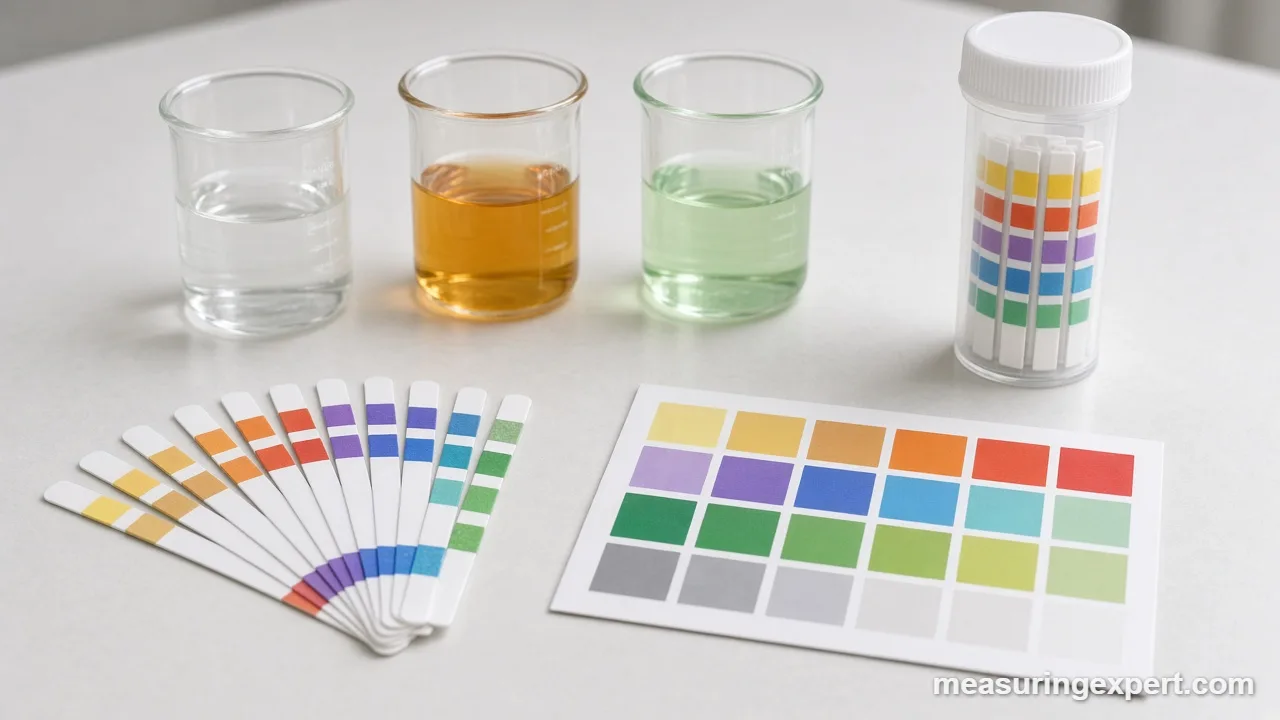
- Range: does the strip cover the pH you actually expect?
- Color steps: how far apart are the blocks on the chart?
- Bleeding: does dye leach into the sample?
- Extra pads: chlorine, alkalinity or hardness where the job needs them.
- Published data: brands that state specs ranked higher than vague listings.
For background on the scale itself, the USGS pH and Water guide explains why each pH unit is a 10-fold change.
Strip Resolution vs pH Meters: What the Steps Really Mean
In technical terms, resolution is the smallest change a tool can show. Thus, on a strip, it is the gap between two color blocks on the chart. Because pH is logarithmic, that gap hides more than it seems. For example, one full pH unit is a 10-fold change in hydrogen ion activity.
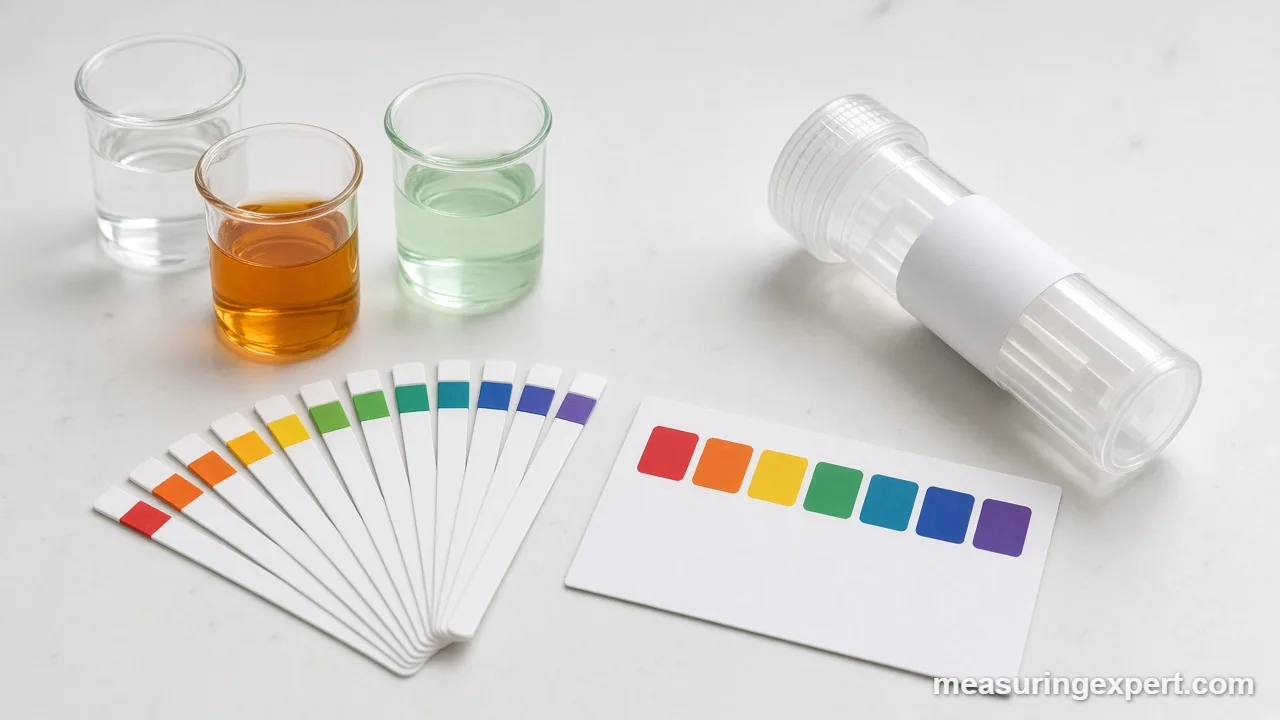
| Tool | Typical step | Change hidden inside one step | Good for |
|---|---|---|---|
| Wide-range strip (0-14) | 1.0 pH | 10x | Acid, neutral or base |
| Pool strip (LaMotte blocks) | 0.4 to 0.6 pH | about 2.5x to 4x | Keeping a pool in range |
| Narrow paper (Hydrion 067) | 0.2 to 0.3 pH | about 1.6x to 2x | Near-neutral water and logs |
| Calibrated pH meter | 0.1 or 0.01 pH display | about 1.26x or 1.02x | Hydroponics, labs, soil work |
In short, a strip reading of “7” on a 0-14 scale only tells you the sample sits somewhere near 6.5 to 7.5. On the other hand, a meter can split that range into tenths or hundredths. Still, display resolution is not accuracy. After all, a meter is only as good as its last calibration with buffer solutions, and its glass electrode needs care.
So, when should you switch? If you grow hydroponic crops, brew to a recipe or test soil for a lab-style result, a meter pays off. Our dual display pH meter picks cover water and hydroponics, and the best soil pH meter guide explains glass electrodes for soil. However, for a quick yes-or-no check, strips are faster, cheaper and need no calibration.
Matching the Best pH Test Strips to Your Sample
Generally, each sample type has a different target range. As a result, the right strip depends more on the sample than on the brand.
| Sample | Strip type | Why | Our pick |
|---|---|---|---|
| Lab liquids, cleaners, food | Wide 0-14, non-bleeding | Unknown samples can be anywhere on the scale | MColorpHast or pH-Fix |
| Drinking water | Narrow near-neutral paper | EPA guidance for pH is 6.5 to 8.5 | Hydrion 067 (reads to 8.0) |
| Pools and spas | Multi-pad pool strip | pH and chlorine must be read together | LaMotte or AquaChek |
| Freshwater aquarium | Multi-pad aquarium strip | KH and nitrates explain pH swings | Tetra 6-in-1 |
| Garden soil | Wide strip on a soil slurry | Rough check only; a meter or lab is better | MColorpHast |
| Urine or saliva | Narrow 5.5-8.0 paper | Logging only, not diagnosis | Hydrion 067 |
For drinking water, the EPA secondary standards list pH 6.5 to 8.5 as a non-enforceable guideline. For example, low pH can taste metallic and corrode pipes, while high pH can leave deposits. Also, hard water often pushes pH up, so our water hardness test kit picks pair well with a pH check.
For pools, the pH reading drives how much acid or base you add. Because dosing depends on water volume, measure your pool first with our pool volume guide. LaMotte publishes its Insta-Test 3 Plus color blocks, which shows how coarse even good pool strips are.
How to Read a pH Test Strip Correctly
Usually, errors come from timing and light, not from the strip itself. Therefore, follow the same routine every time.
- First, wash and dry your hands, then take one strip without touching the pads.
- Next, close the vial or bottle right away to keep out moisture.
- Then dip the strip for the time the label states, usually one to two seconds.
- After that, shake off extra liquid and hold the strip level so colors do not run.
- Wait the stated read time, such as 15 seconds for AquaChek or about 60 seconds for Tetra.
- Match the color in daylight or under a white LED, holding the strip beside the chart.
- Finally, write down the closest block, or note “between 7.2 and 7.8” when it falls between two.
For soil, mix one part soil with one part distilled water, let it settle, and test the clear liquid. However, treat that number as a rough guide, because a soil meter or lab test is far more reliable.
Urine and Saliva Strips: What They Can and Cannot Tell You
Many shoppers search for pH strips to track urine or saliva. Indeed, that is a legitimate use when a clinician asks you to keep a log. However, a body-fluid reading changes with recent meals, fluids and time of day. Also, it does not measure blood pH, and it does not show whether a diet is working.
For that reason, we list only one body-fluid option, and we make no claims about diets or health outcomes. Even the maker states that its products are not intended to diagnose or treat any condition.
Storage, Shelf Life and Color Accuracy
Over time, indicator dyes slowly react with humidity and light. Consequently, a strip that sat open for a month can read wrong even though it looks fine.
- Keep the cap closed: moisture is the main enemy of pool and aquarium strips.
- Store cool and dry: MilliporeSigma lists 2 to 30 C (36 to 86 F) for MQuant strips.
- Check the date: discard strips past the date printed on the pack.
- Avoid steamy rooms: a bathroom or pool shed raises humidity fast.
Honest Limits of Color Matching
Admittedly, strips are quick, yet they have real limits. First, color matching is subjective, and people see colors differently. Second, strongly colored samples such as red wine or juice can mask the pad. Third, very pure water (like distilled or RO water) has little buffering, so strips often read it poorly. In those cases, a calibrated meter gives a far more honest number.
Best pH Test Strips FAQ
What are the best pH test strips for drinking water?
For drinking water, narrow-range paper such as Hydrion 067 (pH 5.5 to 8.0) works best, because its color steps are about 0.2 to 0.3 pH apart. EPA guidance lists pH 6.5 to 8.5, so a wide 0 to 14 strip is too coarse to tell much.
How accurate are pH test strips?
Accuracy is limited by the color steps. A wide 0 to 14 strip reads to about the nearest whole unit, while narrow papers reach about 0.2 to 0.3 pH. In contrast, a calibrated meter can show 0.1 or 0.01 pH.
Are the best pH test strips good enough for a pool?
Yes, for routine checks. Pool strips such as LaMotte Insta-Test 3 Plus show pH blocks 0.4 to 0.6 apart, which is enough to keep water in range. However, use a drop kit or a meter when you need a precise dose.
What is the difference between pH strips and litmus paper?
In short, litmus paper only shows acid (red) or base (blue). By contrast, universal pH strips use several dyes, so they show a numbered value on a color chart.
Can I use the best pH test strips on soil?
Yes, but only as a rough check. Mix soil with distilled water, let it settle and test the clear liquid. For planting decisions, a soil pH meter or a lab test is more reliable.
Do pH strips work on urine and saliva?
They can show the pH of the sample, and some clinicians ask patients to keep a log. However, the reading changes with meals and time of day, and it does not diagnose anything. This is not medical advice, so ask a doctor about any health concern.
Why do my strips read differently from my meter?
Usually, the strip has a coarse color step or the meter is out of calibration. Also, old strips drift after exposure to humidity. Calibrate the meter with fresh buffers, then compare again with a new strip.
How long do pH test strips last?
In general, shelf life depends on storage. Keep the container sealed, cool and dry, and discard strips past the printed date. Pool and aquarium strips are especially sensitive to moisture once opened.
What does non-bleeding mean on pH strips?
In short, non-bleeding strips fix the indicator dye to the strip. As a result, the dye does not leach into the sample, so the strip can stay in the liquid until the color settles.
Which are the best pH test strips for an aquarium?
For freshwater tanks, multi-pad strips such as Tetra EasyStrips 6-in-1 work well, because they read pH along with KH, GH, nitrite, nitrate and chlorine. For reef tanks, use liquid kits or a meter.
Bottom Line on the Best pH Test Strips
Overall, the MilliporeSigma MColorpHast (MQuant) 0-14 strips are the best pH test strips for most liquids, because the fixed indicator keeps samples clean and the four zones make matching easier. Still, choose by sample: Hydrion 1-12 for cheap sorting, Hydrion 067 for finer steps near neutral, LaMotte or AquaChek for pools, and Tetra for fish tanks. Finally, when a decimal really matters, a calibrated meter beats any strip.