

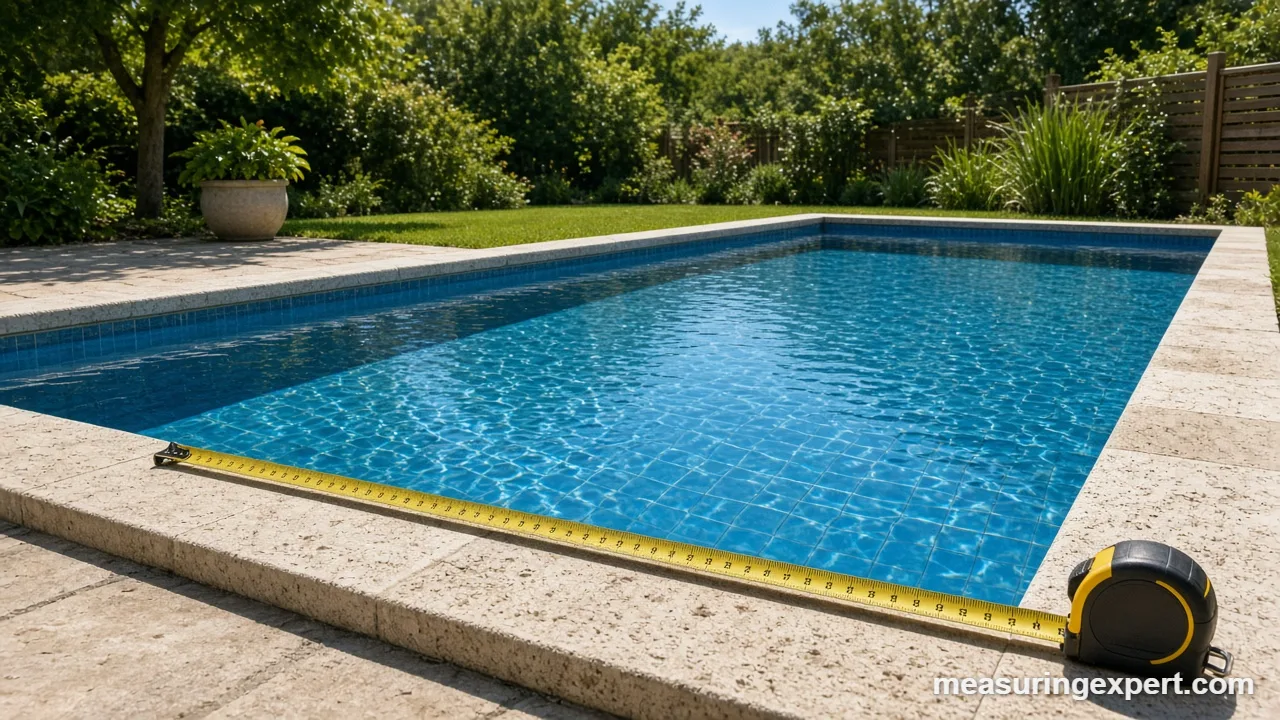
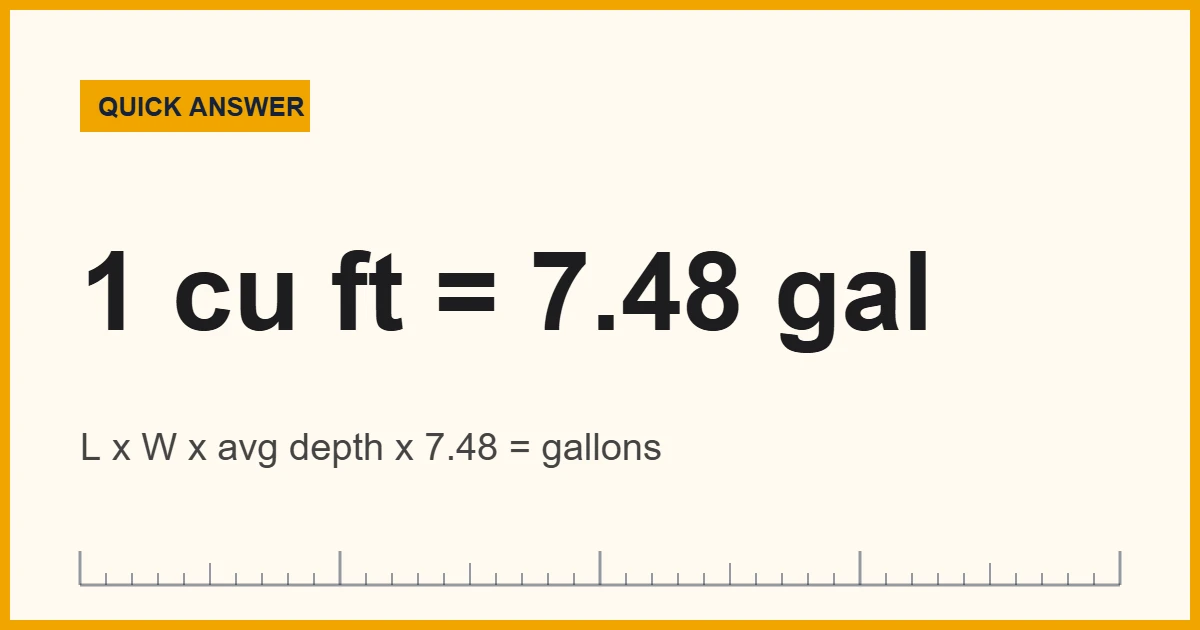
To find pool volume, first get the volume in cubic feet, then multiply by 7.48 gallons per cubic foot. A rectangular pool is length x width x average depth x 7.48. A round pool is 3.14 x radius x radius x average depth x 7.48. To get liters, multiply gallons by 3.785.
Every pool chemical label, heater chart and pump sizing guide starts with one number: how many gallons your pool holds. So if you get it wrong by a third, every dose you add is wrong by a third too. Luckily, however, you do not need special equipment. A long tape measure, a few depth readings and the right formula for your pool’s shape will get you within a few percent.
In short: measure the surface, work out the average depth, multiply to get cubic feet (or cubic meters), and then convert to gallons or liters. Below, the formulas cover rectangular, round, oval and freeform pools, plus sloped floors.
The 7.48 factor is not a rule of thumb. Instead, it comes straight from unit definitions: one cubic foot is exactly 28.316846592 liters and one US gallon is exactly 3.785411784 liters, so a cubic foot holds about 7.4805 gallons. For reference, the US National Institute of Standards and Technology lists these volume units in its customary-to-metric conversion table.
Convert Your Pool Volume From Gallons to Liters
Do you already have a figure in gallons from the formulas below? Then enter it here. The converter switches it to liters, quarts and other units using the exact US gallon, so you can match whichever unit your chemical label uses.
Recommended Tools for Measuring a Pool
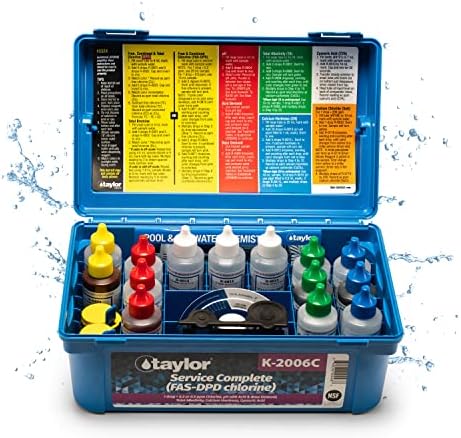
A 100-foot open-reel or closed-case tape lets one person stretch the full length of most backyard pools. Also, a fiberglass blade does not rust when it gets wet. In addition, once you know the gallons, a good test kit helps you turn that number into correct chemical doses, because every dosing chart assumes you know both the volume and the current water chemistry.




As an Amazon Associate, Measuring Expert earns from qualifying purchases.
- 1 cubic foot holds about 7.48 US gallons; 1 cubic meter holds exactly 1,000 liters.
- Rectangle: length x width x average depth x 7.48.
- Round: diameter x diameter x average depth x 5.9 (the same as 3.14 x radius squared x depth x 7.48).
- Oval: length x width x average depth x 5.9.
- For a sloped floor, average the shallow and deep ends; for a hopper bottom, measure in sections.
- Above-ground pools: use the water depth, not the wall height.
- Chemical doses scale directly with volume, so a 20% error means a 20% wrong dose.
Pool Volume Formulas by Shape
All of these formulas do the same thing. First they find the volume in cubic feet; then they convert it to gallons. The 5.9 factor for round and oval pools simply folds pi / 4 into the 7.48 (0.7854 x 7.4805 = 5.875, rounded to 5.9).
| Pool shape | Gallons (feet in) | Liters (meters in) |
|---|---|---|
| Rectangle or square | L x W x avg depth x 7.48 | L x W x avg depth x 1,000 |
| Round | diameter x diameter x avg depth x 5.9 | diameter x diameter x avg depth x 785 |
| Oval (true ellipse) | L x W x avg depth x 5.9 | L x W x avg depth x 785 |
| Oval with straight sides | rectangle + one round end circle | rectangle + one round end circle |
| Kidney / freeform | split into rectangles and circles, then add | same method |
For instance, many older guides use 7.5 instead of 7.48 for rectangles. The difference is only about 0.3%, so either is fine for dosing. Similarly, if you want to brush up on the underlying math, our guide on how to calculate cubic volume walks through length x width x height with more examples.
How to Measure Pool Volume Step by Step
- Identify the shape. Decide whether the pool is a rectangle, a circle, an ellipse, an oval with straight sides, or a freeform shape you will split into pieces.
- Measure the water surface. Run the tape across the inside of the walls at the waterline, not across the coping or deck.
- Take depth readings. Measure from the water surface to the floor at the shallow end, the deep end and, for long pools, the middle.
- Work out the average depth. Add the readings and divide by how many you took, or use the section method below for a hopper bottom.
- Calculate cubic feet. Multiply the surface area by the average depth.
- Convert to gallons or liters. Multiply cubic feet by 7.48 for gallons, then use the converter above for liters.
- Write it down. Keep the figure with your test kit so you never have to redo the math.
Finding the Average Depth of a Sloped Floor
Depth, in fact, is where most estimates go wrong. A pool that runs from 3.5 feet to 8 feet does not hold an 8-foot pool’s worth of water. Instead, for a floor that slopes evenly from end to end, the average depth is simply (shallow + deep) / 2, which here gives 5.75 feet.
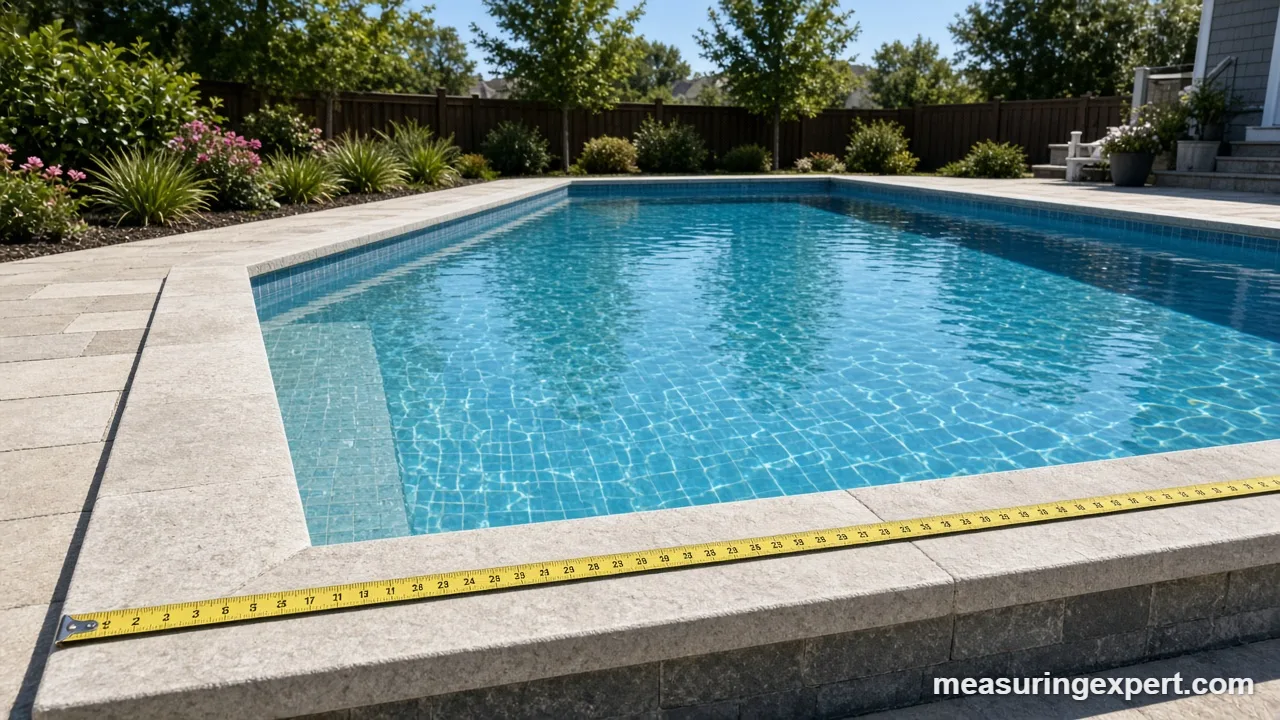
However, many in-ground pools have a hopper or spoon-shaped deep end: a long flat shallow area, then a steep drop. In that case a simple average overstates the water, so a better approach is to split the pool lengthwise. For example, treat the shallow section as one rectangle with its own average depth, and the deep section as another, then add the two volumes.
| Floor type | How to get average depth |
|---|---|
| Flat (most above-ground pools) | One reading: the water depth |
| Even slope end to end | (shallow + deep) / 2 |
| Shallow, slope, then deep | Measure each section, weight by its length |
| Hopper or diving well | Split into 2-3 boxes and add their volumes |
As a worked example, a 32 x 16 ft pool that slopes evenly from 3.5 to 8 ft has 32 x 16 x 5.75 = 2,944 cubic feet. Next, 2,944 x 7.48 gives about 22,000 gallons, or roughly 83,400 liters.
Round and Oval Pool Volume Examples
First, round above-ground pools are the easiest shape to calculate. Take a 24-foot round pool with 4 feet of water. The radius is 12 feet, so the volume is 3.1416 x 12 x 12 x 4 = 1,810 cubic feet. Then 1,810 x 7.48 gives about 13,500 gallons, or 51,200 liters. Similarly, the shortcut gives the same result: 24 x 24 x 4 x 5.9 = 13,594 gallons.
A true oval works the same way with two different widths. So a 30 x 15 ft oval with 4.5 feet of water holds 30 x 15 x 4.5 x 5.9, or about 11,900 gallons (roughly 45,000 liters).
Many “oval” above-ground pools, though, are really a rectangle with a half circle on each end. For those, measure the straight section and the width. Next, calculate the middle as a rectangle, and treat the two ends together as one full circle whose diameter equals the pool width. Finally, add the two results.
Irregular, Kidney and Freeform Pools
No single formula fits a freeform pool, but you can get close by breaking it into simple pieces. First, sketch the outline, then draw the largest rectangle that fits inside it. After that, fill the leftover lobes with half circles or smaller rectangles, calculate each piece, and add them up.
For a quick kidney-shaped estimate, pool builders often use (A + B) x length x 0.45 x average depth x 7.48, where A and B are the widths of the two lobes. Because kidney shapes vary a lot, treat that result as a starting point and compare it with your builder’s paperwork if you have it.
Why Pool Volume Matters for Chemical Dosing
Pool chemistry is measured as a concentration, usually parts per million (ppm). As a result, the amount of product you add depends directly on how much water it mixes into. Therefore, if you think your pool holds 15,000 gallons but it really holds 11,000, every dose will be about 36% too strong.
To see the scale, 10,000 gallons of water weigh about 83,400 pounds. Raising that by 1 ppm takes about 0.083 pounds (1.3 ounces) of pure available chlorine. However, real products contain only part of that, so the amount you actually add depends on the label strength. In other words, the volume is only half the calculation; the product label supplies the other half.
The CDC’s guidance for pool operators calls for a minimum free chlorine level of 1 ppm and a pH of 7.0 to 7.8. Consequently, overdosing or underdosing because of a bad volume figure can push water outside those ranges. Volume also matters for heaters, pumps and filters, since their sizing charts assume a known number of gallons and a target turnover time.
Gallons, Liters and the Weight of Pool Water
US pool products usually list doses per 10,000 gallons, while most other countries use liters or cubic meters. For that reason, below are the conversions you are most likely to need.
| Unit | Equals |
|---|---|
| 1 cubic foot | 7.4805 US gallons = 28.32 liters |
| 1 US gallon | 3.785 liters (exact: 3.785411784) |
| 1 cubic meter | 1,000 liters = 264.2 US gallons |
| 1 imperial gallon | 4.546 liters = 1.201 US gallons |
| 1 US gallon of water | about 8.33 to 8.34 lb (3.78 kg) |
Pool water is heavy, and that weight explains why decks and above-ground frames need solid, level ground. For the per-gallon numbers behind that, see how much 5 gallons of water weighs. Meanwhile, if you measured in meters, the math is simpler still: a 10 x 5 m pool with 1.5 m average depth holds 75 cubic meters, or 75,000 liters (about 19,800 US gallons).
Do and Don’t
Do
- Measure inside the walls at the waterline.
- Take at least three depth readings on long pools.
- Split complex shapes into simple pieces.
- Record the final number with your test kit.
- Recheck after a liner change or resurfacing.
Don’t
- Use the deep-end reading as the average depth.
- Measure wall height on an above-ground pool.
- Assume “oval” means a true ellipse.
- Mix feet and meters in one calculation.
- Guess a dose when the label asks for gallons.
Honest Limits of Pool Volume Estimates
A tape-and-formula estimate is usually within 5 to 10% of the true figure, and that is good enough for routine dosing. Still, several things push it off. Rounded corners, steps, benches and sun shelves all take up water space, so a simple rectangle slightly overstates the total. In addition, vinyl liners also stretch and settle over time, and a pool kept at a different water level holds a different amount.
If you need a more exact number, there is another option. With a water meter on the fill line, you can read the gallons directly the next time you fill from empty. Otherwise, start with conservative doses, test, and adjust gradually.
When to Call a Pool Professional
Above all, call a pool service or builder when the pool has an unusual shape with no plans available, when you are sizing a new heater, pump or salt system, or when water chemistry keeps drifting even though your doses seem right. A pro can also confirm volume from construction drawings or by metering a refill.
Pool Volume FAQs
What is the formula for pool volume in gallons?
For a rectangle, multiply length x width x average depth in feet, then multiply by 7.48. For a round pool, use diameter x diameter x average depth x 5.9.
Why is 7.48 used to calculate gallons?
One cubic foot holds about 7.48 US gallons. It comes from the exact definitions: 28.316846592 liters per cubic foot divided by 3.785411784 liters per gallon.
How do I find pool volume in liters?
Measure in meters and multiply length x width x average depth to get cubic meters, then multiply by 1,000. Alternatively, multiply gallons by 3.785.
How many gallons are in a 24-foot round pool?
With 4 feet of water, a 24-foot round pool holds about 13,500 gallons. With 4.5 feet of water it holds about 15,200 gallons.
How do I calculate pool volume with a deep end?
Average the shallow and deep readings if the floor slopes evenly. For a hopper bottom, split the pool into sections, calculate each one, and add them.
Should I use wall height or water depth?
Use water depth. Pools are filled to the middle of the skimmer, several inches below the top of the wall.
Is the 7.5 multiplier accurate enough?
Yes. Using 7.5 instead of 7.48 adds only about 0.3%, which is far smaller than typical measuring error.
Why does pool volume matter for chemicals?
Chemical doses are based on concentration in ppm, so the amount you add scales with the gallons. A wrong figure gives a proportionally wrong dose.
How much does the water in a pool weigh?
A US gallon of water weighs about 8.34 pounds, so 10,000 gallons weigh roughly 83,400 pounds, or about 37,800 kg.
How accurate is a measured pool volume estimate?
Usually within 5 to 10% for regular shapes. Steps, benches and rounded corners reduce the real volume slightly.
The Bottom Line
Pool volume comes down to surface area times average depth, converted with 7.48 gallons per cubic foot or 1,000 liters per cubic meter. Round and oval pools use the 5.9 shortcut, sloped floors need a true average depth, and freeform pools work best when you break them into simple shapes.
So once you have the number, write it down and use it for every chemical dose, heater choice and pump sizing chart. Finally, if you want the result in liters or quarts, the converter near the top of this page does it in one step.