

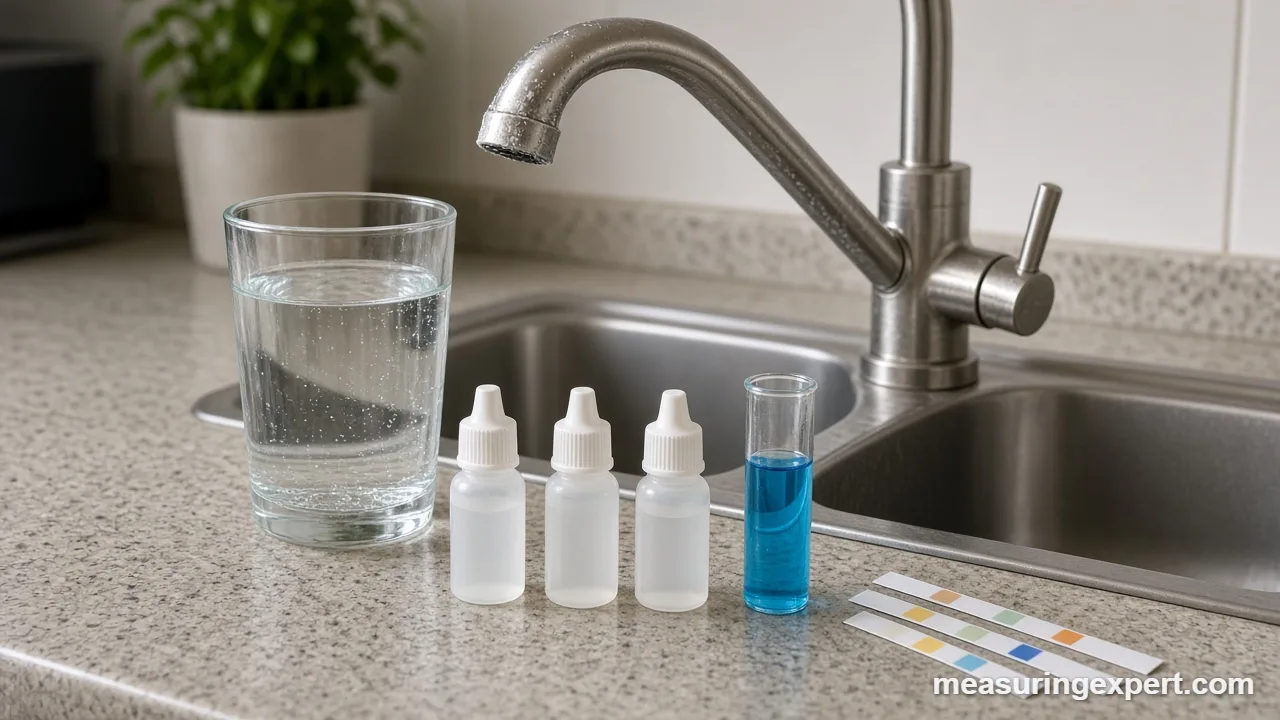
The best water hardness test kit for most homes is the Hach 5-B, because its drop count titration reads total hardness in grains per gallon, one drop per grain. Strips are cheaper and faster, but they read in color bands. So the choice comes down to how precise a number you need.
In short: titrate with the Hach 5-B, screen cheaply with Varify strips, and split calcium from magnesium with the Hach HA-4P.
As an Amazon Associate, Measuring Expert earns from qualifying purchases. Our picks are based on research, specifications and owner feedback, not paid placement.
Best Overall

Best Budget

Best Pro

Quick Answer: Which Water Hardness Test Kit Fits Your Job
- Sizing or checking a home softener: Hach 5-B, which reads 1 drop per grain per gallon.
- A cheap first look at tap or well water: Varify strips, or WeAQUA DoubleCheck if you test often.
- Calcium and magnesium as separate numbers: Hach HA-4P.
- Extremely hard well water: WaterWorks 481108, whose chart runs to 1,000 ppm.
- Pools and hot tubs: Taylor K-2006C for calcium hardness, or LaMotte Insta-Test 4 Plus for a quick dip.
- Key fact: a TDS meter does not measure hardness, so use a hardness kit for softener decisions.
On This Page
- Comparison table
- The 8 picks, reviewed
- How we chose
- Strips vs drop kits vs TDS meters
- Why TDS is not hardness
- gpg vs ppm and the USGS hardness scale
- How to run a drop count test
- Getting an accurate reading
- Do and Don’t
- Honest limits
- FAQ
- Bottom line
Water Hardness Test Kit Comparison Table
Also, each name links to its full review below.
| # | Product | Best For | Standout Feature | Amazon |
|---|---|---|---|---|
| 1 | Hach Total Hardness Test Kit, Model 5-B | Tap, well and softener water at home | 1 drop = 1 gpg drop count titration | View |
| 2 | Varify Water Hardness Test Kit | A quick first check of tap or well water | 0 to 425 ppm strip read in about 30 seconds | View |
| 3 | Hach Hardness (Total and Calcium) Test Kit, Model HA-4P | Splitting calcium from magnesium | Total and calcium hardness, magnesium by difference | View |
| 4 | Industrial Test Systems WaterWorks Total Hardness (481108) | Very hard well water | Chart runs to 1,000 ppm (58 gpg) | View |
| 5 | WeAQUA DoubleCheck Water Hardness Test Kit | Routine checks after a softener | Two identical pads on every strip | View |
| 6 | Taylor K-2006C Complete Pool Test Kit | Pool calcium hardness and full chemistry | Calcium hardness drop test at 10 ppm per drop | View |
| 7 | LaMotte Insta-Test 4 Plus Test Strips | Spas and quick pool checks | Total hardness to 800 ppm plus four other tests | View |
| 8 | API GH and KH Test Kit | Freshwater aquariums and coffee water | 1 drop = 1 dGH (17.9 ppm) | View |
The 8 Best Water Hardness Test Kit Picks, Reviewed
These picks cover three styles: drop count titration kits, dip strips and multi-test pool kits. If you also check pH, chlorine or other chemistry, see our guide to the best chemical tester.
Best Overall
1. Hach Total Hardness Test Kit, Model 5-B
Best for: Homeowners who want a real number in grains per gallon before they buy, size or check a water softener.
The Hach 5-B is our pick for the best water hardness test kit for most homes. It uses drop count titration, the same EDTA chemistry that labs use. First, a reagent turns the sample red or pink. Then you add titrant one drop at a time until the color flips to blue, and you count the drops.
Because Hach sets the kit so that 1 drop equals 1 grain per gallon (17.1 mg/L as CaCO3), the math is done for you. In addition, the 1 to 30 gpg range (17 to 513 mg/L) covers soft city water and very hard well water alike. So you get a reading that softener makers actually ask for, not a color band.
- Range: 1 to 30 gpg (17 to 513 mg/L as CaCO3)
- Resolution: 1 drop = 1 gpg (17.1 mg/L)
- Method: EDTA drop count titration, red to blue endpoint
- About 100 tests per kit
Pros
- Reads in gpg, the unit softeners use
- Clear color change and simple drop count
- Accurate enough to check softener output
Cons
- Takes a few minutes per test
- Resolution is 1 gpg, not finer
- Reagents age and need replacing
Skip it if: You only want a rough soft or hard answer, because a strip is faster and cheaper.
Best Budget
2. Varify Water Hardness Test Kit
Best for: Renters and new homeowners who want a fast first answer before they spend more on a drop kit or softener.
First of all, strips are the cheapest way to start. Next, you dip one, wait, and match the pad to a color chart. Varify lists a range of 0 to 25 gpg (0 to 425 ppm) and results in about 30 seconds. As a result, you can test the kitchen tap, the shower and a dishwasher fill in a few minutes.
However, a strip reads in steps, not single grains. So treat the result as a band such as soft, moderate or hard. If your number lands near a softener setting, confirm it with a titration kit like the Hach 5-B.
- Range: 0 to 25 gpg (0 to 425 ppm)
- Reads calcium plus magnesium as total hardness
- Result in about 30 seconds
- Large color chart for reading the pad
Pros
- Lowest cost per test
- No drops, vials or mixing
- Good for testing many taps fast
Cons
- Color bands, not exact numbers
- Tops out at 25 gpg
- Pads fade if the bottle is left open
Skip it if: You need to set a softener precisely, because the color steps are too wide.
Best Pro
3. Hach Hardness (Total and Calcium) Test Kit, Model HA-4P
Best for: Well owners, water treatment pros and hobby brewers who need calcium and magnesium as separate numbers.
In general, total hardness lumps calcium and magnesium together. However, some jobs need them apart. For example, brewers adjust calcium for mash chemistry, and treatment pros compare the two when scale keeps coming back. The HA-4P runs two titrations, one for total hardness and one for calcium, so magnesium is the difference.
Hach lists a range of 20 to 400 mg/L as CaCO3 for both tests and about 100 tests per kit. Also, it reports in mg/L, so divide by 17.1 if you want grains per gallon. Therefore, it suits people who already know the basics and want more detail.
- Tests: total hardness and calcium hardness
- Range: 20 to 400 mg/L as CaCO3
- Magnesium hardness found by difference
- Method: EDTA drop count titration; about 100 tests
Pros
- Separates calcium from magnesium
- Lab-style method with a sharp endpoint
- Reports in mg/L for water reports
Cons
- Two titrations take longer
- More reagents to store and replace
- Overkill for a yes or no answer
Skip it if: You only need total hardness for a softener, because the 5-B is simpler.
Best for Very Hard Water
4. Industrial Test Systems WaterWorks Total Hardness (481108)
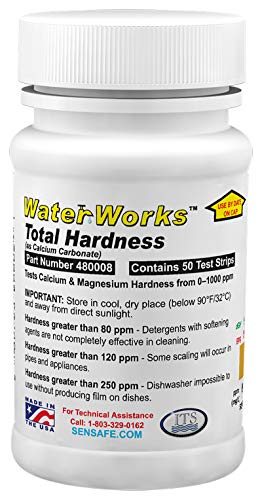
Best for: Well owners in limestone areas whose water may run above the 25 gpg ceiling of most strips.
First, note that most hardness strips stop at 425 ppm. In contrast, the WaterWorks chart runs to 1,000 ppm, or about 58 gpg. So if your well water is extremely hard, this strip can still show a band rather than simply maxing out.
The chart lists 0, 40, 80, 120, 180, 250, 425 and 1,000 ppm, with matching gpg and German degree (dH) scales. Notice, however, that the steps widen at the top. Therefore, a reading between 425 and 1,000 ppm tells you the water is very hard, but not exactly how hard. For a precise figure, dilute a sample or use titration.
- Chart: 0, 40, 80, 120, 180, 250, 425, 1,000 ppm
- Same chart in gpg (0 to 58) and dH (0 to 56)
- Total hardness strip, no drops to count
- Made by Industrial Test Systems (SenSafe)
Pros
- Covers far harder water than most strips
- Three unit scales on one chart
- Fast and simple
Cons
- Wide gaps between the top color steps
- Less useful for soft water fine-tuning
- Strip reading depends on good light
Skip it if: Your city water is soft or moderate, because a 0 to 425 ppm strip reads that range in finer steps.
Best for Softener Checks
5. WeAQUA DoubleCheck Water Hardness Test Kit
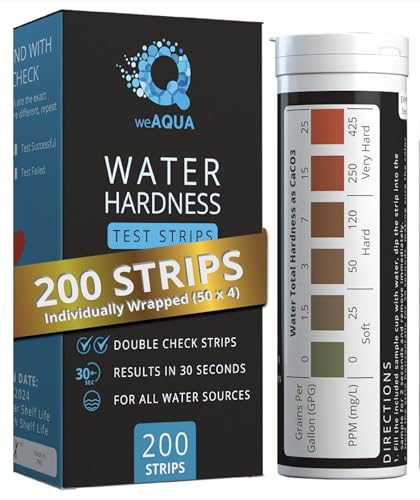
Best for: Softener owners who test often and want a second pad to confirm each reading.
After a softener is installed, the main question is whether it still works. The WeAQUA DoubleCheck helps here because each strip carries two identical pads. If both pads agree, you can trust the band. If they differ, you know to test again.
Also, the kit includes a sample cup, which keeps the water depth and dip consistent. The strips are individually foil wrapped, so humidity does not spoil the rest of the pack when you open one. Meanwhile, the 0 to 25 gpg (0 to 425 ppm) range covers both raw and softened water.
- 200 individually foil-wrapped strips
- Range: 0 to 25 gpg (0 to 425 ppm)
- Dual identical pads on each strip
- Sample cup included
Pros
- Built-in second reading on each strip
- Foil packs keep strips fresh
- Large count for monthly checks
Cons
- Still a color band, not an exact gpg
- Cannot split calcium from magnesium
- Foil wrappers add waste
Skip it if: You test once a year, because a smaller pack or a drop kit will last longer.
Best for Pools
6. Taylor K-2006C Complete Pool Test Kit
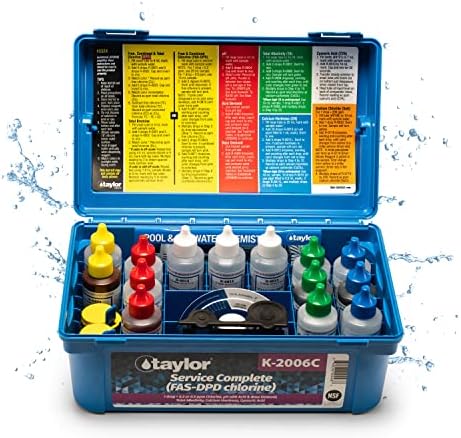
Best for: Pool owners who want calcium hardness plus chlorine, pH, alkalinity and stabilizer in one kit.
In contrast, pools care about calcium hardness rather than total hardness. Too little calcium can etch plaster, while too much can leave scale. The Taylor K-2006C measures it with a drop test. With a 25 mL sample, each drop of titrant equals 10 ppm. With the optional 10 mL sample, each drop equals 25 ppm, which speeds up very hard water.
In addition, the kit covers free and combined chlorine with FAS-DPD, pH with acid and base demand, total alkalinity and cyanuric acid. So one case handles the full weekly routine, not just hardness.
- Calcium hardness: 1 drop = 10 ppm (25 mL) or 25 ppm (10 mL)
- FAS-DPD free and combined chlorine
- pH, total alkalinity and cyanuric acid tests
- 2 oz reagent bottles
Pros
- Drop titration for pool calcium
- Complete pool chemistry in one case
- Large sample gives 10 ppm steps
Cons
- Measures calcium hardness, not total
- More steps than strips
- Pricier than a single-test kit
Skip it if: You only test drinking water, because a total hardness kit fits that job better.
Best for Hot Tubs
7. LaMotte Insta-Test 4 Plus Test Strips
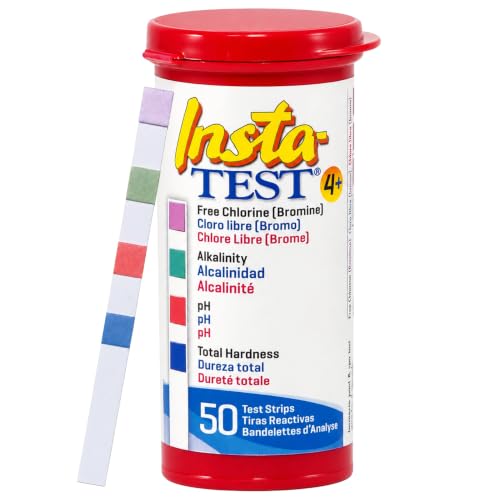
Best for: Hot tub owners who want hardness, sanitizer, pH and alkalinity from a single dip.
Spas run hot and lose water to evaporation, so hardness climbs between drains. The LaMotte Insta-Test 4 Plus reads total hardness from 0 to 800 ppm on the same strip as free chlorine, bromine, total alkalinity and pH. As a result, one dip covers the whole weekly check.
However, the hardness pad is a color match, so it gives a band rather than a drop-by-drop figure. Use it to spot a trend, then confirm with a drop test before you add calcium or drain the tub.
- Total hardness: 0 to 800 ppm
- Free chlorine 0 to 10 ppm; bromine 0 to 20 ppm
- Total alkalinity 0 to 240 ppm; pH 6.2 to 9.0
- 50 strips per bottle
Pros
- Five readings from one strip
- Wide hardness range for spas
- Works with chlorine or bromine tubs
Cons
- Hardness is a coarse color band
- Only 50 strips
- Not meant for drinking water decisions
Skip it if: You need a precise calcium number, because the Taylor drop test resolves 10 ppm.
Best for Aquariums
8. API GH and KH Test Kit

Best for: Fishkeepers and coffee hobbyists who think in German degrees and also need carbonate hardness.
Similarly, aquarium keepers track two numbers. General hardness (GH) is calcium plus magnesium, and carbonate hardness (KH) is carbonate and bicarbonate, which buffers pH. The API kit tests both with simple drop counts in a 5 mL sample.
Each drop equals 1 degree (dGH or dKH), and API converts that to 17.9 ppm. So 8 drops means about 143 ppm, which is moderately hard. Also, the small sample makes it quick, although it gives coarser steps than the Hach kits.
- Tests general hardness (GH) and carbonate hardness (KH)
- Each drop = 1 degree = 17.9 ppm
- 5 mL sample in the supplied tube
- Drop count with a clear color change
Pros
- Two hardness numbers in one kit
- Fast, small sample
- Degrees match aquarium and coffee guides
Cons
- 18 ppm steps are coarse for drinking water
- Units need converting for softeners
- Small reagent bottles
Skip it if: You are sizing a home softener, because gpg kits read in the right unit.
How We Chose the Best Water Hardness Test Kit
We did not run hands-on tests. Instead, our picks are research-based. First, we read the maker spec pages and instructions for range, resolution and method. Next, we compared those numbers with the hardness levels homes, pools and aquariums actually see. Finally, we weighed owner feedback on how easy each endpoint or color chart is to read.
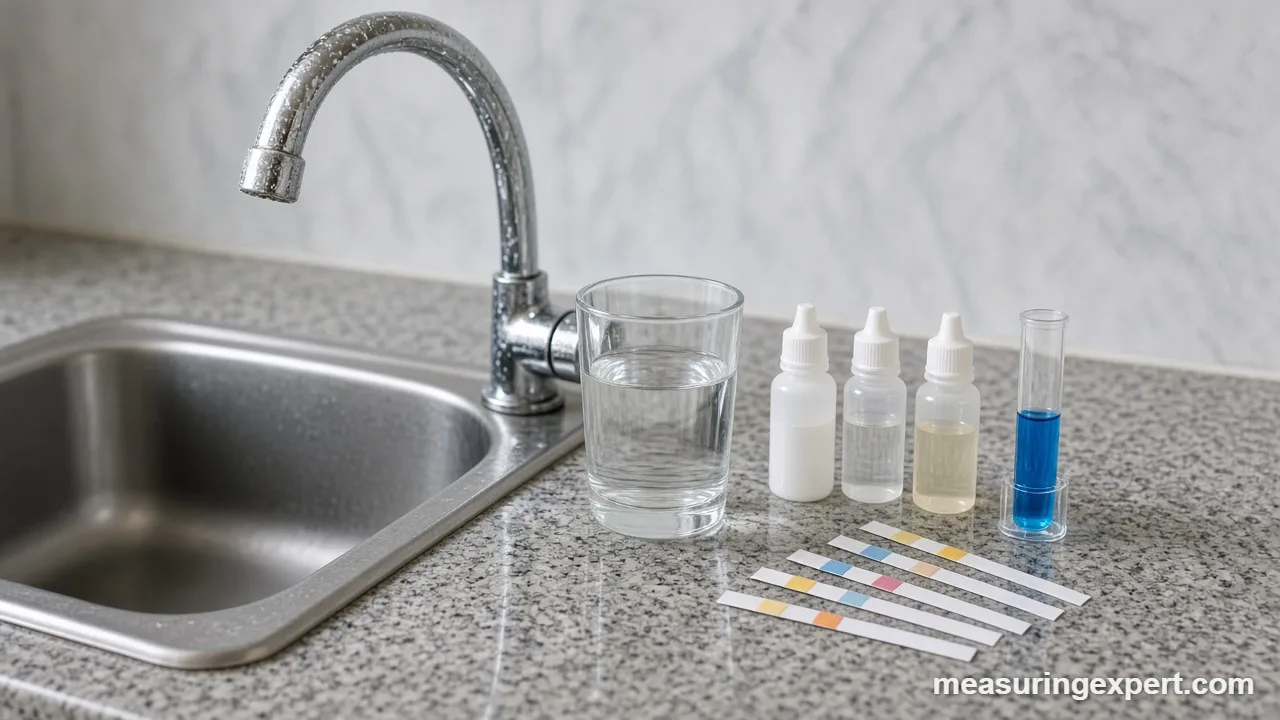
- Method: drop count titration ranked above strips for precision.
- Range: the kit must cover soft water up to at least 400 mg/L as CaCO3.
- Resolution: smaller steps per drop or per color block earned points.
- Units: we noted whether each kit reads in gpg, ppm (mg/L) or degrees.
- Spread of uses: one pick per job, with no more than two per brand.
Our main sources were the USGS water hardness FAQ, the Hach 5-B product page, and the Taylor calcium hardness drop test instructions.
Strips vs Drop Kits vs TDS Meters
Three kinds of tools show up when you shop for a water hardness test kit. However, only two of them measure hardness at all.
| Tool | What it measures | Typical resolution | Best use |
|---|---|---|---|
| Test strip | Calcium plus magnesium, by color | Bands such as 0, 40, 80, 120, 180, 250, 425 ppm | Quick screening, many taps |
| Drop count titration kit | Total (or calcium) hardness, by counting drops | 1 gpg (17.1 mg/L) for the Hach 5-B; 10 ppm for Taylor pool tests | Softener sizing, checks after treatment |
| TDS meter | Electrical conductivity, shown as estimated dissolved solids | Often 1 ppm on the display | Filter and RO checks, not hardness |
In short, strips trade precision for speed, and titration trades speed for precision. Meanwhile, a TDS meter answers a different question.
Why a TDS Meter Is Not a Water Hardness Test Kit
To begin with, TDS stands for total dissolved solids. A pen meter does not weigh those solids, though. Instead, it measures how well the water conducts electricity and multiplies by a factor to estimate ppm. As a result, every dissolved ion counts, including sodium, chloride and sulfate, not just the calcium and magnesium that cause scale.
This matters most after a softener. A softener swaps calcium and magnesium for sodium, so hardness falls to near zero. However, the dissolved solids stay in the water, which means the TDS reading barely moves. So a TDS meter can tell you a reverse osmosis filter is working, but it cannot tell you a softener is working. For that job, use a hardness kit. If you want a TDS meter for filters, see our guide to the best TDS water tester.
Grains per Gallon vs ppm: Reading a Water Hardness Test Kit
First, hardness is reported as if all the calcium and magnesium were calcium carbonate. That is why labs write mg/L as CaCO3. In dilute water, 1 mg/L is about 1 ppm, so the two are used interchangeably.
Softener makers, on the other hand, use grains per gallon (gpg). One grain is 64.79891 mg, and one US gallon is 3.785 L. Therefore, 1 gpg equals 17.1 mg/L. For more on the old grain unit, see what a grain measurement is. Aquarium kits add a third unit: German degrees (dGH), where 1 degree is about 17.8 mg/L, and API rounds it to 17.9.
USGS Hardness Classes in Every Unit
| USGS class | mg/L (ppm) as CaCO3 | Grains per gallon | German degrees (dGH) |
|---|---|---|---|
| Soft | 0 to 60 | 0 to 3.5 | 0 to 3.4 |
| Moderately hard | 61 to 120 | 3.6 to 7.0 | 3.4 to 6.7 |
| Hard | 121 to 180 | 7.1 to 10.5 | 6.8 to 10.1 |
| Very hard | Over 180 | Over 10.5 | Over 10.1 |
To convert, divide mg/L by 17.1 to get gpg, or multiply gpg by 17.1 to get mg/L. For example, 150 mg/L is about 8.8 gpg, which the USGS scale calls hard. Also note that the EPA sets no health limit for hardness, so these classes describe scale and soap use, not safety. For a wider look at concentration units, see our guide to measurement units in chemistry.
How to Test Water Hardness with a Drop Count Kit
The steps below follow the general pattern of EDTA drop count kits such as the Hach 5-B. Always follow the exact sample size and reagent order in your own kit’s instructions.
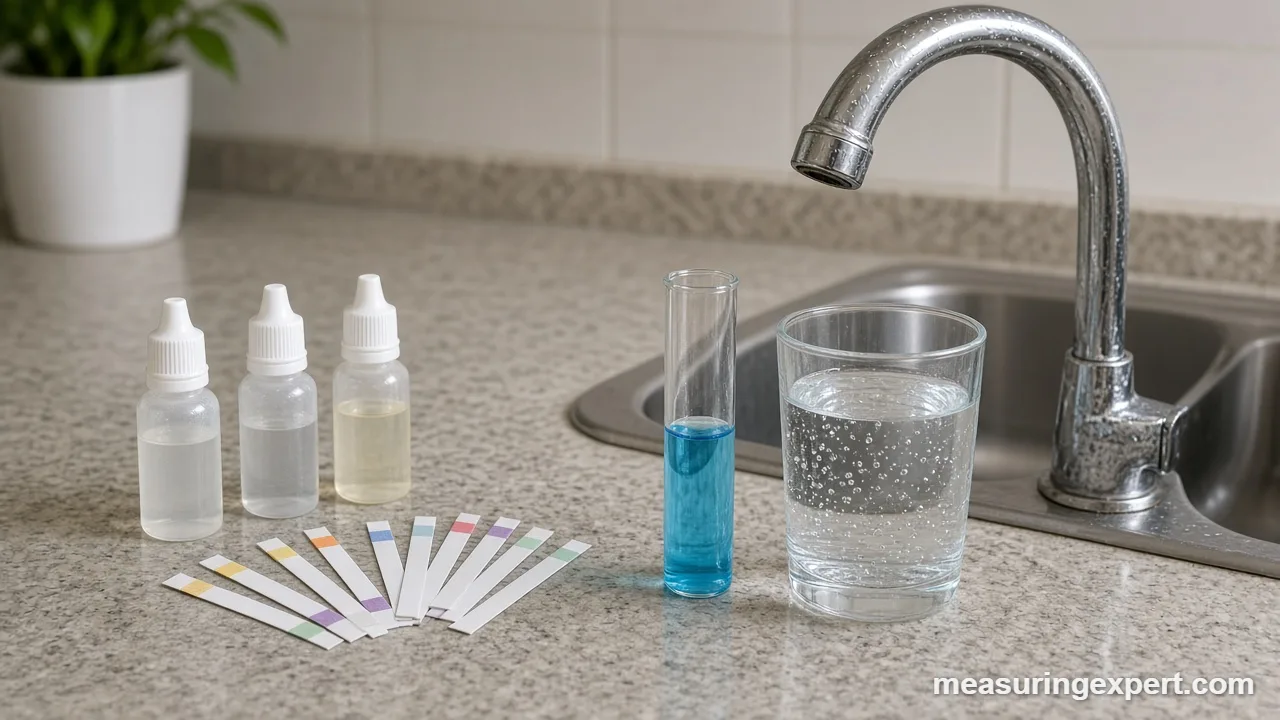
- Run the cold tap for a minute, then rinse the sample tube with the water you will test.
- Fill the tube or bottle to the line your kit names, holding it at eye level.
- Add the buffer or indicator reagent and swirl; hard water turns red or pink.
- Add titrant one drop at a time, holding the dropper straight up, and swirl after each drop.
- Stop when the color turns fully blue with no red or purple left, and count the drops.
- Convert the count with your kit’s factor, such as 1 drop = 1 gpg, and write the result down.
For strips, the routine is shorter. Dip the strip for the time on the label, shake off extra water, then match the pad to the chart in daylight within the stated window.
Getting an Accurate Reading from Any Water Hardness Test Kit
Small habits change the result more than the brand does. First, hold the dropper vertically, because a tilted dropper makes smaller drops and inflates the count. Next, read colors in daylight or under a white light, since warm bulbs shift reds and blues.
In addition, check expiry dates. Reagents and strips both age, and old indicator gives a muddy endpoint. Also, store kits cool and dry with caps closed. Finally, if a strip and a drop kit disagree, trust the drop kit and repeat the test once to confirm it.
For very hard water above a kit’s range, dilute the sample. For example, mix one part sample with one part distilled water, test it, and then double the result.
Do and Don’t
Honest Limits of Home Hardness Testing
Home kits measure hardness well, but they do not measure safety. For example, they cannot detect lead, bacteria or nitrate. So if you have a private well, use a certified lab for health tests, and use your kit for scale and softener work.
Also, strips are only as good as the eye that reads them. For instance, two people can pick different color blocks on the same strip. Meanwhile, even good titration kits resolve 1 gpg or 10 to 18 ppm per drop, which is fine for homes but not for lab reports.
Best Water Hardness Test Kit FAQ
What is the best water hardness test kit for a water softener?
For softener work, the best water hardness test kit is a drop count titration kit that reads in grains per gallon, such as the Hach 5-B. Each drop equals 1 gpg, which matches the setting on most softener controls.
Are water hardness test strips accurate?
Strips are accurate enough to place water in a band such as soft or very hard. However, they read in color steps, so they cannot show small changes. Use a drop kit when you need a precise number.
Can a TDS meter measure water hardness?
No. A TDS meter measures conductivity and estimates all dissolved ions, not only calcium and magnesium. After a softener, hardness drops while TDS stays about the same, so a TDS meter cannot confirm softening.
How do I convert ppm to grains per gallon?
Divide ppm (mg/L as CaCO3) by 17.1. For example, 171 ppm equals 10 gpg. To go the other way, multiply grains per gallon by 17.1.
What hardness level is considered hard water?
The USGS calls 121 to 180 mg/L as CaCO3 hard, and anything over 180 mg/L very hard. In grains per gallon, hard water starts at about 7.1 gpg.
Is hard water safe to drink?
Yes, in general. The USGS notes that the EPA has set no limit for hardness, because calcium and magnesium are not toxic. Hard water mainly causes scale and extra soap use.
How often should I test my water hardness?
Test once before you buy or set a softener, then every month or two after it is installed. Also test after you add salt, change settings or notice new scale.
Does a water hardness test kit expire?
Yes. Strips and reagents both lose strength over time, so check the date on the package. Keep the kit cool, dry and closed between tests for the best results.
What is the difference between total hardness and calcium hardness?
Total hardness counts calcium plus magnesium. In contrast, calcium hardness counts calcium only. Pools use calcium hardness, while softeners and drinking water use total hardness.
How long does a water hardness test kit take to give a result?
A strip gives a reading in under a minute, including the dip and the wait before you match colors. A drop count titration kit usually takes a few minutes, because you add the titrant one drop at a time and swirl after each drop.
Bottom Line on the Best Water Hardness Test Kit
Overall, the Hach 5-B is the best water hardness test kit for most homes, because one drop equals one grain per gallon and the endpoint is easy to see. Meanwhile, Varify or WeAQUA strips make cheap screening tools, and the Hach HA-4P adds a calcium split for pros. Finally, pool and spa owners should pick the Taylor or LaMotte kit instead.
2 thoughts on “Best Water Hardness Test Kit: 8 Picks for Home, Pool and Aquarium (2026)”