

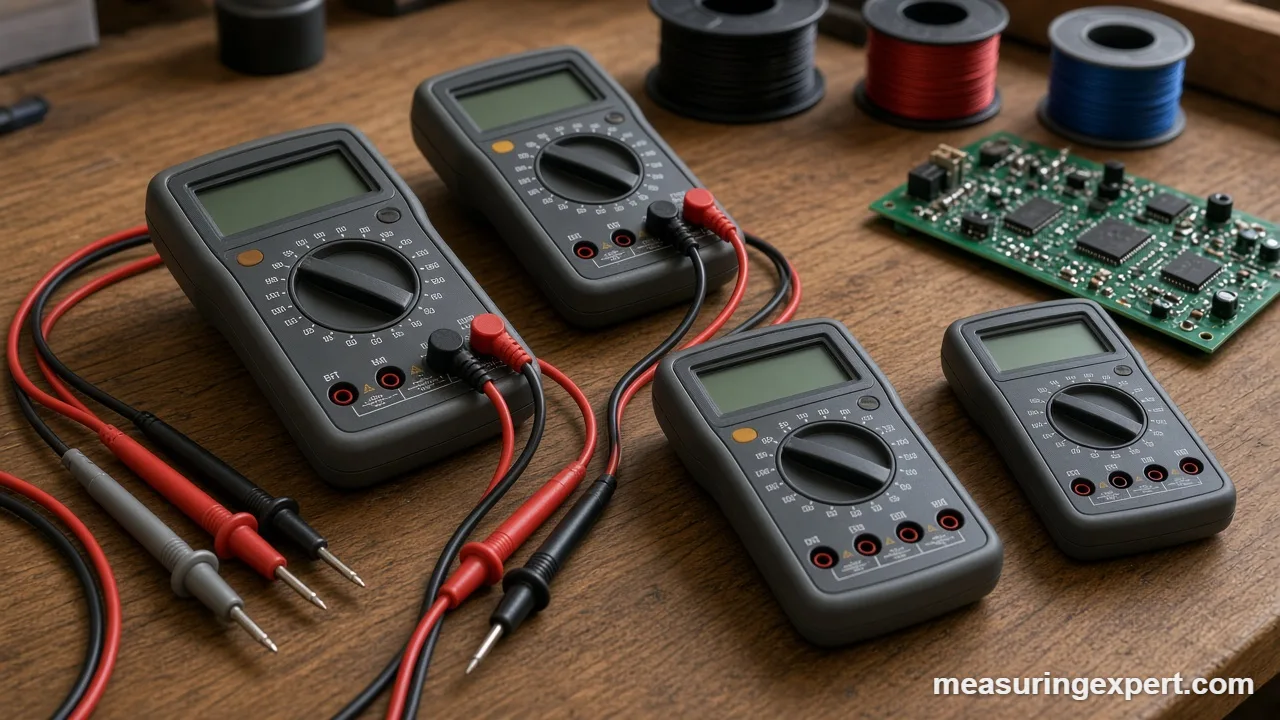
The best auto-ranging multimeter for most people is the Klein MM720, a True RMS meter rated CAT IV 600 V with a LoZ mode for ghost voltage. Still, the right choice depends on three things: the CAT rating your work needs, how fast the meter settles, and whether you can lock the range by hand.
In short: get the Klein MM720 for mixed electrical work, the UNI-T UT139S on a budget, and the Extech EX505A kit for wet, dusty or industrial sites.
As an Amazon Associate, Measuring Expert earns from qualifying purchases. Our picks are based on research, specifications and owner feedback, not paid placement.
Best Budget

Best Pro

Quick Answer: The Best Auto-Ranging Multimeter for Each Job
- Klein MM720: CAT IV 600 V, True RMS, LoZ and a thermocouple in one meter.
- UNI-T UT139S: a budget meter with both auto-ranging and a manual range lock.
- Extech EX505A-K: IP67 sealing and CAT IV 600 V, plus a voltage detector in the kit.
- Fluke 17B+: clear auto and manual range control with Fluke build quality.
- Fluke 116: microamps, temperature and capacitance for HVAC calls.
- Klein MM420 and KAIWEETS HT118E: an easy home meter and a 20,000-count hobby meter.
- OWON XDM2041: a 55,000-count bench meter that ranges at up to 65 readings per second.
On This Page
- Comparison table
- The 8 picks, reviewed
- How we chose
- Auto vs manual ranging
- Settling time explained
- When manual range is better
- CAT ratings
- How to use auto-range well
- Ohm’s law calculator
- Honest limits
- FAQ
- Bottom line
Best Auto-Ranging Multimeter Comparison
First, scan the table to match a meter to your work. Then read the full review for the CAT rating, resolution and range behavior.
| # | Product | Best For | Standout Feature | Amazon |
|---|---|---|---|---|
| 1 | Klein Tools MM720 | Mixed electrical work | CAT IV 600 V, LoZ mode, 6000 counts | View |
| 2 | UNI-T UT139S | Tight budgets | Auto and manual range, LoZ, NCV | View |
| 3 | Extech EX505A-K Kit | Wet or industrial sites | CAT IV 600 V, IP67, detector included | View |
| 4 | Fluke 17B+ | Fluke quality and range control | Auto-range by default, push to lock range | View |
| 5 | Fluke 116 HVAC | HVAC service | Microamps, temperature, Auto-V/LoZ | View |
| 6 | Klein Tools MM420 | Home DIY | Lead Alert, temperature, 6.6 ft drop | View |
| 7 | KAIWEETS HT118E | Electronics hobbyists | 20,000 counts, +/-(0.08% + 5) DC volts | View |
| 8 | OWON XDM2041 Bench Meter | Bench and lab work | 55,000 counts, 65 readings per second | View |
The 8 Best Auto-Ranging Multimeter Picks, Reviewed
First, each review covers the safety category, then resolution, update speed and range control.
Best Overall
1. Klein Tools MM720
Best for: Electricians and serious DIYers who want one auto-ranging meter for panels, motors and HVAC.
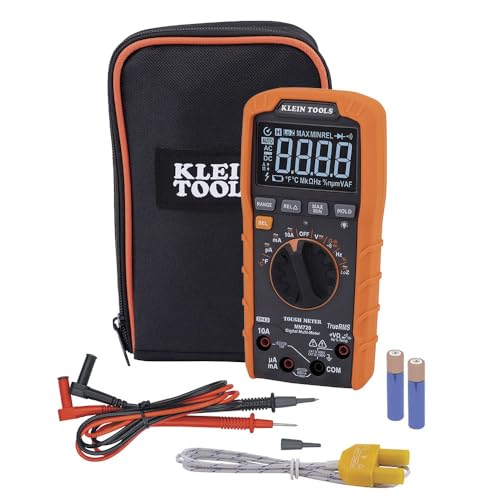
The Klein MM720 is our best auto-ranging multimeter for most buyers because it pairs fast True RMS auto-ranging with a high safety rating. Klein rates it CAT IV 600 V and CAT III 1000 V, so it can go from a bedroom outlet to a service panel without a meter swap. In addition, the 6000-count display gives 1 mV resolution on the 6 V range, which suits sensors and batteries as well as mains work.
For auto-ranging work, the LoZ mode matters most. For instance, a high-impedance meter can show a “ghost” voltage on an open wire, and that phantom value can push the meter into a range you did not expect. LoZ loads the circuit; as a result, the phantom reading collapses.
- Safety: CAT IV 600 V, CAT III 1000 V
- Display: 6000 counts, reverse-contrast LCD
- Ranges: 1000 V AC/DC, 10 A AC/DC, 60 megohms, 6000 uF, 1 Hz to 500 kHz
- Temperature: -40 to 1832 F (-40 to 1000 C) with the included thermocouple
- Build: 6.6 ft (2 m) drop rating, IP42, two AAA batteries
Pros
- High CAT rating for an everyday meter
- LoZ mode for ghost voltage
- Temperature probe included
Cons
- Klein does not publish a manual-range spec on the product page
- Heavier than pocket meters at 12.2 oz
- IP42 is splash-level, not waterproof
Skip it if: you only check batteries and fuses at a hobby bench, because a cheaper CAT III meter covers that.
Best Budget
2. UNI-T UT139S
Best for: Budget buyers who want auto-ranging plus a manual range button.
The UNI-T UT139S is a low-cost meter that still gives you the choice this guide is about: it starts in auto-range, but you can lock a range by hand. Therefore, it is a smart first meter for learning ranges. UNI-T lists DC voltage accuracy of +/-(0.5% + 2 counts) on the 600 V range, so it is honest enough for appliance and car work.
It also adds LoZ for AC volts, an NCV alert and True RMS. However, the AC bandwidth is listed as 45 to 400 Hz, so it is built for line-frequency power, not audio or fast electronics. Also, its CAT III 600 V rating covers household circuits and panels, but not the service entrance.
- Safety: CAT III 600 V
- Display: 6000 counts, auto and manual ranging
- DC volts: +/-(0.5% + 2) on the 600 V range
- Current: 10 A AC/DC
- Extras: True RMS, LoZ, NCV, temperature, capacitance
Pros
- Manual range lock at a budget price
- LoZ and NCV for safer checks
- True RMS on AC
Cons
- Narrow 45 to 400 Hz AC bandwidth
- CAT III 600 V only
- Smaller brand support network than Fluke or Klein
Skip it if: you work on utility meters, service drops or anything outdoors before the main breaker.
Best Pro
3. Extech EX505A-K Kit
Best for: Industrial and outdoor work where water, dust and drops are routine.
The Extech EX505A is a heavy-duty True RMS meter rated CAT IV 600 V and sealed to IP67, so rain, dust and washdown areas do not stop it. Extech lists a 2 m (6.5 ft) drop rating, and the manual covers both automatic and manual range modes. In addition, this kit bundles a DV25 non-contact voltage detector rated CAT IV 1000 V and a TL808 lead set rated CAT III 1000 V.
The 6000-count display and 0.1 uA current resolution cover control loops, while the 10 A range handles motor loads. Meanwhile, the Type K input reads -4 to 1400 F (-20 to 760 C), which suits HVAC and process checks.
- Safety: CAT IV 600 V meter; DV25 detector CAT IV 1000 V
- Sealing and drop: IP67, 2 m (6.5 ft) drop
- Display: 6000 counts, backlit, True RMS
- Ranges: 0.1 mV to 1000 V, 0.1 uA to 10 A, 0.1 ohm to 40 megohms
- Power and warranty: one 9 V battery, 3-year warranty
Pros
- Waterproof and dustproof to IP67
- Kit adds a voltage detector and leads
- Auto range with a manual option
Cons
- Bulky for a tool pouch
- Capacitance tops out at 100 uF
- Extech pages list basic accuracy in two different ways, so check the manual
Skip it if: you need a slim meter for a small toolbox or bench electronics.
Best Fluke Value
4. Fluke 17B+
Best for: Users who want Fluke build quality and a simple manual range toggle.
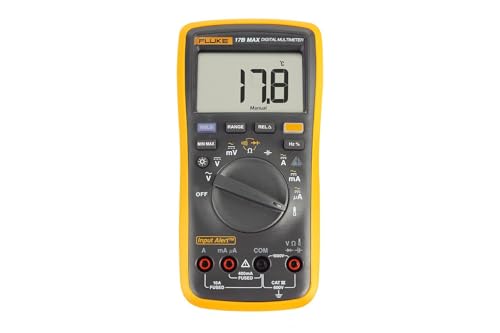
The Fluke 17B+ shows how a good auto-ranging meter should behave. It starts in auto-range in every multi-range function, and a single press enters manual range. Each further press steps up one range, and a two-second hold returns it to auto. Fluke rates it CAT III 600 V and IP40, with DC accuracy of +/-(0.5% + 3).
Meanwhile, it is a 4000-count meter that updates three times per second. So, a 12.60 V car battery reads on the 40.00 V range, and the error limit works out to about +/-0.09 V. In addition, it measures temperature from -67 to 752 F (-55 to 400 C), capacitance to 1000 uF and frequency to 100 kHz. However, Fluke does not list it as True RMS, so treat AC readings on dimmers and drives with care.
- Safety: CAT III 600 V (IEC 61010-1), IP40
- Display: 4000 counts, 3 updates per second, backlight
- DC volts: +/-(0.5% + 3); AC volts +/-(1.0% + 3) from 40 to 500 Hz
- Current: 400.0 uA to 10 A AC/DC
- Power: two AA batteries, 500 hours minimum
Pros
- Clear auto and manual range behavior
- Microamp range for sensors and HVAC flame circuits
- Long battery life
Cons
- Not listed as True RMS
- 4000 counts, so less resolution than 6000-count meters
- No CAT IV rating
Skip it if: you measure variable-speed drives or LED dimmer circuits, where a True RMS meter is the better tool.
Best for HVAC
5. Fluke 116 HVAC

Best for: HVAC technicians checking flame sensors, capacitors and temperature.
The Fluke 116 is an auto-ranging True RMS meter built around HVAC jobs. For example, it has a 600.0 uA range for flame-rectification sensors, a Type K temperature input and capacitance up to 9999 uF for run and start capacitors. Fluke rates it CAT III 600 V under IEC 61010-2-033, with DC accuracy of +/-(0.5% + 2).
Also, its Auto-V/LoZ mode picks AC or DC on its own and loads the line to cut ghost voltage. The 6000-count display updates four times per second, and the 33-segment bar graph updates 32 times per second. Therefore, you can watch a drifting signal on the bar while the digits catch up after a range change.
- Safety: CAT III 600 V (IEC 61010-2-033)
- Display: 6000 counts, 4 updates per second, 32/s bar graph
- AC volts: True RMS, +/-(1.0% + 3) to 500 Hz
- Temperature: -40 to 752 F (-40 to 400 C)
- Power: one 9 V battery, about 400 hours
Pros
- Microamp range for flame sensors
- Fast bar graph shows trends during range changes
- Auto-V/LoZ for quick live checks
Cons
- No mA or 10 A current ranges
- Only CAT III 600 V
- Specialized for HVAC
Skip it if: you need to measure amps on motors or circuits; pair it with a clamp meter or choose the Klein MM720.
Best for Home DIY
6. Klein Tools MM420
Best for: Homeowners who want an easy auto-ranging True RMS meter.
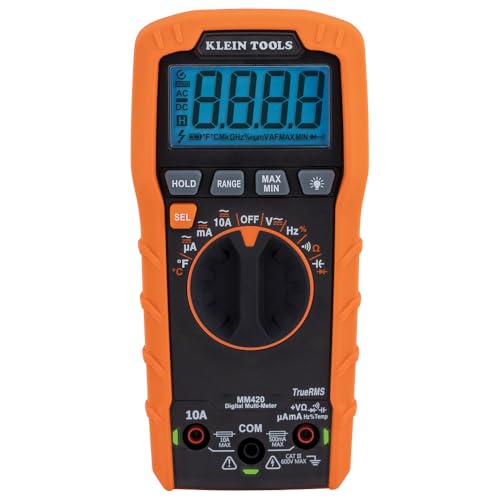
The Klein MM420 is a lighter, simpler auto-ranging meter for home projects. First, it reads up to 600 V AC/DC and 10 A, and Klein rates it CAT III 600 V. As a result, it covers outlets, switches, appliance cords and the house panel, which is all most homeowners need.
Above all, one feature makes it beginner-friendly: Lead Alert warns you when the test leads sit in the wrong jacks for the selected function. Also, the 4000-count backlit display, min/max and data hold keep readings easy to capture.
- Safety: CAT III 600 V
- Display: 4000 counts, backlit, True RMS, auto-ranging
- Ranges: 600 V AC/DC, 10 A, 50 megohms, 400 uF, 1 Hz to 50 kHz
- Temperature: -40 to 1832 F (-40 to 1000 C)
- Build: 6.6 ft (2 m) drop, 8.2 oz, two AAA batteries
Pros
- Lead Alert prevents jack mistakes
- Light at 8.2 oz
- Thermocouple included
Cons
- Klein lists accuracy only in the instructions
- 4000-count resolution
- 600 V maximum
Skip it if: you work in commercial three-phase gear above 600 V.
Best High Resolution
7. KAIWEETS HT118E

Best for: Electronics hobbyists who want fine resolution in a handheld.
The KAIWEETS HT118E stands out for resolution. Its 20,000-count display reads a 12.6 V battery to 0.001 V, and KAIWEETS lists DC voltage accuracy of +/-(0.08% + 5) from 200 mV to 1000 V. So, the error limit on that battery is about +/-0.015 V, which is tighter than most handhelds here.
Still, watch the range edges. For example, a value near 2 V sits right at the edge of the 2 V and 20 V ranges, so the meter may switch back and forth. In addition, it has a red-screen NCV alarm, a back flashlight and a thermocouple for -4 to 1832 F (-20 to 1000 C).
- Safety: CAT III 1000 V, CAT IV 600 V (as listed by KAIWEETS)
- Display: 20,000 counts, backlit, auto-ranging
- DC volts: +/-(0.08% + 5), 200 mV to 1000 V
- Capacitance: 20 nF to 2 mF
- Extras: NCV with red-screen alert, flashlight, two AAA batteries
Pros
- High resolution for the price
- Tight DC voltage spec
- NCV and flashlight built in
Cons
- Manual ranging is not described on the product page
- Less third-party safety testing data than Fluke
- Fewer published specs than Fluke or Klein
Skip it if: you need documented third-party certification for work on large electrical systems.
Best Bench
8. OWON XDM2041 Bench Meter

Best for: Makers and labs who want fast, high-resolution auto-ranging on a desk.
The OWON XDM2041 is a 4 1/2-digit bench meter with 55,000 counts and a reading rate of up to 65 values per second. As a result, auto-ranging feels almost instant compared with a handheld that updates three or four times per second. OWON lists DC accuracy of +/-(0.025% + 5) on the 5 V range, so a 3.3 V rail reads within about +/-0.0013 V.
In addition, it does 4-wire resistance, PT100 and Type K temperature, and trend charts on a 3.7 in display. However, the sources we checked do not state a CAT rating, so keep it on low-energy bench circuits and use a CAT-rated handheld for mains work.
- Display: 55,000 counts, 3.7 in dual-line LCD with trend chart
- Speed: up to 65 readings per second
- DC volts: +/-(0.025% + 5) on the 5 V and 500 mV ranges
- Limits: 1000 V DC, 750 V AC, 10 A
- Extras: 4-wire ohms, PT100 and Type K, RS232 with SCPI
Pros
- Very fast auto-ranging
- Highest resolution in this list
- 4-wire ohms for low resistance
Cons
- Needs mains power and a bench
- No CAT rating stated in our sources
- RS232 rather than USB in the listed specs
Skip it if: you need a portable meter or plan to test mains panels.
How We Chose the Best Auto-Ranging Multimeter Picks
We did not bench-test these meters. Instead, our picks are based on research: maker spec sheets and manuals, safety ratings, and patterns in owner feedback. We also kept this list separate from our best digital multimeter roundup and our best digital voltmeter guide, so you can see different models here.
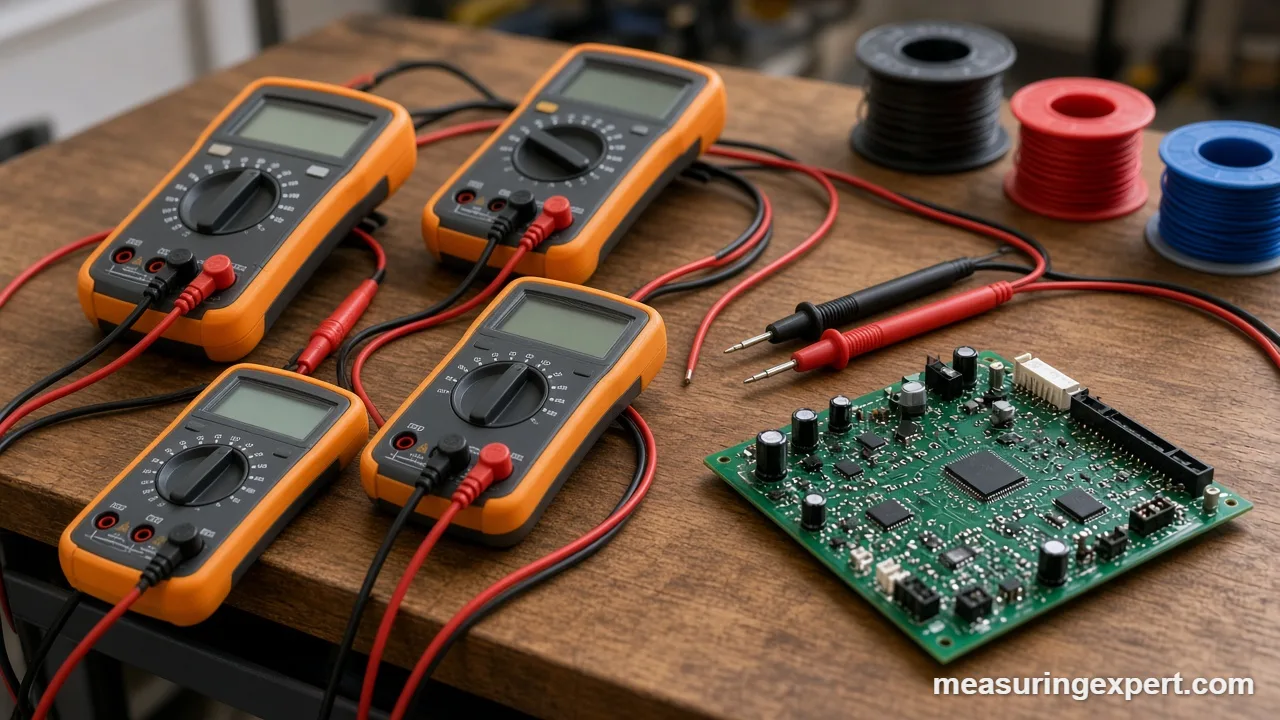
Specifically, we weighed five things:
- Safety category: a published CAT rating from the maker, checked on the product page or manual.
- Range control: true auto-ranging, plus a manual override where the maker documents one.
- Resolution and speed: display counts and, where listed, how many readings per second the meter takes.
- Published accuracy: a stated spec in the form +/-(% of reading + counts).
- Distinct use cases: one pick each for home, HVAC, rugged sites, hobby electronics and the bench, with no more than two per brand.
Our main sources were the Fluke 17B+ product page, the Klein MM720 spec page, Extech, UNI-T, KAIWEETS and OWON spec pages, and the Fluke 110-series user manual for range-button behavior.
Auto-Ranging vs Manual Ranging: What Actually Changes
Every digital meter measures on a set of ranges, such as 6 V, 60 V and 600 V. First, a manual meter makes you pick one on the dial. An auto-ranging meter, by contrast, measures first, then steps up or down until the value fits the range with the best resolution.
In other words, the range sets the resolution. For example, a 6000-count meter shows 5.999 V on its 6 V range. However, at 6.01 V it must jump to the 60 V range, so the last digit becomes 0.01 V. The accuracy spec still applies, but you lose one digit at that boundary. If you need a refresher on units, see our guide to the voltage symbol and unit.
| Factor | Auto-ranging | Manual ranging |
|---|---|---|
| Setup | Pick the function only | Pick the function and the range |
| Speed on unknown values | Fast, no guessing | Slow; you may need several tries |
| Speed on repeated values | Slower; it may re-range every time | Fast; the range is already set |
| Overload risk | Low; it moves up on its own | Higher; the display shows OL if the range is too low |
| Noisy or drifting signals | Can “hunt” between ranges | Stable; the range stays put |
| Best for | Troubleshooting and mixed work | Production tests, current and boundary values |
In short, the best auto-ranging multimeter gives you both modes: auto for most work and a RANGE button for the jobs where auto gets in the way.
Settling Time: Why the Best Auto-Ranging Multimeter Still Pauses
In short, settling time is the delay between touching the probes and seeing a stable value. On an auto-ranging meter it has two parts. First, the meter needs time to sample the input. Then, if the value does not fit, it must switch range and sample again.
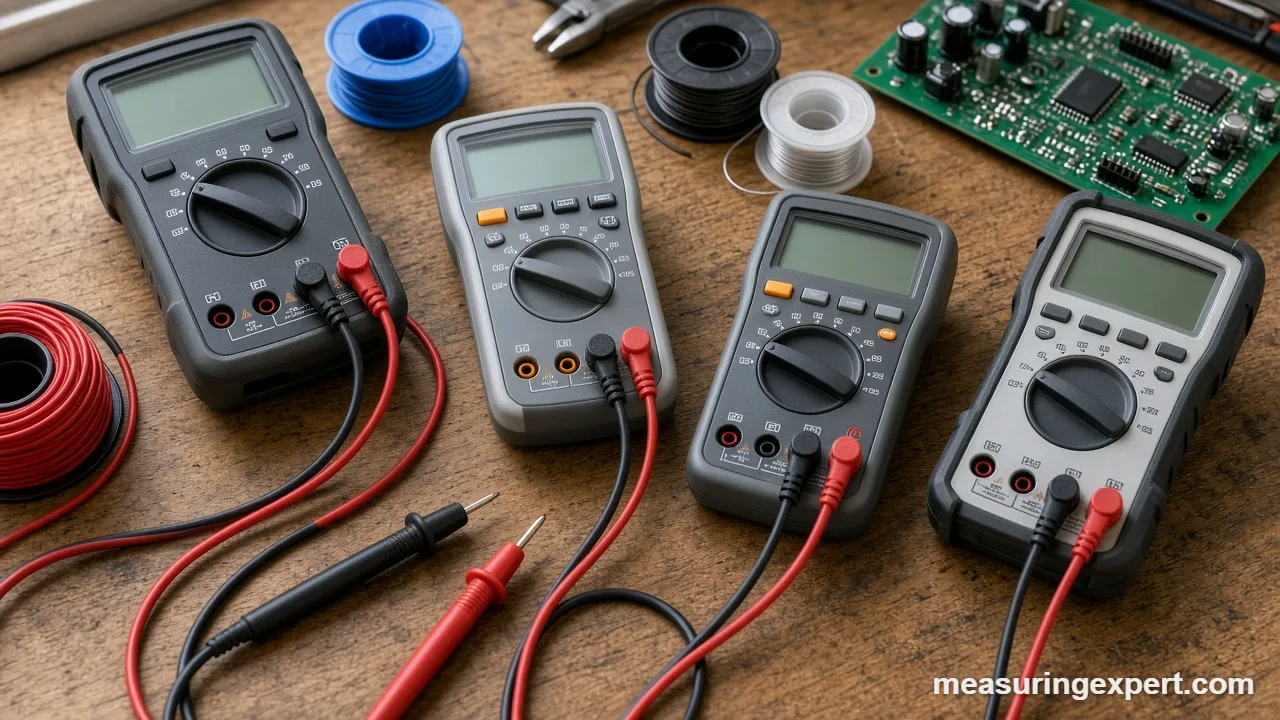
Above all, update rate drives the second part. The Fluke 17B+ updates three times per second, so each extra range step costs about a third of a second. As a result, stepping through three ranges takes about one second. The Fluke 116 updates four times per second, but its bar graph refreshes 32 times per second, so you can watch the trend while the digits settle. By contrast, the OWON XDM2041 takes up to 65 readings per second, which makes ranging feel instant.
Resistance and capacitance tests settle more slowly, because the meter has to charge the part under test. In addition, a reading right on a range boundary may flip back and forth.
When Manual Range Beats the Best Auto-Ranging Multimeter
Overall, auto-ranging is the right default, but manual range wins in five common cases:
- Repeated checks: if you test 50 identical boards, a locked range skips the re-range delay on every one.
- Boundary values: a 6 V circuit on a 6000-count meter sits on the 6 V/60 V edge, so lock the 60 V range for a steady display.
- Current tests: each current range uses a different shunt. Therefore, a range change alters the burden voltage and can upset a sensitive circuit.
- Noisy or intermittent signals: a fixed range stops hunting, so you can watch for a dropout or spike.
- Logging and trend work: a fixed range keeps the resolution the same from start to finish.
On the Fluke 17B+, for example, one press of the range button enters manual mode, more presses step up, and a two-second hold returns to auto-range. The UNI-T UT139S and Extech EX505A manuals also describe both modes.
CAT Ratings for an Auto-Ranging Meter
Auto-ranging protects the display from overload, but it does not protect you from a transient spike. Instead, that job belongs to the CAT rating. According to Fluke’s multimeter safety guide, you should pick a meter rated for the highest category you might work in.
| Category | Where it applies | Picks in this guide |
|---|---|---|
| CAT II | Plug-in loads, appliances, outlets on long branch circuits | All CAT III and CAT IV meters cover this |
| CAT III | Panels, feeders, fixed wiring, motors, lighting in larger buildings | Fluke 17B+, Fluke 116, Klein MM420, UNI-T UT139S (600 V) |
| CAT IV | Service entrance, utility meters, outdoor conductors | Klein MM720, Extech EX505A, KAIWEETS HT118E (600 V) |
| Not stated | Low-energy bench circuits only | OWON XDM2041 |
Also check the voltage after the category. CAT III 1000 V is a higher rating than CAT III 600 V, and the test leads need the same rating as the meter.
How to Take a Reading With the Best Auto-Ranging Multimeter
In general, this routine works for voltage on most auto-ranging meters. Always follow the manual for your model.
- Inspect the meter and leads for cracks or bare metal, and confirm the CAT rating suits the circuit.
- Next, plug the black lead into COM and the red lead into the jack for the function you need.
- Turn the dial to the function, such as DC volts, and let the meter start in auto-range.
- Then touch the probes to a known source to confirm the meter works.
- Connect to the circuit and wait for the range indicator and digits to stop changing.
- If the reading hunts between two ranges, press RANGE to lock the higher range.
- Finally, record the value with its units and range, and return the meter to auto-range.
Ohm’s Law Calculator for Meter Readings
Use this calculator to sanity-check a reading. For example, enter a measured voltage and resistance to see the current and power you should expect, and then pick a current range above that value.
Keeping an Auto-Ranging Meter Accurate
Because accuracy drifts over time, a meter needs checks. First, compare it now and then with a second meter or a known reference, such as a fresh 1.5 V cell. Next, inspect the leads, because cracked insulation is the most common failure. Finally, replace fuses only with the exact rating the maker lists. For more on why this matters, read our article on calibration in engineering measurement tools.
Honest Limits of Auto-Ranging
Auto-ranging cannot fix a wrong function or a lead in the wrong jack. Besides, it adds delay on every new reading and may hunt on noisy signals. Lastly, no feature replaces a proper CAT rating and good habits.
Best Auto-Ranging Multimeter FAQ
What is the best auto-ranging multimeter for most people?
Overall, the Klein MM720 is our top pick. It combines True RMS auto-ranging, a 6000-count display, LoZ mode and a CAT IV 600 V / CAT III 1000 V rating.
Is an auto-ranging multimeter better than a manual one?
For most jobs, yes, because it picks the range for you and prevents overload mistakes. However, manual ranging is faster and steadier when you repeat the same measurement or test a noisy signal.
Why is my auto-ranging meter slow to settle?
First, the meter must take a reading, decide the range is wrong and switch. At three updates per second, stepping through three ranges takes about one second, and resistance tests can take longer.
Can I lock the range on an auto-ranging meter?
Usually, yes. Many models have a RANGE button. On the Fluke 17B+, one press enters manual range, more presses step up, and a two-second hold returns to auto. The UNI-T UT139S and Extech EX505A also offer manual range.
What CAT rating does the best auto-ranging multimeter need?
Choose CAT III 600 V for household panels and branch circuits. However, choose CAT IV 600 V if you test service entrances, utility meters or outdoor feeders.
Does auto-ranging affect accuracy?
The accuracy spec is the same, but the range sets the resolution. A 6000-count meter shows 5.999 V on the 6 V range and 6.01 V on the 60 V range, so you lose one digit at the boundary.
Should I use auto-ranging when measuring current?
Be careful, because each current range uses a different shunt, so a range change alters the burden voltage and can disturb a sensitive circuit. Lock the range when you can.
How many counts should the best auto-ranging multimeter have?
Generally, a 4000 or 6000 count meter covers home and HVAC work. Choose 20,000 counts or more for electronics, sensors and calibration checks.
Is a bench meter better than a handheld for auto-ranging?
A bench meter such as the OWON XDM2041 reads up to 65 times per second, so it ranges much faster. However, it lacks a stated CAT rating in our sources and needs mains power.
Do auto-ranging multimeters need calibration?
Yes. For example, check them against a known reference now and then, and send pro meters for calibration about once a year or as your quality system requires.
Bottom Line: Our Best Auto-Ranging Multimeter
For most buyers, the Klein MM720 is the meter to get. Also, it ranges quickly, cuts ghost voltage with LoZ, and carries a CAT IV 600 V rating, so it will not limit you as your work grows. On the other hand, choose the UNI-T UT139S if you want a manual range lock on a small budget, or the OWON XDM2041 if you mostly measure electronics on a bench.
1 thought on “Best Auto-Ranging Multimeter: 8 Picks for Fast, Safe Readings”