

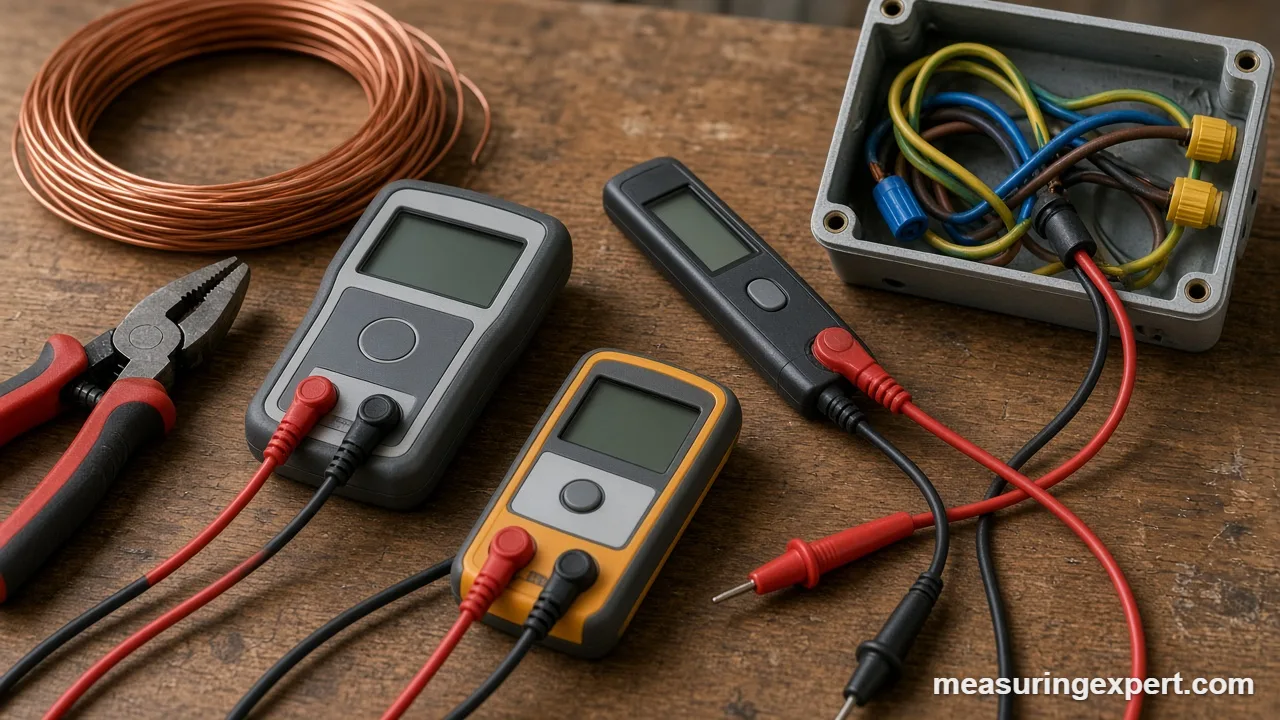
The best digital voltmeter for most people is the Fluke T5-1000, because it reads AC and DC voltage to 1000 V, checks continuity and clamps AC current, all under a CAT IV 600 V rating. Still, the right pick depends on where you measure: outlets, electronics, a car, or a fixed solar bank.
In short: get the Fluke T5-1000 for wiring work, the Klein ET250 for home outlets, and the UNI-T UT195DS when you need sealed, precise DC readings.
As an Amazon Associate, Measuring Expert earns from qualifying purchases. Our picks are based on research, specifications and owner feedback, not paid placement.
Best Overall

Best Value
Best Rugged
Quick Answer: Which Digital Voltmeter Should You Buy?
- Building wiring: Fluke T5-1000, with CAT IV 600 V and clamp-free current.
- Home outlets on a budget: Klein ET250, tough and simple.
- Batteries and electronics: Fluke 15B+ for +/-(0.5% + 3) DC accuracy.
- Wet or dusty sites: UNI-T UT195DS, sealed to IP65.
- Your car: Innova 3721 plugs into the 12 V socket.
- Solar or RV bank: DROK panel monitor for constant volts and amps.
On This Page
- Digital voltmeter comparison table
- The 8 picks, reviewed
- How we chose
- Tester, meter or panel gauge
- CAT ratings explained
- Accuracy, counts and resolution
- How to measure voltage safely
- Ohm’s law calculator
- Ghost voltage and false readings
- Do and Don’t
- Where a voltmeter falls short
- FAQ
- Bottom line
Best Digital Voltmeter Comparison Table
Each pick gets one row below. The reviews then explain the specs, the CAT ratings and the trade-offs.
| # | Product | Best For | Standout Feature | Amazon |
|---|---|---|---|---|
| 1 | Fluke T5-1000 | Electricians and serious DIYers | OpenJaw AC current to 100 A, CAT IV 600 V | View |
| 2 | Klein Tools ET250 (with Spare Leads) | Homeowners checking outlets and switches | CAT IV 600 V, IP53 and a 9.8 ft drop rating | View |
| 3 | Fluke 15B+ | Car, battery and electronics checks | +/-(0.5% + 3) DC accuracy on a 4000-count display | View |
| 4 | UNI-T UT195DS | Field work in dust, rain and drops | IP65, 2 m drop proof, LoZ mode and dual display | View |
| 5 | IDEAL 61-557 Voltage and Continuity Tester | Electricians who want NCV and leads in one tool | LCD voltage reading plus a built-in NCV tip | View |
| 6 | Klein Tools MM450 | Tool-belt carry and HVAC temperature checks | Slim TRMS body with Lead-Alert LEDs and temperature | View |
| 7 | Innova 3721 Battery and Charging System Monitor | Drivers watching battery and alternator voltage | Plug-in 12 V voltmeter with color-coded LEDs | View |
| 8 | DROK 8-100V 100A Battery Monitor | RV, solar and off-grid battery banks | Permanent volt, amp and watt display for 12 to 60 V banks | View |
The 8 Best Digital Voltmeter Picks, Reviewed
This list covers tools whose main job is reading voltage: handheld testers, voltmeter-first meters, a plug-in car monitor and a panel monitor. For full-featured meters, see our best digital multimeter guide. Likewise, outlet testers and breaker finders live in our electric circuit tester roundup, so we do not repeat those picks here.
Best Overall
1. Fluke T5-1000
Best for: Electricians, maintenance techs and serious DIYers who want one rugged tool for voltage, continuity and current.
Overall, the T5-1000 is the best digital voltmeter for people who work on building wiring. It is a tester rather than a full multimeter, so it does a few jobs fast. First, it reads AC and DC voltage up to 1000 V. Next, the OpenJaw slot measures AC current without breaking the circuit. Also, it checks continuity and resistance.
Fluke lists DC voltage accuracy of +/-(1% + 1 count) and AC accuracy of +/-(1.5% + 2 counts). For example, a 120 V outlet reading carries about +/-1.8 V plus 2 counts. That is plenty for confirming a circuit is live or dead. In addition, the tester carries a CAT IV 600 V and CAT III 1000 V rating. Note that Fluke now lists the sister T6-1000 as discontinued, so the T5 is the one to buy.
- Voltage: 0 to 1000 V AC or DC; DC +/-(1% + 1 count), AC +/-(1.5% + 2 counts)
- OpenJaw current: 0 to 100.0 A AC (50/60 Hz), +/-(3% + 3 counts); jaw opening 0.5 in (12.9 mm)
- Resistance 0 to 1000 ohms; continuity beeper below 25 ohms
- Safety: CAT IV 600 V, CAT III 1000 V
- 2 x AA batteries, up to 400 hours on alkaline; two-year warranty
Pros
- Shares the top CAT rating on this list
- Clamps current with no meter in the circuit
- Simple dial that is hard to misuse
Cons
- Resistance stops at 1000 ohms, so it is not an electronics meter
- Current reading is AC only
- Looser accuracy than the Fluke 15B+ or UNI-T UT195DS
Skip it if: you repair circuit boards or need millivolt detail, because a full multimeter reads finer steps.
Best Value
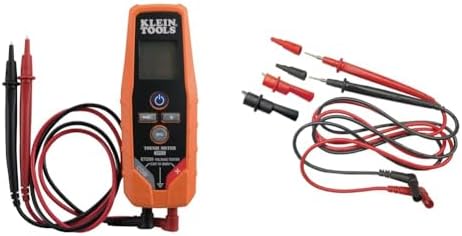
2. Klein Tools ET250 (with Spare Leads)
Best for: Homeowners and handymen who want a tough, readable AC/DC voltage tester for outlets, switches and low-voltage gear.
The ET250 is a two-lead voltage and continuity tester with a digital LCD. Also, it tests GFCI circuits, so one tool covers most outlet work. In addition, a backlight and a built-in flashlight help in dark boxes. This bundle adds a replacement test lead set and right-angle clips.
However, its accuracy is coarse. Klein lists +/-(2% + 2 V) from 2 to 600 V AC/DC. So at 120 V, the reading can be off by about 4.4 V. That is fine for live-or-dead checks. On the other hand, it is too rough for judging a 12 V battery.
- Voltage: 2 to 600 V AC/DC, +/-(2% + 2 V); frequency 45 to 400 Hz
- Safety: CAT IV 600 V; IP53 (except the lead jacks)
- Drop protection: 9.8 ft (3 m)
- Continuity, GFCI test, backlight and flashlight
- 3 x AAA batteries; weight 6 oz (170 g)
Pros
- CAT IV rating at a homeowner-friendly level
- Built for drops and dust
- Lead storage keeps the probes together
Cons
- +/-2 V offset makes low-voltage readings rough
- No current or resistance values
- Not useful below 2 V
Skip it if: you test batteries or electronics, since the 2 V offset hides small changes.
Best for DC Accuracy
3. Fluke 15B+

Best for: Hobbyists, auto owners and students who want Fluke-grade DC readings on batteries, chargers and electronics.
The 15B+ is a compact digital multimeter, yet most owners use it as a voltmeter. Fluke lists DC accuracy of +/-(0.5% + 3 digits) from the 4 V range up to 1000 V. For example, a 12.60 V battery on the 40.00 V range reads within about +/-0.09 V. As a result, you can tell a charged battery from a tired one.
In addition, it measures current to 10 A, resistance, capacitance and diodes. However, check the safety rating before panel work. The meter reads up to 1000 V, but it is rated CAT III 600 V. In short, the voltage range and the safety category are two different numbers.
- DC voltage: 400 mV to 1000 V; +/-(0.5% + 3) above 400 mV
- AC voltage: to 1000 V, 40 to 500 Hz, +/-(1.0% + 3)
- Display: 4000 counts, 3 updates per second, backlight
- Current: to 10 A AC/DC, +/-(1.5% + 3)
- Safety: CAT III 600 V; 2 x AA, 500+ hours
Pros
- Tight DC accuracy for the money
- Full meter functions, including current and capacitance
- Long battery life
Cons
- CAT III 600 V rating sits below its 1000 V range
- 4000 counts give only 0.1 V steps on the 400 V range
- Slower than a tester for quick yes/no checks
Skip it if: you work at service panels or meters outdoors, because those jobs call for CAT IV.
Best Rugged
4. UNI-T UT195DS
Best for: Solar installers, HVAC techs and field crews who need a sealed, accurate meter that survives rough use.
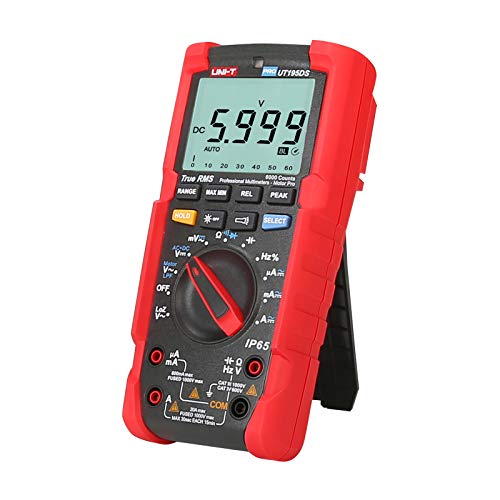
UNI-T builds the UT195 series for harsh sites. The housing is IP65 sealed and rated for a 2 m drop. Also, the DS version adds a dual display, a flashlight and a motor phase-sequence test. It also reads true RMS AC.
Meanwhile, the voltmeter numbers are strong. UNI-T lists DC accuracy of +/-(0.2% + 5) up to 1000 V on a 6000-count display. Therefore, a 12.60 V reading on the 60.00 V range is good to about +/-0.08 V. It also has a LoZ ACV mode, which drains ghost voltage before you trust a reading. Finally, it carries CAT III 1000 V and CAT IV 600 V ratings.
- DC voltage: 1000 V, +/-(0.2% + 5); AC voltage: 1000 V, +/-(1% + 3), true RMS
- LoZ ACV: 600 V, +/-(2% + 3)
- Current: 20 A AC/DC (20 A for 30 s max)
- Safety: CAT III 1000 V, CAT IV 600 V; IP65 and 2 m drop proof
- Power: 9 V battery; auto backlight and flashlight
Pros
- Sealed IP65 body
- Best DC accuracy on this list
- LoZ mode cuts false readings
Cons
- Bulky next to a slim meter
- Uses a 9 V battery rather than AA cells
- Smaller US service network than Fluke or Klein
Skip it if: you only check outlets at home, because a simple tester is faster and lighter.
Best Two-Pole Tester
5. IDEAL 61-557 Voltage and Continuity Tester
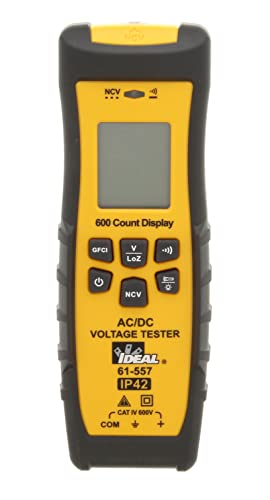
Best for: Electricians and remodelers who want a two-probe tester with an LCD, continuity and a non-contact voltage tip.
The 61-557 pairs a solenoid-style two-probe body with a digital readout. First, the LCD shows AC or DC voltage from 0 to 600 V. Next, a non-contact sensor in the tip flags 90 to 600 V AC before you touch anything. Also, a test button trips GFCI outlets.
However, the spec sheet we opened does not publish an accuracy figure. So treat it as a fast, safe yes/no tool with a number attached. In addition, it carries a CAT IV 600 V rating, an IP42 housing and a 6.5 ft (2 m) drop rating.
- Voltage: 0 to 600 V AC/DC on an LCD
- Non-contact detection: 90 to 600 V AC with LED and tone
- Safety: CAT IV 600 V; cULus and CE
- IP42; 6.5 ft (2 m) drop rating
- 3 x AAA batteries with auto power-off; weight about 7 oz (200 g)
Pros
- NCV, leads and GFCI test in one body
- CAT IV rating for service work
- Probes stay attached, so nothing gets lost
Cons
- No published accuracy figure
- IP42 is less sealed than the ET250
- No current or resistance values
Skip it if: you need logged or precise numbers, since a meter like the UT195DS reports far tighter tolerances.
Best Slim Meter
6. Klein Tools MM450
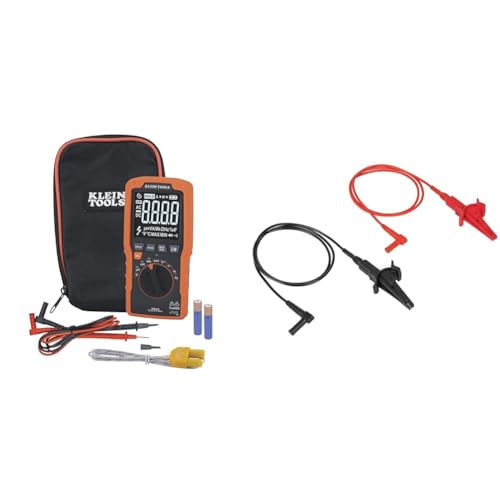
Best for: Electricians and HVAC techs who want a slim, auto-ranging true RMS meter that fits a pouch.
The MM450 is about 1.1 in (2.8 cm) thick, so it rides in a pocket or tool pouch. Also, it is true RMS and auto-ranging up to 600 V AC/DC. In addition, Lead-Alert LEDs show which jacks the probes belong in. That prevents a common mistake with the amps jack.
Beyond voltage, it measures 10 A AC/DC, resistance to 50 megohms, capacitance and temperature. However, Klein’s product page does not list accuracy; it points to the manual instead. Meanwhile, the meter is rated CAT III 600 V, while its leads are CAT III 1000 V and CAT IV 600 V.
- Voltage: 600 V AC/DC, true RMS, auto-ranging; 4000 counts
- Current 10 A AC/DC; resistance 50 megohms; capacitance 400 uF
- Temperature: -40 to 1832 F (-40 to 1000 C)
- Safety: CAT III 600 V; 6.6 ft (2 m) drop protection
- 2 x AAA; 6.5 x 3.14 x 1.09 in; 9.1 oz (258 g)
Pros
- Slim enough for a shirt pocket
- Lead-Alert LEDs guard the amps jack
- Temperature probe adds HVAC use
Cons
- Accuracy is only in the manual, not the product page
- CAT III only, not CAT IV
- 600 V ceiling
Skip it if: you test at service entrances, because the meter itself is not CAT IV rated.
Best for Cars
7. Innova 3721 Battery and Charging System Monitor

Best for: Drivers who want to watch battery and charging voltage from the seat, with no probes or wiring.
The Innova 3721 is the simplest digital voltmeter here. It plugs into a 12 V accessory socket and shows system voltage on an LCD. Also, green, yellow and red LEDs give a quick status.
It covers 9 to 16 V on 12 V negative-ground systems. However, it reads voltage only at the socket, and only while that socket is powered. For load or capacity checks, see our battery tester guide.
- Range: 9 to 16 V DC
- For 12 V negative-ground systems
- LCD voltage readout with bar graph
- Green, yellow and red status LEDs
- Pivoting head; plugs into a 12 V power socket
Pros
- Zero setup
- Shows charging problems while you drive
- Easy for anyone to read
Cons
- 12 V systems only
- No published accuracy
- Some sockets go dead with the key off
Skip it if: you need to probe a single circuit or fuse, because it only reads the socket.
Best Panel Meter
8. DROK 8-100V 100A Battery Monitor

Best for: RV owners and solar DIYers who want a permanent digital voltmeter on a battery bank.
A panel voltmeter stays wired in, so it watches a system all day. DROK lists this monitor for DC 8 to 100 V systems and up to 100 A. Also, the color screen shows volts, amps, watts, capacity and time. As a result, you see voltage sag under load, not just a resting number.
However, it is an install, not a handheld. So follow the wiring diagram, fuse the supply lead, and size the cables for the current. In addition, DROK does not publish a formal accuracy figure that we could verify. Therefore, check it once against a good handheld meter after install.
- Voltage: DC 8 to 100 V (12, 24, 36, 48 and 60 V banks)
- Current: up to 100 A DC
- Displays volts, amps, watts, capacity and time
- Large color LCD for panel or dash mounting
Pros
- Constant monitoring, unlike a handheld
- Shows current and power too
- Fits common 12 to 48 V banks
Cons
- Needs careful wiring
- DC systems only
- No verified accuracy spec
Skip it if: you only need spot checks, because any handheld voltmeter here does that with no install.
How We Chose the Best Digital Voltmeter Picks
We did not bench-test these tools. Instead, our picks are research-based. First, we read manufacturer spec pages and manuals for every model. Next, we compared published accuracy, safety category, durability ratings and features. Then we weighed owner feedback for long-term problems.
Also, we set a few hard rules. Each handheld pick had to carry a stated CAT rating. In addition, we dropped unbranded listings, parts-only items and models that the maker lists as discontinued. Finally, we kept at most two models per brand, so the list covers distinct jobs. Our main sources were Fluke, Klein Tools, IDEAL, UNI-T, Innova and DROK product pages, plus the OSHA 1910.333 work-practice rule.
Tester, Meter or Panel Gauge: Picking the Best Digital Voltmeter Type
A “digital voltmeter” can mean three different tools. So decide which one fits your work before comparing specs.
| Type | Examples here | Strength | Weak spot |
|---|---|---|---|
| Voltage tester with LCD | Fluke T5-1000, Klein ET250, IDEAL 61-557 | Fast live/dead checks, high CAT ratings | Coarser accuracy |
| Voltmeter-first multimeter | Fluke 15B+, UNI-T UT195DS, Klein MM450 | Fine resolution, many functions | More dial positions to get wrong |
| Plug-in or panel monitor | Innova 3721, DROK monitor | Watches a system all the time | One location only; must be installed |
In short, testers answer “is it live?” and meters answer “exactly how many volts?”. Meanwhile, panel monitors answer “what is my battery doing right now?”.
CAT Ratings: Why the Best Digital Voltmeter Is More Than a Big Number
The CAT rating tells you where a tool can survive a voltage spike. It comes from the IEC 61010-1 safety standard. According to Fluke’s guide to IEC category ratings, the categories map to places in a building:
- CAT II: loads plugged into single-phase outlets, such as appliances and portable tools.
- CAT III: fixed distribution, such as switchgear, commercial lighting and motors.
- CAT IV: the utility connection, such as service entrances, outdoor conductors and meters.
Higher categories face bigger transients, because less wiring sits between you and the utility. Therefore, CAT IV 600 V is a tougher rating than CAT III 600 V. Also, the voltage range and the rating are separate. For example, the Fluke 15B+ reads 1000 V but carries CAT III 600 V. So use the lower of the tool rating and the lead rating as your limit.
Accuracy, Counts and Resolution on a Digital Voltmeter
Spec sheets write accuracy as +/-(percent of reading + counts). The percent part scales with the reading. Meanwhile, the counts part is a fixed number of steps in the last digit. Here is how the math plays out on a 12.60 V battery:
| Tool | Published DC spec | Range used | Worst-case error at 12.60 V |
|---|---|---|---|
| UNI-T UT195DS | +/-(0.2% + 5) | 60.00 V (0.01 V steps) | +/-0.08 V |
| Fluke 15B+ | +/-(0.5% + 3) | 40.00 V (0.01 V steps) | +/-0.09 V |
| Klein ET250 | +/-(2% + 2 V) | Single range | +/-2.25 V |
As a result, a tester can be perfect for an outlet and useless for a battery. In addition, “counts” set the resolution. A 4000-count meter shows up to 3999, so 12.60 V fits the 40.00 V range. Likewise, a 6000-count meter shows up to 5999 on its 60.00 V range.
Next, check whether AC readings are true RMS. Average-responding meters assume a clean sine wave. However, variable-speed drives and LED drivers distort the wave, so a true RMS meter reads them more honestly. For more on the unit itself, see our explainer on the volt symbol and unit.
How to Use the Best Digital Voltmeter Safely
This live-dead-live routine works with any handheld digital voltmeter. Also, OSHA requires a check of the test equipment immediately before and after the test on circuits over 600 V nominal. It is a good habit at any voltage.
- Confirm the tool and leads are rated for the circuit, both in volts and in CAT category.
- Inspect the leads for cracked insulation or exposed metal, and replace damaged leads.
- Set the dial to AC or DC volts, or let an auto-detecting tester choose.
- Test a known live source, such as a working outlet, to prove the tool reads.
- Touch the black probe to neutral, ground or negative first, then the red probe to the test point.
- Read the display, then remove the red probe before the black one.
- Re-test the known live source to prove the tool still works.
Ohm’s Law Calculator for Voltmeter Readings
A voltage reading becomes more useful when you link it to current and resistance. So enter any two values below to get the third, plus power in watts.
For example, a 12 V circuit through 4 ohms draws 3 A and turns 36 W into heat. Similarly, voltage missing at a load is usually lost in a loose or corroded joint.
Ghost Voltage and Other Readings That Fool People
Digital meters have very high input impedance, often millions of ohms. Therefore, they can pick up voltage coupled from a nearby live wire. A dead conductor may then show tens of volts. This “ghost voltage” fools many first-time users.
To sort it out, use a LoZ (low impedance) mode, like the one on the UNI-T UT195DS. It loads the circuit, so coupled voltage collapses and real voltage stays. Alternatively, a solenoid-style tester gives a similar load. Also, watch for these traps:
- Wrong mode: DC volts on an AC outlet may read near zero.
- Weak battery: a low battery can skew readings, so replace it early.
- Lead in the amps jack: this can blow a fuse or worse, which is why Lead-Alert LEDs help.
Best Digital Voltmeter Do and Don’t
Where a Digital Voltmeter Falls Short
A voltmeter samples a few times per second. So it can miss a brief dip or spike unless it has a min/max or peak mode. In addition, resting voltage alone cannot prove a battery is healthy, because a weak battery can read fine with no load.
Finally, no tool replaces training. If a service panel job feels unclear, hire a licensed electrician.
Best Digital Voltmeter FAQ
What is the best digital voltmeter for home use?
For most homes, the Klein ET250 is the best digital voltmeter for outlet and switch checks, because it is simple, tough and CAT IV rated. However, if you also test batteries or electronics, the Fluke 15B+ reads DC voltage far more precisely.
What CAT rating should the best digital voltmeter have?
Match the rating to the location. CAT II covers plug-in loads, CAT III covers fixed wiring and panels inside a building, and CAT IV covers service entrances and outdoor conductors. Also, use the lower of the meter and test lead ratings.
Is a digital voltmeter the same as a multimeter?
Not quite. A multimeter includes a voltmeter plus current, resistance and other functions. A voltage tester, on the other hand, focuses on voltage and usually on continuity. In short, every multimeter is a voltmeter, but not every voltmeter is a multimeter.
How accurate is the best digital voltmeter?
It depends on the tool. Good meters list DC accuracy near +/-(0.2% to 0.5%) plus a few counts, which means under 0.1 V of error on a 12 V battery. Many testers, by contrast, allow 2 V or more of error.
What is ghost voltage on a voltmeter?
Ghost voltage is a reading caused by coupling from nearby live wires. A high-impedance digital meter can show it on a dead conductor. Therefore, a LoZ mode or a solenoid-style tester helps confirm whether the voltage is real.
Can I test a car battery with a digital voltmeter?
Yes. Measure across the posts with the engine off, then again with it running to check charging. However, voltage alone does not prove battery health, so use a load or conductance tester for that.
What do 4000 counts and 6000 counts mean?
Counts are the largest number the display can show before switching ranges. So a 4000-count meter shows up to 3999, and a 6000-count meter shows up to 5999. As a result, more counts often give a finer resolution on common readings.
Do I need a true RMS digital voltmeter?
You need true RMS if you measure motor drives, LED drivers, dimmers or other distorted AC. Otherwise, an average-responding meter can read high or low. For plain outlet checks, though, either type works.
How often should I calibrate a voltmeter?
Professional users often calibrate yearly, or as their quality system requires. At home, compare readings against a second trusted meter once a year. Also, replace any meter that reads differently after a drop.
What is a panel voltmeter used for?
A panel voltmeter stays wired into a system, such as an RV, boat or solar battery bank. Because it runs all the time, it shows voltage sag under load and slow battery drain that a quick handheld check can miss.
Bottom Line: The Best Digital Voltmeter to Buy
Overall, the Fluke T5-1000 is the best digital voltmeter for most buyers. It reads voltage to 1000 V, clamps AC current and shares the top CAT rating here. However, match the tool to the job. For example, pick the Fluke 15B+ or UNI-T UT195DS for battery and electronics work, and the Innova or DROK for constant monitoring.
2 thoughts on “Best Digital Voltmeter: 8 Top Picks for Outlets, Batteries and Solar”