

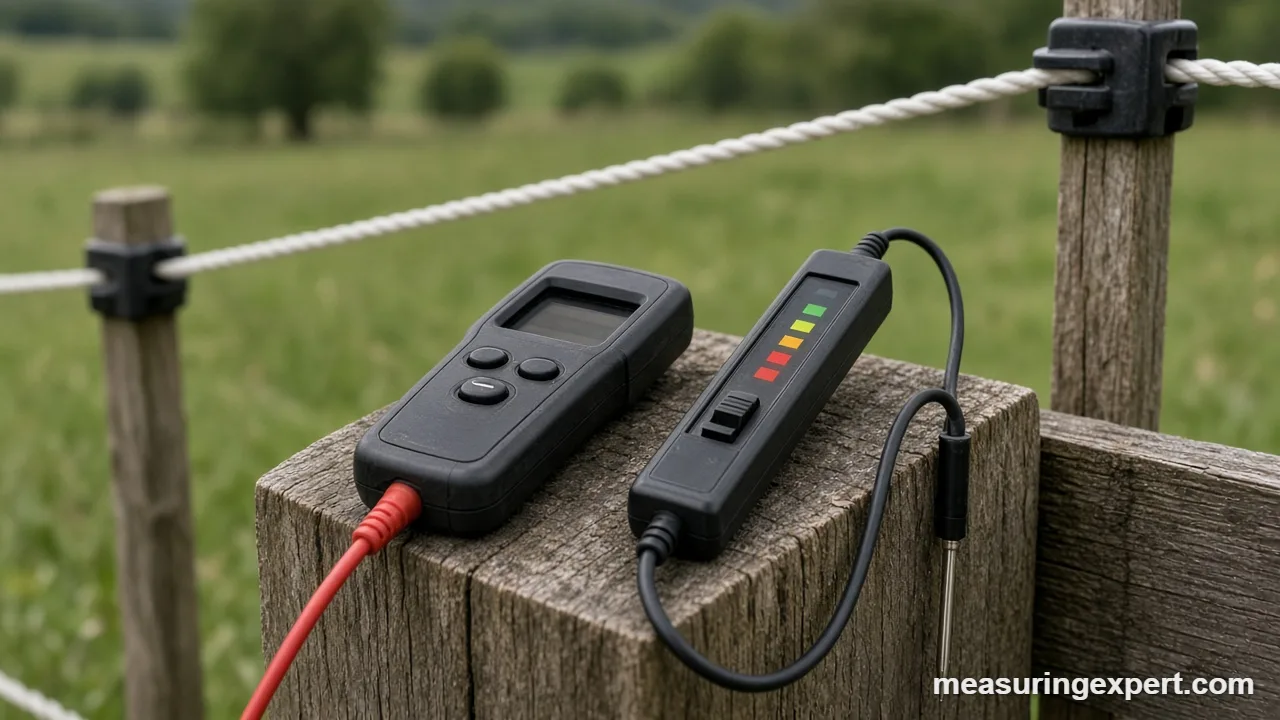
The best electric fence tester for most livestock owners is the Gallagher SmartFix, because it reads both voltage and current and points you toward a fault. However, the right choice depends on fence length, your animals, and whether you need exact kV numbers or a simple light check.
In short: buy the Gallagher SmartFix to find faults, the Zareba DEFT for exact kV, or the Parmak 817 as a budget light tester.
As an Amazon Associate, Measuring Expert earns from qualifying purchases. Our picks are based on research, specifications and owner feedback, not paid placement.
Best Overall
Best Budget
Best Pocket Digital
Quick Answer: Best Electric Fence Tester Picks
- Overall: Gallagher SmartFix reads kV and amps, so it shows which way the fault lies.
- Runner-up fault finder: Speedrite Digital Fault Finder also recalls your last reading.
- Ground checks: Gallagher Digital Volt Meter turns on by itself and also tests ground rods.
- Pocket digital: Zareba DEFT gives a backlit three-digit kV readout.
- Solar or battery fences: Premier 1 tester also checks your 12V battery.
- Budget: Parmak 817 is cheap, yet its six lights span 1,000 to 10,000 V.
On This Page
- Comparison table
- The 7 picks, reviewed
- How we chose
- Neon lights vs digital meters vs fault finders
- Recommended voltage by animal
- How to test fence voltage
- Grounding check
- Specs that matter
- Do and do not
- Safety note
- Honest limits
- FAQ
- Bottom line
Best Electric Fence Tester Comparison
| # | Image | Product | Best For | Standout Feature | Amazon |
|---|---|---|---|---|---|
| 1 |  | Gallagher SmartFix | Finding faults fast on long or multi-wire fences | kV, amps and a direction arrow | View |
| 2 |  | Speedrite Fault Finder | Comparing readings as you walk a big fence | Recalls the previous reading | View |
| 3 |  | Gallagher Digital Volt Meter | Checking the energizer ground and far-end voltage | Ground rod connection and auto-on | View |
| 4 |  | Zareba DEFT | Horse and hobby farm owners who want numbers, not lights | Backlit three-digit kV display | View |
| 5 | 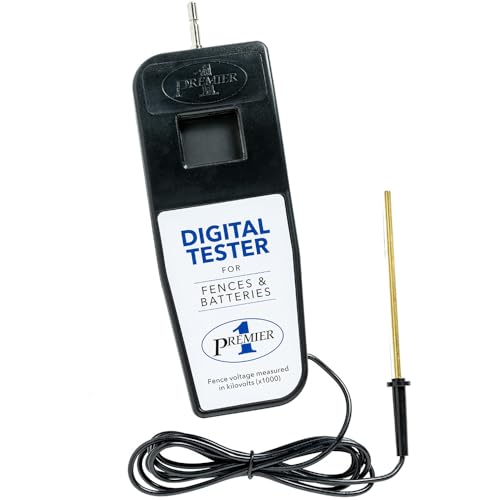 | Premier 1 Dual Tester | Portable fences run from a 12V battery | Tests the fence and the 12V battery | View |
| 6 |  | Dare 2411 | A no-frills digital reading for small fences | Reads up to 9,999 V | View |
| 7 | 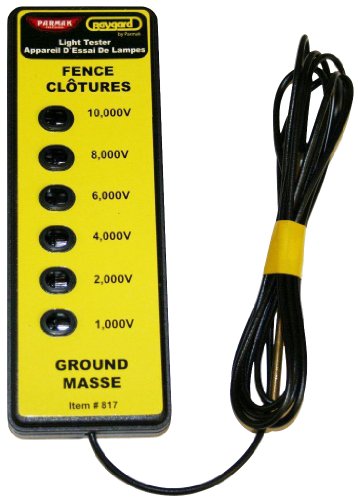 | Parmak 817 | A cheap go/no-go check for any fence | Six lights from 1,000 to 10,000 V | View |
The 7 Best Electric Fence Tester Options, Reviewed
First, we cover fault finders, then move to digital volt meters and finally to a light tester.
Best Overall
1. Gallagher SmartFix Volt Meter and Fault Finder
Best for: Graziers, ranchers and anyone with more than a few hundred feet of fence who wants to find a short, not just know that one exists.
The SmartFix is our pick as the best electric fence tester for most livestock owners. In short, it is two tools in one body. In Volt Meter mode it shows fence voltage in kilovolts. Then, in Fault Finder mode, it reads the current in amps and shows an arrow that points the way the current flows. As a result, you can walk the line and follow the current straight to the leak.
Moreover, Gallagher’s manual explains the method. First, record the current on a fault-free fence as your baseline. Next, take readings every 50 to 100 m (about 165 to 330 ft) or at each junction. Then, a drop in current between two checkpoints puts the fault between them. Also, there are no probes to push into the ground: you slide the wire into the slot on top.
- Voltage range: 0.2 to 14 kV (per the SmartFix manual)
- Current range: 1 to 35 A, with a flow direction arrow
- Power: one CR2032 coin cell
- Optional earth lead for extra accuracy on earth-return systems
Pros
- Shows where the fault is, not only that it exists
- Also needs no ground probe for normal readings
- Small enough for a shirt pocket
Cons
- However, the arrow is only reliable above about 1 A
- Changing the coin cell means opening the case
- Costs more than light testers
Skip it if: You only have a short garden or pet fence, because a light tester or a basic digital meter will tell you all you need.
Best Fault Finder Runner-Up
2. Speedrite Digital Fault Finder
Best for: Large grazing operations and anyone who runs portable netting or many paddocks off one energizer.
Speedrite is the fence brand of Datamars, and its fault finder works on the same idea as the SmartFix. Specifically, it displays fence voltage and current together, plus the direction the current is flowing. Premier1, which sells this unit, adds that it shows your previous reading on screen. Therefore, you can compare two checkpoints without writing anything down.
Like the Gallagher, it needs no ground probe, so it is quick to use from a four-wheeler. However, note one limit Premier1 points out: it cannot show direction inside a single roll of netting, only between rolls. For that reason, netting users still split the fence into sections to narrow a fault down.
- Shows fence voltage, current and current direction
- Backlit LCD (about 2 x 1.5 in) with previous reading shown
- Power: replaceable 9V battery with low-battery warning
- Weatherproof body with belt clip; also no ground probe needed
Pros
- Previous reading makes comparisons easy
- Backlit screen also works at dawn and dusk
- Also has an audible current indicator
Cons
- Larger than the SmartFix
- Direction does not work within one roll of netting
- But overkill for a single short fence
Skip it if: You want the smallest pocket tool, because the Gallagher SmartFix does the same job in a smaller body.
Best for Ground Checks
3. Gallagher Digital Volt Meter
Best for: Owners who want a reliable digital reading and a simple way to test their ground rods.
If you do not need current readings, Gallagher’s plain digital volt meter is a solid choice. First, it turns on by itself when it detects a fence pulse. In addition, it works in an energizer’s battery save mode, which some cheaper meters miss. Also, a ground connection lets you test the earth system, and that is where many weak fences really fail.
Moreover, Jeffers, a long-time farm supplier, lists 100 V steps below 10 kV and 1,000 V steps above that. So, the resolution is fine enough to spot a slow drop over a season. For example, if your far-end reading slides from 6.0 kV to 4.5 kV over a few weeks, weeds or a failing insulator are the likely cause.
- Resolution: 0.1 kV below 10 kV, 1 kV steps above
- Turns on automatically when it senses a pulse
- Power: one 9V battery with low-battery indicator
- Ground rod connection for earth tests; water resistant
Pros
- Simple to read with one hand
- Also checks the energizer ground
- Battery lasts for months of normal use
Cons
- No current or fault direction
- Coarse 1 kV steps at high voltage
- Also lacks a backlight
Skip it if: You want to find faults by current, because the SmartFix and Speedrite fault finders do that.
Best Pocket Digital
4. Zareba DEFT Digital Fence Tester
Best for: Horse owners, hobby farmers and gardeners who want a true digital reading in a pocket-size case.
Zareba has made fence controllers for decades, and the DEFT is its digital tester. For instance, it gives a three-digit reading, so 10,000 volts or more shows as 10.0 kV and up. Moreover, the display is backlit, which helps on early morning checks. Zareba lists a range of 0.5 to 19.9 kV, which covers nearly every farm energizer.
Since it gives a real number, it beats a neon light tester for diagnosis. For example, a light tester might show four lights on two days in a row, while the DEFT shows the reading fell from 7.2 to 5.1 kV. As a result, that early warning lets you clear weeds before animals test the fence.
- Range: 0.5 to 19.9 kV (Zareba)
- Three-digit backlit digital readout
- Power: one 9V battery
- Rugged ABS plastic, pocket-size case
Pros
- Real kV numbers for tracking trends
- Backlight helps in low light
- Works on any fence wire, tape or rope
Cons
- No current or direction readings
- One owner found the screen hard to read in bright sun
- Also, check whether a battery comes in the box
Skip it if: You want a tool that leads you to the fault, because only a fault finder shows current direction.
Best for Solar and Battery Energizers
5. Premier 1 Fence and 12V Battery Tester
Best for: Sheep and goat keepers, rotational graziers and anyone running portable netting off a 12V battery or solar unit.
Premier1 is a well-known supplier of portable netting, and this tester fits that world well. In addition to fence voltage, it reads a 12V battery in volts. As a result, one tool tells you whether a weak fence is a battery problem or a fence problem. Premier1 notes that a fully charged 12V battery reads about 12.6 V or more, while about 12.2 V means roughly 40 percent charge.
Meanwhile, on the fence side, it reads in kV and shows HI above 13 kV. Also, the metal ground probe sits on a 4 ft cord, so you can push it into moist soil and still reach the wire.
- Fence: reads in kV; shows HI above 13 kV
- 12V battery test: reads in volts; HI above 18 V
- Ground probe: 3 in metal probe on a 4 ft cord
- Power: one 9V battery (included); 4.75 x 3 in, 0.35 lb
Pros
- Two tests in one tool
- Long ground cord, so the probe reaches moist soil
- Very light for daily moves
Cons
- No current or fault direction
- Lowest fence reading is not published
- Also needs good ground contact for accurate numbers
Skip it if: Your energizer plugs into the wall, because the battery test then adds little.
Best Simple Digital
6. Dare 2411 Digital Volt Meter
Best for: Small farms, gardens and homesteads that want a digital number without extra features.
Dare Products has built fence supplies in Michigan for many years, and the 2411 is its basic digital meter. According to Dare’s 2025 catalog, it reads up to 9,999 volts and runs on a 9V battery that comes in the package. Therefore, that range suits most garden, pet and small pasture energizers.
Since the display tops out just under 10 kV, a strong energizer close to the charger may read off the scale. Even so, that rarely matters in practice. After all, the numbers you care about are at the far end of the fence, where voltage is lowest.
- Range: up to 9,999 V (Dare catalog)
- Digital readout
- Power: one 9V battery, supplied
- Packed one per package
Pros
- Simple digital reading
- From an established US fence maker
- Battery also included
Cons
- Tops out below 10 kV
- Dare publishes few other specs
- Also, no backlight is listed
Skip it if: You run a high-power energizer and want readings near the charger above 10 kV.
Best Budget
7. Parmak 817 Six-Light Tester
Best for: Budget buyers and anyone who wants a spare tester in every truck or barn.
Parmak is a long-running US energizer maker, and the 817 is a classic light tester. Six lights glow in sequence to show approximate voltage, from 1,000 V up to 10,000 V. So, more lights means more voltage. You hook the tester to the wire and push the ground probe into the soil, as Parmak advises, for the most accurate reading.
Of course, a light tester cannot give you a precise number. Still, it answers the key question: is the fence hot enough for my animals? For instance, if your sheep need about 4,000 V or more, you simply check that the lights reach at least that step at the far end.
- Six lights glow in sequence for approximate voltage
- Indicates 1,000 to 10,000 V peak
- Fence hook and ground probe
- Works with all fence energizers
Pros
- Low cost
- Easy for anyone on the farm to read
- Still covers the voltage range most animals need
Cons
- Approximate readings only
- Lights can be hard to see in bright sun
- Also lacks current or direction readings
Skip it if: You want to track small changes over time, because a digital meter like the Zareba DEFT shows exact kV.
How We Chose the Best Electric Fence Tester Picks
These picks are research-based, so we did not run lab tests or hands-on trials. Instead, we started with testers from established fence brands: Gallagher, Speedrite, Zareba, Premier1, Dare and Parmak. Next, we checked each one against the maker’s manual, product page or catalog. Then we read owner feedback for common failures, such as hard-to-read screens or weak ground probes.
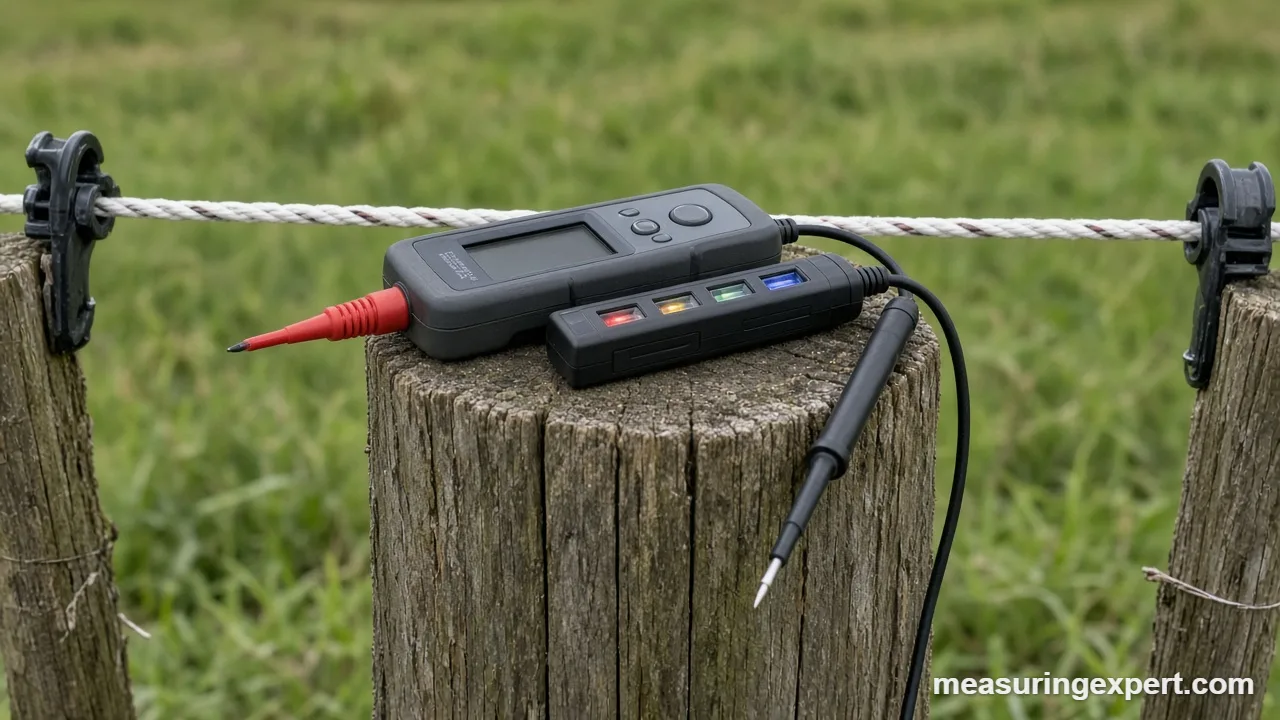
We also weighed what the tester actually measures. A light tester shows a rough voltage band. By contrast, a digital meter shows exact kV. Finally, a fault finder adds current and direction, which is what saves time on a long fence. In addition, we dropped unbranded listings whose specs we could not confirm, and we kept to two picks per brand. For the voltage targets below, we used extension and government guides: the Virginia Cooperative Extension grounding guide, the Manitoba Agriculture electric fencing guide and the USDA NRCS Electric Fencing for Serious Graziers.
Neon Lights vs Digital Meters vs Fault Finders
All three types read the short, high-voltage pulse an energizer sends down the wire. However, they tell you very different amounts about it. So, match the type to the size of your fence and how often you troubleshoot.
| Type | What it shows | Best for | Main limit |
|---|---|---|---|
| Single neon or lamp tester | Fence is on or off | A quick yes/no check | No voltage level at all |
| Multi-light tester (5 to 8 lights) | Approximate voltage band | Budget checks, spare testers | Steps of about 1,000 V or more |
| Digital volt meter | Exact peak voltage in kV | Tracking trends and ground tests | Cannot point to a fault |
| Fault finder | kV plus current (amps) and direction | Long fences, many paddocks | Costs the most |
Keep in mind that a fence tester is not the same as a household voltage tester. A standard electric circuit tester or multimeter is built for steady AC or DC up to roughly 600 to 1,000 V. A fence pulse, by contrast, can reach several thousand volts, so use a tool made for fences. Likewise, if you also want a general bench meter, see our guide to the best digital voltmeter.
Recommended Fence Voltage by Animal
In general, how much voltage is enough depends on the animal, its coat and the soil. Also, the reading that counts is at the far end of the fence, not at the energizer. Below, the table combines extension and government guidance with Zareba’s published chart. Therefore, treat these as minimums on the fence line.
| Animal | Minimum on the fence line | Source |
|---|---|---|
| Cattle (summer) | 2,000 V (2 kV) | Manitoba Agriculture |
| Cattle (winter, thick coats, snow) | 4,000 V (4 kV) | Manitoba Agriculture |
| Cattle (general target) | 3,000 to 5,000 V | Virginia Cooperative Extension |
| Bulls and bison | 3,000 to 4,000+ V | Zareba |
| Horses | 2,000 to 3,000 V | Zareba |
| Sheep and goats | 4,000 to 5,000+ V | Zareba |
| Wool sheep | 8,000 V | Virginia Cooperative Extension |
| Pigs | 2,000+ V | Zareba |
| Predators, deer | 4,000 to 5,000+ V | Zareba |
| Pets | 700 to 1,000 V | Zareba |
As a rule of thumb, Gallagher also recommends keeping at least 3 kV on the fence line. Sheep and goats need more because thick wool and hair insulate. Similarly, dry soil and snow weaken the return path, so readings that look fine in spring can fail in a drought. For that reason, write down your baseline readings after you build the fence and compare against them.
How to Test Fence Voltage With the Best Electric Fence Tester
Generally, the steps below work for light testers and digital meters. Fault finders use the same idea, but they also read current, so see the tips after the list.
- Check the energizer first: disconnect the fence lead and test across the energizer’s fence and ground terminals to confirm its output.
- Reconnect the fence and walk to the point farthest from the energizer, because voltage is lowest there.
- Push the tester’s ground probe fully into moist soil, away from metal posts and the energizer ground rods.
- Touch or hook the tester’s fence contact to the hot wire and hold it there for several pulses.
- Read the highest steady value, then compare it with the minimum for your animals.
- Repeat at gates, corners and each branch, and note any place where the reading drops sharply.
- Record the readings with the date, so you can spot a slow decline over the season.
With a fault finder, first note the normal current on a fault-free fence. Then take readings every 165 to 330 ft (50 to 100 m) and follow the arrow. Gallagher advises against reading within about 10 ft (3 m) of the energizer, where results are not accurate. According to Virginia Cooperative Extension, a fence typically draws about 1 to 2 amps per mile. So, a big jump in amps along with a voltage drop often means a wire touching a steel T-post.
Grounding Check: The Test Most People Skip
In fact, a weak ground is one of the most common causes of a weak fence. That is because the shock only works when current returns through the soil to the ground rods, a poor ground limits every reading on the line. Fortunately, you can test it with a digital volt meter in about ten minutes.
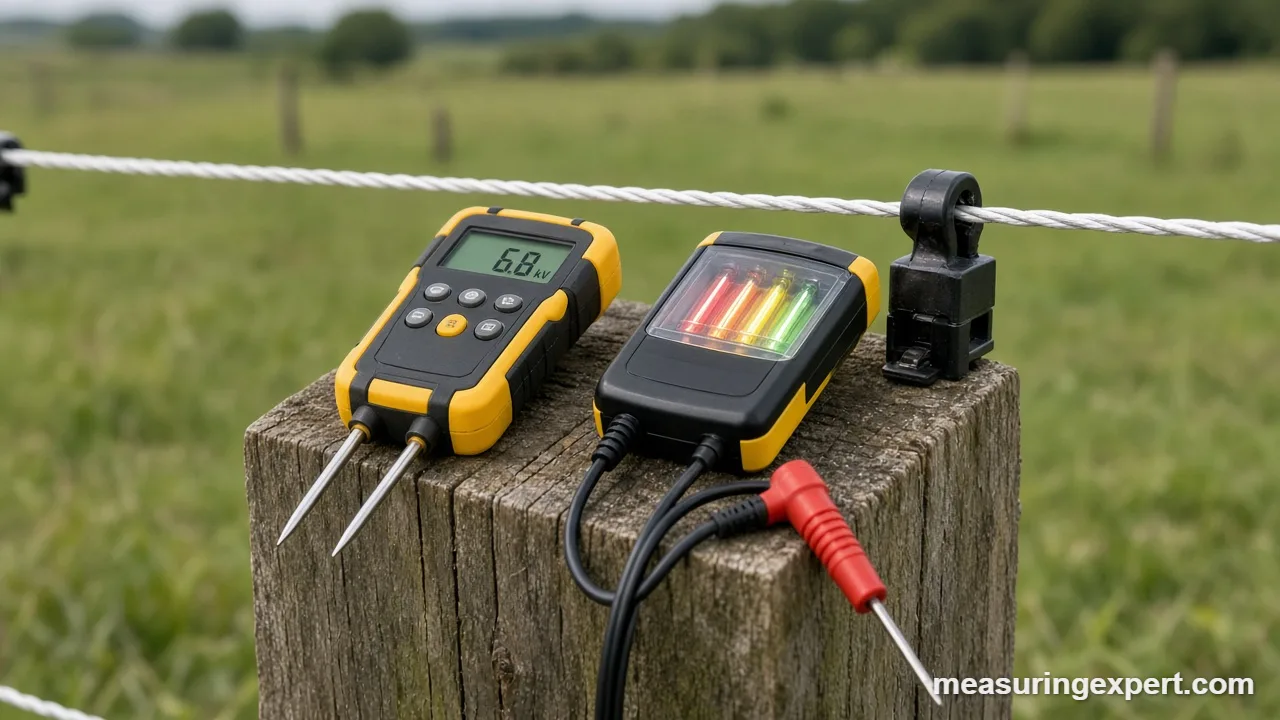
First, go at least 300 ft (about 90 m) from the energizer and short the fence. For instance, lean several steel posts against the hot wire until the fence reads 2,000 V or less. Next, measure the voltage on the ground rod farthest from the energizer. The Virginia Cooperative Extension grounding guide says a reading under about 500 V means a good ground. However, other guides set a tighter bar: USDA NRCS says the reading should ideally be zero, and Manitoba Agriculture suggests adding rods above 200 V. So, aim as close to zero as you can, and follow your energizer maker’s limit.
If the reading is too high, then add ground rods and retest. For example, Virginia Extension suggests at least three 6 ft rods spaced 10 ft apart for energizers up to 15 joules. Finally, remove the shorting posts. Fence voltage should then rise noticeably.
Best Electric Fence Tester Specs to Compare
| Spec | What it means | What to look for |
|---|---|---|
| Voltage range | The lowest and highest pulse it can show | Up to at least 10 kV; 13 kV or more for big energizers |
| Resolution | The smallest step it shows | 0.1 kV on digital meters; light testers jump about 1 kV or more |
| Current range | How many amps a fault finder reads | Gallagher SmartFix lists 1 to 35 A |
| Ground method | Probe, cord or thumb contact | A long cord helps; fault finders often need none |
| Power | 9V battery, coin cell or none | Many light testers run off the fence pulse itself |
Also, if you run a battery or solar energizer, check the battery too. A tester like the Premier 1, or a dedicated battery tester, shows whether low fence voltage starts at the battery.
Do and Do Not
Do
- Test at the far end of every fence line.
- Record a baseline reading after building the fence.
- Also recheck the ground during dry spells.
- Clear weeds touching the bottom wire.
- Finally, keep a spare battery for your digital tester.
Do not
- Use a household multimeter on a live fence.
- Read next to the energizer and assume the whole fence is fine.
- Push the ground probe into dry, frozen soil if you can avoid it.
- Touch the wire with your hand to check it.
- Ignore a steady drop in readings over weeks.
Safety Note
Fences can also spark when they short against dry grass. Therefore, NRCS suggests turning energizers down or off during high wildfire risk. In addition, keep children away from electric fences and from the energizer.
Honest Limits
First of all, no tester can make a weak energizer strong. So if the energizer itself reads low with the fence disconnected, the problem is the unit, its power supply or its ground. Likewise, a light tester gives a band, not a number, so two lights can hide a 900 V difference.
Readings also change with the weather. For example, wet soil improves grounding, while drought and snow weaken it. As a result, a fence that tests at 6 kV in May may test at 3 kV in August. Finally, a fault finder works best on wire and tape; inside a single roll of netting, direction readings are limited.
Electric Fence Tester FAQ
What is the best electric fence tester for cattle?
For most cattle fences, the Gallagher SmartFix is the best electric fence tester because it reads both voltage and current and points toward faults. Manitoba Agriculture suggests at least 2,000 V in summer and 4,000 V in winter at the far end of the fence.
How many volts should an electric fence have?
In short, it depends on the animal. Zareba lists 2,000 to 3,000 V for horses and 4,000 to 5,000 V or more for sheep, goats and predators. Gallagher recommends keeping at least 3 kV on the fence line.
Is a digital fence tester better than a light tester?
A digital tester shows exact kV, so you can spot slow drops over time. In contrast, a light tester only shows a rough band. However, a light tester is cheaper and is fine for a quick check.
What does a fence fault finder do?
A fault finder reads current in amps and shows the direction it flows. Since a short draws extra current, you follow the arrow and watch for the point where the current drops. As a result, you narrow the fault down quickly.
Can I use a regular multimeter to test an electric fence?
No. Most multimeters are rated for roughly 600 to 1,000 V, while fence pulses can reach several thousand volts. Instead, use a tester made for electric fences.
Where should I test my electric fence?
Test at the point farthest from the energizer, because voltage is lowest there. Then also test at gates, corners and branches, and record each reading.
How do I test the fence ground with a tester?
Short the fence to 2,000 V or less at least 300 ft from the energizer, then read the farthest ground rod. Virginia Cooperative Extension says under about 500 V is good, while USDA NRCS says zero is ideal.
Does the best electric fence tester need batteries?
Digital meters and fault finders need a battery, usually a 9V or a coin cell. However, many simple light testers run off the fence pulse itself and need no battery.
Which electric fence tester is best for solar fences?
The Premier 1 Fence and Battery Digital Tester suits solar and battery fences, because it also reads the 12V battery. Premier1 says a full 12V battery reads about 12.6 V or more.
What is the best electric fence tester on a budget?
The Parmak 817 is the best electric fence tester for a tight budget. Even so, its six lights show approximate voltage from 1,000 to 10,000 V, which covers what most animals need.
Bottom Line on the Best Electric Fence Tester
For most farms, the Gallagher SmartFix Fence Volt and Current Meter is the best electric fence tester. That is because it reads kV and amps, and its arrow leads you to the fault instead of leaving you to walk every foot of wire. However, pick the Zareba DEFT if you only want exact voltage, the Premier 1 tester for battery-powered fences, or the Parmak 817 to save money.
Black Friday is coming: shop the deals with Prime