

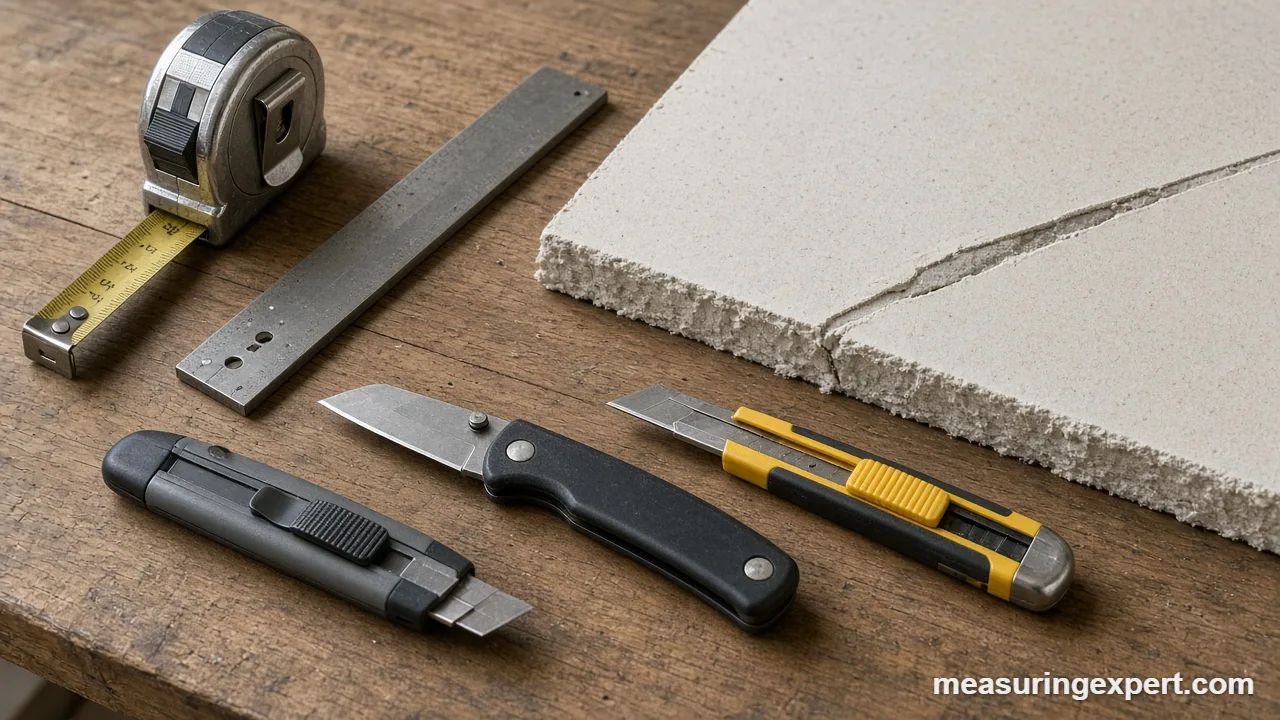
The best utility knife for most people is the Milwaukee Fastback, a press-and-flip folder that stores five spare blades and strips wire. However, the right choice depends on how deep you cut, how often you change blades, and whether a snap-off or an auto-retracting safety blade suits the job better.
In short: carry the Milwaukee Fastback, keep a Stanley 99 in every drawer, and add an OLFA L-1 for long, straight drywall and carpet cuts.
As an Amazon Associate, Measuring Expert earns from qualifying purchases. Our picks are based on research, specifications and owner feedback, not paid placement.

Best Budget

Best Snap-Off

Quick Answer: The Best Utility Knife for Each Job
- Overall: Milwaukee Fastback 48-22-1502, a folder with five-blade storage and a wire stripper.
- Budget: Stanley Classic 99, the retractable design Stanley has sold since 1952.
- Snap-off: OLFA L-1, an 18 mm ratchet-lock knife for drywall, carpet and insulation.
- Safety: Slice 10554, an auto-retracting ceramic blade for warehouses and classrooms.
- Folding retractable: DeWalt DWHT10035L with a metal body and onboard blade storage.
- Pocket carry: Gerber EAB Lite, a slim money-clip knife that takes standard blades.
- Precision: OLFA SAC-1 with a 30-degree blade for vinyl, film and template work.
On This Page
- Side-by-side comparison
- The 8 picks, reviewed
- How we chose
- Retractable vs folding vs snap-off vs auto-retract
- Blade exposure and cut depth
- How to measure and score drywall
- Cutting along a straightedge
- Do and do not
- Honest limits
- FAQ
- Bottom line
Best Utility Knife Comparison Table
| # | Product | Best For | Standout Feature | Amazon |
|---|---|---|---|---|
| 1 | Milwaukee Fastback 48-22-1502 | Trades and daily carry | Five spare blades stored in the handle | View |
| 2 | Stanley Classic 99 | Home toolboxes on a budget | Holds up to 10 spare blades | View |
| 3 | OLFA L-1 | Drywall, carpet and insulation | 18 mm blade with eight snap-off segments | View |
| 4 | Slice 10554 | Shipping rooms and shared workspaces | Auto-retracting ceramic blade, 20 mm max depth | View |
| 5 | DeWalt DWHT10035L | Users who want a retractable blade that also folds | Rapid Load blade change | View |
| 6 | Klein Tools 44306 Flickblade | Electricians and remodelers | Utility blade and scraper in one folder | View |
| 7 | Gerber EAB Lite | Pocket and office carry | Money clip, 5.1 in open | View |
| 8 | OLFA SAC-1 | Vinyl, film, paper and templates | 30-degree 9 mm snap blade | View |
The 8 Best Utility Knife Picks, Reviewed
Best Overall
1. Milwaukee Fastback 48-22-1502
Best for: electricians, framers and anyone who wants one knife on the belt all day.
First, the Fastback opens with one hand: press the button and flip the blade out. In addition, a metal guard sits around the release button, so the blade is less likely to deploy in a pocket. Also, spare blades live inside the handle, and you can swap them without a screwdriver.
For measured work, the scoring tip is the useful extra. You can mark a line with a tape and pencil, then score it lightly before the full cut. Similarly, the wire stripper saves a trip to the pouch when you are pulling cable.
- Press-and-flip opening with a guarded release button
- Stores five spare blades in the handle
- Wire stripper up to 12 gauge, plus a gut hook
- Tool-free blade changes and a wire belt clip
Pros
- Fast one-hand opening
- Onboard blade storage
- Useful wire-stripping notch
Cons
- Fixed blade length, no depth settings
- Bulkier than a slim pocket folder
Skip it if: you need to set a shallow, exact cut depth; a retractable or snap-off knife does that better.
Best Budget
2. Stanley Classic 99 (10-099)
Best for: home toolboxes, kitchens and junk drawers where a knife should simply work.
Stanley introduced this retractable design in 1952, and since then the formula has barely changed. Also, the 6 in (152 mm) die-cast body splits with one screw, so you change blades with a screwdriver. Meanwhile, the slider gives you a few locked blade positions, which is handy for setting a shallow depth on cardboard.
Because the handle holds up to 10 spare blades, one knife lasts a long time. As a result, it remains the default choice for many contractors who lose knives often.
- 6 in (152 mm) die-cast zinc body
- Retractable blade with locked positions
- Stores up to 10 spare blades
- InterLock nose holds the blade securely
Pros
- Simple and very durable
- Adjustable exposure for shallow cuts
- Huge spare-blade capacity
Cons
- Blade changes need a screwdriver
- Heavier than plastic knives
Skip it if: you swap blades several times a day; a tool-free design saves time.
Best Snap-Off
3. OLFA L-1 Ratchet-Lock
Best for: drywall hangers, carpet and flooring installers, and insulation work.
To start, the L-1 uses an 18 mm snap-off blade with eight segments. When the tip dulls, you snap one segment off and get a fresh point instantly. Next, the ratchet wheel lets you set blade exposure in small steps, so you can match the depth to the material instead of guessing.
That control matters when you score drywall face paper. In addition, a long, steady blade tracks well against a T-square. Therefore, this is our pick for cuts that start with a tape measure and end with a straight line.
- 18 mm silver snap-off blade, eight segments
- Ratchet-Lock wheel for precise exposure
- Stainless steel blade channel
- Contoured ABS handle, tool-free blade change
Pros
- Fine, locked depth control
- Fresh tip in seconds
- Long reach for thick materials
Cons
- Plastic handle is not for prying
- Long blades flex if pushed sideways
Skip it if: you need a compact pocket knife; the L-1 is a pouch tool.
Best Safety Knife
4. Slice 10554 Auto-Retractable
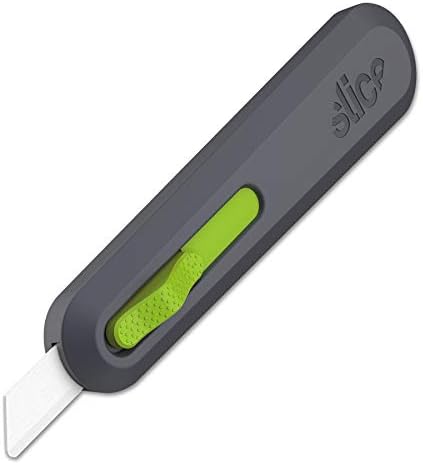
Best for: warehouses, retail back rooms, schools and shared craft spaces.
First, the Slice blade pulls back into the handle as soon as you release the slider. In addition, the zirconium oxide ceramic blade has a finger-friendly edge and does not rust. Slice says the blade lasts up to 11.2 times longer than steel, so you change blades less often.
Slice lists a maximum cutting depth of 20 mm (0.79 in). As a result, that figure is a handy measurement: it clears double-wall cardboard but limits how far the blade can reach past the box wall into the contents.
- Zirconium oxide ceramic blade, 66 x 12.1 mm
- Auto-retracts when you let go
- Maximum cutting depth 20 mm (0.79 in)
- Ambidextrous handle with a lanyard hole
Pros
- Blade hides itself automatically
- Rust-free, long-lasting edge
- Works for left and right hands
Cons
- Less aggressive than a fresh steel blade
- Not for carpet or heavy roofing
Skip it if: you cut thick carpet or shingles all day; a steel blade is faster.
Best Folding Retractable
5. DeWalt DWHT10035L

Best for: users who want a folding knife that still lets them set the cut depth.
Unlike most folders, this DeWalt folds like a pocketknife, yet the blade also retracts and extends. So you get compact carry and variable cut depth in one metal body. Also, the Rapid Load system speeds up blade changes, and the handle stores spares.
For measuring jobs, the retractable slider is the selling point. For example, you can set a short exposure for vinyl flooring, then extend it for foam board.
- Folding body with a retractable blade
- Variable cut depth
- Rapid Load quick blade change
- Blade storage and a belt clip; ships with three blades
Pros
- Folds and retracts
- Quick blade swaps
- Rugged metal body
Cons
- Opening takes two motions
- Heavier than plastic folders
Skip it if: you want true one-hand flip opening like the Fastback.
Best for Electricians
6. Klein Tools 44306 Flickblade 2-in-1

Best for: electricians and remodelers who cut, then clean up.
In short, Klein pairs a folding utility blade with a scraper in one tool. As a result, you can cut caulk, labels or tape and then scrape residue without reaching for a second tool. Moreover, the folding design keeps the edge covered in a pocket.
Because Klein builds tools for the electrical trade, this folder suits panel and box work. However, we found fewer published specs for this newer model than for the others, so we list only its core features.
- Folding utility knife with a built-in scraper
- Onboard blade storage
- Takes standard utility blades
Pros
- Two tools in one
- Edge folds away for carry
- Trade-focused brand
Cons
- Fewer published specifications
- Bulkier than a single-purpose folder
Skip it if: you never scrape; the Fastback is the simpler folder.
Best Pocket Carry
7. Gerber EAB Lite

Best for: office workers, shoppers and anyone who opens boxes but hates a bulky tool.
First of all, the EAB (exchange-a-blade) Lite is a thin stainless steel frame that holds a standard utility blade. In addition, it measures 5.1 in (130 mm) open and about 2.8 in (70 mm) closed. Also, the clip doubles as a money clip, so it rides flat in a pocket.
Because it uses ordinary utility blades, you never sharpen it. Instead, you swap in a new blade when the edge dulls.
- Stainless steel handle with a liner lock
- 5.1 in (130 mm) open, about 2.8 in (70 mm) closed
- Takes standard utility blades
- Pocket clip that also works as a money clip
Pros
- Very slim and light
- Cheap replacement blades
- Clean, minimal design
Cons
- No blade storage
- Fixed exposure, no depth control
Skip it if: you cut drywall or carpet; it is a light-duty pocket tool.
Best Precision
8. OLFA SAC-1 9 mm Graphics Knife

Best for: vinyl wrap, window film, paper templates and model making.
By contrast, the SAC-1 carries a 9 mm snap blade ground to a sharp 30-degree point. Compared with a standard utility blade, that narrow tip turns tight corners and follows a ruler edge closely. In addition, the auto-lock slider advances in micro-clicks, so you can expose just a sliver of blade.
For this reason, pair it with a steel precision ruler when you cut to a marked dimension. Then the thin blade sits right on the line instead of drifting off it.
- 9 mm snap-off blade with a 30-degree tip
- Auto-lock slider with micro-click advance
- Corrosion-resistant stainless steel handle
- Pocket clip doubles as a blade snapper
Pros
- Very sharp, precise tip
- Fine exposure control
- Slim metal handle
Cons
- Too light for heavy materials
- Thin blades snap if twisted
Skip it if: you mainly break down boxes or cut carpet.
How We Chose the Best Utility Knife Picks
We did not run hands-on tests. Instead, we compared manufacturer specifications, user manuals and owner feedback, and then we checked each listing for a current, complete product. We weighed five things:
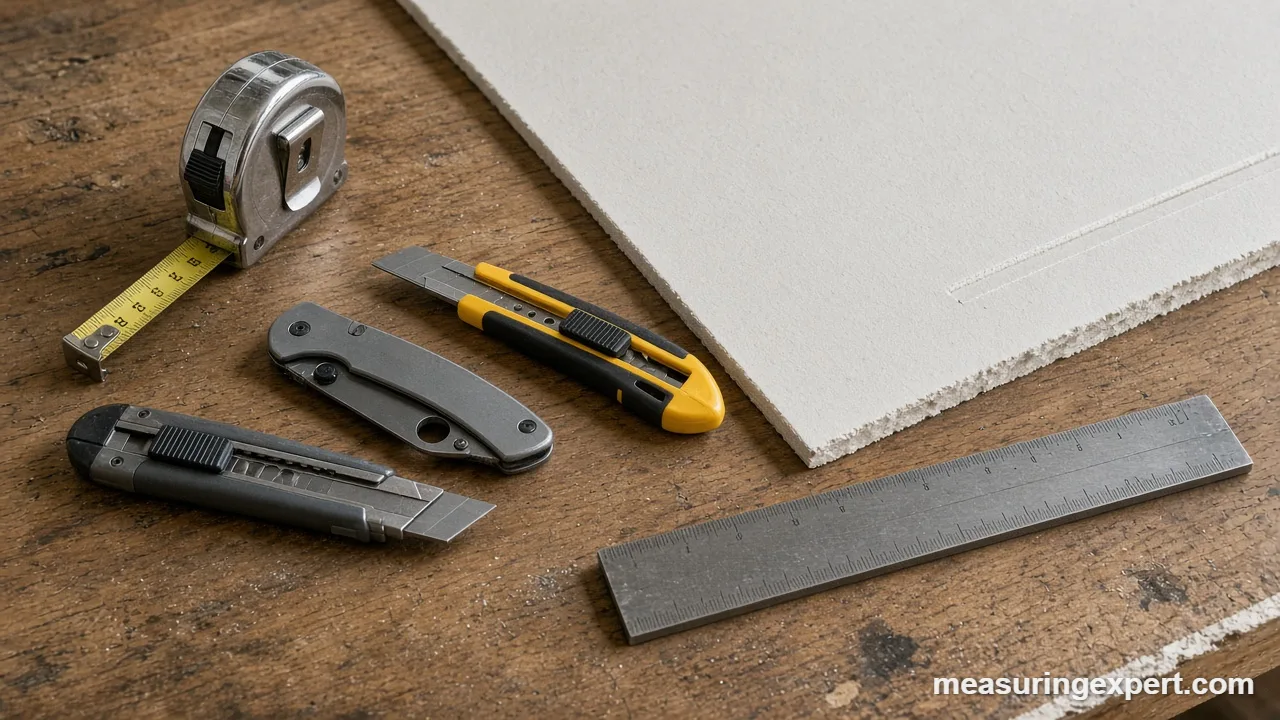
- Blade control: locked positions, ratchet steps or auto-retract, because depth decides cut quality.
- Blade changes: tool-free systems and onboard storage scored higher.
- Safety: guarded buttons, locks and retracting blades.
- Build: metal bodies for trades, light frames for pocket carry.
- Use case: each pick covers a different job, with no more than two knives per brand.
Sources included the OLFA L-1 product page, the Slice 10554 sell sheet and the Klein Tools utility knife catalog.
Retractable, Folding, Snap-Off or Auto-Retract?
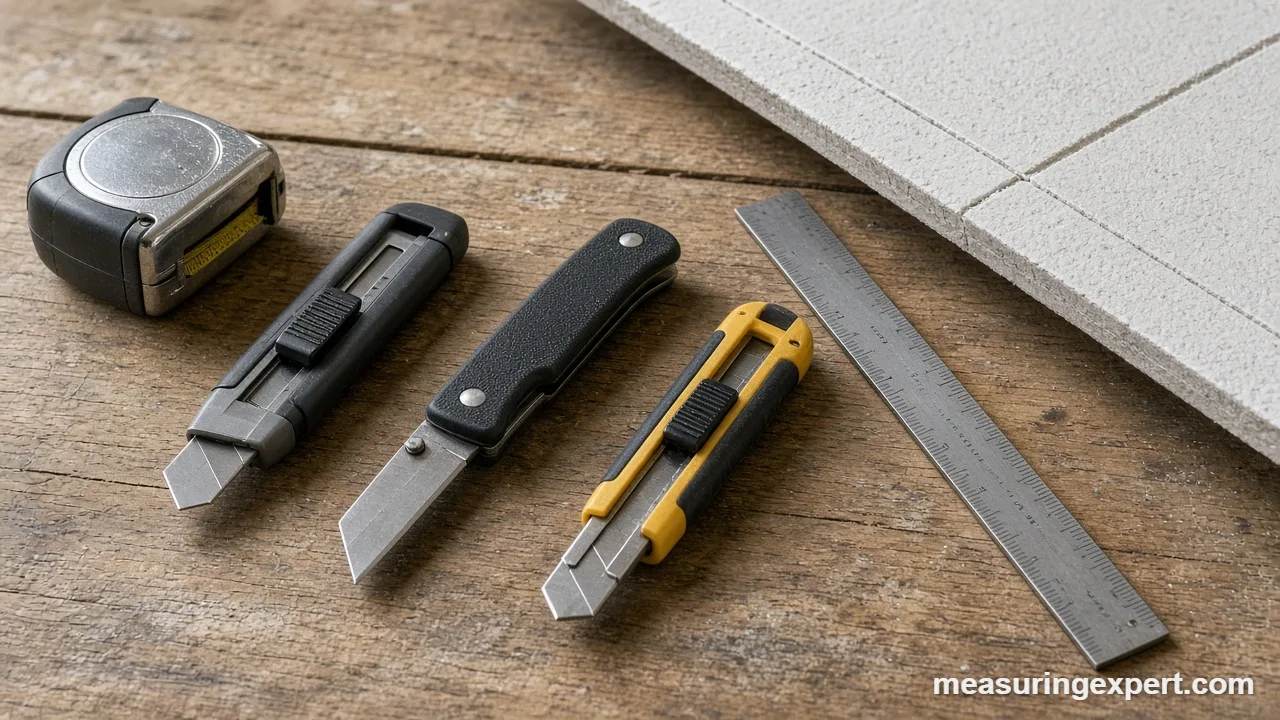
Each knife style handles blade exposure differently, because the mechanism decides how depth is set. So start with the material, then pick the mechanism.
| Type | Depth control | Blade change | Good for |
|---|---|---|---|
| Retractable | Locked slider positions | Screw or tool-free | Boxes, drywall, general use |
| Folding (fixed) | None; full blade out | Usually tool-free | Belt carry, trades |
| Folding retractable | Slider inside a folder | Quick-load systems | Mixed jobs, pocket carry |
| Snap-off (18 mm) | Ratchet or slide, fine steps | Snap a segment | Drywall, carpet, insulation |
| Snap-off (9 mm) | Micro-click slider | Snap a segment | Film, vinyl, paper, templates |
| Auto-retract | Fixed maximum depth | Tool-free | Warehouses, classrooms |
In short, retractable and snap-off knives give the most control over depth. Folders, on the other hand, win on carry and quick deployment.
Blade Exposure: Measuring How Deep the Best Utility Knife Cuts
Blade exposure is the length of edge that sticks out past the nose. First, it sets your maximum cut depth, and second, it sets how much the blade can flex. As a rule, expose only a little more blade than the material is thick.
- Cardboard: a short exposure opens the box without slicing what is inside.
- Drywall: you only score the face paper and a bit of gypsum, so a shallow setting works best.
- Carpet: cut from the back, just through the backing, so the pile stays intact.
- Foam board and insulation: these need long exposure; an 18 mm snap-off reaches farther than a standard blade.
Snap-off blades also make depth math simple. For example, the OLFA L-1 blade has eight segments, while the 9 mm OLFA SVR-2 blade has 13. Since each snap removes one segment, you know how much blade remains. Similarly, Slice publishes its 20 mm (0.79 in) maximum depth, which tells you exactly what the knife can and cannot reach.
Blade angle matters too. For instance, a standard utility blade has a fairly blunt point, which resists breaking. A 30-degree precision tip, however, is sharper and follows curves, so it suits film and paper. For more on reading angles, see our guide to types of angles.
How to Measure and Score Drywall With the Best Utility Knife
A clean drywall cut is mostly measuring. In fact, the knife only finishes what the tape and square start.
- Measure the opening with a tape measure at both ends, because walls and ceilings are rarely square.
- Subtract about 1/8 in (3 mm) for an easy fit, then mark that dimension on both edges of the sheet.
- Lay a drywall T-square on the marks; our T-square guide covers 48 in models that span a full sheet.
- Set a short blade exposure, then hold the blade against the square and score the face paper in one steady pass.
- Snap the sheet away from the scored face so the gypsum breaks along the line.
- Next, cut through the back paper along the fold with the same knife.
- Finally, check the piece with the tape and shave any high spots with a rasp.
The same steps also work for vinyl plank and ceiling tile. In that case, only the exposure changes.
Cutting Along a Straightedge
In general, a straight cut depends on the guide, not on a steady hand. Use a metal ruler or square, because a knife can bite into wood or plastic edges.
- Clamp or press the straightedge firmly, and keep your fingers on the far side of the guide.
- Hold the blade upright against the edge so the cut stays square to the face.
- Make two or three light passes instead of one hard one; therefore, the blade will not wander.
- Pull the knife toward you along the guide, never across your body.
For small parts, a steel precision ruler with a cork back stays put and shows millimeters right at the cut line.
Do and Do Not
Most knife injuries happen when a dull blade slips. Therefore, keep these rules in mind.
Do
- Change or snap the blade as soon as it drags.
- Retract or fold the blade every time you set the knife down.
- Wear cut-resistant gloves for long sessions.
- Dispose of old blades in a closed blade bank.
Don’t
- Pry with a snap-off blade; it can shatter.
- Expose more blade than the material needs.
- Cut toward your free hand or your leg.
- Leave loose blades in a pocket or toolbox tray.
Honest Limits of the Best Utility Knife
Even the best utility knife is not a saw. For example, thick lumber, metal and hard plastics need a different tool. Likewise, ceramic safety blades cut slower than fresh steel. Moreover, no knife makes up for a bad measurement, so mark twice and cut once.
Best Utility Knife FAQ
What is the best utility knife for most people?
The Milwaukee Fastback 48-22-1502 is the best utility knife for most people because it opens with one hand, stores five spare blades and changes blades without tools.
What is the best utility knife for drywall?
The OLFA L-1 is the best utility knife for drywall in this list because its ratchet lock sets a precise, shallow depth for scoring face paper along a T-square.
Is a snap-off or a retractable knife better?
Snap-off knives give finer depth control and an instant fresh tip, so they suit drywall and film. Retractable knives use stronger blades, so they suit general and heavy cutting.
Which is the best utility knife for safety at work?
An auto-retracting knife such as the Slice 10554 is the best utility knife for shared workspaces because the blade hides itself the moment you let go.
How much blade should I expose?
Expose only slightly more blade than the material is thick. A short exposure flexes less, cuts straighter and cannot reach as far into whatever is underneath.
How often should I change the blade?
Change it as soon as the knife starts to tear or drag. A dull blade needs more force, and extra force is what makes a knife slip.
Do utility knives use a standard blade size?
Most retractable and folding knives take standard trapezoid utility blades, while snap-off knives take 9 mm or 18 mm segmented blades. Check the knife before you buy refills.
What is the best utility knife for a pocket?
The Gerber EAB Lite is the best utility knife for a pocket in this list because it is slim, has a money clip and uses ordinary replacement blades.
Can I cut a straight line without a straightedge?
You can for rough work, but a metal ruler or T-square gives far straighter cuts. Score lightly along the guide first, then deepen the cut.
Are ceramic blades as sharp as steel?
Ceramic blades last longer and resist rust, but a fresh steel blade usually cuts faster through tough materials. Ceramic is a good trade for safety-focused jobs.
Bottom Line
For one knife that handles most jobs, choose the Milwaukee Fastback 48-22-1502. Then add an OLFA L-1 if you hang drywall or lay carpet, and pick the Slice 10554 if safety comes first. Above all, measure carefully, set a short exposure and cut along a straightedge.