

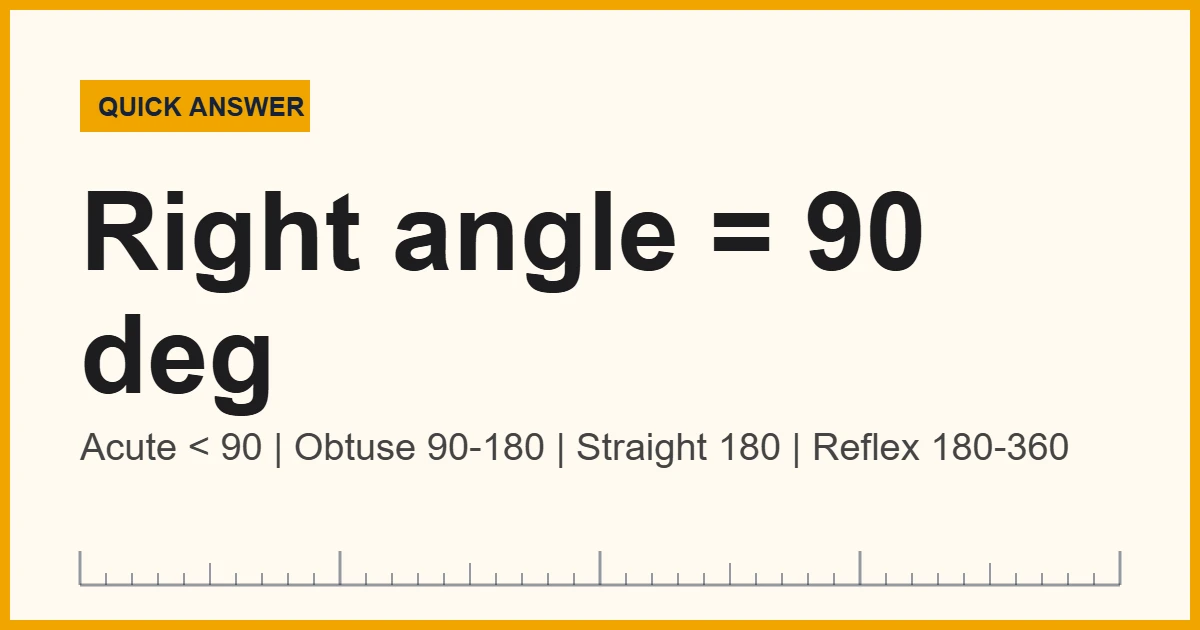
The main types of angles are acute (more than 0 but less than 90 degrees), right (exactly 90 degrees), obtuse (between 90 and 180 degrees), straight (exactly 180 degrees), reflex (between 180 and 360 degrees) and full (exactly 360 degrees). In other words, you sort any angle by comparing it with a quarter turn and a half turn.
An angle forms wherever two rays, lines or edges meet at a shared point called the vertex. In fact, the size of the angle is the amount of turn from one side to the other, not the length of the sides. That is why, for example, a tiny drawing and a huge roof truss can share exactly the same 30-degree angle.
Geometry names angles by size because people want to describe a shape in one word. For example, a carpenter who says “that corner is obtuse” tells you instantly that it opens wider than a square corner. Likewise, a teacher who says “the triangle has a right angle” tells you that the Pythagorean theorem applies. As a result, once you know the six size groups, you can classify any angle you meet with a quick glance or a protractor.
In short: compare the angle with a square corner (90 degrees) and with a straight line (180 degrees), and the name follows from that comparison.
Why the Angle Boundaries Are Exact
The units are fixed by definition, too. The US National Institute of Standards and Technology lists the degree in its guide to units outside the SI as exactly pi/180 radians, so a full turn is 360 degrees or 2 pi radians (about 6.2832 rad). As a result, every boundary in this guide, from 90 to 360 degrees, is an exact number rather than a rounded one.
Below you will find a chart of all types of angles, a converter, a step-by-step method for measuring and naming an angle, the angle pairs that show up in homework and construction, and the mistakes that trip people up most often.
Convert an Acute Angle to Slope and Roof Pitch
Most real-world angles you measure on ramps, roofs and stairs are acute, so this converter works between -90 and 90 degrees. First, enter an angle in degrees, or switch the unit to percent grade or roof pitch, and it shows the other two. Behind the scenes, it uses the exact formulas grade = tan(angle) x 100 and pitch = tan(angle) x 12.
A 45-degree angle is a 100% grade because the rise equals the run. Then, as the angle approaches 90 degrees (a right angle), the grade climbs toward infinity, which is why the converter stops just short of it.
Recommended Tools for Measuring Types of Angles
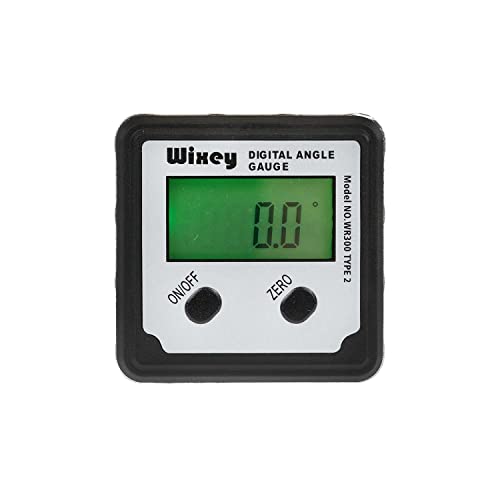
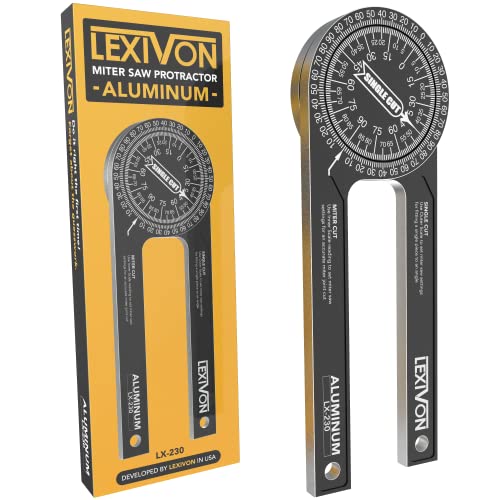
You only need one good tool to identify most angles on paper: a clear 180-degree protractor with crisp markings. For full-circle work, such as reflex angles, a 360-degree protractor saves you a subtraction step. On the other hand, if you measure angles on wood, metal or walls, a digital angle finder or a bevel gauge is easier to hold against real edges. Also, look for markings that are printed on the underside or engraved, so they do not rub off.




As an Amazon Associate, Measuring Expert earns from qualifying purchases.
- There are six types of angles by size: acute, right, obtuse, straight, reflex and full.
- The two reference points are 90 degrees (a square corner) and 180 degrees (a straight line).
- Acute means below 90 degrees; obtuse means between 90 and 180 degrees.
- Reflex angles are bigger than a straight line, so they lie between 180 and 360 degrees.
- Complementary angles add to 90 degrees, and supplementary angles add to 180 degrees.
- Side length never changes an angle; only the amount of turn does.
- A full turn is 360 degrees, 2 pi radians or 400 gradians.
Types of Angles Chart
This chart lists all six size groups with their exact ranges. In addition, the radian column uses the definition 1 degree = pi/180 rad, rounded to four decimals.
| Type | Size in degrees | Size in radians | Fraction of a full turn | Quick picture |
|---|---|---|---|---|
| Zero angle | 0° | 0 | none | Both sides lie on top of each other |
| Acute | more than 0°, less than 90° | 0 to 1.5708 | less than 1/4 | Narrow slice of pizza |
| Right | exactly 90° | 1.5708 (pi/2) | 1/4 | Corner of a sheet of paper |
| Obtuse | more than 90°, less than 180° | 1.5708 to 3.1416 | between 1/4 and 1/2 | Laptop screen tilted back |
| Straight | exactly 180° | 3.1416 (pi) | 1/2 | A flat, straight line |
| Reflex | more than 180°, less than 360° | 3.1416 to 6.2832 | between 1/2 and 1 | The outside of a pizza slice |
| Full (complete) | exactly 360° | 6.2832 (2 pi) | 1 | One complete turn back to the start |
Most textbooks list the six named types and treat the zero angle as a special case. So, if a worksheet asks for “6 types of angles”, it means acute, right, obtuse, straight, reflex and full.
The Types of Angles Explained, With Real Examples
Each group below has a simple test you can apply by eye. Then, if the angle is close to a boundary, measure it with a protractor.
Acute angles: less than 90 degrees
An acute angle is any angle greater than 0 and less than 90 degrees, including fractions such as 89.5 degrees. In addition, a simple test is that it fits inside the corner of a sheet of paper with room to spare. The hands of a clock at 1:00 make 30 degrees, and at 2:00 they make 60 degrees, so both are acute. Similarly, every angle in an equilateral triangle is acute, at exactly 60 degrees each.
Right angles: exactly 90 degrees
A right angle is exactly a quarter turn. For this reason, diagrams mark it with a small square at the vertex instead of an arc. In other words, two lines that meet at a right angle are perpendicular. You see right angles in door frames, book corners, floor tiles and the clock hands at 3:00 or 9:00. Meanwhile, in construction, “square” means the same thing as a right angle.
Obtuse angles: between 90 and 180 degrees
An obtuse angle is wider than a square corner but not yet a straight line. For instance, a laptop screen pushed back past upright forms an obtuse angle with the keyboard. The clock hands at 4:00 make 120 degrees, and at 10:10 they make 115 degrees, so both are obtuse. Likewise, each interior angle of a regular hexagon is 120 degrees, which is also obtuse.
Straight angles: exactly 180 degrees
A straight angle is a half turn, so its two sides point in opposite directions and form one straight line. For example, a book opened completely flat, or the clock hands at 6:00, shows a straight angle. Even though it does not look like a corner, it still has a vertex and two rays, so it counts as an angle.
Reflex angles: between 180 and 360 degrees
A reflex angle is the “long way around” between two rays. In fact, whenever two rays form an angle, they also form a reflex angle on the other side. For example, if a pizza slice has a 40-degree tip, the rest of the pizza has a 320-degree reflex angle, because 360 – 40 = 320. Our guide to measuring a reflex angle walks through that subtraction with a standard protractor.
Full angles: exactly 360 degrees
A full angle, also called a complete angle or a full turn, brings one side all the way around to where it started. For instance, a wheel that makes one complete revolution turns through 360 degrees. Similarly, skateboarders and figure skaters use the same idea when they talk about a “360” or a “720” (two turns).
How to Measure and Name Types of Angles
You can classify most angles by eye. Still, a protractor removes doubt when the angle sits close to 90 or 180 degrees.
- Find the vertex. Locate the point where the two sides meet, and extend short sides with a ruler so they reach past the protractor scale.
- Place the protractor. Put the center hole or crosshair exactly on the vertex, and line up the zero line with one side.
- Read the correct scale. Start from the 0 on the side you lined up, and follow that same scale to where the second side crosses it.
- Check for a reflex angle. If you need the outside angle, subtract the reading from 360 degrees.
- Name the type. Compare the number with 90, 180 and 360 degrees, and use the chart above to pick the name.
- Sanity-check by eye. Next, ask whether the angle looks narrower or wider than a square corner; if your reading disagrees, you probably used the wrong scale.
For a fuller walkthrough with pictures of both scales, see how to measure angles using a protractor.
Angle Pairs: Complementary, Supplementary and More
Beyond size, geometry also names angles by how they relate to each other. However, these pair names describe relationships, not new sizes, so they sit alongside the six size types rather than replacing them.
| Pair name | Rule | Example |
|---|---|---|
| Complementary | Two angles that add up to 90° | 35° and 55° |
| Supplementary | Two angles that add up to 180° | 120° and 60° |
| Explementary (conjugate) | Two angles that add up to 360° | 40° and its 320° reflex partner |
| Adjacent | Share a vertex and one side, with no overlap | Two slices next to each other in a pie |
| Linear pair | Adjacent angles that form a straight line, so they are supplementary | 110° and 70° along a straight edge |
| Vertical (opposite) | The angles across from each other when two lines cross; always equal | Both 50° angles in an X |
| Corresponding, alternate interior | Formed when a line crosses two parallel lines; equal in size | Rungs crossing the rails of a ladder |
Because vertical angles are always equal, you only need to measure one angle where two lines cross. After that, the other three follow from the linear-pair rule.
Types of Angles People Often Confuse
Some words sound alike or overlap, and they cause most of the wrong answers on quizzes. For that reason, this table separates them.
| Often confused | What actually differs |
|---|---|
| Obtuse vs reflex | Obtuse stops before 180°; reflex starts after 180°. |
| Straight angle vs straight line | A straight angle has a marked vertex and measures 180°; a plain line has no vertex. |
| Right angle vs right triangle | A right angle is one 90° corner; a right triangle is a shape with one such corner. |
| Complementary vs supplementary | Complementary pairs add to 90° (“C” for corner); supplementary pairs add to 180° (“S” for straight). |
| Angle size vs side length | Longer sides do not make a bigger angle; only the opening between the sides counts. |
| Degrees of angle vs degrees of temperature | Same word, unrelated units: an angle degree is pi/180 radians. |
Types of Angles Inside Triangles and Polygons
Shapes are where angle types become useful, because the sum of the angles is fixed. For instance, the interior angles of any triangle add up to 180 degrees. Therefore, a triangle can have at most one right angle or one obtuse angle, and the other two corners must be acute.
The same logic extends to polygons: the interior angles of a shape with n sides add up to (n – 2) x 180 degrees. For example, a square has four 90-degree right angles, a regular pentagon has five 108-degree obtuse angles, and a regular octagon has eight 135-degree angles. In addition, a concave shape, such as an arrowhead or a star, also contains at least one reflex angle.
| Shape (regular) | Sum of interior angles | Each angle | Type |
|---|---|---|---|
| Equilateral triangle | 180° | 60° | Acute |
| Square | 360° | 90° | Right |
| Pentagon | 540° | 108° | Obtuse |
| Hexagon | 720° | 120° | Obtuse |
| Octagon | 1,080° | 135° | Obtuse |
Triangles also take their names from their angles: acute triangles have three acute angles, right triangles have one 90-degree angle, and obtuse triangles have one obtuse angle.
Degrees, Radians and Gradians
The degree is the everyday unit, but it is not the only one. In fact, the SI unit for plane angle is the radian, and engineers and programmers use it constantly. Surveyors in some countries also use the gradian (gon), which splits a right angle into 100 parts.
| Angle | Degrees | Radians | Gradians |
|---|---|---|---|
| Right | 90° | pi/2 = 1.5708 | 100 gon |
| Straight | 180° | pi = 3.1416 | 200 gon |
| Three-quarter turn (reflex) | 270° | 3 pi/2 = 4.7124 | 300 gon |
| Full | 360° | 2 pi = 6.2832 | 400 gon |
The type of an angle does not depend on the unit. For example, a 1-radian angle is about 57.3 degrees, so it is acute either way. For the full method, see our guide to converting degrees to radians.
Do and Don’t When Classifying Angles
Do
- Compare every angle with 90 and 180 degrees first.
- Extend short sides before you measure.
- Look for the small square that marks a right angle.
- Subtract from 360 degrees to get a reflex angle.
- Write the unit (degrees or radians) next to every answer.
Don’t
- Judge an angle by how long its sides are.
- Call an angle obtuse if it passes 180 degrees.
- Assume a corner is square just because it looks square.
- Read the protractor scale that starts from the wrong side.
- Mix up complementary (90) and supplementary (180) pairs.
Honest Limits of Naming Types of Angles
The definitions are exact, but measurements are not. For example, a plastic school protractor reads to the nearest degree at best, so an angle that measures “90 degrees” on paper might really be 89.6 or 90.4. In practice, that matters only near the boundaries, where one degree can change the name from acute to right or from right to obtuse.
Conventions also vary slightly between sources. For instance, some references, such as Wolfram MathWorld, count a full 360-degree turn as a reflex angle, while most school textbooks keep “reflex” for angles strictly between 180 and 360 degrees. Likewise, a few curricula skip the zero angle entirely. Therefore, if a teacher or exam board gives a definition, follow theirs. Finally, real objects have rounded edges and thickness, so “the angle of a roof” depends on which surfaces you measure between.
When to Call a Professional
Of course, classifying angles on paper is a skill anyone can learn. However, some angle work carries real risk if it goes wrong. Call a licensed surveyor for property lines and site layout, a structural engineer or roofer for roof pitches and load-bearing framing, and an accessibility specialist for ramp slopes that must meet building codes. Similarly, precision machining and calibration of digital angle gauges belong with a calibration lab.
Types of Angles: Frequently Asked Questions
What are the 6 types of angles?
The six types of angles by size are acute (under 90 degrees), right (90), obtuse (between 90 and 180), straight (180), reflex (between 180 and 360) and full (360).
What are the 7 types of angles?
Lists of 7 types of angles add the zero angle (0 degrees) to the six size types: zero, acute, right, obtuse, straight, reflex and full.
What are the 4 basic types of angles?
The four basic types are acute, right, obtuse and straight. However, many early lessons stop there and add reflex and full angles later.
Is 90 degrees acute or obtuse?
Neither. An angle of exactly 90 degrees is a right angle. Anything smaller is acute, and anything between 90 and 180 degrees is obtuse.
Is 180 degrees an angle?
Yes. An angle of exactly 180 degrees is a straight angle. As a result, its two sides point in opposite directions and form a straight line through the vertex.
How do you find a reflex angle?
Measure the smaller angle with a protractor, then subtract it from 360 degrees. For example, a 70-degree angle has a 290-degree reflex angle on its other side.
Can a triangle have two right angles?
No. The angles of a triangle add up to 180 degrees, so two right angles would leave 0 degrees for the third corner.
What angle do clock hands make at 10:10?
At 10:10 the hour and minute hands are 115 degrees apart, which is an obtuse angle. At 3:00 they form a right angle, and at 6:00 a straight angle.
Do longer lines make a bigger angle?
No. An angle measures the amount of turn between two sides, so extending the sides does not change its size or its type.
What tool is best for measuring types of angles?
A clear protractor works best on paper. For wood, metal or walls, a digital angle finder or a sliding bevel is easier to hold against real edges.
The Bottom Line
To sum up, every angle falls into one of six size groups, and two numbers decide which: 90 degrees and 180 degrees. In other words, below a square corner is acute, exactly square is right, between square and straight is obtuse, a flat line is straight, past a line is reflex, and a complete turn is full.
So when you meet a new angle, check it against those benchmarks first, then confirm with a protractor if it sits close to a boundary. Finally, use the converter near the top of this page whenever you need to turn a ramp or roof angle into percent grade or pitch.
4 thoughts on “Types of Angles: Acute, Right, Obtuse, Straight, Reflex and Full Angles Explained”